Daily Archives: July 22, 2013
Oromo and Ogaden Protest Against Dictator’s Financiers
(A4O, 22 July 2013) According to Canada – CBC news many Oromo and Ogaden Protest in Edmonton, Canada, Against Ethiopian Empire’s Financiers; heavy police presence, no arrests at Edmonton protest.
Police responded to a call of an officer in distress during rally against the Ethiopian government
A heavy police presence formed outside the Belmead Community league in west Edmonton Saturday afternoon when about 100 protesters gathered to rally against the Ethiopian government.
Protesters told CBC News that representatives from the Ethiopian government were meeting inside the community league’s building to discuss selling bonds for a hydroelectric dam project on the Blue Nile River in Ethiopia.
Several people involved in the protest said their goal in rallying at the building was to disrupt the meeting.
Edmonton protest sparks huge police presence
EDMONTON – A standoff between two Ethiopian groups attracted more than 45 police officers, some in riot gear, to a west end community league Saturday afternoon.
 At around 3 p.m., police responded to a protest in the parking lot of the Belmead Community Centre at 182nd Street and 90th Avenue where more than 100 demonstrators had gathered. Officers called for backup after they were surrounded by a large group, Edmonton Police Service said in a news release.
The protest started escalating when demonstrators were denied access to a meeting of about 40 people that was taking place inside the community centre, said EPS spokeswoman Patrycia Thenu.
Several police officers blocked off the entrance to the building and made protesters stand on the sidewalk on the other side of the parking lot. There were more than a dozen police vehicles in the parking lot and blocking off the entrance to the community centre. There were several more police vehicles parked around the corner behind a strip mall on 89th Avenue.
Just before 5:30 p.m., an Edmonton Transit System bus drove up behind the building and the meeting attendees were escorted onto it. The protesters on the sidewalk started cheering, waving Ethiopian flags, one Canadian flag, and placards. When they got to the entrance of the community centre’s parking lot, some started chanting and dancing in a circle.
Protesters claimed the individuals at the meeting were representatives of the Ethiopian government. Sayf Abdi said the group is trying to collect money from Ethiopian-Canadians to fund development projects in their homeland, such as a massive hydroelectric damn in the Blue Nile River.
“That’s not true, this is a dictator government, they (are) killing people over there, it’s a military government,” he said. “There’s only one party for 22 years. There’s no democracy, no elections, no anything. We need (them) to know we are not supportive for them. We need to tell to them our voice. We need peace and democracy. That’s why we’re not supporting you.”
After talking to the media, most of the protesters disbanded.
At 6 p.m., the ETS bus returned and dropped off the meeting attendees so they could collect their vehicles and go home. Many wore white hats and had booklets with the Ethiopian flag on it.
Co-ordinator Desalegn Abara said about 120 members of the Ethiopian-Canadian Development Discussion Forum had gathered at the community centre for a meeting. He said the group is not affiliated with the Ethiopian government.
“Our goal is to provide information where people can participate either by investing, or through their skills, or by supporting the (development) projects,” he said.
Abara said the group is not asking for money, “there is no forcing or coercing in any way.”
He said protesters did not get into the building. However, Abara said he is disappointed that the meeting was interrupted.
“Unfortunately, the police collaborated with them and they stopped our meeting, we cut it short, as criminals we’ve been put in a bus and (taken) out of the premises,” he said.
He said the meeting will resume at a later date.
Thenu confirmed there were no injuries among the protesters or the individuals at the meeting. She said the demonstrators did have a permit for a peaceful protest.
No arrests were made or charges laid at the scene, but charges are pending against one male protester upon further investigation, the EPS news release said.
Source: http://www.edmontonjournal.com/news/edmonton+protest+sparks+huge+police+presence/8687831/story.html
Canadian Oromos protest the Ethiopian dictator supports
(A4O, 22 July 2013) July 21, 2013, According to Edmonton, Canada based TV news (CTV) an estimated 100 people were believed to be involved in a heated protest at the Belmead Community League Hall Saturday afternoon.
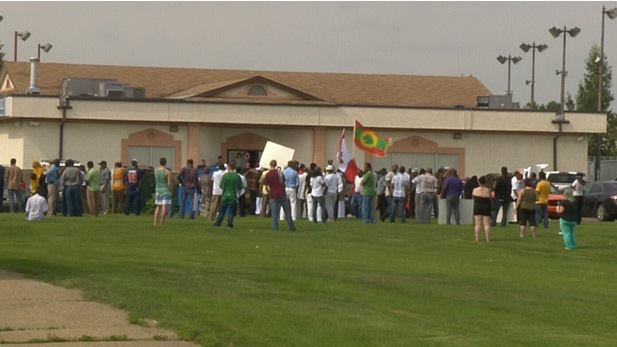 Authorities said about 20 police officers were called in after the situation escalated.
Media and the general public were removed to a safe distance.
Protesters called the gathering in the hall of Ethiopian government supports was illegal and they were standing up for those in their home country.
“They are speaking out you know for the right of their brothers and sisters in their home country and the illegal meeting the government agents are holding here and they are agents and messengers,” Derej Geleta explained to CTV News.
“It is a peaceful demonstration for the right of our peoples in our home country,” he added.
A confrontation was avoid as police lined up with riot gear at the back of the building, creating a safe space for those inside the building to exit into a bus.
Complicating the Notion of Home: Notes on Kuwee’s ‘Home and Exile’
by Tsegaye R. Ararssa
(A4O, 22 July 2013) – Professor Kuwee Kumsa’s 2007 article, ‘Home and Exile’, evoking (and perhaps inspired by) Chinua Achebe’s book with the same title (2000), is extraordinary. It is extraordinary both in its style and in its effect.
In style, it is atypical in that it is presented as a story although it appears in a professional academic journal devoted to social work. It tells a story and does so rather dramatically. In its effect, it enchants us first lamenting injustice (exile) and later expressing a longing for justice/freedom (home). To me, it is one of the most remarkable pieces she has written so far. The fact that it appeared in Qualitative Social Work aside, the piece echoes the style of ‘magical realists’. The story it tells is one that is written as such: a story written in prose but told poetically.
In less than five pages, ‘Home and Exile’ tells the story of suffering and loss, a story of how she lost her brother, but more importantly how she lost her freedom, how she ‘regained’ it, and how she lost it again to a life of exile. Her story can be read as one that does what good stories do: remembering. Re-membering (and bringing back) the deceased and mourning the loss. And unleashing a longing, thereby enchanting us to a different world, a better world, a fairer and a more just world. In her attempt to come to grips with her loss, she tells of the epiphanic moment of reconnecting with her deceased brother, that moment with the Ekerdubbiftuu. And the story— and the re-membering work of the ekerdubbiftuu—brings the brother back. And now, he lives on, with her and, by extension, with us.
1. Complicating the Notion of Home
In this piece, Kuwee successfully problematizes and complicates the notion of home as it should be. “What is home, baby Brother? And what is exile?” she asks. She then refers to enjoying “home in exile” and to the state of being “rendered homeless at home”. She complicates the notion by nudging us in the direction of collapsing boundaries we often take for granted. She does so, for example, by collapsing the boundary between home and exile as she does the ones between escape and entrapment, freedom and bondage, loss and victory, friend and foe, death and life, and dream and reality. “Home is freedom…Home is bilisumma. Home is dignity. Home is justice.”
And “exile is wherever home is not”, at once suggesting that wherever home is not is exile, and wherever oppression is not is home. Even the state of struggle and resistance, the itching and groping, is home—even if it is only a state of longing, of desire, of hope and anticipation. “In an unjust world,” she reminds us, again, through the words of her brother, “home can only be in the struggle to restore freedom and justice.” In a broken world, home is what you make of whatever you have: resistance, struggle, longing, be-longing. In an unjust world, home is made, not necessarily inherited—whether you live in it or you fly away from it, or you submit to its tyranny. Home is what you make. Even when betraying angst at being on exile (deploring the scorching sun and the greed), she seems to insist that, in the context of the Oromo struggle, home can be exile and exile can be home. Hence, the complication.
Reading Kuwee unleashes a host of thoughts in us about home/exile and its deeply problematic nature as a social construct. We are reminded, twice, that at least in the saga of the Oromo struggle for freedom, the friend is the foe, the loss is in triumph, and victory in the loss.
Kuwee seems to draw out this fact, the fact that home is complex as a concept, that it is multiple, layered, fluid, and shifting. As we read Kuwee, we note that the notion of home is at once inviting and elusive. We also note that it is intensely contested and contestable, not to mention the fact that it could be a site of contestations. We encounter its sheer malleability.
2. Malleability of Home
Home is malleable. As such, it can have contrasting meanings. Home can be romanticized as well as demonized. It can, for instance, be viewed as a place to be desired: the cozy space of rest, protection, grounding, and belonging. It can also be viewed as a place to be detested: the unsightly site of oppression, inequality, dispossession, displacement, and injustice. It can be a place of joy, celebration, and festivity. But it can also be a place of woe, lamentation, and suffering. Likewise, it can be a place of love. It can also be a site of violence. It can at once be a place of peace, and a site of war. As a place of peace, home can be viewed as the site of rest, relief, recovery, and of restoration. But it can also be a place of strife, of fear, terror, pain, and suffering. It can be conceived of as a place of care, nurture, and flourish. It can also be a site of domination, exclusion, and destruction. It can be a place of fertility and hope. It can also be a site of death and despair, a site of aborted dreams and deferred hope.
As a metaphor, ‘home’ has been used varyingly as one’s private house, one’s state, one’s country (homeland), or even as one’s body, etc. We shall take up these varied conceptions of home that these metaphors evoke in other subsequent discussions. For now, let us to focus on Kuwee’s ‘Home and Exile’ as we respond, albeit in gloss, to the questions we had raised a while back and share our take on her piece.
3. Five Ways of Viewing ‘Home’: Lessons?
From reading Kuwee, one can identify at least five major ways of conceiving the home, namely: a) home as agency; b) home as a moment; c) home as a process; d) home as a/in relationship; and e) home as a longing.
a. Home as Agency
Home can be conceived as an assertion of agency. In this sense, home is subjecthood, reclamation of the self. It is a re-appropriation of lost and recovered self-hood. It is a projection of a recovered self. It is a discovery of the self, the ‘I’, or the discovery of the collective self, the ‘We’. Home is belonging. For the Oromo person, home therefore is Oromumma, or those layers of identity we juggle through in the routine of everyday life. In a sense, home is me; Home is ‘I’. Home is us, home is ‘We’. Home is in the desire, the deep aspiration to name oneself, and to declare ‘I am me’, that I am the real and the imagined me, but perhaps the as-yet-not-named me. Indeed, home is a moment of self-determination in its primal form. The insistence on freedom and dignity is, in part, an insistence on the imperative of regaining agency.
b. Home as a Moment in time: Home in its Temporality
Home is a moment. It is temporal. It is in time, not just in place, not just in space. It is a moment of arrival, the moment of “slumber” (or death in bilisuma), the moment of rest and infinite bliss. In a sense, it is also that liminal moment, the twilight zone, the moment of reflective and reflexive critical self-awareness. It is a moment of reckoning with oneself. It is one’s moment of destiny. As such, it includes the moment of critical engagement with the self.
c. Home as a Process
But home is also a process, one of self-discovery, self-construction and reconstruction. As a friend once said to me, it is a process of self-recovery. As a process, it involves struggle. Yes, home is struggle. Home is resistance. Kuwee makes this very point in her piece rather emphatically. And, for us, resistance is in the geographic everywhere. And in the temporal now, always.
d. Home as a Relationship and as Relational
Although we don’t see this point made explicitly in Kuwee’s piece, one hardly fail to observe how ‘home’ is implicitly postulated as intensely relational. One notices it in the intense longing to see her brother, in her brother’s lamentation of the loss of several family members which he names one after the other, and in the familial metaphor he uses to refer to the struggle (“the struggle was my only friend, my only love, my only family, my only home”). Even in his insistence that the struggle is not monolithic (“there are struggles within a struggle”), thereby suggesting that the struggle (his home) is not monolithic–that the home has its discords, too–one is confronted with how the notion of home is relational, and intensely so.
Along that line, or away from it, I sometimes think that home is other people. (‘Hell is other people,’ Sartre said. Is he right, I sometimes wonder. But I guess he is, at least in part.) In ideal situations, in the best of times, home is people in whose presence we are free to let be. Home thus is presence. Home is togetherness. It is companionship. Home is friendship. When it works well, it is ‘mutual recognition’ of each other informed by ‘other-regarding’ set of ethical imperatives. Home, conceived in this sense, is harmony. Peace. But home is also strife, friction, quarrel, and misunderstanding. Home could be a site of heartbreak, even of murder.
e. Home as a Longing
For me, home has increasingly come to strike me as that sense of infinite longing to belong. Home is a moment of hope. It is a moment of anticipation. Kuwee’s reconceptualization of home as a longing is thus apt. Thus, home is/in the longing. The longing for freedom, dignity, and justice. The longing that prompts one to struggle. Home is in the wanting to go away, in the wanting to come back. Home is in the desire to go away from injustice—even on to exile—but also the desire to come back, to… the place of wholeness, dignity, and peace.
As a longing, home can be conceived of as a movement, a flight away from an impossible self to a preferred possibility. (Some of us find our homes in our imaginations. Some of us in our readings, in the metaphors, in words that transport us from ‘here’ to ‘there’.) Home is a flight away from injustice, abuse, and all forms of oppression. As Kuwee reminds us in relation to her brother’s escape, prison was a ‘home’ to run away from, and such running away marked the realm of possibilities, of new openings (and of closure, too).
For the Oromo person, home-as-movement is a flight away from colonialism, from that monstrous enemy of selfhood. Home is thus in decolonization (of the mind, the body, and the land.) It is in the re-appropriation of one’s legitimate place of abode, one’s place of seeing, being, and living. In a sense, home is self-estrangement. It is a flight away from the self, in the constant search for a better self, in becoming “what we were not at the beginning” (a la Foucault). As a longing, home is in the transience, too. It is the quest for the permanent in the transient, the abiding in the passing.
But most importantly, home is the quest for that eschatological moment, the moment of experiencing the sublime, the moment of bliss. It is the longing for bilisumaa, for the “ultimate home”, for our “only permanent exile”, and our “only permanent home.” (Here we witness complication par excellence’.)
Conclusion
In conclusion, one can also say that home is in us (echoing the social constructionist thesis which Kuwee seems to embrace). Home is what we make, both literally and figuratively. As we read Kuwee’s extraordinary piece and the remarkable story she tells, we find ourselves thinking that, in a sense, home is our story. It is in what we tell the world. Even when it is the place we tell a story about, home is, in a sense, in what we say. It is in our words. With words, we create our homes. We claim our homes. We claim our place in the world. With them, we make, or find, our way of being in the world. We find our bearings, collective as well as individual. In our stories, we find our voices.
Our voices, our words, our home.
May we continue to tell our stories, stories of resistance, struggle, and longing. May we all find, and found, our homes in our words, in our voices, in our stories. May our words take us from ‘here’ (the site of exile, the site of oppression, violation, and injustice) to ‘there’ (the home site, the site of freedom, emancipation, dignity, and justice). May we, like Kuwee, find the words—and the concepts–with which we can imagine our freedom. May we find metaphors with which to inscribe the tunes of our hearts, even the songs of freedom. May we discover words with which to write songs of (re-)enchantment, songs that excite us towards the pillars of our freedom: liberty and equality, justice and dignity–our values in the presence of which we find our home, in the absence of which we will always be on exile.
__
*Tsegaye R. Ararssa is a Melbourne-based legal scholar.




 Advocacy for Oromia