Monthly Archives: August 2024

Want to fight gender inequality? A review of data from 118 counties shows that development aid works
Professor of Economics, University of Minnesota Duluth
Gender inequality isn’t just unfair — it’s also a drag on the world economy. Giving women the same economic opportunities as men would add about US$12 trillion to global gross domestic product by 2025, one analysis found. That’s an 11% boost.
The link between women’s empowerment and economic growth is well established. When women are economically empowered, they invest more in their families, creating a cycle of positive outcomes that spans generations. Women’s participation in the workforce leads to greater productivity and brings diverse perspectives that enhance decision-making and drive innovation.
Recognizing these benefits, governments and nongovernmental organizations have increasingly directed aid — funds provided to developing countries to foster economic growth — toward promoting women’s empowerment.
As an economist who studies development, I wanted to know: Does all that money really make a difference? So, in a recent study, my colleagues and I analyzed the impact of gender-related aid on gender inequality using data from 118 countries over a 13-year period, from 2009 to 2022.
What we found was uplifting: Gender-related aid reduced inequality in most countries we studied.
We looked at two types of gender-related aid. The first is funding for projects that tie gender into larger economic goals. Development experts call this “significant gender-related aid.” There’s also aid funding that narrowly and explicitly targets gender equality. Experts call this “principal gender-related aid.”
We found that the first approach consistently and significantly reduced gender inequality in 115 out of 118 counties we studied. The latter approach had statistically significant effects in 85 countries. It also appeared to be much more effective when paired with the first approach.
Our findings strongly suggest that integrating gender-related aid into broader development efforts is crucial for promoting gender equality. Gender and development are intricately intertwined, a fact often overlooked. Recognizing this connection is crucial for achieving sustainable and inclusive growth.
Women’s empowerment success stories
That might all sound pretty abstract, but our research shows that the world has made progress in real people’s lives over the past decades. Cases from several countries show just how much progress is possible:
Rwanda: Following the 1994 genocide, Rwanda made a concerted effort to rebuild its society with gender equality at its core. Today, women hold 61% of parliamentary seats, the highest percentage in the world. This remarkable achievement is in part a direct result of gender-focused policies and significant investments in women’s political empowerment. Rwanda’s progress illustrates how political will and dedicated gender-related aid can transform a society.
Bangladesh: Despite traditional gender roles, Bangladesh has made significant strides in gender equality, particularly in education and economic participation. Through targeted programs like the Female Secondary School Stipend Program and microfinance initiatives by organizations like the Grameen Bank, Bangladesh has seen substantial improvements in girls’ education and women’s economic empowerment. These initiatives have contributed to a decline in gender disparities and have spurred economic growth.
Ethiopia: In recent decades, Ethiopia has invested heavily in education, particularly for girls. Programs aimed at increasing school enrollment and reducing dropout rates among girls have led to improved literacy rates and better health outcomes. These educational advancements have empowered women economically and socially, reducing gender inequality.
Despite progress made, these achievements aren’t set in stone. Instability can rapidly undo years of progress. Recent policy backsliding in Afghanistan, Brazil and the United States shows the need for vigilance.
Empowering women empowers men, too
Discussions about the importance of reducing gender inequality often revolve around the direct benefits to women and girls. But everyone, including men, stands to win in a more gender-equal society.
First, women’s economic empowerment leads to stronger economies, which benefits everyone. Research shows that gender equality promotes healthier relationships, reduces violence and fosters more cohesive and supportive communities. Similarly, workplaces prioritizing gender equality tend to have better team dynamics, higher employee satisfaction and increased productivity. These are gains for everyone, regardless of gender.
And gender equality has distinct benefits for men. This is because it alleviates the pressures associated with traditional masculinity, which can lead to better mental health. For example, in more gender-equal societies, men report being happier with life and less stressed and depressed.
This shows that the benefits of gender equality aren’t limited to women and girls; they extend to all members of society. Everyone has a stake in helping progress move along.
Research-backed best practices
Governments and aid professionals should follow five steps for success to safeguard the advances made in gender equality and continue progressing:
1. Keep the aid flowing: Continued financial and technical support for gender equality initiatives is vital. Our research suggests policymakers should focus on integrating gender considerations into all development projects.
2. Engage everyone: Involving men and boys in gender equality efforts helps to challenge and change harmful gender norms, fostering a more inclusive society.
3. Tailor strategies: Although aid has an effect across the board, gender equality initiatives must consider each country’s unique sociopolitical and cultural contexts. Tailoring strategies to fit these contexts ensures that interventions are relevant and practical.
4. Strengthen institutions: Effective institutions and governance are crucial for successfully implementing and sustaining gender equality initiatives. Efforts to improve governance and reduce corruption will enhance the impact of aid
5. Promote education: Schools are a powerful tool for promoting gender equality. Investing in educational programs that empower women and girls and raise awareness about gender issues is essential for long-term change.
Gender equality is a cornerstone of a just and prosperous society. The benefits of empowering women extend far beyond the immediate recipients of gender-related aid, fostering economic growth, political stability and social cohesion. Our research shows that efforts to empower women really do pay off — literally and otherwise.

The Music Albums released by Elemoo Ali (1982-1998)
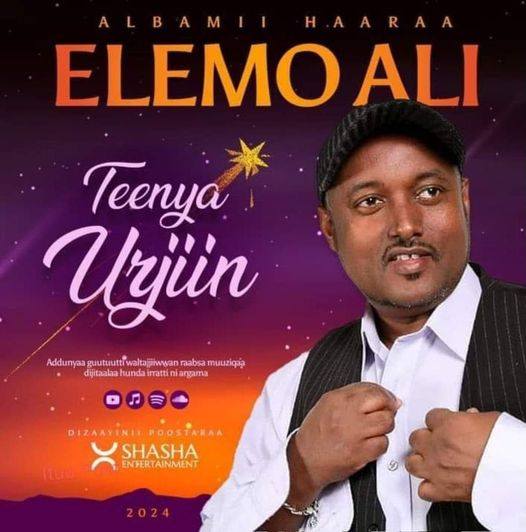
As a long time listener of Elemo Ali’s songs and an ethnographic writer who explores the music of different cultures, I list down the albums released by the artist so far and present my reflections in some of them.
1. His first album was released in Djibouti (circa 1982)-
It was an audio cassette. Elemo used his acoustic guitar ( a.k.a. “box guitar”) for that album.
2. His second album released in Saudi Arabia- 1986.
It was an audio cassette and a female singer called “Shamsi” featured Elemo Ali (she had two solo songs; the rest of the songs were by Elemo) . In the cassette Elemo sung in Harari language too. But what many people remember from that cassette was Elemo’s singing Mahmoud Ahmed’s famous Amharic song called “እንቺ ልቤ እኮ ነው” in Oromo language. The lyrics used by Elemo was very similar to the Amharic one.
3. The album he has done with Nuho Gobana in Saudi Arabia (1987)-
This was also an audio cassette. From that album a single that goes like “Biiftuu tiyya, urjii tiyya, suma bira jira yaadni kiyya” became popular in the media (I repeatedly heard it while Harar Radio Stations Oromo Language Service broadcasted it).
However, people usually confuse this album with the one he released with “Shamsii”. This happened because the music arrangements of the two albums were the very similar.
4. The album he released in Italy in 1988:
Truly speaking, I have no detail information about this album. I heard recently from the words of Elemo when we communicate through telephone that he released an album in Italy while he was living in that country for a short period of time. I will seek additional information on the album and bring to the public.
Elemo Ali produced most of his albums in Canada and a gained popularity there. Here are the list of those albums and my reflection on them.
5. “Jabeessa Aadaa Teenya”-1989:.
According to my evaluation this was Elemo Ali’s finest album of all time and one of the best albums in the history of Oromo Music and art. The rich linguistic treasure seen in the lyrics of the songs, the artist’s ability to sing in different musical scales in addition to the standard pentatonic scale derived from Oromo cultural beats, and Elemo Ali’s emblematic ability to display the vocals in a clear way were the main features that gave the album special color and quality. The most surprising thing was that almost all of the lyrics an the melodies of that album were created by Elemo Ali himself. Of course songs like ” Xiyyaan Nadirtee”, “Yaa jiruu biyya Ormaa”, “Jabeessaa Aadaa Teenyaa”, ” Koottu yaa Boontuu”, “Yaa Urjii Samiidhaa” are unforgettable.
6. “Oromiya”- 1990:
Another critically acclaimed and artistically emboldened album of Elemo Ali. It was a historical album in which Elemo addressed the Oromo people’s quest for freedom and justice in a highly organized and rhythmically synthesized Oromo poetry. This was also one of the best albums seen in the history of Oromo music. From the album ” Yaa Biyya too Gaarii”, “Oromiyaa” and “Carcar Xirroo” were the top ones.
7. ” Guyyaanis Keenya”- 1993:
This was the first album of Elemo Ali produced by a local music shop in our country. In that album Elemo brought many new songs together with certain songs from his earlier cassets (example: “Baadiyyaadha jirtii tanin ani jaallee from his album with Nuho Gobana, and Kottu yaa Boontuu Yaa shaggee tiyya from his album of 1989)
The album was released by Biftu Music Shop of Dire Dawa and became one of the best selling Oromo music albums of 1993 together with Shamsadin Yusuf’s “illii Jannataa” album.
7. “Leelloo Tiyya”: 1998:
Another critically aclaimed album of Elemo Ali which contains songs in multiple beats , the Oromo traditional “ragada” and “Shaggoyee”, the Caribbean “reggae”, the Central African “rumba” and “Afrobeats”, the Sudanese “hageeba” and the Western “pop”, “jazz” and “blues”. The band accompanied him for that album as well had members from many countries, Africans and North Americans.(Continued from above)
From the album the single titled ” Himi naaf Himi” became the most popular.
It was clear that Elemo brought a tradition of using multiple beats from different traditions for his songs in order to introduce the Oromo, Ethiopian and East African music and culture to the global audience.
The album was very fruitful in attaining its goals and introducing Elemo Ali to music fans of different countries. Elemo Ali won Canada’s annual music award for that album.

DAABANAA: Prof Kuwee Kumsaa
Mariin Prof Kuwee Kumsaa waliin taasifame kun kan kutaa duraa ti. Kutaa kana keessatti waa’ee maqaa isaanii, waa’ee muuxannoo hojii isaanii fi mudannoo adeemsa kana keessatti isaan mudate gadfageenyaan kaafnee jirra. Itti dhiyaadhaa!
KUTAA 1FFAA




 Advocacy for Oromia