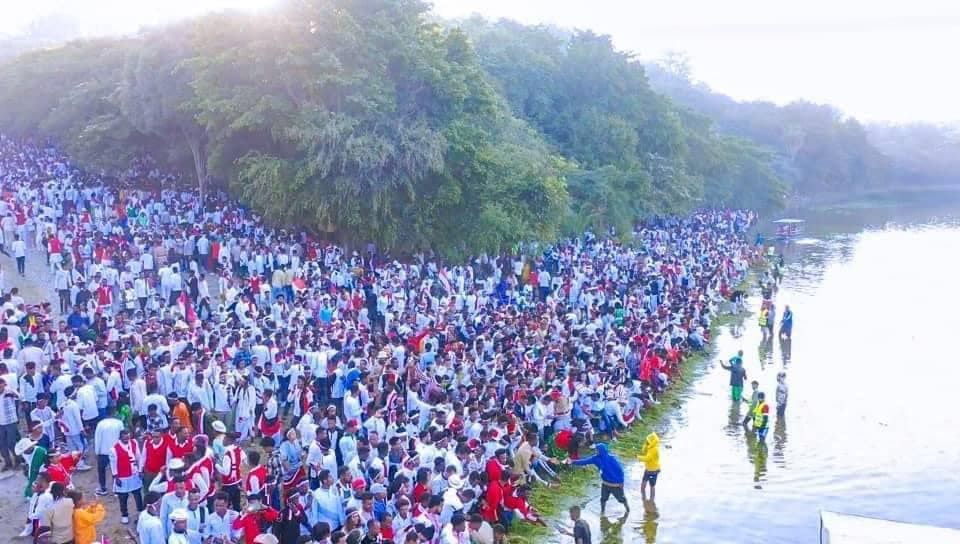
The 2024 Irreecha festival is going to be celebrated in a warm and special atmosphere in Oromia and abroad.
The annual Oromo Irreechaa festival, the Oromo Thanksgiving Day, in Oromia and diaspora is approaching this month. Irreechaa is not merely a festival; it is the vibrant heart of Oromo culture, a celebration that transcends mere tradition to embody the essence of gratitude, unity, and renewal.
As the Oromo people gather each year to honor this grand occasion, they connect deeply with their history and the rhythms of nature, marking a profound celebration of life and harmony.
Irreechaa, the Oromo Thanksgiving Day, is celebrated twice annually: once at the banks of rivers or lakes during Irreecha Malkaa/Birraa in late September, and again on mountain tops or hills during Irreecha Tuulluu/Arfaasaa in autumn. The former, occurring at the close of winter and the dawn of spring, is a tribute to the end of the rainy season and the promise of new beginnings. The latter, celebrated in the dry season, heralds the approach of winter, symbolizing reflection and preparation.
The term "Irreechaa" itself conjures images of verdant green, symbolizing fertility and thriving life, nourished by the blessings of Waaqaa, the Creator. This ancient festival, with roots extending over 6,000 years, was momentarily eclipsed during the late 19th century when the Oromo were integrated into the Abyssinian Empire. However, the spirit of Irreechaa has persisted, thriving in Oromia and among the Oromo diaspora worldwide, from North America to Europe.
Central to the celebration is the belief that every element of creation is imbued with the spirit of Waaqaa. The Oromo consider that the divine essence resides in natural elements such as the sea, great rivers, and mountain peaks. Thus, Irreechaa is celebrated at these sacred places—rivers and mountains—where the Oromo people express their gratitude and seek blessings.
The essence of Irreechaa lies in giving thanks to Waaqaa for guiding the Oromo people through the trials of winter, for the sustenance provided throughout the year, and for the transition to a season of growth and harvest. It is a time to appreciate the divine for the survival of families, the flourishing of crops, and the bounty of the spring season. Beyond gratitude, Irreechaa also serves as a celebration of the forthcoming harvest and a joyous welcome to the new season.
The rainy season, stretching from June to September, is seen as a challenging period marked by floods and isolation. It is during this time that Irreechaa provides a platform for peace, reconciliation, and renewal. The festival is renowned for its emphasis on unity and the restoration of harmony. Elders and Abbaa Gadaas (community leaders) play a crucial role, offering blessings and promoting the values of peace and coexistence.
Irreechaa also serves as a communal stage for significant life events, including naming ceremonies, weddings, and matchmaking. It is a moment when the community comes together to celebrate Oromummaa (Oromoness) and sabboonummaa (nationality), transcending differences in age, sex, religion, or social status. It embodies a collective affirmation of unity, respect, and shared heritage.
The celebration culminates at major sites like Hora Finfinnee and Lake Arsadi, where thousands of Oromos converge. The evening of Irreechaa is a poignant moment of reflection and reconciliation. Elders ask the community whether they are at peace with one another and with Waaqaa. Those with unresolved conflicts are encouraged to seek resolution before the festivities begin, underscoring the festival’s commitment to harmony.
Irreechaa is a powerful expression of Oromo cultural values, a living testament to the strength and unity of the Oromo people. It is a celebration that not only acknowledges the past and the present but also renews the bonds of community and the shared joy of life’s blessings.
Festivals of peace are a wonderful way to understand other cultures, and the values that matter to them.
Advocacy for Oromia was established in 2010 with the purpose of enabling and empowering Oromo people by providing accurate and timely information that will help to make better choices to create the kind of future in which they wish to live.
It also provides information focus on the major issues facing us in the 21st century and it is going to try and bring a balanced approach with factual information that is positive and solution based.
The website has been in operation for the last nine years with the mission of promoting and advancing causes of Oromo people through advocacy, community education, information service, capacity building, awareness raising and promotion.
The website is also the official site of Advocacy for Oromia Association in Victoria Australia Inc., a non-profit organisation, registered under the Associations Incorporation Reform Act 2012 in Victoria as April 2014.
Our team already had considerable community development experience and expertise. Our various projects helped to develop our confidence and the capacity of our agency. Our team used every gained knowledge, skills and experiences as an opportunity to design and develop new approaches, to documenting progress, supporting positive employment outcomes, liaising with community stakeholders, and conduct evaluation.
Advocacy for Oromia is devoted to establishing Advocacy for Oromia organisation to close the gaps where we can stand for people who are disadvantaged and speaking out on their behalf in a way that represents the best interests of them. We are committed to supporting positive settlement and employment outcomes for Victoria’s Oromo community.
Advocacy for Oromia Office
Addresses:
39 Clow St,
Dandenong VIC 3175
=====================
247-251 Flinders Lane
Melbourne VIC 3000
Activities Address
Springvale Neighbourhood House Inc
Address: 46-50 Queens Ave, Springvale VIC 3171
Postal Address:
P. O. Box 150
Noble Park, Vic 3174
With your support, we can continue to help community build a better future.
Advocacy for Oromia Mental Health Program
The aim of the program is to improving the mental health and well-being of Oromo community in Victoria. It aims to assist those experiencing, mental ill-health, their families and carers of all ages within this community to address the social determinants of mental health for Oromo community. It helps:
Identify and build protective factors,
Reduce stigma and discrimination
Build capacity for self-determination
Better understand mental wellbeing, mental ill-health and the impacts of trauma
The goal of the project is to increase mental health literacy of Oromo community that aims:
To assist people with mental health issues
To increase the capacity of mental health worker
To better understand mental wellbeing
To provide mental health education and information
To address the social and cultural causes of mental health issues
Advocacy for Oromia will organise information session, women performance, radio programs, culturally adopted conversations on Oromo Coffee Drinking ceremony, providing training for mental health guides and forum and producing educational materials on the selected groups and geographical area.
Human Rights Education Program
The Human Rights Education Program is a community based human rights program designed to develop an understanding of everyone’s common responsibility to make human rights a reality in each community.
Human rights can only be achieved through an informed and continued demand by people for their protection. Human rights education promotes values, beliefs and attitudes that encourage all individuals to uphold their own rights and those of others.
The aim of the program is to build an understanding and appreciation for human rights through learning about rights and learning through rights. We aimed at building a universal culture of human rights. Thus, we aimed:
To build an understanding and appreciation for human rights through learning about rights and learning through rights.
To build capacities and sharing good practice in the area of human rights education and training
To develop human rights education and training materials and resources
The goal of the project is to increase human rights literacy of Oromo community that aims:
To better understand human rights
To increase the capacity of human rights worker
To analyse situations in human rights terms
To provide human rights education and information
To develop solidarity
To strategize and implement appropriate responses to injustice.
The ultimate goal of education for human rights is empowerment, giving people the knowledge and skills to take control of their own lives and the decisions that affect them.
Human rights education constitutes an essential contribution to the long-term prevention of human rights abuses and represents an important investment in the endeavour to achieve a just society in which all human rights of all persons are valued and respected.
Advocacy for Oromia will organise information session, performance, radio programs, culturally adopted conversations on Oromo Coffee Drinking ceremony, providing training for Human Rights guides and forum and producing educational materials on the selected groups and geographical area.
Community Safety Program
The program aims to strengthen existing collaborations and identify opportunities for the development of partnerships aimed at community safety and crime prevention activities. This approach seeks to improve the individual and collective quality of life by addressing concerns regarding the wider physical and social environment. Importantly, community safety means addressing fear of crime and perceptions of safety as without this any actions to address the occurrence of crime and anti-social behaviour are of less value.





 Advocacy for Oromia