#Opinion: #Namummaa: Reviving humanity through #Oromo wisdom
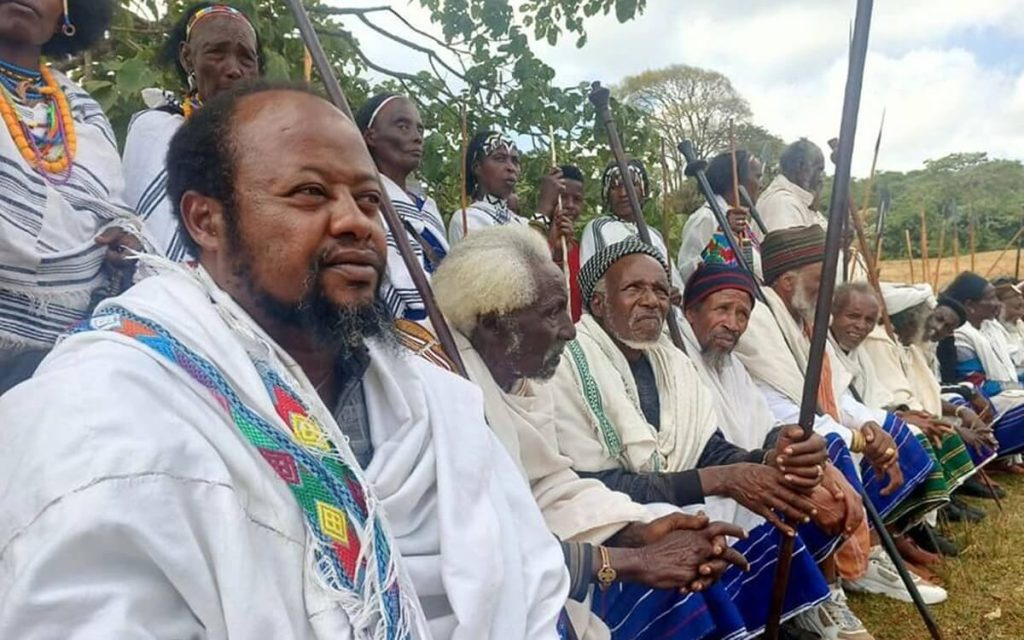
The 75th Gadaa power transfer ceremony of Gujii Oromo was held in February 2024 (Photo: Social Media)
Addis Abeba – In today’s world, we must once again ask: What does it mean to be human? For me, this question is far from abstract. It is rooted in my lived experience in the Betcho district (1972–1988). I was born and raised in Betcho, in the Ilu Abba Bora Zone of the Oromia region, where Namummaa was not merely spoken of but practiced daily within the community. I witnessed humanness expressed not only through words but also in the way people related to one another and to nature.
Today, we live in an age of extraordinary possibility—and peril. Science is decoding the universe, technology is reshaping our lives, and yet, the human spirit often feels adrift. Conflict, ecological breakdown, and deep societal fragmentation define too much of our global experience. Even our systems of knowledge, governance, and progress frequently lose sight of the very human beings they are meant to serve.
It is time we ask again—not philosophically alone, but practically and urgently: What does it mean to be human? And how can we live in ways that regenerate, rather than degrade, our shared humanness?
Across continents and centuries, many traditions have attempted to answer this. In this moment of global reckoning, we offer one deeply rooted in the African Oromo worldview—Namummaa—as both ancient wisdom and a fresh ethical compass.
Namummaa: Living legacy of Oromo
As shared by the late Haji Boru Guyo during informal discussions (1998–2003), Namummaa is discussed as a lived ethic and everyday guidance, not as a theory. Their wisdom echoes in scholarship—for example, Asmarom Legese and Asefa Jalata document the Gadaa system as a great democratic and ethical tradition.
In the worldview of the Oromo people of Ethiopia, Namummaa is not a label. It is a lived ethic. A lifelong journey. A way of being. To this, the author’s childhood lived experience (1972-1988) as well as informal discussions (1998-2003) with the late Haji Boru Guyo are the living testaments.
At its heart, Namummaa means being fully human—not just in isolation, nor just in relationship to others, but through the integration of self-realization, social harmony, and moral alignment with the natural world.
This was no abstraction in Oromo society. It was nurtured intentionally from childhood, embedded in institutions like the Gadaa system (a sophisticated, age-based democratic governance model), and governed by Saffuu—a moral code that honored balance, respect, and responsibility to all life. The African Centre for the Constructive Resolution of Disputes (ACCORD) posits Gadaa as the embodiment of democracy as it should be.
An in-depth study by Darwish & Huber (2003) discusses individualism vs. collectivism across cultures. Unlike many global ideologies that lean toward either rugged individualism or enforced collectivism, discussed in-depth by Namummaa, scored, Namummaa holds both in dynamic balance. Every person is guided to realize their full potential while being equally accountable to the well-being of others and the living world.
Michuu Namummaa: Regenerative framework
Recent scholarship, such as Bekalu Wachiso’s exploration of Namummaa as an indigenous peace philosophy and Geebi Jeo Wake’s framing of it as the Oromo gift to the world, reinforces Michuu Namummaa as both a rooted and globally relevant concept. To bring this ethical power into contemporary relevance, we propose a living framework: Michuu Namummaa—a regenerative model for what it means to be, live, and lead as a human in the 21st century.
This framework unfolds across three interconnected dimensions:
1. Essence: Recognizing and Honoring Humanity
This dimension entails embracing your own humanity through self-inquiry and authenticity. It also involves treating others as fellow human beings, beyond labels and identities, and showing respect for nature. The regenerative essence of Namummaa, as theorized by Bekalu Wachiso and Gerbi Jeo Wake, invites us to treat others with dignity and nature with reverence. This philosophy is not abstract; it is lived, as I witnessed in the Betcho district and heard echoed in conversations with elders like Haji Boru Guyo (1998–2003). As the saying goes, “Let every interaction become a site of dignity, not degradation.”

2. Living: Nurturing Potential and Togetherness
This dimension requires us to reframe how we raise children, educate citizens, and design institutions. It involves nurturing Namummaa to unleash both individual excellence and collective harmony, recognizing that transformation begins with awareness but only manifests through sustained action.
3. Excellence: Becoming Beacons of Namummaa
This final dimension involves cultivating people who embody humanity as a moral force and encouraging regenerative leadership—leaders who heal, not harm, and who create, not conquer. In his op-ed, Girma Gadissa asserts the need for a governance model that empowers the youth and harmonizes society, rather than perpetuating conflicts. The Gadaa system, explored in depth by Asmarom Legesse and Asafa Jalata, offers a model of excellence rooted in ethical leadership and rotational accountability. If even 2–5% of humanity fully lives out Namummaa, it may catalyze a profound shift: a tipping point toward a more ethical, peaceful, and creative human civilization.
Beyond Labels: Namummaa as movement for our time
Based on my development practice across civil society organizations (1991–2008), sustainable development is impossible without Namummaa—without the ethic of dignity, balance, and interdependence guiding collective efforts.
In today’s world, people are routinely reduced to categories: race, religion, nation, and ideology. These identifiers can hold meaning—but they must never replace or override our fundamental Namummaa. We reject a world where humans are alienated from one another, from themselves, and from nature. We call instead for a movement grounded in shared humanness, not shallow identities; in dignity, not division; in regeneration, not consumption.
Let every scientist, educator, policymaker, artist, parent, and leader ask: How does my work serve or diminish Namummaa? How can it be reframed to uplift our shared humanity?
From Betcho to Adama, from Haji Boru’s wisdom to scholars like Asmarom, Asefa, Bekalu, and Gerbi, the call of Namummaa is clear: humanness must be lived, not theorized. Michuu Namummaa is carrying this legacy forward.
Thus, Michuu Namummaa is not merely a framework. It is a call to recenter the human being within all our systems, to reclaim morality not as dogma but as a generative responsibility, and to live in a manner worthy of our highest human potential—while fostering societies in which all can flourish.
This is not a call for utopia; it is a call for balance. It is a call for courage and a call for each of us to become, in our own way, a beacon of Namummaa. AS
Editor’s Note: Berhanu Workneh Desta is the Founding Director of Michuu Namummaa Development Organization, an Ethiopian civil society organization dedicated to advancing shared humanity (Michuu Namummaa) as a framework for peace, justice, and sustainable development. He previously worked as a development practitioner (1991–2008) with both local and international civil society organizations and currently serves as a freelance consultant and trainer. Berhanu can be reached at berhanu.consult@gmail.com

Posted on September 10, 2025, in Uncategorized. Bookmark the permalink. Leave a comment.




 Advocacy for Oromia
Leave a comment
Comments 0