Daaniyaa represents the Oromo worldview’s deep belief in a self-regulating, moral universe where balance, justice, and harmony are the ultimate realities.
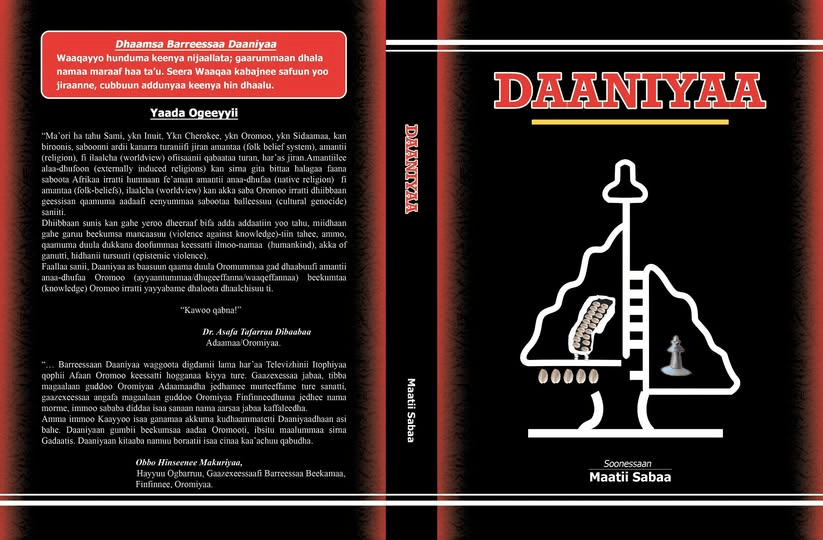
Daaniyaa is a highly significant concept in Waaqeffannaa, the traditional Oromo religion. It is not merely a word but a profound spiritual and philosophical principle.
Here is a detailed explanation of its meaning and significance:
Definition of Daaniyaa
Daaniyaa can be translated as “curse” or “divine retribution,” but this simple translation fails to capture its full depth. It is best understood as:
The inevitable, cosmic consequence for violating Safuu (moral and natural law).
It is the automatic, self-executing principle of justice maintained by Waaqa (God) to ensure balance and order in the universe.
Core Principles of Daaniyaa
- Cause and Effect: Daaniyaa is a universal law of cause and effect. If a person commits a moral wrong—especially a severe one like murder, incest, betraying a guest, or breaking a sacred oath—they set in motion a chain of consequences that will result in their suffering or downfall.
- Automatic and Impersonal: Unlike a curse cast by a person, Daaniyaa is not a personal spell. It is an impersonal, cosmic mechanism. Waaqa, as the sustainer of order, does not actively “punish” the individual; the violation itself disrupts the cosmic balance, and Daaniyaa is the re-balancing effect that inevitably follows.
- Can be Collective: While it can affect an individual, Daaniyaa can also befall a family or an entire community if the transgression is communal or if the community tolerates a grave injustice in its midst.
- Intergenerational: The consequences of Daaniyaa can extend to the offspring of the wrongdoer. This reflects the Oromo understanding that actions have long-lasting repercussions that can affect future generations.
How Daaniyaa Manifests
The effects of Daaniyaa are believed to be severe and tangible, often taking the form of:
- Unexplained illnesses and chronic sickness.
- Persistent poverty and failure in endeavors.
- Barrenness in land, livestock, or people.
- A string of misfortunes and untimely deaths within a family.
- Mental distress and social isolation.
The Relationship Between Daaniyaa, Safuu, and Araara
To fully understand Daaniyaa, it must be seen in relation to two other key concepts:
| Concept | Relationship to Daaniyaa |
|---|---|
| Safuu (Moral/Legal Code) | Safuu is the law. Daaniyaa is the automatic penalty for breaking that law. Living by Safuu is how one avoids Daaniyaa. |
| Araara (Reconciliation) | Araara is the only remedy for Daaniyaa. If a person commits a wrong, they must proactively seek reconciliation. This involves confessing the wrongdoing, seeking forgiveness from the victim, performing a cleansing ritual, and often paying compensation (Gumaa). A successful Araara ritual is believed to stop the effects of Daaniyaa and restore cosmic and social balance. |
The Cycle: Violating Safuu → Invokes Daaniyaa → Requires Araara → Restores Balance.
A Practical Example
- The Transgression: A man kills another man in a fight.
- The Violation: This is a gross violation of Safuu.
- The Consequence: The killer and his family are now subject to Daaniyaa. They may experience a series of misfortunes—their cattle die, their children fall ill, their crops fail.
- The Solution: The family must seek Araara (reconciliation) with the victim’s family. This involves elders mediating, the killer confessing, paying Gumaa (compensation), and both families participating in a ritual (like sacrificing an animal and swearing an oath of peace). Once Araara is achieved, the Daaniyaa is lifted.
Conclusion
Daaniyaa is a cornerstone of Oromo ethics and spirituality. It serves as a powerful social and religious mechanism that:
- Upholds Justice: It provides a divine assurance that wrongdoing will not go unaddressed.
- Deters Transgressions: The fear of Daaniyaa encourages individuals to live ethically and according to Safuu.
- Promotes Reconciliation: It makes the process of Araara not just a social formality but a spiritual necessity for healing and survival.
In essence, Daaniyaa represents the Oromo worldview’s deep belief in a self-regulating, moral universe where balance, justice, and harmony are the ultimate realities.

Posted on October 2, 2025, in Uncategorized. Bookmark the permalink. Leave a comment.




 Advocacy for Oromia
Leave a comment
Comments 0