Ethiopia’s Red Sea Dilemma: A One-Sided Perspective
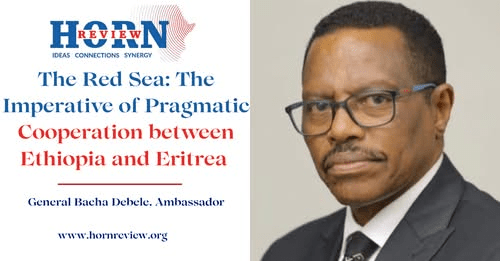
General Bacha Debele’s article presents a characteristically Ethiopian nationalist perspective on the Red Sea issue, skillfully blending pragmatic language with a deep-seated narrative of historical grievance and a thinly veiled threat. While it calls for cooperation, its foundational premises are so fundamentally one-sided and dismissive of Eritrean sovereignty that they ultimately undermine its own stated goal.
Here is a counter-analysis of its core arguments:
1. On the “Existential Imperative” and Historical Grievance:
- The Article’s Claim: Ethiopia’s need for sea access is an “existential imperative” due to an “unjust” deprivation in 1993. It challenges the legal legitimacy of its loss of Assab and frames the issue as a demand for “historical truth.”
- The Counter-Response: This framing is the primary obstacle to cooperation. It resurrects the central ideological conflict that led to a 30-year war. The 1993 Eritrean independence referendum was conducted with overwhelming international recognition and Ethiopian consent. To now question its legal and moral foundation is to question the very basis of Eritrea’s statehood. For Eritrea, this is not a negotiating point; it is a non-starter. An “existential imperative” for one nation cannot be pursued by threatening the existential sovereignty of another. True pragmatism would accept the 1991-1993 settlement as the immutable foundation for all future talks, not as a subject for “continuous reflection” and re-litigation.
2. On the Portrayal of Eritrea and Its Leadership:
- The Article’s Claim: Eritrea is a “stagnant,” “closed,” “totalitarian” state, a “political relic” whose leadership is isolated, illegitimate, and betrays its own people.
- The Counter-Response: This ad hominem attack on President Isaias and the Eritrean state is not a basis for diplomacy; it is a provocation. Regardless of the accuracy of these criticisms, using them as a preamble to a call for “cooperation” is deeply disingenuous. It positions Ethiopia as both judge and interested party, demanding partnership from a regime it simultaneously declares morally and politically bankrupt. A genuine pragmatist would engage with the state as it is, not as they wish it to be, and would avoid inflammatory language that guarantees a defensive and hostile response.
3. On the Accusations and the “Burden of Restraint”:
- The Article’s Claim: Ethiopia has shown “maximum restraint” while Eritrea “recklessly” undermines it by supporting insurgents and engaging in illicit activities. It places the entire “burden of maintaining stability” on Ethiopia.
- The Counter-Response: This narrative completely inverts the recent history of the region. From an Eritrean and regional perspective, it was Ethiopia under Abiy Ahmed that unilaterally tore up the foundational 2018 peace agreement by reigniting the Tigray conflict in 2020, drawing Eritrea into a devastating war. The article’s portrayal of Ethiopia as the perpetual victim of Eritrean aggression ignores this pivotal context. The claim of “restraint” rings hollow to those who witnessed the consequences of that conflict. The “burden of stability” is a shared one, and Ethiopia’s own actions have been the single greatest destabilizing factor in the Horn in recent years.
4. On the Nature of “Pragmatic Cooperation”:
- The Article’s Claim: The solution is “pragmatic, mutually beneficial cooperation,” which it defines as joint ventures in ports and logistics.
- The Counter-Response: The article’s concept of “pragmatism” is entirely transactional and self-serving. It proposes cooperation on Ethiopian terms, predicated on Ethiopia’s needs, while demanding Eritrea abandon its core security posture. For Eritrea, which fought a long war for sovereignty, security is paramount. Its “isolation” is, from its perspective, a defensive necessity against a much larger and historically dominant neighbor that has never fully accepted its separation. True pragmatism would require Ethiopia to first provide irreversible security guarantees and demonstrate through sustained action that it respects Eritrea’s sovereignty unconditionally. Only then could talks about port access be credible.
Conclusion:
General Bacha’s article, despite its polished language, is not a genuine offer of partnership. It is an ultimatum disguised as diplomacy. It tells Eritrea: “Your state is a failed relic, your leader is a tyrant, your independence is legally questionable, and you are a source of instability. Now, please grant us sovereign access to your coast for our existential needs.”
This approach is destined to fail. It reinforces every Eritrean suspicion about Ethiopian hegemony. If Ethiopia sincerely desires Red Sea access, it must abandon the language of historical grievance and moral superiority. It must:
- Formally and unequivocally reaffirm the borders established in 1993.
- Engage in quiet, respectful diplomacy without public preconditions and inflammatory rhetoric.
- Acknowledge its role in regional instability and work to rebuild decimated trust.
The “defining moment” for the Horn of Africa is not whether Eritrea capitulates to Ethiopian demands, but whether Ethiopia can evolve beyond a neo-imperial mindset that views its neighbors as extensions of its own national destiny. Until it does, the Red Sea will remain not a conduit for shared prosperity, but a moat guarding against a past Eritrea will never accept again.

Posted on November 1, 2025, in Uncategorized. Bookmark the permalink. Leave a comment.




 Advocacy for Oromia
Leave a comment
Comments 0