Resilience and Celebration: Oromo New Year Events Worldwide

Feature Commentary: The Unbroken Circle — How Oromo New Year Gatherings Forged a Global Covenant
As the world celebrated the turning of another calendar year, scattered communities across the globe engaged in a different kind of reckoning. From the quiet halls of Victoria, Canada, to the solitary open office in Gullalle, Oromia, and across the digital squares of a global Zoom call, the Oromo people marked the dawn of 2026 not with fleeting resolutions, but with a profound, collective covenant.
What emerged from these simultaneous gatherings—Amajjii (Oromo New Year) fused with the commemoration of the Oromo Liberation Army (OLA)—was not merely a series of cultural events. It was the clear, unified heartbeat of a movement at a critical inflection point, revealing a sophisticated national narrative being woven across continents.
The Dual Flame: Culture and Resistance
The first striking feature is the intentional fusion of the sacred and the strategic. This is no coincidence. The Eebba (invocation) of elders in Minneapolis, the shared meals in Victoria, and the celebration of Ayyaana Amajjii online are acts of cultural sustenance. They root a people in an identity that predates the current conflict. But this cultural flame is deliberately kept in the same hearth as the martial memory of the OLA. The message is unambiguous: to be Oromo is to cherish their heritage and to acknowledge the armed struggle undertaken in its defense. This duality—the cultural citizen and the resistance fighter—forms the inseparable core of the modern Oromo political identity.
From Vigil to Vanguard: The Diaspora’s Vital Role
The events in Victoria, Toronto, Minneapolis, and Edmonton powerfully redefine the role of a diaspora. This is not a community looking wistfully homeward. It is an active, organized, and indispensable limb of the body politic. When an elder in Victoria prays, “God bless our sons who sacrificed for us,” the grief is intimate and immediate. When the Edmonton chapter is honored for ensuring the “continuity” of support, it is framed as a duty, a logistical and moral lifeline.
The diaspora’s gatherings are described as declarations: “ni jirra!” — “we are here!” This presence is more than symbolic; it is the foundation for institutional strength (jabeenya jaarmiyaa), a theme hammered home in Toronto and Edmonton. In the movement’s calculus, a robust community hall abroad is as strategically vital as a forest clearing in Oromia.
The Strategic Pivot: From Resistance to Responsibility
The most significant revelation comes from the heart of the struggle itself—the Gullalle office. The address by Jaal Jabeessaa Gabbisaa there was not just a speech; it was a strategic state-of-the-union. His declaration that the OLF is transitioning from “resistance” to “elections” is a monumental shift. It signals an evolution from a movement seeking to challenge a state to one preparing to administer one.
This pivot reframes the entire struggle. The goal is no longer just recognition or even victory in a conflict, but the establishment of a democratic standard “for the world.” It is an audacious claim that immediately raises the stakes, transforming the narrative from one of victimhood to one of future governance. The admission of challenges in campaigning in certain regions underscores this new, sober, political realism.
The Unbroken Chain: Seed, Sphinx, and Succession
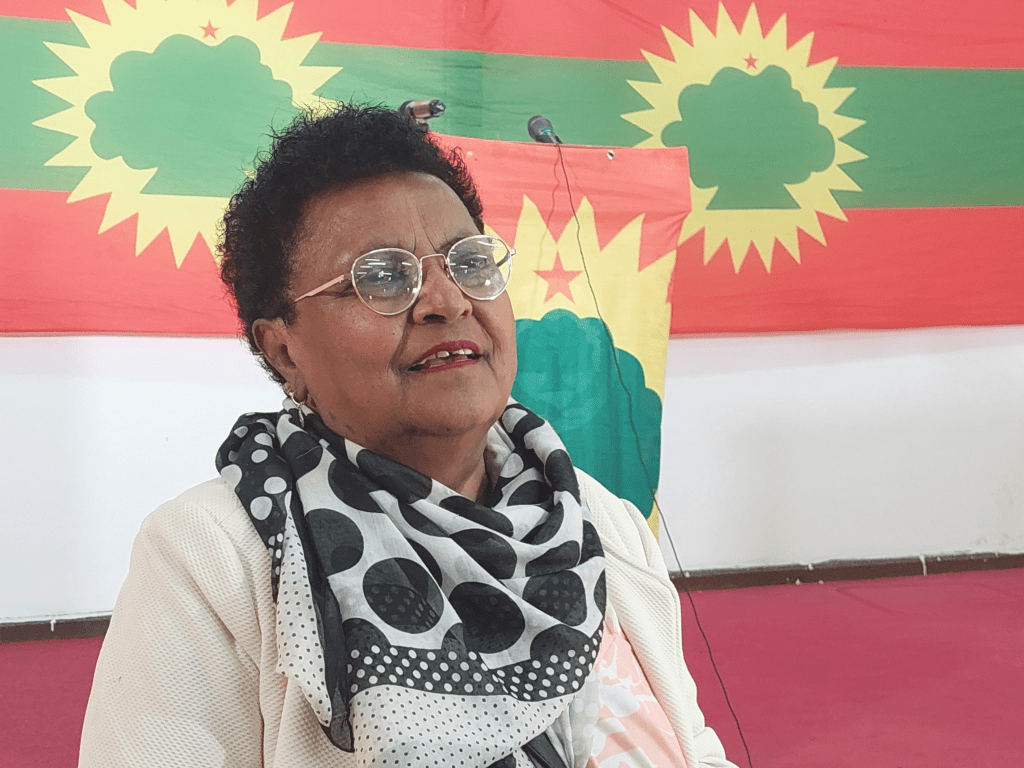
Amidst this strategic planning, the gatherings were anchored by powerful, human symbols of continuity. The frail but fiery activist Ilfinesh Qannoo, carried to the Gullalle stage, became the living soul of the struggle. Her proverb, “Ilkaan socho’e buqqa’uun isaa hin oolamu” (A seed that moves does not rot), provided the perfect metaphor. The Oromo movement, she argued, is that moving seed—its perpetual motion, its constant struggle, is what prevents its dream from decay.
This connects directly to the intergenerational charge that echoed in every location, from the global Zoom call to the local chapter halls. The youth are not an audience; they are, as Dr. Daggafaa Abdiisaa stated, the “beloved children of the fallen heroes” upon whom the “duty” now rests. The movement is consciously passing the torch, framing the next generation as the rightful heirs and executors of a will written in sacrifice.
Conclusion: The Virtual Hearth and the Perpetual Motion
Together, these scattered celebrations formed a single, coherent Chaffe—a traditional assembly for the digital age. The virtual Zoom hearth, the solitary Gullalle office, the prayerful halls in North America—all were nodes in a network of unwavering resolve.
They balanced the sorrow of memory with the rigor of strategy. They honored sacrifices not with passive remembrance, but with a pledge to build a future where such sacrifices cease. They announced a movement in motion, guided by the wisdom of elders, fueled by diaspora resolve, executed by a preparing youth, and strategically pivoting toward the responsibilities of a political future.
The Oromo New Year 2026, therefore, was more than a celebration. It was a global statement of perpetual motion. The seed is moving. The covenant is renewed. And the message, from every corner of the world, is one of unbroken and determined continuity.


Posted on January 4, 2026, in News. Bookmark the permalink. Leave a comment.




 Advocacy for Oromia
Leave a comment
Comments 0