Ilfinesh Qannoo: The Artist of Resistance and Liberation

Feature Commentary: Beyond the “Cichoominaa” – The Unbreakable Symphony of Ilfinesh Qannoo
There is a word in Oromiffa that falls painfully short in describing the life of artist Ilfinesh Qannoo: cichoominaa. It translates roughly to “perseverance” or “steadfastness,” but like a thimble trying to hold an ocean, it cannot contain the vast, roaring symphony of her existence. To speak of Ilfinesh Qannoo is not to speak of merely enduring. It is to speak of a life as a deliberate, unbroken act of revolutionary art, where every strand of hair, every whispered verse, and every labored breath is a note in the grand composition of the Oromo struggle.
The call from the global Oromo community is correct and profound: she must be honored not with a single, simplistic label, but with a full-throated acknowledgment of her multi-dimensional defiance. Her life is a triptych of resistance, each panel inseparable from the others.
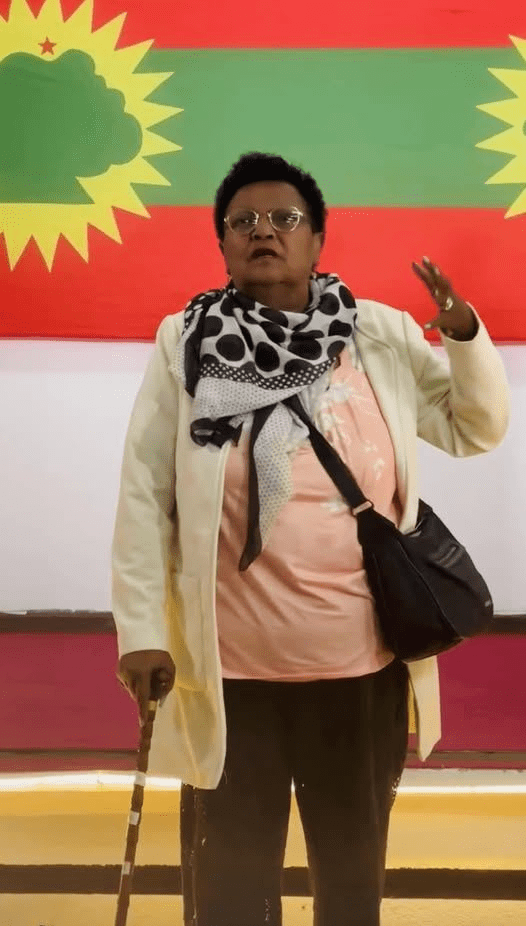
The First Panel: The Body as Battleground and Banner. “From the hair on her head shaved by prison guards to the fields of struggle where she stood with the WBO…” This is not merely a chronological note; it is a map of sacred scars. The shaved head was an attempt by oppressors to strip her of dignity, to reduce her to anonymity. Yet, this very act transformed her body into a public testament to state brutality. She wore that violation not as a mark of shame, but as a badge of a battle endured. Her physical presence, later frail yet carried to podiums, became a living flag—a testament that the spirit they tried to break only grew more visible, more potent.
The Second Panel: The Art as Weapon and Compass. Ilfinesh Qannoo was not an artist who occasionally addressed politics. She was a freedom fighter whose medium was verse and song. Her art was never decorative; it was directional. She took the ancient proverbs of the Oromo, like “Ilkaan socho’e buqqa’uun isaa hin oolamu” (A seed that moves does not rot), and charged them with urgent, contemporary meaning. She didn’t just write poetry; she crafted mantras for the movement, spiritual fuel for the weary, and ideological compasses for the young. Her voice, whether thundering from a stage or trembling from a frail body, did not entertain—it awakened and oriented.
The Third Panel: The Bridge Between Fronts. Her legacy dismantles artificial barriers. She stood with the Oromo Liberation Army (WBO) in spirit and solidarity, strengthening their resolve, while also being the soulful voice that reached diaspora halls, university students, and international audiences. She connected the armed vanguard to the cultural heartland, proving that the struggle is fought with both the gun and the weeduu (hymn), in both the forest and the concert hall. She was the human synapse between the political and the poetic, the military and the moral.
To call this cichoominaa is to call a hurricane a breeze. Hers is a story of alchemical resistance. She transformed personal suffering into collective strength. She translated historical oppression into timeless art. She converted the malice of her jailers into an unquenchable love for her people.
The Oromo community worldwide is right to insist on a fuller recognition. Honoring Ilfinesh Qannoo requires a vocabulary of reverence fit for a prophet-artist of liberation. She is the embodiment of Safuu (moral balance) under fire, the living Weeduu of resistance, the unyielding Odaa (sacred sycamore tree) providing shade and shelter for the movement’s spirit.
Her life proclaims that true revolution is not just a political project but an artistic and spiritual one. To honor her is to understand that the fight for bilisummaa (freedom) must also be a fight to preserve and elevate the culture, the language, and the artistic soul that she so fiercely represented. The seed she planted, through her art and her agony, is in perpetual motion. It will not rot. And for that, our gratitude must be as deep, as complex, and as enduring as her monumental life.

Posted on January 5, 2026, in News. Bookmark the permalink. Leave a comment.




 Advocacy for Oromia
Leave a comment
Comments 0