A City Rises, A People Displaced: Oromo Liberation Front Condemns ‘Mega Airport’ Project as Cultural Erasure
A City Rises, A People Displaced: Oromo Liberation Front Condemns ‘Mega Airport’ Project as Cultural Erasure
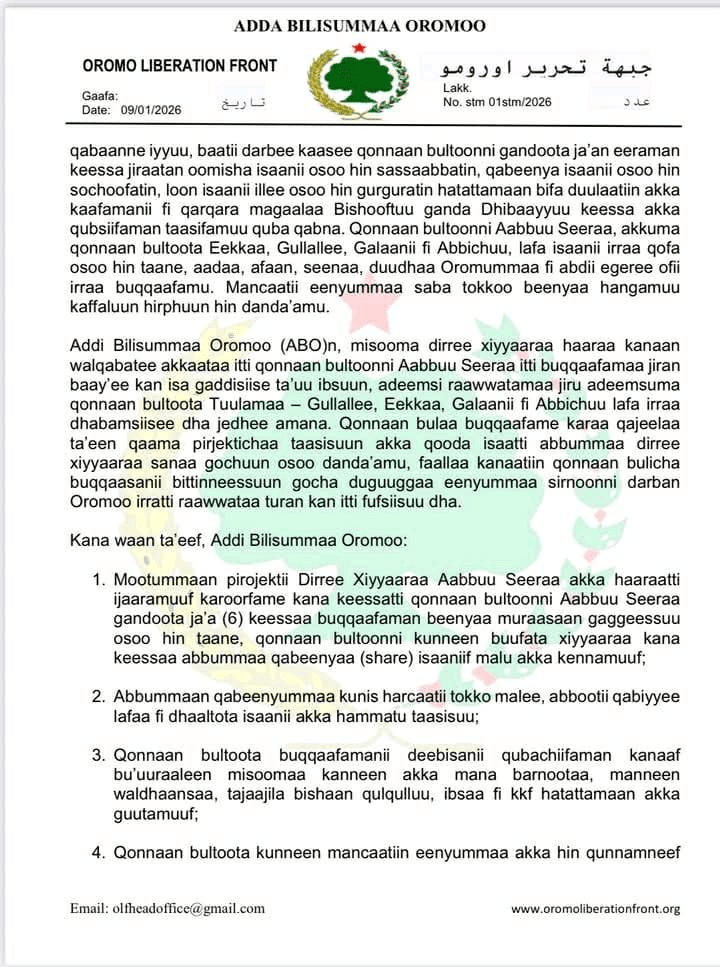
FINFINNEE / AABBUU SEERAA (BISHOOFTU) – In a forceful and detailed statement, the Oromo Liberation Front (OLF) has issued a scathing condemnation of Ethiopia’s planned new “Mega Airport” project and its adjoining “Airport City” in Aabbuu Seeraa (Bishoftu), framing it as the latest and most severe chapter in a decades-long campaign of displacing Oromo farmers and eroding their identity.
Marking a major political intervention, the OLF’s statement, dated April 9, 2026, draws a direct line from the historic displacement of Oromo clans around the capital to the imminent eviction of thousands in Bishoftu, warning that the project constitutes a form of “ethnic cleansing.”
“History Repeating, on a Grander Scale”
The OLF asserts that for the past thirty years, Oromo farmers across the region have been illegally displaced from their land for “development” projects, receiving minimal or no compensation. This, they argue, has systematically eroded Oromo culture, language, history, and collective identity.
“Particularly, the situation inflicted upon the farming community in the Finfinnee (Addis Ababa) periphery has dismantled social foundations, scattered families, and escalated to the level of national genocide (ethnic cleansing),” the statement declares. It points to the fate of clans like the Eekkaa, Galaan, Gullallee, and Abbichuu, who were displaced from their heartland to make way for the capital’s expansion and whose current whereabouts are often unknown.
The OLF accuses the government of surreptitiously reviving the controversial 2014 “Master Plan” for Addis Ababa—a proposal that sparked the historic Oromo youth (Qeerroo) protests—piece by piece under new names. The Aabbuu Seeraa airport project, they state, is a direct continuation of this plan, now “expanded and intensified.”
The Imminent Displacement: 15,000 Lives in the Balance
The core of the crisis, as detailed by the OLF, is the imminent eviction of farmers from six villages: Aabbuu Aciroo, Aabbuu Garbii, Aabbuu Kombolchaa, Aabbuu Looyyaa, Aabbuu Lugnaa, and Aabbuu Saarkamaa. This would affect an estimated 3,000 households, or about 15,000 people.
The OLF reports that despite a regional budget of 17 billion Birr earmarked for farmer resettlement and rehabilitation, the on-the-ground reality is brutal. “Starting last month,” the statement alleges, “farmers… have been forcibly ordered, in a manner of war, to leave without harvesting their crops, moving their property, or even selling their cattle.” They are reportedly being temporarily housed in Dhibaayyuu village on the outskirts of Bishoftu.
A Demand for Equity, Not Eviction
Moving beyond condemnation, the OLF lays out a concrete, four-point alternative path that rejects mere cash compensation:
- Farmers as Shareholders: Displaced communities must be granted equity shares (abbummaa qabeenyaa) in the new airport project, making them co-owners, not casualties.
- Intergenerational Rights: These shares must be inheritable, benefiting both current landowners and their descendants.
- Rehabilitation Infrastructure: Immediate construction of schools, health centers, clean water, and electricity in resettlement areas.
- Cultural Safeguards: Special programs must be established to prevent the loss of Oromo identity, language, and culture.
“The cultural genocide of a nation cannot be compensated with any amount of money,” the statement asserts.
A Broader Call to Action
The OLF pledges to fight for this solution for the Aabbuu Seeraa farmers. It also praises the legal advocacy of the Global Oda Nabe Association (GLONA) and calls on all Oromo institutions to learn from this case and proactively resist human rights violations carried out in the name of “development” across Oromia.
The statement concludes with a rallying cry: “Victory to the Broad Masses!” It frames the airport conflict as a microcosm of the larger Oromo struggle for land, self-determination, and the right to exist as a people on their own terms—not as obstacles to someone else’s progress. The coming weeks will test whether the government engages with these demands or if the bulldozers proceed, writing another painful entry in what the OLF calls a long history of displacement.



Posted on January 10, 2026, in News. Bookmark the permalink. Leave a comment.




 Advocacy for Oromia
Leave a comment
Comments 0