Oromo Congress Challenges Addis Mega Airport Project

“Mega Airport or Mega Displacement?” Oromo Congress Raises Alarm Over Addis Ababa ‘Airport City’ Project
ADDIS ABABA – The Oromo Federalist Congress (OFC) has issued a stark warning and a detailed critique of the proposed “Mega Airport Project” and its adjoining “Airport City” development in the Aabbuu Seeraa (Bishoftu/Debre Zeit) area, framing it not as a symbol of progress but as a potential humanitarian and cultural disaster.
In a powerful statement of concern, the Congress denounced the current plan as a “grave and deeply worrying” strategy that will inevitably lead to the mass displacement of indigenous communities. The project, intended to expand Bole International Airport and construct a new urban center, threatens to forcibly evict over 3,000 farming families—more than 15,000 people—from villages including Aabbuu Aciroo, Aabbuu Garbii, and Aabbuu Saarkamaa.
A Violation of Land, Law, and Livelihood
The OFC forcefully challenged the narrative of the project, stating, “What is being carried out under the name of ‘development’ is in fact saamicha—dispossession.” They accused the government of ignoring their prior calls for a halt and said they are now “obliged to issue a special red alert” for the affected communities.
Citing Article 40 of the Ethiopian Constitution, which guarantees farmers’ rights to land and protection from displacement, the Congress argued the project’s “top-down” approach is illegal and unethical. “Land is the foundation of a farmer’s life, not a commodity for sale,” the statement declared, warning that short-term financial compensation will quickly vanish, leaving generations trapped in poverty.
Echoes of a Painful Past
The statement draws a direct and chilling parallel to the displacements that accompanied the expansion of the capital into surrounding Oromo areas like Boolee, Qooqaa, and Wonji. “At that time, the displaced Oromo community was scattered, losing its culture and way of life. We fear this will not be repeated in Aabbuu Seeraa,” the OFC cautioned.
They condemned the use of “world-class” labels to justify destroying the future of local inhabitants, arguing, “Any development project must be inclusive and create shared opportunities, not displace native residents from their own developmental path without their free, prior, and informed consent—a practice unacceptable both legally and historically.”
A Demand for Equity, Not Just Eviction
Moving beyond mere criticism, the OFC laid out a series of non-negotiable demands for a just path forward:
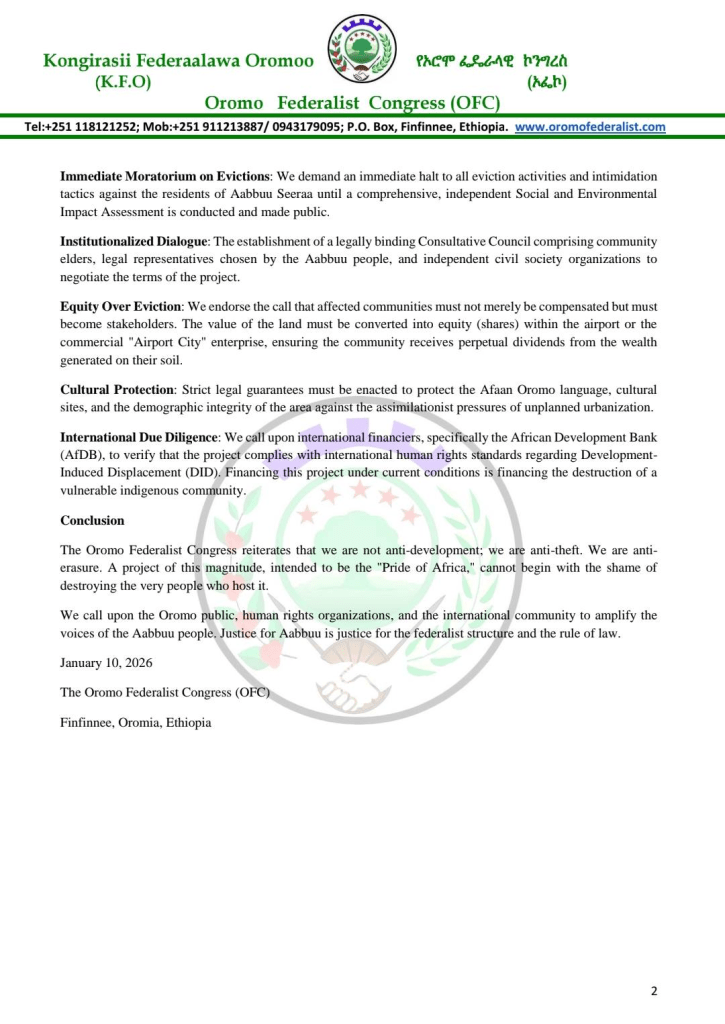
- Immediate Halt: An immediate suspension of all eviction and demolition activities pending a credible, independent Social and Environmental Impact Assessment (SEIA).
- Inclusive, Transparent Dialogues: Meaningful public consultations with the displaced community, local civil societies, and legal experts.
- Community as Shareholders: The displaced community must be recognized as equity shareholders (Abbaa Aksiyoonaa) in the “Airport City” project, receiving annual dividends rather than a one-time payment for their land.
- Cultural Safeguards: Strong legal mechanisms must be established to protect the local language, culture, and identity from being erased by the new urban sprawl.
- Donor Accountability: The Congress called on financiers like the African Development Bank (AfDB) to verify that the project complies with international human rights standards before releasing funds.
A Question of True Development
The OFC’s intervention reframes the core question: Is this project truly for national development, or is it another chapter in the long history of displacing Oromo farmers for urban expansion? By demanding equity and inclusion, they propose a revolutionary alternative—that the original inhabitants of the land should not be its first victims of progress, but its lasting beneficiaries.
The ball is now in the court of the government and international financiers to respond. The future of Aabbuu Seeraa hangs in the balance, caught between the blueprint for a mega-city and the determined resolve of a community fighting to stay on the map.


Posted on January 10, 2026, in News. Bookmark the permalink. Leave a comment.




 Advocacy for Oromia
Leave a comment
Comments 0