The Oromo Flag: Shining Light on a Legacy of Struggle
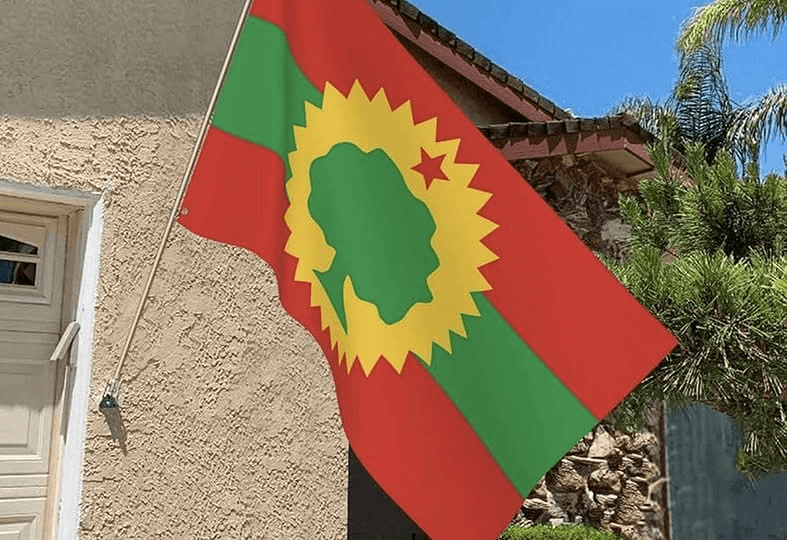
Feature News: The Unbroken Symbol – The Oromo Flag as a Nexus of Identity and Struggle
In the annals of liberation movements, a symbol is never just cloth and color. It is a repository of memory, a map of a desired future, and a target for those who fear the unity it inspires. A recent, poignant statement from within the Oromo struggle underscores this eternal truth: “Oromoon akka mul’atuu fi dhabama irraa hafu kan godhe faajjii qabsoo kana! Alaabaa Oromoo ibsituu dukkanaa..!!” (“What made the Oromo people visible and saved them from extinction is this struggle! The Oromo flag that shines in the darkness..!!”).
This declaration is not mere rhetoric; it is a historical verdict and a living reality. The Oromo flag—with its horizontal stripes of black, red, and white—has evolved from a clandestine emblem of resistance to a powerful, public declaration of an identity long suppressed. Its journey from the shadows into the light is the story of the Oromo people’s modern political awakening.
From Suppression to Symbol: The Flag’s Forbidden History
For decades under successive Ethiopian regimes, the display of the Oromo flag was a criminal act, punishable by imprisonment or worse. Its colors were banned, its meaning erased from official discourse in a systematic attempt to enforce cultural and political assimilation. To raise it was an act of profound bravery, a silent shout of existence against a state policy that sought to render Oromoness—Oromumma—invisible.
“The struggle gave us visibility,” the statement asserts, pointing to the decades-long political and cultural mobilization led by groups like the Oromo Liberation Front (OLF). The flag became the central emblem of this movement, its display at protests, cultural festivals, and in diasporic communities a direct repudiation of enforced silence. It transformed from a party symbol into a national one, representing not just a political program but the very sovereignty of the Oromo nation—a people with a distinct history, language, and the Gadaa system of governance.
“Shining in the Darkness”: A Beacon of Collective Memory
The phrase “shining in the darkness” is deeply evocative. The “darkness” represents eras of persecution, mass displacement, and cultural negation. The flag’s light is the enduring spirit of resistance, the scholarly work preserving Oromo history, the poets singing in Afaan Oromo, and the millions who now claim their identity publicly.
It shines on the graves of martyrs like Hundee (Ahmad Taqii), whose sacrifice was meant to sow terror but instead planted a seed of defiance. It illuminates the wisdom of oral traditions like Mirriga, which carries the constitutional memory of the people. It is the light held high by each new generation of Qeerroo and Qarree, the youth who have carried the struggle into the 21st century.
The Contemporary Crucible: Between Celebration and Conflict
Today, the flag flies openly across Oromia, a testament to a hard-won political space. It is celebrated during festivals like Irreechaa and marks public buildings. Yet, its display remains a potent and often contentious political act. To some, it is an unequivocal symbol of self-determination; to the state, its political interpretation can be seen as a challenge to national unity.
This tension ensures the flag is more than a celebratory banner; it remains a banner of contention. Each time it is raised, it reiterates the unresolved questions at the heart of the Ethiopian federation: the meaning of true multinational equality, the right to self-administration, and the legacy of a struggle that saved a people from cultural extinction.
An Amaanaa Carried Forward
The featured statement connects directly to the core Oromo concept of Amaanaa—the sacred trust of the martyrs. To bear the flag is to bear that trust. It is a vow that the sacrifice of those named in the litany of heroes—from Elemoo Qilxuu to Mecha Tullu—will not be betrayed for fleeting political gain. The flag is the physical manifestation of that covenant, a daily reminder that the visibility it represents was purchased at an incalculable price.
As one Oromo intellectual noted, the struggle is an unstoppable train; some may disembark, but the journey continues. The Oromo flag is the headlight of that train, cutting through the darkness of history, its light a constant, challenging, and unifying glow for millions. It is, as the voice from the struggle declared, the brilliant, undeniable proof that the Oromo people are here, they remember, and they endure.

Posted on January 22, 2026, in News. Bookmark the permalink. Leave a comment.




 Advocacy for Oromia
Leave a comment
Comments 0