The Poet Who Spoke for a Continent: Remembering Tsegaye Gabre-Medhin (1936-2006)
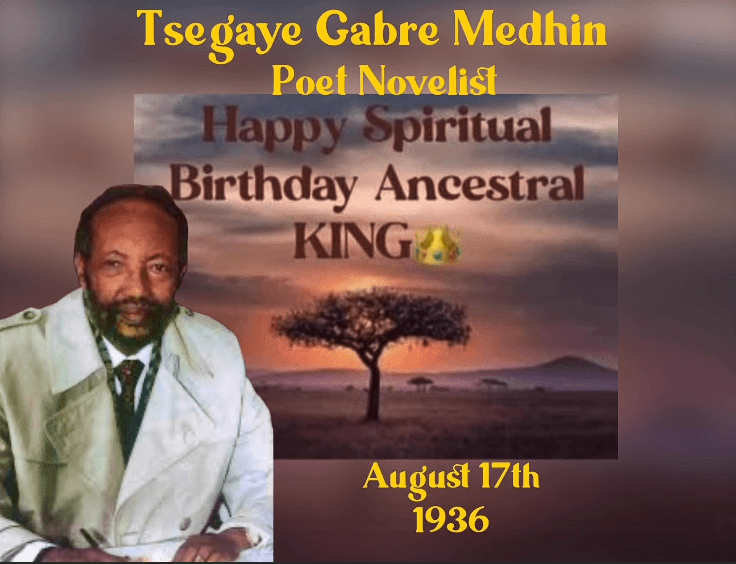
Subtitle: Ethiopia’s towering playwright, poet laureate, and pan-African visionary left a legacy that bridged tradition, revolution, and human dignity.
On a February day in 2006, in a Manhattan hospital room far from the highlands of Boda where he was born, the heart of Ethiopian letters ceased to beat. Tsegaye Gabre-Medhin – playwright, poet, pan-Africanist, and keeper of his nation’s conscience – passed away at 69, physically separated from the land he immortalized but spiritually never departed from it.
Tsegaye’s life was a testament to the power of art to shape national identity and awaken continental consciousness. Educated in the wake of Ethiopia’s liberation from Italian occupation, his genius was recognized early. While still a schoolboy, he wrote a play performed before Emperor Haile Selassie—a prophetic beginning for a writer who would spend a lifetime wrestling with the myths, heroes, and soul of his nation.
The Playwright as Patriot and Teacher
Rejecting careers in law and commerce, which he saw as “soul-destroying,” Tsegaye devoted himself to the stage. As a director of Ethiopia’s National Theatre, he became a deliberate pedagogue. He believed his country needed heroes, and through historical dramas like Tewodros and Petros at the Hour, he taught Ethiopians to respect the martyrdom, reform, and resistance that defined their past. Yet his vision was never parochial. His celebrated play The Oda Oak Oracle, a comedy of Ethiopian country life, was performed across eight nations, proving the universal appeal of locally-rooted storytelling.
The Poet as Pan-African Visionary
Tsegaye’s patriotism was expansive, firmly rooted in an Africanist worldview. A friend of Senegal’s President Léopold Sédar Senghor, he engaged deeply with the Négritude movement. His scholarship led him to trace the linguistic and cultural threads linking the Nile Valley civilizations, asserting Ethiopia’s place within a broader African continuum. This vision culminated in 2002 when his poem, calling to “make Africa the tree of life,” was adopted as the anthem of the newly-formed African Union.
The Advocate as Unyielding Conscience
Beyond the stage and page, Tsegaye was a formidable advocate for justice. He campaigned tirelessly for the return of Ethiopia’s looted heritage—the Aksum Obelisk taken by Mussolini and the priceless manuscripts pillaged from Emperor Tewodros’s fortress at Magdala. For him, these were not mere artifacts but fragments of the national soul.
In his later years, his focus broadened to the universal themes of peace and human dignity, earning him international recognition and a place in the United Poets Laureate International.
A Legacy of Unbroken Spirit
Confined to exile by the medical necessity of dialysis, Tsegaye became a spiritual anchor for the diaspora, affectionately known as Blattengetta—the great scholar. His seminal poem, “Prologue to African Conscience,” remains a piercing critique of post-colonial malaise, warning of “luxury and golden chains that free the body and enslave the mind.”
Tsegaye Gabre-Medhin taught us that to look forward, a people must first learn to look deeply into their own past and see themselves within the grand tapestry of their continent. He was not just Ethiopia’s poet laureate; he was Africa’s scribe, a visionary who understood that true freedom lives in the stories we tell, the history we reclaim, and the conscience we dare to awaken.
Galatoomaa, Blattengetta. Your footprints in time are indelible.

Posted on February 11, 2026, in News, Oromia, Press Release. Bookmark the permalink. Leave a comment.




 Advocacy for Oromia
Leave a comment
Comments 0