Daily Archives: February 15, 2026

Celebrating 36 Years of Operation Fenkil in Eritrea
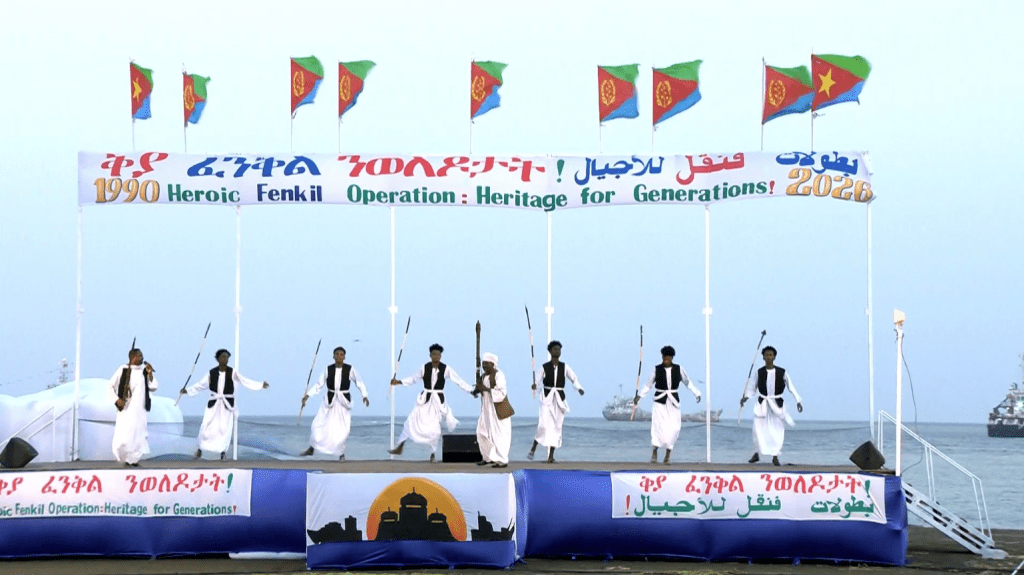
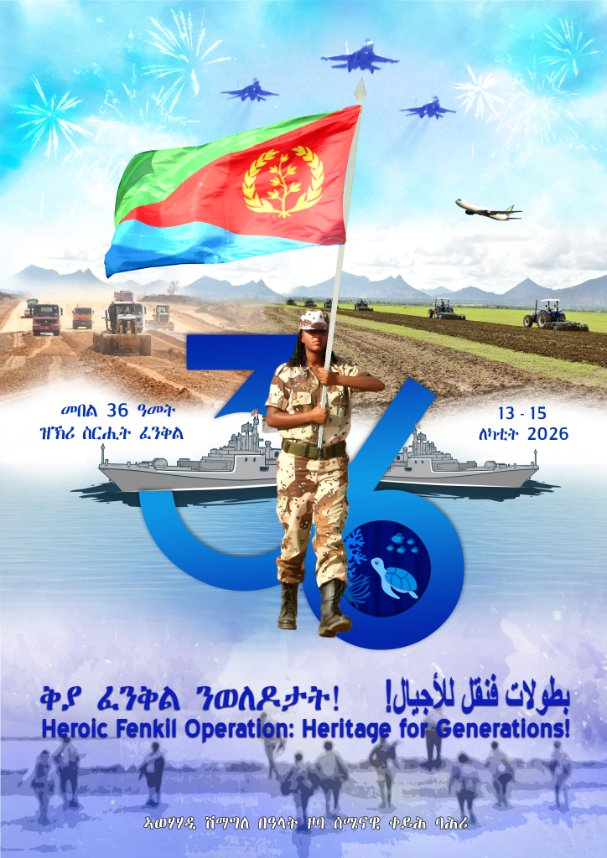
“Heroic Fenkil Operation: Heritage for Generations” celebrated as national symbol of liberation struggle
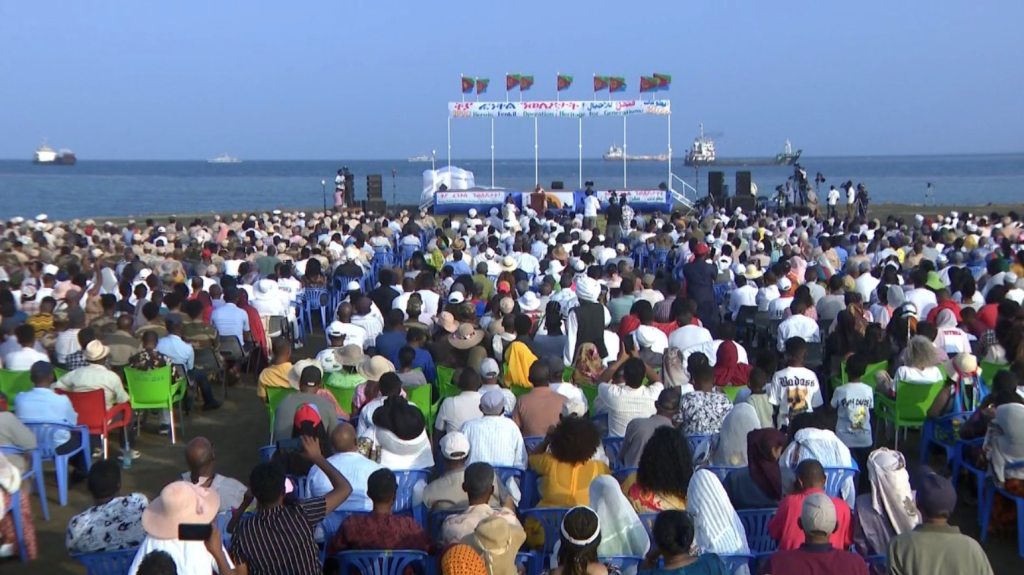
MASSAWA, Eritrea — The seashore of the historic port city of Massawa came alive today with patriotic fervor as Eritrea officially commemorated the 36th anniversary of Operation Fenkil, the decisive military offensive that liberated the strategic Red Sea port from Ethiopian occupation in 1990.
The official ceremony, held under the theme “Heroic Fenkil Operation: Heritage for Generations,” was broadcast live across the nation by Eritrean Television and Radio Dimtsi Hafash, bringing the celebration to every corner of the country. President Isaias Afwerki attended the event, joined by ministers, government and PFDJ officials, army commanders, religious leaders, and numerous nationals who gathered to honor this pivotal moment in Eritrea’s liberation history .
A Legacy of Heroism and Perseverance
Ms. Asmeret Abraha, Governor of the Northern Red Sea Region, delivered the keynote address, emphasizing the enduring significance of Operation Fenkil in the national consciousness. “The history of Operation Fenkil is a history of heroism, resolve, and perseverance of the Eritrean people and freedom fighters that will be remembered by future generations,” she declared to the assembled crowd .
The Governor drew direct connections between the sacrifices of the past and the development priorities of the present. She highlighted that national development programs being carried out in coordination with the public, members of the Defense Forces, construction companies, and other stakeholders represent the continuation of the Fenkil spirit. These programs, she noted, are based on “active and conscious public participation” and founded on “the pillars of social justice,” which together constitute the main message of the commemoration event .
Naval Power and Cultural Celebration
A dramatic highlight of the ceremony featured Fast Patrol Boats operated by female members of the Eritrean Naval Force, showcasing the integration of women into all aspects of national defense and the ongoing strength of Eritrea’s maritime capabilities .
The celebration wove together military display and cultural expression, with performances depicting the history of Operation Fenkil, praising the Eritrean people and freedom fighters, and conveying messages to adversaries. The artistic presentations also carried a message of social solidarity, encouraging support for disadvantaged citizens and families of martyrs who made the ultimate sacrifice for national liberation .
Week-Long Commemoration Activities
The 36th anniversary observance extends well beyond today’s official ceremony, encompassing a diverse array of activities designed to engage all sectors of society:
- Youth Week, organized in collaboration with the National Union of Eritrean Youth and Students, providing platforms for young Eritreans to connect with their national heritage
- Sports competitions celebrating physical fitness and team solidarity
- Photo exhibitions documenting the historic operation and its place in Eritrean history
- General knowledge contests testing understanding of the liberation struggle
- Children’s programs ensuring the youngest generation learns about this heritage
- The Fenkil Award ceremony recognizing contributions to national development and preservation of Fenkil values
- Seminars and community gatherings fostering discussion and reflection on the operation’s significance
Historical Significance of Operation Fenkil
Operation Fenkil, launched in February 1990, stands as one of the most decisive military campaigns of Eritrea’s 30-year war for independence from Ethiopia. The operation’s success in capturing Massawa, Eritrea’s second-largest city and primary port, dealt a crippling blow to Ethiopian forces and their Soviet-backed military apparatus. The victory severed critical supply lines and provided the Eritrean People’s Liberation Front (EPLF) with a strategic stronghold that would prove instrumental in the final push toward liberation in 1991.
Military historians note that the operation demonstrated the tactical sophistication of EPLF forces, combining conventional warfare with the guerrilla expertise honed during years of struggle. The capture of Massawa’s port facilities and the nearby islands fundamentally altered the strategic calculus of the war, opening new supply routes for the liberation forces while denying them to the enemy.
Fenkil in National Memory
For Eritreans, Fenkil represents more than a military victory—it embodies the resilience and determination that carried the nation through decades of struggle. The operation’s anniversary has become an annual opportunity to honor the martyrs who fell during the campaign and to transmit the values of sacrifice and national unity to younger generations.
The presence of female naval personnel in today’s ceremony carried particular resonance, reflecting how the liberation struggle transformed gender roles and established women as equal participants in national defense and development. During the armed struggle, women comprised approximately one-third of EPLF fighters, and their descendants continue to serve in all branches of the national defense forces.
Development as Continuation of Struggle
Governor Asmeret’s emphasis on development programs as the “main message” of the commemoration reflects a consistent theme in contemporary Eritrean national discourse: that the task of building the nation continues the work of liberating it. The “active and conscious public participation” she referenced draws direct parallels to the mass mobilization that sustained the armed struggle.
Infrastructure development in and around Massawa holds particular significance. The port city, once a major Ottoman and Italian colonial center, suffered extensive damage during the liberation war and has been the focus of ongoing reconstruction and modernization efforts. Development programs in the Northern Red Sea Region aim to restore Massawa’s historic role as a commercial hub while improving living conditions for its residents.
Transmitting Heritage to Generations
This year’s theme, “Heroic Fenkil Operation: Heritage for Generations,” explicitly frames the commemoration as an exercise in intergenerational transmission. With Eritrea’s population increasingly composed of young people born after independence, the challenge of conveying the lived experience of the struggle to those who did not witness it has become a national priority.
The variety of activities scheduled throughout the commemoration period—from children’s programs to youth competitions to general knowledge contests—reflects a deliberate strategy to engage different age groups through formats appropriate to their experiences and interests. The participation of the National Union of Eritrean Youth and Students in organizing Youth Week activities ensures that young people are not merely passive recipients of historical information but active participants in shaping how that history is remembered and transmitted.
A Nation Remembers
As the sun set over the Massawa seashore, the site where liberation fighters stormed ashore 36 years ago, the gathered nationals departed with renewed commitment to the values Fenkil represents. The ceremony, blending solemn remembrance with celebration of national achievements, reinforced the bonds that unite Eritreans across generations and regions.
For the families of martyrs, whose sacrifices were specifically honored in today’s proceedings, the commemoration offered public recognition of losses that can never be fully compensated. For the veterans of the liberation struggle in attendance, it provided validation that their efforts are remembered and valued. And for the young people participating in the week’s activities, it opened a window onto the experiences that shaped the nation they have inherited.
The 36th anniversary commemoration of Operation Fenkil continues through the coming days, ensuring that this pivotal moment in Eritrean history receives the reflection and celebration it deserves, and that its lessons and values continue to inform Eritrea’s national journey.

Exploring Indigenous Peacemaking at the 2026 Oromo Conference
Oromo Studies Association Honors Legacy of Prof. Hamdessa Tuso with Mid-Year Conference on Conflict Resolution and Peace-Building
Scholars and researchers invited to explore indigenous peacemaking traditions at University of Minnesota gathering
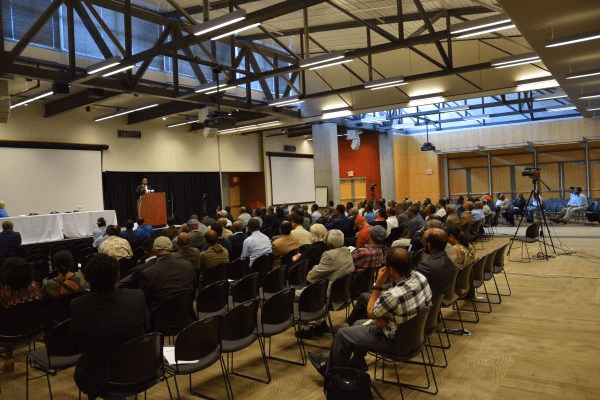
MINNEAPOLIS — The Oromo Studies Association (OSA) has issued a call for papers and panels for its 2026 Mid-Year Conference, scheduled for April 11-12 at the University of Minnesota Medical Center’s West Bank campus. This year’s gathering carries special significance as it will honor the life and legacy of Professor Hamdessa Tuso, a founding member of OSA and a towering figure in the study of indigenous conflict resolution mechanisms .
Under the theme “Conflict Resolution & Peace-Building: Honoring the Life and Legacy of Prof. Hamdessa Tuso,” the conference invites scholars, researchers, and community leaders to submit abstracts exploring the rich traditions of peacemaking that have sustained Oromo society for generations. The event will take place at 2450 Riverside Ave, Minneapolis, MN 55454.
A Life Devoted to Indigenous Peacemaking
Professor Hamdessa Tuso, who passed away on November 22, 2025, in Winnipeg, Manitoba, dedicated his life to studying and teaching about African indigenous conflict resolution processes . His scholarly work emphasized that indigenous forms of peacemaking—long dismissed by Western academics as “irrelevant and backward tribal rituals”—contain sophisticated mechanisms for building lasting peace .
Dr. Tuso earned his Ph.D. in Conflict Resolution and Peacebuilding from Michigan State University in 1981 and served in distinguished academic roles across North America, including as Professor of Peace and Conflict Studies at the University of Manitoba and as a faculty member at Nova Southeastern University . His landmark work, “Creating the Third Force: Indigenous Processes of Peacemaking,” which he co-edited with Maureen P. Flaherty, presented the Oromo Gadaa system as a global model for conflict resolution .
In that seminal volume, Tuso contributed chapters including “Indigenous processes of conflict resolution: neglected methods of peacemaking by the new field of conflict resolution” and “Ararra: Oromo indigenous processes of peacemaking,” establishing a scholarly foundation for understanding how Oromo traditional institutions can address contemporary conflicts .
Conference Theme and Significance
The conference announcement highlights the Oromo people’s historical role as “the anchoring population that cemented the coexistence of peoples of various creeds” and “guarantors of peace, stability and justice everywhere its rule prevailed.” According to the call for papers, historical accounts indicate that before the precolonial era, the Oromo managed to create alliances with neighboring tribes, transforming former rivals into partners.
The announcement also addresses historical challenges to Oromo recognition: “Since the formation of Ethiopia as an empire State, the Oromo people were brutally oppressed, marginalized, dehumanized and the contributions of the Oromo to maintaining peace and stability in the horn of Africa were denied the due recognition they deserved in history.”
It was not until the early 1970s that organized scholarly attention began to reveal “the hidden truth that the Oromo in fact are custodians of indigenous institutions of governance that guarantees equality of all its citizens, rule of law, justice and fairness for all living things and the environment.”
The conference draws on core Oromo values of Nagaa (peace) and Araara (reconciliation)—traditional principles that guide conflict resolution when disputes arise between groups and individuals. As the call for papers notes, “The Oromo Land is therefore rightly described as the sea of blessings, where elders call for peace to prevail over everything living and the environment.”
Call for Submissions
OSA invites abstracts for individual paper presentations, posters, panels, and roundtables addressing the conference theme and the following sub-themes:
- Indigenous Oromo institutions: exploring the mechanisms of peacebuilding and conflict resolution
- Mitigating intra-ethnic conflicts in Ethiopia, the Horn of Africa and elsewhere globally: lessons learned from other settings
- Building peace and resolving conflicts among the Oromo and neighboring nations and nationalities (such as Somali, Afar, Sidama) past, present, and future
- Federalization and exclusion of Oromo cities Harar, Dire Dawa, Jigjiga: case studies of the impact of forced division on Oromo approaches to peacebuilding and stability
- Dedicated Panel: Remembering the Life and Legacy of Prof. Hamdesa Tuso — welcoming reflections on how he approached the study of conflict resolution
- Examining women’s leadership in traditional Oromo peacebuilding and conflict resolution
- Transmitting the wisdom of peacebuilding to the younger generation in a time of intense war, violence and undermining of culture
Other topics will be considered, but priority will be given to abstracts relevant to the theme and sub-themes.
Submission Guidelines
Individual Papers or Posters: Submissions should include a 200-300 word abstract providing 1) title, 2) specific contribution to the theme, 3) evidence on which the presentation is based, and 4) brief findings or conclusions. Authors must include names, country of residence, affiliation, field of specialization, and contact information (email and WhatsApp).
Panels: Panels consist of four members of a pre-assembled group. Proposals should include the panel title and brief biographies of each panel member with academic credentials or community roles.
Roundtables: Roundtables bring together qualified scholars and prominent personalities moderated to discuss a specific topic, book, or research finding. Submissions should include the roundtable title, relevance to the conference theme, moderator information, and speakers’ names with contact details.
The deadline for submission is March 10, 2026, at midnight. Acceptances will be notified on a rolling basis, with final notices made by March 21. All submissions should be sent to: oromostudiesassociation@gmail.com
A Legacy of Scholarship and Advocacy
Professor Tuso’s contributions extended far beyond academia. He was among the earliest pioneers of the Arsi Basic School movement, helping ignite a culture of learning across Arsi in Oromia at a time when education itself was considered a revolutionary act . He championed Tokkumaa Oromoo (Oromo unity) and stood firmly against what he termed “the colonization of the Oromo mind.”
His service included organizing the Oromo Committee for Immigration and Refugees (OCIR) in the 1980s, helping secure asylum for thousands of Oromos in the United States at a time when the U.S. government had restricted asylum for Ethiopians . He also participated in the 1991 London Peace Conference, advocating for a just political reordering of Ethiopia .
As a founding force behind the Oromo Studies Association and its first president, Tuso nurtured generations of scholars committed to researching and preserving Oromo history and culture . The upcoming conference represents a continuation of that mission, bringing together researchers to explore how indigenous wisdom can address contemporary challenges.
For scholars of peace and conflict studies, African studies, and indigenous governance systems, the April conference offers a unique opportunity to engage with Oromo intellectual traditions at a moment of both remembrance and renewal.

Victorian Multicultural Commission Celebrates New ECCV Leadership

Melbourne, VIC – The Victorian Multicultural Commission (VMC) has extended its warm congratulations to Silvia Renda following her election as the new Chair of the Ethnic Communities’ Council of Victoria (ECCV).
Ms. Renda, a former VMC Commissioner, brings a wealth of experience to the role, having demonstrated a longstanding dedication to advancing the rights, representation, and wellbeing of multicultural communities across the state. The VMC highlighted that her previous tenure as Commissioner has left a “lasting impact on Victoria,” marking her as a seasoned advocate for social cohesion.
In a statement released this week, the Commission also praised the election of Jennifer Huppert to the position of ECCV Secretary. Ms. Huppert, also a former VMC Commissioner, is recognized for her continued commitment to community advocacy within the state’s diverse sector.
The VMC emphasized that the election of these two familiar figures to key leadership positions signals a strong future for cross-organizational collaboration.
“We are thrilled to see Silvia and Jennifer take on these vital roles within the ECCV,” the Commission stated. “We look forward to working closely with them as we continue our shared commitment to a harmonious, inclusive, and socially cohesive Victoria—a state where every community feels valued and heard.”
The Ethnic Communities’ Council of Victoria is the peak body for multicultural communities in the state, advocating for policies and services that support Victoria’s rich cultural diversity. The VMC, as a government-appointed body, serves as a vital link between multicultural communities and the Victorian Government.
The alignment between the two organizations, now strengthened by the shared history of the new ECCV leadership, is expected to bolster advocacy efforts for multicultural communities in the year ahead.




 Advocacy for Oromia