Celebrating 49 Years of Bariisaa: A Voice for Oromo Equality
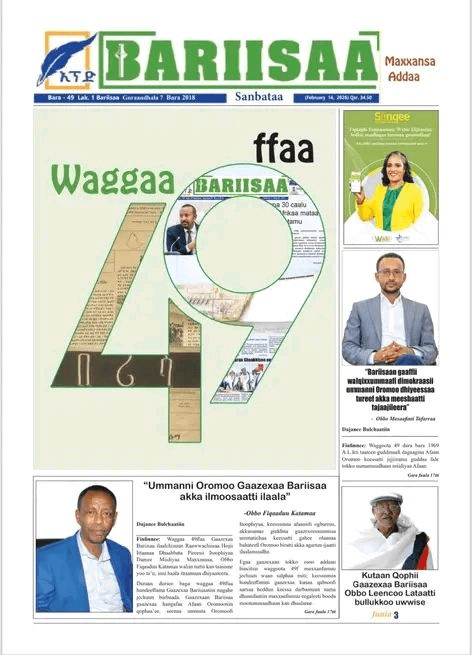
“Bariisaa Served as a Tool for the Oromo People’s Quest for Equality and Democracy”
– Mr. Masafinti Tafarraa
Oromo-language newspaper marks 49 years of serving as a beacon of information, identity, and struggle
FINFINNE — Forty-nine years ago, in 1969 E.C. (1976/77 G.C.), a transformative development in the growth and flourishing of the Afaan Oromo language occurred that would fundamentally reshape the landscape of Oromo media and lay the foundation for where Oromo-language outlets stand today: the establishment of Bariisaa Newspaper .
In an era before the proliferation of science and technology, when broadcast media could be counted on one’s fingers and the internet had not yet become the domain of a generation, the Oromo people’s love, effort, and desire for information and knowledge could only be satisfied through written word. It was in this context that the demand for and acceptance of newspapers was immense .
Bariisaa Newspaper, carried forward by scholars and heroes who toiled from afar and succeeded, passing from generation to generation through the接力 of struggle against tyranny, has now marked 49 years of existence .
Today marks the anniversary of Bariisaa Newspaper’s founding—for the Oromo people, a day when the dawn of information and knowledge shone brightly, just as the name “Bariisaa” (Dawn) suggests the morning star appears .
A Tool for the People’s Struggle
In an interview commemorating the anniversary, Mr. Masafinti Tafarraa, Executive Officer of the Ethiopian Press Agency, shared reflections on the newspaper’s historic role .
According to Mr. Masafinti, from its inception through half a century of service, Bariisaa Newspaper has undertaken and achieved great work for the freedom, equality, and democracy of the Oromo people .
Crucially, he noted that Bariisaa was established precisely at a time when the Oromo people’s demand for equality and democracy was being raised. In this context, the newspaper served as a vital medium of communication for the people’s aspirations .
Following that period and continuing after the people’s demands were reiterated, Bariisaa never halted its mission but persevered and has arrived at today’s milestone .
The founders of the newspaper were themselves participants in the struggle for the people’s equality movement at that time and played significant roles. Through their involvement, the newspaper became intertwined with the contemporaneous struggle being waged .
A Legacy of Forty-Nine Years
For nearly five decades, Bariisaa has chronicled the Oromo experience, documenting both the ordinary and extraordinary moments of Oromo life while serving as a platform for intellectual and political discourse. The publication has weathered changing political climates, technological revolutions, and shifts in the media landscape while maintaining its commitment to providing information in Afaan Oromo.
The newspaper’s endurance through nearly half a century reflects both the dedication of those who have sustained it and the persistent hunger for Oromo-language media among its readership. From its early days when written word was the primary means of mass communication to the contemporary era of digital media, Bariisaa has adapted while maintaining its core mission.
The Founders’ Vision
The founders of Bariisaa were not merely journalists but activists who understood the power of the written word in advancing the cause of equality. By establishing a newspaper in Afaan Oromo at a time when the language itself was marginalized, they made a profound statement about Oromo identity and the right to information in one’s mother tongue.
Their vision extended beyond simple news reporting to encompass the broader struggle for recognition and rights. The newspaper became both a record of that struggle and a participant in it, documenting abuses while articulating aspirations.
From Print to Digital: Evolution of a Legacy
As Bariisaa celebrates 49 years, it does so in a media environment dramatically transformed from its founding era. The broadcast media that were once scarce are now abundant, and the internet that was unknown to the generation of the 1970s has become ubiquitous.
Yet the fundamental need that Bariisaa addresses—the desire of Oromo people to receive information and analysis in their own language, reflecting their own perspective—remains unchanged. The newspaper has evolved alongside technology, with many readers now accessing content digitally while others continue to value the tangible experience of print.
Cultural and Linguistic Significance
Beyond its journalistic function, Bariisaa has played an important role in the development and standardization of written Afaan Oromo. At a time when the language was primarily oral in many contexts, the newspaper provided a model for written expression and helped establish conventions that would influence subsequent Oromo-language publishing.
For generations of Oromo readers, Bariisaa has been a window onto their world and beyond—a source of news, analysis, and cultural content that affirmed the value and vitality of their language. The newspaper has helped maintain and strengthen Oromo identity, particularly among diaspora communities separated from their homeland.
Forty-Nine Years of Service
The 49th anniversary represents a significant milestone, approaching the half-century mark that will be celebrated next year. For an independent publication to endure for nearly five decades in challenging political environments is a testament to the commitment of its staff, the loyalty of its readers, and the enduring need it fulfills.
Mr. Masafinti Tafarraa’s acknowledgment of Bariisaa’s role as a “tool” for the Oromo people’s quest for equality and democracy captures the publication’s essential character. It has never been merely a commercial enterprise or a neutral conveyor of information, but rather an institution deeply engaged with the aspirations of the people it serves.
Looking to the Future
As Bariisaa approaches its golden jubilee, questions of sustainability, adaptation, and continued relevance arise. The media landscape continues to evolve rapidly, with social media and digital platforms reshaping how people consume information. Younger generations, in particular, may engage with news differently than their parents and grandparents.
Yet the need that Bariisaa addresses—for information in Afaan Oromo that speaks to Oromo concerns from an Oromo perspective—remains as pressing as ever. The newspaper that has survived and thrived for 49 years has demonstrated remarkable adaptability, and there is every reason to believe it will continue to find ways to serve its readership.
A Dawn That Continues to Shine
The name Bariisaa—Dawn—carries with it the promise of new beginnings and the light that follows darkness. For forty-nine years, the newspaper has lived up to its name, bringing the light of information and knowledge to successive generations of Oromo readers.
As Mr. Masafinti Tafarraa’s reflections make clear, Bariisaa’s significance extends beyond its role as a news outlet. It stands as a testament to the power of the written word in struggles for justice, a record of a people’s journey through nearly five decades of change, and a continuing voice for equality, democracy, and the rights of the Oromo people.
The 49th anniversary of Bariisaa Newspaper is not merely a celebration of longevity but a recognition of enduring purpose—a purpose rooted in the struggles of the past and reaching toward the dawn of a future where the aspirations that gave birth to the publication may finally be realized.

Posted on February 16, 2026, in Finfinne, Information, News, Oromia. Bookmark the permalink. Leave a comment.




 Advocacy for Oromia
Leave a comment
Comments 0