Dinqinesh Dheressa and Dr. Trevor Trueman: Two Pillars of the Oromo Struggle Forever Remembered with Honor
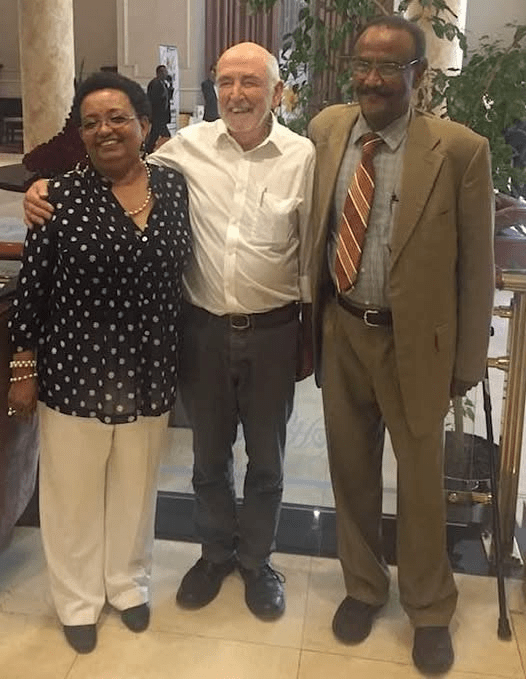
Activist and ally exemplify the international solidarity and unwavering commitment that sustain the movement for Oromo self-determination
GLOBAL — Dinqinesh Dheressa and Dr. Trevor Trueman stand as figures who will forever be remembered with honor in the annals of the Oromo liberation struggle—one a devoted activist who gave voice to Oromo women’s oppression, the other a British physician who became one of the movement’s most effective international advocates.
Their contributions, though arising from vastly different backgrounds, together illustrate the multifaceted nature of the Oromo struggle: a fight carried forward not only by those who bear its identity but also by allies whose solidarity transcends ethnicity and origin. As the Oromo liberation struggle continues “as a shield of humanity strengthening humanity itself,” the legacies of Deressa and Trueman remind us that the quest for freedom draws strength from diverse sources of commitment and courage .
Dinqinesh Dheressa: A Voice for Oromo Women
Dinqinesh Dheressa Kitila is an Oromo woman whose activism emerged from personal experience of discrimination and grew into institutional leadership. As the founder of the International Oromo Women’s Organization, a non-profit registered in the United States, she has dedicated her life to standing against discrimination and bringing social change, with particular emphasis on women’s empowerment.
Born and raised in Oromia, Ethiopia, Dheressa’s commitment to justice was forged in childhood. During elementary school, when she ran for student council president, a boy was preferred over her despite her having the highest grades. This early experience of discrimination motivated her to lead a fight against discrimination against women—a fight she has continued throughout her life.
Dheressa’s analysis of Oromo women’s situation is stark and unflinching. “The state of oppression is very deep in general but Oromo women face even greater difficulty,” she has stated. “Abyssinians treat Oromo women poorly. If a woman proposes a constructive idea, it doesn’t get proper attention as women are discriminated against up to a level where they are not considered as human beings”.
For Dheressa, self-determination is not an abstract political concept but a deeply personal and practical matter. She describes it as “a process by which one can take control of her/his whole life, decide freely what is good for her/him or not, what is important to her/him.” Beyond self-determination, she sees independence as giving people “the power to act freely” .
The key to achieving self-determination, in her view, lies in empowering oppressed people and standing for their rights as human beings. She emphasizes that organization is vital—if one wants to stand for peace and especially for women and their rights, being organized is essential .
Dheressa has also consistently called upon the international community to act. “The international community and humanitarian organisations have to take appropriate action to stop the Ethiopian government’s brutality against the Oromos,” she has urged. Her work with the Unrepresented Nations and Peoples Organization (UNPO) has helped bring Oromo concerns before international audiences, ensuring that the struggle receives attention beyond Ethiopia’s borders.
Dr. Trevor Trueman: The Quiet Ally
If Dheressa represents the voice of Oromo womanhood speaking on behalf of her people, Dr. Trevor Trueman represents something equally: the outsider who becomes an essential insider through decades of faithful service.
Dr. Trueman—affectionately known by the Oromo name Galatoo, meaning “Thank You”—has woven himself so deeply into the narrative of the Oromo struggle that he has become inseparable from it, transcending geography, ethnicity, and origin .
His journey with the Oromo people began not in the halls of advocacy, but in the gritty, desperate reality of survival. In the late 1980s, as a family health physician, he was in Sudan training Oromo health workers in refugee camps. When the Derg fell in 1991, he moved into Wallagga, shifting his focus to training community health workers. This foundation is crucial: his alliance was born not of abstract political theory, but of humanitarian connection—of seeing, firsthand, the people behind the cause. He didn’t arrive as an activist; he became one through service .
It was from this ground-level view that his pivotal role emerged. Starting in 1992, he began the critical, dangerous work of documenting and internationalizing the Ethiopian government’s systematic human rights violations against the Oromo people. While the OLF and others fought on the political and military fronts, Dr. Trueman opened a vital front in the global arena of information. He understood that tyranny thrives in silence and that the world’s conscience must be awakened with evidence. His reports became the credible, external voice that the diaspora and activists within could amplify, forcing the “Oromo question” onto agendas where it was being ignored .
His strategic genius is perhaps best embodied in the Oromia Support Group (OSG) , which he co-founded in 1994. The OSG was not a protest group but a clearinghouse for truth. It methodically gathered testimony, verified atrocities, and funneled this information to UN bodies, foreign governments, NGOs, and media outlets. For decades, when the Ethiopian state dismissed accusations as rebel propaganda, the OSG’s meticulously documented reports stood as unassailable counter-evidence. Dr. Trueman became a bridge of credibility, translating the suffering of a distant people into a language the international system was compelled, at least, to acknowledge .
A recent tribute to Dr. Trueman highlights several profound truths about his work:
- The Outsider as Essential Insider: Dr. Trueman’s identity as a “foreign national” was not a barrier but a unique asset. It lent his documentation a perceived objectivity that was desperately needed to break through global apathy. He wielded his privilege as a tool for the voiceless .
- Advocacy as a Marathon, Not a Sprint: His commitment, spanning from 1988 to the present day, defines “umurii dheeradhaa” —a long life of dedication. While political fortunes and rebel movements evolved, his channel of advocacy remained constant, providing a thread of continuity through decades of struggle .
- The Strategic “Taphat” (Preparation) : The tribute notes he will be remembered for his “shoora taphataniif” —his strategic preparations. His work was the essential groundwork. By ensuring the world could not plead ignorance, he created the political space and pressure that empowered all other facets of the Oromo struggle .
Dr. Trevor Trueman’s legacy is a masterclass in effective international solidarity. He did not seek to lead the Oromo struggle; he sought to amplify it. He did not fight with weapons, but with words, facts, and an unwavering moral compass. In the grand symphony of the Oromo quest for freedom, if some voices are the roaring melodies and others the steady rhythm, Dr. Trueman’s has been the crucial, clear note of the witness—persistent, truthful, and cutting through the noise to make the world listen .
For this, the name Galatoo is not merely a token of thanks, but a title of honor, earned over a lifetime. His work ensures that the crimes committed in darkness are recorded in light, and that the struggle of the Oromo people has, indeed, been given an echo the world cannot un-hear .
The Struggle Continues
The Oromo liberation struggle, which both Dheressa and Trueman have served so faithfully, continues today against a backdrop of ongoing conflict and human rights concerns. Recent reports from Oromia describe a region marked by insecurity, with civilians caught between government forces and insurgent groups.
The Associated Press reported in February 2026 that Oromia remains “very insecure,” with armed banditry, kidnapping, and extortion affecting daily life. Humanitarian access is restricted, and the conflict remains largely underreported due to government restrictions on journalists and rights groups .
It is precisely in such circumstances that the work of advocates like Dheressa and Trueman proves most vital. Their documentation, their amplification of Oromo voices, and their insistence that the world pay attention create the conditions under which accountability becomes possible.
As one tribute to Trueman noted, “His work ensures that the crimes committed in darkness are recorded in light” . Dheressa, through her women’s organization and international advocacy, ensures that the particular suffering of Oromo women—too often ignored in broader narratives—receives the attention it demands.
A Shared Legacy
Dinqinesh Dheressa and Dr. Trevor Trueman represent different faces of the same commitment: Dheressa, the Oromo woman who transformed personal experience of discrimination into lifelong activism for her people; Trueman, the British physician who arrived as a humanitarian worker and became one of the movement’s most effective international advocates.
Both have demonstrated that the struggle for Oromo self-determination is not confined to Oromia’s borders, nor limited to those who share Oromo identity. It is a human rights struggle that calls upon all people of conscience to bear witness and to act.
As the Oromo liberation continues as “a shield of humanity strengthening humanity itself,” the contributions of these two figures will forever be remembered with honor. Their lives demonstrate that the fight for freedom draws strength from many sources—from the mother who organizes women in her community to the physician who documents atrocities for the United Nations. Each, in their own way, has helped ensure that the Oromo struggle for truth, justice, and self-determination continues to resonate across generations and around the world.

Posted on February 16, 2026, in News, Oromia, Uncategorized. Bookmark the permalink. Leave a comment.




 Advocacy for Oromia
Leave a comment
Comments 0