The TPLF: A Brutal Force That Should Never Have Been Given a Single Day’s Opportunity as an Organization
Oromo voices reflect on three decades of suffering under Tigrayan-led rule
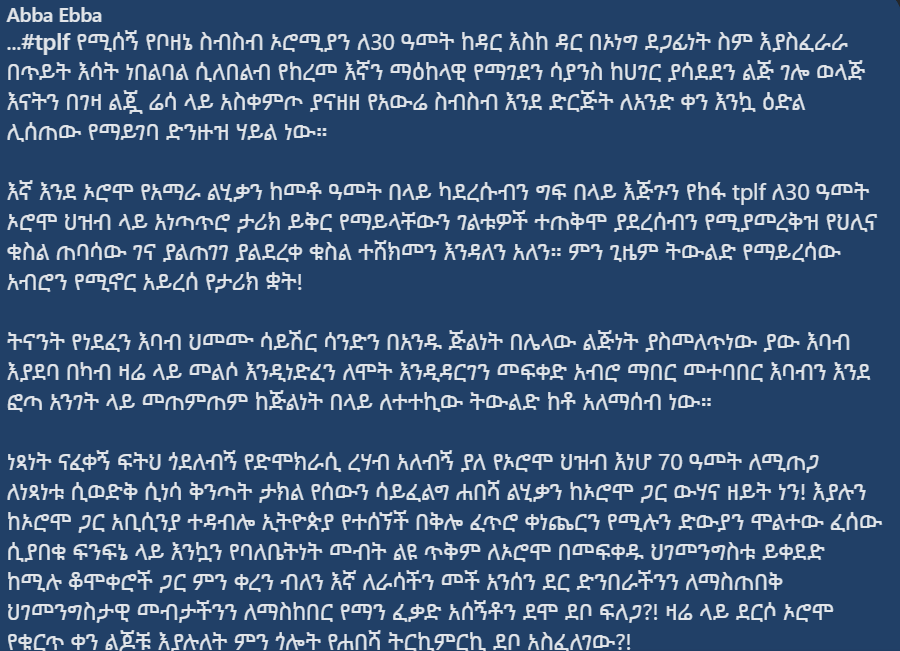
FINFINNE — In a powerful and searing social media commentary that has resonated across Oromo networks, a voice identified as Abba Ebba has articulated the deep historical wounds and enduring grievances of the Oromo people against the Tigray People’s Liberation Front (TPLF), describing the organization as a “brutal force” that should never have been legitimized .
The statement, shared under the hashtag #Abba_Ebba, offers a raw and unflinching examination of the TPLF’s three-decade rule over Ethiopia and its specific impact on the Oromo people—a period the author describes as inflicting wounds “far worse than a hundred years of Abyssinian elite oppression” .
Thirty Years of Suffering
According to the commentary, the TPLF, operating under the banner of the Ethiopian People’s Revolutionary Democratic Front (EPRDF), controlled Oromia for thirty years, threatening the region from end to end in the name of supporting the Oromo Liberation Front (OLF) while actually enveloping the land in flames of gunfire .
The author describes how the TPLF blocked Oromos from the center, drove them from their country, killed children, and placed mothers upon the corpses of their own offspring in acts of unspeakable cruelty . This “collection of beasts,” as the author characterizes the TPLF, is portrayed as having committed atrocities that have left permanent scars on the Oromo collective consciousness .
“More than a hundred years of oppression by Abyssinian elites, the TPLF targeted the Oromo people for thirty years with historically unforgivable atrocities, using every means available,” the statement reads. “The wound of conscience they inflicted upon us is still unhealed, a scar not yet dried—we carry this unhealed wound with us” .
A Legacy That Lives With Generations
The commentary emphasizes that these historical wounds are not merely past events but living realities carried by the Oromo people. “Generations will not forget—it lives with us, an unerasable historical scar” .
The author draws a powerful analogy: “Yesterday, a snake bit us. Before the pain subsided, because of the foolishness of one and the childishness of another, we let it escape. That same snake, growing fat and multiplying, has returned today to bite us again, to bring us to death” .
Allowing this to happen, the author argues, is worse than foolishness—it is a failure to think of the coming generation. Collaborating with such forces, treating the snake as if it were a towel to be wrapped around one’s neck, represents a profound betrayal of the future .
The Quest for Freedom and Justice
The commentary gives voice to the Oromo people’s longstanding aspirations: “The Oromo people who say ‘I long for freedom, justice has been denied me, I hunger for democracy’—here they are, for nearly 70 years falling and rising in their struggle for freedom” .
Unlike others, the author asserts, Oromos have never sought scraps from anyone’s table. Yet Abyssinian elites have consistently declared, “We are like water and oil with Oromos!” while simultaneously claiming to have created a hybrid “mule” called Ethiopia through fusion with Oromos .
The author questions how, when the constitution grants special rights to Oromos even in Finfinne, there are those who would tear up the document, asking what remains for Oromos. “When will we stand up for ourselves, to protect our borders, to secure our constitutional rights—whose permission do we need to seek?” .
Today, the author notes, people say of Oromos, “They are children of the moment.” But what need has the Oromo of Abyssinian political maneuvering and crumbs?
The Folly of Sacrificing Justice for Peace
The commentary critiques those who urged compromise: “Yesterday, for the sake of peace, we abandoned justice! We forgave what you did publicly! There is no peace without justice” .
Those who stole wealth, whether collectively or individually, who used power to destroy lives, burn forests, displace people, commit inhuman acts in any form—the author insists they must not escape accountability .
Questions are raised about political transitions: “What and who is bringing the transition? From where to where?” The author suggests that those who mocked others for not understanding politics are now seeing the consequences .
What once appeared to some as downhill before them now seems as distant as the sky, transformed into an uphill struggle. “Are you truly not angered as you watch?” the author asks, suggesting that deep regret, not indifference, is the appropriate response .
Historical Memory: The Western Oromo Confederation of 1936
The commentary invokes a crucial but often overlooked chapter of Oromo history: the Western Oromo Confederation of 1936. Before the TPLF was even created, Oromos sent a delegation to the United Nations seeking to govern themselves through confederation .
This historical episode, disrupted by Italy’s five-year colonization of Abyssinia, demonstrates the long-standing Oromo pursuit of self-determination, predating the TPLF’s emergence by decades .
The author cites scholarly work by Ezekiel Gebissa on “The Italian Invasion, the Ethiopian Empire, and Oromo Nationalism: The Significance of the Western Oromo Confederation of 1936,” pointing to a tradition of Oromo political organizing that Abyssinian and Tigrayan narratives have systematically obscured .
Cultural Appropriation: The Heritage of “Weyane”
The commentary also raises questions of cultural appropriation, asking whether the TPLF has forgotten that “Weyane”—the traditional struggle strategy from which the organization derives its name—is actually Oromo heritage from Raya and Rayuma .
This observation, the author explains, is offered to counter any suggestion that Tigrayan or Amhara elites taught Oromos about freedom struggle. The historical record, including scholarship on “Peasant Resistance in Ethiopia: the Case of Weyane” published in the Journal of African History, demonstrates that Oromo traditions of resistance long preceded TPLF organizing .
The Complexity of Recognition
The author acknowledges that the situation is complex—like makeup applied and removed, artificial people appearing before cameras, living under disguise. But the weight of the matter, they emphasize, concerns the supremacy of the people, the formation of the nation, the debt owed to fathers, mothers, and faith .
“Knowledge means grasping the trunk of the tree, not hanging on its branches—hold the branches and you will fall” .
A Warning Unheeded?
The commentary concludes with a stark image: “O TPLF! The one who never says ‘enough’ will spit and continue. ‘Emboor! Emboor!’ (Get away! Get away!) they say to those who hold back and separate—now the flood has reached the neck, asking ‘What has brought my situation?'”
This metaphorical warning suggests that those who ignored calls for restraint and justice now find themselves overwhelmed by consequences of their own making .
Historical Context
The TPLF led the armed struggle that overthrew the Derg regime in 1991 and subsequently dominated Ethiopian politics for nearly three decades until Prime Minister Abiy Ahmed came to power in 2018. During their rule, the TPLF was the dominant force within the EPRDF coalition, controlling the levers of state power and directing security forces that, according to numerous human rights reports, committed widespread abuses against civilians in Oromia and other regions .
The period from 1991 to 2018 saw repeated military campaigns in Oromia, mass arrests of Oromo activists and politicians, and systematic suppression of Oromo political expression. The International Criminal Court’s Office of the Prosecutor noted in 2019 that it had received information regarding alleged crimes against humanity in Ethiopia dating back to 2015, including in Oromia .
Contemporary Relevance
The commentary appears against the backdrop of ongoing tensions in Ethiopia’s post-2018 political transition. While the TPLF was removed from federal power, it retained control over Tigray regional state until the recent Tigray War (2020-2022) dramatically altered the political landscape .
For Oromos, the question of accountability for past abuses remains unresolved. Many Oromo activists and politicians have called for justice for victims of TPLF-era atrocities, even as they navigate complex relationships with other political forces in contemporary Ethiopia .
A Voice for the Unhealed Wound
Abba Ebba’s commentary gives voice to what it describes as an “unhealed wound” in Oromo collective memory—the accumulated trauma of three decades of TPLF rule that compounded more than a century of Abyssinian domination .
The response to the post, shared widely across Oromo social media networks, suggests that these sentiments resonate deeply within the Oromo community. The demand for justice, the insistence on historical memory, and the refusal to accept narratives that minimize Oromo suffering emerge as consistent themes .
As Ethiopia navigates an uncertain political future, with ongoing conflicts in multiple regions and unresolved questions about the country’s constitutional order, voices like Abba Ebba’s serve as reminders that for many Oromos, the past is not past—it is a living wound that demands acknowledgment and, ultimately, healing through justice .
Whether such justice will be achieved, and what form it might take, remains one of the most pressing and unresolved questions in Ethiopian politics. For the Oromo people, as the commentary makes clear, the struggle continues—not only for freedom and democracy in the future but for acknowledgment and accountability for the crimes of the past.

Posted on February 16, 2026, in News, Oromia, Finfinne, Information, Promotion, Press Release. Bookmark the permalink. Leave a comment.




 Advocacy for Oromia
Leave a comment
Comments 0