Nuhoo Goobanaa (1939-2022): The Legendary Oromo Artist Whose Voice Became a Weapon of Liberation
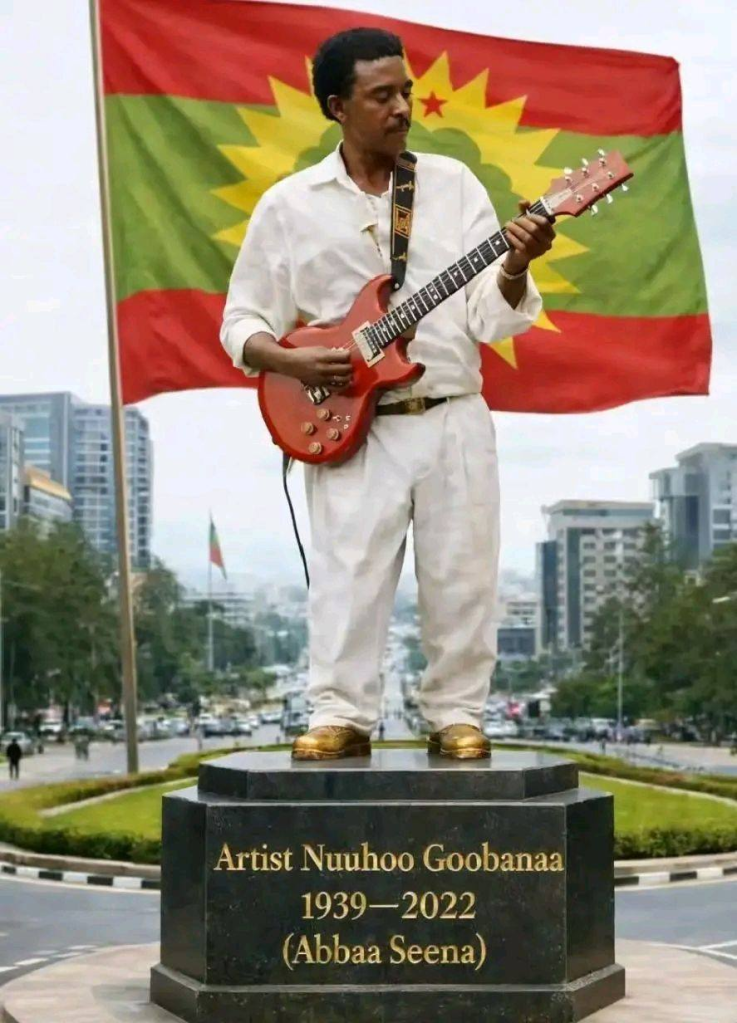
A towering figure of Oromo music and resistance, remembered for his timeless call for unity and freedom
OROMIA — Nuhoo Goobanaa, one of the most iconic and beloved figures in Oromo music and the struggle for cultural and political recognition, left an indelible mark on generations of Oromos through his powerful voice, poetic lyrics, and unwavering commitment to his people’s liberation. Born in 1938 in the historic eastern Oromia city of Dire Dawa to his father Muhaammad Goobanaa and mother Faaxumaa Adam, Nuhoo would grow to become the “virtuoso of revolutionary songs” whose influence transcended borders, languages, and generations.
Early Years: Awakening to Injustice
Nuhoo Goobanaa was born in Laga Mixe, East Hararghe Zone, but grew up in Dire Dawa, where his family moved when he was five years old. From an early age, his natural inclination for singing and art was evident. He began testing his vocals at Madrasa (Quran school) by adding lyrics and changing the rhythms to Manzuma (Islamic chants)—a creative impulse that occasionally landed him in trouble with his teachers. As a youth, he absorbed the rich musical environment of Dire Dawa, mimicking Hindi, Harari, and Sudanese songs that were abundant in the cosmopolitan city.
The trajectory of his life changed dramatically through his encounters with discrimination against the Oromo during the Haile Selassie era. As a teenager in the 1960s, Nuhoo would occasionally skip school to work as an interpreter at the local court in Dire Dawa. This experience exposed him directly to the injustices of the system: three judges presiding in Amharic, a language the majority Oromo population did not speak. The experience led him to profound questions that would shape his life’s work: “Who are the three panel of judges who spoke Amharic? Why didn’t they speak the language of the majority Oromo? Who are we [the Oromo]? Why are the Oromo treated differently?”.
Rather than accepting these injustices as inevitable, Nuhoo embarked on a transformative musical journey of self-discovery and political awakening. He dedicated his life to raising consciousness among his people, becoming one of the most beloved household names in Oromia.
The Birth of an Artist-Activist
In the early 1960s, as a teen, Nuhoo applied to join a newly formed Oromo music band called Biiftuu Ganamaa (The Morning Sun). At 14, he was deemed too young and denied membership. Undeterred, he signed on as a volunteer poet, staying up late at night writing lyrics until he earned his place in the band. “I used to write poems in Amharic and contribute to the band,” he recalled in a 2012 interview.
His formal entry into music came in 1960 when he joined the World of Music within the government structure, eventually becoming a voice alongside intellectuals and national figures. But Nuhoo was never merely an entertainer—he was an artist who carried a weapon, singing revolutionary songs day and night to support the Oromo liberation struggle.
Exile and the Spreading of the Message
Following the breakup of the Afran Qalloo band around 1968, Nuhoo fled to Djibouti as a refugee. It was there that he learned to play the guitar in just one month. “Art was already in me,” he recalled. “In Djibouti, I recorded two albums”. For Djibouti’s Independence Day celebrations in 1969, he performed musical works in Afaan Oromo, Somali, and Arabic.
His journey of exile took him across continents. He traveled to Yemen, Saudi Arabia, and Egypt, living in these countries for many years. In Saudi Arabia, he recorded and released his first through fourth albums, working alongside fellow artists including Elemo Ali, Jamal Ibro, and Aziz, producing music from their homes. During the 1980s, he lived as a refugee in Djibouti, Saudi Arabia, and Canada, never ceasing to create music that empowered his people.
In 1978, he and fellow Oromo artists made their way to Canada, where they continued producing revolutionary songs celebrating unity, love of country, and the struggle for liberation. His long-time friend and fellow musician Elemo Ali recalled of their time together in Saudi Arabia: “Back then, Nuho was doing songs to empower his people. His music was easily memorable”.
A Polyglot Voice for the Oromo
Nuhoo’s artistic reach extended far beyond Afaan Oromo. He recorded and performed in numerous languages, including English, Somali, Tigrinya, and notably Arabic making him the only Oromo artist to write and perform a full song in Arabic, symbolizing the deep connection between the Oromo and Sudanese peoples during a critical historical period. Another friend, Abdo Alisho, spoke of the power of his songs: “They made you love your country. Nuho lived for his people”.
The Return Home and Continued Struggle
When political changes came to Ethiopia in 1991, Nuhoo returned to Finfinne along with the Oromo Liberation Front and other organizations that had been in exile, establishing the transitional government. Together with fellow artists, he produced revolutionary and solidarity music at the OLF office and Lideta Hall at Finfinne University. Following the OLF’s withdrawal from the transitional government, Nuhoo returned to Canada.
But the dream of seeing a liberated Oromia kept calling him back. Though he had a comfortable life in Canada, it was not enough to satisfy his longing. He left Canada to live for several years in Yemen and Kenya, though life there proved difficult, and he faced various pressures from government authorities. In 2002, he made the decision to return from Kenya to his homeland, living in the Oromia he loved until his passing.
Musical Legacy: Tokkummaa and Beyond
Nuhoo Goobanaa’s songs spanned every conceivable aspect of Oromo life: the indignities of exile, the ups and downs of the Oromo struggle, the Oromo flag song (anthem), his beloved Oromia, yearning for home and return, Finfinne, the Gulalle of the early 1990s, love, family, marriage, cultural clashes among the Oromo diaspora, and his own winding life journey . By his own account, he wrote and produced an estimated 380 memorable songs across 38 albums.
His timeless classic “Tokkummaa” (Unity) is widely regarded as akin to an Oromo national anthem, serving as a powerful intergenerational call for transcendent unity of purpose. The song’s refrain—”Tokkummaa, Tokkummaa, Yaa Ilmaan Oromoo Tokkummaa” (Unity, Unity, O Children of Oromo, Unity)—became a rallying cry that resonated across generations.
Other seminal works include:
- “Yaa Rabbi” (Oh God), a spiritual invocation that became another fulcrum for Oromo unity
- “Isin Waamti Harmeen” and “Lallabanee” or “Nu Dirmadha” —desperate calls to action, reproaching and exhorting Oromo intellectuals and personalities to return to Oromia and confront injustice
- “Alaabaa Oromiyaa” —a concise homily on the aims and aspirations of the Oromo movement for self-determination
- “Dhufaan Jiraa” —a soulful and nostalgic yearning for home and belonging
- “Geerarsa” —a robust and searing criticism of dysfunction and failure in Oromo leadership
- “O Galaana Qonnaan Bulaa” and “Alaabaa” , songs whose lyrics became part of the cultural fabric of the struggle
One of his most famous lyrical passages decried division and appealed to Oromummaa as a unifying creed:
“Shan, kudha shan, shantam taatanii, Gargar facaatanii, Bineensa beelaweef hiraata taatanii” (Five, fifteen, fifty, you allowed yourselves to be divided and thus became prey for the hungry beast).
Influence on a New Generation
Nuhoo’s influence extended directly to the next generation of Oromo artists, most notably Hachalu Hundessa, whose songs became anthems in the wave of protests that reshaped Ethiopian politics in the late 2010s. After being partially paralyzed, frequent visits from younger prodigies like Hachalu lifted his spirits. At every opportunity, in speech and gesture, Nuhoo had one request of the Oromo: “Tokkummaa jabeessaa” (Strengthen your unity).
During and in the immediate aftermath of the Oromo protests, Nuhoo saw his dream partially fulfilled and marveled at the state of the Oromo struggle. His songs had laid the foundation for contemporary protest music in Oromia, inspiring, exhorting, and arousing fellow musicians and Oromos to do what was necessary for liberation.
Final Years: A Community’s Love
Nuhoo’s last decade was marked by profound struggle. Around 2007/08, he suffered a stroke that partially paralyzed him and affected his powerful voice. From approximately 2013 onward, he was unable to continue performing. His yearning to live and work among his people was thwarted by deteriorating health.
The Oromo community, both at home and in the diaspora, rallied around their beloved artist. When fans realized the seriousness of his situation, multiple global fundraisers were organized for his medical treatment. In 2013, through the initiative of community members, a campaign called “Let’s Buy Nuhoo a House” succeeded in purchasing a home for him in Adama, east of the capital. The GoFundMe campaign organized for his support emphasized: “It is the responsibility of the entire community that lived off of his lyrics and his strong words to support him in his time of need”.
Despite these efforts, Nuhoo never fully regained his roaring voice, strength, or towering presence . Speaking to the BBC from his hospital bed two years before his death, his message to fans remained consistent: “Keep your unity strong” .
Passing and Funeral
Nuhoo Goobanaa passed away on Tuesday, January 18, 2022, at the age of 74, after a long illness. He died in Adama, in the house that fans had helped purchase for him.
However, the Oromo biography provided for this feature notes that the artist passed away on October 25, 2023 (G.C.) in Oslo, Norway, while undergoing medical treatment. According to this account, cancer was discovered in addition to the stroke that had afflicted him, and despite receiving treatment, his body resisted healing. Following his death, his body was transported back to his homeland (Oromia), and a funeral ceremony was conducted with great honor in Finfinne.
A Legacy That Endures
Nuhoo Goobanaa was more than a musician—he was a “pioneering singer-songwriter and guitarist whose name is near synonymous with Tokkummaa”. He embodied Oromummaa and lived a selfless life of service and struggle. As one tribute noted: “Nuho dedicated his life to promoting the virtues of Tokkummaa and Oromummaa. He leaves behind a momentous legacy that will inspire current and future generations”.
Dr. Awol Kassim Allo, in a comprehensive tribute, wrote: “Nuho’s songs are healing and transformative, expanding our sensibilities and teaching us to pay attention not just to the large-scale system of oppression he witnessed in the courts as an interpreter but also to the everyday, the familiar, the emotional, and intimate aspects of our lives”.
The Oromia Tourism Commission, in its memorial statement, expressed: “The Oromia Tourism Commission expresses its deep sorrow at the death of the hero Artist Nuhoo Goobanaa. May God grant him paradise. We wish strength to his family, relatives, fans, and the entire Oromo people”.
Fana Broadcasting Corporate, in its announcement of his passing, noted: “In addition to Nuhoo’s struggle for the development of Oromo art and language, the work he contributed to the Oromo political struggle holds a significant place in the history of the people’s struggle. Nuhoo understood the divisive politics and factionalism within the Oromo struggle and sang as an artist for Oromo unity”.
A Photograph as Memory
The photograph accompanying this feature captures Artist Nuhoo Goobanaa in 1991 at Gulallee prison, during a moment of singing—a poignant image preserved as a memory of him, combined with the legacy that lives on in our hearts.
Conclusion
Nuhoo Goobanaa’s life was a testament to the power of art as a weapon in the struggle for justice, dignity, and self-determination. From the courts of Dire Dawa where he first witnessed injustice, to the refugee camps of Djibouti where he learned to play guitar, to the stages of Canada, Europe, and the Middle East where his voice thundered for Oromo liberation, he never wavered in his commitment.
His songs remain—hundreds of them—carrying forward his message of unity, his critique of division, his love for his people, and his unwavering hope for Oromo liberation. As the Oromo people continue their journey, Nuhoo Goobanaa’s voice echoes across generations, still calling them to unity, still reminding them of who they are, still urging them forward.
“Nuti lallabna nuti qabsaa’ota…” (We proclaim, we are struggle participants…)
Rest in power, Nuhoo Goobanaa. Your voice never dies.

Posted on February 17, 2026, in Events, Finfinne, Information, News, Oromia, Promotion. Bookmark the permalink. Leave a comment.




 Advocacy for Oromia
Leave a comment
Comments 0