Ethiopia Revokes Addis Standard’s License in Latest Blow to Independent Media
Authorities silence critical voice as crackdown on press freedom intensifies ahead of June elections
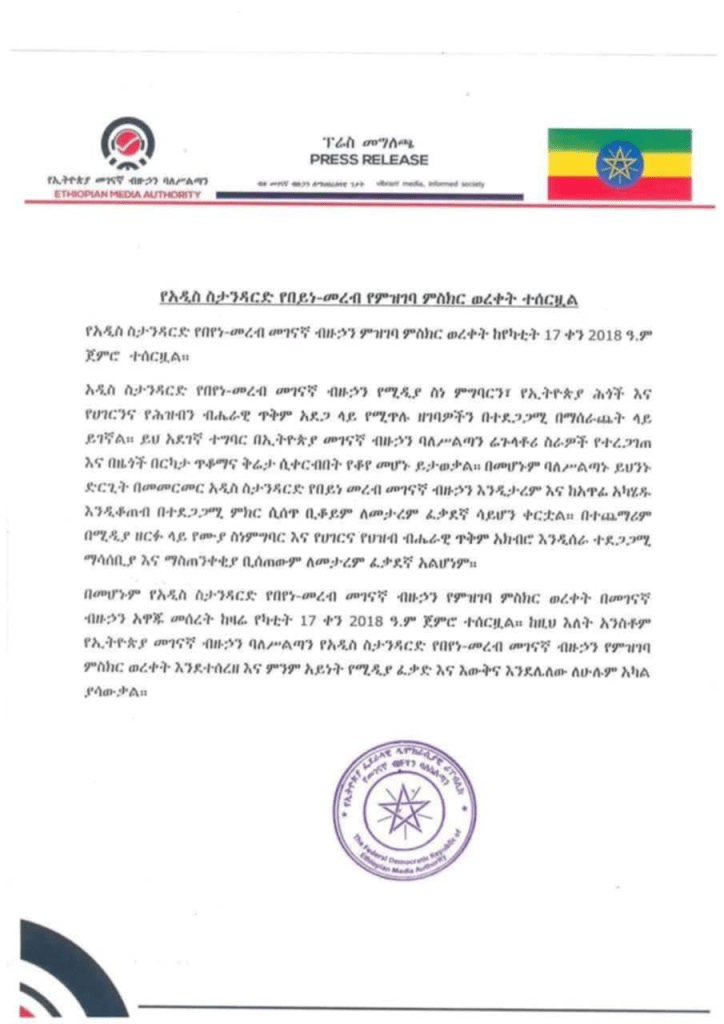
ADDIS ABABA — The Ethiopian Media Authority (EMA) has revoked the online media registration certificate of Addis Standard, one of the country’s most respected independent news outlets, effective February 24, 2026, in a move that press freedom advocates condemn as part of a widening crackdown on independent journalism.
The decision strips Addis Standard of its legal recognition to operate in Ethiopia, citing alleged “repeated violations of media ethics, national laws, and the country’s national interests,” though the Authority’s statement did not specify which reports or actions formed the basis of the decision.
A History of Targeting Independent Media
Addis Standard, established in 2011 as a monthly magazine and published in Afaan Oromo, Amharic, and English, has faced repeated government harassment over the years. The outlet discontinued its print edition in October 2016 in response to censorship, continuing online only, before resuming monthly print editions in 2018.
The latest revocation follows a pattern of escalating pressure on independent media:
- April 2025: Ethiopian police raided Addis Standard’s office and the home of a senior staff member, detaining three managers for several hours and confiscating laptops, phones, and data storage equipment. The Committee to Protect Journalists (CPJ) expressed “grave concerns about potential misuse of sensitive data” following the raids.
- June 2021: During the Tigray war, the EMA suspended Addis Standard, accusing it of advancing the agenda of what it described as a “terrorist group”. CPJ condemned the move, noting that Addis Standard “has been an important source of critical reporting and commentary on Ethiopia”.
- November 2020: Police arrested Medihane Ekubamichael, then product editor at Addis Standard, accusing him of attempting to “dismantle the constitution through violence”.
Editor-in-Chief Rejects Allegations
Responding to the EMA’s announcement, Yonas Kedir, Editor-in-Chief of Addis Standard publications, categorically rejected the Authority’s claims, stating the outlet had never received any formal notices of violations.
“The claim that Addis Standard received repeated notices is factually incorrect. At no point has the Ethiopian Media Authority formally notified Addis Standard newsroom of any prior violations or enforcement actions,” he said.
The publisher, JAKENN Publishing PLC, is reviewing legal options to protect its rights and ensure due process is upheld.
Broader Crackdown on Press Freedom
Addis Standard’s license revocation is not an isolated incident but part of a broader pattern of repression against independent media in Ethiopia, particularly as the country approaches national elections scheduled for June 2026.
Recent actions against media outlets include:
- Wazema Radio (January 2026): The EMA compelled Wazema Media to surrender its operating license, accusing the outlet of reporting contrary to “national interest” and lacking balance. The station has continued publishing content from abroad.
- Reuters (February 2026): The government declined to renew accreditation for three Addis Ababa-based Reuters journalists and withdrew the outlet’s accreditation to cover the African Union Summit, days after Reuters published an investigative report alleging Ethiopia hosts a training camp for Sudan’s Rapid Support Forces (RSF).
- Deutsche Welle (October 2025): The EMA suspended several correspondents working for Deutsche Welle. While most were later reinstated in December, two remain permanently suspended.
- Tesfalem Waldyes (June 2025-present): The founder of Ethiopia Insider remains detained despite a court ordering his release and bail being posted, in what CPJ calls “the Ethiopian government’s disregard for judicial processes and press freedom”.
From Hope to Retrenchment
The crackdown represents a dramatic reversal from the promise of Prime Minister Abiy Ahmed’s early years in power. In May 2019, addressing UNESCO’s World Press Freedom Day in Addis Ababa, Abiy declared a decisive break with Ethiopia’s repressive past, stating: “A democratic Ethiopia cannot be materialized if individuals are imprisoned for generating and sharing their ideas responsibly”.
His government opened more than 200 blocked websites, freed imprisoned journalists, allowed exiled media to return, and initiated reforms of laws long criticized for stifling expression.
Nearly seven years later, that horizon has receded. Ethiopia now ranks 145th out of 180 countries in the 2025 Reporters Without Borders World Press Freedom Index, falling for the first time into the “very serious” category. The Committee to Protect Journalists counts 12 journalists behind bars in Ethiopia, putting it among the worst countries in Africa for jailing journalists.

Legal Architecture of Control
The legal framework governing media has shifted away from the reform spirit of 2019. Amendments to the Media Proclamation in 2025 shifted critical oversight powers from the legislature to the executive, weakening the EMA’s independence in practice.
Meanwhile, the Hate Speech and Disinformation Prevention Proclamation (1185/2020) remain dangerously vague, with undefined terms such as “falsehood,” “hate,” and “national interest” deployed to enable selective enforcement. It is within this legal gray zone that outlets like Addis Standard and Wazema become most vulnerable—not through transparent judicial processes, but through administrative decree.
The Ethiopian Human Rights Commission (EHRC), a state-appointed constitutional body, has formally recommended further revisions to media laws, citing persistent structural flaws.
Election Concerns
The crackdown comes at a particularly sensitive time, as Ethiopia prepares for national elections in June 2026. Candidate registration and campaign activities are currently underway, raising concerns among media observers about the operating environment for independent journalism.
The National Election Board of Ethiopia (NEBE) now requires media organizations to sign a mandatory oath as a condition for accreditation, attaching legal liability for alleged “misinformation” directly to editorial leadership. Critics argue this transforms accreditation into a loyalty test, institutionalizing self-censorship and recasting election coverage from a public duty into a controlled privilege.
As one Addis Standard editorial noted: “Journalism ethics cannot be governed through compulsory oaths; they must be safeguarded through independence, due process, and constitutional protection”.
International Condemnation
International press freedom organizations have condemned Ethiopia’s escalating repression of independent media. Muthoki Mumo, CPJ’s Africa Program Coordinator, called the revocation of Reuters’ credentials “the latest in a troubling pattern of repressive regulatory action against international and independent press in Ethiopia”.
On World Press Freedom Day in 2025, 14 diplomatic missions in Addis Ababa issued a joint statement warning of a shrinking media and civic space, stressing that a free, pluralistic press is indispensable to democracy and social cohesion, particularly ahead of national elections.
The Stakes for Oromo Media and Voices
For Oromo media and those covering Oromo issues, the crackdown carries particular significance. Independent media have been essential platforms for amplifying Oromo voices, documenting human rights abuses, and providing counter-narratives to state-controlled discourse.
Addis Standard’s publication in Afaan Oromo, alongside Amharic and English, made it accessible to Oromo readers seeking news and analysis in their mother tongue. Its silencing represents another closure of space for Oromo expression and information access.
Looking Forward
As Addis Standard reviews its legal options and considers next steps, the broader question remains whether Ethiopia will reverse course on press freedom or continue its trajectory toward increasing repression.
The contradiction is stark: international partners, from Germany and the European Union to multiple diplomatic missions, warn that peace, partnership, and credible elections cannot endure without an open media environment. Yet domestically, legal ambiguity, bureaucratic obstruction, and administrative punishment steadily entrench the opposite trajectory.
For independent media operating in Ethiopia, the message from authorities is increasingly clear: critical journalism will not be tolerated. And for the Ethiopian people, access to information—essential for informed citizenship and meaningful democratic participation—grows ever more constrained.
As one Addis Standard editorial concluded: “Press freedom is not ornamental. It is central to transparency, accountability, and democratic legitimacy. Treating it as a privilege to be withdrawn in the name of ‘national interest’ undermines not only journalists, but the credibility of the political order itself” .
Media is independent. It works to bring out the truth of the people that has been suppressed. The Ethiopian government is silencing the voice of the people, especially when the suppressed truth of oppressed nations is heard—this threatens independent media freedom. It is a major problem for the political and media space when the government intensifies its pressure.

Posted on February 24, 2026, in Finfinne, Information, News, Oromia, Press Release, Promotion. Bookmark the permalink. Leave a comment.




 Advocacy for Oromia
Leave a comment
Comments 0