Oromia Support Group Submits Damning Report to UN Human Rights Council, Documents Over 7,500 Civilian Deaths
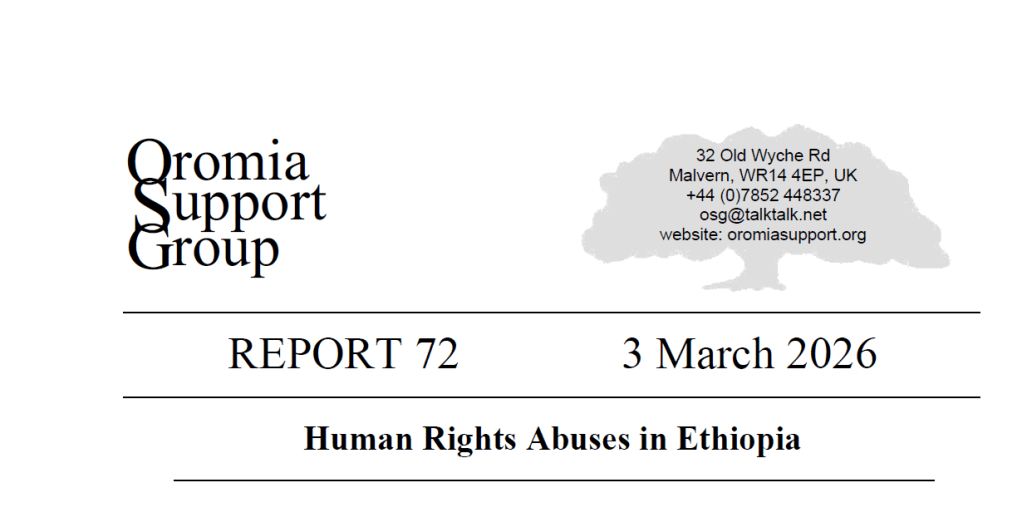
The 61st session of the UN Human Rights Council receives evidence of widespread abuses, forced conscription, and the catastrophic entanglement of Ethiopia in Sudan’s civil war.
GENEVA — The Oromia Support Group (OSG) has submitted a comprehensive report to the current 61st session of the United Nations Human Rights Council, documenting a grim catalogue of human rights abuses against Oromo civilians under the rule of Prime Minister Abiy Ahmed.
Report 72, now being distributed as widely as possible by the UK-based human rights organization, includes not only the organization’s formal submission to the UNHRC but also reveals Ethiopia’s deepening involvement in Sudan’s civil war—supporting the genocidal Rapid Support Forces (RSF) from a new base inside Ethiopia, funded and equipped by the United Arab Emirates.
“Please find attached Report 72 from the Oromia Support Group and please distribute it as far and wide as possible,” the organization urged in its statement accompanying the release.
A Bloody Toll: 7,511 Civilians Killed
According to OSG, the organization has now documented 7,511 Oromo civilian deaths under Abiy Ahmed’s rule—a staggering figure that represents only a fraction of the true toll. Most of the victims are young people, the Qeerroo generation, whose peaceful pro-democracy demonstrations in 2018 opened the political space that allowed Abiy Ahmed to seize power.
“Prime Minister Abiy Ahmed stated in government meetings in early 2019 that his top priority was the extermination of Qeerroo members because they were the greatest obstacle to his power,” the report reveals.
Since the beginning of 2025 alone, OSG has recorded 1,244 civilian killings—a dramatic escalation in violence that spans all zones of Oromia Region and the Oromia Special Zone in Amhara Region. Killings and destruction of property have been particularly egregious in Wallega zones, with increasing frequency in the latter half of 2025 in Arsi and West Arsi zones. Poor access and communication continue to hinder data collection, especially from Guji and Borana zones.
“Bullet Food”: Oromo Youth Forced into Sudan Conflict
One of the most alarming revelations in Report 72 concerns Ethiopia’s involvement in Sudan’s civil war. According to OSG, the Ethiopian government has established a base near Asosa to support the genocidal Rapid Support Forces, funded and equipped by the United Arab Emirates.
“Forcibly conscripted destitute Oromo youth are already ‘bullet food’ in this war and scores of thousands will follow,” the report warns.
The organization describes this development as a “catastrophic decision” that invites proxy wars to be fought by regional powers on Ethiopian territory, with Oromo youth paying the ultimate price.
A Government That Does Not Represent Its People
OSG’s submission challenges the characterization of Ethiopia’s government as an “Oromo government,” noting that although many individuals in government are Oromo, “the abuses against Oromo are as severe and widespread as those against any of the country’s other peoples.”
The Prosperity Party government, the report argues, “does not represent the interests of any of the peoples of Ethiopia.”
Economic Mismanagement and Militia Terror
Behind the facade of modernization and development projects lies a different reality, according to OSG. The report describes how poorly paid and poorly trained local militias engage in looting and extortion of spurious and arbitrary taxes from rural and urban populations already unable to sustain themselves economically or access adequate health care or education.
A “dog-eat-dog situation has developed whereby militia members depend for their and their families’ survival on looting and extortion from people with nothing left to give,” the report states.
Reasons given for extortion include financing local administrative buildings, “health insurance,” arming and feeding federal and local security forces, bribes for the release of prisoners and victims of forced conscription, and licenses for businesses and vehicles.
Military Tactics: Drones, Artillery, and Burning Villages
National defense forces continue to use drones and heavy artillery in attacks on defenceless villagers, killing people and livestock. In areas where the Oromo Liberation Army (OLA) is active, villages are burnt “to drain the ocean to kill the fish”—a military tactic that punishes entire communities for the actions of a few.
Villagers are threatened at gunpoint to indicate the homes of parents or other relatives of OLA members, which are then systematically destroyed.
Young men and respected community members without any connection to OLA have been killed in their homes, on the streets, in churches, and on their way to and from markets. Many have been taken from police custody or from detention in military camps and summarily executed, sometimes in public in order to terrorize the population.
Sexual Violence and Crimes Against Children
The report documents horrific accounts of sexual violence perpetrated by government soldiers. Children, prepubescent girls and young boys, and mothers of families have been cruelly raped. The rape and killing of teenage girls and girls aged as young as ten years are documented.
Deliberate shooting of infants and children under ten years old by national defense forces, for frivolous reasons, has also been recorded.
Forced Displacement: Modernization as a Weapon
Hundreds of thousands of villagers have been displaced due to the destruction of their homes and farms. Added to these are those displaced by “modernization projects,” where even moderately sized conurbations such as Dembi Dollo in Qellem Wallega have been subjected to “corridor projects”—private houses and business properties bulldozed without consultation or compensation.
Large-scale developments including the Gadaa Special Economic Zone project and the $12.5 billion Bishoftu “Mega” Airport in Aabbuu Seeraa, Bishoftu, are displacing tens of thousands with no consultation and hardly any compensation. The report warns that these projects appear designed to completely divide Oromia Region into two, destined to bring millions of people from other regions into a narrow strip of land in southern East Showa.
The Destruction of the Karrayyu and Gadaa Heritage
The Karrayyu pastoralists in East Showa—one of the major remaining centers practicing the Gadaa system of social, spiritual and democratic governance, acknowledged as UNESCO World Heritage—have been “almost completely destroyed” since fourteen of their leaders were killed on the orders of Oromia Region authorities in December 2021.
“The long-term livelihood of Oromo and the traditional heritage, deeply attached to their land, is being destroyed,” OSG states.
Inter-Ethnic Conflict: Deliberately Fomented
The report alleges that division and hatred between Oromo and Amhara peoples has been deliberately fomented by the government. Clandestine federal forces, masquerading as Fano Amhara fighters and as OLA fighters, have been established in at least Showa and Wallega zones, where they have been responsible for massacres and numerous smaller scale killings with the sole purpose of spreading discord and hostility.
In one chilling example, federal forces wearing wigs of braided hair and loudly calling to each other “Jaal” (comrade in Afaan Oromoo) terrorized villagers in Dandi district, West Showa in September 2025, going from house to house at night, raping and looting.
Innocent teenagers have been beaten and imprisoned, dressed in military uniforms and paraded on media as if they were OLA fighters.
Religious Persecution
The report documents persecution on religious grounds. Oromo priests within the Ethiopian Orthodox Tewahedo Church have been detained and killed. Followers of the traditional Oromo religion, Waaqeffannaa, have been killed and driven out of areas, and their worship halls (galma) burned down.
Regional Attacks Unopposed
National and regional governments have not opposed the killings of civilians and destruction of their property by Somali Region forces (Liyyu) in West Bale, East and West Hararge and South Borana zones of Oromia Region.
Desperate Refugees Face Hostility at Every Turn
Refugees fleeing to Djibouti and Somaliland in desperate attempts to seek illegal work in Saudi Arabia face abuse and extortion on their journeys and at their destinations. The report describes refugees being treated with hostility and disdain in Egypt, Libya, Tunisia, Djibouti, Somaliland, Somalia and Yemen.
Thousands are detained in life-threatening conditions or subject to slavery in Libya. Unknown numbers die in deserts between Ethiopia and the Red Sea or Mediterranean Sea and by drowning in those seas. Those who survive dangerous journeys to Europe are met with hostility, disbelief and discrimination.
Individuals Who Speak Truth Hounded Out
The report notes that individuals who have risked their lives to investigate and publish human rights abuses and the dire economic and health crises in rural areas have been hounded out of Ethiopia, and family members have been detained.
OSG’s Call: Distribute Widely
The Oromia Support Group concludes its report with a call for the widest possible distribution of its findings, urging recipients to share Report 72 “as far and wide as possible.”
The submission to the 61st session of the UN Human Rights Council represents a continued effort to bring international attention to the ongoing crisis in Oromia and to hold the Ethiopian government accountable for what OSG describes as systematic human rights abuses against the Oromo people.
For further information:
Dr. Trevor Trueman
+44 (0)7852 448337
osg@talktalk.net
This report includes information contained in Reports 69-72 from the Oromia Support Group (OSG).

Posted on March 4, 2026, in Events, Information, News, Oromia, Press Release, Promotion. Bookmark the permalink. Leave a comment.




 Advocacy for Oromia
Leave a comment
Comments 0