Daily Archives: March 7, 2026

Honoring the Heroes of Oromia: A March Tribute to Those Who Sacrificed for Liberation
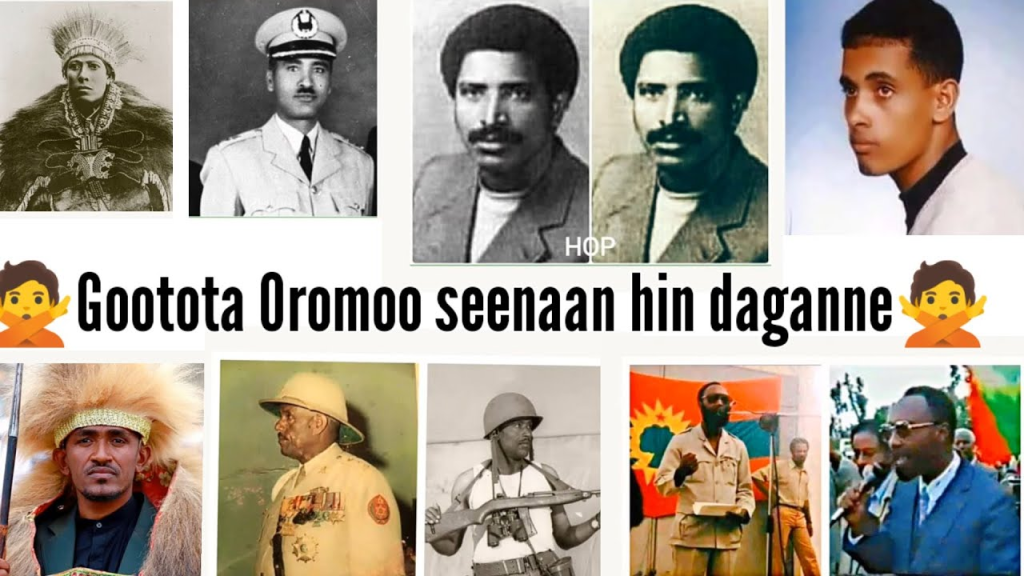
As the month of March unfolds, it carries with it the weight of memory—a time to reflect on the extraordinary sacrifices of Oromo heroes who gave everything for the freedom and dignity of their people.
March holds particular significance in the Oromo liberation struggle. It was in this month, on March 19, 1975, that General Tadesse Birru—the father of modern Oromo nationalism—was executed by the Derg regime alongside fellow commanders Hailu Regassa and other Oromo leaders. Their blood soaked the soil of Addis Ababa, but their legacy seeded the consciousness of generations to come.
General Tadesse Birru: The Father of Oromo Nationalism
Colonel General Tadesse Birru (circa 1920 – March 19, 1975) stands as a colossus in Oromo history—a man whose journey from loyal imperial soldier to revolutionary nationalist embodies the Oromo people’s awakening to self-determination .
Born in Salele, Shewa province, Tadesse’s early life was marked by tragedy. His father, Birru, was killed by poison gas during the Second Italo-Ethiopian War, and his mother died of grief just three months later. Orphaned, young Tadesse joined his uncle as a member of the Arbegnoch—patriots fighting Italian occupation. Captured and sentenced to life in prison with hard labor in Mogadishu, he was freed when the British captured the city in 1940, received military training in Kenya, and returned to Ethiopia in 1941 .
His military career was distinguished. By 1954, he was a lieutenant colonel, later commanding the “Fetno-Derash” (Rapid Force)—Ethiopia’s special forces. In a remarkable historical footnote, it was Tadesse Birru who trained Nelson Mandela in guerrilla warfare and gave the South African anti-apartheid leader his famous lost Liliesleaf pistol .
The turning point came during a meeting with Prime Minister Aklilu Habtewold. Unaware of Tadesse’s Oromo heritage, the prime minister suggested it was unwise to educate or recruit Oromos into the military. This revelation of deep-seated prejudice transformed the general. He joined the Mecha and Tulama Self-Help Association in 1963, a Oromo social movement that his public stature elevated into a pan-Oromo organization advocating for Oromo empowerment through education and self-reliance .
The government responded with brutal repression. The organization was banned, its members arrested, killed, or exiled. Tadesse was placed under house arrest, escaped after three years, and attempted an unsuccessful coup in 1966. Captured and tortured, his death sentence was commuted to life imprisonment. Released but kept under house arrest in Gelemso, he was visited by legendary Oromo leaders including Baro Tumsa, Elemo Qiltu, and Shaykh Bakhri Saphalo .
As the imperial regime weakened in 1974, Tadesse escaped and returned to Addis Ababa. The Derg offered him the Ministry of Interior—he refused twice. When police came to detain him, he fled again and began organizing an armed Oromo rebellion in Shewa, joined by fellow officers including Colonel Haile Regassa. In respect to the defunct Oromo army of Elemo Qiltu, his forces operated under the name of the Oromo Liberation Army (Waraanna Bilisummaa Oromoo) .
Captured along with Hailu Regassa, they were tried, sentenced to life imprisonment, then executed by the Derg on March 19, 1975. The OLA continued to operate and became part of the Oromo Liberation Front in 1976 .
Tadesse’s legacy is immeasurable. His lectures on Oromo identity and nationhood inspired an entire generation, leading to the reaffirmation of Oromo culture, language, and identity. He is rightly considered the father of modern Oromo nationalism .
Jaarraa Abbaa-Gadaa: The Uncompromising Combatant
March 2013 brought another grievous loss. Jaarraa Abbaa-Gadaa, the great national hero of Oromia, passed away in exile on March 3 of that year, still actively engaged in the liberation struggle until his final days .
Known in his youth as Abdulkarim, Jaarraa began his activism organizing secondary school students in Harar, speaking with “touching eloquence” about the trials of the Oromo people under imperial rule and the responsibility of the new generation to organize for national resistance .
He joined the heroic Bale resistance led by Waaqo Guutoo and others, then continued organizing in neighboring Somalia, where he resisted efforts to subordinate Oromo national aspirations to the Greater Somalia project. Finding sanctuary in South Yemen, he played a decisive role in planning a pan-Oromia liberation struggle. His daring 1969 return to Oromia ended in over five years of Somali imprisonment—a setback that only hardened his resolve .
Released in 1975 as Siad Barre prepared for war with Ethiopia, Jaarraa courageously reminded the Somali president that Oromos wished to continue their sacred mission to liberate Oromia. When this proved unacceptable, he secretly slipped back into Oromia, consulted with underground leaders including Baro Tumsa, and successfully reignited the fire of pan-Oromo national liberation .
General Ismail Ahmed of the Somali regime later recalled Jaarraa’s courage in speaking truth to power: “Abdulkarim was courageous, and he loved and respected his people very much” .
The Bale Resistance: Waqo Gutu and Elemo Qiltu
The Bale Revolt of the 1960s produced two other towering figures whose sacrifices in March and beyond shaped Oromo resistance.
Waqo Gutu Usu (1924 – February 3, 2006) was a revolutionary leader of the Bale Revolt, which fought against the feudal system of the Ethiopian Empire. Born to an Oromo father and Somali mother, his rebellion began almost accidentally when a grazing rights conflict was ignored by the central government. After waiting in vain for three months, Waqo “went to Somalia and brought back 42 rifles and two Thompson submachine guns” .
By 1966, about three-fifths of Bale Province was in turmoil. The revolt, running from 1964 to 1970, addressed issues of land, taxation, class, and religion. Waqo surrendered in 1970, but the struggle he ignited continued .
After the Ethiopian revolution, Waqo established the United Oromo People Liberation Front in 1989 and later formed the ULFO in 2000 to unite armed and political groups fighting for Oromo self-determination. He died in a Nairobi hospital on February 3, 2006, survived by 20 sons and 17 daughters. Following the fall of the EPRDF regime in 2018, a statue of Waqo Gutu was erected in Bale .
Elemo Qiltu (Hassen Ibrahim) was another legendary figure who gave his life in the struggle. Visited by General Tadesse Birru during his house arrest, Elemo commanded Oromo forces in the Bale resistance. The Oromo Liberation Army later named its Shewa unit in honor of his defunct army, ensuring his name lived on .
Hachalu Hundessa: The Voice of a Generation
Though June 29, 2020, not March, claims the date of his assassination, no tribute to Oromo heroes would be complete without Hachalu Hundessa—the 34-year-old singer whose murder by gunmen in Addis Ababa sent shockwaves through Oromia and the diaspora .
Hachalu was more than a musician. He was “a voice for the deliberately silenced,” in the words of Amina Dedefo, a young Oromo activist. “A majority of Oromo people don’t have education or access to education. They’re not able to articulate their struggles, but he did it for them through his music” .
His songs like Maalan Jira directly addressed the preservation of Oromo land and culture. His lyrics served as the soundtrack to the Oromo-led social movement that defined Ethiopian politics from 2014 to 2018. Ayantu Ayana, an Oromo historian, likened Hachalu to “a living, breathing historical archive for a group of people whose cultural ways have been continually endangered” .
Hachalu spent five years in prison for his activism as a young man, writing many of his early songs behind bars. His music resonated in “the soul of every Oromo person,” bridging generations in the diaspora and at home. “Hachalu made it cool to be Oromo and to be proud of it,” said Girma Hassen of the Oromo Cultural Institute of Minnesota .
His assassination sparked massive protests and a brutal government crackdown, with Amnesty International reporting at least 5,000 arrests. But his legacy endures. As Abdulrahman Wako, a young Oromo organizer in Minnesota, reflected: “Being Oromo is something I used to run away from. But when I saw Oromo youth peacefully protesting against the Goliath that is the Ethiopian government, I felt closer to what my dad and grandfather had to go through” .
Ancient Heroes: Oromo Commanders at the Battle of Adwa
The tradition of Oromo heroism extends back centuries. At the Battle of Adwa on March 1, 1896—another March date of profound significance—Oromo commanders played decisive roles in securing Ethiopia’s victory over Italian invasion .
Fitawrari Gebeyehu (Abba Gammada) was a top-ranking Oromo commander and hero, known for his bravery and leadership. He led the advance guard and is celebrated for his sacrifice, dying in the heat of battle while charging Italian positions .
Dejazmach Balcha Safo (Abba Nefso) was an influential Oromo general who later became Governor of Sidamo. He led Oromo soldiers and distinguished himself through valiant resistance .
Ras Makonnen Wolde Mikael, though of mixed Oromo and Amhara ancestry, commanded a large contingent of troops and was one of Emperor Menelik II’s most trusted generals .
Fitawrari Tekle and Birru Wolde Gabriel also commanded Oromo troops, contributing to the victory that ensured Ethiopia remained independent .
The Living Legacy
As March 2026 unfolds, the Oromo people carry forward the legacy of these heroes. The struggle they began continues. The torch they lit still burns.
General Tadesse Birru, executed March 19, 1975, taught that Oromo identity was not a source of shame but a wellspring of dignity. Jaarraa Abbaa-Gadaa, who passed March 3, 2013, demonstrated that courage never compromises. Waqo Gutu, who died February 3, 2006, showed that resistance can take many forms. Elemo Qiltu gave his life in the field. Hachalu Hundessa gave his voice, then his blood.
The young Oromo generation, in Minnesota and across the diaspora, has taken up their mantle. As Amina Dedefo said, borrowing Hachalu’s own words: “Waa’ee keenya yoo Otto dhissan silaa nama hin dhiisu”—”Even if we left our struggle, our struggle won’t leave us” .
In this month of memory, we honor:
- General Tadesse Birru – Father of modern Oromo nationalism, executed March 19, 1975
- Jaarraa Abbaa-Gadaa – Uncompromising liberation fighter, died March 3, 2013
- Waqo Gutu – Bale Revolt leader, died February 3, 2006
- Elemo Qiltu – Legendary commander of early Oromo forces
- Hachalu Hundessa – Voice of the Oromo people, assassinated June 29, 2020
- Fitawrari Gebeyehu and the Adwa commanders – Oromo heroes of March 1, 1896
Their sacrifices were not in vain. The Oromo people endure. The struggle continues. And one day, when Oromia is free, their names will be carved not only in memory but in the foundations of a nation they gave everything to build.
Gootota Oromoo, ulfina fi kabajaan isinif haa tahu!
(Heroes of Oromia, honor and respect be upon you!)

Amnesty Report Under Fire: OLA Rejects Sexual Violence Allegations as “Investigative Failure” and “Portrait of Bias”
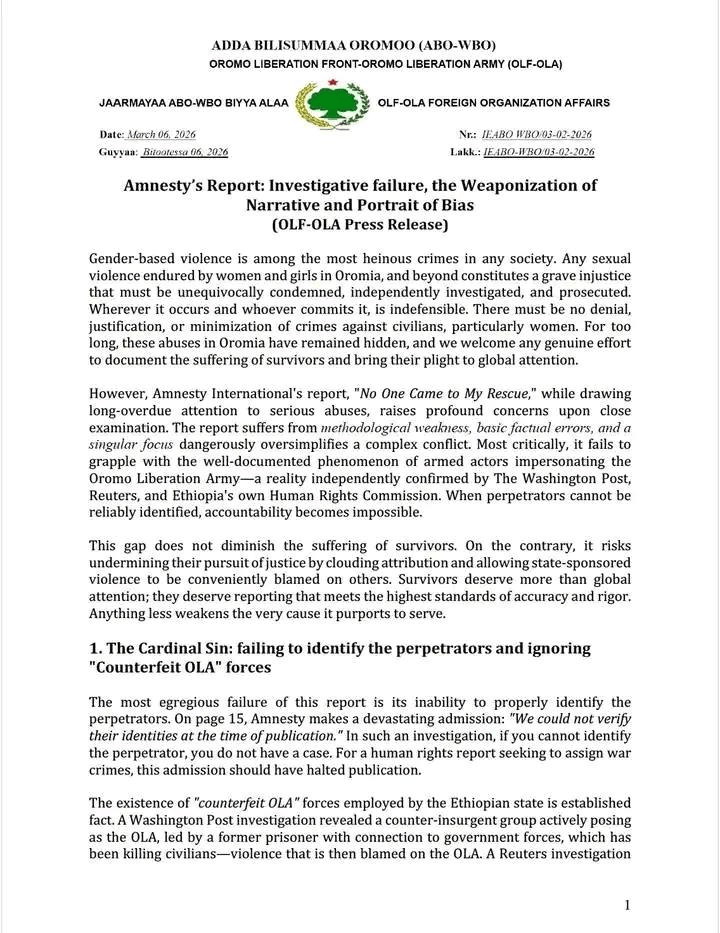
In a blistering 11-page response, the Oromo Liberation Army accuses Amnesty International of ignoring documented evidence of state-sponsored “counterfeit OLA” forces, factual errors about command structures, and selective focus that lets the Ethiopian government “off the hook.”
MARCH 6, 2026 — A day after Amnesty International released its devastating report documenting gang rape, sexual slavery, and mass displacement in western Oromia, the Oromo Liberation Army (OLA) has fired back with a detailed, point-by-point rebuttal accusing the world’s largest grassroots human rights organization of “investigative failure,” “weaponization of narrative,” and “portrait of bias.”
The OLA’s response, issued by its High Command, does not deny that women have suffered sexual violence. “Gender-based violence is among the most heinous crimes in any society,” the statement begins. “Any sexual violence endured by women and girls in Oromia, and beyond constitutes a grave injustice that must be unequivocally condemned, independently investigated, and prosecuted.”
However, the organization argues that Amnesty’s report, titled “No One Came to My Rescue,” is so fundamentally flawed in its methodology, factual accuracy, and attribution that it risks undermining the very justice it purports to serve.
The “Cardinal Sin”: Failure to Identify Perpetrators
The OLA’s most damning critique centers on what it calls the report’s “cardinal sin”: its inability to properly identify the perpetrators of the documented violence.
On page 15 of the Amnesty report, researchers make a striking admission: “We could not verify their identities at the time of publication.”
For the OLA, this admission alone should have halted publication. “In such an investigation, if you cannot identify the perpetrator, you do not have a case,” the response states. “For a human rights report seeking to assign war crimes, this admission should have halted publication.”
The OLA argues that this failure is particularly egregious given the well-documented existence of what it calls “counterfeit OLA” forces—armed actors employed by the Ethiopian state who actively pose as OLA fighters while committing atrocities, which are then blamed on the liberation movement.
The “Counterfeit OLA” Phenomenon: Documented Reality
The OLA’s response cites multiple independent investigations establishing the existence of state-sponsored forces masquerading as OLA fighters.
A Washington Post investigation revealed a counter-insurgent group actively posing as the OLA, led by a former prisoner with connections to government forces. This group has been killing civilians—violence that is then attributed to the OLA in official narratives.
A Reuters investigation uncovered the operations of the Koree Nageenyaa (Security Committee), a clandestine body of senior Oromia officials that has ordered extra-judicial killings and illegal detentions. Crucially, Reuters found that the massacre of the Karrayyuu Abba Gada leaders was orchestrated by these officials, who then instructed the Oromia Communication Bureau to attribute the killings to the OLA.
The OLA points to a telling detail in the Amnesty report itself: survivors say the perpetrators “wanted to be identified and explicitly told victims they were OLA” (p. 15). For the OLA, this is a classic hallmark of a false flag operation.
“Why would actual OLA fighters, operating in their own strongholds, need to announce their identity as they commit crimes, and to villagers who would already know them?” the response asks. “The behaviour described fits the precise profile of agents provocateurs sent by the state to commit atrocities and blame on the OLA.”
The OLA’s accusation is stark: “By utterly ignoring this well-documented reality, Amnesty International is not just making a mistake; they are actively laundering the reputation of a state-sponsored death squad. They are taking the government’s propaganda at face value and presenting it as human rights research.”
The “Draining the Sea” Doctrine: A State Confession Ignored
The OLA response highlights what it considers a staggering omission: the failure to connect documented displacement and home-burning to the explicit, publicized policy of the Ethiopian regime.
Fekadu Tessema, the Oromia Prosperity Party chief until recently, publicly stated: “We have to drain the sea to catch the fishes.”
This is a publicly stated counter-insurgency doctrine that views the civilian population (the sea) as the support base for the OLA (the fish). The mass displacement, the burning of homes, and the terrorization of communities described in the Amnesty report are, the OLA argues, a textbook implementation of this state policy.
“Amnesty’s report, by blaming the OLA for this displacement, has effectively taken the confession of a senior government official and turned it into an indictment of his victims,” the response states.
The report’s legal analysis, which claims “it is reasonable to believe that the armed group’s fighters are using sexual violence to expel a section of the civilian population” (p. 23), is, in the OLA’s view, “rendered absurd by the existence of a documented state policy with the exact same goal.”
Factual Errors: “Shoddy Research” Undermines Credibility
The OLA response catalogs what it describes as basic factual errors that undermine the report’s credibility. These include:
- “The OLA has five main commands” (p. 11) — The OLA states this is FALSE; it has eight commands across Oromia.
- “The Western command is led by Jal Gemechu Aboye” (p. 11) — The OLA states this is FALSE; Gemechu Aboye has never been the Western Commander.
- “The Central Regional Command… is reported to be led by Jal Jiregna” (p. 11) — The OLA states this is FALSE; the central command has never been led by anyone called Jaal Jiregna.
“If Amnesty International cannot accurately report the number of commands or the names of commanders, why should any reader trust their conclusions about specific acts of violence?” the response asks. “This is not a minor oversight; it demonstrates a fundamental lack of understanding of the subject they are investigating and casts yet another doubt on every single ‘finding’ in the report.”
The Selective Lens: Ignoring State Culpability
Perhaps the most substantive critique concerns what the OLA calls the report’s “selective lens”—its focus solely on the OLA while ignoring overwhelming evidence of state-perpetrated violence.
The OLA response cites United Nations data showing that state forces (ENDF, police, and affiliated militias) were responsible for 70% of all human rights violations in Ethiopia in 2023, affecting 7,103 victims. All non-state armed groups accounted for only 22.3%.
The UN also documented that between August and December 2023 alone, 18 drone strikes by the ENDF resulted in 248 civilian deaths and 55 injuries, destroying schools and hospitals.
Other investigations by the UN International Commission of Human Rights Experts on Ethiopia (ICHREE) have consistently indicated the disproportionate role of regime forces in abuses.
“Amnesty International is aware of these figures. They are public,” the OLA response states. “Yet they chose to produce a report that effectively ignores the primary perpetrator of violence in the region. This effectively makes the report a political hit job, not a human rights report. By singling out the OLA, Amnesty, wittingly or otherwise, seem to be providing cover for a state that has raped, killed and displaced far more civilians.”
Methodological Concerns: Remote Research and Unverified Claims
The OLA raises serious concerns about Amnesty’s research methodology. The report acknowledges it was conducted during a government-imposed communications blackout with restricted access (p. 11). Interviews were conducted via “encrypted communication apps” (p. 8).
“In an environment of intense state surveillance and propaganda, where ‘counterfeit OLA’ forces are actively trying to frame the OLA, relying on remote testimony without the ability to forensically verify the scene, the perpetrators, or the chain of command is a recipe for disaster,” the response argues.
“The victims’ trauma is real, but the attribution of that trauma is based on the word of individuals in a war zone who are being terrorized by multiple regime forces, including those pretending to be the OLA. A responsible human rights organization would have paused, acknowledged the ‘unverified’ status of the perpetrators, and investigated the role of state-sponsored imposters. Amnesty did the opposite: they rushed to print a headline that condemns the OLA and exonerates the regime.”
Call for Report Withdrawal and Independent Audit
The OLA’s conclusion is uncompromising:
“Amnesty International’s ‘No One Came to My Rescue’ is a reckless and biased document that fails the standards of investigative rigor. By ignoring the well-documented existence of ‘counterfeit OLA’ forces and the state’s own policy of ‘draining the sea,’ by getting basic facts about the OLA’s command structure wrong, and by ignoring UN data showing that the state is responsible for 70% of all abuses, Amnesty has produced a report that is as flawed as it is dangerous.”
The OLA alleges that the report, “wittingly or unwittingly, provides diplomatic cover for a regime that tortures its citizens, runs secret death squads (Koree Nageenyaa), and kills civilians with drones on daily basis. It denies the OLA, a legitimate armed actor in a non-international armed conflict, as the report itself concludes, the presumption of a fair investigation. And worst of all, it weaponizes the trauma of ten women to serve a political narrative that lets the primary perpetrators of violence in Oromia—the Ethiopian regime and its proxies—off the hook.”
The OLA formally requests that the report be withdrawn and its methodology subjected to an independent audit.
Call for Independent Investigations
The response concludes by reiterating the OLA’s long-standing call for independent investigations into serious crimes previously attributed to it—calls that have largely been dismissed or ignored by the Ethiopian regime and its backers.
The OLA notes that the regime has mounted a sustained diplomatic campaign to terminate the mandate of the International Commission of Human Rights Experts on Ethiopia at the United Nations Human Rights Council, effectively shutting down the body in the midst of its investigative work.
“Against this backdrop, the OLA reiterates its call for comprehensive and genuinely independent investigations, not only into the latest allegations documented in western Oromia, but across all parts of the Oromia region where there is evidence of grave abuses committed,” the statement concludes. “Ensuring justice for survivors requires a process that is independent, transparent, and capable of examining the actions of all actors involved in the conflict. Only through such an approach can accountability be established, disinformation avoided, and the dignity and rights of victims upheld.”
The OLA’s full statement was issued on March 6, 2026. Amnesty International has not yet responded to the OLA’s specific allegations regarding the report’s methodology and factual accuracy.




 Advocacy for Oromia