Amnesty Report Under Fire: OLA Rejects Sexual Violence Allegations as “Investigative Failure” and “Portrait of Bias”
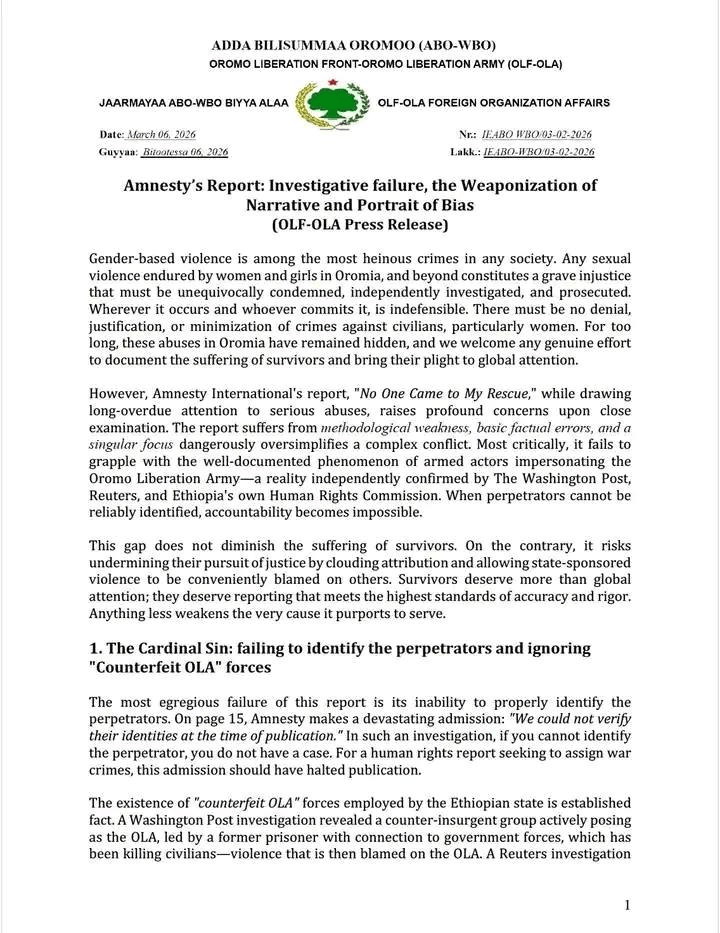
In a blistering 11-page response, the Oromo Liberation Army accuses Amnesty International of ignoring documented evidence of state-sponsored “counterfeit OLA” forces, factual errors about command structures, and selective focus that lets the Ethiopian government “off the hook.”
MARCH 6, 2026 — A day after Amnesty International released its devastating report documenting gang rape, sexual slavery, and mass displacement in western Oromia, the Oromo Liberation Army (OLA) has fired back with a detailed, point-by-point rebuttal accusing the world’s largest grassroots human rights organization of “investigative failure,” “weaponization of narrative,” and “portrait of bias.”
The OLA’s response, issued by its High Command, does not deny that women have suffered sexual violence. “Gender-based violence is among the most heinous crimes in any society,” the statement begins. “Any sexual violence endured by women and girls in Oromia, and beyond constitutes a grave injustice that must be unequivocally condemned, independently investigated, and prosecuted.”
However, the organization argues that Amnesty’s report, titled “No One Came to My Rescue,” is so fundamentally flawed in its methodology, factual accuracy, and attribution that it risks undermining the very justice it purports to serve.
The “Cardinal Sin”: Failure to Identify Perpetrators
The OLA’s most damning critique centers on what it calls the report’s “cardinal sin”: its inability to properly identify the perpetrators of the documented violence.
On page 15 of the Amnesty report, researchers make a striking admission: “We could not verify their identities at the time of publication.”
For the OLA, this admission alone should have halted publication. “In such an investigation, if you cannot identify the perpetrator, you do not have a case,” the response states. “For a human rights report seeking to assign war crimes, this admission should have halted publication.”
The OLA argues that this failure is particularly egregious given the well-documented existence of what it calls “counterfeit OLA” forces—armed actors employed by the Ethiopian state who actively pose as OLA fighters while committing atrocities, which are then blamed on the liberation movement.
The “Counterfeit OLA” Phenomenon: Documented Reality
The OLA’s response cites multiple independent investigations establishing the existence of state-sponsored forces masquerading as OLA fighters.
A Washington Post investigation revealed a counter-insurgent group actively posing as the OLA, led by a former prisoner with connections to government forces. This group has been killing civilians—violence that is then attributed to the OLA in official narratives.
A Reuters investigation uncovered the operations of the Koree Nageenyaa (Security Committee), a clandestine body of senior Oromia officials that has ordered extra-judicial killings and illegal detentions. Crucially, Reuters found that the massacre of the Karrayyuu Abba Gada leaders was orchestrated by these officials, who then instructed the Oromia Communication Bureau to attribute the killings to the OLA.
The OLA points to a telling detail in the Amnesty report itself: survivors say the perpetrators “wanted to be identified and explicitly told victims they were OLA” (p. 15). For the OLA, this is a classic hallmark of a false flag operation.
“Why would actual OLA fighters, operating in their own strongholds, need to announce their identity as they commit crimes, and to villagers who would already know them?” the response asks. “The behaviour described fits the precise profile of agents provocateurs sent by the state to commit atrocities and blame on the OLA.”
The OLA’s accusation is stark: “By utterly ignoring this well-documented reality, Amnesty International is not just making a mistake; they are actively laundering the reputation of a state-sponsored death squad. They are taking the government’s propaganda at face value and presenting it as human rights research.”
The “Draining the Sea” Doctrine: A State Confession Ignored
The OLA response highlights what it considers a staggering omission: the failure to connect documented displacement and home-burning to the explicit, publicized policy of the Ethiopian regime.
Fekadu Tessema, the Oromia Prosperity Party chief until recently, publicly stated: “We have to drain the sea to catch the fishes.”
This is a publicly stated counter-insurgency doctrine that views the civilian population (the sea) as the support base for the OLA (the fish). The mass displacement, the burning of homes, and the terrorization of communities described in the Amnesty report are, the OLA argues, a textbook implementation of this state policy.
“Amnesty’s report, by blaming the OLA for this displacement, has effectively taken the confession of a senior government official and turned it into an indictment of his victims,” the response states.
The report’s legal analysis, which claims “it is reasonable to believe that the armed group’s fighters are using sexual violence to expel a section of the civilian population” (p. 23), is, in the OLA’s view, “rendered absurd by the existence of a documented state policy with the exact same goal.”
Factual Errors: “Shoddy Research” Undermines Credibility
The OLA response catalogs what it describes as basic factual errors that undermine the report’s credibility. These include:
- “The OLA has five main commands” (p. 11) — The OLA states this is FALSE; it has eight commands across Oromia.
- “The Western command is led by Jal Gemechu Aboye” (p. 11) — The OLA states this is FALSE; Gemechu Aboye has never been the Western Commander.
- “The Central Regional Command… is reported to be led by Jal Jiregna” (p. 11) — The OLA states this is FALSE; the central command has never been led by anyone called Jaal Jiregna.
“If Amnesty International cannot accurately report the number of commands or the names of commanders, why should any reader trust their conclusions about specific acts of violence?” the response asks. “This is not a minor oversight; it demonstrates a fundamental lack of understanding of the subject they are investigating and casts yet another doubt on every single ‘finding’ in the report.”
The Selective Lens: Ignoring State Culpability
Perhaps the most substantive critique concerns what the OLA calls the report’s “selective lens”—its focus solely on the OLA while ignoring overwhelming evidence of state-perpetrated violence.
The OLA response cites United Nations data showing that state forces (ENDF, police, and affiliated militias) were responsible for 70% of all human rights violations in Ethiopia in 2023, affecting 7,103 victims. All non-state armed groups accounted for only 22.3%.
The UN also documented that between August and December 2023 alone, 18 drone strikes by the ENDF resulted in 248 civilian deaths and 55 injuries, destroying schools and hospitals.
Other investigations by the UN International Commission of Human Rights Experts on Ethiopia (ICHREE) have consistently indicated the disproportionate role of regime forces in abuses.
“Amnesty International is aware of these figures. They are public,” the OLA response states. “Yet they chose to produce a report that effectively ignores the primary perpetrator of violence in the region. This effectively makes the report a political hit job, not a human rights report. By singling out the OLA, Amnesty, wittingly or otherwise, seem to be providing cover for a state that has raped, killed and displaced far more civilians.”
Methodological Concerns: Remote Research and Unverified Claims
The OLA raises serious concerns about Amnesty’s research methodology. The report acknowledges it was conducted during a government-imposed communications blackout with restricted access (p. 11). Interviews were conducted via “encrypted communication apps” (p. 8).
“In an environment of intense state surveillance and propaganda, where ‘counterfeit OLA’ forces are actively trying to frame the OLA, relying on remote testimony without the ability to forensically verify the scene, the perpetrators, or the chain of command is a recipe for disaster,” the response argues.
“The victims’ trauma is real, but the attribution of that trauma is based on the word of individuals in a war zone who are being terrorized by multiple regime forces, including those pretending to be the OLA. A responsible human rights organization would have paused, acknowledged the ‘unverified’ status of the perpetrators, and investigated the role of state-sponsored imposters. Amnesty did the opposite: they rushed to print a headline that condemns the OLA and exonerates the regime.”
Call for Report Withdrawal and Independent Audit
The OLA’s conclusion is uncompromising:
“Amnesty International’s ‘No One Came to My Rescue’ is a reckless and biased document that fails the standards of investigative rigor. By ignoring the well-documented existence of ‘counterfeit OLA’ forces and the state’s own policy of ‘draining the sea,’ by getting basic facts about the OLA’s command structure wrong, and by ignoring UN data showing that the state is responsible for 70% of all abuses, Amnesty has produced a report that is as flawed as it is dangerous.”
The OLA alleges that the report, “wittingly or unwittingly, provides diplomatic cover for a regime that tortures its citizens, runs secret death squads (Koree Nageenyaa), and kills civilians with drones on daily basis. It denies the OLA, a legitimate armed actor in a non-international armed conflict, as the report itself concludes, the presumption of a fair investigation. And worst of all, it weaponizes the trauma of ten women to serve a political narrative that lets the primary perpetrators of violence in Oromia—the Ethiopian regime and its proxies—off the hook.”
The OLA formally requests that the report be withdrawn and its methodology subjected to an independent audit.
Call for Independent Investigations
The response concludes by reiterating the OLA’s long-standing call for independent investigations into serious crimes previously attributed to it—calls that have largely been dismissed or ignored by the Ethiopian regime and its backers.
The OLA notes that the regime has mounted a sustained diplomatic campaign to terminate the mandate of the International Commission of Human Rights Experts on Ethiopia at the United Nations Human Rights Council, effectively shutting down the body in the midst of its investigative work.
“Against this backdrop, the OLA reiterates its call for comprehensive and genuinely independent investigations, not only into the latest allegations documented in western Oromia, but across all parts of the Oromia region where there is evidence of grave abuses committed,” the statement concludes. “Ensuring justice for survivors requires a process that is independent, transparent, and capable of examining the actions of all actors involved in the conflict. Only through such an approach can accountability be established, disinformation avoided, and the dignity and rights of victims upheld.”
The OLA’s full statement was issued on March 6, 2026. Amnesty International has not yet responded to the OLA’s specific allegations regarding the report’s methodology and factual accuracy.

Posted on March 7, 2026, in Events, Finfinne, Information, News, Oromia, Press Release, Promotion. Bookmark the permalink. Leave a comment.




 Advocacy for Oromia
Leave a comment
Comments 0