Honoring Oromo Women: A Celebration of Strength and Sacrifice
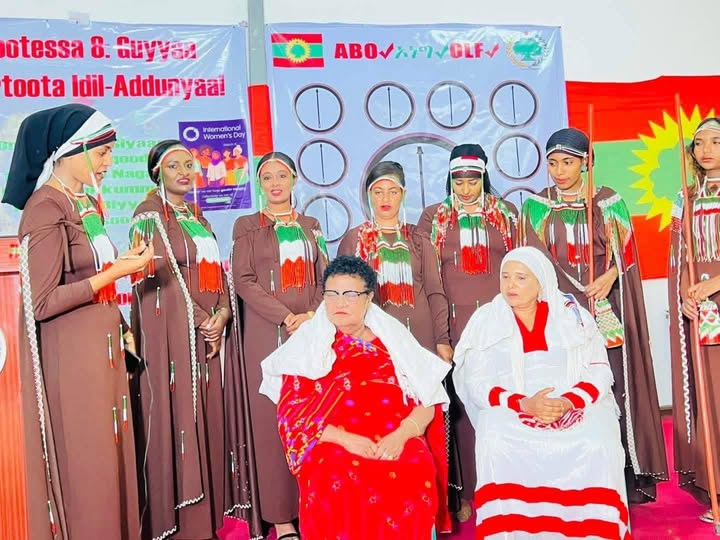
In a ceremony marked by deep respect and gratitude, the Women’s and Children’s Affairs Wing of the Oromo Liberation Army (ABB) in Gullallee honored two remarkable women for their enduring contributions to the Oromo struggle.
GULLALLEE, OROMIA — As the world celebrated International Women’s Day, the Women’s and Children’s Affairs Wing of ABO in Gullallee turned the occasion into a powerful moment of recognition for two women whose artistic and personal sacrifices have left an indelible mark on the Oromo liberation movement.
In a formal ceremony, the Women’s Wing presented a ceremonial shawl (Gaabii) to Artist Ilfineesh Qannoo and Aadde Olaantuu Gammachuu, wife of the late artist Zarihuun Wadaajoo. The gesture was more than symbolic—it was a public acknowledgment of women whose contributions to the struggle have often been carried out away from the spotlight, yet whose impact resonates through generations.
Ilfineesh Qannoo: The Mother of Love and Resistance
Artist Ilfineesh Qannoo, widely known as “Haadha Jaalalaa” (Mother of Love), represents a unique convergence of art and activism in the Oromo experience . Her life and voice have become intertwined with the identity and aspirations of her people, making her far more than an entertainer—she is a symbol of resilience, a living archive of Oromo cultural expression, and a quiet warrior whose medium has always been melody and meaning.
Throughout her decades-long career, Ilfineesh’s songs have carried the deep cultural motifs and subtle yearnings of the Oromo people, serving as a soundtrack to both everyday life and collective struggle . She did not simply perform; she gave voice to history, to joys, to sorrows, and to an enduring hope that has never dimmed despite the challenges faced by her people.
In the words of those who have documented her legacy, Ilfineesh became a “mallattoo cichoominaati”—a symbol of identity and steadfastness . Her music has been a vessel carrying the language, the pain, and the beauty of her community, affirming its existence and its right to be heard. The title “Haadha Jaalalaa” speaks to the nurturing quality of her presence, both personal and public. For her biological family, she has been the center of love and care. For her wider community, she has offered a maternal embrace through her art, providing comfort, strength, and a profound sense of belonging.
One tribute to Ilfineesh captured her essence powerfully: “Her life is a triptych of resistance—the body as battleground and banner, the art as weapon and compass, the bridge between fronts” . She has stood with the Oromo Liberation Army in spirit and solidarity, strengthening their resolve, while also being the soulful voice reaching diaspora halls, university students, and international audiences. She has connected the armed vanguard to the cultural heartland, proving that the struggle is fought with both conviction and culture, in both the forest and the concert hall.
Aadde Olaantuu Gammachuu: Strength Through Sacrifice
The ceremony also honored Aadde Olaantuu Gammachuu, widow of the esteemed artist Zarihuun Wadaajoo. Her recognition speaks to a different but equally vital dimension of the struggle: the quiet, often invisible sacrifice of women who support, sustain, and survive alongside those who take up the public mantle of resistance.
As the wife of Zarihuun Wadaajoo—an artist whose own contributions to Oromo culture and consciousness remain cherished—Aadde Olaantuu has carried the weight of personal loss while continuing to embody the resilience that defines Oromo womanhood. Her presence at the ceremony, honored alongside Ilfineesh Qannoo, served as a reminder that the struggle is not fought by individuals alone, but by families, by partners, by those who endure separation, worry, and grief while their loved ones answer the call of their people.
The Women’s Wing’s decision to honor both women together reflects a profound understanding: the artist who gives voice and the woman who gives strength through her quiet endurance are two sides of the same coin. Both are essential. Both deserve recognition.
The Significance of the Gaabii
The presentation of the Gaabii—a traditional ceremonial shawl—carries deep cultural meaning. In Oromo tradition, draping a respected figure with a shawl is an act of profound honor, a public acknowledgment of dignity, worth, and gratitude. It says: “We see you. We value you. We thank you.”
For the Women’s and Children’s Affairs Wing of ABO in Gullallee to bestow this honor on International Women’s Day amplifies its significance. It declares that the struggle for Oromo liberation cannot be separated from the struggle for women’s recognition, and that the women who have carried the movement—as artists, as mothers, as widows, as quiet pillars of strength—must be honored not in abstract but in tangible, public ways.
Women in the Oromo Struggle
The ceremony in Gullallee reflects a broader recognition of women’s indispensable role in the Oromo liberation movement. From the ancient Siinqee institution—a traditional women’s system of mutual protection and conflict resolution—to the Qarree movement of young women activists today, Oromo women have always been at the forefront of resistance .
Yet their contributions have too often been overlooked, their sacrifices minimized, their names omitted from the roll of honor. Events like this International Women’s Day ceremony serve as corrective acts—small but significant gestures toward setting the historical record straight.
A Call for Continued Recognition
As the Gaabii was draped around Ilfineesh Qannoo and Aadde Olaantuu Gammachuu, the message was clear: this honor is not merely for them, but for all the women whose names may never be recorded but without whom the struggle could not continue.
The Women’s and Children’s Affairs Wing of ABO in Gullallee has set an example that deserves emulation across Oromia and the diaspora. By taking the time to identify, honor, and thank the women who have given so much, they remind us all that gratitude is not merely a feeling but an action—and that honoring those who came before is essential work for those who carry the struggle forward.
Ilfineesh Qannoo and Aadde Olaantuu Gammachuu join a growing list of Oromo women being formally recognized for their contributions to the liberation movement. May their examples inspire gratitude and recognition for women everywhere who give, sacrifice, and endure for the sake of their people.

Posted on March 8, 2026, in Events, Finfinne, Information, News, Oromia, Press Release, Promotion. Bookmark the permalink. Leave a comment.




 Advocacy for Oromia
Leave a comment
Comments 0