Voices Across the Ocean: Oromo Diaspora in London Protests Alleged Atrocities in Ethiopia
By: Oromia News Agency
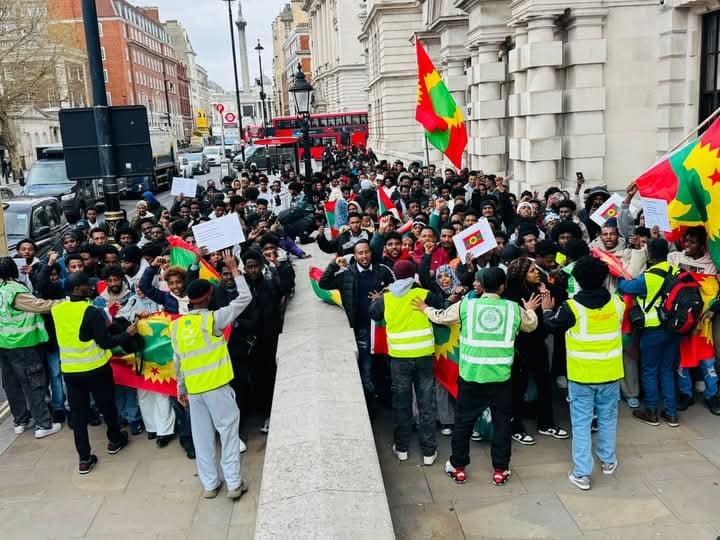
(London, UK, ONA) – In a stirring display of collective grief and political defiance, hundreds of members of the Oromo diaspora gathered in central London today to raise their voices against the government of Ethiopian Prime Minister Abiy Ahmed. The protesters, many draped in the traditional red, green, and red colors of the Oromo flag, marched to demand an immediate end to what they describe as systematic human rights violations, including extrajudicial killings and forced displacement in the Oromia region.
“We Are Here to Speak for the Voiceless”
The demonstration, which saw the closure of a major thoroughfare outside the Ethiopian Embassy, was marked by a palpable sense of urgency. Chanting slogans and holding placards reading “Stop the Genocide” and “Abiy Ahmed is a killer,” the protesters accused the Ethiopian National Defense Forces and allied regional militias of waging an offensive against Oromo civilians.
Recent reports from international observers have painted a grim picture of the security situation in Ethiopia. In its World Report 2026, Human Rights Watch (HRW) documented continued hostilities between federal forces and the Oromo Liberation Army (OLA) in parts of Oromia, resulting in significant civilian casualties and widespread displacement. Similarly, Genocide Watch’s 2025 country report highlights systematic patterns of violence against ethnic groups, noting that thousands of civilians have been killed in the Oromo and Amhara regions over the past year.
“We are here to speak for the voiceless in Oromia,” said one organizer, who identified himself as Bulti. “The international community cannot stay silent while our people are killed, our villages are burned, and our children are forced to flee their homes.”
Demands for Sanctions and ICC Prosecution
The London protest, which follows similar rallies in other major European capitals, carried a list of specific demands. Organizers submitted a formal petition to the UK Foreign Office, urging the British government to suspend financial and diplomatic support for the Ethiopian administration.
Among the key demands issued by the protest leaders were:
· Immediate Halt of Offensives: A call for the Ethiopian government to cease military operations in Oromia and withdraw security forces from civilian areas.
· Accountability: A demand for Ethiopian officials implicated in human rights abuses to be brought before international courts, including the International Criminal Court (ICC).
· Release of Political Prisoners: An urgent request for the unconditional release of opposition figures and activists held without trial.
· Justice for Slain Activists: The demonstrators specifically demanded justice for murdered artists and activists, including the iconic singer Hachalu Hundessa, whose death in 2020 sparked massive nationwide protests.
“We want the UK government to stop arming this regime,” protester Lemlem Tadese told reporters. “They have blood on their hands.”
A Deepening Crisis
The unrest in Ethiopia, Africa’s second-most populous nation, has been escalating for years. While the Tigray war officially ended in 2022 with the signing of the Cessation of Hostilities Agreement (CoHA), violence in the Amhara and Oromia regions has continued unabated.
Recent conflict dynamics have further complicated the situation. Reports from late March 2026 indicate that a rebel alliance, including Oromo forces, was closing in on the capital, Addis Ababa, leading to a state of emergency declaration. Concurrently, fierce fighting has been reported in western Oromia, where Oromo and Amhara militants have clashed, leaving civilians caught in the crossfire.
The humanitarian toll is staggering. According to the UN Office for the Coordination of Humanitarian Affairs (UNOCHA), over 288,000 people have been displaced since July 2025 following renewed inter-communal violence along the Oromia-Somali regional border, with many lacking access to clean water, shelter, or medical care.
A History of Marginalization
For many in the diaspora, the protests in London are not just a reaction to recent events but a culmination of decades of perceived marginalization. The Oromo, Ethiopia’s largest ethnic group, have long complained of political and economic disenfranchisement, including the historical banning of their language and the expropriation of their ancestral lands.
Protesters pointed to the government’s handling of the Addis Ababa Master Plan as a flashpoint, arguing that the expansion of the capital constitutes land grabs that displace Oromo farmers. “This is a struggle for survival,” said protester Desta Mulugeta. “We are fighting for our right to exist.”
A Divided Response
The Ethiopian government has consistently denied allegations of committing atrocities or targeting civilians along ethnic lines. Officials often characterize the OLA and other opposition groups as terrorist organizations bent on destabilizing the nation.
The London protest, however, highlighted the deep divide between the diaspora and the current administration. While the demonstration was largely peaceful, it reflects a growing frustration among the Oromo diaspora, who feel that diplomatic pressure alone is insufficient to halt the violence.
The Road Ahead
As the sun set over London, the protesters dispersed, but they vowed to return. Organizers announced plans for a nationwide awareness campaign and a potential mass rally in front of Parliament.
“We will not be silenced,” Bulti declared. “Until justice is served in Oromia, we will be here, every week, until the world listens.”

Posted on March 31, 2026, in Events, Finfinne, Information, News, Oromia, Press Release, Promotion. Bookmark the permalink. Leave a comment.




 Advocacy for Oromia
Leave a comment
Comments 0