Author Archives: advocacy4oromia

Oromo Mourns the Loss of Veteran Artist and Freedom Fighter Abdulhakim “Abdiyuun” Habib
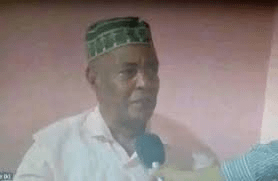
A towering figure of Oromo art and struggle passes, leaving a legacy of resistance through music
GLOBAL — The Oromo community is in mourning following the passing of veteran artist and dedicated freedom fighter Abdulhakim “Abdiyuun” Habib, a prominent singer, composer, and cultural icon whose life was devoted to the advancement of Oromo art and the struggle for Oromo liberation. His death has left a profound void in the hearts of those who knew him and the countless fans whose lives were touched by his music and activism .
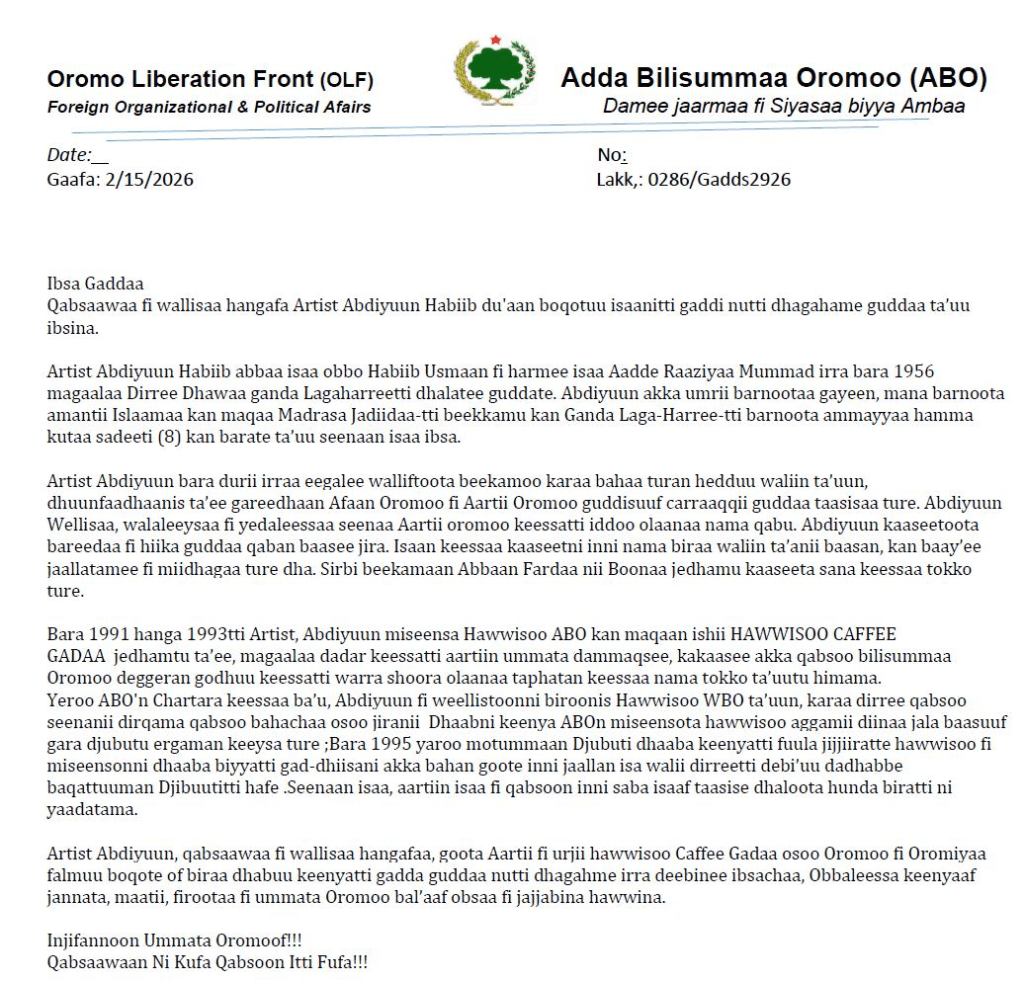
The Oromo Liberation Front (ABO) issued a statement expressing deep sorrow: “We express our immense grief at the passing of the senior freedom fighter and singer Artist Abdiyuun Habib. He has rested in death” .
Early Life and Formation
Artist Abdiyuun Habib was born in 1956 in the historic eastern Oromia city of Dire Dawa, in the Lagaharre neighborhood, to his father Habib Usmaan and mother Raaziyaa Mummad . He grew up in Dire Dawa, a cosmopolitan city known for its cultural diversity and rich artistic traditions, which would profoundly influence his development as an artist.
For his formal education, Abdiyuun attended the Islamic religious school known as Madrasa Jadiida in the Laga-Harree neighborhood, where he studied up to the eighth grade . This early exposure to education and religious learning provided a foundation for the intellectual depth that would later characterize his artistic work.
A Life Dedicated to Oromo Art
From early in his life, Abdiyuun collaborated with numerous renowned artists from the eastern region, working both individually and in groups to advance Afaan Oromo and Oromo art . His contributions spanned multiple genres—he was a singer, a composer, and a performer whose work earned him a prominent place in the history of Oromo art .
Abdiyuun produced beautiful and meaningful cassette recordings throughout his career. Among his most beloved works were collaborations with other artists, producing music that resonated deeply with Oromo audiences. One of his famous songs, “Abbaan Fardaa nii Boonaa” (The Horseman Boasts), remains cherished by fans for its artistic beauty and cultural significance .
Artist and Freedom Fighter
Between 1991 and 1993, Abdiyuun became a member of the HAWWISOO CAFFEE GADAA (the cultural troupe of the Oromo Liberation Front) in Dadar, where he played a significant role in awakening and mobilizing the masses through art, encouraging them to support the Oromo liberation struggle . His work during this period exemplified the Oromo tradition of art as a weapon in the fight for freedom.
When the Oromo Liberation Front withdrew from the transitional government, Abdiyuun and other artists continued as members of the WBO cultural troupe, entering the battlefield and participating directly in the armed struggle while fulfilling their duties as fighters . The ABO sent members of the cultural troupe to Djibouti to rescue them from enemy persecution.
In 1995, when the Djibouti government changed its position toward the organization, it forced the cultural troupe and other members to leave the country. Unable to return to the battlefield with his comrades, Abdiyuun remained in Djibouti . Despite the difficulties of exile, his history, his art, and the struggle he waged for his people will be remembered by all generations.
A Legacy of Resistance
Abdiyuun Habib’s life exemplified the inseparable connection between Oromo cultural expression and political struggle. Like his contemporaries—artists such as Nuhoo Goobanaa, Elemo Ali, and others—he understood that art was not merely entertainment but a vital medium for preserving Oromo identity, raising political consciousness, and mobilizing resistance against oppression.
His work with the HAWWISOO cultural troupes represented the institutionalization of this vision, bringing artistic expression directly into the service of the liberation movement. The songs created during this period—including those from the cassette he produced with fellow artists—continue to resonate with Oromos who remember the struggle and inspire younger generations discovering his work.
Community Mourning
Following news of his passing, tributes have poured in from across the Oromo community, both within Oromia and throughout the diaspora. Fans, fellow artists, and activists have shared memories of how Abdiyuun’s music touched their lives and inspired their commitment to Oromo causes.
The ABO statement expressed the collective grief: “Artist Abdiyuun, a senior freedom fighter and singer, a hero of Art and the star of the Caffee Gadaa cultural troupe, has passed away while fighting for Oromo and Oromia. We once again express the deep sorrow we feel at losing him” .
Condolences
The Oromo Liberation Front extended its condolences to all those affected by this loss: “We wish paradise for our beloved brother, and patience and strength for the family, relatives, and the entire Oromo people” .
As the Oromo community mourns this profound loss, they also celebrate a life lived in faithful service to the people and the cause. Abdiyuun Habib’s music will continue to inspire future generations, his voice echoing across time as a testament to the power of art in the struggle for justice and freedom.
Injifannoon Ummata Oromoof! (Victory to the Oromo People!)
Qabsaawaan Ni Kufa Qabsoon Itti Fufa! (The freedom fighter never dies, the struggle continues!)

AMES Australia Welcomes the Year of the Horse with Vibrant Lunar New Year Celebrations
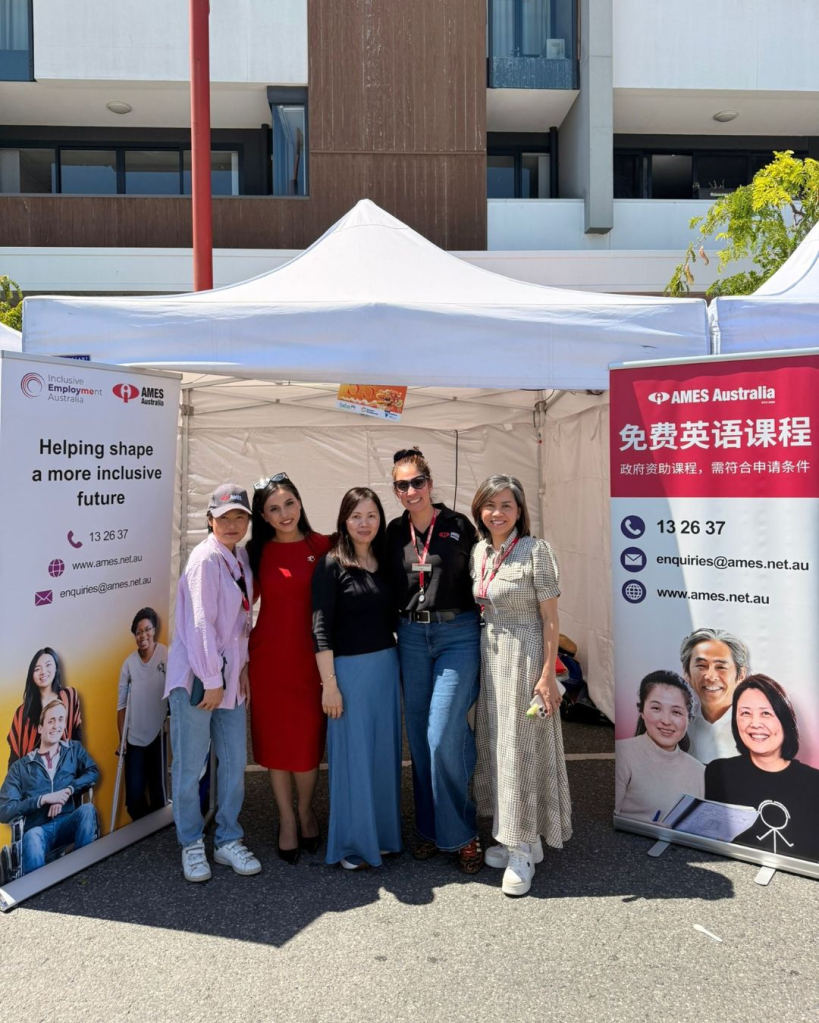
Organization connects with diverse communities at Springvale festival, celebrating cultural traditions across Asia
SPRINGVALE, Melbourne — AMES Australia joined communities across Victoria in welcoming the Year of the Horse over the weekend, participating in a lively Lunar New Year festival in Springvale that brought together thousands celebrating one of the most significant cultural occasions on the Asian calendar.
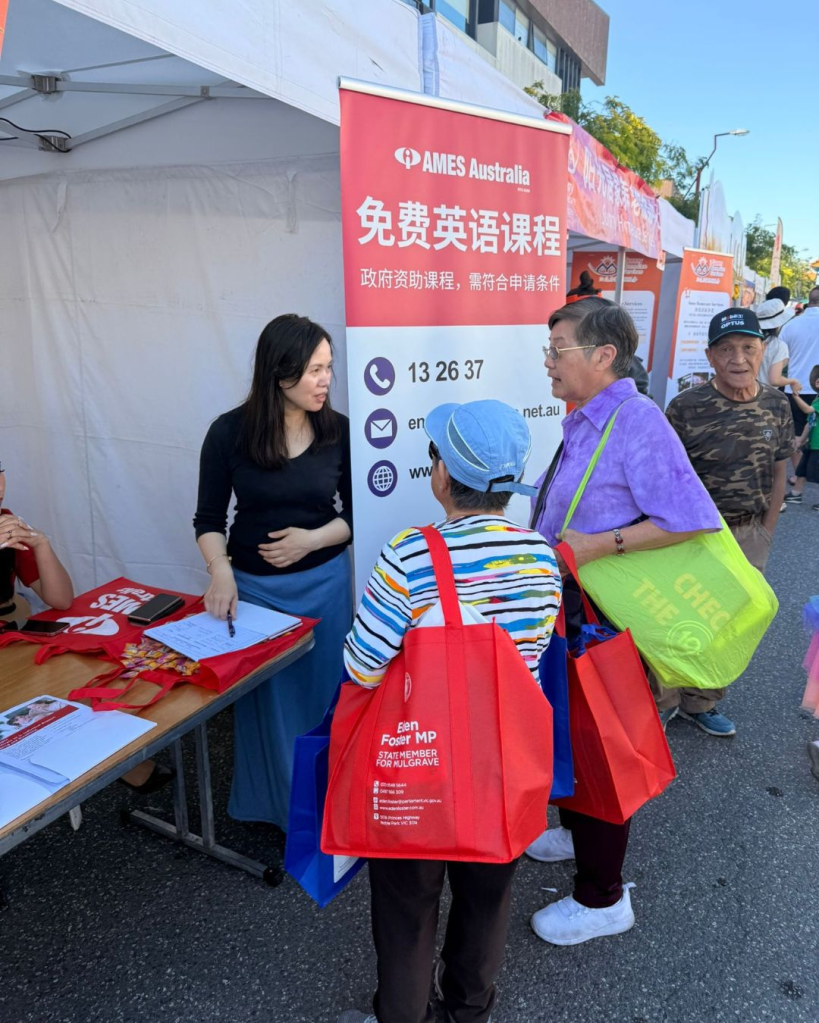
The event, marked by vibrant decorations, traditional performances, and community gatherings, saw AMES Australia team members engaging directly with local community members, sharing information about services and celebrating alongside families from diverse cultural backgrounds.
A Celebration of Many Names and Traditions
Lunar New Year is known by different names across the many cultures that observe it—Chinese New Year, Tết in Vietnam, Seollal in Korea, and various other designations across Asia and among diaspora communities worldwide. Each tradition brings its own customs, foods, and rituals, while sharing common themes of family reunion, renewal, and hope for prosperity in the year ahead.
The Year of the Horse, the seventh animal in the 12-year zodiac cycle, symbolizes energy, strength, and perseverance. Those born in Horse years are traditionally associated with traits including independence, intelligence, and a free-spirited nature. The horse’s symbolism of forward movement and progress resonates across cultures celebrating the new year.
AMES Australia’s Community Engagement
AMES Australia’s participation in the Springvale festival reflects the organization’s ongoing commitment to connecting with and supporting culturally diverse communities across Victoria. The festival provided an opportunity for AMES staff to meet community members in a celebratory setting, building relationships and sharing information about the organization’s services.
“We loved being part of such a joyful event,” an AMES Australia representative shared following the festival. The organization extended a warm thank you to everyone who stopped by to chat with their team during the celebrations.
Springvale: A Hub of Cultural Diversity
Springvale, located in Melbourne’s southeast, is one of Victoria’s most culturally diverse suburbs, with significant populations of Chinese, Vietnamese, Cambodian, and other Asian communities. The suburb’s Lunar New Year festival has grown into one of Melbourne’s premier multicultural events, drawing visitors from across the city to experience traditional performances, food stalls, and community activities.
The festival’s location in Springvale reflects the broader demographic landscape of Victoria, where Asian communities have become an integral part of the state’s multicultural identity. For many families, events like the Springvale festival provide an opportunity to maintain cultural traditions while sharing them with the broader Australian community.
AMES Australia’s Role in Multicultural Victoria
AMES Australia has long played a vital role in supporting migrants, refugees, and asylum seekers as they build new lives in Victoria. The organization provides a range of services including settlement support, English language education, employment assistance, and pathways to further education and training.
Participation in community events like the Lunar New Year festival represents an extension of AMES Australia’s mission—meeting people where they are, building trust within communities, and ensuring that newcomers and established communities alike can access the support they need to thrive in their new homeland.
The Symbolism of the Horse
The Year of the Horse arrives with particular resonance for many in attendance. In Chinese astrology, the horse represents freedom, enthusiasm, and determination—qualities that resonate with the journeys of migrants and refugees who have traveled great distances to build new lives in Australia.
For AMES Australia clients and staff alike, the horse’s symbolism of forward movement and progress aligns with the organization’s work supporting people as they move forward in their Australian journeys—learning language, finding employment, building connections, and creating futures.
Gratitude and Connection
The festival provided not only celebration but genuine connection between AMES Australia and the communities they serve. Conversations at the AMES stall ranged from inquiries about services to shared wishes for prosperity in the new year—each interaction strengthening the bonds between organization and community.
“Thank you to everyone who stopped by to chat with us,” AMES Australia expressed following the event, capturing the spirit of mutual appreciation that characterized the day.
Looking Forward
As the Year of the Horse begins, AMES Australia looks forward to continuing its work supporting Victoria’s culturally diverse communities. The organization’s presence at community celebrations like the Springvale Lunar New Year festival demonstrates a commitment to being present, accessible, and engaged with the people they serve.
For the thousands who attended the festival, the event marked both celebration of tradition and hope for the year ahead. For AMES Australia, it represented another opportunity to demonstrate that the organization stands with Victoria’s diverse communities—not only in times of need, but in times of joy and celebration as well.
Happy Year of the Horse! 🐎🧧✨

Nuhoo Goobanaa (1939-2022): The Legendary Oromo Artist Whose Voice Became a Weapon of Liberation
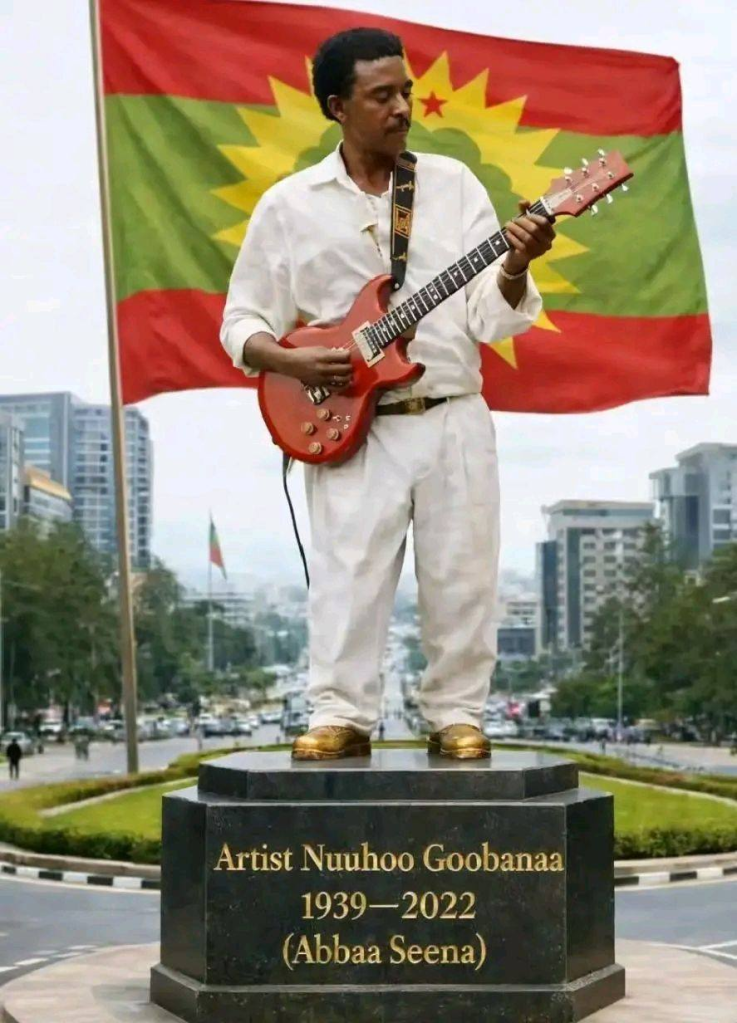
A towering figure of Oromo music and resistance, remembered for his timeless call for unity and freedom
OROMIA — Nuhoo Goobanaa, one of the most iconic and beloved figures in Oromo music and the struggle for cultural and political recognition, left an indelible mark on generations of Oromos through his powerful voice, poetic lyrics, and unwavering commitment to his people’s liberation. Born in 1938 in the historic eastern Oromia city of Dire Dawa to his father Muhaammad Goobanaa and mother Faaxumaa Adam, Nuhoo would grow to become the “virtuoso of revolutionary songs” whose influence transcended borders, languages, and generations.
Early Years: Awakening to Injustice
Nuhoo Goobanaa was born in Laga Mixe, East Hararghe Zone, but grew up in Dire Dawa, where his family moved when he was five years old. From an early age, his natural inclination for singing and art was evident. He began testing his vocals at Madrasa (Quran school) by adding lyrics and changing the rhythms to Manzuma (Islamic chants)—a creative impulse that occasionally landed him in trouble with his teachers. As a youth, he absorbed the rich musical environment of Dire Dawa, mimicking Hindi, Harari, and Sudanese songs that were abundant in the cosmopolitan city.
The trajectory of his life changed dramatically through his encounters with discrimination against the Oromo during the Haile Selassie era. As a teenager in the 1960s, Nuhoo would occasionally skip school to work as an interpreter at the local court in Dire Dawa. This experience exposed him directly to the injustices of the system: three judges presiding in Amharic, a language the majority Oromo population did not speak. The experience led him to profound questions that would shape his life’s work: “Who are the three panel of judges who spoke Amharic? Why didn’t they speak the language of the majority Oromo? Who are we [the Oromo]? Why are the Oromo treated differently?”.
Rather than accepting these injustices as inevitable, Nuhoo embarked on a transformative musical journey of self-discovery and political awakening. He dedicated his life to raising consciousness among his people, becoming one of the most beloved household names in Oromia.
The Birth of an Artist-Activist
In the early 1960s, as a teen, Nuhoo applied to join a newly formed Oromo music band called Biiftuu Ganamaa (The Morning Sun). At 14, he was deemed too young and denied membership. Undeterred, he signed on as a volunteer poet, staying up late at night writing lyrics until he earned his place in the band. “I used to write poems in Amharic and contribute to the band,” he recalled in a 2012 interview.
His formal entry into music came in 1960 when he joined the World of Music within the government structure, eventually becoming a voice alongside intellectuals and national figures. But Nuhoo was never merely an entertainer—he was an artist who carried a weapon, singing revolutionary songs day and night to support the Oromo liberation struggle.
Exile and the Spreading of the Message
Following the breakup of the Afran Qalloo band around 1968, Nuhoo fled to Djibouti as a refugee. It was there that he learned to play the guitar in just one month. “Art was already in me,” he recalled. “In Djibouti, I recorded two albums”. For Djibouti’s Independence Day celebrations in 1969, he performed musical works in Afaan Oromo, Somali, and Arabic.
His journey of exile took him across continents. He traveled to Yemen, Saudi Arabia, and Egypt, living in these countries for many years. In Saudi Arabia, he recorded and released his first through fourth albums, working alongside fellow artists including Elemo Ali, Jamal Ibro, and Aziz, producing music from their homes. During the 1980s, he lived as a refugee in Djibouti, Saudi Arabia, and Canada, never ceasing to create music that empowered his people.
In 1978, he and fellow Oromo artists made their way to Canada, where they continued producing revolutionary songs celebrating unity, love of country, and the struggle for liberation. His long-time friend and fellow musician Elemo Ali recalled of their time together in Saudi Arabia: “Back then, Nuho was doing songs to empower his people. His music was easily memorable”.
A Polyglot Voice for the Oromo
Nuhoo’s artistic reach extended far beyond Afaan Oromo. He recorded and performed in numerous languages, including English, Somali, Tigrinya, and notably Arabic making him the only Oromo artist to write and perform a full song in Arabic, symbolizing the deep connection between the Oromo and Sudanese peoples during a critical historical period. Another friend, Abdo Alisho, spoke of the power of his songs: “They made you love your country. Nuho lived for his people”.
The Return Home and Continued Struggle
When political changes came to Ethiopia in 1991, Nuhoo returned to Finfinne along with the Oromo Liberation Front and other organizations that had been in exile, establishing the transitional government. Together with fellow artists, he produced revolutionary and solidarity music at the OLF office and Lideta Hall at Finfinne University. Following the OLF’s withdrawal from the transitional government, Nuhoo returned to Canada.
But the dream of seeing a liberated Oromia kept calling him back. Though he had a comfortable life in Canada, it was not enough to satisfy his longing. He left Canada to live for several years in Yemen and Kenya, though life there proved difficult, and he faced various pressures from government authorities. In 2002, he made the decision to return from Kenya to his homeland, living in the Oromia he loved until his passing.
Musical Legacy: Tokkummaa and Beyond
Nuhoo Goobanaa’s songs spanned every conceivable aspect of Oromo life: the indignities of exile, the ups and downs of the Oromo struggle, the Oromo flag song (anthem), his beloved Oromia, yearning for home and return, Finfinne, the Gulalle of the early 1990s, love, family, marriage, cultural clashes among the Oromo diaspora, and his own winding life journey . By his own account, he wrote and produced an estimated 380 memorable songs across 38 albums.
His timeless classic “Tokkummaa” (Unity) is widely regarded as akin to an Oromo national anthem, serving as a powerful intergenerational call for transcendent unity of purpose. The song’s refrain—”Tokkummaa, Tokkummaa, Yaa Ilmaan Oromoo Tokkummaa” (Unity, Unity, O Children of Oromo, Unity)—became a rallying cry that resonated across generations.
Other seminal works include:
- “Yaa Rabbi” (Oh God), a spiritual invocation that became another fulcrum for Oromo unity
- “Isin Waamti Harmeen” and “Lallabanee” or “Nu Dirmadha” —desperate calls to action, reproaching and exhorting Oromo intellectuals and personalities to return to Oromia and confront injustice
- “Alaabaa Oromiyaa” —a concise homily on the aims and aspirations of the Oromo movement for self-determination
- “Dhufaan Jiraa” —a soulful and nostalgic yearning for home and belonging
- “Geerarsa” —a robust and searing criticism of dysfunction and failure in Oromo leadership
- “O Galaana Qonnaan Bulaa” and “Alaabaa” , songs whose lyrics became part of the cultural fabric of the struggle
One of his most famous lyrical passages decried division and appealed to Oromummaa as a unifying creed:
“Shan, kudha shan, shantam taatanii, Gargar facaatanii, Bineensa beelaweef hiraata taatanii” (Five, fifteen, fifty, you allowed yourselves to be divided and thus became prey for the hungry beast).
Influence on a New Generation
Nuhoo’s influence extended directly to the next generation of Oromo artists, most notably Hachalu Hundessa, whose songs became anthems in the wave of protests that reshaped Ethiopian politics in the late 2010s. After being partially paralyzed, frequent visits from younger prodigies like Hachalu lifted his spirits. At every opportunity, in speech and gesture, Nuhoo had one request of the Oromo: “Tokkummaa jabeessaa” (Strengthen your unity).
During and in the immediate aftermath of the Oromo protests, Nuhoo saw his dream partially fulfilled and marveled at the state of the Oromo struggle. His songs had laid the foundation for contemporary protest music in Oromia, inspiring, exhorting, and arousing fellow musicians and Oromos to do what was necessary for liberation.
Final Years: A Community’s Love
Nuhoo’s last decade was marked by profound struggle. Around 2007/08, he suffered a stroke that partially paralyzed him and affected his powerful voice. From approximately 2013 onward, he was unable to continue performing. His yearning to live and work among his people was thwarted by deteriorating health.
The Oromo community, both at home and in the diaspora, rallied around their beloved artist. When fans realized the seriousness of his situation, multiple global fundraisers were organized for his medical treatment. In 2013, through the initiative of community members, a campaign called “Let’s Buy Nuhoo a House” succeeded in purchasing a home for him in Adama, east of the capital. The GoFundMe campaign organized for his support emphasized: “It is the responsibility of the entire community that lived off of his lyrics and his strong words to support him in his time of need”.
Despite these efforts, Nuhoo never fully regained his roaring voice, strength, or towering presence . Speaking to the BBC from his hospital bed two years before his death, his message to fans remained consistent: “Keep your unity strong” .
Passing and Funeral
Nuhoo Goobanaa passed away on Tuesday, January 18, 2022, at the age of 74, after a long illness. He died in Adama, in the house that fans had helped purchase for him.
However, the Oromo biography provided for this feature notes that the artist passed away on October 25, 2023 (G.C.) in Oslo, Norway, while undergoing medical treatment. According to this account, cancer was discovered in addition to the stroke that had afflicted him, and despite receiving treatment, his body resisted healing. Following his death, his body was transported back to his homeland (Oromia), and a funeral ceremony was conducted with great honor in Finfinne.
A Legacy That Endures
Nuhoo Goobanaa was more than a musician—he was a “pioneering singer-songwriter and guitarist whose name is near synonymous with Tokkummaa”. He embodied Oromummaa and lived a selfless life of service and struggle. As one tribute noted: “Nuho dedicated his life to promoting the virtues of Tokkummaa and Oromummaa. He leaves behind a momentous legacy that will inspire current and future generations”.
Dr. Awol Kassim Allo, in a comprehensive tribute, wrote: “Nuho’s songs are healing and transformative, expanding our sensibilities and teaching us to pay attention not just to the large-scale system of oppression he witnessed in the courts as an interpreter but also to the everyday, the familiar, the emotional, and intimate aspects of our lives”.
The Oromia Tourism Commission, in its memorial statement, expressed: “The Oromia Tourism Commission expresses its deep sorrow at the death of the hero Artist Nuhoo Goobanaa. May God grant him paradise. We wish strength to his family, relatives, fans, and the entire Oromo people”.
Fana Broadcasting Corporate, in its announcement of his passing, noted: “In addition to Nuhoo’s struggle for the development of Oromo art and language, the work he contributed to the Oromo political struggle holds a significant place in the history of the people’s struggle. Nuhoo understood the divisive politics and factionalism within the Oromo struggle and sang as an artist for Oromo unity”.
A Photograph as Memory
The photograph accompanying this feature captures Artist Nuhoo Goobanaa in 1991 at Gulallee prison, during a moment of singing—a poignant image preserved as a memory of him, combined with the legacy that lives on in our hearts.
Conclusion
Nuhoo Goobanaa’s life was a testament to the power of art as a weapon in the struggle for justice, dignity, and self-determination. From the courts of Dire Dawa where he first witnessed injustice, to the refugee camps of Djibouti where he learned to play guitar, to the stages of Canada, Europe, and the Middle East where his voice thundered for Oromo liberation, he never wavered in his commitment.
His songs remain—hundreds of them—carrying forward his message of unity, his critique of division, his love for his people, and his unwavering hope for Oromo liberation. As the Oromo people continue their journey, Nuhoo Goobanaa’s voice echoes across generations, still calling them to unity, still reminding them of who they are, still urging them forward.
“Nuti lallabna nuti qabsaa’ota…” (We proclaim, we are struggle participants…)
Rest in power, Nuhoo Goobanaa. Your voice never dies.

Oromo Liberation Front Warns: “The Cloud of War Drifting Across the Country and the Danger It Brings to Oromia Is Severe and Heinous”
OLF calls for united stand against cross-border incursions and lasting peaceful solution to Ethiopia’s conflicts
(February 17, 2026, FINFINNE) — The Oromo Liberation Front (OLF/ABO) has issued a stark warning about the escalating security situation in Ethiopia and the severe danger posed to Oromia by ongoing conflicts. In a statement released on February 17, 2026, the organization characterized the recurring “cloud of war drifting across the country” as an increasingly grave threat to the Oromo people and their homeland.
“The security situation in our country has been concerning for decades,” the statement reads. “Oromia has for generations been transformed from a land where peace, stability, and promising development should prevail into a battlefield of war interests and political machinations”.
Decades of Unresolved Conflict
According to the ABO statement, the persistent cloud of war that continues to drift across the country has its roots in decades of unresolved political, military, economic, and social problems. The unceasing conflicts emanating from within the country have continued for generations and show no signs of abating.
Specifically, the organization points to conflicts over land grabbing and resource exploitation in Oromia, as well as territorial expansion by Abyssinian and colonial systems, as ongoing drivers of violence that have continued without interruption.
“The struggle of Oromo people and Oromia residents has been unceasing,” the statement notes. “Although the war devastating Oromia sometimes retreats, because the desire and ambition to plunder Oromia have not stopped, the dream of yesterday and today continues to attack Oromia, and efforts to forcefully seize it have not ceased”.
The Post-1991 Context
The statement particularly emphasizes the severe and heinous harm inflicted upon Oromo people and Oromia residents since the 1991 Charter period. The ABO describes being pushed out of the transitional government through tactical political maneuvering by forces competing for influence, leaving Oromia as a battlefield of looting and exploitation.
As a result, the organization asserts, Oromo people and Oromia residents have been impoverished while outsiders have prospered in their land. Oromia—blessed and fertile—has become a land where its own residents are impoverished while others thrive.
Escalating Violence in Recent Years
In the past eight years specifically, the ABO reports that in addition to the ongoing conflict throughout Oromia, armed incursions by irregular forces crossing Oromia’s borders have further disturbed the peace of Oromia residents.
“Oromia’s borders have been breached, many areas have been left without Oromia administration, land and property owners have been forcibly displaced from their lands, Oromo property has been forcibly looted, innocent people have lost their lives unnecessarily, and the peaceful existence of Oromia residents has been prevented”.
The statement details the multifaceted damage caused by cross-border armed incursions:
- Displacement of peaceful residents from their lands and properties
- Economic deterioration through looting and destruction
- Weakening of social trust and community cohesion
- Proliferation of divisive ideologies and deepening fragmentation
- Absence of effective governance and public administration
- Complete erosion of public trust in government
Call for Comprehensive Peaceful Solution
To mitigate the damage and losses caused by war, the OLF/ABO has consistently advocated for comprehensive peaceful solutions. The organization reiterates its call for:
- Genuine and inclusive political dialogue conducted by the government with all relevant parties
- Proper respect for democratic rights and human rights
- Resolution of regional boundaries through law, dialogue, and lasting agreement rather than force
- Public and international community participation in matters of national peace and security
“These are not merely desirable but essential,” the statement emphasizes.
Regional Context and Urgent Threat
The OLF warns that given the instability, conflicts, and humanitarian crises affecting the Horn of Africa region, combined with the dangers of ongoing war and absence of political solutions, Oromia risks continuing as a battlefield of war interests and political machinations.
“The Oromo people and Oromia residents must not accept this,” the organization declares. “To prevent the evil and heinous consequences of border violations into Oromia, standing united—beyond political and other differences—is the duty imposed by the future situation we face”.
A Call for Unity
The statement concludes with a powerful appeal for Oromo unity in defense of their homeland:
“Therefore, we urge that the Oromo people and Oromia residents, both within and outside, stand together to protect their land and borders from the drifting cloud of war that crosses boundaries and enters their territory—uniting beyond political and other differences—and recognize that collaboration is a national duty”.
The ABO also calls upon social and political actors in the country who genuinely seek peaceful solutions, as well as human rights organizations, the international community, diplomats, and various embassies in the country, to prioritize lasting peace and stability as a matter of collective concern.
Renewed Commitment
“The Oromo Liberation Front reaffirms that it will continue to fulfill its responsibility to protect the peace of Oromia, united with its people”.
The statement is signed and dated February 17, 2026, in Finfinne, carrying the organization’s motto: “Victory to the Masses!”
This report is based on an official statement issued by the Oromo Liberation Front (ABO) on February 17, 2026, addressing the security situation in Oromia and calling for peaceful resolution of conflicts and united defense of Oromia’s territorial integrity.

Bicultural Educators Strengthen Skills to Combat Elder Abuse in Victoria’s Diverse Communities
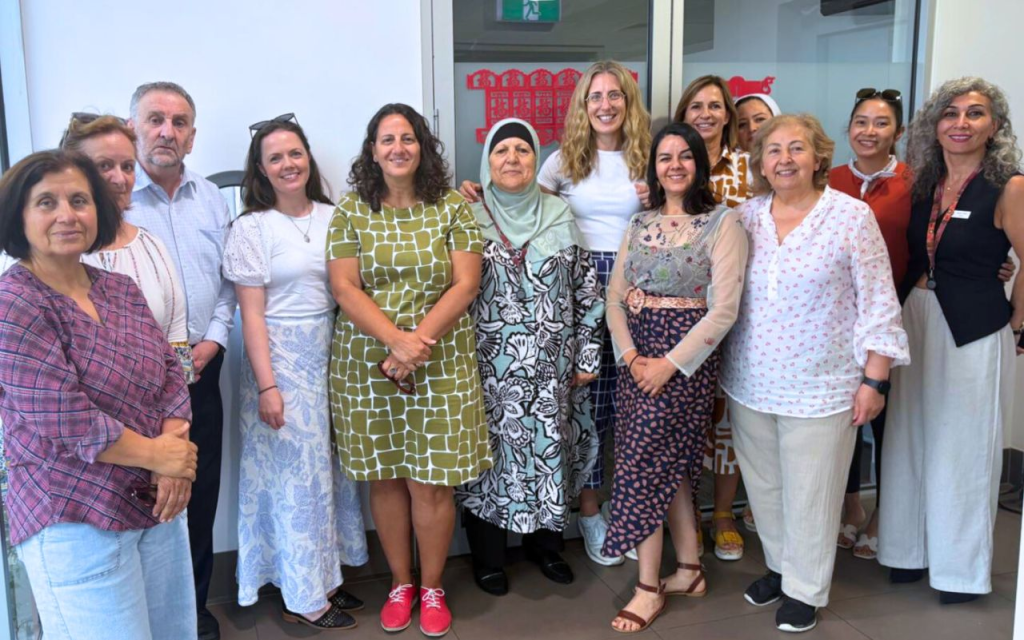
Refresher training brings together multilingual educators to promote respectful relationships and raise awareness using trusted, in-language information
MELBOURNE, Australia — The Ethnic Communities’ Council of Victoria (ECCV) has convened a vital refresher training session for Bicultural Educators working to prevent elder abuse across Victoria’s culturally diverse communities. The session, held last week as part of ECCV’s Elder Abuse Prevention program, equipped multilingual community educators with updated knowledge and resources to continue their essential work protecting older community members .
Seven Bicultural Educators attended the training, representing a remarkable cross-section of Victoria’s linguistic diversity. Languages covered by the attending educators included Dari, Hazaragi, Urdu, Serbian, Persian, Turkish, Spanish, Vietnamese, Greek, and Italian—reflecting the program’s reach into communities spanning Eastern Europe, the Middle East, Asia, and Latin America .
A Trusted Approach to a Sensitive Issue
The Elder Abuse Prevention program supports community members who speak English and another language to raise awareness about elder abuse and promote respectful relationships in their communities. The program’s effectiveness rests on a simple but powerful insight: information about sensitive family matters is most effectively communicated by trusted voices within communities, using languages that older people understand fully .
Elder abuse—which can take forms including financial exploitation, psychological manipulation, physical harm, and neglect—often goes unreported in culturally diverse communities due to language barriers, isolation, cultural norms around family privacy, and lack of awareness about available support services. Bicultural Educators bridge these gaps by bringing information directly to communities in ways that respect cultural contexts while clearly communicating rights and resources.
Expert Facilitation and Guest Presentations
The refresher session was delivered by Hayat Doughan from ECCV and Gary Ferguson from Seniors Rights Victoria, combining ECCV’s community expertise with Seniors Rights Victoria’s specialized knowledge of legal and advocacy supports for older people experiencing abuse .
A guest presentation from ECCV’s Nikolaus Rittinghausen addressed the new aged care reforms, ensuring that Bicultural Educators can help older community members navigate the evolving aged care landscape. As Australia’s aged care system undergoes significant changes, access to clear, in-language information about rights, services, and how to access support becomes increasingly critical for older people from migrant and refugee backgrounds .
Government Partnership
The session also included attendance from staff at the Victorian Department of Families, Fairness & Housing, demonstrating the Victorian government’s commitment to supporting community-led approaches to elder abuse prevention. This partnership between government and community organizations recognizes that effective responses to elder abuse must be co-designed with the communities most affected .
The Department’s involvement also ensures that Bicultural Educators’ on-the-ground insights about challenges facing diverse communities can inform policy development and service design at the state level.
Building Capacity Across Communities
ECCV continues to support Bicultural Educators to work with seniors’ organizations and community groups across Victoria, helping older people and families stay informed and safe. The refresher training represents an ongoing investment in the skills and knowledge of these essential community connectors .
For the educators themselves, the training provides opportunity to share experiences with peers working in different communities, learn about new developments in policy and practice, and refresh their understanding of elder abuse dynamics and intervention strategies. This peer learning dimension strengthens the network of educators across Victoria, creating a community of practice that supports individual educators in their demanding roles.
Addressing a Growing Concern
Elder abuse is a significant and growing concern in Australia, with research suggesting that between 2% and 14% of older people experience abuse in any given year. For older people from culturally and linguistically diverse backgrounds, additional barriers—including language, migration status, financial dependence on family members, and cultural expectations about family care—can increase vulnerability and complicate help-seeking .
The Bicultural Educator model directly addresses these barriers by meeting communities where they are, using languages they understand, and working through trusted relationships. Rather than expecting older people to navigate complex service systems designed for English-speaking Australians, the program brings information and support directly into community spaces.
Community-Led Prevention
The emphasis on promoting “respectful relationships” reflects an understanding that preventing elder abuse requires more than crisis intervention—it requires shifting community norms and expectations about how older people should be treated. Bicultural Educators are positioned to influence these norms from within, drawing on cultural values of respect for elders while challenging practices that cross into abuse .
This preventive approach aligns with public health models that emphasize primary prevention—stopping problems before they start—as the most effective long-term strategy for addressing complex social issues. By building awareness of what constitutes abuse, rights of older people, and available supports, Bicultural Educators help communities develop the knowledge and language to address elder abuse before it escalates.
Languages of Reach
The ten languages represented at the refresher training illustrate the program’s remarkable reach:
- Dari and Hazaragi, spoken by Afghanistan’s diverse communities
- Urdu, widely spoken in Pakistan and parts of India
- Serbian, serving communities from the former Yugoslavia
- Persian, connecting with Iranian communities
- Turkish, serving Victoria’s long-established Turkish community
- Spanish, reaching communities from Latin America and Spain
- Vietnamese, supporting one of Victoria’s largest migrant communities
- Greek, serving generations of Greek Australians
- Italian, connecting with Italian-Australian communities across generations
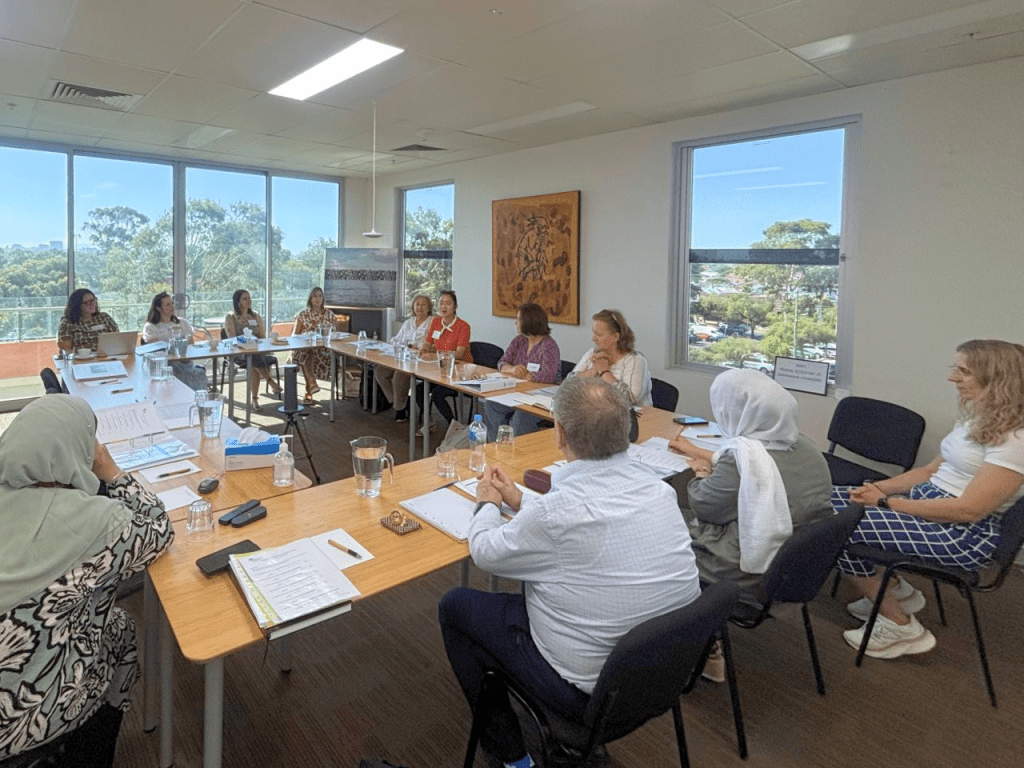
Each language represents not merely a mode of communication but a gateway to communities whose older members might otherwise remain isolated from information about their rights and available supports.
Continuing Commitment
ECCV’s ongoing support for Bicultural Educators reflects a long-term commitment to elder abuse prevention that extends well beyond individual training sessions. The organization works continuously to connect educators with seniors’ organizations and community groups, ensuring that their expertise reaches those who need it most .
The program also contributes to broader advocacy efforts, with insights from Bicultural Educators informing ECCV’s policy work on aged care, elder abuse prevention, and the needs of older people from migrant and refugee backgrounds. This two-way flow—from communities to policymakers via educators—ensures that systemic advocacy remains grounded in lived experience.
How to Learn More
ECCV encourages community members, seniors’ organizations, and anyone concerned about elder abuse to learn more about the organization’s work in this critical area. Detailed information about the Elder Abuse Prevention program, including resources and contact information, is available through ECCV’s website .
For Bicultural Educators interested in participating in the program, or for community organizations seeking to connect with educators serving specific language communities, ECCV welcomes inquiries about how the program can support diverse communities across Victoria.
The refresher training session concluded with renewed commitment from all participants to continue this essential work—ensuring that older Victorians from all backgrounds can age with dignity, respect, and safety, supported by communities that understand and value them.

InTouch Unveils Evolved Brand Identity: A Future Beyond Violence
For forty years, the organization has walked alongside women, children, and communities with courage, care, and deep cultural understanding
MELBOURNE, Australia — After four decades of dedicated service supporting migrant and refugee women experiencing family violence, intouch has unveiled a refreshed brand identity that signals both continuity and evolution. The organization, which has grown exponentially in both reach and complexity since its founding, announced the transformation as a clearer expression of who they have always been—and who they are becoming .
“Today, we are proud to share our evolved brand identity,” the organization announced. “This evolution is not a departure from who we are, but a clearer expression of it. It reflects our growth, our leadership, and our commitment to ensuring the way we communicate truly aligns with the strength, dignity and purpose that define our work” .
Four Decades of Culturally Safe Support
For forty years, intouch has walked alongside women, children and communities with courage, care and deep cultural understanding. What began as a grassroots response to the specific needs of migrant and refugee women experiencing family violence has grown into a nationally recognized leader in culturally safe family violence support .
The organization’s longevity speaks to both the enduring need for its services and the effectiveness of its approach. By centering cultural understanding as essential to effective support, intouch has developed expertise that generic family violence services cannot replicate. Their work acknowledges that safety cannot be separated from cultural identity—that true support must honor who women are, where they come from, and what they need.
Growth and Responsibility
As the organization’s work has grown in reach and complexity, so too has its responsibility—to the people they support, the partners who trust them, and the future they are helping to shape. This evolution reflects a mature organization stepping fully into its leadership role within the family violence sector .
The refreshed identity positions intouch to meet contemporary challenges with renewed clarity and purpose. Family violence does not stand still, and neither can the organizations dedicated to ending it. By evolving how they communicate and present themselves, intouch ensures they remain relevant and accessible to those who need them most.
A Clearer Expression of Purpose
The evolution represents not a departure from the organization’s core identity but a more precise articulation of it. Every element of the refreshed brand has been designed to communicate the strength, dignity and purpose that have always characterized intouch’s work .
This clarity extends to the organization’s fundamental purpose, now stated with renewed conviction:
“To champion culturally safe family violence support for anyone who needs it, anywhere they need it.”
This purpose statement encompasses both the “what” and the “how” of intouch’s work—the commitment to supporting all who need help, regardless of location or circumstance, and the distinctive approach of ensuring that support is culturally safe. For migrant and refugee women, cultural safety is not a luxury or an add-on; it is essential to effective intervention and genuine healing.
Strengthening Advocacy and Connection
The refreshed identity strengthens how intouch shows up, advocates, and connects with the communities they serve. In a crowded field of service providers, clear communication about what makes intouch distinctive helps ensure that those who need their specific expertise can find them .
For partners and funders, the evolved identity signals an organization confident in its leadership role and clear about its contribution to the broader effort to end family violence. For the women and children intouch supports, it promises continuity of the culturally safe care they have always received, delivered with renewed clarity and purpose.
Honoring Those Who Shaped the Organization
The evolution honours the community, staff, partners and supporters who have shaped intouch over four decades. No organization reaches forty years without the dedication of countless individuals whose contributions, large and small, built the foundation upon which today’s work stands .
By evolving thoughtfully—building on what has always been true while adapting to meet present and future needs—intouch ensures that the legacy of those who came before continues to inform and inspire the work going forward. The refreshed identity carries forward the values and commitments that have always defined the organization, expressed for a new era.
Equipped for the Future
The evolution ensures intouch is equipped to continue this vital work with clarity, courage and care into the future. The challenges ahead—changing demographics, evolving forms of family violence, shifting policy landscapes—require an organization that is both grounded in experience and adaptable to change .
With refreshed tools for communication and advocacy, intouch stands ready to meet these challenges. The clarity of purpose that emerges from this process will guide decision-making and priority-setting for years to come, ensuring that resources are directed where they can have the greatest impact.
The Work Continues
“This evolution honours the community, staff, partners and supporters who have shaped intouch over four decades,” the organization stated. “It ensures we are equipped to continue this vital work with clarity, courage and care into the future” .
The announcement carries a message of both continuity and recommitment:
“The work continues. The commitment deepens. The future is beyond violence.”
This framing positions the brand evolution not as an endpoint but as a milestone on an ongoing journey. The work of ending family violence is generational; forty years represents a significant chapter, but the story continues. With deepened commitment and renewed clarity, intouch presses forward toward the future they are helping to create.
A Vision of What’s Possible
The tagline “A future beyond violence” encapsulates both hope and determination. It acknowledges that such a future is possible—that family violence is not inevitable but can be prevented and ultimately ended. At the same time, it recognizes that achieving this future requires sustained effort, cultural competence, and unwavering commitment .
For the migrant and refugee women intouch supports, a future beyond violence is not abstract—it is the concrete goal of every intervention, every safety plan, every supportive conversation. The organization’s evolved identity keeps this vision front and center, reminding all who encounter it of what they are working toward.
Looking Forward
As intouch enters its fifth decade with refreshed identity and renewed purpose, the organization looks forward to continuing its essential work. The challenges remain significant: family violence affects migrant and refugee women at disproportionate rates, and barriers to support—language, culture, immigration status, isolation—can seem insurmountable.
But intouch has forty years of evidence that these barriers can be overcome with the right approach. Culturally safe support works. Women and children can and do find safety and healing. And with each life transformed, the vision of a future beyond violence comes closer to reality.
The evolved brand identity announced today serves as both celebration of what has been achieved and commitment to what remains to be done. For intouch, for the communities they serve, and for all who share their vision, the work continues—toward a future beyond violence.

Ethiopia to Mandate Premarital Training Certificate for Couples Seeking Marriage
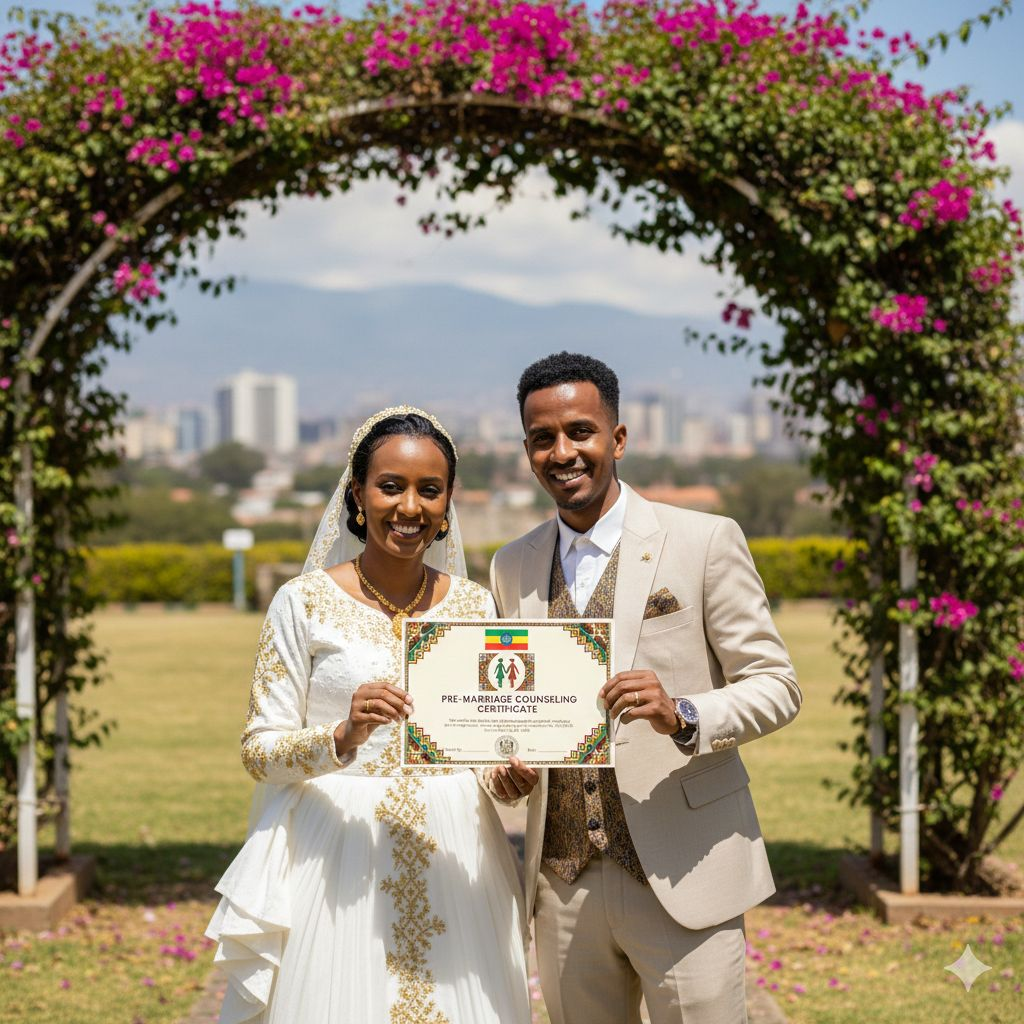
Ministry announces new regulation to combat skyrocketing divorce rates through mandatory education and certification
ADDIS ABABA — In a landmark initiative aimed at reversing Ethiopia’s rising divorce rates, the Ministry of Women and Social Affairs has announced plans to implement mandatory premarital training certification for all individuals seeking to enter into marriage. The new regulation would prohibit anyone without the required certificate from legally marrying .
The innovative approach, slated to take effect next year, represents a significant intervention in Ethiopia’s social policy landscape, targeting what officials identify as a primary cause of marital breakdown: lack of awareness and understanding about the realities of married life .
Alarming Statistics Drive Policy Response
The announcement follows concerning data released by the Addis Ababa City Civil Registration and Residence Service Agency, which revealed that divorce rates have increased by 54 percent compared to previous years. With over 20 million families currently in Ethiopia, the stability of the family unit has emerged as a pressing national concern demanding urgent attention .
Mr. Tesfaye Robele, Chief Executive for Elderly and Family Affairs at the Ministry of Women and Social Affairs, confirmed that preparations are underway to implement the system in the coming year. Speaking to Sheger Radio, officials outlined the ministry’s comprehensive approach to addressing what they describe as a crisis in Ethiopian family life .
“We have prepared training manuals to address this problem,” Mr. Tesfaye stated. “The primary cause for many marital breakdowns is the lack of awareness and understanding about what marriage truly entails” .
Collaborative Development with Religious and Community Leaders
Recognizing that marriage in Ethiopia is deeply intertwined with religious and cultural traditions, the ministry is pursuing a collaborative approach to implementation. Officials emphasize that the new system will be developed in consultation with religious institutions and community elders, ensuring respect for diverse cultural and faith-based marriage traditions .
“We are working in consultation with religious institutions and elders,” Mr. Tesfaye confirmed, highlighting the ministry’s commitment to creating a system that honors Ethiopia’s rich diversity of marriage practices while establishing consistent standards for preparation .
This collaborative framework acknowledges that marriage ceremonies in Ethiopia are performed through various institutions—religious bodies, civil authorities, and traditional community structures—all of which will need to participate in implementing the new requirements.
Comprehensive Strategy Beyond Certification
The premarital certification requirement represents just one component of a broader strategy to strengthen Ethiopian families. The ministry also announced the establishment of a joint forum bringing together various institutions working on family issues .
According to Mr. Tesfaye, this forum aims to identify and address gaps in family management practices while providing recommendations and guidance to the government on necessary actions to support family stability. The initiative reflects a holistic understanding that healthy marriages require ongoing support, not merely preparation before the wedding .
“We must begin the journey toward national change starting from the family,” the official emphasized, highlighting the fundamental role that stable households play in broader societal development . This perspective positions family stability as not merely a private concern but a public good essential to national progress.
Training Curriculum and Implementation
Ministry officials indicate that training manuals have already been prepared for the program. While specific curriculum details are still being finalized in consultation with religious and community leaders, the training is expected to cover fundamental aspects of marriage including communication skills, conflict resolution, financial management, and realistic expectations about married life .
The duration of required training and specific certification mechanisms remain under development, with implementation details to be announced following the consultation period. The goal of launching within the next year provides a clear timeline for completing these preparations .
Addressing a Growing Social Challenge
Ethiopia’s divorce rate increase of 54 percent reflects broader social transformations affecting families across the nation. Urbanization, changing gender roles, economic pressures, and evolving social expectations have all contributed to shifting dynamics in marital relationships .
The ministry’s initiative recognizes that many couples enter marriage with romanticized expectations rather than practical understanding of the commitment involved. By requiring structured preparation, officials hope to reduce the likelihood of marriage breakdown stemming from preventable misunderstandings or mismatched expectations.
Religious and Cultural Considerations
The collaborative approach with religious institutions acknowledges the complex landscape of marriage in Ethiopia, where religious ceremonies carry legal weight and traditional marriages performed by community elders remain common. Any successful intervention must work within these existing structures rather than attempting to supersede them.
Ethiopia’s religious diversity—encompassing Orthodox Christianity, Islam, Protestant Christianity, and traditional belief systems—means that marriage preparation will need to accommodate varied perspectives while maintaining consistent core content about marriage fundamentals.
Potential Impact and Challenges
If successfully implemented, the mandatory premarital training requirement would position Ethiopia among a growing number of countries recognizing the value of marriage preparation. Research in other contexts has suggested that well-designed premarital education can reduce divorce rates by helping couples develop realistic expectations and essential relationship skills.
However, implementation challenges remain significant. Ensuring accessibility of training across Ethiopia’s diverse regions, managing costs for prospective couples, and maintaining consistent quality while respecting local traditions will require careful planning and adequate resources.
The ministry’s emphasis on collaboration with existing institutions—religious bodies, community elders, and family service organizations—suggests an awareness that successful implementation depends on building upon established community structures rather than creating parallel systems.
Broader Social Implications
The initiative reflects growing recognition in Ethiopia that family stability has cascading effects on broader social outcomes. Children from stable households generally show better educational and health outcomes, while family breakdown can contribute to economic hardship and social challenges .
By intervening at the point of marriage, the ministry aims to prevent problems before they develop rather than responding after families have already fractured. This preventive approach aligns with public health models that emphasize early intervention and education as cost-effective strategies for addressing social challenges.
Looking Forward
As Ethiopia prepares to launch this innovative program, attention will focus on the consultation process with religious and community leaders, the development of culturally appropriate training materials, and the establishment of certification mechanisms that are accessible to all Ethiopians regardless of location or economic circumstance.
The coming year will see these elements take shape, with ministry officials working to transform policy announcement into operational reality. If successful, Ethiopia’s experiment in mandatory marriage preparation could offer lessons for other nations grappling with similar challenges of family stability in rapidly changing societies.
For Ethiopian couples planning to marry in the coming years, the new requirement will add an additional step to the marriage process—one that officials hope will prove invaluable in building the foundation for lasting, healthy unions. As Mr. Tesfaye emphasized, the ultimate goal extends beyond certification to the creation of stable families capable of contributing to national development and social wellbeing .

The TPLF: A Brutal Force That Should Never Have Been Given a Single Day’s Opportunity as an Organization
Oromo voices reflect on three decades of suffering under Tigrayan-led rule
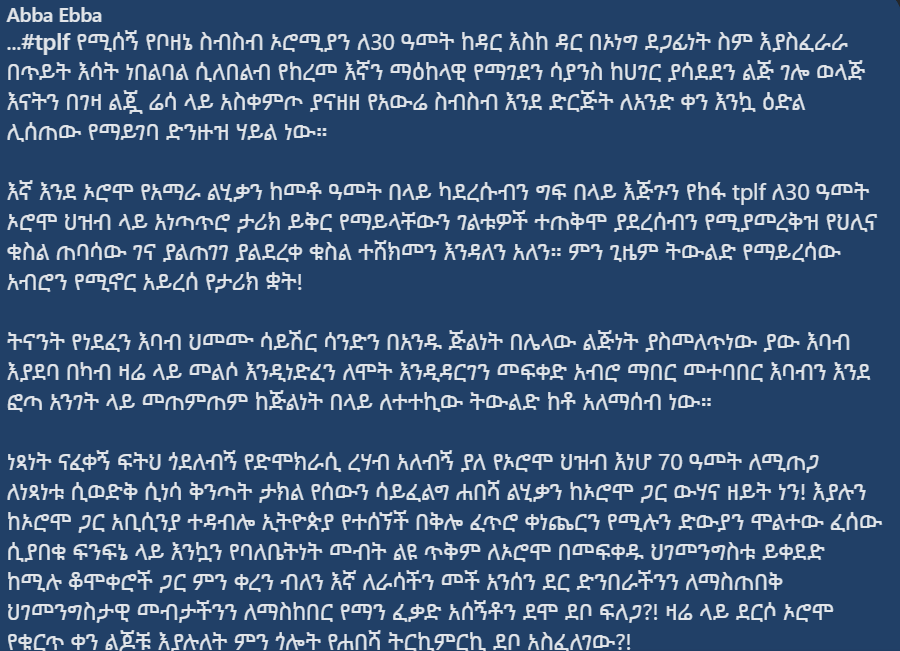
FINFINNE — In a powerful and searing social media commentary that has resonated across Oromo networks, a voice identified as Abba Ebba has articulated the deep historical wounds and enduring grievances of the Oromo people against the Tigray People’s Liberation Front (TPLF), describing the organization as a “brutal force” that should never have been legitimized .
The statement, shared under the hashtag #Abba_Ebba, offers a raw and unflinching examination of the TPLF’s three-decade rule over Ethiopia and its specific impact on the Oromo people—a period the author describes as inflicting wounds “far worse than a hundred years of Abyssinian elite oppression” .
Thirty Years of Suffering
According to the commentary, the TPLF, operating under the banner of the Ethiopian People’s Revolutionary Democratic Front (EPRDF), controlled Oromia for thirty years, threatening the region from end to end in the name of supporting the Oromo Liberation Front (OLF) while actually enveloping the land in flames of gunfire .
The author describes how the TPLF blocked Oromos from the center, drove them from their country, killed children, and placed mothers upon the corpses of their own offspring in acts of unspeakable cruelty . This “collection of beasts,” as the author characterizes the TPLF, is portrayed as having committed atrocities that have left permanent scars on the Oromo collective consciousness .
“More than a hundred years of oppression by Abyssinian elites, the TPLF targeted the Oromo people for thirty years with historically unforgivable atrocities, using every means available,” the statement reads. “The wound of conscience they inflicted upon us is still unhealed, a scar not yet dried—we carry this unhealed wound with us” .
A Legacy That Lives With Generations
The commentary emphasizes that these historical wounds are not merely past events but living realities carried by the Oromo people. “Generations will not forget—it lives with us, an unerasable historical scar” .
The author draws a powerful analogy: “Yesterday, a snake bit us. Before the pain subsided, because of the foolishness of one and the childishness of another, we let it escape. That same snake, growing fat and multiplying, has returned today to bite us again, to bring us to death” .
Allowing this to happen, the author argues, is worse than foolishness—it is a failure to think of the coming generation. Collaborating with such forces, treating the snake as if it were a towel to be wrapped around one’s neck, represents a profound betrayal of the future .
The Quest for Freedom and Justice
The commentary gives voice to the Oromo people’s longstanding aspirations: “The Oromo people who say ‘I long for freedom, justice has been denied me, I hunger for democracy’—here they are, for nearly 70 years falling and rising in their struggle for freedom” .
Unlike others, the author asserts, Oromos have never sought scraps from anyone’s table. Yet Abyssinian elites have consistently declared, “We are like water and oil with Oromos!” while simultaneously claiming to have created a hybrid “mule” called Ethiopia through fusion with Oromos .
The author questions how, when the constitution grants special rights to Oromos even in Finfinne, there are those who would tear up the document, asking what remains for Oromos. “When will we stand up for ourselves, to protect our borders, to secure our constitutional rights—whose permission do we need to seek?” .
Today, the author notes, people say of Oromos, “They are children of the moment.” But what need has the Oromo of Abyssinian political maneuvering and crumbs?
The Folly of Sacrificing Justice for Peace
The commentary critiques those who urged compromise: “Yesterday, for the sake of peace, we abandoned justice! We forgave what you did publicly! There is no peace without justice” .
Those who stole wealth, whether collectively or individually, who used power to destroy lives, burn forests, displace people, commit inhuman acts in any form—the author insists they must not escape accountability .
Questions are raised about political transitions: “What and who is bringing the transition? From where to where?” The author suggests that those who mocked others for not understanding politics are now seeing the consequences .
What once appeared to some as downhill before them now seems as distant as the sky, transformed into an uphill struggle. “Are you truly not angered as you watch?” the author asks, suggesting that deep regret, not indifference, is the appropriate response .
Historical Memory: The Western Oromo Confederation of 1936
The commentary invokes a crucial but often overlooked chapter of Oromo history: the Western Oromo Confederation of 1936. Before the TPLF was even created, Oromos sent a delegation to the United Nations seeking to govern themselves through confederation .
This historical episode, disrupted by Italy’s five-year colonization of Abyssinia, demonstrates the long-standing Oromo pursuit of self-determination, predating the TPLF’s emergence by decades .
The author cites scholarly work by Ezekiel Gebissa on “The Italian Invasion, the Ethiopian Empire, and Oromo Nationalism: The Significance of the Western Oromo Confederation of 1936,” pointing to a tradition of Oromo political organizing that Abyssinian and Tigrayan narratives have systematically obscured .
Cultural Appropriation: The Heritage of “Weyane”
The commentary also raises questions of cultural appropriation, asking whether the TPLF has forgotten that “Weyane”—the traditional struggle strategy from which the organization derives its name—is actually Oromo heritage from Raya and Rayuma .
This observation, the author explains, is offered to counter any suggestion that Tigrayan or Amhara elites taught Oromos about freedom struggle. The historical record, including scholarship on “Peasant Resistance in Ethiopia: the Case of Weyane” published in the Journal of African History, demonstrates that Oromo traditions of resistance long preceded TPLF organizing .
The Complexity of Recognition
The author acknowledges that the situation is complex—like makeup applied and removed, artificial people appearing before cameras, living under disguise. But the weight of the matter, they emphasize, concerns the supremacy of the people, the formation of the nation, the debt owed to fathers, mothers, and faith .
“Knowledge means grasping the trunk of the tree, not hanging on its branches—hold the branches and you will fall” .
A Warning Unheeded?
The commentary concludes with a stark image: “O TPLF! The one who never says ‘enough’ will spit and continue. ‘Emboor! Emboor!’ (Get away! Get away!) they say to those who hold back and separate—now the flood has reached the neck, asking ‘What has brought my situation?'”
This metaphorical warning suggests that those who ignored calls for restraint and justice now find themselves overwhelmed by consequences of their own making .
Historical Context
The TPLF led the armed struggle that overthrew the Derg regime in 1991 and subsequently dominated Ethiopian politics for nearly three decades until Prime Minister Abiy Ahmed came to power in 2018. During their rule, the TPLF was the dominant force within the EPRDF coalition, controlling the levers of state power and directing security forces that, according to numerous human rights reports, committed widespread abuses against civilians in Oromia and other regions .
The period from 1991 to 2018 saw repeated military campaigns in Oromia, mass arrests of Oromo activists and politicians, and systematic suppression of Oromo political expression. The International Criminal Court’s Office of the Prosecutor noted in 2019 that it had received information regarding alleged crimes against humanity in Ethiopia dating back to 2015, including in Oromia .
Contemporary Relevance
The commentary appears against the backdrop of ongoing tensions in Ethiopia’s post-2018 political transition. While the TPLF was removed from federal power, it retained control over Tigray regional state until the recent Tigray War (2020-2022) dramatically altered the political landscape .
For Oromos, the question of accountability for past abuses remains unresolved. Many Oromo activists and politicians have called for justice for victims of TPLF-era atrocities, even as they navigate complex relationships with other political forces in contemporary Ethiopia .
A Voice for the Unhealed Wound
Abba Ebba’s commentary gives voice to what it describes as an “unhealed wound” in Oromo collective memory—the accumulated trauma of three decades of TPLF rule that compounded more than a century of Abyssinian domination .
The response to the post, shared widely across Oromo social media networks, suggests that these sentiments resonate deeply within the Oromo community. The demand for justice, the insistence on historical memory, and the refusal to accept narratives that minimize Oromo suffering emerge as consistent themes .
As Ethiopia navigates an uncertain political future, with ongoing conflicts in multiple regions and unresolved questions about the country’s constitutional order, voices like Abba Ebba’s serve as reminders that for many Oromos, the past is not past—it is a living wound that demands acknowledgment and, ultimately, healing through justice .
Whether such justice will be achieved, and what form it might take, remains one of the most pressing and unresolved questions in Ethiopian politics. For the Oromo people, as the commentary makes clear, the struggle continues—not only for freedom and democracy in the future but for acknowledgment and accountability for the crimes of the past.

Celebrating 49 Years of Bariisaa: A Voice for Oromo Equality
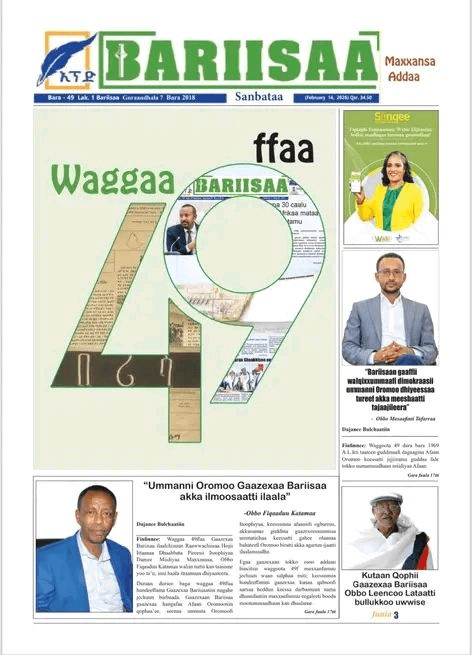
“Bariisaa Served as a Tool for the Oromo People’s Quest for Equality and Democracy”
– Mr. Masafinti Tafarraa
Oromo-language newspaper marks 49 years of serving as a beacon of information, identity, and struggle
FINFINNE — Forty-nine years ago, in 1969 E.C. (1976/77 G.C.), a transformative development in the growth and flourishing of the Afaan Oromo language occurred that would fundamentally reshape the landscape of Oromo media and lay the foundation for where Oromo-language outlets stand today: the establishment of Bariisaa Newspaper .
In an era before the proliferation of science and technology, when broadcast media could be counted on one’s fingers and the internet had not yet become the domain of a generation, the Oromo people’s love, effort, and desire for information and knowledge could only be satisfied through written word. It was in this context that the demand for and acceptance of newspapers was immense .
Bariisaa Newspaper, carried forward by scholars and heroes who toiled from afar and succeeded, passing from generation to generation through the接力 of struggle against tyranny, has now marked 49 years of existence .
Today marks the anniversary of Bariisaa Newspaper’s founding—for the Oromo people, a day when the dawn of information and knowledge shone brightly, just as the name “Bariisaa” (Dawn) suggests the morning star appears .
A Tool for the People’s Struggle
In an interview commemorating the anniversary, Mr. Masafinti Tafarraa, Executive Officer of the Ethiopian Press Agency, shared reflections on the newspaper’s historic role .
According to Mr. Masafinti, from its inception through half a century of service, Bariisaa Newspaper has undertaken and achieved great work for the freedom, equality, and democracy of the Oromo people .
Crucially, he noted that Bariisaa was established precisely at a time when the Oromo people’s demand for equality and democracy was being raised. In this context, the newspaper served as a vital medium of communication for the people’s aspirations .
Following that period and continuing after the people’s demands were reiterated, Bariisaa never halted its mission but persevered and has arrived at today’s milestone .
The founders of the newspaper were themselves participants in the struggle for the people’s equality movement at that time and played significant roles. Through their involvement, the newspaper became intertwined with the contemporaneous struggle being waged .
A Legacy of Forty-Nine Years
For nearly five decades, Bariisaa has chronicled the Oromo experience, documenting both the ordinary and extraordinary moments of Oromo life while serving as a platform for intellectual and political discourse. The publication has weathered changing political climates, technological revolutions, and shifts in the media landscape while maintaining its commitment to providing information in Afaan Oromo.
The newspaper’s endurance through nearly half a century reflects both the dedication of those who have sustained it and the persistent hunger for Oromo-language media among its readership. From its early days when written word was the primary means of mass communication to the contemporary era of digital media, Bariisaa has adapted while maintaining its core mission.
The Founders’ Vision
The founders of Bariisaa were not merely journalists but activists who understood the power of the written word in advancing the cause of equality. By establishing a newspaper in Afaan Oromo at a time when the language itself was marginalized, they made a profound statement about Oromo identity and the right to information in one’s mother tongue.
Their vision extended beyond simple news reporting to encompass the broader struggle for recognition and rights. The newspaper became both a record of that struggle and a participant in it, documenting abuses while articulating aspirations.
From Print to Digital: Evolution of a Legacy
As Bariisaa celebrates 49 years, it does so in a media environment dramatically transformed from its founding era. The broadcast media that were once scarce are now abundant, and the internet that was unknown to the generation of the 1970s has become ubiquitous.
Yet the fundamental need that Bariisaa addresses—the desire of Oromo people to receive information and analysis in their own language, reflecting their own perspective—remains unchanged. The newspaper has evolved alongside technology, with many readers now accessing content digitally while others continue to value the tangible experience of print.
Cultural and Linguistic Significance
Beyond its journalistic function, Bariisaa has played an important role in the development and standardization of written Afaan Oromo. At a time when the language was primarily oral in many contexts, the newspaper provided a model for written expression and helped establish conventions that would influence subsequent Oromo-language publishing.
For generations of Oromo readers, Bariisaa has been a window onto their world and beyond—a source of news, analysis, and cultural content that affirmed the value and vitality of their language. The newspaper has helped maintain and strengthen Oromo identity, particularly among diaspora communities separated from their homeland.
Forty-Nine Years of Service
The 49th anniversary represents a significant milestone, approaching the half-century mark that will be celebrated next year. For an independent publication to endure for nearly five decades in challenging political environments is a testament to the commitment of its staff, the loyalty of its readers, and the enduring need it fulfills.
Mr. Masafinti Tafarraa’s acknowledgment of Bariisaa’s role as a “tool” for the Oromo people’s quest for equality and democracy captures the publication’s essential character. It has never been merely a commercial enterprise or a neutral conveyor of information, but rather an institution deeply engaged with the aspirations of the people it serves.
Looking to the Future
As Bariisaa approaches its golden jubilee, questions of sustainability, adaptation, and continued relevance arise. The media landscape continues to evolve rapidly, with social media and digital platforms reshaping how people consume information. Younger generations, in particular, may engage with news differently than their parents and grandparents.
Yet the need that Bariisaa addresses—for information in Afaan Oromo that speaks to Oromo concerns from an Oromo perspective—remains as pressing as ever. The newspaper that has survived and thrived for 49 years has demonstrated remarkable adaptability, and there is every reason to believe it will continue to find ways to serve its readership.
A Dawn That Continues to Shine
The name Bariisaa—Dawn—carries with it the promise of new beginnings and the light that follows darkness. For forty-nine years, the newspaper has lived up to its name, bringing the light of information and knowledge to successive generations of Oromo readers.
As Mr. Masafinti Tafarraa’s reflections make clear, Bariisaa’s significance extends beyond its role as a news outlet. It stands as a testament to the power of the written word in struggles for justice, a record of a people’s journey through nearly five decades of change, and a continuing voice for equality, democracy, and the rights of the Oromo people.
The 49th anniversary of Bariisaa Newspaper is not merely a celebration of longevity but a recognition of enduring purpose—a purpose rooted in the struggles of the past and reaching toward the dawn of a future where the aspirations that gave birth to the publication may finally be realized.

Dinqinesh Dheressa and Dr. Trevor Trueman: Two Pillars of the Oromo Struggle Forever Remembered with Honor
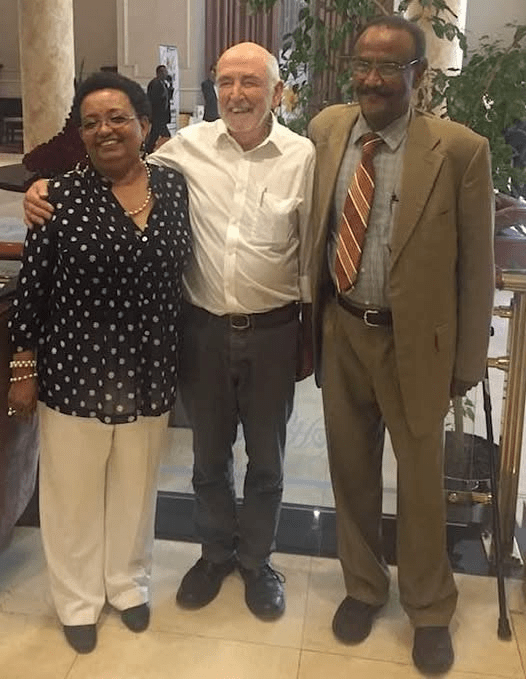
Activist and ally exemplify the international solidarity and unwavering commitment that sustain the movement for Oromo self-determination
GLOBAL — Dinqinesh Dheressa and Dr. Trevor Trueman stand as figures who will forever be remembered with honor in the annals of the Oromo liberation struggle—one a devoted activist who gave voice to Oromo women’s oppression, the other a British physician who became one of the movement’s most effective international advocates.
Their contributions, though arising from vastly different backgrounds, together illustrate the multifaceted nature of the Oromo struggle: a fight carried forward not only by those who bear its identity but also by allies whose solidarity transcends ethnicity and origin. As the Oromo liberation struggle continues “as a shield of humanity strengthening humanity itself,” the legacies of Deressa and Trueman remind us that the quest for freedom draws strength from diverse sources of commitment and courage .
Dinqinesh Dheressa: A Voice for Oromo Women
Dinqinesh Dheressa Kitila is an Oromo woman whose activism emerged from personal experience of discrimination and grew into institutional leadership. As the founder of the International Oromo Women’s Organization, a non-profit registered in the United States, she has dedicated her life to standing against discrimination and bringing social change, with particular emphasis on women’s empowerment.
Born and raised in Oromia, Ethiopia, Dheressa’s commitment to justice was forged in childhood. During elementary school, when she ran for student council president, a boy was preferred over her despite her having the highest grades. This early experience of discrimination motivated her to lead a fight against discrimination against women—a fight she has continued throughout her life.
Dheressa’s analysis of Oromo women’s situation is stark and unflinching. “The state of oppression is very deep in general but Oromo women face even greater difficulty,” she has stated. “Abyssinians treat Oromo women poorly. If a woman proposes a constructive idea, it doesn’t get proper attention as women are discriminated against up to a level where they are not considered as human beings”.
For Dheressa, self-determination is not an abstract political concept but a deeply personal and practical matter. She describes it as “a process by which one can take control of her/his whole life, decide freely what is good for her/him or not, what is important to her/him.” Beyond self-determination, she sees independence as giving people “the power to act freely” .
The key to achieving self-determination, in her view, lies in empowering oppressed people and standing for their rights as human beings. She emphasizes that organization is vital—if one wants to stand for peace and especially for women and their rights, being organized is essential .
Dheressa has also consistently called upon the international community to act. “The international community and humanitarian organisations have to take appropriate action to stop the Ethiopian government’s brutality against the Oromos,” she has urged. Her work with the Unrepresented Nations and Peoples Organization (UNPO) has helped bring Oromo concerns before international audiences, ensuring that the struggle receives attention beyond Ethiopia’s borders.
Dr. Trevor Trueman: The Quiet Ally
If Dheressa represents the voice of Oromo womanhood speaking on behalf of her people, Dr. Trevor Trueman represents something equally: the outsider who becomes an essential insider through decades of faithful service.
Dr. Trueman—affectionately known by the Oromo name Galatoo, meaning “Thank You”—has woven himself so deeply into the narrative of the Oromo struggle that he has become inseparable from it, transcending geography, ethnicity, and origin .
His journey with the Oromo people began not in the halls of advocacy, but in the gritty, desperate reality of survival. In the late 1980s, as a family health physician, he was in Sudan training Oromo health workers in refugee camps. When the Derg fell in 1991, he moved into Wallagga, shifting his focus to training community health workers. This foundation is crucial: his alliance was born not of abstract political theory, but of humanitarian connection—of seeing, firsthand, the people behind the cause. He didn’t arrive as an activist; he became one through service .
It was from this ground-level view that his pivotal role emerged. Starting in 1992, he began the critical, dangerous work of documenting and internationalizing the Ethiopian government’s systematic human rights violations against the Oromo people. While the OLF and others fought on the political and military fronts, Dr. Trueman opened a vital front in the global arena of information. He understood that tyranny thrives in silence and that the world’s conscience must be awakened with evidence. His reports became the credible, external voice that the diaspora and activists within could amplify, forcing the “Oromo question” onto agendas where it was being ignored .
His strategic genius is perhaps best embodied in the Oromia Support Group (OSG) , which he co-founded in 1994. The OSG was not a protest group but a clearinghouse for truth. It methodically gathered testimony, verified atrocities, and funneled this information to UN bodies, foreign governments, NGOs, and media outlets. For decades, when the Ethiopian state dismissed accusations as rebel propaganda, the OSG’s meticulously documented reports stood as unassailable counter-evidence. Dr. Trueman became a bridge of credibility, translating the suffering of a distant people into a language the international system was compelled, at least, to acknowledge .
A recent tribute to Dr. Trueman highlights several profound truths about his work:
- The Outsider as Essential Insider: Dr. Trueman’s identity as a “foreign national” was not a barrier but a unique asset. It lent his documentation a perceived objectivity that was desperately needed to break through global apathy. He wielded his privilege as a tool for the voiceless .
- Advocacy as a Marathon, Not a Sprint: His commitment, spanning from 1988 to the present day, defines “umurii dheeradhaa” —a long life of dedication. While political fortunes and rebel movements evolved, his channel of advocacy remained constant, providing a thread of continuity through decades of struggle .
- The Strategic “Taphat” (Preparation) : The tribute notes he will be remembered for his “shoora taphataniif” —his strategic preparations. His work was the essential groundwork. By ensuring the world could not plead ignorance, he created the political space and pressure that empowered all other facets of the Oromo struggle .
Dr. Trevor Trueman’s legacy is a masterclass in effective international solidarity. He did not seek to lead the Oromo struggle; he sought to amplify it. He did not fight with weapons, but with words, facts, and an unwavering moral compass. In the grand symphony of the Oromo quest for freedom, if some voices are the roaring melodies and others the steady rhythm, Dr. Trueman’s has been the crucial, clear note of the witness—persistent, truthful, and cutting through the noise to make the world listen .
For this, the name Galatoo is not merely a token of thanks, but a title of honor, earned over a lifetime. His work ensures that the crimes committed in darkness are recorded in light, and that the struggle of the Oromo people has, indeed, been given an echo the world cannot un-hear .
The Struggle Continues
The Oromo liberation struggle, which both Dheressa and Trueman have served so faithfully, continues today against a backdrop of ongoing conflict and human rights concerns. Recent reports from Oromia describe a region marked by insecurity, with civilians caught between government forces and insurgent groups.
The Associated Press reported in February 2026 that Oromia remains “very insecure,” with armed banditry, kidnapping, and extortion affecting daily life. Humanitarian access is restricted, and the conflict remains largely underreported due to government restrictions on journalists and rights groups .
It is precisely in such circumstances that the work of advocates like Dheressa and Trueman proves most vital. Their documentation, their amplification of Oromo voices, and their insistence that the world pay attention create the conditions under which accountability becomes possible.
As one tribute to Trueman noted, “His work ensures that the crimes committed in darkness are recorded in light” . Dheressa, through her women’s organization and international advocacy, ensures that the particular suffering of Oromo women—too often ignored in broader narratives—receives the attention it demands.
A Shared Legacy
Dinqinesh Dheressa and Dr. Trevor Trueman represent different faces of the same commitment: Dheressa, the Oromo woman who transformed personal experience of discrimination into lifelong activism for her people; Trueman, the British physician who arrived as a humanitarian worker and became one of the movement’s most effective international advocates.
Both have demonstrated that the struggle for Oromo self-determination is not confined to Oromia’s borders, nor limited to those who share Oromo identity. It is a human rights struggle that calls upon all people of conscience to bear witness and to act.
As the Oromo liberation continues as “a shield of humanity strengthening humanity itself,” the contributions of these two figures will forever be remembered with honor. Their lives demonstrate that the fight for freedom draws strength from many sources—from the mother who organizes women in her community to the physician who documents atrocities for the United Nations. Each, in their own way, has helped ensure that the Oromo struggle for truth, justice, and self-determination continues to resonate across generations and around the world.




 Advocacy for Oromia