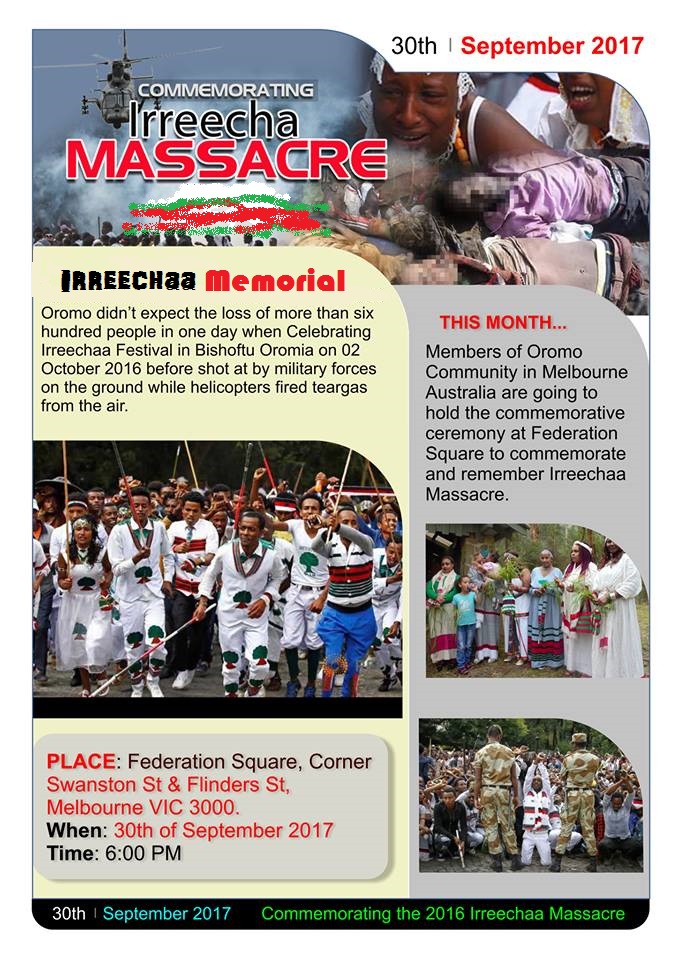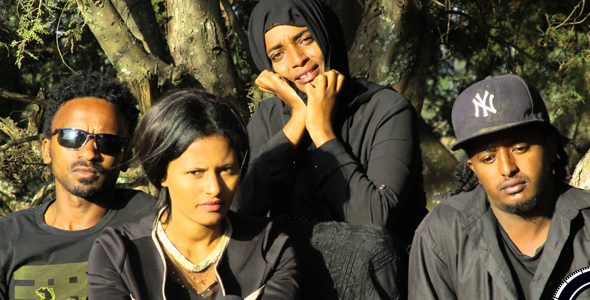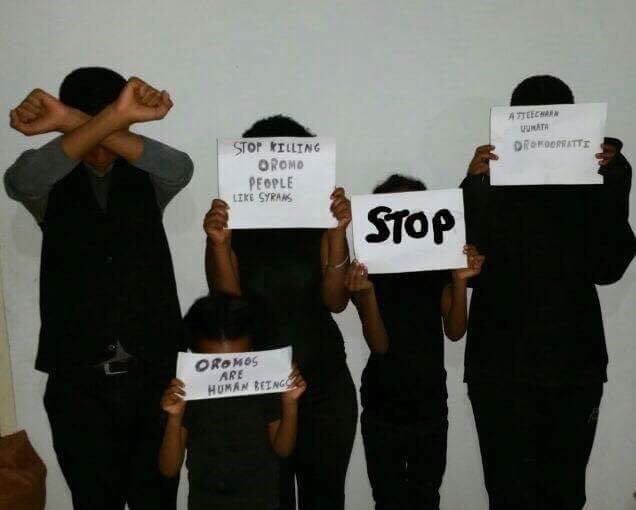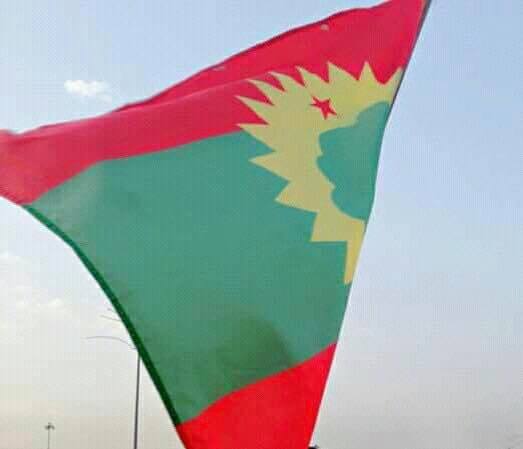
Author Archives: advocacy4oromia

ADVOCACY4OROMIA

You are invited you to an event posted on Upcoming!

Dear friends, We have a big national celebration to commemorate our fallen heroes.  We believe that our living patriots are building on the achievements of our fallen heroes and heroines will liberate their people and country by any means necessary.

Event Details: (http://upcoming.yahoo.com/event/11137133/?invitation=81ce2bb502)The Oromian Martyrs Day
Sunday April 21, 2013 ( 4:00PM –  8:00PM)April 15: Oromo Martrys DayAsxaa GGOApril 15th is Oromo Martyrs Day also known as Guyyaa Gootota Oromo. This commemorative day was first started by Oromo Liberation Front (OLF) following the death of its prominent leader’s on diplomatic mission enrouted to Somalia on April 15, 1980. Since then this day was observed as Oromo Martyrs Day by Oromo nationals around the world to honor those who have sacrificed their lives to free Oromia and to renew a commitment to the cause for which they have died.

Why April 15?

Mid 1978-1979 is remembered as the period when the survival of the Oromo national liberation struggle led by the Oromo Liberation Army (OLA) was under severe threat of extinction. It was feared that OLA units in Arsi, Bale, and Hararghe would disintegrate and their channel of connection and supplies would be cut off by the Dergue army that just recuperated from the Ethio-Somalia war. Upon defeating the Siad Barre army, the Dergue turned its face on OLA. The OLA in the fronts of Arsi, Bale, and Hararghe fought steadfastly and scored victory over the Dergue army and regrouped once again in January 1st 1980. In the wake of their military victory, OLF intensified its political struggle inside the country and abroad. The initial political victory includes the persuasion of the Siad Barre government to allow the opening of OLF office in Moqaddisho, Somalia in 1980, to serve as a center of consultation and deliberation between OLF political and military leaders.

In the same year, a ten member high-ranking military delegates* were on their way to Somalia to meet with political leaders there when they were captured by Somali bandits in Shinniga desert (in Ogaden). These bandits were members of a splinter group from the Siad Barre army that harbored bitter hatred towards Oromo and OLF. These bandits abused and severely tortured their Oromo captives; they were strip naked in the desert with their hands tied behind their backs. The bandits finally ordered the Muslims and Christians to segregate before their execution. These Oromo comrades chose to stay together and face any eventualities than identifying themselves as nothing else but Oromo. On the day of April 15, 1980 all the ten were executed and their bodies thrown in a single grave.
Our martyrs lost their lives while dreaming and fighting for freedom, justice, democracy and development of their people and their country.All Oromo nationalists must be cadres, teachers, students, leaders, followers, fighters, financiers, ideologues, organizers, defenders and promoters of the Oromo cause. We should not keep quiet when certain individuals attack our organizations, leaders, communities and Oromo peoplehood to satisfy their troubled ego or their masters. If we do some of these activities in our daily lives, the spirits of our fallen heroes and heroines will survive through our actions.

Venue Details:
Flemington Community Centre
25 Alexander Rd.
Melbourne, Victoria 3032

For more details about this event, including maps, comments, and other attendees, visit the event page at http://upcoming.yahoo.com/event/11137133/?invitation=81ce2bb502

Oromo must fulfill their historical obligations by supporting the Oromo national struggle

(Advocacy 4 Oromia) We Oromos in the Diaspora should follow the footsteps of the fallen and surviving Oromo heroes and heroes by contributing anything we can to support the Oromo national struggle. If the fallen Oromos had paid with their lives to liberate us, how can we fail to contribute our time, money and expertise to liberate our beloved country, Oromia?

Ebla 15 Guyyaa Gootota Oromoo 1How can we sleep when our mothers, daughters and sisters are raped in Oromia? How can we be at peace when genocide is committed on our people? Since our people live under Ethiopian political slavery and since no country supports the Oromo struggle, we must fulfill our historical obligations by supporting the Oromo national struggle.

Our martyrs lost their lives while dreaming and fighting for freedom, justice, democracy and  development of their people and their country. They recognized that agitating, educating, organizing, and mobilizing a colonized and dehumanized nation for liberation requires courage,  determination, bravery and self-sacrifice without fear of suffering and death in the hands of the enemy and their collaborators. We have moral and national responsibilities to achieve the objectives for which our heroines and heroes sacrificed their lives.

The Oromo national movement is a very dangerous project. Tens of thousands of our people have been imprisoned, tortured, raped, and received all forms of abuse from successive Ethiopian governments in general and that of the Meles Zenawi in particular. The Tigrayan-led government has been systematically targeting and killing all Oromo leaders and those who have potentials of leadership while promoting the most despicable elements of Oromo society and the children of colonial settlers as leaders of the Oromo nation.

http://trace.tennessee.edu/cgi/viewcontent.cgi?article=1011&context=utk_socopubs

Some Teaching Methods of Traditional Children

To herd cattle they have to be ready to walk for a long distance and away from home for weeks if not months. There they had to be armed with skills for protecting the herd from raiders and wild animals. There are always elders accompanying them for guidance. Whether they were around home or away from home they will make fire in the evening. They sit around it and play game of word or listening history as told by elders.

It is not known when the Oromo stopped writing. What is known is that they have no scripts though their oral tradition is so strong that each child knows what has come and passed in the life of its nation. In all corners of Oromiya it is told that once upon a time the Oromoo had qubee (letters). But it so happened that cattle became unruly and attacked home materials. It was then that they devoured all written materials.

This incident it was said to have been prophesied by ancient raagaas and so was the order of Waaq. As such no body could have stopped it. Therefore instead of people writing on parchments, Waaq would write on the suet of the cattle and experts will read the messages of providence from there, in matters concerning the future. Records will be kept in mind and past events passed to children through word of mouth.

Since then experts read the mooraa (suet) of slain animals to foretell the future and elders tell history by word of mouth to their children who will pass it down generations. The mooraa readers are called moora dubbistuu (mooraa readers). That is why the name “moor” is adopted by some to mean book rather than the Arabic “kitaabaa” or Amharic “macaafaa”. Stories are called “dur durii”, what the English start with “once upon a time” the Oromo starts with “dur, dur”.

Here it would be helpful to cite some efforts made by Oromo individuals to write in their language. Gooshuu Zawudee of Goojjam and Sana Ibsaa of Limmuu used strange letters in their correspondence around 1880; Alaqaa Zeyinaba (1860s) translated and taught the Gospel in his mother tongue, Afaan Oromo. Hiikaa Awaajii and Aster Gannoo in the same century translated the bible to Afaan Oromo. Those were so far known examples of efforts made. When was writing in qubee started? It is unfortunate we cannot conclusively tell. But the OLF should be credited to implement it in the present official standard form. The remaining Oromoo literary history needs more effort from future researchers.

Some of the games played by traditional children and story telling were also part of the teaching process.

Field Activity

  1. Geengoo/Korboo (wheel): a wheel usually made from vine is thrown across a field in any direction. All children had sharpened spear like sticks. They will try to stop the wheel by spearing through its center. This besides helping as athletic competition teaches children to target running object. This art helps in later life hunting expedition. It is also an introduction to the art of war.
  2. Kollee/qillee (hokey): kollee is similar to ice hokey. A butt cut from tree branch and a ball made from joints of branches are made. There are houses (goals) of opposing teams on opposite sides of the field. Two teams play against each other
  3. Utaalchoo (Jumping): two poles are put in the ground and another tender stick is put across at different levels. The one who jumps the highest level is the winner. Poll volt was also a known practice
  4. Utaalchoo lafaa (long jump): lines are made on the ground. One who jumps beyond the furthest line is the winner
  5. Furguggee: swings made of vines naturally hanging from branches of trees are used to play swinging.
  6. Waldhaansoo/ waldhaantoo (wrestling) kids and addle play it
  7. Garmaamsa (horse race) the Oromo are renowned horse men. Children learn about horses and how to use them at early age
  8. Saddeeqa: parallel rows of eight holes are made on the ground. Each person will be given equal numbers of pebbles. The game is played by putting the pebbles in each others whole and getting the pebbles of the other. It is capturing the others whole like in checkers. 
  9. Waantaphee (Toys): Waantaphees are made from wooden objects or mud. Each child creates its own toy. Utensils, guns and airplanes and cars were made. Flat bars of wood tied on tip of long string was also rotated to make a buzzing sound
  10. Sigigoo (slide): steep grounds are wetted with water if it was not already muddy and children slide on their buttocks or on their feet. Sometimes they also use banana branches to sit on and slide
  11. Shekkelloo (hoping): parallel lines are drawn on dusty ground. A pebble is put at one and hopping on one leg and pushing the pebble from one end to the other the game was played
  12. Walee (yodeling): children from across a river or from a distance call each other and call names by yodel. They put their index finger on their wind pipe and harp on it as they utter a word and saying “walee” in between (changing frequently from low to high pitch)
  13. Dancing and dating: Dancing is performed during holidays and ceremonies. There are romantic dances, war dances, religious dances and work dances. To mension some names of dances, ragada, dhiichisa, gelloo, sirba mormaa, shaggooyyee, goondaa, kukummee, iyyaasee, shubbisa, gajjafa, dalaga etc. Romantic dances are held mostly during weddings. They start days before wedding ceremonies near the brides and bride grooms houses during moony nights. Dancing during such occasions is only for young unmarried men and women. Married men can participate in dhiichisa or war dances but this may vary from community to community. Youngsters sit with girls there. It is called qabdoo sitting (date sitting). They fondle and kiss each other under their linen or toga and no hanky panky before marriage. Young people date each other at river sides or when they go for collecting wood. There they sit qabdoo. They sit on leaves as cushion prepared by the boy.  In some areas they can be naked above the waist. They are called michuu (sweat hearts). In many communities a girl introduces her michuu to her parents. He wouldn’t be the future husband but a protector until her marriage.

The above and more are all field performances and part of the informal education.
Religious dances are performed at the temple or Galmaa of Warra Ayyaanaa (Qaalluu) also at child birth it is called faga, gajjafa or dalaga.

Home Activities
Each evening fire will be made in the living room or the same fire for cooking is used for warming. All residents of a house except the ones cooking sit around the fire place. Then elders tell history as well as stories they inherited from the past and those they went through. Children attentively listen to what they were told.

Especially they should be well versed in their family tree otherwise they will be shamed by strangers who ask them to identify themselves. Each child must count at least seven generations. If it can’t do that, it will be suspecting for being from unknown origin. In addition children had games they play with each other. In most of them, the children start by making statement or question or posing a problem. In the following we shall use Q for problem and A for Response.

  1. Hibboo: hibboo is puzzle in which statements are made symbolically and guessing is requested. One who puts forward the puzzle begins by saying “hibboo” the replier says “hiph or hibbakka” then the puzzle is stated. Example:
  2. We are eating together why are you emaciated?
  3. The answer is spoon

Q. The red man is shouting standing in a stream.
A. The reply is tongue
Q. corpse when asleep lion when awake.
A. the reply is gun

  1. Hibboon ten (Hibboon xar): this requires awareness of the neighborhood. One of the children says hibboon teen. The others say teen, teen. In the question heifer means girl, bull means boys. Example:
  2. Hibboon ten
  3. Ten, ten
  4. Husband; wife; heifer, heifer, heifer; bull, bull; dependent, dependent (birtaa’o), whose house is that? (guest and visitors are all birtaa’o)
  5.  Mr. Jaarsoo’s
  6. No
  7. Lie on your back and drink spiced butter 
  8. You prepared I drunk, yours is by the lid mine is by madaala (big milk utensil). Pass under bent stub and fart for ever. Lean on cactus lose you psyche. I will not insult you more than this let hyena devour you down so and so stream. It was embarrassing for the loser to be ridiculed in front of peers.
  9. Bino: one child starts the game by saying binoo (animal)! The others say bineensa (wild animal)! The one who started asks what? Then one of the children starts naming animals it knows fast, with the other saying what after each animal, after some time it says what do you eat? If he mentions animals which are not clean at that juncture, he will be laughed at and loses the game. Example:

Q. animal?
A. beast
Q. which ones?
Q&A. lion, which? tiger, which? Leopard, which? Gazelle, which? Pig, which do you eat? Dog (laughter)

  1. Jimmaa jimmitoo (jimmiitee): this is a test for being capable of keeping quite. One begin the game by saying jimmaa jimmitoo or jimmiitee, all the children say jijim (hush). It names rotten of animals by mentioning the name of animals and offensive rots of other things one by one. Then he says any one who utters or made to utter until my hen reaches the seas and comes back and crows shall eat all said rots and the rotten ciimmaa (rheum) and pus of the back of Haadha Baqqoo and all her girls. Unless the beginner crows no one can utter a word or laughter. It is difficult to keep quite for a long time, some one usually bursts with laughter and eats every thing and the hen crows and saves the strong.  

Q. Jimmaa jimmitoo
A. jijim
Q. rot of donkey
A. jijim
Q. rot of dog
A. jijim
Q. rot of garbage etc.

  1. Uummoon maal baattee dabarte (carrying what did the hornbill passed)? The response is “haamtuu dhaa fi cidii” (sickle and straw). Then the questioner says with it her neck? The responder says “cut” fast after her neck. Questioner continues “her neck?” Then suddenly says “your neck?” If the responder says cut, he will be laughed at, and gives up his turn. Example:
  2. Ummoon maal baattee dabarte
  3. sickle and straw

Q. with it her neck?
A. cut
Q. her neck?
A. cut
Q. your neck
A. cut!  he loses

Count down
The questioner asks what is a unit. The responder says unit is finger; then what is two? Two is tit of goat, one is unit. What is three? Three is tripod, two is tit of goat, and unit is finger. What is four? Four is tit of cow, three is tripods, two is tit of goat, and unit is finger. What is five? Five is fingers of the hand, four is tit of cow, three is tripods, two is tit of goat, and one is unit. In this manner it goes up to possible relations. The usual is up to ten:

1= tokkeen qubaa
2= lamaan mucha reettii
3= sadan sunsummanii
4= arfan mucha saayyaa
5= shaman qubaa harkaa
6= ja’an jabbii qaraxa (dowry calves)
7= turban torbee sanbataa (7 week of Sabbath)
8= saddeettan dhala leencaa (eight cubs of lion)
9= salgan yaa’ii Booranaa (nine assemblies of Boorana)
10= kurnan kurnii Waaqayyoo (ten tithe of God)

Story telling
Most stories revolve around animals and human like creatures like Bulguu, Hilluu, Adii, Haadha Sharraxee (sorts of boggy man), imaginary figures, human relations like children and step mothers, strong persons. Stories could be constructed by story tellers.

Oromian Traditional Products

The profile Mr. Legesse Deti Dhaba, the former Secretary General of Mecha-Tulama Self-help Associati

(The Oromian Story, 24 September 2011) Mr. Legesse Deti Dhaba, former Secretary General of Mecha-Tulama Self-help Association, is held incommunicado at the Maikalawi Prison Center (locally known as the Torture Center of Melese Zenawi) in the Ethiopian Capital Addis Ababa.

According to reliable sources,the Zenawi regime denied all forms of access to Mr. Legesse Deti Dhaba including visits by family, lawyers and medical doctors since his detention on August 29, 2011.  Family and close relatives of Mr. Dhaba are in state of grieve and serious worries since both of Mr. Dhaba’s arms and hands were broken during torture and severe beatings in earlier detention. Mr. Dhaba is the victim of the ongoing waves of arrests by the ethnic minority regime of Meles Zenawi targeting the Oromo cultural leaders, community elders, students and teachers.

Mr. Legesse Deti Dhaba is 58 years old Oromo Elder from Dandi District in Western Shewa Zone of Oromia Regional State in Ethiopia. Legesse was born and raised on his ancestral homestead in his home village of Kere Garie in Dandi District. He is a husband and father of five Children, two sons and three girls. He is the only breadwinner for his family.  Mr. Dhaba also supports his 89 years old elderly mother who lives with him. Mr. Dhaba’s elderly father died while he was in Melese Zenawi’s prison.

Mr. Legesse Deti is a well liked and well respected elderly person in his community and among the Oromo people nationwide. His knowledge of the history of the Oromo people and culture amazes those who know him closely. He is particularly very knowledgeable and well liked due to his narration of the oral history tradition of the Oromo people including stories of traditional tales and cultural ceremonies such as weddings, Christening, Thanksgiving (Irreecha). It was his knowledge of the history and culture of the Oromo people which prompted the elders of the well respected and oldest Oromo Self-help Association, Mecha-Tulama Self-help Association (MTA) to approach Mr. Dhaba to be a member of the Association. Mr. Dhaba was ultimately elected to serve as Secretary General of Mecha-Tulama Self-help Association for the year 2002 to 2003. Mr. Dhaba has been the Chairman of History and Culture Committee of MTA, the Committee responsible for the organization of the yearly Oromo Thanksgiving Holiday ( Irreecha) and other cultural events.

Mr. Legesse Deti Dhaba is a very resourceful person with all rounded personality. In addition to being a well respected elderly person among the Oromo people, he is a trained accountant, economist who attended Addis Ababa University and aviation technician. In fact, till his detention, Mr. Dhaba was working for MIDROC Aviation. MIDROC Aviation is the aviation wing of MIDROC Ethiopia, a holding company for over 30 companies operating in Ethiopia and owned by the Saudi Billionaire, Mohammed Al-Amoudi, who is closely connected with the brutal Meles Zenawi regime. Mr. Dhaba was well respected and highly regarded employee at MIDROC Aviation. He travelled to a number of countries including the United States on the business of the company.

Mr. Legesse Deti Dhaba was detained on August 24 on his way home from a social event in his home District of Dandi. He was returning from a celebration of Gubaa Ceremony, one of the oldest Oromo traditional holidays celebrated in connection with the beginning of the New Year in early September. As local elder, he was invited to the event to pray on the Gubaa Ceremony. It is on his way home that he was detained by the local regime agents. At the time of his detention, Mr. Dhaba was with Mr. Mulugeta Rikitu, Director of Private School and Board Member of MTA; and Student Sisay Serbesa, 3rd year Information Technology Student at Addis Ababa University (5 Kilo Engineering Campus). They were all detained together at Ginichi Town Police Station, the capital of Dandi District.

On the morrow, August 25, 2011, alarmed by the unlawful detention of Mr. Dhaba and his companions, relatives and family members contacted local lawyers. Their lawyers immediately filed a habeas corpus petition asking the Court for the immediate release of the detainees on lack of probable cause for their arrest, and arrest warrant. The District Court ordered the regime’s security agents to present the detainees before the court and reviewed the petition of the detainees. After reviewing the petition, the District Court ordered the immediate release of the detainees for want of probable cause or even reasonable suspicion of any wrongdoing. The police defied the court order and refused to release the detainees.

On the morrow again, August 26, 2011, the lawyers of the detainees filed a petition at the District Court of Dandi District for the Court to enforce its order on the release of the detainees. The District Court reviewed the petition and gave appointment to hear the petition on contempt of Court by the local police on August 29, 2011 at 2:00 P.M.

On the morning of August 29, 2011at 8:00 A.M. the unthinkable happened. The Meles Regime sent about twenty (20) Tigrigna speaking security forces with machine guns, satellite phones, sharp shooting snipers and military pickup trucks in this rural community in the heart of the Oromo nation. Oromo speaking local regime agents were told to step aside. Tigrigna speaking regime’s forces then started terrorizing the local population with show of forces and sense of disdain for the local population with foul words against bystanders, according to local peoples present at the scene.

The drama was over at about 9:00 A.M. The Detainees were thrown on board the military pickup trucks while being beaten and insulted. Mr. Legesse Deti Dhaba, Mr. Mulugeta Rikitu, School Director and Board Member of MTA; and Sisay Serbesa, 3rd Year IT Student at Addis Ababa University, all of them disappeared with their Tigrigna speaking capturers, the security forces of Meles Zenawi who come from his ethnic homeland of Tigray two thousand kilometers away to this evergreen and pristine Oromo District.

The District Court Judge of Dandi District, seeing what happened that morning, never showed up for the hearing at 2:00 P.M. on that beautiful August 29, 2011 afternoon. There is no law left form him to enforce. The ethnic militia of Mr. Zenawi knows no law and they think they are above the law at least in Ethiopia and until Zenawi is in power. A frustrated local farmer told us “there is no law for the Oromo people under this regime except gun carrying cadres of the who raid our villages now and then to terrorize and kill our people.” Meles Zenawi and his security forces might have been over rejoiced by the humiliation of Oromo elders in their hands and in front of their family, relatives and countrymen; but many Oromo youth also took note of what befell them under this lawless and brutal regime.

This is brief account of how the regime of Melese Zenawi conducts its hidden and brutal war on the Ethiopian people. Mr. Dhaba, Mr. Mulugeta Rikitu and Student Sisay Serbesa are all held incommunicado at the Maikelawi Torture Center in Addis Ababa. There is serious concern as to the safety and wellbeing of these detainees. The Ethiopian regime has well documented history of using torture on detainees, and extrajudicial execution of detainees in cold blood.

Families, relatives and friends of Mr. Legesse Deti Dhaba, Mr. Mulugeta Rikitu and Student Sisay Serbesa seek your help to petition the Obama Administration, European governments, your local and federal elected officials, human rights groups and political leaders to urge the Ethiopian regime to release these innocent detainees immediately and unconditionally; and stop its ongoing war of intimidation and terror on the Ethiopian people.

Source: http://ayyaantuu.com/horn-of-africa-news/oromia/victims-of-the-hidden-war-of-meles-zenawi-profile-of-mr-legesse-deti-dhaba-an-oromo-elder/#more-3841

Being Recognised – Sinke’s journey

Sinke Wesho is an Oromo refugee who migrated to Australia at the end of 2007. Her story shows what can happen when young people from migrant  backgrounds are given the support to overcome the barriers thrown up in front of them as they attempt to settle in Australia.

My people come from the horn of Africa and their reason of migrating has been due to a brutal government regime. We have been driven out of our country because we are what we are, Oromos. Although we are about 45 million in Oromia, we have been forced to be called Ethiopians and refused the opportunity to call ourselves Oromo; we had our lands grabbed off us and our families, students and elites have been imprisoned for decades. Mind you, this is still happening!

I do not mean to disturb your mentality with some horrific truth about my people, but I must mention my identity and my causes for being driven out of my country and many others like me in Diasporas.

I got to know CMY when I was doing my VCE in 2009 during ESL classes. I was shown the advantages of being in Australia and the support that I could get from the organisation. But my strong connection was not made until March the next year. After I got a high score in VCE and secured a spot at Deakin University, a nasty surprise caught my attention. The Department of Immigration had not processed my papers and I was not a permanent resident even after two years of being in the country.

What did this mean to me? I had to either raise at least $10,000 or take off a year from my education. The latter seemed unbearable and the former impossible. as I was not working and was not even receiving a full social welfare income. I was going to be treated as an international student at the university and pay that amount. With that followed the question of “where do I get the money from?” I had no job, no experience and so forth. My world came crashing down on me. I had planned to do a double degree in International Studies and Law straight after my VCE, but in time I realised that was not going to happen.

That is when I contacted CMY. They helped me contact the immigration department, and helped me with lobbying and advocating my case. It is through CMY that I got a volunteering position at Springvale Community Centre. That kept my head busy, at the same time my search for a solution seemed to ease as I came across a wide range of people. My youth support worker Maya Chandra was there with me throughout, listening to me when I needed, sitting there and writing my letters and giving me ideas on how to go about things.

Finding a job now became a little bit easier since I could see myself doing something. I could list skills and responsibilities on my resume more than just jotting down my subjects in high school. While looking for work, volunteering and lobbying the immigration department, I also participated in community work. It gave me a sense of pride when I got people patting me on the back saying, “You will get there”. What I achieved from the above actions was the skill of multi-tasking. Previously all I had to do was go to school and read, only that. After these broader experiences however, the world wasn’t just that, it was different and I needed to explore my abilities and this came through with the help of my family, community and CMY.

Around May 2010 my youth support worker called me up and informed me of an opportunity to work with other young people on a project. I was thrilled beyond words, but at the same time I was not sure of what I was expected to do or the type of young people I was going to face. One thing I was ready to do was explore Australia and be a charitable person just like the workers that supported me throughout that despondent period of letting go of my studies. The group was started by three young ladies (including myself) from refugee background and two youth workers who supported us throughout. We were given the freedom to come up with ideas and then create a project that would be suitable for young people from diverse backgrounds.

You couldn’t be given more than this, so we got our heads together, brainstormed the ideas and finally came up with the full version. CMY helped in writing up our ideas and also greatly invested on finding funds for the whole program. Briefly, the program was divided into three parts. It included the group having fun like travelling to places that we would not be able to do alone, learning a leadership program and giving back to the community. It was designed for people aged between 15 and 21 years.

It was not long after this get together, through this experience and meeting different people and actively looking for a job that I landed anadministration job for a small business. Now everything seemed to be falling into place, and by November I had been granted my Permanent Residency. But by the time I had the job and my permanent residency, it was late for me to enrol for my bachelor at Deakin University. However, I was able to plan things easily and get myself ready for school payment for the following year and support myself financially.

When we got 10 group members, we came up with the group name  ‘Invincible’, this was a new vocabulary for me. It just showed the power of working with different lots of people. Then we set off exploring Australia and having fun as planned. When we headed to Parliament house we learned about the political system, when we visited Wileys Publishing we learned about books, but more so about the experiences of people who have made it to good positions in life and in work places. When we held a session for homelessness, I was appalled by the number of homeless Australians and young people who are stuck in this mess. It taught me how to appreciate what I have more than ever and to lend a hand to others. When I saw a picture of our group in the local paper creating awareness about homelessness, I could not feel any better satisfaction. We were heading somewhere.

Then came the big day in everyone’s mind, the camp! It was going to be my first time spending nights away from home with my friends and the best part was that I had helped create the whole idea. We set off to Phillip Island in the second week of December 2010. At the camp we worked together, set up the tents, took turns to cook and clean up. Taking on responsibilities at the same time as working together with others really taught me lessons about respect, sharing ideas, respecting different values and many more. In one big word, the experience of being with other people taught me the power of harmony. That is when I thought to myself ‘I wish the government of my country could just respect me and my people for who we are’. Our achievements and happiness can only be explained explicitly by the number of photos we took and our facial expressions. We laughed and smiled the whole time. I doubt if I did not smile in my sleep.

It is from all these that a got an opportunity to travel to Sydney to attend the Australian Youth Affairs Coalition's annual national conference. Travelling to Sydney for a good cause, representing the voice of my group and the youth at large. What could be a bigger honour at this at this stage of my life? During our stay at Sydney I enjoyed every second of it, listening to people from different experiences,  meeting other young people. By the time we had to present our half an hour session, we were already inspired and were determined toshow our super project to the crowd. And we did it well. The audience responded greatly and for us, it was an achievement to be able to share our  experiences, abilities and contributions with other people. At the end of the three days all I could see was that youth are so powerful; that
if given the chance and support at all times, we could make this world a better and best place to live in.

The journey has inspired me to be a better person in my family, my community, at my work and in the world. I remember posting on my Facebook wall ‘I hate 2010’, but now if I was still using Facebook I would post otherwise. I have been inspired by those who have dedicated their time, effort and finance to get me to where I am. I cannot thank CMY workers and the groups I have worked with enough for being the backbone of my successful journey.

When Ralph came to award me a certificate from ‘Creating Dreams’ it showed me the power of caring for others and also recognition. He drove from Sunshine to Dandenong to hand me a certificate of achievement. Somebody was acknowledging my abilities and encouraging me to pursue my dreams. What ‘Creating Dreams’ did for me to travel to Sydney only shows that there are people out there who are more than willing to do anything, even sacrificing their wages to put a smile on someone’s face. All I can say is a gruff ‘Thank you’ to you all, those who we’ve worked together and those who have supported me without face to face meeting. You all contribute to my future even more.

To finish off, I am currently in my first year of Bachelor of International Studies at Deakin University while working and still  engaging with CMY. I am one of the committee members for CMY’s Youth  Advisory Group, composed of young people who work together to represent the interests of young people and also pursue to influence the policies of our government to cater to the needs of youth and families. Our issues include government funding to combat homelessness, education for migrants, and the lack of jobs for culturally diverse youth. I intend to complete my bachelor and work as human rights activist in the future. It is through these efforts that I want to be a voice for Oromo people, who still fight for their freedom by giving up everything, even lives.

Source: http://www.cmy.net.au/SinkesJourney

Irreechaa: A Thanksgiving Day In Oromia, Cushitic Ethiopia and Africa

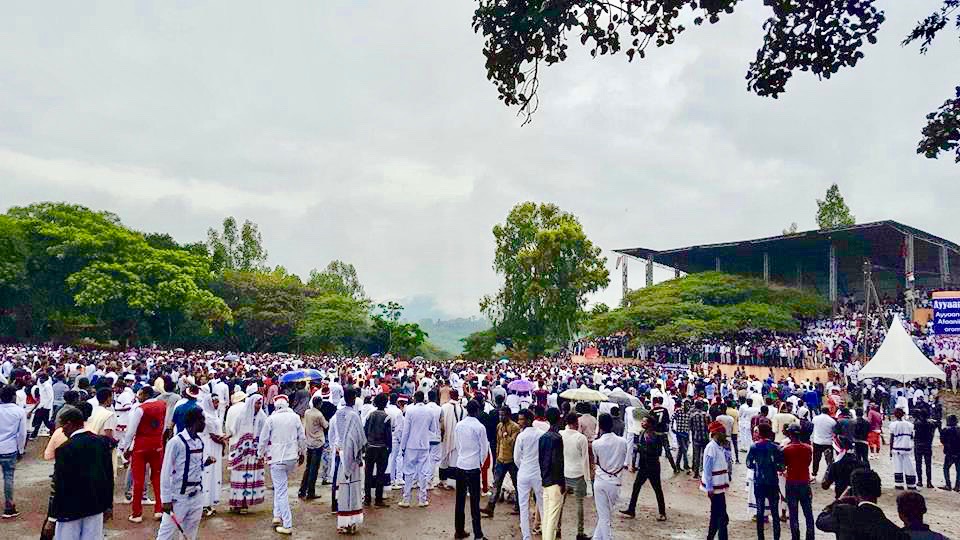
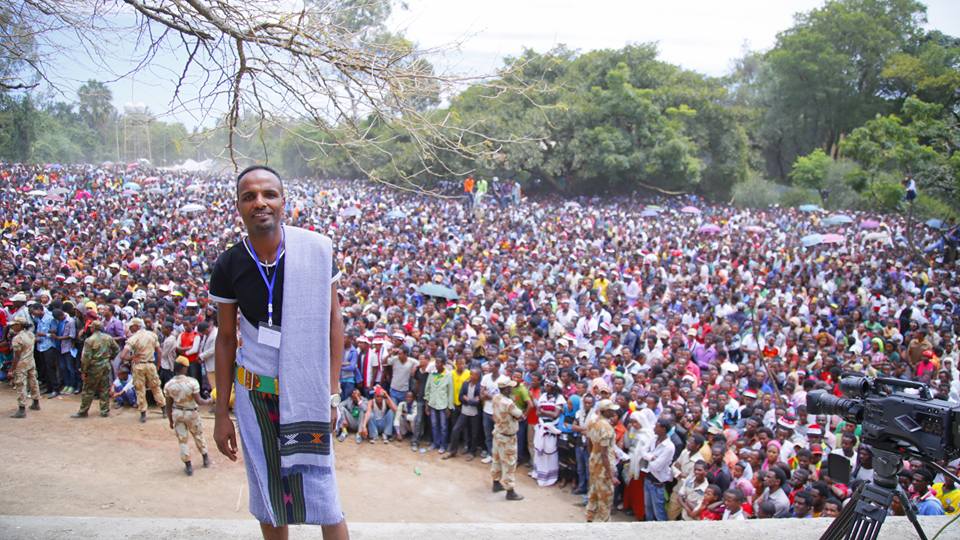
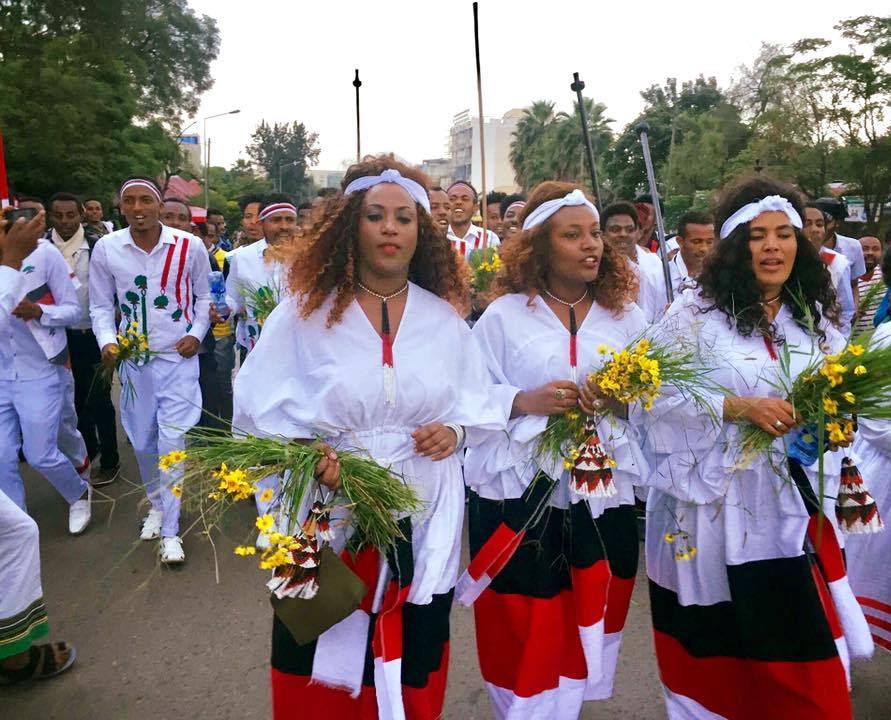
Irreechaa is celebrated annually worldwide in the months of September and October, and the largest Irreechaa celebration is in Bishoftuu, Oromia, at the Horaa Arsadii Sanctuary, where some three million pilgrims give thanks to Waqaa (God).
Still longing for the day, when the Oromo Christians, Muslims and Waaqeffataas will come out together during the Irreechaa in order to celebrate in mass our Rabbi/Waaqa, we should at the same time be able to commit ourselves to do His will in our Oromo way of private and public life. Irreechaa is not only celebrating the past good and only striving for the future  good, but it is also the day of remembering our brothers and sisters,  who had sacrificed their limbs and lives for our common Oromo cause of bilisummaa.
This includes the commemoration of the recently imprisoned Oromo  nationalists, who are now suffering under the notorious torture in Ma’ikelawi prison, being accused as “terrorists,” just because of their attempt to promote and support the currently ongoing Qeerroo national Oromian movement for freedom & democracy. The following timely article is from a famous  writer
Fayyis Oromia.*

Thanksgiving Day is a holiday internationally celebrated  primarily in the United States and Canada. Traditionally, it has been a time to give thanks to God, friends, and family. Thanksgiving Day in North America had originated from a mix of European and native traditions. Typically in Europe, festivals were held before and after  the harvest cycles to give thanks for a good harvest, to rejoice together after much hard work with the rest of the community. At the  time, native Americans had also celebrated the end of a harvest season. When Europeans first arrived America, they brought with them their own harvest festival traditions from Europe, celebrating their safe voyage, peace and good harvest. Thanksgiving Day, which is currently celebrated on the fourth Thursday in November, has been an annual official tradition in the United States since 1863.

Interestingly, the people of Oromia in particular, the Cushitic people of Ethiopia and the whole black people of Africa in general, have
been celebrating this type of thanksgiving day, the Irreechaa, for more than 5000 years. It is from this ancient people that, firstly, the ancient Egyptians took the tradition, which was further overtaken by the Jews of Israel, then by the Arabs, and then followed by the traditional Europeans, and, finally, by the relatively new states of USA and Canada. It is just like the development of the monotheistic belief in Waaqa Tokkichaa (belief in one God), which had started in the Cushitic Ethiopia in particular, and in Africa in general, and then had spread first to the ancient Egypt, then to the ancient Israel, further to the Arab world, Europe and, finally, to North America.

The Oromo people, being the stem for the other Cushitic nations living in the north-eastern Africa, have kept and preserved this noble
tradition of thanksgiving in a form of Irreechaa celebration, whereas the other African nations seem to have forgotten and lost it. Now, it is the right time for these Cushitic Ethiopians and the other Africans to re-learn it from the Oromians, and to revive their lost  cultural values. Even though most of them have already converted to Christianity and Islam, there is no much antagonizing issue (between these monotheistic religions), which can hinder the believers from celebrating Irreechaa together. The USA and Canada just Christianized the Irreechaa, and they do celebrate it as a Thanksgiving Day. There is no reason why the Christians and Muslims in the Cushitic Ethiopia and in the other African nations can not re-adopt this nice virtue from Oromia, and celebrate it together with the Oromo people.

When we look at the similarity between Christianity, Islam and Waaqeffannaa, it may surprise us that the Borantichaa (the first holy person according to the Waaqeffannaa faith) is the chosen holy man of God similar to Jesus of Christianity  and Mohammad of Islam. These three holy personalities are the classical Qaalluu’s (individuals, who could communicate with Waaqa/Allah/God, and who could live optimally according to the will of this Supreme  Being). This similarity is the reason for the fact that Irreechaa is the thanksgiving day for, not only the descendants of Borantichaa, but also the believers of Jesus and the followers of Mohammed.

Even the concept of ‘a chosen people of God’ is taken from the Cushites. The Holy Bible testifies this, in the speech of Jahwe to
Israelis: “are you not as dearly as Cush/Ethiopia to me?” The Qalluu are the chosen part of the Oromo people to have such a position in front of Waaqa, just like the Levites were the ritual leaders chosen by Jahwe. The meaning of the Cushitic word Kasa (Kaasaa) is ‘God’s People’ (Creator’s people). According to the ancient language of Cush, the word Ka = God (spiritual being, the creator), and the word Sa = People, thus the word Kasa = ‘God’s People.’ The two Agew Kings (Theodros and Yohannes) were named as Kasa just to designate themselves as the rulers of ‘God’s People.’ Similarly, the word Saba (Saabaa) is equivalent to the ‘created people’ for the Cushitic word Sa = people, and Ba = the created (physical being, the nature). Interestingly, the Afan Oromo equivalent words are: Ka = Uumaa, Ba = Uumama and Sa = Uummata. Accordingly, the Queen Saba wanted to call herself the ruler of the  ‘created people’ whereas the two Agew Kings tried to call themselves as
the rulers of the ‘Creator’s people.’

If Oromo nationals from the three religious groups had to celebrate Irreechaa together, then they have to appreciate this common base and common cultural heritage as well as they have to be able to decide for common place of celebration in the future. As far as I am concerned, for Finfinne is the political center and the traditional core of Oromia/Cushitic Ethiopia/Africa, I would like to suggest that we do celebrate Irreechaa in the future, not only in Horaa Arsadii, but mainly/nationally at the Lake Gafarsaa of Finfinne. This must be the major site of Irreechaa celebration, being accompanied by the celebration in Bishoftuu and the festivities at other localities. Making Finfinne the core of this thanksgiving day will certainly help all other localities be supplied by more ‘river of eebba/river of blessing’ from the center of Oromia.

Picture: Oromo men at morning prayer to Waaqa.

We need to keep Irreechaa as a very good tradition of Oromia, which is one of the very attractive traditions in this land of eebbaa/blessing and land of Irreechaa/thanksgiving. It is a common daily experience in Oromia to observe elders blessing others routinely and to see people practicing Irreechaa at different occasions on small scales and at lower levels, including their morning and evening prayers, which is mostly considered as thanksgiving, where the Oromo people do say ritually: galata kee ya Waaq! It is based on this observation that certain European scholars and writers described Oromia as a ‘land filled with the rivers of blessing.’ I hope that, not only Oromia, but also the Cushitic Ethiopia and the  whole Africa will be filled with such ‘rivers of ebbaa and Irreechaa‘ in the future, especially if we decide to harmoniously celebrate Irreechaa as our common thanksgiving day together.

Irreechaa, as Oromia’s/Cushitic Ethiopia’s/Africa’s thanksgiving day, is a symbol for a day of a public freedom from the oppressive regimes like the brutal Abyssinian elites with colonialist mentality. On this day, the celebrating Oromo people do feel free, at least on this single day out of a year-round oppression, even though the security machine of the colonizers continue harassing this  freedom-loving and pro-democracy nation. Irreechaa also signifies the victory of the Oromo liberation struggle – the reason why Oromo nationals say: Irreechi irree keenya!

Not only the Oromo nationals, but surprisingly the ordinary Abyssinized people also do celebrate these values of the Gadaa Oromia in their own style/version, like the celebration during Ximqat (equivalent to Irreechaa at the lakeside or riverside), Masqal/Demeraa (equivalent to Gubaa), Buhee (equivalent to Taaboree), Ashanda of Tigrai (equivalent to Ingicaa) etc. Despite these good elements taken from the Cushitic cultural values, Abyssinianism is an anti-thesis of Oromummaa, and a diametrically opposite position to that of the Cushitic
Ethiopianity. Abyssinianism is a symbol for a false self-identity, and  it is an example for the ‘victim victimizing another victim.’ Abyssinian
elites are like the torture victims, who are usually trained to be  notorious and brutal torture perpetrators themselves. Classical examples
are the Woyane elites, who have been brutally victimized by the Derg, and now, they themselves, have become the worst tormentors of the Oromo people and that of the other oppressed nations.

When we do celebrate Irreechaa in this year, we have to commit ourselves also to transform Finfinne from being the center of these tormentors with false identity into the capital of the future Gadaa Oromia/Cushitic Ethiopia/federal Africa. That means Finfinne needs to be changed from the hitherto center of Abyssinianism, the symbol for oppression, tyranny, authoritarianism, torture, misery, hunger and agony
into the core of Oromummaa characterized by Gadaa/democracy, bilisummaa/freedom, prosperity, harmony, peace, equality and social egalitarianism. Irreechaa is the day of celebrating this Oromummaa on the grave of the obsolete Abyssinianism.

That is why we do call upon all the pro-freedom Cushitic Ethiopians, democratic Africans and humanisitic others to join this celebration of Irreechaa in Finfinne of Oromia, the political center of Africa. Irreechaa can be used as the symbol of freedom movement for all Africans, whose monotheistic system of faith in Waaqa Tokkicha (in one God) used to be denigrated by the Arab invaders, who promoted Islam at the cost of African traditional religions like Waaqeffannaa.This original African religion had also been attacked by the European colonizers, who cursed the belief system as something “paganism or satanism.” In this sense, Irreechaa celebration is one of the victories we have already got, not only over the alien forces from far away, but also over the neighboring oppressive Abyssinian elites. For instance, the brutal fascist and racist Woyane had tried to suppress this victory, but had failed miserably.

Here, we need to try to differentiate the innocent ordinary people of Abyssinia from their ruling criminal elites. To the surprise of my readers, I personally saw the celebration of Borantichaa in my life for the first time, not in Oromia proper, but in the heart of Abyssinia – in Gondar. Then, can anyone try to convince me that Gondar is not part of Oromia? Can anybody tell me that Quwaaraa of the Emperor Theodros, which has been ruled by an Oromo called Aluulaa, was not part and parcel of Oromia? That is why my Oromia is necessarily limited neither to the OPDO map nor to the OLF map, rather it extends to the bigger, inclusive and greater map, which includes all the Oromo people of the region.

So, let the Ethiopia of Laureate Tsegaye Gebre Medhin Qawweessaa (http://gadaa.com/oduu/10224/2011/07/26/ethiopia-their-ethiopia/) be celebrated in a sense of promoting freedom and democracy, i.e. in a sense of Irreechaa – and let not the Ethiopia of the colonizers be adored; Ethiopiais the name given to us by the Greeks and the name, behind which, Abyssinian elites like to hide. The Oromo people do give glory to Waaqa for all what we have achieved, such as the partial bilisummaa/freedom, scare nagaa/peace and limited badhaadhummaa/prosperity, and then we commit ourselves (demand more effort from ourselves) to achieve what we yet need. That means we give galata/glory for what we have achieved, and at the same time, we forward our gaaffii/demand committing ourselves to do our best in order to achieve the rest of our vision.

In this regard, there is nothing what Waaqa alone does for us when we are passive. Waaqa is helpful only through our activities and efforts. Only when we are active and creative, then Waaqa also does his plan for us, in us, through us. We should not mislead ourselves and “beg” Waaqa to do our bidding. We rather have to commit ourselves to do Waaqa’s good plans for our lives. Not only HE, even the human helpers, do help us only when we try to help ourselves. That is why we need to celebrate Irreechaa in this sense of being very pro-active to achieve the rest part of our bilisummaa/freedom and our Gadaa/democracy. We ought to celebrate the half-full glass of the past and should commit ourselves to fill the half-empty part of the qabsoo bilisummaa Oromoo (Oromo liberation struggle) in the future.

Still longing for the day, when the Oromo Christians, Muslims and Waaqeffataas will come out together during the Irreechaa in order to celebrate in mass our Rabbi/Waaqa, we should at the same time be able to commit ourselves to do His will in our Oromo way of private and public life. Irreechaa is not only celebrating the past good and only striving for the future good, but it is also the day of remembering our brothers and sisters, who had sacrificed their limbs and lives for our common Oromo cause of bilisummaa. This includes the commemoration of the recently imprisoned Oromo nationalists, who are now suffering under the notorious torture in Ma’ikelawi prison, being accused as “terrorists” just because of their attempt to promote and support the currently ongoing Qeerroo national Oromian movement for freedom and democracy.

In spite of this Woyane’s brutality, we do hope that the day will come, when we, all Oromians/Cushitic Ethiopians/Africans, will celebrate Irreechaa on the grave of the presently tormenting Woyane tyranny. Adoring Waaqa is the same as celebrating the best version of our own personal and  collective identity. That is why it is usually said by Oromo nationalists: ‘being Waaqeffata is the same as being one’s own
true-self.’ Thus, I encourage those with false-identity to come back to their true Cushitic self and to celebrate with us the holy Irreechaa, which is originally from Oromia/Cushitic Ethiopia, and now even practiced by the citizens of USA and Canada. Happy Irreechaa to all , who do like to celebrate this noble national holiday with us! May Rabbi/Waaqa bless us! May He bless Oromia, which is the land of eebba /blessing and the land of Irreechaa/thanksgiving, as the political center and traditional core of our continent Africa.

Galatoomaa!

* Fayyis Oromia can be reached at fayyis@yahoo.de.

Religious faith and the Oromo struggle

This piece of work reflects solely a personal feeling and shall never been considered a scholarly article. The Article is intended to provoke discussion among scholars and religious thinkers on sensitive subjects such as this. The benefits of religion may outweigh its negativity but the article is not about comparing its pros and cons. Religious faith is also both a matter of individual and public domain. Due to the social nature of this public good, my opinion is jut to target the social realm of faith otherwise I have no any vested interest to attack individual believers.

Now days we have often heard shocking news about the ever polarizing nature of Oromo differences. Among several possible factors, I believe, Oromo fragmentation is principally caused by the differences harbored by religious ideology. Even though the early Oromo world view was shaped by its indigenous belief, the introduction of aliens’ faith had changed things for good. By design we happened to intake various religious prescriptions. Christianity has outlawed the “Waqeffannaa”1. Islam has become the most competing force against Christianity to further conquer and scramble the Oromos. In due process the Oromo society have seen unparalleled and inconceivable deconstruction to its entire foundation of the social structure. As the home grown social system was abolished and replaced by the foreign one, the Oromos had lost the wisdom of their appealing tradition. “Oromummaa”2 was at stake and faced incomparable danger from these forces of foreign evils.

In those good old days Oromo “Gada” system was the hallmark of the entire Oromo life. Egalitarianism, communality and mutual cooperation were the sources social order, ultimate peace, security, harmony and Oromo democracy. “Waqqeffannaa” had promoted understanding among various Oromo groups; it capitalized on their common values, shared vision and vitalized tolerance and resilience. In this sense of harmony and unity, Oromos used to pray to the supreme “Waqayyo”3 in search of answers in times of major challenges and catastrophes. “Waqayyoo” was answerable and had never let them down.

There was a real love to one another; the fraternity and sorority that existed was based on unfettered greed and there was not ideological corruption. Through their unity and strength the Oromos were able to defend their country; they protected the national interest and defeated their common adversaries. They had never emphasized on significance of religious belief, and not on any particular clans and tribes either rather they centered their conviction on the underlying concept of “Oromummaa”. “Orommumma” was equally felt and applicable across the entire Oromo Land and the faith had ruled over their collective universal interest. In general, there was a genuine human face of “Oromumma” than any other pursuit of opportunistic and divisive group curiosity.

In any given circumstance, diversity in religion faith breeds different values and vision. The space is so limited for these social groups to come to common denomination while promoting different religious ideology. They are mostly characterized by a deficit of common vision and are less likely to appreciate their opponent’s faith. They usually eye animosity and see each other as threat to one another rather than cooperating partners. At times religion is a source of conflict and contention and can be a dangerous one. For instance, “at the dawn of the twenty-first century, a casual glance at world affairs would suggest that religion is at the core of much of the strife around the globe. Religion is also important because, as a central part of many individuals’ identity, any threat to one’s beliefs is a threat to one’s very being. This is a primary motivation for ethno-religious nationalists.”4

Religion shapes the way we perceive the world around us like how we view others, cooperate with others, socialize, customize, build and capitalize on our identity. When it comes to synchronizing the very foundation of Oromo identity, however, the diverse nature of Oromo faiths have made it difficult if not impossible. By their very polarizing views these characteristic features of religious faith is less active utmost and staggeringly dormant at all among the contemporary Oromo society.

Based on their religious denominations, I would like to categorize the contemporary Oromo society in to two primary groups. These categories are the ‘Born’ and the ‘Made’. The first class /“Born” Oromos are those who have stick to their original religious belief and who uphold the original values of Oromo indigenous system. To me this group is a genuine believer in the primacy of Oromo identity who put “Oromumma” before any thing else. They value authenticity than artificial cosmetic makeover in their being Oromo. They have more devotion to their origin, see wider and bigger picture in “Oromummaa’ and maintain strong affiliations to the pioneering value of Oromo democracy and Gada system. They demonstrate strong social cohesion and solidarity that can inspire and promote trust among the members. This group of the Oromo society is few in number and that is why we see a small minority in the contemporary times.

On the other hand, the second group, “Made”, Oromo are those groups, which happened to be the majority, have been forced to abandon their original faith of the home grown Oromo religious belief. They have been artificially engraved in the images of their religious masters and have deviated from their precedes’ religion due to exposure to foreign religious domination. These constitute two categories. One is the Christian group who had been subjected to religious slavery by the European colonialists and missionaries. In this group falls domestic colonization that devastated the way of Oromo life by forceful conversion to Orthodox Christianity. The other category is Muslim. Like that of Christian group this category is also the victim of religious domination by their Arab masters who were able to convert a massive number of people in the Oromo society.

The second group (“Made”) of Oromo society has many things in common. They both may not possess the true spirit of the original Oromo after all. They are victims of colonizers who have been incarcerated to grab the prescription of their colonial masters at the cost of trading their own minds and spirit. The Christian denomination pursues the values of the western ideological divide. The Muslim group models the Arab world and capitalizes on the values of Islam. Both place their religious faith before their Oromo Identity and they are short of common denomination with home grown Oromo world view if they have any at all. They are less likely to promote cooperation with different faith groups except within themselves. They dream different Oromia and see different vision instead of aspiring for the indigenous Oromo social system. Both the Christian and Muslim groups tend to mainly identify themselves most commonly with their colonial masters than they have with the Oromo people5.

Once ethno-identity is compromised against religious identity the fracture is so wide and powerful. Like a broken glass assembling it would be a very difficult and awkward task. I hold a firm belief that this is among the principal sources of disintegration among the Oromo. And also the same factor might have played a greater part in crippling the Oromo freedom movement for liberation and social justice.

Let me use a simple example to make a point. Ask a devoted protestant or a Muslim about his/her preference of ethno- national identity versus religious belief. While I should not expect 1000% response rate, I can be 100% sure that religion would be the most single important factor in building solidarity and strong social cohesion in any society. In similar circumstance, ask a person if he or she value their Oromo Identity more than their religious denomination. I wouldn’t be mistaken he or she tell you religion is more important, crucial and an essential part of their life than the Oromo identity.

The Arab world comprises “1.75 billion Muslim populations.” What make them earn the common term the “Arab’? Be it the Shiite, Sunni or any other denominations, whatever its form may be, they share ‘Islam’ as ideological divide and Islam as religious faith shapes their way of thinking around common good. Each Muslim nation has its own race or ethno national identity, be it the Sudan, Saudi Arabia, Iraq, or Indonesia to mention a few. Indonesians, or Iranians and or Saudi Arabians, for instance, are predominantly Muslim and described as Muslim Nations. Indonesians never identify themselves with the Philippines even though they have much in common in terms of race, social status, geographic location and so forth. However, for Indonesians and Saudi Arabia the bond is so powerful because they all are assembled around a very powerful common denomination- Islam. The Hajj pilgrimage is the best example that brings millions of Muslim together world wide annually.

On the other hand, Christianity is also an indisputably powerful force that indoctrinates and assembles billions around common objectives. What would be the primary interest of an individual priest of Ethiopian origin to associate himself to a vulgar white protestant German or a Catholic American? The former is a desperate poor, black and uncivilized whatever his socioeconomic status may be. The latter is a white, affluent, extravagant, and modernized. Even though they both maintain their distinct identity, there is a fundamental fact we would not afford to deny. They both claim one thing in common because they belong to same category, Christianity.

My argument is not to talk about the sheer religious diversity in any particular context. However, I attempt to argue that religious diversity in a given society is a divisive force when it comes to rally society around common goals. At the same time, the stark reality is that faith is a powerful and an essential ingredient of identity formation compared to any particular source of identity. Therefore, religion plays a very decisive role in bringing desired changes among various social groups and its effect on winning the sole and mind of individuals for any particular cause is so enormous. In any circumstance, religion is unparalleled by any factors such as race and ethnicity when it comes to enslaving its devout followers. We Oromos have been severely infested with this syndrome that undermines our unity and costs us the fundamental value of self-possession- Oromo Identity. Do you understand that we do not really own ourselves?

“Religion continues to influence social and political values at the foundational level. Take the Catholic Church for instance one can hardly separate it from the evolution and governing ideals of Western nations. Even if subtle or ingrained, faith and spirituality are a part of identities at many levels of society”6. Even though, I believe in the separation of state and religion, I am still convinced that religious belief is the core component of nation formation and nation building. Let us assume Oromia will be free and autonomous, in any form, sooner or later. And which dominant religious ideology should it pursue then? Christianity? Islam? Waqeffanna? I do not think the Oromos will come to consensus when it comes to nation formation on the core values of religious belief. Because Oromos have been subjected to the polarizing establishment of religious faiths, it may instigate conflict against one another and further aggravate the differences. Each group would push for an acute form of religious fascism. Christianity would be considered a legitimate imposition on their converts. Islam would fight hard to expand and maintain the status qua.

In any case the nation will not be formed and built on a single fundamental religious value when it is basically fragmented on several fronts. An attempt to unify the population on a common ground would also be that hard to achieve. This is basically what we are witnessing at this particular time in point. To my understanding, the unproductive and ineffective Oromo struggle reflects, in part, this fundamental reality. I challenge you to critically examine your self and come up with your opinion to share with your fellow citizens.

Even though the essential destiny of all major world religions is preaching love, peace and eternity, among many other intractable religious values, Oromians are deeply divided among themselves pursuing different religious ideologies to uphold those sacred values. When the division is so obsolete and irresistible, religion eats them in and out very hard. It erodes their internal strengths; consumes the tolerance needed to understand one another; deeply disconnects one group from the other and provides an ideal condition for conflicting interests while breeding confusion, illusion and ultimately resulting in irreconcilable identity crisis. Religion subjects individuals to slavery by degenerating self-confidence and taking away their consciousness to a particular cause other than the consciousness needed to advance the destiny of eternity.

Generally the lethal force of religion makes its victims so weak and dependent by enslaving their reasoning power and corrupting the intellectual judgment to a skewed and a single side of reality. Religion after all is a coercive instrument primarily designed to control their victims and inherently a necessary evil. “Religion controls billions of people using concepts not based on reality. It tells people how to think, and what moral guidelines to follow. It undermines the most basic concepts of reality, and becomes the entire foundation for one’s thinking.”7

I am not prescribing a remedy for every single Oromo individuals to abandon their religious belief. I have no any intention to target and attack a single faith for that matter and describe the negative or/and downside of any religion in the Oromo society. In fact, any religion has its own positive merits and downside. And I also have neither moral authority nor professional ethics to make such a sweeping recommendation. My message is simple and clear. The more society is divided along various religious faiths the less likely that it finds a common ground and shared vision particularly when it comes to the very sensitive and delicate pursuit of identity.

My fellow citizen, my appeal is to try to provoke an open dialogue about the very nature of our division along various religious ideologies. Constructive engagement and discussion among us would unfold the potential for understanding reality and challenge the obstacles contributing to the making of our own failure. Open dialogue will give us strong resilience for self awareness and fight our illusion so that we may be able to find a common ground in pursuit of “Oromumma” and confront the horrifying oppression in that empire state. Keep your religious faith as personal and private matter and stand united to defend the truth cause of “Oromummaa”. Put your Oromo identity foremost before any thing else and battle the religious prejudice imposed on you by unimaginable force of evils.

As a society we all have made a greater stride to a clear and unambiguous historical route towards building “Oromumma”. Our religious faith came far later after we had formed “Orommumma” as a common denominator. However, we have terribly lost a greater momentum against our conquerors fighting an agonizing, senseless and shameful war among ourselves. Those lost years of internal chaos, confusion and skirmish must come to an end for the common good. Now “Oromummaa” is in a desperate need of renaissance and unity than ever before. Stop the present status qua as a sleeping giant and wake up to step up your self-consciousness and advance the cause of freedom, human dignity and social justice. A protracted and further failure to unite toward our collective cause would leave us in an absolute, never-ending suffering, and pains of slavery under the brute force which we all describe as our common enemy.

Notes

1 . “Waqeffannaa” is an Oromo word meaning belief in God
2 “Oromumma” is an Oromo word roughly translated into Oromo Identity
3 “Waqayyoo” is an Oromo word which means God.
4 www.beyondintractability.com
5 Note that my opinion focuses on the religious institutions rather than individual believers. And also not every Christian, Muslim and or Waqeffata are self-conscious of their being belonging to an Oromo identity and not all Christian and Muslim are in identity crisis. Millions from every single faith are out there are proud of their identity.
6 www.pulse-berlin.com, Religion and Identity, As much bad as good? By Erin Wilson
7 www.groups.google.com: How religion makes you weak.
Thinking men cannot be ruled. – Ayn Rand

Oromo Liberation Front (OLF)

by David H. Shinn Elliott School of International Affairs George Washington University

The Oromo constitute the most numerous ethnic group in Ethiopia and occupy a huge land area that extends from the Sudan border to the Kenyan border. According to the 2007 census, the Oromo account for about 35 percent of Ethiopia’s population. (The OLF claims that the Oromo constitute almost half of Ethiopia’s population.) Throughout recent Ethiopian history, the Oromo have never held political power commensurate with their numbers, resulting in political marginalization and real and perceived grievances. The Oromo practice Islam, Christianity and traditional Oromo faiths. The largest group is Muslim with Christians not far behind. Persons following traditional beliefs constitute the smallest percentage. Established in 1973, the fundamental objective of the OLF is the Oromo peoples’ right to national self-determination. Some in the OLF interpret this as an independent Oromia while others seek Oromo autonomy within a unified Ethiopia where the political system reflects the Oromo population percentages. The OLF describes its armed resistance as an act of self-defense by the Oromo people against successive Ethiopian governments. From its inception, however, there has been tension within the OLF between those who pursue political or military solutions to resolve Oromo grievances. The OLF opposed the Derg regime of Mengistu Haile Mariam and even aligned itself with the TPLF during the period immediately before the overthrow in 1991 of Mengistu. In the late 1970s and early 1980s, the OLF controlled significant territory in southeastern Ethiopia. It opened a front in western Ethiopia in 1981 from bases in Sudan. In 1991, as the TPLF marched on Addis Ababa, the OLF advocated a policy of ethnic federalism. The OLF joined the EPRDF and EPLF at a conference in London aimed at a peaceful political transition after the fall of Mengistu. The OLF did not, however, achieve its objective in London of convincing the EPRDF to hold a referendum on Oromo self-determination. Nevertheless, it joined the new transitional government led by the EPRDF. At the same time, it retained some of its fighting force. Its participation in the EPRDF’s transitional government was brief and contentious. The OLF objected to the procedures for district and regional elections in June 1992 and withdrew from the transitional government. OLF leaders went into exile and the organization resumed its armed struggle to liberate Oromia. The OLF armed insurrection occurred mostly in eastern Ethiopia where it achieved little. Some forces, which claimed to be OLF, resorted to terrorist tactics by placing bombs in hotels and restaurants. The OLF signed a political and military agreement with the Ogaden National Liberation Front in 1996. It also continued ties with the largely defunct Sidama Liberation Front, Beni Shangul Liberation Movement and Gambela People’s Liberation Front. Other OLF supporters regrouped in Sudan where the government welcomed them until the outbreak of the Ethiopian-Eritrean war in 1998, after which Ethiopia normalized relations with Sudan and convinced it to end support for the OLF. Requiring a new base, the OLF moved its operations briefly to unstable Somalia on Ethiopia’s eastern border and operated sporadically out of northern Kenya. Eritrea, which for all practical purposes has been at war with Ethiopia since 1998, began training OLF fighters and provided them with military assistance. The OLF concluded that Somalia was too difficult a country to operate from and that most Somalis had no interest in helping the Oromo. The OLF then moved its headquarters to Eritrea, which was and continues to be the only country bordering Ethiopia that is willing to receive the organization. The OLF also maintains small political offices in London, Washington, Khartoum and perhaps elsewhere. Soon after the OLF left the Ethiopian transitional government in 1992 and went into exile, it began to engage in a series of talks organized outside Ethiopia by third parties to establish a process for resolving differences with the EPRDF. The most recent initiative involved Oromo elders and the OLF, who met in Amsterdam in late 2008. The discussions continued into 2009. All of the efforts so far have failed. The OLF insists on holding substantive talks without conditions while the EPRDF has consistently required that the OLF first renounce the use of armed force and accept the Ethiopian constitution. The EPRDF argues that the OLF is a terrorist organization and encourages foreign governments to add the OLF to their lists of such groups. The OLF strongly condemns terrorism in all of its forms and points out that it is no more a terrorist organization than was the TPLF when it toppled the Mengistu regime. Since the EPRDF came to power in 1991, the OLF military wing has never seriously threatened Ethiopian government forces. Over the years, the OLF has conducted small scale military actions. In 2006, Brigadier-General Kemal Gelchu, an Oromo commanding Ethiopia’s 18th Army division on the Ethiopia-Eritrea border, defected to the OLF with between 150 and 500 soldiers. This development led many to believe that the OLF would finally become a significant military threat. It did not happen and the OLF leadership actually split in 2008. There was already a dissident OLF faction led by former OLF chairman Galassa Dilbo in London. The new split left the main OLF group under its longtime chairman, Dawud Ibsa, at its headquarters in Asmara. The new faction is led by Kemal Gelchu, who remained in Asmara. Lenco Latta, a former OLF deputy secretary general who lives in Oslo, is working with others to reconcile the factions in the context of reinventing the movement. So far, all efforts to reconcile the factions have failed, further diminishing the OLF’s military activity inside Ethiopia. Because of the OLF leadership split, it is difficult to estimate the number of effective soldiers now under arms. Earlier estimates put the figure at a few thousand; the OLF has claimed as many as 5,000 soldiers in recent years. The number is probably lower now. The OLF recruits fighters from Oromo communities inside Ethiopia, Oromo refugees outside the country and Oromo defectors from the Ethiopian army. The OLF has both long and medium range radio sets and trained radio operators. Military equipment includes Kalashnikov and G-3 assault rifles, RPGs and anti-tank mines. The OLF frequently uses small remote-controlled explosive devices. Eritrea has provided some military training to OLF fighters and may provide military advisers and land mine experts. Eritrea is the primary source of arms. OLF troops are organized conventionally into military units with corresponding rank structures and differentiated roles within each unit. The Oromo diaspora in North America, Europe and Australia contributes funds that help pay for headquarters’ expenses and the purchase of weapons.