Author Archives: advocacy4oromia

THE PEOPLES’ ADWA: The Imperative of Embracing Plural Interpretation

Tsegaye R. Ararssa  (1 March 2016)

ras-nasibu-850x500Every year, when March is around the corner, Ethiopian social media activists start to be noisy. The defenders of Adwa as a phenomenal black history moment and the revisionists battle it out, often in a vulgar mode of exchange. Over the last two years, I have been observing this discussion between those who seek to promote the old narrative of state orthodoxy as the only and the universal meaning of Adwa and those who take a more sceptical stance seeking to show the darker sides that the Adwa moment signifies. The following paragraphs were written in response to those who seek to impose on the Oromo this exhausted old narrative of the ideologically motivated imperial State Orthodoxy.
1. There are right reasons to celebrate the battle of Adwa. But to say Adwa is a black man’s war fought for securing the freedom of the people of the black race is celebrating the event for the wrong reason.

  1. Truth be told, it was a colonial war fought among colonial empires, framed by rules of colonial international law, with a colonizing consequence for Africa.
  2. It was a war fought between two maiden empires competing over the fate of black peoples in Ethiopia and beyond. This was clearly stated by the emperor himself several times, the emperor who also clearly denied that he is black, the emperor who rather mysteriously claimed to be Caucasian, the emperor who refused to identify with Afro-Americans and Haitians who saw him as one of their own and sought to salute him for his achievements at Adwa, the emperor who brutally murdered millions of black people, the emperor who personally owned over 70, 000 black slaves, the emperor who negotiated with white colonial powers on the fate of other black peoples (Eritreans, Djiboutians, Somalis, and the Sudanese) under white colonial rule.
  3. To say Adwa is a pride of black people, therefore, is a distortion of historical truth and a gross misrepresentation of the man and the event.
  4. To say that our people sacrificed, especially those of them who were in chains, to preserve a semblance of an African sovereignty; to commemorate the lives lost in that war and to honor the sacrifices thereof is the right reason to celebrate it. As someone whose forefathers have paid dearly for this and for the subsequent fascist war, I feel the pain, I share the loss, and I honor their sacrifice.
  5. As I honor their sacrifice and commemorate and celebrate the lives of the many black bodies lost there, I speak the truth, the whole truth, and stick only to the truth.
  6. To my compatriots who insist that we should celebrate it for the wrong reason, I insist in telling you the truth, the raw truth, especially on the issues we disagree strongly. Doing this is paying a proper tribute to the agony and anguish of those who lived and died in chains to defend a state that left them outside of the polity. To do this is a sacred duty, a civic duty, an act of loyalty–even to the state that is formed on my forefathers’ graves.

Source: THE PEOPLES’ ADWA: The Imperative of Embracing Plural Interpretation

Jimma University hosts the First International Conference on Oromo Studies

(A4O, Jimma, Oromia) Jimma University organized the first international conference on Oromo studies under the grand theme ‘Oromo Knowledge Systems and Practices.’ The conference was held from 21st – 22nd May, 2016 at Jimma University College of Agriculture and Veterinary Medicine Conference Hall. It was attended by dignitaries, representatives from several government institutions, university presidents, scholars extensively engaged in Oromo studies and Aba Gedas’ from different parts of Oromia National Regional State.

The conference is aimed at bringing together scholars from various disciplines and institutions that are engaged in Oromo studies and also creating the opportunity to identify core thematic research areas, generating scholarly views to identify core activities to be undertaken in the future and indicating directions to policy makers. It is also aimed to serve as an initiative for collaboration among universities in the country and other governmental and non-governmental organizations.

The conference was started by the blessing of all Aba Gedas present at the conference who colorfully expressed their good wishes and blessings as per the Oromo culture. Professor Fikre Lemessa, President of Jimma University, while welcoming all the guest and participants of the conference underscored that initiating a scientific discourse on Oromo studies was pretty well unimaginable a century back while the Oromo people had unfathomable oral traditions and were also farsighted and endowed with hospitality.

He also underlined that the knowledge systems and practices exercised by the Oromo people has not been recognized at national and international level, despite the language is spoken by many other ethnic groups in Ethiopia and the Oromo people practiced a democratic system of governance during the time when democracy was a luxury for significant portion of the world population and western ideals of democracy has not be as ubiquitous as today. It is in line with recognizing these historical facts that JU launched the Institute of Oromo Studies. The community is in the ambit of JU’s philosophy and it fully affirms the very important benefit of taking indigenous knowledge of the community in to account as an engine of scientific exploration. Therefore, according to him, the institute will serve as an interdisciplinary, extra- departmental and interuniversity collaborative institute with the primarily focus on research and outreach making the community as orbit of attention. He has also firmly stated that, the conference will be a landmark in Oromo Studies to open the doors for well-organized and high quality research in the area.

Present on the occasion and guest of honor of the event was Dr. Kaba Urgessa, Minister of the F.D.R.E ministry of Education. He stated that the Ethiopian government has been relentlessly endeavoring and investing huge sum of capital on building facilities and building human resource capacity to ensure access to quality education. Education is the key for the aspired for national development and the government is investing to its highest possible capacity to improve access and quality of education in the country. He further underlined that, Universities are fully mandated in their three major functional areas of teaching, research and community services and as a result should give sufficient attention to reflect the culture, values and practices of their surrounding community. He further stated that, the existing constitution and federal state arrangement has created a fertile political ground and a level field for the representation, refection and practice of the values and cultures of the diverse ethnic groups in the country.

In this regard, according to him, JU has been on the right path and can be exemplary to all other higher education institutions in the country, as it took the initiative to open the department of Afan Oromo in 2002 and yet again pioneered the launching of the Institute of Oromo Studies currently. The institute will definitely play a crucial role in promoting the culture of the Oromo people on the basis of scientific evidences and will also contribute in initiating network of scholars and institutions to expand the efforts with hands joined from all relevant stakeholders. He finally affirmed that the Ministry will fully support JU to strengthen the institute and solicit efforts from other similar institutions.

At the subsequent stages of the conference, thirty one papers were presented by different prominent scholars in the plenary and four parallel sessions. Among the scholars presented lead paper at the conference were Professor Ephraim Issac, Professor Tessema Ta’a, Dr. Taddesse Berisso, Dr. Chikage Oba-Smidt and others.

At the final stage of the conference, Mr. Kora Tushune, V/P for Business and Development of JU chaired the session that discussed on the way forward to glean out outstanding issues which have to be emphasized for the successful accomplishment that aspired for targets of the institute at institutional, national and international level. Mr. Kora presented a comprehensive list of proposals that needs due attention to enrich the institute, sustain its efforts and take it further steps to meet its set forth goals. The points he raised were instrumental in shaping the discussions and later on substantiated by the panelists of the session and the participants. Finally, it was agreed that, the institute should target the production of high quality research outputs and dissemination, ensure scientific and evidence based promotion of the Oromo cultural values and practices, gather all research outputs and books at national and international level to organized an archive of Oromo studies and support future young researchers, form robust network of institutions and scholars to extend the efforts initiated by JU and institutionalize the efforts to a broader level of collaboration to bring international actors on board.

The Conference was wrapped up after certificates were awarded to paper presenters and institutions sponsored the workshop and with a closing speech by Dr. Taye Tolemariam, V/P for Academic Affairs of JU who extended his gratitude for participants from abroad and within Ethiopia and organizers of the workshop. He has also underlined the importance of giving special emphasis on the outstanding issues suggested by participants and panelists to register sustained success by the institute in the country and beyond.

Source: https://www.ju.edu.et/ju-hosts-first-international-conference-oromo-studies

Jimma University Holds First International Oromo Studies Conference

The 1st International Oromo Studies Conference was held Saturday at Jimma University with the theme: ‘Oromo Knowledge Systems and Practices’ whereby researchers and higher learning institutions urged to work on the indigenous knowledge of various nations, nationalities and peoples.

13265915_608477355994856_831843319168363835_n
Speaking at the event, Education State Minister Dr. Kaba Urgessa said that the diverse culture, language, economy and natural resource, conservation of cultural values and indigenous knowledge of many of nations and nationalities of Ethiopia including the Oromo is not well addressed in researches.

“Besides its contribution to the Oromo studies, the Conference could initiate others to conduct research on other nations and nationalities culture and history in the country. To this end, other universities need to follow the footprint of Jimma University in promoting communities indigenous knowledge and wisdom.”

According to Dr. Kaba, before two decades it was unthinkable to establish an independent institution to study and research the Oromo, however, the democratic transition made in the country has given rise to such remarkable improvements.

Jimma University President Prof. Fikre Lamessa on his part said though the Oromo people represent large number and its language spoken by many other ethnic groups such as Somali, Harari, Agaw, Sidama, Kambata, Konso and many others and though the people have been practicing, democratic system of administration for centuries its values have not been promoted. “It is pity that all knowledge systems and practices these people exercised have not been recognized in Africa in particular and in the world at large.”

13239932_1185138841510878_2111774539343976905_n The right is on the ground it is up to the researchers as well as institutions to bring the case and go through practically. The indigenous values of societies are so constructive that could give us learn how we should react to any kind of challenges and resolve in its way.

Indicating that the Gada system has guided the religious, social, political and economic life of the Oromo for centuries, Dr. Taddesse Beriso from Addis Ababa University’s Institute of Ethiopia Studies said that the system is an indigenous knowledge institution of the Oromo that needs to be preserved.

According to Prof. Fikre, the University launched Institute of Oromo Studies (IOS) with a belief that the people’s indigenous knowledge are the sources for the huge potential in serving as an engine for scientific explorations. The IOS focuses on research and outreach centering the community.

It was learnt that in the two-day conference over forty papers were presented in relation to Oromo knowledge system and practices in various parts of the State.

Source: http://allafrica.com/stories/201605241158.html

ETHIOPIA CHARGES 22 OROMOS WITH TERRORISM

By Mahlet Fasil

(A4O, 22 April 2016) Prosecutors have today charged 22 individuals, including prominent opposition member Bekele Gerba (pictured), first secretary general of the opposition Oromo Federalist Congress (OFC), with various articles of Ethiopia’s much criticized Anti Terrorism Proclamation (ATP). Addis Standard could not obtain details of the charges as of yet.

946779_10207242346111379_3420673711001401442_nHowever, charges include, but not limited to, alleged membership of the banned Oromo Liberation Front (OLF), public incitement, encouraging violence, as well as causing the death of innocent civilians and property destructions in cities such as Ambo and Adama, 120km west and 100km east of Addis Abeba during the recent Oromo protests in Ethiopia.

As per the decision during the last hearing, defendants were expected to appear at the Arada First Instance Court this afternoon, but were instead taken to the Federal High Court 19th criminal bench this morning. The court adjourned the next hearing until Tuesday April 26th.

The defendants that include a Kenyan citizen were all arrested between November and December 2015, shortly after the start (and in connection with) Oromo protests in November that gripped the nation for the next five months. Defendants also include several members of OFC, students and civil servants who came from various parts of the Oromia regional state. Except for the one Kenyan, whose name Addis Standard couldn’t obtain as of yet, all of the defendants came from Addis Abeba and various cities and towns within the Oromia regional state, the largest of the nine regional states in Ethiopia.

Although Bekele Gerba et.al were represented by lawyer Wondmu Ebbissa during the last five court appearances that took place at the Arada First Instance Court, today’s hearing in which the charges were read to the defendants happened with neither Wondmu nor any public defendant present, the reason why the court adjourned the next appearance until Tuesday April 26th. The next hearing is also scheduled to help six of the 22 defendants who spoke only in Afaan Oromo to come up with interpreters.

The court also ordered the police to relocate defendants from the notorious Ma’ekelawi detention center to prison facilities under the Addis Abeba Prison Authority. During the last hearing on March 18th, Bekele Gerba made an emotional appeal to the court revealing he and the 21 others with him were kept inhumanly in a cell the size of 4 X 5m that included a toilet and beds for all. “To be imprisoned is nothing new”, Bekele was quoted by his lawyer as telling the court, “but there is almost no country in the world which violates your basic rights while one is under police custody. I have never seen a government as cruel as the government in Ethiopia.”

In January Bekele Gerba et al went on a hunger strike protesting against inhuman treatments in the hands of the police including denial of family visits at Ma’ekelawi. Sever tortures against the defendants were reported in the same month.

Bekele Gerba, who is the fourth defendant (and a high profile defendant of all), was arrested on Dec. 23 2015.  His arrest is the second time since 2011, during which he was sentenced to eight years in prison suspected of allegedly belonging to the banned Oromo Liberation Front (OLF). He spent almost four of the eight years before he was freed in April 2015. In a May 2015 interview with Addis Standard, Bekele Gerba, known for his outspoken criticism of widespread injustices in Ethiopia, said prison was “not a place one appreciates to be. But I think it is also the other way of life as an Ethiopian; unfortunately it has  become the fate of many of our people.”

Source: http://addisstandard.com/breaking-ethiopia-charges-prominent-opposition-member-bekele-gerba-others-with-terrorism/

Heavily armed group kills 140 innocent people in Gambella

(A4O, Finfinne, April 16, 2016) A heavily armed group has killed several innocent people in Gambella regional state at a place called Jakawa yesterday.

According to Sudan Tribune, however, a massive and coordinated attack has left at least 221 people dead on both sides.

Heavily armed group kills 140 innocent people in Gambella

The deadly attack occurred on Friday morning when heavily armed thousands of men, most of them reportedly in South Sudan’s military uniform, crossed into Ethiopia and simultaneously attacked about 10 different villages inhabited by the Nuer ethnic group in Ethiopia.

The attacked villages are inhabited by the Gaajaak-Nuer sections who are Ethiopian citizens.

At least 170 members of the Nuer ethnic group, mainly women and children, are feared killed, many others wounded and some children abducted.

At least 51 members of the Murle were also counted lying dead on the ground from the different villages.

Eyewitnesses told Sudan Tribune that the dead were identified to be members of the Murle community.

“They are from Murle community. Their dead have been identified. They have killed a lot of people, about 170 now confirmed dead. Majority of the dead are women and children. They have also abducted a number of children. It was difficult to resist them because our populations have no guns. The Murle came heavily armed, some with RPGs and in military uniform of South Sudan,” said Chuol Gach, one of the survivors who witnessed the attacks.

“They attacked about 10 villages in Jekow and Nyinenyang woredas [counties],” he said.

Other sources also told Sudan Tribune that at least 51 members of the Murle attackers were killed, 16 in the early morning of the fighting and 35 others were later killed in the afternoon when they were trying to retreat with over 600 heads of cattle and fell into ambush from the Cie-Nyajaani sub-section.

Most of the heads of cattle were recovered, he said, and the attackers have been pursued back into South Sudan’s territory.

Gach blamed the authorities of Gambella regional government for not responding quickly with security forces to rescue the “unarmed civilians.”

It was not the first time for the Murle armed men to carry out such attacks across the Ethiopian border. But eyewitnesses said the Friday attack was the first of its kind in decades due to the huge number of Murle forces involved and the number of the villages affected, in addition to the death toll.

Source: http://www.sudantribune.com/spip.php?article58646

Oromia: Oromo protest displacement and death

Saturday, April 9, 2016

“This government is at least better than previous ones,” remarked a 74-year-old Eritrean man to me last month in the Ethiopian capital of Addis Ababa, his longtime residence.

As it turned out, his assessment of the relative superiority of the current Ethiopian administration was for good reason: two of his children had been killed by a previous ruling outfit, the Derg military junta that took power in 1974 and began eliminating suspected opponents in droves.

Although that particularly bloody epoch came to an end in 1991, many a resident of Ethiopia might nowadays still have cause to complain about homicidal activity by the state.

Members of the Oromo community in Melbourne protest against the Ethiopian regime, January 3. Photos: Ali Bakhtiarvandi.

Members of the Oromo community in Melbourne protest against the Ethiopian regime, January 3. Photos: Ali Bakhtiarvandi.

In the Oromia region surrounding Addis Ababa, for example, there are claims that more than 200 people have been killed by Ethiopian security forces since November 2015, when protests broke out in response to the government’s so-called “Master Plan” to expand the boundaries of the capital by a factor of 20.

As a Newsweek article explains, the Oromo inhabitants of the region viewed the plan as “an attempted land grab that could result in the forced eviction of Oromo farmers and the loss of valuable arable land in a country regularly plagued by drought.”

This was no doubt a valid concern given the government’s established tradition of wantonly displacing Ethiopians in the interest of “development” — that handy euphemism for removing human obstacles to the whims of international and domestic investment capital.

Apparently, torture has also been a difficult habit for security forces to break.

Comprising some 35% of the population, the Oromo are Ethiopia’s largest ethnic group and have regularly decried discrimination by the ruling coalition party, the Ethiopian People’s Revolutionary Democratic Front (EPRDF), which is dominated by ethnic Tigrayan interests.

Politically motivated detention, incarceration, and other abuses have long characterised the landscape in Oromia, and the current protests have seen children as young as eight arrested.

And while the government has opted to shelve the Master Plan for now, protests in Oromia have continued. When I recently visited the town of Woliso, one of many protest sites in the region, residents pointed out that cancelling the plan wouldn’t bring back the dead people.

Events in Oromia have been described as the worst civil unrest in a decade.
Even without the Master Plan, meanwhile, the government is doing a decent job of courting investors. As I travelled west from Addis Ababa toward Woliso – a journey of about two hours — I passed sprawling factory complexes, including one featuring a Turkish flag flying alongside its more indigenous counterparts.

Launched in 2010 with a price tag of US$140 million, the Turkish-owned Ayka Addis factory is said to occupy several hundred thousand square meters of land.

The website of the Ethiopian Investment Commission furthermore lists Ayka Addis as one of “a number of private Industrial Zones” in Ethiopia, described as “success stories.”

Indeed, the EPRDF can point to double-digit economic growth over recent years to justify plowing ahead with its development model. But there’s more to life than GDP – as sizable poverty-stricken sectors of the Ethiopian population can presumably confirm.

About 200,000 people were reportedly in danger of trachoma-induced blindness in Oromia alone.

We might also take a look at the estimated 10.2 million Ethiopians currently “in need of urgent food assistance” — as reported, perhaps ironically, in a March edition of the English-language Ethiopian newspaper Capital, “the paper that promotes free enterprise.”

Additional troublesome statistics are contained in a 2014 BBC dispatch titled “The village where half the people are at risk of blindness.” The village in question is Kuyu, located in the Oromia region; the risk is due to infectious trachoma, “the world’s leading cause of preventable blindness.”

In the end, a lot of people in Oromia and beyond might have greater priorities than, say, income tax immunity for international developers.

[Abridged from TeleSUR English.]

Source: https://www.greenleft.org.au/node/61511

BETWEEN PROTESTS AND FOREIGN INVESTMENT: ETHIOPIA WILL BE THE NEW STARTING POINT OF THE MIGRANTS?

                                                                                                    By Rosy D’Elia (30 March 2016)

etiopia

The protest in Ethiopia. Source: Google

“The question Oromo in Ethiopia is much more ancient and complex Master Plan”, as well Tsedale Lemma , director of the magazine Addis Standard that deals with political and socio-economic issues, said the protests that have turned the spotlight on Ethiopia. Because of the Master Plan, approved in 2014, the government confiscated and sold to foreign investors land belonging to the Oromo peasants, an ethnic group that makes up about 32 percent of the population and is traditionally engaged in agriculture. The news came to Rome with migrants who have made ​​a stop at the facility operated by the Red Cross in via del Frantoio.  It is not a coincidence that in the last period the number of Ethiopian immigrants, as noted by the operators, has grown considerably.

The government’s plan was suspended in January but after months away protests do not stop, “the way in which the plan was announced, and as has been suspended has no legal foundation. After a long history of marginalization, protests continue for at least three reasons: self-determination, a just allocation of resources and economic benefits, the recognition of the identity and the Oromo language “.

And if stubborn is the protest, the harder the repression: ” Human rights, rule of law and freedom of the press have never reached encouraging levels in Ethiopia, recent anti-terrorism measures and new media laws have legitimized repression. Unfortunately, we go from bad to worse , “says Tsedale Lemma.

But the troubles for the Master Plan are just the tip of the iceberg of an extremely controversial situation. The International Monetary Fund ranking Ethiopia among the five fastest growing economies in the world, and at the same time the lack of food, caused by the drought, threat of death as many as 10 million people. While the country is tempting to investors around the world, who have a look too long to notice the hungry, the protests and repression, Ethiopians continue to pay the bills.

“What happened in the last four months has marked a dramatic change from the way the ruling party considers the business: there has been a decisive break with the people. People in Oromia are no longer willing to accept their status quo . In spite of what the propaganda says, we know on our skin that life as we knew it, the largest region of the country, has been completely transformed. I will not give a catastrophic prediction, but no country in the world has survived a situation like one we are living without a meltdown , “says the director.

“Wealth is concentrated in the hands of an elite linked all’EPRDF, the Ethiopian People’s Revolutionary Democratic Party who is in government. The galloping GDP growth rarely results in an actual development on a human level. Over the years the country has always been considered among the poorest in the Human Development Index of the United Nations “, he comments. “The finance and infrastructure projects, whether dams, roads, railways and skyscrapers, are regarded as indicators of a growing economy”. To Addis Ababa , in fact, it was recently opened the first metro in sub-Saharan Africa and the construction of the dam Gerd should lead Ethiopia to assume a strategic role in the relationship with the other countries of the Nile. Who cares if hunger continues to be a matter of life and death.

Tsedale Lemma admits that the connections and infrastructure in the country have improved. “But there is adisturbing silence of the government on the drought that is threatening millions of Ethiopians and on which there has been no official announcement. Indeed when government officials, and the prime minister himself, appeal to investors not mention the problem but keep repeating the mantra of economic growth “.

Difficult to determine whether the real Ethiopia is that of Gerd dam and investors or that of the Oromo, someone stubborn to complain and someone else resigned to leave the country, but Tsedale Lemma says: “Hundreds of thousands of young people every year embark on dangerous journeys to escape economic marginalization, lack of freedom and the inability to choose. there are several signs that could indicate that there is a number of Ethiopian migrants even higher than that of the Eritreans. But I can not say for sure or support it with data.They are considered internal factors, such as the extension of the population of the two countries or the fact that impersonate Eritrean makes the easiest route to Europe, because Eritrea is considered a country much more repressive. It must also point out that thousands of Ethiopians seeking the move to South Africa as well as in Europe. ”

He concludes: “If the country will become the next production car of refugees, just depends on how you will experience the meltdown, which is imminent.”

Source: http://www.piuculture.it/2016/03/tra-proteste-e-investimenti-esteri-sara-letiopia-il-nuovo-punto-di-partenza-dei-migranti/

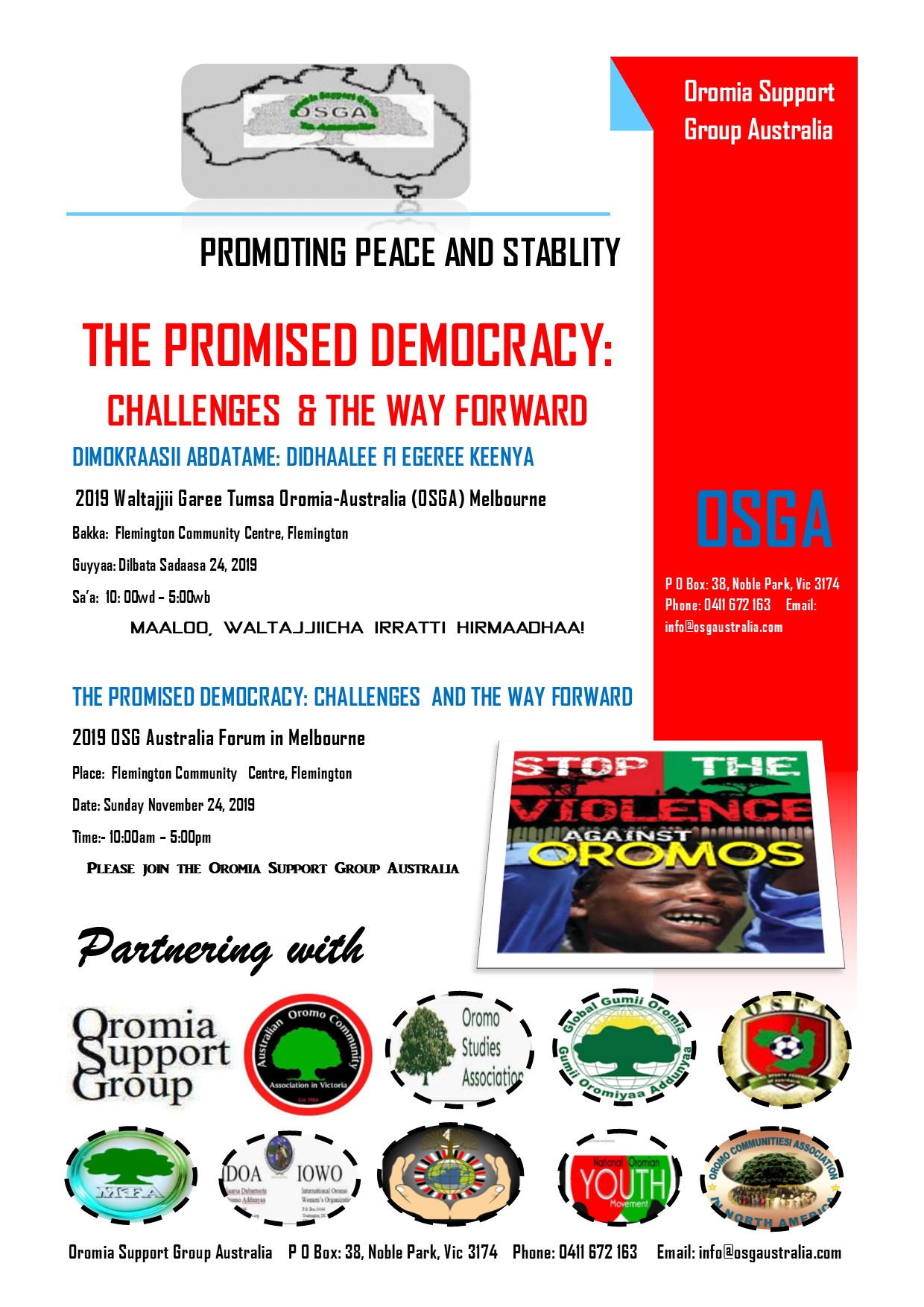
The Right to Freedom: A solution to Justice & Peace for Oromia

DAA Friends Event on 15 April: guest speaker Dr Trevor Trueman, founder of UK-based Oromia Support Group

Don’t miss our Friends Event on 15 April: guest speaker Dr Trevor Trueman, founder of UK-based Oromia Support Group, and the Iranian Women’s Choir

246d216c-73f4-47f6-8fe9-d282736a7554


The Right to Freedom: A solution to Justice & Peace for Oromia

12928434_10208043920127523_4076928287416834140_n