Oromo, at home and abroad please get organized; let those claiming to have been organized also get stronger. For how long will you live grumbling or kneel and beg to be noticed? Get up on your knees, raise your head and assert your rights as you did four years ago. This time has been called transitional but where it transits it is not clear. All oppressors’ tricks seem to be exhausted but no one knows this time with what they might come out to save the empire? Heating up war of words is heard between Amaaraa and Tigree.
From speeches of leaders, it seems the empire’s administration is inclining towards Amaaraa. Because Oromo entered the palace power did not go for Oromiyaa but for Ethiopia. Persons who are in power in Ethiopia and Oromiyaa are members of EPRDF. For that reason, they are fanning Ethiopianism; that means Oromiyaa colonial status is still in their minds. When they say Ethiopia, Ethiopia it is as if they lost and found. Oromiyaa’s independence has been forgotten as dead. In order for past dangers not to occur again we have to remind about it to those who are wavering. And point out directions as to what to do next, for untimely and misplaced criticisms against each other or the enemy alone cannot be a solution. If whatever we say to each other or others has no concrete benefit why would we badmouth and humiliate ourselves? When a beast can no more devour after its strong canine teeth had fallen and strong new one comes and improves on its methods and gnaw not only the flesh but also the bones, what is their difference? If not, the size it chomps at, being eaten means being eaten? Unless we see similarities of what Habashaa of Ankobar and that of Adwa did to us, we could make a mistake of looking for a different panacea.
It is good to develop the stamina to say for all, “Stop your domination and plundering just now”. Tigree and Amaaraa had lived waging power struggle among themselves at least from the time they destroyed Aksum. Occupying us together reconciled them, for a part starting to lose us made them to quarrel. Of what concern is it for an Oromo person to interfere in their wars before he/she stands on own feet and build strong rear? How can one choose between masters when one can liberate oneself? Had our crooks not helped them in the past they could not have been able to devour us alone. Bragging by changes brought by Oromoo Qeerroo and Qeerrantii they still are warming up to destroy Tigree and reoccupy Oromiyaa with Oromo blood. Oromo is withdrawing after opening for them Minilik’s palace which the Tigree closed on them. Because they did that they were branded as “Zaranyaa” (racist?) What made them to be called Zaranyaa is their asserting that what is ours is ours and what is yours is yours, let us know that and respect for each other.
Oromo in their history had ever discriminated others for their blood line for they think as human beings. It is not only in today’s history that those they trusted turned their backs on Oromo. The gratitude for what Qeerroo /Qeerrantii contributed is denial of rescuing when they were slain in Cinaaksan, Mooyaalee, Areeroo, Wanbara, Goobba, Baatii etc.
Freedom cannot be achieved without organizing oneself. It was because you were not organized that Nafxanyaa remnants stomped on you at DC. You were not noticed though present. Minnesota made history because they were organized. Little Oromiyaa exposed what great Oromiyaa looks like. So far Oromo survived destruction by Ethiopian governments by their relentless struggle. There is no doubt in the minds of the revolutionary that they will again survive by their own efforts and regain their sovereign right. If possible, Oromo will go forward with “Ilaa fi Ilaamee” (dialogue) for resolutions; that is their culture. If that fails, to fend off the enemy with any means available is a birth right. Get organized; unless organized you will remain lamenting.
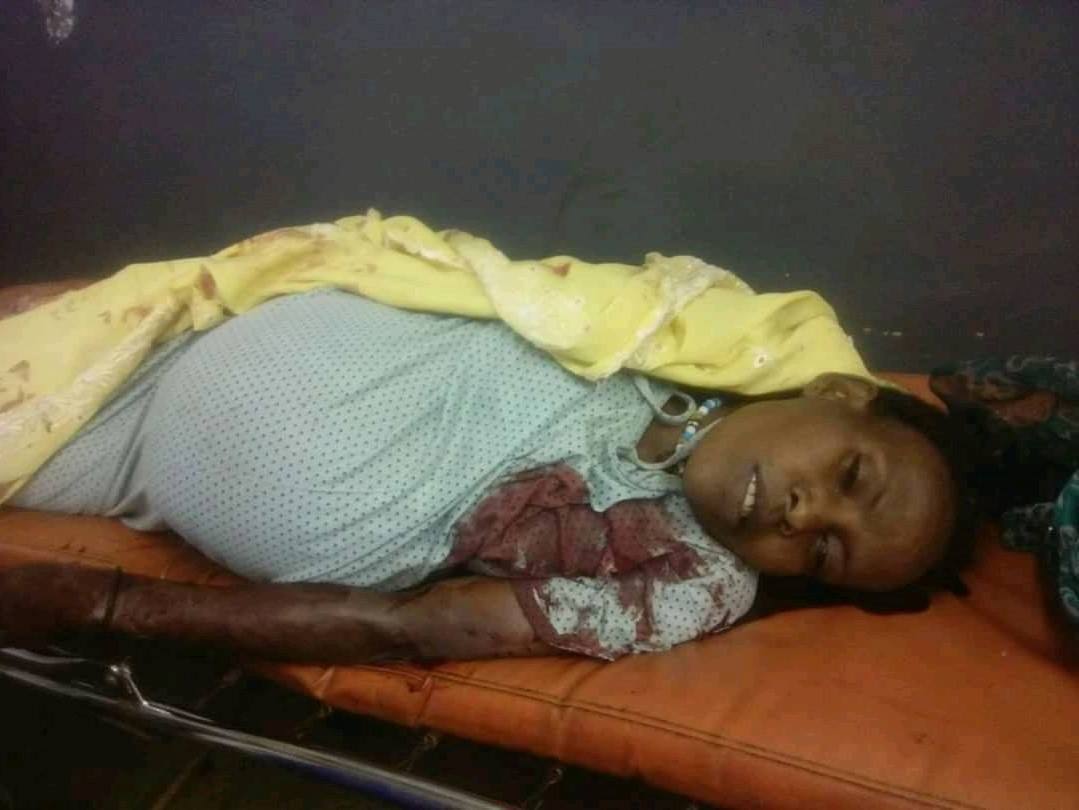
(A4O, July 24, 2018) A pregnant woman was shot and killed by OPDO police forces in Dambi Dolo, south west Oromia.
According to sources, a pregnant mother, Birhane Mamo, who was heading to Dembi Dollo hospital for delivery was killed by armed policemen Yesterday.
Berhane Mamo was shot and killed by OPDO police forces in Dambi Dolo, south west Oromia.
A pregnant mother in labor and four members of her family including her husband were severely injured and hospitalized.
The pregnant mother was getting transported to hospital for delivery, bullets showered on her from Oromiya Special Force without any warning. She died on the scene. Three others in the car were seriously wounded.
The Oromia regional government hasn’t issued any official statement on this killing.
However, our sources indicated that three members of security forces who were on patrol during the killing of Berhane Mamo in Dembi Dollo, were arrested this afternoon: security forces from the #Oromia regional state, the Federal police &, the national defense force are paroling the area.
Dambi Dollo communication officer has also published the information it gathered from eye witnesses. Accordingly, the women was killed by Oromia Special Force while getting transported to hospital for delivery.
Dembi Dollo is a capital city of Qellem Wollega Zone, mostly known for its gold and busy cash-crop business including coffee Arabica. It was relatively peaceful and calm before the government sent heavily armed soldiers and special police forces last month in a move to curb the recent progress of Oromo Liberation Army in the area.
Nevertheless, Oromo Liberation Front has recently announced that it has temporarily ceased fire in order to sit down for peace deal with the government. It is unclear why the government still wanted to settle armed soldiers in a populated civilians city.
(Advocacy4Oromia, 12 July 2018) Oromo Liberation Front (OLF) announces temporary Declaration of Unilateral Cease fire.
In a statement the party issued it says the discussion between OLF and PM of Ethiopia, is ‘one step forward to resolve the existing political problem.’
‘‘Tokening the seriousness of this affair in to consideration the Oromo Liberation Front has declared a unilateral cease fire in order to accelerate the initiated peace talk to a successful conclusion. We hope this temporary declaration of cease fire will take us to the final declaration of bilateral cessation of hostilities once for all and conclusion of the conflict.
Therefore, the Oromo Liberation Front executive committee instruct the Oromo Liberation Army, operating all over Oromia, to implement the temporary declaration of this cease fire.’’
Here below is the statement issues by OLF
Oromo Liberation Front’s Temporary Declaration of Unilateral Cease Fire
It is to be recalled that the Oromo Liberation Front had for years repeatedly called for a peaceful and negotiated settlement of political problems with Ethiopian government. We have also recently and repeatedly reiterating this call for peace talk. However, the OLF’s call for peace did not get proper response for a long period of time.
We believe that the recently Oromo Liberation Front higher delegation led by OLF Chairman meeting with the Prime Minister of the Federal Democratic Republic of Ethiopia, Dr Abiyi Ahmed is one step forward to resolve the existing political problem. The OLF also well aware that all peace loving people and governments wish the commencement of peace talk between the OLF and the Ethiopian government.
Tokening the seriousness of this affair in to consideration the Oromo Liberation Front has declared a unilateral cease fire in order to accelerate the initiated peace talk to a successful conclusion. We hope this temporary declaration of cease fire will take us to the final declaration of bilateral cessation of hostilities once for all and conclusion of the conflict.
Therefore, the Oromo Liberation Front executive committee instruct the Oromo Liberation Army, operating all over Oromia, to implement the temporary declaration of this cease fire.
Victory to the Oromo People!
July 12, 2018
Oromo Liberation Front
The explosive device delivered this morning in a Police car (Numberplate: ET Police0384) in Finfinne (Addis Ababa), during a public rally in support of the Ethiopian Prime-Minister with several fatalities and a yet unknown number of many people injured, shows that the new moves might not be taken lightly by the die-hards of the old regime without attempts to disrupt the peace. But is all smells like a false-flag.
By Thomas C. Mountain (*) – 23. June 2018
Game Over! The Tigray People’s Liberation Front which has ruled
Ethiopia since 1991 has been ousted from power in Ethiopia, replaced
by a new breed of leadership who have quickly moved to reassure the
people that a real change is in the making.
This past Wednesday, June 20, was a busy day for the new Prime
Minister Abiye, an ethnic Oromo, Ethiopia’s largest nationality,
travelling to the site of the latest ethnic massacre and addressing the
leadership of the Gurage community calling on them to end the ethnic
violence and bring peace to their land by dialogue and mediation. This
was all broadcast live for all Ethiopians, both at home and abroad, to
see via satellite television and warmly received by those to whom he
directly spoke.
Next door, here in Eritrea we sat glued to our TVs late into the
night watching Ethiopian television broadcast the address our
President Issias Aferwerki had made early that morning during our
annual Martyrs Day commemoration where he held out an olive branch of
peace to our neighbours in Ethiopia, repeated over and over. The
Ethiopian P.M. then went live and thanked the Eritrean President and
promised a future of peace and prosperity in brotherly respect. And he
did it in Tigrinya, the de facto national language of Eritrea.
We could only pinch ourselves in disbelief, to have our long time
enemies in Ethiopia suddenly change so positively, I mean EVERYTHING
the Ethiopian P.M. has been saying could not be more true.
The Ethiopian P.M. has gone on TV and described his governments past
actions, and he acknowledges he was a part of this, as “terrorist”
regarding its treatment of its political prisoners. He has addressed
the T.P.L.F regimes past policy of divide and rule via instigation of
ethnic bloodshed and spoke to what needs to be done to heal divisions
and move forward.
Here in Eritrea what we are hearing is music to our ears for the
Ethiopian P.M. is saying just what our President Issias Aferwerki has
been saying for two decades now, that we shouldn’t be fighting,
instead uniting, to build a more humane and just society absent of
foreign intervention.
If this new Ethiopian leader manages to stay alive, there is hope for
Ethiopia, that the nationalities, starting with the Oromo’s, the
largest, who have been calling for independence, will reconsider their
quest for separation and continue as one country.
While one must respect the right to self determination reality is that
the “Prison House of Nations” that has been Ethiopia up to now is best
transformed into a modern, peoples democracy rather than torn asunder
and left to fend for themselves as small, independent countries. This
new P.M. could be the one to give them hope and allow a violent
upheaval to be avoided.
The Horn of Africa, the Horn of Hunger, the Horn of War and Famine may
be seeing the birth of a new era, where Ethiopia no longer invades its
neighbors at the behest of the USA. Where Ethiopians are able to leave
behind their lives of hunger and thirst, of being cold, sick and
illiterate and start to feed, clothe, house, medicate and educate its
people, and turn a perpetual famine victim into a modern, prosperous
land.
For us here in Eritrea after 20 years of war followed by no war, no
peace, we have hardened ourselves to not seeing a light at the end of
the tunnel. This new leadership in Ethiopia is almost to much to
believe, its almost like a dream to us still. Could we really live as
brothers and sisters with our huge neighbour to our south?
Just as with North Korea the Trump Regime has broken with decades of
past policy towards the the Horn of Africa and allowed common sense
and experience to hold sway. It may be just pragmatism, but those
veteran diplomats in the US State Department know they have little
choice in the matter, any further support for the TPLF regime would
have been counter-productive and damage American credibility let alone
result in the disintegration of Ethiopia, possibly followed by a South
Sudan scenario.
One thing is for sure, and Eritrean President Issias Aferworki said it
with glee when he spoke at our Martyrs Day commemoration, “Game Over!”
for the T.P.L.F regime, shocking all in attendance into spontaneous
applause. What we have only dreamed about is now reality here in the
Horn of Africa, and if the seasonal rains arrive this year and another
drought is averted, then we can truly be blessed with
“selam(peace) and rain for the Horn of Africa”.
(*) Thomas C. Mountain is an independent journalist and historian in Eritrea, living and reporting from here since 2006. See thomascmountain on Facebook or best reach him at thomascmountain at g mail dot com
While this messge is concerning a situation of global importance, it is here addressed solely, but specifically to all members of the Oromo nation. PLEASE PROTECT AND HELP OUR MINORS AND CARE FOR OUR ELDERLY PEOPLE
While the vice of abuse especially of young girls from among the refugees is not new, we find that more and more unaccompanied minors (boys and girls) are found stranded in Kenya where they survive in appalling situations and under dreadful circumstances.
Many people simply don’t know or are not aware of that appalling situation, but we come across more and more such cases in the shadows of society.
UNHCR is less than helpful.
What needs to be done?
We are not advocating the building of new institutions like orphanages or to herd these helpless people into another corral or camp, or to blow the horn for more state control – the opposite. Anyone, who wants to learn more about this and why also we are against the institutionalized approach, can read up on the excellent website of www.wearelumos.org
We are appealing today to you by addressing the pride of the Oromo people as a nation, of whom already over 10% live in exile, to come to the rescue of the most vulnerable among our people, who had to flee our homeland Oromiya – alone and unaccompanied. They live under constant fear.
Please reach out with a helping hand and take them in – in good old Oromo tradition!
DON’T LEAVE ANY OROMO BEHIND
Right now we are looking for reputable Oromo families living in Nairobi or Kenya, who would be willing to help and take in an unaccompanied Oromo minor or an elderly person, while we sort out their refugee status or other bureaucratic problems with UNHCR or the Government of Kenya and try to find their next of kin.
These wonderful, often very young or very old people need your protection and shelter, your love and support, your care and encouragement – and they will enlighten your life as a family.
Please spread this message far and wide to the reputable members of the Oromo nation in Kenya.
Those who can and will help, please send us your contact, so that we can facilitate.
Right now we are looking for Oromo families of good standing, who could take in one of the 3 unaccompanied minors (we already could register them) or one of the seven (male) elders on our list.
Thank you very much
Bontu, Anane, Betelihem, Getahun et al.
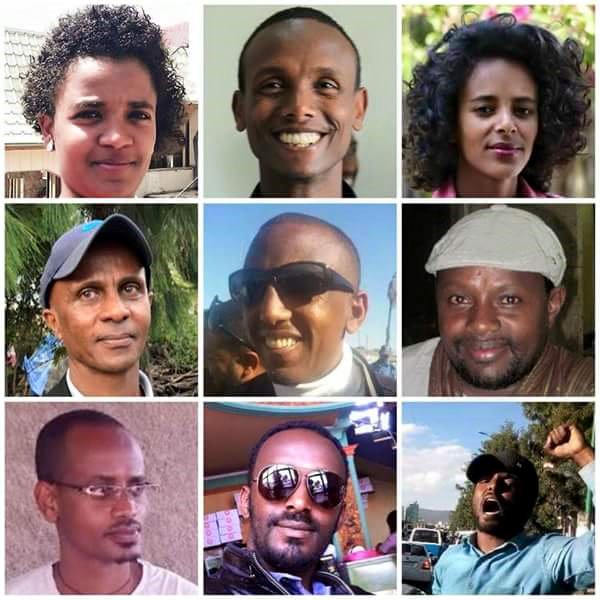
(A4O, April 1, 2018)– Advocacy for Oromia is gravely concerned that dozens of journalists, human rights activists and prominent opposition figures have been arrested and are being held in inhuman condition at Police Station.
On 25 March 2018, Ethiopian security forces arrested journalists Eskinder Nega and Temesgen Desalegn, Zone9 bloggers Mahlet Fantahun, Befekadu Hailu, blogger Zelalem Workaggnhu and political activists Andualem Arage, Addisu Getinet, Yidnekachewu Addis, Sintayehu Chekol, Tefera Tesfaye and Woynshet Molla.
According to reports, the arrests were made while the defenders were attending a private meeting at the home of journalist Temesgen Desalegn in Addis Ababa. The private gathering was held in recognition of the recent release of thousands of political prisoners amidst ongoing and widespread protests against political marginalisation and land grabbing in the Oromia and Amhara regions which began in late 2015. The eleven who have previously been jailed for their work as journalists or human rights activists are currently being held at Gotera-Pepsi Police Station in Addis Ababa.
Among those arrested Temesghen was taken from the prison to Zewditu hospital “due to severe back pain he developed during his jail time in recent past.”
Nega, who is a prominent political journalist, had previously spent nearly seven years behind bars on terrorism charges. He was released from prison several weeks ago, on February 14, only to be re-arrested this week.
The arrests follow the declaration of a national State of Emergency on 16 February for a period of six months. The State of Emergency imposes a blanket ban on all protests, the dissemination of any publication deemed to “incite and sow discord” including those who criticise the State of Emergency and allows for warrantless arrest.
Advocacy for Oromia asks for emails and letters urging Ethiopian authorities to secure Eskinder Nega, Temesgen Desalegn, Mahlet Fantahun, Befekadu Hailu, Zelalem Workaggnhu, Andualem Arage, Addisu Getinet, Yidnekachewu Addis, Sintayehu Chekol, Tefera Tesfaye and Woynshet Molla immediate, unconditional release and, pending their release, ensure that their cases proceed in a manner consistent with Ethiopia’s obligations under international law, in particular internationally recognized standards of due process, fair trial, and free expression; to ensure their well-being while in custody, including access to legal counsel and family and to bring an end to the suffering.
Subject: Release journalists, human rights activists and prominent opposition figures
Prime Minister Abiy Ahmed
Ministry of Foreign Affairs
P.O. Box 393
Addis Ababa
Federal Democratic Republic of Ethiopia
cc: Federal Attorney General of Ethiopia, President of Oromia Regional State, Ethiopian Ambassador to the United States, United States Ambassador to Ethiopia, United Nations High Commissioner for Human Rights, and Advocacy for Oromia
Your Excellency:
I write to to express grave concern that dozens of journalists, human rights activists and prominent opposition figures have been arrested and are being held in inhuman condition at Police Station.
On 25 March 2018, Ethiopian security forces arrested journalists Eskinder Nega and Temesgen Desalegn, Zone9 bloggers Mahlet Fantahun, Befekadu Hailu, blogger Zelalem Workaggnhu and political activists Andualem Arage, Addisu Getinet, Yidnekachewu Addis, Sintayehu Chekol, Tefera Tesfaye and Woynshet Molla. The eleven who have previously been jailed for their work as journalists or human rights activists are currently being held at Gotera-Pepsi Police Station in Addis Ababa.
I further understand from Advocacy for Oromia that, on March 25, 2018, 11 journalists, human rights activists and prominent opposition figures were arrested while attending a private meeting at the home of journalist Temesgen Desalegn in Addis Ababa. The private gathering was held in recognition of the recent release of thousands of political prisoners amidst ongoing and widespread protests against political marginalisation and land grabbing in the Oromia and Amhara regions which began in late 2015.
I welcome any additional information that may explain these events or clarify my understandings. Absent this, the facts as described suggest that dozens of journalists, human rights activists and prominent opposition figures were arrested as a result of nonviolent expressive activity, conduct that is expressly protected under international human rights instruments including the Universal Declaration of Human Rights and the International Covenant on Civil and Political Rights, to which Ethiopia is party. This raises not only serious concerns for Eskinder Nega, Temesgen Desalegn, Mahlet Fantahun, Befekadu Hailu, Zelalem Workaggnhu, Andualem Arage, Addisu Getinet, Yidnekachewu Addis, Sintayehu Chekol, Tefera Tesfaye and Woynshet Molla’s well-being, but for the ability of journalists, human rights activists and prominent opposition figures generally in Ethiopia to exercise their right to free expression.
I therefore respectfully urge you to investigate the situation and to secure Eskinder Nega, Temesgen Desalegn, Mahlet Fantahun, Befekadu Hailu, Zelalem Workaggnhu, Andualem Arage, Addisu Getinet, Yidnekachewu Addis, Sintayehu Chekol, Tefera Tesfaye and Woynshet Molla’s immediate, unconditional release and, pending their release, ensure that their cases proceed in a manner consistent with Ethiopia’s obligations under international law, in particular internationally recognized standards of due process, fair trial, and free expression; and to ensure their well-being while in custody, including access to legal counsel and family.
I appreciate your attention to this important matter and look forward to your reply.
Sincerely,
(Here-sign)
(Here -Your Name)
cc: The Honorable Getachew Ambaye
Attorney General, Federal Democratic Republic of Ethiopia
Email:justabr@ethionet.et
cc: The Honorable Zeid Ra’ad Al Hussein
United Nations High Commissioner for Human Rights
Email:InfoDesk@ohchr.org
cc: Advocacy for Oromia
Email:info@advocacy4oromia.org
The Honorable Abiy Ahmed
Prime Minister of the Federal Democratic Republic of Ethiopia
Email:public@mfa.gov.et
cc: Ambassador Kassa Tekleberhan Gebrehiwot
Ambassador of the Federal Democratic Republic of Ethiopia to the United States of America
Email:ethiopia@ethiopianembassy.org
cc: The Honorable Lemma Megersa
President of Oromia Regional State
Email:oromiaweb@ethionet.et
cc: The Honorable Michael Raynor
United States Ambassador to the Federal Democratic Republic of Ethiopia
Qeerroo – young Oromo activists – drove the mass strike that helped topple the prime minister of one of Africa’s most autocratic governments
Tom Gardner in Adama
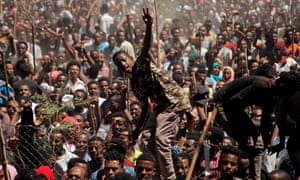
Supporters of Bekele Gerba, secretary general of the Oromo Federalist Congress, celebrate his release from prison, in Adama, February 2018. Photograph: Tiksa Negeri/Reuters
Today, Desalegn is a banker. But once he was a Qeerroo: a young, energetic and unmarried man from Ethiopia’s largest ethnic group, the Oromo, bound by what he calls a “responsibility to defend the people”.
Twelve years ago he helped organise mass protests against an election result he and many others believed the ruling Ethiopian People’s Revolutionary Democratic Front (EPRDF) had rigged. This landed him in prison, along with thousands of others, on terrorism charges.
Since then he has married and, like many of his generation in Ethiopia, mostly avoided politics. That was until 12 February, when he joined almost everyone in the town of Adama, and in many others cities across the region of Oromia, in a strike calling for the release of opposition leaders and an end to authoritarianism.
The boycott, which lasted three days and brought much of central Ethiopia to a standstill, culminated on 13 February with the release of Bekele Gerba, a prominent Oromo politician who lives in Adama, and, within 48 hours, the sudden resignation of Ethiopia’s beleaguered prime minister, Hailemariam Desalegn. The shaken federal government then declared a nationwide state-of-emergency on 15 February, the second in as many years.
“It was a total shutdown,” says Desalegn, of the strike in Adama. “Almost everybody took part – including government offices. You wouldn’t have even been able to find a shoeshine boy here.”
For him and many other residents of Adama, about 90km south-east of the capital, Addis Ababa, there is only one explanation for how a normally quiescent town finally joined the uprising that has billowed across much of Oromia and other parts of Ethiopia since late 2014: the Qeerroo.
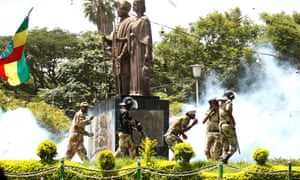
Police fire teargas to disperse protesters during the Oromo festival of Irreecha, in Bishoftu, October 2016. Photograph: Tiksa Negeri/Reuters
Who the Qeerroo are, and how they have helped bring one of Africa’s strongest and most autocratic governments to its knees, is only dimly understood.
Advertisement
In traditional Oromo culture the term denotes a young bachelor. But today it has broader connotations, symbolising both the Oromo movement – a struggle for more political freedom and for greater ethnic representation in federal structures – and an entire generation of newly assertive Ethiopian youth.
“They are the voice of the people,” explains Debela, a 32-year-old taxi driver in Adama who says he is too old to be one but that he supports their cause. “They are the vanguard of the Oromo revolution.”
The term’s resurgence also reflects the nature of Oromo identity today, which has grown much stronger since Ethiopia’s distinct model of ethnically based federalism was established by the EPRDF in 1994.
“In the past even to be seen as Oromo was a crime,” says Desalegn, of the ethnic assimilation policies pursued by the two preceding Ethiopian regimes, imperial and communist. “But now people are proud to be Oromo … So the Qeerroos are emboldened.”
As the Oromo movement has grown in confidence in recent years, so the role of the Qeerroo in orchestrating unrest has increasingly drawn the attention of officials.
At the start of the year police announced plans to investigate and crack down on the Qeerroo, arguing that it was a clandestine group bent on destabilising the country and seizing control of local government offices. Party sympathisers accused members of being terrorists.
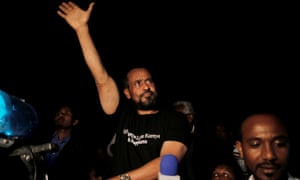
Bekele Gerba waves to his supporters after his release from prison in Adama, on 13 February. Photograph: Tiksa Negeri/Reuters
Though many dispute this characterisation, few doubt the underground strength of the Qeerroo today.
Since the previous state of emergency was lifted last August, Qeerroo networks have been behind multiple strikes and protests in different parts of Oromia, despite obstacles like the total shutdown of mobile internet in all areas beyond the capital since the end of last year.
Bekele Gerba, the opposition leader, credits the Qeerroo with securing his release from prison, and for sending hundreds of well-wishers to his home in Adama in the aftermath. But like many older activists, he confesses to limited knowledge of how they organise themselves.
“I only became aware of them relatively recently,” he says. “We don’t know who the leadership is and we don’t know if they have a central command.”
But in a recent interview with the Guardian, two local leaders in Adama, Haile and Abiy (not their real names), shed light on their methods.
According to the two men, who are both in their late 20s, each district of the city has one Qeerroo leader, with at least 20 subordinates, all of whom are responsible for disseminating messages and information about upcoming strikes.
They say their networks have become better organised in recent months, explaining that there is now a hierarchical command chain and even a single leader for the whole of Oromia. “This gives us discipline and allows us to speak with one voice,” says Abiy.
Their job has become more difficult in the absence of the internet.
“With social media you can disseminate the message in seconds,” says Abiy. “Now it can take two weeks, going from door to door.” Instead of using WhatsApp and Facebook, they now distribute paper flyers, especially on university campuses.
The role of Oromo activists among the diaspora, especially those in the US, also remains crucial, despite the shutdown.
Zecharias Zelalem, an Ethiopian journalist based in Canada, argues that it is thanks to prominent social media activists that the Qeerroo have acquired the political heft that youth movements in other parts of the country still lack. He highlights in particular the work of Jawar Mohammed, the controversial founder of the Minnesota-based Oromia Media Network (which is banned in Ethiopia), in amplifying the voice of the Qeerroo even when internet is down.
“[Jawar] gives us political analyses and advice,” Haile explains. “He can get access to information even from inside the government, which he shares with the Qeerroos. We evaluate it and then decide whether to act on it.”
He and Abiy both dismiss the assumption, widespread in Ethiopia, that Jawar remote-controls the protests. “The Qeerroos are like a football team,” counters Haile. “Jawar may be the goalkeeper – helping and advising – but we are the strikers.”
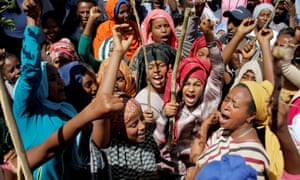
Supporters of Bekele Gerba chant slogans to celebrate Gerba’s release from prison. Photograph: Tiksa Negeri/Reuters
The reimposition of the state-of-emergency has angered many Qeerroos in Adama and elsewhere in Oromia, where the move was widely seen as heavy-handed bid to reverse the protesters’ momentum.
Some analysts fear further repression will push members of a still mostly peaceful political movement towards violence and extremism.
Jibril Ummar, a local businessman and activist, says that he and others tried to ensure the protests in Adama were peaceful, calming down overexcited young men who wanted to damage property and attack non-Oromos.
“It worries me,” he admits. “There’s a lack of maturity. When you are emotional you put the struggle in jeopardy.”
Gerba says he worries about violence, too, including of the ethnic kind. “We know for sure that Tigrayans are targeted most, across the country. This concerns me very much and it is something that has to be worked on.”
In the coming days the EPRDF will decide on a new prime minister, and many hope it will be someone from the Oromo People’s Democratic Organisation (OPDO), the Oromo wing of the ruling coalition.
This might placate some of the Qeerroo, at least in the short term. But it is unlikely to be enough on its own to dampen the anger.
“When we are married we will retire from the Qeerroo,” says Haile. “But we will never do that until we get our freedom.”
… we have a small favour to ask. More people are reading the Guardian than ever but advertising revenues across the media are falling fast. And unlike many news organisations, we haven’t put up a paywall – we want to keep our journalism as open as we can. So you can see why we need to ask for your help. The Guardian’s independent, investigative journalism takes a lot of time, money and hard work to produce. But we do it because we believe our perspective matters – because it might well be your perspective, too.
I appreciate there not being a paywall: it is more democratic for the media to be available for all and not a commodity to be purchased by a few. I’m happy to make a contribution so others with less means still have access to information.Thomasine F-R.
If everyone who reads our reporting, who likes it, helps fund it, our future would be much more secure. For as little as $1, you can support the Guardian – and it only takes a minute. Thank you.
Advocacy for Oromia was established in 2010 with the purpose of enabling and empowering Oromo people by providing accurate and timely information that will help to make better choices to create the kind of future in which they wish to live.
It also provides information focus on the major issues facing us in the 21st century and it is going to try and bring a balanced approach with factual information that is positive and solution based.
The website has been in operation for the last nine years with the mission of promoting and advancing causes of Oromo people through advocacy, community education, information service, capacity building, awareness raising and promotion.
The website is also the official site of Advocacy for Oromia Association in Victoria Australia Inc., a non-profit organisation, registered under the Associations Incorporation Reform Act 2012 in Victoria as April 2014.
Our team already had considerable community development experience and expertise. Our various projects helped to develop our confidence and the capacity of our agency. Our team used every gained knowledge, skills and experiences as an opportunity to design and develop new approaches, to documenting progress, supporting positive employment outcomes, liaising with community stakeholders, and conduct evaluation.
Advocacy for Oromia is devoted to establishing Advocacy for Oromia organisation to close the gaps where we can stand for people who are disadvantaged and speaking out on their behalf in a way that represents the best interests of them. We are committed to supporting positive settlement and employment outcomes for Victoria’s Oromo community.
Advocacy for Oromia Office
Addresses:
39 Clow St,
Dandenong VIC 3175
=====================
247-251 Flinders Lane
Melbourne VIC 3000
Activities Address
Springvale Neighbourhood House Inc
Address: 46-50 Queens Ave, Springvale VIC 3171
Postal Address:
P. O. Box 150
Noble Park, Vic 3174
With your support, we can continue to help community build a better future.
Advocacy for Oromia Mental Health Program
The aim of the program is to improving the mental health and well-being of Oromo community in Victoria. It aims to assist those experiencing, mental ill-health, their families and carers of all ages within this community to address the social determinants of mental health for Oromo community. It helps:
Identify and build protective factors,
Reduce stigma and discrimination
Build capacity for self-determination
Better understand mental wellbeing, mental ill-health and the impacts of trauma
The goal of the project is to increase mental health literacy of Oromo community that aims:
To assist people with mental health issues
To increase the capacity of mental health worker
To better understand mental wellbeing
To provide mental health education and information
To address the social and cultural causes of mental health issues
Advocacy for Oromia will organise information session, women performance, radio programs, culturally adopted conversations on Oromo Coffee Drinking ceremony, providing training for mental health guides and forum and producing educational materials on the selected groups and geographical area.
Human Rights Education Program
The Human Rights Education Program is a community based human rights program designed to develop an understanding of everyone’s common responsibility to make human rights a reality in each community.
Human rights can only be achieved through an informed and continued demand by people for their protection. Human rights education promotes values, beliefs and attitudes that encourage all individuals to uphold their own rights and those of others.
The aim of the program is to build an understanding and appreciation for human rights through learning about rights and learning through rights. We aimed at building a universal culture of human rights. Thus, we aimed:
To build an understanding and appreciation for human rights through learning about rights and learning through rights.
To build capacities and sharing good practice in the area of human rights education and training
To develop human rights education and training materials and resources
The goal of the project is to increase human rights literacy of Oromo community that aims:
To better understand human rights
To increase the capacity of human rights worker
To analyse situations in human rights terms
To provide human rights education and information
To develop solidarity
To strategize and implement appropriate responses to injustice.
The ultimate goal of education for human rights is empowerment, giving people the knowledge and skills to take control of their own lives and the decisions that affect them.
Human rights education constitutes an essential contribution to the long-term prevention of human rights abuses and represents an important investment in the endeavour to achieve a just society in which all human rights of all persons are valued and respected.
Advocacy for Oromia will organise information session, performance, radio programs, culturally adopted conversations on Oromo Coffee Drinking ceremony, providing training for Human Rights guides and forum and producing educational materials on the selected groups and geographical area.
Community Safety Program
The program aims to strengthen existing collaborations and identify opportunities for the development of partnerships aimed at community safety and crime prevention activities. This approach seeks to improve the individual and collective quality of life by addressing concerns regarding the wider physical and social environment. Importantly, community safety means addressing fear of crime and perceptions of safety as without this any actions to address the occurrence of crime and anti-social behaviour are of less value.








 Advocacy for Oromia