Author Archives: advocacy4oromia

Oromia: Human Rights Speaks

Many Oromo people living in Oromia, East Africa, Marama was forced to leave to save his life. Since he reached the safety of Australia after spending years in a refugee camp, Marama does everything he can to help his people still suffering in Ethiopia. Through community run organisations such the Oromia Support Group and the Oromo Relief Association , Marama tirelessly campaigns to raise awareness about the plight of Oromo people, works to get Oromo people out of refugee camps to countries like Australia and helps them to settle into their new lives once they arrive. His own story is at the core of his motivation, as he understands better than most what it takes to survive.

OMN: Irreeffannaa Hawaasa Oromoo Meelbarni – Onkoloolessa 12, 2014

Against the waves

Insights of the 2014 Irreecha festival

By Daniel Dormeyer

When they left from Addis Ababa early in the morning of Sunday October 5, the two Europeans, James Cator from England and Daniel Dormeyer from Germany, accompanied by two Ethiopians, Minassie Alemayehu and Haile Mekonen, did not really gauge the significance and importance of what they would experience when attending Irreecha in Bishoftu, Oromia regional state, around 45 minutes south of the capital.

With almost one third of Ethiopia’s population, the Oromo constitute the largest ethnicity in Ethiopia and the wider Horn of Africa.

Cator and Dormeyer had just arrived, excited about a country charged of history, culture and noble values, and willing to overcome waves of preconceived ideas about Ethiopia.

The season of blessing and love

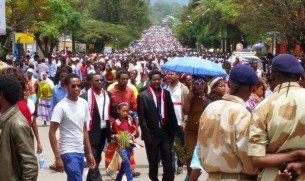
Traditionally decorated Oromos headed by a man with baboon skin head dress

Traditionally decorated Oromos headed by a man with baboon skin head dress

Established by Oromo forefathers, Irreacha (also called Irreessa) takes place annually throughout Oromia and amongst Oromo communities abroad on the first Sunday of last week of September or the first Sunday of the first week of October according to Oromo time reckoning (Dhahaa). Bishoftu hosts the major gathering of a festival believed to be one of the largest in Africa.

Known as Oromo’s Thanksgiving to their God (Waaqa) for his goodness over the past year, Irreecha marks the beginning of a new lunar calendar and a seasonal change from winter to spring, and more particularly the end time of starvation (Gadaa Belbaa), disunity, chaos (Mormor), and the auspicious occasion to wish plentiful harvests in the upcoming year.

After a pleasant drive through enchanting though unexpected landscapes on the uncrowded highway in the wee hours of the morning, during which they wondered about a dead hyena and the probability of getting hit by a car, the multicultural group of friends finally reached Bishoftu.

Bishoftu means “the land full of water” in Oromiffa language. Indeed, the main ceremony would take place at the Lake Hora Arsadii. In fact they reached sacred ground, where Oromo people believe God will grant all their wishes.

Waves of joy, harmony and unity

The car needed to get parked right before a blocked area. It was a short, but already crowded walk down to the lake. The rising sun dispelled the last clouds around Bishoftu, and casted bright spotlights on first waves of chanting and dancing people running down the street and moving towards the venue. Like tens of thousands of Ethiopia’s ethnic Oromo, they gathered for Irreecha to celebrate the transition from the dark and challenging rain season to the sunny new Birraa (Spring) season.

Even though some habitants got together in front of their homes around a delicious coffee while teenagers were still playing football, they knew that new waves of people from different parts of the country would arrive soon and just take them along to the ceremony. The effervescence, an irresistible attraction was already palpable.

“I was so impressed by the huge number of people, all beautifully dressed and moving ahead peacefully and cheerfully. A real festival of colors. I can’t remember having seen in my country such a traditional event respected and followed by so many people and with so much passion.”, Cator says.

Symbols of an identity and a worldview

The group of four bought scarfs in the traditional white / red / black colors and a green tree on it, as well as the green grass and yellow flowers (umama) to comply with the tradition. Indeed, everything related to Irreecha has a meaning and a purpose: for instance the Oromo gather in symbolic places such as hilltops, river sides and the shades of big sacred trees. Green being a symbol of fertility, peace, abundance and rain.

At Lake Hora Arsadii the three predominant Oromo colors on the Oromia’s traditional dressings sticked out of this huge green area.

Waves of joy and happiness brought the pilgrims and the group of four to the shores, amongst thousands of people already standing there and waiting the elders to stir long grasses in the lake before sprinkling the blessed water. They believe to get blessed as well and that it will bring them closer to Waaqa (God). Many of them also made presents to thank God for the blessings and mercies received in the previous year.

In the distance various boats could be spotted on the lake, sometimes with newly married couples aboard.

An older man started explaining the spiritual significance of Irreecha to Minassie and his obligation to convey the meaning of a ritual that has been passed down many generations and that will be passed to the next ones.

Then the group of friends also dipped their grass in the water, trying to imitate the repetitive hand movements people did to reject all possible bad vibrations while making wishes. Probably more generally about peace and health when the Oromos praise God also for fertility and abundance with regards to the one who matter to them, their livestock and the upcoming harvest.

Three united dimensions

Overwhelmed by this visual feast of colors and the irresistible vision of fraternity, the four friends climbed back to a clearing where the main ceremony would take place. The white seats in the shade of the big sacred trees they spotted when walking down to the lake were now occupied by the central persons of the blessing festival.

At this very moment the group of four realized the union of three dimensions of Irreecha: religious, political and social.

First this thanksgiving embraces all religious persuasions: Christians (amongst them Orthodox, Protestants), Muslim and Animists. They all came to thank the higher force and pray for a fruitful harvest.

Second Oromos from all ages and all stripes gather to Irreecha, sharing the same values and respect for the traditions.

Third various officials (speaker of the House of Peoples’ Representatives, officials from the Ministry of Culture and Tourism, President of the Oromia Regional State) performed in harmony with the honored Abagedas (the elders, the traditional leaders of the Oromo community, elected according to the traditional Gadaa principles). The speeches were held in three languages: English, Amharic and Oromiffa. Solemnity, pride, confidence and magnificence emerged from the speeches, reminding people about the uniqueness of this highly symbolic and truly global event.

Ethiopia is coming

Warmth was in the air and also in the words. Besides the respect of tradition and the awareness for the Oromo culture and history, this unique event symbolizes the pride and rise of Ethiopia.

Elites and supporters got encouraged to help paving the way for promoting Ethiopian values of sharing and fraternity conveyed by Irreecha, but also to convince the United Nations Educational, Scientific and Cultural Organization (UNESCO) to register this outstanding festival on the representative list Intangible Cultural Heritage of Humanity.

“The holiday is the only occasion, to the best of my knowledge, that brings together members from all religious persuasions to honor it. Seeing the masses attending this day is an evidence to how people here have not abandoned their traditional values even as they embrace modernity. It’s no wonder that it is a candidate for UNESCO’s World Heritage list with generations after generations protecting it,”Minassie says.

A sign sent to the world

When the group of four left, they walked back against further, even more massive waves of people joining the celebration. Waves of peace (Nagaa), freedom (bilisummaa), unity (tokkummaa), and reconciliation (araara), bringing people closer to each other and making religious, political and social bonds.

The two Europeans perceived Irreecha also as a positive movement against many waves they are experiencing in their societies: tradition resisting to modernity (people still looking for endorsement by the elder), all ages united instead of generations divided, all social classes brought together rather than class struggle, all confessions in harmony unlike so many parts of the world.

This year Oromos celebrated the Irreecha blessing festivities in millions. The group of four felt proud and honored to have been part of this movement. And they simply let themselves go with these positive waves.

Source: http://www.thereporterethiopia.com/index.php/living-and-the-arts/society/item/2608-against-the-waves
Oromia: The Price of Aid

This trailer of the feature length documentary  was recorded by Amanda Walsh a couple or years ago about the human rights abuses inflicted by the Ethiopian Government under the rule of the then Prime Minister Meles Zenawi. Unfortunately, she was never able to find finance for it. Hence, she decided to upload the trailer to the social media.

Filmed/Directed/Writer: Amanda Walsh 2008

CCTV Africa Report: Oromo’s Irreecha Festival

Irreechaa celebrated one of its biggest religious and social gatherings in the country.Close to three million domestic and international tourists graced this years “Irreechaa celebrations ”

Irreecha: Oromo’s Largest African Festival Celebrated by Millions at Hora Arsadi, Bishoftu

On Sunday October 5, 2014 an estimated 4 million people attended the annual Irreecha Festival at Hora Arasdi (lake) in Bishotu town, located 47.9 kilometers southeast of the Oromo nation’s capital Finfinne (aka Addis Ababa).

Although not conceptually, historically and purposively equivalent, people sometimes superficially use the word from the American holiday “Thanksgiving” to describe Irreecha Festival to expatriates. Oromo and friends of Oromo from across all religions and backgrounds converged to celebrate the transition from a gloomy (dukkana) rainy season  to a bright (booqaa) birraa (fall season).

The rainy season that runs for 3 months–June to August– is considered a harsh winter and  is associated with darkness and separation from friends and families because of rivers swelling, (and also because of the lack of electricity). In contrast, Fall is considered a more pleasant season of festivity.   Honestly  the tropical rainy season is not as a harsh a season as Winter as we know it in the northern hemisphere if you have the skills to swim and walk in and on waters.

https://www.youtube.com/watch?v=gn8MzduVUE4

To say that Irreecha is  a celebration of escaping a bad season, would be a gross oversimplification given the long and complex history of the Oromo indigenous African holiday practiced for thousands of years before the arrival of Abrahamic faiths in Oromia, Ethiopia and the Horn of Africa. Some people try to desecularize the holiday, but elders relate to us that Irreecha is quintessentially about uplinking with God and thanking God at natural and beautiful sites that he created for allowing people to withstand harsh weather conditions and natural disasters.

A bouquet of flowers arranged with wet grasses is presented to God (Waaqaa/Creator/Uumaa) as a gift on outdoor natural sites such as rivers, lakes and hilltops. People dip the grasses, coqorsa, in water and sprinkle the water over their foreheads sometimes as a way of receiving blessings.

Then they leave the gifts on the side of a lake for Waaqaa to see and enjoy the sight.   This shows the deep Oromo connection with nature and creatures. Irreecha is about thanking God, it’s about preserving the environment, keeping nature intact and green and about maintaining harmony between human and non-human beings in the universe.  Hence the prayer for araaraa-reconciliation with God and nature.

The concepts of celebrating the link between uumaa and uumamaa(Creator and Creation) is at the core of Irreecha.   It’s also about freedom music, having fun, expressing social grievances and the need for liberation, meeting people, recovering and re-asserting the marginalized and lost Oromo way of life–culture and identity.

According to the description of Irreecha obtained from the website of Waldaa Waaqeffattoota Addunyaa (Council of World Worshippers of the Oromo God), a body with authority to comment on the subjectmatter of Irreecha, Irreecha is celebrated for the following main reasons in outdoor natural settings:

  • to thank Waaqaa (God) for blessings and mercies we have received throughout the past year at the sacred ground of Hora Arsadi, Bishotu, Oromia;
  • to welcome the new season of plentiful harvests after the dark and rainy winter season associated with disruption of social life; and
  • to mark the end of rainy season (winter) and the beginning of Birraa (Fall);

Irreecha has been celebrated for the last 6400 years in Oromia and the Horn of Africa, according to the source above.

With this many million visiting the town of Bishoftu near the Irreecha site, the economic and tourism benefits of Irreecha is obviously tremendous. Pilgrims from other Oromia areas pay for public transportation and stay in hotels and some go to opening and closing concerts and other sub-events contributing to the economic growth of the state. Millions buy cultural clothes as well, which is a huge economic boost for Oromo and other traders.

Seemingly caving to popular demand for the holiday to be registered as a world heritage by UNESCO, Oromia State’s administrators and Ethiopia’s Ministry of Culture and Tourism allege that they are teaming up in an effort to register Irreecha with UNESCO and report that 80% of the work needed  for the registration has already been completed. While seeking international recognition is right, ironically Ethiopia doesn’t have the holiday on its list of national holidays.  If it materializes (it is a big IF), this can be  an important development as many Ethiopian regimes have long suppressed every element of Oromo culture as alien even internally, let alone seeking international recognition for them.

The Abbaa Gadaas who did the blessings praising the Ethiopian government did so under duress and they may not mean it anyway. The EPRDF government deployed an an entire Central Command part of its army in full gear, making the festival tense and occupied by TPLF soldiers. Yet, Qeerroo Oromiyaa kept singing freedom songs and didn’t budge at this huge display of force.

Source: http://oromopress.blogspot.com.au/2014/10/irreecha-oromos-largest-african.html

————–

Notes: Italicized words are from Afan Oromo, a language spoken by the Oromo people, making up nearly half of Ethiopia’s population, single largest and one of the most repressed ethno-national groups in Oromia and Ethiopia.

“Holiday” and “Holyday” can be used interchangeably in this text depending on why you are clebrating Irreecha.

Gadaa.com’s Irreecha “Central” is recommended if you want to view further photos and videos of the event in Oromia, Ethiopia and worldwide.

http://finfinnetribune.com/Gadaa/2014/10/in-photosvideo-the-2014-irreecha-colorefully-celebrated-at-hora-arsadi-despite-the-military-occupation-of-the-heavily-armed-tigrean-tplf-army/

THOUSANDS celebrates the Oromo Thanksgiving through out the world.

Adeola: Can somebody tell this guy this is not Ethiopia!

Hon. Anthony Byrne, Member of the Australian Parliament, attends the Irreechaa held in Melbourne

(A4), 5 October 2014) Hon. Anthony Byrne, Member of the Australian Parliament, attends the Irreecha (Oromo Thanksgiving) held in Melbourne, Australia, on October 5, 2014.

He reflects on his Facebook as follows:

“Wonderful to attend the Oromo Community’s Irreechaa or Thanksgiving ritual yesterday. As part of Irreechaa it is in Oromo tradition to gather at the river banks and lakes shores to give thanks to the almighty Waaqaa for all the blessings throughout past years and ask for Araaraa (Reconciliation), Nagaa (Peace), Walooma (Harmony) and Finnaa (Holistic Development) for the past, the present and the future. #ThisIsAustralia ”

https://www.facebook.com/anthonybyrne/photos/a.441152599304385.1073741826.440809762672002/700457830040526/?type=1&permPage=1


Oromo community in Uganda celebrate Irreecha festival

The Oromo community in Uganda celebrate Ireecha which is a thanksgiving festival.

The Oromo community in Uganda celebrated Irreecha, a festival of thanksgiving, on Sunday. The Oromo people are Ethiopia’s largest ethnic group.

Oromo communities spread out across the world on this day perform rituals around water sources to thank God for enduring the rainy season and ushering in the spring season. The Oromo Community in Uganda have held their celebrations at the Kabaka’s Lake in Lubaga.

– See more at: http://www.ntv.co.ug/news/local/06/oct/2014/ethiopias-oromo-community-uganda-celebrate-irreecha-festival#sthash.JZjOIcMT.dpuf
