Author Archives: advocacy4oromia
Memorial Day of the Oromo Martyrs
By Leenjiso Horo | April 13, 2014
The legacy of heroes is the memory of a great name and the inheritance of a great example
–Benjamin Disraeli
The 15th day of April/Ebla is the Memorial Day of the Oromo Martyrs. For this, on this day of April, we come together to commemorate the fallen Oromo heroes and heroines. This day has been designated as the Memorial Day of Oromo Martyrs at the meeting of the National Council (Gumii Sabaa) of Oromo Liberation Front held in 1984. Since then, the Oromo have been observing this Memorial Day and it has gained widespread acceptance and popular support among the Oromo people and the Oromo nationals in the Diaspora. This day is popularly known as Guyyaa Yaadannoo Gootoota Oromoo.
Every nation has a day set aside for the remembrance of those who gave their lives for the defense of their country; for freedom, liberty and dignity of their people. This is also true for the Oromo nation. For the Oromo, Guyyaa Gootoota Oromoo is especially important and significant for two reasons. One is for no other people have given so many martyrs in the defense of their country and nation for over a century consistently without giving up the struggle and without failing to sacrifice their precious lives. The struggle and sacrifice are still continuing. The second significance of this day, as noted above, is this: on this day of 15th of April 1980, the whole leadership of the OLF was murdered by a splinter group of Somalia Army while this leadership was on a diplomatic mission to Somalia. Such a massacre of a whole leadership of an organization is the first in history.
Throughout our long history of occupation, each time an Oromo man, woman, or child stood up against the colonialist, he or she is brutally murdered. Every Oromo man, woman, or child who refused to give up his/her name, religion, language, national identity has been ridiculed, humiliated, despised, castigated, and denied opportunities. So, it is these nationals as a whole that through their resistance to colonial occupation and through their fighting against it that pulled the Oromo nation one step back from the abyss of extinction. These nationals chose death over betrayal of the struggle for independence of Oromiyaa. Hence, these martyrs form the core of Oromo history. They are the ones who bravely and selflessly with determination defended and still defending our existence as a nation and as a people. It is these nationals who fought and still fighting for the independence of Oromiyaa even to the point of giving up their own lives so that we could continuously have before us example of self-sacrifice which would serve to encourage us to preserve ourselves today and our country for future generation.
The legacy of our martyrs is a sacred obligation for each and every one of us to fight for our country to liberate, defend and protect it. But the question to be raised is this: have we Oromo nationals at the present time lived up to this obligation? It is clear that some nationals do indeed lived up to this obligation, while others not. It is also true some Oromo have fulfilled or fulfilling this obligation more thoroughly than others. Today, as it always has been, is the call of the time that all Oromo nationals fulfill their obligation so as to expel the enemy from their country-Oromiyaa.
This Martyrs Day is meant to commemorate the Oromo heroes and heroines who had fallen in the defense of and in liberation struggle of Oromiyaa beginning with its colonization to the present and to commemorate those who had been massacred by the successive Abyssinian colonial regimes. Throughout the history of colonization of Oromiyaa, massacres and persecutions have been with the Oromo people. Today, under the Tigrayan occupation army the massacres and persecutions of the Oromo have surpassed that of its predecessors combined. The Oromo people have been targeted for a total annihilation. Along with this, the plunder, the stealing and the looting of Oromo resources and the environmental degradation in Oromiyaa and mutilation of Oromiyaa itself have been undertaken. These are unparalleled in the history of colonial occupation of Oromiyaa.
Here are the names of heroic leadership who were murdered on the 15th of April 1980:
1. Magarsaa Barii (nom de guerre Barisoo Waabi)-Secretary-General of the OLF;
2. Demise Tacaane (nom de guerre Gadaa Gammadaa);
3. Abboma Mitikku (non de guerre Abbaa Xiqii);
4. Yiggazu Banti(nom de guerre Doori Barii);
5. Falmataa Gadaa (aka. Umar, Caccabsaa);
6. Fafamaa Doyyoo;
7. Irrinaa Qacale(non de guerre Dhiba);
8. Dhaddachaa Mul’ataa;
9. Dhaddachaa Boruu and
10. Marii Galan.
One really needs to understand that 15th day of April is the commemoration of these martyrs as well as the past, the present, and the future martyrs. On this day, we think of martyrs; retell their stories and their heroic did and remember their names. It is also a day for the inheritance of their great examples. In the light of their sacrifices, we must make a firm commitment for which these patriotic nationalists gave their lives. This is the only fitting way to commemorate our martyrs. For this, we must be determined to preserve the very things for which they gave up their lives- the independence of Oromiyaa, the liberty, dignity and honour of their people.
In this struggle of ours, we must understand that in the condition we are in now, the international community will not note us. It no longer remembers what we say at forums, and meetings. Our letters to Presidents, Prime Ministers, the Secretary-General of UN, Senators, Congressmen and women, Governors, Mayors, and to the Editors of Newspapers and the Media outlets do not mean anything to them. We must learn lessons from Cambodia, Rwanda, Darfur, Bosnia and etcetera. Genocides were committed in these countries while the international community was watching on. Despite these, some Oromo nationals are still foolishly penning their hopes on the international community particularly on western countries. These Oromo nationals miserably failed to understand that the Tigrayan regime is client of the western governments. For this, they do not pay attention to us, but international community can never avoid our direct action if we fight; if we build uncontested liberation military might and make the empire ungovernable, then and only then, everybody will pay attention to us. We are in a protracted national liberation struggle. We have to earn the name liberation by our action. We have to make sure that the Oromiyaa’s soil burn the enemy feet and the Oromiyaa’s air burn the enemy faces. The Oromo roads have to be hostile to the enemy. We must make Oromiyaa a graveyard of the enemy-the TPLF. For these, we must fight on the ground-in the valleys, plains and villages everywhere across Oromiyaa. No Oromiyaa land be left for the enemy to walk on. “Once we have a war,” remarked Ernest Hemingway, “there is only one thing to do. It must be won. For the defeat brings worse things than any that can ever happen in war.” We are the living example of the conquest. The success of Amhara at the Berlin Conference of 1884/85 was followed with Tigrayan success at the London Conference of 1991. Both Conferences facilitated the conditions for the Abyssinians for the conquest of Oromiyaa. With the Berlin Conference, over five million Oromo were exterminated; many sold into slavery; the land was taken away and the remaining Oromo population became landless-tenants and their institutions were destroyed.
A century later, in a political maneuver at the London Conference of 1991, the TPLF grabbed opportunity to occupy Oromiyaa and has become master over it. With this, the use of violence, disrespect for the Oromo nation, illegal method of acquiring Oromo properties, and killings of Oromo become the Tigrayan methods of rule. This is what the Tigrayan regime of TPLF is and has been. Long before arriving in Oromiyaa, the Tigrayan elites saw the control of Oromiyaa and the annihilation of Oromo as its only option to rule the Ethiopian empire. For this, as soon as it entered Oromiyaa, it disrespected our people, threatened and endangered their wellbeing and then it resorted to widespread wave of annihilation throughout Oromiyaa. Then, by the law of conquest, it began grabbing Oromo land, creating and securing settlement sights for Tigrayans and other non-Oromo from across the empire in Oromiyaa, while evicting the Oromo population from their lands to make way for the newly arriving settlers. This has been organized by the Tigrayan elites who stand to gain from the crimes against the Oromo people. These heinous crimes committed in Oromiyaa against the Oromo people are all perpetrated with planning, organization and access to the empire resources including weapons, budgetary, distention facilities and mass media.
In London Conference, the “Oromo delegates” lost in the battlefield of the game of politics, whereby rivals maneuver for control of the issues and outcomes, practicing a brutal form of politics in which loss often equals death. The Oromo loss is attributed to those who went to the London Conference on their own without securing authorization from the collective leadership of the Oromo Liberation Front, its members, supporters, and the Oromo people. Because of this failure, the Tigrayans grabbed the opportunity to win and enter Oromiyaa. This led to a renewed wave of Oromo genocide and mutilation of Oromiyaa by the Tigrayan regime of Meles Zenawi. This must be reversed sooner than later. The TPLF must be expelled from Oromiyaa and its leaders must be brought to justice for the genocide they committed on the Oromo people.
For over a century, the Oromo patriotic nationalists had been sacrificed their lives for independence fighting against Abyssinian colonial occupation of Oromiyaa and many are still sacrificing in the struggle. Therefore, it is for us the living, rather, to dedicate ourselves here and now to the unfinished cause for which our heroes and heroines those who had fought and fallen and those who are still fighting have thus far so nobly advanced. It is rather for us the living to dedicate ourselves to the great task standing before us-that from those honored martyred we take increased devotion to the cause for which they gave the last full measure of devotion-that we here and now decisively resolve that those who martyred shall not have martyred in vain-that this great nation of ours shall have a birth of new Oromiyaa-an independent Democratic Republic of Oromiyaa-and that independent Oromiyaa shall establish an independent government of the people, by the people, for the people of Oromiyaa.
The lesson of Oromo martyrs is the love of Oromiyaa, identification with it; loyalty to the Oromo nation and determination to fight for independence if necessary unto death. This is what the brave sons and daughters of Oromiyaa had done in their fight against the occupier of their country. These patriotic nationalists brought Oromiyaa to light and put it on the map through their sacrifice and action. They embody great virtues; they stand for great principles; they illustrate noble qualities. It is for these, the colonialist guns and swords, its prisons, tortures, and the killings could not kill their spirit of fighting and their love for their people and country. Kidnappings, arrests, persecutions, concentration camps, secret cells, and the death squads did not deter them from their struggle for independence. All these, strengthened their attachment to the love of their country and people and so strengthened their resolve to fight for the independence of their country and for freedom, liberty, justice, and dignity of their people. History teaches us that no amount of arrests, persecutions, killings, rapes, tortures and plundering can stop a nation that is determined to struggles for their liberation and human dignity. And so nothing can stop the Oromo nation and their nationalists from the struggle for the independence of their country-Oromiyaa. These are the lessons to be learned from the Oromo martyrs and should indelibly be written upon minds of present generation and the new generations to come.
There is only one thing which can be dangerous to the liberation of Oromiyaa and to the Oromo national existence as a nation. That is the indifference of our own nationals to the cause of their people. Other than this, nothing an outsider can do will ever permanently harm us, but the collaboration with the colonialist against independence of Oromiyaa and the attitude of indifference and neglect on the part of some of our own fellow nationals to the Oromo national liberation struggle will surely be the dangerous ones. Such individuals are those whose spirits are broken, determination effaced and their courage fled. Such are individuals that lick the enemy hand that smite them. These individuals are the profiteers in the blood of their people. And they are dangerous to the national liberation struggle.
For a national liberation struggle to be successful first it needs strong organization; it needs nationalists with high spirit, determination, and courage to fight. Second, it needs unity of members and leaders on common objective; along with these there must be internal peace, political stability and a unified central leadership and command with common vision. To win a war without these is impossible.
“Culullee dhibbaa mannaa Risaa tokko wayya,” says the Oromo proverb. Metaphorically speaking it means, strong organization is better than hundred weak ones. Looking back at the Oromo history, we see this to be true. During the war of Oromiyaa conquest in the late nineteenth-century, there were many Oromo kingdoms and many regional Abbaa Duulaas/Defense Ministers. Each of them was not strong enough by themselves. On the other hand, they did not unite to stand against the enemy. Consequently, they were defeated one by one by the Army of king Menelik. Again, in 1991 there were five Oromo political organizations against one Tigrayan organization-the TPLF. All of them were unable to stop the TPLF from entering Oromiyaa. Again, after it entered Oromiyaa, they were unable to expel it from their country. The reason was simply there was no unity among Oromo political organizations.
The saddest of all is, most of the leadership of the Oromo political organizations are living in exile. Leadership in exile is a wrong model of leadership. Even during the dark days of Dergue regime, no Oromo political leadership ever left the country to live in exile. This is first time in the history of the Oromo national liberation struggle for the leadership to be in exile. History teaches us that no a Liberation Movement has ever liberated its country from colonial occupation without its leadership embedded within it. Moreover, never in history a leadership has ever liberated its country from foreign occupation from exile. Hence, it is vitally important for the Oromo political organizations to re-visit and re-examine the mistakes they made in the past so as to rectify them and unite the organizations into one-single whole with unified Central leadership and command. And the Politico-Military leadership should be in the country. Let this Memorial Day of the Oromo Martyrs guide us in this direction.
On this Memorial Day of Oromo Martyrs, let us dedicate ourselves to the struggle for independence of Oromiyaa in unity and harmony. Let us be worthy of the example of our martyrs. Let us honour their memory in this most suitable way by preserving the very ideas, values, principles and goal for which these Oromo nationalists martyred for-the independence of Oromiyaa.
Finally, I would like to say this, that it is also important to set the Oromo Genocide Memorial Day or Guyyaa Yaadannoo Sannyii Duguuggaa Oromoo aside for the remembrance of those millions of Oromos exterminated by the colonialist regime of King Menelik II during his war of colonial conquest of Oromiyaa. To establish such a Memorial Day for the victims of genocide is important. We do not have to wait until independence to set a day for observation. Such a Memorial Day will lead to greater unity among the nations and nationalities who were the victims of genocide of King Menelik II of Abyssinia. Let us do our part first.
Oromiyaa Shall Be Free!
April 15, 2014: Oromo Heroes and Heroines Day
By Ibsaa Guutama*
An Oromo hero/heroine is one who effects change or dedicated one’s life to change Oromo life with his/her determination and sacrifice. An Oromo hero/heroine is known for bravery, generosity and wisdom, and never flinches in the face challenges and temptations. An Oromo hero/heroine is a patriot for whom the national cause and the love of the people stand first, rather than personal interests. Oromiyaa has produced numberless heroes and heroines for whose sake Oromos have started walking with heads raised. A nation without a hero cannot express its feelings even when it is hurt. It is afraid of aggravating the already worst situation. But, if it has a hero to guide it, fear and pain will no further intimidate it. That is what Oromo heroes and heroines have done. They have helped their people to attain political consciousness, and recognize their identity and rights pertaining to it. That is why the enemy pursues them. The number of unknown Oromo heroes and heroines; those who have become meals for birds of prey; those who are suffering under enemy captivity; and those who are disappeared and not searched for is greater than the known ones. For all, we owe a lot. We remember Oromo Heroes’/Heroines’ Day to show our gratitude for their contributions and also to help the new generation learn from their patriotism.
Oromo youth started discussion about the liberation of their country in the 60’s; in the seventies, they came out with the vanguard of the Oromo liberation movement, the OLF. Hearing that the grand people, after a century of oppression, are coming out organized to fight for their liberation, there were commotions in all enemy camps. When Zaid Barree and Darg, with their allies, went to war, they hated and feared the Oromo movement more than each other. They attacked it from both sides and fatigued it, but were unable to wipe it out. The brave Oromo raised havoc both enemies never expected. Because war had weakened them, it was decided that ten members of the leadership go to Somalia, and look for help and consultation. But, an unexpected catastrophe betook them on April 15, 1980. From then on, it was decided that April 15 be remembered as Oromo Heroes’/Heroines’ Day for past, present and future.
How do we remember our heroes and heroines? One is meeting each year as usual, and preparing songs, dances, poems, reading materials, arts that reflect the occasion, and sing and dance together in their honor. On that day, we renew our vows to continue the struggle they had started to the finish. By doing so, we appease the spirit of our heroes and our ancestors. Not only that, we will also discuss how we can strengthen the struggle based on future plan of action, not on emotion-scratching handout-seeking annual presentations. This day will give us the opportunity to reflect where we started, and where we have reached now and to assess conditions in which our people find themselves at present and what to do next. We may also hear more about our heroes and heroines.
We appreciate and honor not only heroes that passed away, but also those who survived and are still heating up the struggle with people they initially agitated to rise. Heroes fallen in Ogaden did not budge for the gun pointed at their forehead and give up their unity and national pride for life in return. They stood together with courage and determination to the end, and paid the ultimate sacrificed for their nation. They were entered into the same grave holding to their nation’s dawnkaayyoo without religion and tribe dividing them. Pushing back personal comfort and family interest for the sake of the fatherland, they taught us what firmness on objective, generosity, commitment and determination means. When we remember our martyred heroes and heroines and those who are still languishing in enemy’s captivity, we should also not forget that they like us have old parents, children without support and someone they love to care for.
Honor and glory for the fallen heroines and heroes; liberty equality and freedom for the living and nagaa and araaraa for the Ayyaanaa of our fore parents!
* Ibsaa Guutama is a member of the generation that drew the first Political program of the OLF.
Neglected Identity – A Special Issue of Biftuu – Barii: Seenaa as Sanait
By Seenaa Jimjimo* | April 10, 2014
Even though my story is not as compelling and thrilling as the story of “Chaltu as Helen,” I still find it perplexing to see some Oromos introduce themselves in two characters. Perhaps, you are wondering what I am referring to. Let me take you through the story. It was just this past Sunday; I ran into a beautiful young Oromo woman. Just after she had walked in through the doors with her husband, she introduced herself to me with a typical Habesha name. I couldn’t pronounce her name, but I introduced myself as well. With excitement on her face, she told me her real name was … (let me just say, another typical Oromo name). Now, I am not in any way denigrating her for falling short of stating her real name to herHabesha friends; I was rather heartbroken and saddened by the fact this happened too often.
It is no surprise to me, as it is no surprise to you, that there are too many Oromo men and women who simply want to blend with Habesha identities easily by neglecting who they are. In fact, I have no problem using the name Ethiopia to define where you have come from. I understand it is the easiest and shortest thing to say to non-Ethiopians, and to receive warm welcome from your best “Habesha” friends, whom some of us dearly want.
However, have you considered the other side, the damages you are causing? Perhaps not; if you have done that, I believe that you will most likely make a better choice. The simple statement of your Ethiopianizationdoes not only renounce your Oromummaa, but it also leads you to lose the priceless opportunity to teach your true identity to others. Your statement makes you to acknowledge that you are indeed just another Habesha from that country. Remember the notion of “Ethiopianization” will force you to lose the noble opportunity of becoming a role model to the young generation, that looks up to you and to your peers, to claim who they are as Oromos. You know more than anyone, your people and your nation were (are being) persecuted and killed for simply being Oromos. In fact, most us come to this country claiming the Ethiopian government persecuted our parents or us ourselves.
I recommend each Oromo person to speak your mother tongue aroundHabeshas. For some reason, the best-friend, whom you have known too well, will show you their different side, the side you have never thought they have in them; perhaps, you already know that, maybe that is why you want to avoid bringing up your identity. For me, I have seen it too many times;Habeshas acting surprised that I am an Oromo, and that I don’t speak their language, or even worst, giving me the “eye” because I have announced I am proud to be an Oromo.
On the other hand, I’m a witness to the changes in the country so calledEthiopia. It was just eight years ago that the Ethiopian embassy staffer thought it was funny an Oromo person requested for a translator. Eight years later, I have witnessed great changes and pride to be an Oromo. Here at home, where I have lived for over half of my life, I have met so many young Habesha men who claim to be mixed/half-Oromos. Perhaps, some of these men are motivated to get my number; nevertheless, it makes me happy to know that the once-illegal identity has finally become a popular thing. I just want to acknowledge those changes have come with so much blood and struggle of the Oromo.
While our battles are far from being over, I would like to state that I understand the argument some of us (Oromos) make. Some of us will say, “Our problem is not with the name Ethiopia, rather the Ethiopian government, or even worst, not the Ethiopians, rather their leaders.” I say to you that the name Ethiopia and the government are one and the same. Whether it is the Tigrayan or the Amhara leaders, or their kin foot-soldiers, all have committed the same crimes against the Oromo. When their leaders mutilated and murdered our innocent men and women in such places as Aannolle and Calanqoo, their kin foot-soldiers supported them. Even today, over a century later, their kin foot-soldiers celebrate the leader that had committed numerous crimes against humanity against the Oromo people. Habeshas want the millions of Oromo lives lost by their genocide to be forgotten; our identity to be lost so we can accept Ethiopianization to become Amharas when they dream wildly. Remember, not a century ago, but today, Oromos are still being persecuted for simply being born as Oromos.
Amazingly, here in the West, far away from home, they still seem to control some of us with their spell. The American saying goes, “if it looks like a pig, smells like a pig and tastes like a pig, chances are ‘it is a pig’.” Remember, if we talk like them; dress like them or name our kids like them, then we have become them. The difference between them and us is just our culture, language and religions. With so much complexity in modern religions; truly, it is just our culture and language that differentiate us. In 2014, Habeshas expect us and our kids to speak their language. When we don’t, they ask “Why?!” – as if we are one and the same; worse, they make us feel inferior as we have failed to learn some important language. More importantly, we fail to ask them how come they don’t speak Afan Oromo when they were born and raised with Oromian milk and honey. What happens to the audacity, learning the culture and language of the country you reside? Of course, that does not apply to the Habeshas; they are the “chosen.”
The hardcore that I seem …
To give you an example of my experience, which had led me to who I am today, I would like to take you back to the Spring of 2013. As a last year graduate student in small town Illinois, I ran into a group of students – some of whom I knew, and others new faces. As I got close to the group of students, I noticed an unfamiliar face speaking directly at me in the language that seemed too familiar. Shortly after he had finished his statement, I told him that I did not speak that language. Angry and disappointed as he was, he walked away really fast. Everyone in the group (six people to be exact) smiled. Two second later, he returned with more of his language. Again, I said to him, “no offense, but I think I have told you I do not speak that language.” A good friend of mine, who knew me for almost three years, said, “I told you; she is not an Ethiopian; she is an Oromo.” Surprised and amused, he started laughing.
My colleagues and friends were so surprised by his act; they asked if we knew each other. While I understood my colleague’s confusion, I knew too well what his real aches were. I walked away with a smile on my face, saying to my friend, “clearly, he has a problem.” My friends shook their heads in agreement. Later that evening, two of my colleagues told me some of the things he was saying about me. He said, “He knows I speak the language, but I am trying to act American.” What he did not realize was that those people knew me, way long before he came, and everyone who had a chance to interact with me either as a classmate or a Student Representative (a Senator at Large) knew that I was always Oromo. Even though he failed to learn I was Oromo from his fellow classmates, the following week I taught him a lesson he would never forget. I am sure he had taken the lesson well, and he would never violate anyone else’s identity.
We are in America – the land of the free. It should not be up to someone, like the guys I mentioned, to tell us who we are. No one should define you; that time has passed. We should never alter our identity to please someone, and become something we are not. To some of us, it is time we face our darkest fear. There are far too many of us that believe in being Oromo, but continue to claim someone else’s identity. Our reasons might be different, perhaps many, but if not now, then when? Always remember, you can only overcome your fear only by facing it. To go back to my “little friend,” he later tried to tell me that he was in fact an Oromo from his dad’s side. He didn’t speak the language because he was born and raised in “Addis.” I think we all know what that means.
If you have read this far, you are probably wondering why I am writing about this now. I guess my answer would be, it is because of my recent encounter with the young Oromo lady whom introduced herself asHabesha, I mentioned above, and the place this month holds in my heart. I am not sure if everyone knows what the month of April represents. As the saying goes, it is no brainer to know little about your history. April 15th is the day all Oromos should remember. It is Oromo Martyrs’ Day, or the day we commemorate those who had fallen while paving the path to freedom for us. If you cannot celebrate this day for whatever reason, it is your duty to remember the men and women who sacrifices their precious lives to survive our identity, which we enjoy today. It is your responsibility to educate your fellow Oromos and non-Oromos what this day means to you and your people. The best way to represent your identity is through culture; culture is best kept by practice. As an Oromo, if we cannot agree on everything politically, I am certain that we can all come together to celebrate the national April 15th.
Happy “Guyya Gootata Oromoo!”
——————
* Seenaa Jimjimo is an Oromo Activist and can be reached at sjimjimo@gmail.com
AFO urges to uphold Human Rights of Refugees in Kenya
(Advocacy for Oromia, Press Release, 9 April 2014) Advocacy for Oromia requests the Government of Kenya to ensure that the law enforcement agencies to uphold the rights of all those arrested and to treat them in a humane and non-discriminatory manner.
The press release also emphasizes the need of internal investigations for the breach of the police department orders as issued by the department.
Advocacy for Oromia understands the security concerns of the Government of Kenya and the steps taken to protect the people who live in the country including asylum-seekers and refugees.
As the government does its search to secure the country, at the same time, they have to “to uphold the rights of all those arrested and to treat them in a humane and non-discriminatory manner.” to respect the International law and human rights.
Advocacy for Oromia has been informed that those arrested are held at various police stations as well as at the Kasarani Stadium in a very poor harsh condition.
Press Release Advocacy for Oromia
AANOLEE: ‘A TRAGEDY ON WHICH ETHIOPIAN SOURCES ARE SILENT’
 (OPride) – Hundreds of thousands gathered in Hetosa, Arsi zone of Oromia, the largest of Ethiopia’s nine federal states, for the unveiling of the Aanolee Cultural Center on April 6, 2014, local media reported.
The cultural center houses the Oromo Martyrs’ memorial monument, an ethnographic museum and a mural. Standing several inches on top of a tomb, the monument shows a severed hand stretched upward holding a women’s breast, also severed. It is erected as a tribute to the Arsi Oromo whose hands and breasts were mutilated by 19th century Ethiopian emperor Menelik II.
Located 150kms from the capital Addis Ababa, Aanolee is a site steeped in Oromo history. As Madda Walaabuu stood as the cradle and greatness of the Oromo, Aanolee came to represent its humiliation. For centuries, the Oromo were organized under an egalitarian Gadaa system. It was at Aanolee that power transfer took place among generations of Arsi Abba Gadaa leaders under Odaa Rooba, one of the five Gadaa Oromo assemblies.
In late 19th century, roughly at the same time as the scramble for Africa, emperor Menelik II set out to forcibly incorporate independent Oromo territories into his “nascent empire.” Having conquered the Wollo, Tulama and other Oromo tribes, Menelik faced a fierce resistance from the Arsi.
 The Arsi were not new to their Amhara neighbors to the north. In their encounters in battle, the Arsi did not consider their future nemesis to be much of a contender. The Arsi had, as they still do, much respect, both in war and in peace, for their southern neighbors – particularly the Sidama who are known for their fiercely warrior tradition. Besides, the Amhara did not then know how to ride horses, and the Arsi did not see any reason to be worried about loosing in battle to them. When news came that an invading army was arriving, the Arsi simply asked, “Is this the Sidama?” When told it was not, the Arsi scoffed, lowering their guards.
When Menelik’s army of conquest, equipped with modern firearms acquired from western powers, arrived in early 1880s, the Arsi was in for a rude surprise. However, buoyed by a tradition that bestowed Wayyooma (an almost sacred high honor) accorded to those distinguished in war as in peace, the Arsi waged a valiant war of resistance. The Arsi repeatedly ambushed and kept Menelik’s forces at bay for six years between 1880-86 — winning all 38 running battles. In one instance, in 1885, after Arsi warriors wiped out his elite imperial guard in a nightly ambush at the battle of Doddota near Mount Albasso, Menelik was forced to flee for life, leaving behind his wife and Negarit (the imperial drum). Menelik’s remaining soldiers, awed by the bravery of their opponents, reportedly sung: Doddota ye wandoochu bootaa (Doddota land of the brave).
On Sep. 6, 1886, the ferocious Arsi fighters succumbed to Menelik’s state of the art of the arts armaments with their spears and shields outmatched. An armistice was declared after an estimated 12,000 Oromo fighters, who faced off against a superior force led by general Ras Darge, perished in a single day battle. The Arsi “suspended their struggle to save whatever could be saved,” according to Oromo historian Abbas H. Gnamo, author of a recently published book, “Conquest and Resistance in the Ethiopian Empire, 1880-1974 – The Case of the Arsi Oromo.”
But the suspension of open hostility did not end Menelik’s appetite to crush and humiliate the Arsi. In 1887, Menelik’s forces came back to avenge their repeated defeat at the hands of local Oromo fighters and to terrorize the remaining populace into total submission. Ahead of a scheduled Buttaa event, a power transfer ceremony under the Gadaa system, Ras Darge called for a meeting to “make peace” with the Arsi and “deliberate” on future administrative matters. Thousands gathered at Aanolee. Aanolee was strategically chosen because it was a symbolic site of Arsi power and what is reverently referred to as Arsooma, a custom by which the Arsi Oromo made laws, deliberated on war and peace, elected their leaders and settled their inter and intra clan disputes — the super glue that held the Arsi tightly together.
Menelik’s scheme was to divide the Arsi so as to dismantle their Gadaa government structure and communal unity. Along with other Oromo speakers who served the system, the emperor enlisted local elders such as Tuke Mama and Bitee Dilaato. Mama was installed as the interim governor of sort. But the Arsi refused, not least citing the fact that Mama had outlived his Gadaa and was by then a Gadamojji (way past the retirement age under the age-based Gadaa grades).
The debate then centered on “qubaan moo lubaan bulla” — whether to accept Menelik’s rule or maintain their Gadaa structures. The proud Arsi chose the latter. Menelik himself then arrived to deliver the ultimatum that they would be annihilated if they don’t accept his rule. The Arsi was not ready to do so even long after accepting inevitable military defeat. The Arsi insisted on maintaining their Gadaa while accepting, even if begrudgingly, Menelik as a king. “Nugusummaa fudhannee, seeraa keennan bula,” they proclaimed according to local elders.
In what was to go down in Oromo history as Harmaaf Harka Muraa Aannolee, Ras Darge and Menelik’s army ordered those in attendance at the “peace” gathering to enter a narrow pass one by one. “The right hands of all male that entered were cut off on orders of Ras Darge. The Shoans tied the hand they cut to the neck of the victim. In the same manner, the right breasts of the women were also cut and tied to their necks,” according Gnamo. “As a further form of humiliation, fear and terror, the mutilated breasts and hands were tied around the necks of the victims who were then sent back home.”
As a result, all the men and women who went to Aanolee, the estimates ranging from a low of a thousand to thousands more, returned short of their right hands and right breasts.
That was not all. The local Abbaa Gadaas, the highest-ranking Arsi officials, including those in line to take the reign of power, were castrated. Menelik’s soldiers cut the tongues of those who spoke out against Abyssinian invasion. They went door to door collecting cultural artifacts, including Boku, Caaccuu, waraana, wonte, Siinqee and other relics. In a bid meant to destroy and remove Oromo culture from the people’s psyche, the artifacts were torched. It burned for eight straight days, according to descendants of the survivors.
Arsi oral historiography is replete with the story of the tragedy of the cold-blooded massacre at Aanolee. Told and retold by grandmothers and grandfathers for generations since, Aanolee served to this day as a symbol of Oromo resistance against Abyssinian expansion and its continuing legacy of subjugation. The Arsi saga of the 1880s gave birth to two stories — that of Aanolee and Lenjisoo Diigaa. According to Gnamo, Leenjiso was instrumental in organizing the Arsi resistance against Menelik’s invading army.
Among the Arsi, mention the word Aanolee and the blood of the Arsi boils and its trauma curdles into a rock of determination to see to it that justice is restored. Talk about the bravery of Lenjisoo and the knowledge of the massacre of Aanolee becomes a clarion call for spirited action against injustice and the willingness to pay whatever cost is necessary to re-empower the Oromo and relive the glory of its past patriotism and bravery.
Lenjisoo’s bravery was so well known that one of his earliest Geerarsa’s became part of the Arsi folklore. Gnamo writes,
Koloobni gadi gatee
Abeetni guddifatee
Waan boru biyyaa tayuu
Waan boru Arsii tayuu
Leenjoon ardhumaa mul’dhifatee.
Which means:
Forsaken by the Kollobaa, reared by the Abeeta,
 What he will do tomorrow for the country
 What he will do for the Arsi
 Leenjiso showed it all today.
The fall of the Arsi marked a turning point in Abyssinia’s southern conquest. Although Menelik’s imperial army faced furious resistance at Cali Calanqo, in Eastern Oromia, by that time, a vast swath of the Oromo country was already annexed.
The Aanolee memorial was constructed with a cost of 20 million birr, according to the Oroma Culture and Tourism Bureau. The monument stands erect as a reminder of the tragedy about which, in the words of Gnamo, “Ethiopian history was largely silent.” Even today, some right-wing Ethiopianists, akin to holocaust deniers, claim the incident was a fiction. Aanolee stubbornly stands to remind Ethiopia’s rulers, who refuse to deal with mounting Oromo grievances, that the Oromo issue remains an open wound, a latent volcano — with only the day and time of its eruption uncertain.
Chinese- and European-made spyware is enabling Addis Ababa to silence dissent
by @FelixHorne1
I met Abdi (not his real name), a 32-year-old primary school teacher from Ethiopia’s Oromia region, last July while in Nairobi. Abdi had been arrested a year earlier in his hometown for organizing a protest against local government corruption. He was already under the eye of Ethiopian security officials because he refused to provide information on the activities of his students to local authorities.
Over the course of two weeks in detention, Abdi was repeatedly beaten and accused of belonging to the Oromo Liberation Front (OLF), which originated in nationalist movements fighting for increased autonomy in the 1960s. The Ethiopian government considers the OLF a terrorist organization and uses the threat of an armed struggle to justify repression of ordinary Oromos, who constitute Ethiopia’s largest ethnic group.
The harassment continued after Abdi was released. Eventually, like thousands of other Ethiopians, he felt compelled to flee to Kenya, leaving behind his wife and two children. After some time in Kenya he called home and spoke to his wife, who told him that security officials had been harassing her since he left. That was the last time he spoke to her.
Abdi later learned from neighbors that security officials came to their house hours after his call, demanding to know who was calling her from Kenya and accusing her of being in contact with rebel operatives there. He no longer calls Ethiopia and does not know the whereabouts of his family.
Abdi’s story is not unique. In the last two decades, tens of thousands of Ethiopians have fled their country because of government repression or limited economic opportunities. Most of these migrants, especially those living in neighboring African countries, fear that if they communicate with their families back home, their calls will be traced and their relatives will face repercussions. As new research by Human Rights Watch shows, their fears are well founded. The fear that permeates the lives of many inside Ethiopia has been successfully exported to other countries.
The state-run Ethio Telecom is the sole provider of phone and Internet services in Ethiopia. The Chinese telecom equipment and systems company ZTE is helping Ethiopia modernize its telecommunications infrastructure. The Ethiopian government uses a Chinese-developed telecom system to monitor and control the communications of its citizens and to silence dissenters both in Ethiopia and abroad. Security officials have unlimited access to the phone records of everyone in the country who owns a phone. During abusive interrogations, security officials often play back recorded phone calls to people in their custody. Those calling or receiving calls from foreign numbers are particularly at risk of reprisals by a government keen to punish those it considers a threat.
But Ethiopia goes even further to monitor dissenting voices outside its borders. The government has acquired and is using commercially available European-made spyware — namely the U.K.- and Germany-based Gamma International’s FinFisher and the Italy-based Hacking Team’s Remote Control System — to monitor dissenters in other countries, effectively extending its surveillance capabilities far beyond its borders. These tools provide security and intelligence agencies with full access to files and activity on an infected target’s computer. They can log keystrokes and passwords and switch on a device’s webcam and microphone, turning a computer anywhere in the world into a listening device. Ethiopian expats, including those living in the United States, the United Kingdom, Norway and Switzerland, have become targets of this global espionage.
In late 2012, security officials detained the wife of Yohannes Alemu, a Norwegian citizen and member of a banned opposition group, as she was visiting family in Addis Ababa. They questioned her about her husband’s political connections. Then the security officials demanded information from Yohannes via phone and email about his opposition party colleagues. He refused; after 20 days his wife was finally released and returned to Norway.
But the incident did not end there.
One of the emails he received contained an attachment infected with FinFisher spyware. Once he had downloaded this spyware, the Ethiopian security agencies had unfettered access to all the information on his computer.
While people around the world are right to be shocked by former National Security Agency contractor Edward Snowden’s revelations of mass surveillance by the U.S. government, they should also be concerned that repressive governments such as Ethiopia’s are purchasing and using advanced technologies to target independent voices beyond their borders. The export and use of these European-made commercial products remains virtually unregulated. This is particularly worrying given that evidence exists that similar technologies may be in the hands of authoritarian regimes throughout the world.
These technologies enable repressive governments to monitor dissenting voices in other countries — even in countries where privacy rights are stronger and legal protections are in place to limit state-sponsored surveillance.
The United States, European Union and other donors that together provide an estimated $4 billion in annual aid to Ethiopia should take concerted steps to stop this abuse. They should support global efforts to regulate the export and use of such technologies to governments with poor human rights records. African governments should also speak out and make it clear to Ethiopia that it is an infringement on basic rights to use these technologies to spy on citizens outside of Ethiopia’s borders — people who are all too often seeking protection from repression back home.
The views expressed in this article are the author’s own and do not necessarily reflect Al Jazeera America’s editorial policy.
http://america.aljazeera.com/opinions/2014/4/ethiopia-s-borderlesscyberespionage.html
THE EXPANSION OF THE AMORPHOUS ADDIS ABABA, THE ENDLESS PERSECUTION AND EVICTION OF TULAMA OROMOO
By Bulbulaa Tufaa | April 6, 2014
 Among the major Oromo descent groups, the Matcha-Tulama group has got one of the largest populations, stretching on vast area of land in central and western Oromia. As we are able to learn from our fathers, Matcha and Tulama are Borana brothers, being Tulama angafa (first born) and Matcha qixisuu (second born son). As common to all Oromo ethno-history, the tradition that governs the social role of “angafa and qixisuu”, which begins right from the immediate family unit, has a deep genealogical meaning and social role in re-invigorating the solidarity of the nation. From the earliest time of which we have a tradition hanging down to us,
Matcha-Tulama Oromo has had a supreme legislative organ known as Chaffe. The Chaffe legislates laws which will eventually be adopted as Seera Gadaa. They have a senatorial council known as “Yaa’ii Saglan Booranaa”, in which elected individuals from major clans are represented. The function of Yaa’ii Saglan Booranaa is to deliberate on issues pertaining to regional issues, resolve inter-clan disputes and oversees how interests of each clan in the confederacies are represented; how local resources are fairly shared and wisely utilised according to the law.
These two northern Boorana brothers are historically referred to as Boorana Booroo or Boorana Kaabaa
Among the known five Oromo Odaas, Odaa Nabee and Odaa Bisil are found in Boorana Booroo
However, beginning from the 13th century onward, the Match-Tulama country (Boorana Booroo), adjacent to Abyssinian border, has begun to be ravaged by a group of individuals whose legendary genealogy connects them to a certain King Solomon of non-African origin. They came and settled at a place they call “Manz”.They organised themselves at this place, and started to attack neighbouring villages of Cushitic Oromo family stock of Laaloo, Geeraa and Mammaa. The attacked villages were gradually incorporated into the expanding Manz, which eventually developed to a military outpost known as Showa in the late 18th century. Hereafter, they declared themselves “Ye Negasi Zer, the root of Showa Amhara Dynasty.
After vanquishing Agaw people’s identity and sovereignty on the northern frontier, the Solomonic Negasi Dynasties of Showa intensified their attacks against the Match-Tulama of Borana and the Karrayyu of Barantu Oromos. In such turbulent situation, the rule of yeNegasi Zer entered nineteenth century era, which ushered the era of the Scramble for Africa by European imperialist powers. From Africa, it was only King Minilik of Showa (1866-1889) who was recognised as a partner and invited to attend the Berlin Imperialist Conference of 1884. In this conference, Minilik was represented by his cousin, Ras Mekonnen Tenagneworq Sahile-Sellasie (1852-1906). After completing their mission, King Minilik and the European imperialist powers made concession on border demarcation. After the border demarcation had been completed, a systematic elimination of his prominent general, Ras Goobanaa Daacci (1819-1889), was meticulously carried out. Minilik was so confident to declare himself Emperor of Ethiopia (1889- 1913).This was the Ethiopia, the first time in the history of the region, that brutally annexed and included Oromo, Sidama, Walaita, Kaficho, Beneshangul, Gambella, and others to the expanding of Abyssinia.
The years 1887-89 were the boiling point for Minilik’s declaration of being “Emperor of Ethiopia, ye Itiyophiya Nuguse, nägest. Why?
Because, it was the time when he exterminated the Gullallee Oromo from the marshy-hot spring and pasture land of Finfinnee and collectivised the place under a new colonial name Addis Ababa.
Because, it was the time when he built full confidence in himself and built his permanent palace at Dhaqaa Araaraa, a sacred hill, where the evicted Oromos peacefully used to sit together and conduct peaceful deliberation for reconciliation.
It was the time when he annexed three-fourth of southern peoples’ territories, including the Oromo territory, to the expanding Showan Dynasty and put under the iron-fist of his inderases (viceroys).
It was the time when he assured un-shivering confidence of being continued to be assisted and advised by his European colonial partners: militarily, diplomatically and technically.
Here is the question: What happened to those Oromos who were living in Finfinnee for centuries? Particular mention has to be made about those Tulama Oromo groups of Gullallee, Eekkaa, Galaan, Aabbuu, Jillee. The answer is very simple: They were mercilessly decimated; their villages burnt down, their pasture and arable lands confiscated and shared among the invading Manzian Nagasii families of whom the Dejazmach Mangasha Seifu and the Ras Birru families were the most notorious ones. Thereafter, the Oromo territory occupied by Matcha-Tulama was officially changed to the expanding Kingdom of Showa, a detached enclave from Gonder, Abyssinia. Finfinnee was given a new colonial name “Addis Ababa”, just like Zimbabwe was changed to Rhodesia, Harare to Salisbury. Under this excruciating condition, the conquered Matcha-Tulama region had to lose its historic significance and had to be involuntarily submitted to the colonial name Showa.
In addition to the former derogatory term “Galla”, imposed on the conquered Oromos as a whole, the new regional name of Showa is prefixed to the derogatory term Galla. Hence, “ye Showa Galla” came into force as a collective insulting name in addressing the whole Oromo of Matcha-Tulama. This clearly justifies the vertical segregation policy of the conquerors for easy identification of who is who in the newly colonised territory.
Using various forms of oppressive models, Abyssinian colonial tactics and strategies have been going on violently and, now entered into the first half of the 21st century. Since the second half of the 19th century in particular, the oppressive models have been amassing massive firearms from European colonialist partners, enjoying diplomatic immunities and profitable political advises.
In the late 19th century, one European writer commented that, if the Abyssinians had not been armed and advised by global colonial powers of the day, notably France and Britain, late alone to defeat the ferocious Oromo forces, they could not have even dared to encroach upon the limits of Oromo borders. He wrote what he witnessed the real situation of the time as follows:
“Against the Galla [Oromo] Menelik has operated with French technicians, French map-makers, French advice on the management of standing army and more French advice as to building captured provinces with permanent garrison of conscripted colonial troops. The French also armed his troops with firearms, and did much else to organize his campaigns. Menelik was at a work on these adventures as King of Shewa during John’s lifetime; adding to his revenues and conscripting the Oromo were thus conquered by the Amhara for the first time in recorded history during the last thirteen years of the nineteenth Century. Without massive European help the Galla [Oromo] would not have been conquered at all.”
The writer further explained what he personally encountered during the campaign in the following unambiguous language:
“A large expedition was sent as far South in Arsi as frontier of Kambata to return with100, 000 head of Cattle. The king’s army fought against tribes who have no other weapons but a lance, a knife and shield, while the Amahras always have in their army several thousand rifles, pistols and often a couple cannon.—-Captive able-bodied males and the elderly were killed. The Severity of the Zamacha [campaign] was aimed at the eradication of all resistance. Whenever the army surged forward, there was the utmost devastation. Houses were burned, crops destroyed, and people executed:”
When we see the history of Abyssinian political philosophy, from which we have a written record, it is entirely based on the philosophy of depriving the Oromos from having any right to homeland. To convert Oromummaa to Amaarummaa and ultimately to Itiyophiyawwinnet has been the policy in action up to this very day. Even though the policy works on all Oromos indiscriminately, the one which has been exercising on the Oromos of Tulama in Finfinnee and surrounding areas has its own unique feature. Some of the unique features are embedded in the formation of “Addis Ababa” itself; as a seat of colonial headquarters with all its oppressive machineries. To have ample space for the settlers, to build army headquarters, to build churches in the name of numerous Saints of Greek and Hebrew origins, to build residences and offices for foreign embassies and missionaries, to build factories and storage houses the crucial demand is land. To fulfil these crucial demands of the customers, helpless Oromo peasants of the area have to be evicted. They have been under routine eviction and land deprivation since the seizure of Burqaa Finfinnee and the establishment of Ethiopian Imperial capital at this place.
It could be incorrect to think of the current TPLF-Arinnet Tigray regime as a detached entity from the whole system of Abyssinian colonial regimes, when we equate what they need against the survival needs of the peoples they generically conquered as “Galla and Shanqilla”. Though since 1991, the Ethiopian imperial system has been overtaken from the Showan Nagasi Dynasty by their junior Tigrean brethren, the life of the colonised Oromo people has been going down from worse to the worst.
What makes TPLF-Arinnet Tigray different from its predecessors is its total monopolisation of resources of the empire, right from the imperial palace to the bottom village levels, from the centre to the periphery. Arable and pasture lands, plain and forest lands, rivers and mining areas are totally under its predatory control. It is routinely evicting peasants from their plots, their only means of existence. They are selling to Chinese, Indians, European, Turkish, Pakistani, Arabians and other companies at the lowest price. In making this huge business, the most preferable area in the empire is Oromoland; of which the land around Finfinee holds rank first.
This politically architected scheme, in the name of investment and development, is daily evicting Oromo peasants around Finfinnee often with meagre or no compensation at all. As a consequence,
some of the evicted families are migrating to cities like Finfinnee and are becoming beggars
Some of them are leaving the country for unknown destination and found being refugees in neighbouring countries like Kenya and Yemen.
Since most of them who have no any alternative, they remain on the sold land and become daily labourers, earning less than half dollar a day.
Farm lands that had been producing sufficient grains of various types are now turned to produce non-edible flowers and toxic chemicals that contaminate rivers and lakes.
The incumbent Ethiopian regime of TPLF-Arinnet Tigray, more than any other imperial regimes of the past, is committed to make the Oromo people an “African Gypsy”. At one time the deceased prime minister of the Empire and EPDRF leader, Meles Zenawi, refers to the Oromos, who are numerically majority ethnic group in the Empire, said, “It is easy to make them a minority”. They are practically showing us the evil mission they vowed to accomplish. When they become rich of the richest in the Empire, the Oromo peasants they are daily uprooting are becoming poor of the poorest, being reduced to beggary and often deprived of burial sites after death. This evil work, as indicated above, has given priorities to sweep off “garbage” around Finfinnee and ultimately to encompass three-fourth of the region of “Showa” as a domain of “non-garbage” dwellers.
As vividly explained above, the Oromo of Tulama, since the onset of colonisation, have begun to be collectively addressed as “ye Showa Galla”. Those who resisted the derogatory name, the eviction, and the slavery system have been inhumanly executed or hanged. Their land and livestock have been confiscated and shared among the well-armed conquering power.
When Minilik invaded the Gullalle Oromo in Finfinnee, for instance, they remarkably resisted to the last minute but finally defeated. Those who remained behind the massacre had no other option except to leave for other regions against their choice. In their new homes, they have been even treated as collaborators of the invading “Showans” by their own kinsmen, calling them “Goobanaa”.Those able-bodied Gullallee, Eekkaa, Galaan, Abbichuu youths were involuntarily conscripted to the colonial army which is typical to all colonial policies. They were forced to go for further campaign to the south, east and west commanded by Showan fitawuraris and dejazmaches
From time to time, all Abyssinian forces, changing forms of their names, swearing in the name of Ethiopian unity and inviolable sovereignty, have never turned down the initial policy of evicting and persecuting the Oromo from their ancestral araddaa. Araddaa Oromoo is the embryonic stage where Oromummaa has begun to radiate from. Hence, by virtue of its original formation, now and then, it could not be integrated into the enforced Abyssinian policy of Itiyophiyawwinnet .
Since the enforced policy has shown no visible success for the past 130 years, this time, it has taken on to shoulder the last option of “sweeping them off” from around what they call “Addis Ababa” as a priority number one. As a consequence, came into being the destruction of Oromo survival relationship with their ancestors’ plot of land. The desecration of their shrines, sacred rivers, sacred mountains and sacred trees of which the case of Odaa and Burqaa Finfinnee, Dhakaa Araaraa and Caffee Tumaa in the vicinity of Finfinnee are quite enough to mention. TPLF’s long range missile policy of destroying Oromos’ relation to their historic araddaa is not the end. It is just the beginning extrapolated to destroy Biyyoo Oromoo.
At this critical time, any concerned Oromo should not be oblivious of the dreadful situation going on in Oromiyaa right now; in Finfinnee and surrounding areas in particular. The deliberate expansion of the amorphous city they call “Addis Ababa” is politically architected to divide Oromiyaa into east and west sector. It is not a master plan. It is an evil plan mastered to consummate an evil goal.
At this critical time, may we believe in the “No life after death”? Rather, may we are for the life right now? Those who are for the life right now are genuinely expected to show discernible power through tangible solidarity to our victimised families at home. Pursuant to our tradition, we have been nurtured learning the wisdom of “Dubbiin haa bultu”. Now, we should redirect this wisdom to “Dubbiin kun hin bultu”,that we ought to swear by great confidence to move in unison against the inhuman act, endless atrocities and perpetual eviction of our families from their ancestral araddaa. Thereof, could we recall the intrinsic wisdom of our fathers’ saying “Tokko dhuufuun namummaadha, lama dhuufuun harrummaadha?
Voices from the margins: Young Oromos Speak
This is the first in a series titled Voices from the margins: Young Oromos Speak dedicated to amplifying the experiences and perspectives of young Oromos in the diaspora in their own words.
My first experience of becoming interested in Oromo identity as a form of personal study began when I took a class in African popular culture. I decided to write a paper on Oromo identity in the diaspora and the responsibility of those living outside of Ethiopia to bring global consciousness to our heritage. A constant theme within this is the role of telecommunications development over the past few decades which have created a virtual village which connects Oromos in Ethiopia and abroad.
In terms of my experience as an Oromo person in the diaspora, I feel that outside of my family and friends, my interactions with Oromo identity has been established through social media networks which have allowed me to keep up to date with the latest Oromo news, connect with organizations and activist groups as well as share knowledge. My use of the media has given me access to new understanding of my heritage and allowed me to distinguish myself from the overarching identity of being an ‘Ethiopian’ while living in Canada. Whether we like it or not, once we enter a host country we are viewed as an Ethiopian, not by choice, but by circumstance.
My parents did not land in Canada with an Oromo passport, but with an Ethiopian one. I have heard many Oromo before say that it is just easier to say they are Ethiopian when explaining their identity to an outsider – that saying they are Oromo isn’t met with legitimacy. But I think that just because Oromia is not yet a state does not mean that Oromo identity should be relegated secondary to Ethiopian identity.
My personal goal as an Oromo in the diaspora is to learn how to write in Afaan Oromo. One of the key things that I have learned from Toltu Tufa’s recent language campaign is the importance of the ability to write in Afaan Oromo, something we sometimes forget is an issue especially for Oromo children born outside of Oromia.
Many of us who have grown up in the diaspora can speak in Oromo, but have not been formally taught how to write in it. Personally, both of my parents left Ethiopia well before the language reforms of the 1990s and neither are able to write in Oromo with great fluency. I have come across many people that are ashamed to say that they do not know how to read or write in Oromo – but I do not think this is something to be ashamed of. The ability to access resources to develop Afaan Oromo as a written language is still a new phenomena, both in Ethiopia and abroad. Oromos in the diaspora of all ages should feel empowered to learn Oromo orally and through written word.
In the end, my personal embodiment and representation as a self identifying Oromo has its roots in my immediate family but has grown through my own search for other Oromos in the diaspora. I am proud to identify with my ethnic heritage and I feel that I have a responsibility to contribute to the growth of Oromo cultural expression and heritage. One of the great things about living in Canada is my undeniable right to freedom of cultural expression. This is a right that I am grateful for especially when I realize the ongoing struggle of Oromo identity within Ethiopia.
However, I also understand that my privilege has limitations. I myself have never lived in Ethiopia and I cannot speak of oppression from firsthand experience. I speak through the experiences of my parents and other elders around me who came to Canada from Ethiopia in later years. Yet this does not take away from the fact that I believe that Oromo in the diaspora carry a large responsibility in facilitating Oromo cultural renaissance.
Young Oromos in Diaspora
 Young Oromos born and/or raised away from Oromia, Ethiopia, have a wide range of experiences and perspectives.
However, they share the same longing for belonging, identity and community. They have nagging questions about identity and belonging, about history, and the past as it makes ghostly returns. They seek for resources to make sense of their families’ violent relationship with Ethiopia and define their own relationship to histories that shape their worlds in ways they often do not understand. So they ask questions. Many of these questions remain unanswered.
Young Oromos in the diaspora long for frameworks and lenses through which they can understand and make sense of the past, and through which they can imagine a better future. In the absence of physical spaces and resources for making sense, many turn to social media, and other online spaces where they often find contradictory and colliding information/relationships/frameworks. They come face to face with Oromos who have different understanding of history and identity. They come face to face with Ethiopians who refuse to recognize Oromo identity. They come face to face with themselves. For many young Oromos, the search continues, for the search is about identity, belonging, security and empowerment. The search is about life.
About Bissy Waariyo
Bissy Waariyo was born and raised in Toronto, Canada. She is currently completing an undergraduate degree at York University double majoring in Political Science & African Studies.
She is focused on studying how States incorporate or oppress ethnic identities within their political spheres and how peoples oppressed within their state are able to form cultural identity, belonging, and citizenship through digital avenues, i.e. the Internet, Facebook, blogs, Twitter, and other social networking mediums. Ultimately, Bissy’s goal is to become a professor of African Political Economy.
Follow Bissy on twitter @BissyLansaa
{ Send an email to oromusings@gmail.com or on twitter @oromusings to add your experience and perspective to the series }
Remembering Oromo Martyrs Day in Melbourne
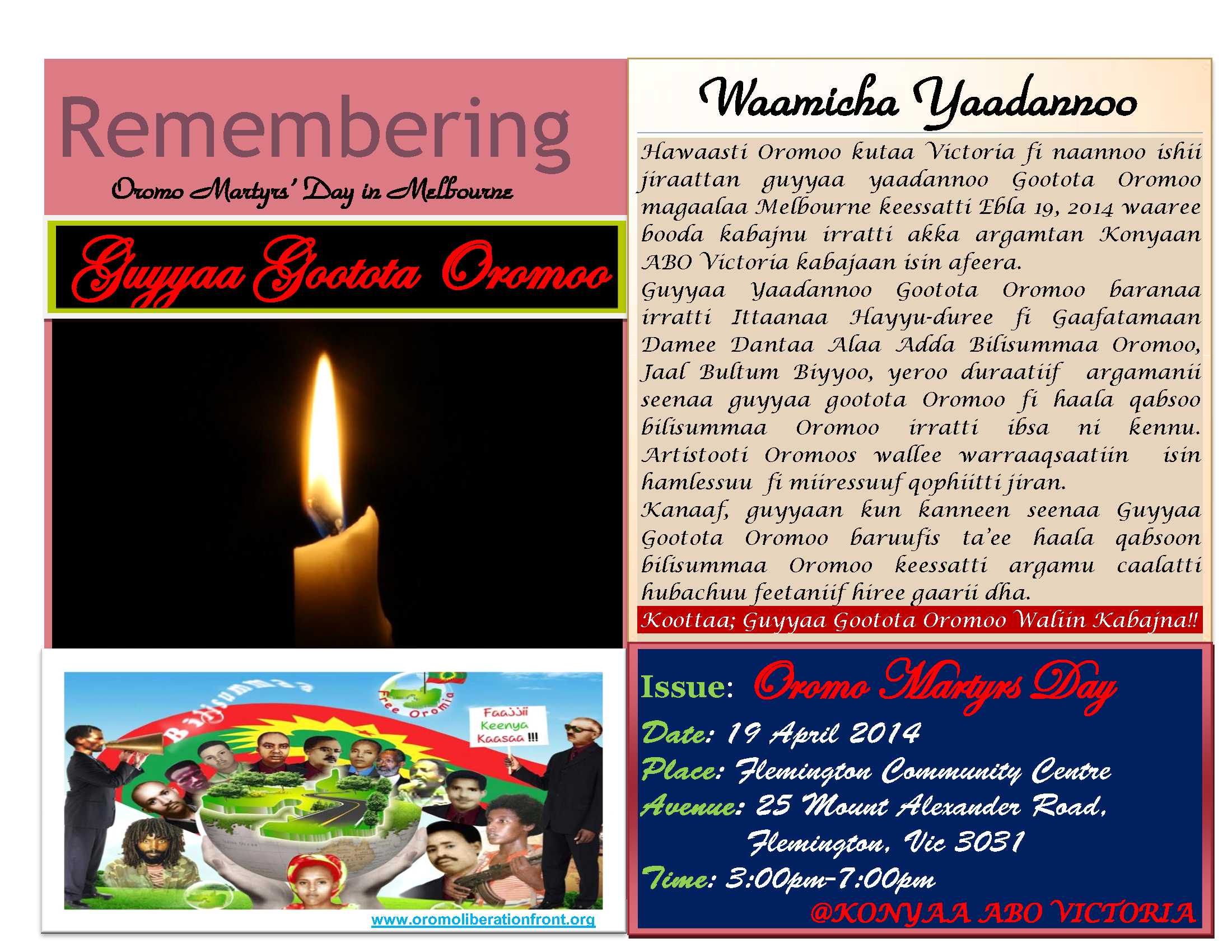 We warmly invite you to join us in celebrating this year’s Oromo Martyrs Day on April 19, 2014 at Flemington Community Centre. This commemorative day was first started by Oromo Liberation Front (OLF) following the execution of its prominent leader’s on diplomatic mission enrouted to Somalia on April 15, 1980. Since then this day was observed as Oromo Martyrs Day by Oromo nationals around the world to honour those who have sacrificed their lives to free Oromia and to renew a commitment to the cause for which they have died.
To welcome the Oromo Martyrs Day, Oromias will be hosting different memorial ceremony at their places. This is a perfect opportunity to network with friends and colleagues and support the work of the Oromo Liberation Front in promoting Oromo freedom struggle.
The event will commence with a special memorial service from 3.00pm, followed by the speech of the Vice Chairperson and Head of OLF Foreign Affairs, Mr Bultum Biyyo, with ample time being given for Q&A and discussion about the historic commencement of Oromo Martyrs Day and current Oromo freedom struggle.
Indeed, it is the right day to salute all martyrs of our people for national freedom struggle as well as our ongoing struggle for full liberation, equality and justice who fell while trying to fight a tyrant by his own weapons.
The Oromo Community in Victoria




 Advocacy for Oromia