Author Archives: advocacy4oromia

A Year on since a Historic Gaado Furra has Voiced Nation’s Grievance in the Sidama Capital; The Handover of the Power to the Nation Yet to Materialise.
By Denboba Natie, Edinburgh, Scotland
(A4O, April 09, 2020) On the early hours of April 09, 2019, the Sidama Women, girls, elderly ladies and grannies staged on a peaceful government’s response delay- demonstration in the Sidama capital, Hawassa. The scorching Hawassa sun didn’t deter them from their mission as the day has progressed. Perhaps it was the first in its kind and composition of the participants in the African soil, not only in Ethiopia. The estimated number of over one (1) million Sidama women and girls in their colourful Sidama costume came out of their entire Sidama districts to show their national grievances to the rulers. However, the PM surrounded by anti-Sidama unionist advisers didn’t say a single word about the Sidama women’s demonstration to this date demonstrating how much he belittles and hates the nation.

The Sidama women’s demonstration was initiated by these groups due to the delay in fixing the date for the Sidama referendum that guarantees the nation of its constitutional rights to a national regional statehood. Sadly, to date the cause Gaado Furra has echoed hasn’t been responded apart from running of the referendum on the 20th of November 2019 whose result was staggering 98.52% in favour of Sidama statehood.
The Sidama nation commemorates this an historic day in nation’s anti-oppression peaceful resistance history as significant milestone in Sidama’s female population contribution and in adding their signature in a traditionally patriarchal society. Their historic action has transcended traditional belief and seen above the traditional assumption on women’s assignment mainly as a household chores bearers.
The Sidama however traditionally asserts that Women are the foundation of the society; and believes without their presence the life and the society can’t continue to exist. Furthermore, historically, the Sidama women have got a very strong association known as ‘Yakiissa’ through which they had effectively defended their rights since time immemorial.
Historically, the Sidama nation has demanded its national rights to be restored since the nation has lost its political and economic power to the invading Abyssinian king, Minelik II’s army in late 1890s. Ever since the nation has been occupied- it has never silently rested and voluntarily allowed its rights to be crushed. Instead, the nation has challenged the successive Abyssinian rulers in different forms and shapes; and the quest has continued to this date.
Due to this quest tens of thousands of Sidama civilians were massacred by the successive Ethiopian rulers. Since the new PM, Dr Abiy Ahmed came to power in April 2018, over 212 Sidama civilians were executed and between 3000 and 3500 civilians were unlawfully arrested and remain in various prison cells throughout the country. Recently, some of those (Ejjeetto leaders) were released after unlawfully incarcerating them for 8 months since July 17, 2019 for no apparent and justifiable reasons. As we speak, there are several hundreds of Sidama politicians and activists commonly known as ‘Ejjeetto’ prisoners arrested in relation to these quests by the current regime in Sidama land and in Hosaena Zone, nearly 200km away from their families and the nation at large.
The Sidama nation is demanding these Sidama prisoners to be unconditionally released as the danger of Covid-19 looms. At the current climate, keeping the Sidama and the other prisoners in entire Ethiopia in their cells equates to sentencing them all to death penalty. The Sidama nation is urging the government to unconditionally release the Sidama, the Oromo and the rest prisoners in Ethiopia. The Sidama also urges the government to immediately handover the Sidama State power to the nation by desisting from joking on our nation. It is imperative to assert that, since the declaration of Sidama victory by the national election board post November 20, 2019 Sidama referendum, the Sidama national regional state (SNRS) must obtain its regional budget to fight poverty, and the current Covid-19 pandemic in addition to planning for its own priorities and objectives.
Finally, I propose April 09 to be honoured in respect of the Sidama women and girls. Therefore, it needs to be commemorated as a historic Sidama Women ‘Gaado Fuura’ day on yearly basis.
I Salute Your Bravery and inde
finability the Sidama Women and Girls!
Furra Gaadanonke Agaxxeommo’ne!!
Stay Safe by Staying Apart for Some time!
April 09, 2020- By Denboba Natie, Edinburgh, Scotland
Urgent Open Letter to The Ethiopian Government, the WHO and International Community
The Ethiopian Government should be part of the World Community in Fighting Against COVID-19 and Respecting Human Rights of the Citizens
Monday, April 06, 2020
 We, Oromo Civic, Professional, and Faith-based organizations in Diaspora write this letter out of grave concern that COVID-19 might cause preventable loss of lives in Oromia and the whole of Ethiopia upon all political prisoners, temporarily displaced persons such as refugee and homeless peoples who are extremely vulnerable because of their unhealthy living conditions. We are also concerned by the damages that could be done by the movement of the military personnel and the continued deployment of the illegal command posts in several Oromia regions during this period of fast-spreading COVID-19 pandemic. At this critical global health emergency, deployment of the military should be to contain the COVID-19, not to harass, kill, displace and plunder the citizens.
COVID-19 is unprecedented pandemic, and it exerts multifaceted threats. We have no cure or vaccination for this highly contagious disease. The only tool we have is prevention and mitigation. Prevention strategies are complex, and they take place at different levels and require coordinated efforts. This necessitates the government and the public to go extra miles. The WHO recommended prevention strategies are social distancing and personal hygiene. Social distancing means being two meters apart from each other, avoiding public meetings, and restricting travels. But the Ethiopian prisons are overcrowded with political prisoners and luck clean water. These conditions put the prisoners and the general public in unnecessary public health risks.
Moreover, the ruling Prosperity Party of Prime Minister Abiy is continuously holding public meetings and forcing people to attend in Oromia Regional State, in packed halls with thousands of people for political orientation. This is neglecting or prudently violating the global health guideline- one of which is social distancing. Such action is deliberately or negligently exposing the people to the deadly virus. This tantamount to genocide.
Ethiopia also has historical practices where the movement of soldiers unwittingly led to the spread of infectious diseases from one place to another and transmitted disease-causing agents. At this time, the Ethiopian army is deployed to several regions and is serving in the command posts.
For over a year, Western and Southern Oromia zones are under illegal command posts or martial law. The soldiers of the command posts are engaged in killings, imprisoning, and harassing civilians. In those regions, farming, businesses, schooling, and other activities are either entirely stopped or significantly disrupted, and the condition has subjected the people to live in poverty and malnutrition.
Poverty and food insecurity also make people vulnerable to infections. Hence, the illegal command post has created unhealthy social conditions and generated unnecessary risks to the transmission of COVID-19. From the zones ruled by the martial law and others, people who feared the atrocities of the Ethiopian security forces are massively fleeing from their homes to major cities. Many of them are now in cities and live in overcrowded housing or homeless. In the last twenty years in Finfinne/Addis Ababa area, the Oromo people have been evicted massively from their homes with little or no compensation, and many of them are now homeless.
Resulted from the Ethiopian government’s divide and rule policies, over two million Oromos have been evicted from their homes. Most of them live in overcrowded housing, and others are homeless. Homelessness and overcrowded housing are major risk factors for COVID-19. The Ethiopian public health action plans to contain the COVID-19 needs to include housing the homeless people and respecting human rights principles.
The widespread human rights violations are causing people to flee from their homes and displacing them locally and making them international refugees. The movement of the armed forces and the displacement of civilian populations are creating fertile grounds for the transmission of COVID-19 and putting the local and global communities at risk.
Breaking the chain of transmission of infections is possible only if we effectively communicate the risk of transmissions and preventive strategies. The significance of effective communication during emergency and epidemics are well known, and the WHO gives specific guidelines. During an emergency, the information should be delivered by the most trusted institution. Mixing politics and public health is counterproductive. However, in Ethiopia, politicians are mixing their party’s political agendas with health information. Some of the Ethiopian government political figures on their Facebook pages describe their political opponents as “the Coronavirus”. The political figures who openly use detestable languages also deliberately misinforms the public. Mixing politics and health education compounded with inaccurate messaging repeal those who do not adhere to party politics and make health education ineffective. At this critical juncture mixing politics and health education and giving misinformation is counterproductive. Health education should have primacy over political indoctrination.
COVID-19 does not discriminate between the supporters of different political parties, languages, religions, and ethnic-national-race groups. In such understanding, the United Nations (UN) Secretary-General António Guterres called for an immediate ceasefire among all parties involved in armed conflict. We know that human rights violations, war, and armed conflict have exposed our people to famine and HIV/AIDS. We urge the Ethiopian government to settle the political differences with the Oromo Liberation Army (OLA) peacefully and focus on the common enemy-the the disease-causing agent. Evidence-based public health policy directions in prevention and mitigating COVID-19 suggest the need for coordinated and multilateral efforts. Highly credible sources suggest that holding back this deadly virus is on the hand of the public, and everyone need to play their parts. This necessitates the need to build the social, economic, political, and cultural capacities of a group of people and individuals. Developing these capacities requires advancing individuals and group rights and communities’ capacity to prevent and mitigate the problem.
We, therefore, urge the Ethiopian government to respect human rights principles, release political prisoners, remove the command posts and protect vulnerable population groups such refugees, those internally displaced, and homeless individuals from the spread of COVID-19. We call upon the Ethiopian government to immediately take the following critical public health measures:
- Release all political prisoners.
- Make prison cells are consistent with the WHO recommended social distancing principles.
- Lift the martial law in the Oromia Regional State because it hinders people from leading a healthy life and playing their role to contain and mitigate the impacts of COVID-19.
- Stop all forms of human rights violations because it kills the aspiration of people to understand and solve problems.
- Stop displacing people locally or making them international refugees,
- Stop armed conflict and settle political differences with the OLA by a peaceful means.
- Overcrowded housing and homelessness are the manifestations of the ill-planned policy, and the government needs to strive to correct those wrongs.
- Stop holding public political meetings, because most of them do not fulfill the principle of social spacing
- Stop harassing and threatening independent mass media, including Oromia Media Network and Oromia News Network and let information to freely flow in Oromia.
Respectfully,
Oromia Global Forum: A consortium of Oromo Civic, Professional and Faith-Based Organizations
Signatories:
Advocacy4Oromia
Bilal Oromo Dawa Center
Canaan Oromo Evangelical Church
Charismatic International Fellowship Church
Global Gumii Oromia
Global Oromo Advocacy Group
Global Waaqeffannaa Council
Horn of Africa Genocide Watch
Human Rights League of the Horn of Africa
International Oromo Women’s Organization
International Qeerroo Support Group
Mana Kiristaanaa Fayyisaa Addunyaa
Oromo Christ Evangelical Lutheran Church
Oromo Communities’ Association of North America
Oromo Evangelical Lutheran Church of Washington DC Metropolitan Area
Oromo Evangelical Lutheran Mission Society
Oromo Human Rights and Relief Organization
Oromo Legacy, Leadership and Advocacy Association
Oromo Lutheran Church of Baltimore
Oromo Parliamentarians Council
Oromo Studies Association
Oromia Support Group
Tawfiq Islamic Center
Union of Oromo Communities in Canada
United Oromo Evangelical Church
Washington DC Metropolitan Oromo SDA Church
CC:
Dr. Tedros Adhanom Ghebreyesus,
Director of World Health Organization (WHO)
Avenue Appia 20 1211, Geneva
Telephone: +41-22-7912111
World Health Organization – Regional Office for Africa
Cité du Djoué, P.O.Box 06 Brazzaville Republic of Congo
Telephone: +(47 241) 39402 Fax: +(47 241) 39503
Email: afrgocom@who.int CC: chaibf@who.int
harrism@who.int jasarevict@who.int
GOVERNMENT AGENCIES
The US Department of State (USA)
Minister of Foreign Affairs (Canada)
Secretary of State for Foreign and Commonwealth Affairs (UK) Minister for
Foreign Affairs (Sweden)
Minister of Foreign Affairs (Norway)
Ministry for Europe and Foreign Affairs (France)
Federal Foreign Office (Germany)
HUMAN RIGHTS GROUPS
UN Human Rights Council
Africa Union (AU)
African Commission on Human and Peoples’ Rights Council of Europe,
UN Office of the Commissioner for Human Rights
Amnesty International
Human Rights Watch
MEDIA AND NEWS GROUPS
Oromia News Network
Oromia Media Network
Hegeree News Network
Radio Sagalee Walabummaa Oromiyaa
VOA Afaan Oromoo Program
BBC Afaan Oromo Program
Addis Standard
Aljazeera English
DW-Amharic
The Washington Post
New York Times
The Guardian
Reuters
Ethiopia: Release detained journalists and opposition politicians immediately
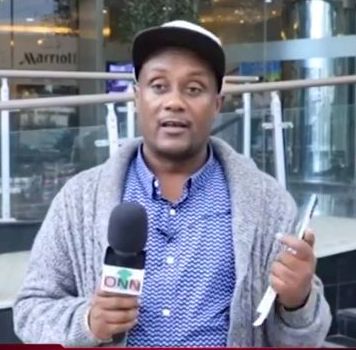
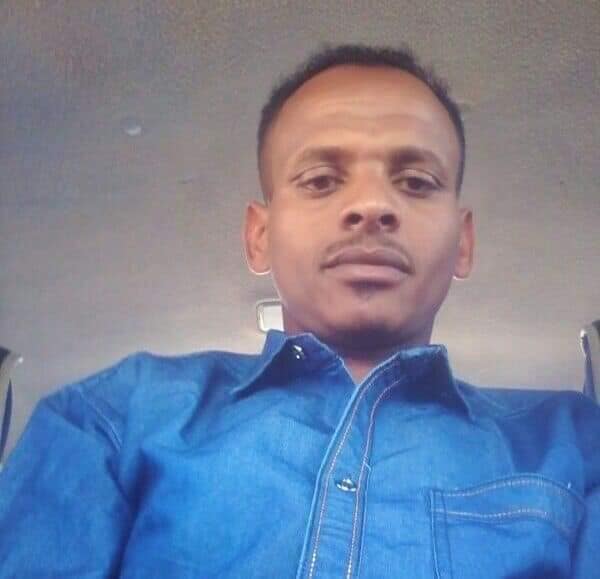
(Amnesty International, 7 April 2020, The Ethiopian authorities must immediately release two journalists from the Oromia News Network and three Oromo Liberation Front (OLF) officials who remain in custody a week after charges against them were dropped and the court ordered their release on 31 March.
The authorities must desist from this intimidation, harassment and arbitrary detention and immediately and unconditionally release these five individuals.
Deprose Muchena, Amnesty International’s Director for East and Southern Africa
“The Ethiopian authorities continue to detain five people long after the court ordered their release. The authorities must desist from this intimidation, harassment and arbitrary detention and immediately and unconditionally release these five individuals,” said Deprose Muchena, Amnesty International’s Director for East and Southern Africa.
The five were charged with taking a photo at the Burayu police station, and for traffic offenses relating to an incident where a vehicle rammed into the back of the police car the arresting officers were using. The prosecutor later dropped the charges, stating none of the alleged acts were crimes under the country’s criminal law.
The police however continue to detain the individuals claiming there were irregularities with the names on their identification documents. However, they have not presented the five in court with any new charges.
The detained are Batir Filae, OLF Central Committee member; Gadaa Gabisa, OLF political officer; and Bilisuma Ararsa, OLF member. With them are Desu Dula, the Vice Director of the Oromia News Network (ONN) and Wako Nole, a journalist with the network.
For more information on the mounting harassment of OLF members and supporters, see links below.
Vendor killed after police attack opposition supporters in Oromia
Authorities crackdown on opposition supporters with mass arrests
Success requires the removal of an obstacle, and OPDO is an obstacle
(A4O, Opinion, 7 April 2020) Professor Asfaw Bayana’s article titled “I must abandon a false hope now” prompted me to contemplate the meaning of hope and further led me to conclude that our greatest hope comes not from the OPDO but from the knowledge that we shall win our freedom soon or later.
For centuries, believers had foretold that a savior who would redeem them from their sins and take them to a place called Heaven will come someday. Such a story represents the hope that people would rise from death and live forever.
Likewise, we pay tribute to all Oromian martyrs, to the suffered, to the jailed, to the tortured, to the exiled, and to those Qeerroos/Qarrees who are still falling at the battlefields being shot by Abiy Ahmed’s killing squads being guided by the hope that the vision of those genius Oromians who articulated the mission of the OLF will become true someday. This means we hope that someday, we are going to build free Oromia, a free state that will accommodate all the needs of its citizens.
To get there, we just have to believe that there are tremendous sources of hope beyond our enemies’ abilities, strength, and capacity.
I am certain that freedom is possible with surety hope for better governance, yea, a liberated country free enough even for our killers. But we must press forward with a steadfastness in our ability to free ourselves, having confidence in ourselves and enduring to the end.
The OPDO is a simple obstacle and removing an obstacle is part of the process of achieving any task. The reason that made the OPDO an obstacle to our freedom can be readily understood by looking at the situation that produced her in the first place. There was a larger global purpose behind the birth of the OPDO back in the 1990s and the same thing is true about the installation of Abiy Ahmed in power in 2018.
That means False Hope is trusting that the OPDO is going to respect the false promises she made just 2 years ago. What we need to know is that, if we act now, the desired freedom will be fulfilled in the future.
The OPDO has been fighting against the Oromians believing that our hopes and aspirations would bring them hopelessness. They understood that If the Oromo people are free, their Nafxanya parents will lose control over the power and economic advantages that they currently enjoy.
Contrary to their selfish reason however, we can still believe in ourselves, fully persuaded that our sheer struggle would help us reach our destination. To do so, we must constantly ask ourselves;
• What was the purpose for which the OLF was formed?
• What was the OLF goal?
• Why did all those Oromians were killed, jailed, exiled, tortured?
• Why do we expect fairness from the enemy spy who had been killing us for the past 27 years?
• What is the message we are sending to the youth by expecting democracy from the enemy?
• What is our responsibility in helping the Oromo youth understand the mission of the OLF?
As an Oromo intellectual, each of us can teach the Oromo youth that success requires the removal of an obstacle and the OPDO is an obstacle.
Hope is an Anchor of the Soul,
Liberation is our Goal!
Oromiyaa: Mootummaan Abiy Guyyuu Oromoota Shan Ajjeesa
(Oromiyaa, 6 Ebla 2020) Mootummaan Abiy Ahmad Guyyaatti yoo xiqqaate Oromoota shan ajjeesaa akka jiru beekame.
Daataa Qeerroo Bilisummaa Oromoon walitti qabame akka ibsutti, baatii lamaan darban kana keessa qofaa sabboontonni Oromoo 150 jala gahan mootummaa Abiyiin ajjeefamaniiru.
Tarreessa maqaa nu gahe irraa akak hubatamutti kanneen ajejechaan kun irratti xiyyeefafte, Qeerroo Oromoo fi sabboontota Oromoo quuqama sabaa qabanii dha.
Daataan Oromoota ajjeemanii kun seenaa qabsoo Oromoo keessatti gochaa hamaa raawwatame ta’ee galmeefafmeera.
Haga yoonaatti qaamni mootumama ajjeechaa sabboontota Oromoo irratti raawwatamee gaafatame fudhate tokko illee hin jiru.
Daataa Oromoota Ajjeefamanii kana PDF kanatti aanee jiru kana tuquun argachuu dandeessu: Daataa Ajjeechaa 2020
Resolution: Conference of Oromo Civic, Professional and Faith-Based Organizations
 (A4O, 28 March 2020) Whereas, the Oromo nation, Oromummaa and Oromia are being subjected to unprecedented repression by the Government of Ethiopia (GoE);
Whereas, the GoE engages in a deliberate destruction of Oromo nationalism, dismantling Oromia and reversing the victories our people achieved by heroic sacrifices of our sons and daughters;
Whereas, the GoE works in concert with neo-nafxayas who aspire to re impose their former oppressive and exploitative system;
Whereas, the GoE promotes division and conflict among the Oromo people along regional and religious lines as a strategy for its success;
Whereas, the GoE, having imposed illegal Command Posts on parts of Oromia, is subjecting the Oromo people to untold misery through military rule;
Whereas, the GoE has widened and deepened the killings, arbitrary arrests and beatings of the Oromo people;
Whereas, the GoE burns houses with families inside and granaries full of grain; and sets fire to farmlands and forests without concern for crops or wildlife;
Whereas, the GoE has deployed armed forces to continue hunting down and murder Oromo youth on a daily basis;
Whereas, the GoE continues to refuse to bring to justice those who committed ethnically motivated murders of Oromo students on the campuses of universities in the Amhara regional state,
Whereas, the GoE is not willing to provide any protection to those spared from the killings, but finds the flimsiest of excuses to suspend or dismiss Oromo students from universities;
Whereas, contrary to its promises a few months ago to widen the political space in the country, that the GoE has actually narrowed the space significantly by illegally arresting and/or causing disappearances of leaders and members of the opposition parties and by obstructing and hindering the contacts of opposition parties with their constituents;
Whereas, the GoE intimidates independent Oromo media outlets and imprisons their management and reporters for reporting the truth;
Whereas, the GoE is engaged in hunting down and arresting politically conscious Oromos for not supporting the ruling Prosperity Party of Prime Minister Abiy Ahmed;
Whereas, the economic deprivation of Oromo people and robbery of the resources of Oromia by the GoE and its cronies have intensified;
Whereas, the GoE is leaving no stone unturned to demoralize and to force the Oromo nation to surrender and;
Deeply Concerned about the fate of the Oromo people and the survival of the Oromo as a nation and Oromia as land of the Oromo, if the current situation is allowed to persist;
Recognizing the need for the Oromo unity inside and outside the of country more than ever before in combating the ongoing difficult situation imposed upon our people;
We, Oromo Civic, Professional and Faith-Based Organizations, whose names are listed below and who share the aforementioned concerns about the situation of our people and our nation, having deliberated on wide-ranging issues pertaining to our people’s dire situation, and having successfully concluding our first conference from March 28-29, 2020;
We, hereby
1. Approve a Memorandum of Understanding (MOU), and pledge to work together to achieve our shared vision of advocating for the voiceless victims of injustices in Oromia and beyond;
2. Authorize and direct the coordinating committee, and the three others operational committees to lead our Advocacy, Information collection and dissemination, and Resource mobilization and organization efforts, to execute the MoU;
3. Strongly condemn and demand an immediate stop to the ongoing killings, arbitrary arrests, rapes and beating against the Oromo people by Ethiopia armed forces;
4. Demand the immediate lifting of the illegal and undeclared command posts and military rule imposed on Western and Southern parts of Oromia;
5. Call up on the Oromo diaspora to join us in condemning and actively opposing the ongoing repression against our people;
6. Call up on Oromo civic organizations whose names are not listed below to join us so that we can together defend our people’s rights;
7. Call up on all Oromo political organizations operating in Oromia to put their differences aside and unite in condemning the repressive policies of the GoE and, coordinate our people’s resistance to end the killings and arbitrary arrests being committed against our people;
8. Call up on all Zones of Oromia to come to the aid of their compatriots in other zones to once and for all uproot the GoE’s repressive policies which are the root causes of the poverty and misery of our people for there is strength in numbers;
9. Call up on all nations and nationalities in Ethiopia to condemn and actively oppose the killings and arbitrary arrests that the GoE is perpetrating against the Oromo and other peoples as all conflicts in one region can easily spread to their regions;
10. Call up on all organizations advocating for respect of human rights to inform the international community the untold human rights violations the Oromo people are subjected to by the GoE;
11. Remind the international community of its moral obligation and responsibility to speak up against, and to work to prevent the population exodus that is sure to ensue from the continued hunting down and killings of Oromo youth and the resulting forced migration and refugee problems;
12. Urge the international community to bring pressure to bear on the GoE to immediately stop the war it has declared on the Oromo people before the situation escalates into massive displacement, famine, civil war and genocide.
United we Stand!!
Oromo Civic, Professional and Faith-Based Organizations
1. Advocacy4Oromia
2. Bilal Oromo Dawa Center
3. Canaan Oromo Evangelical Church
4. Charismatic International Fellowship Church
5. Global Gumii Oromia
6. Global Oromo Advocacy Group
7. Global Waaqeffannaa Council
8. Horn of Africa Genocide Watch
9. Human Rights League of the Horn of Africa
10. International Oromo Women’s Organization
11. International Qeerroo Support Group
12. Mana Kiristaanaa Fayyisaa Addunyaa
13. Oromo Christ Evangelical Lutheran Church
14. Oromo Communities’ Association of North America
15. Oromo Evangelical Lutheran Church of Washington DC Metropolitan Area
16. Oromo Evangelical Lutheran Mission Society
17. Oromo Human Rights and Relief Organization
18. Oromo Legacy, Leadership and Advocacy Association
19. Oromo Lutheran Church of Baltimore
20. Oromo Parliamentarians Council
21. Oromo Studies Association
22. Oromia Support Group
23. Tawfiq Islamic Center
24. Union of Oromo Communities in Canada
25. United Oromo Evangelical Church
26. Washington DC Metropolitan Oromo SDA Church
March 28, 2020
Murtiilee fi Ibsa Ejjennoo Gamtaa Jaarmiyoota Oromoo
(A4O, Bitootess 28, 2020) Uummanni Oromoo, Oromummaa fi Oromiyaan roorroo hamaa jala jiru. Mootummaan Itoophiyaa Oromummaa balleessuu, Oromiyaa diiguu fi injifannoolee ummatni Oromoo dhiigaa fi lafee ilmaan isaatiin gonfate irraa mulquuf karoorfatee itti bobba’ee jira. Biyyattii irratti Nafxanyoota deebisee aangomsuu fi sirna isaanii deebisuuf Habashoota wajjiin qindoominaan socho’aa jira. Akeekasaa kanas milkeessuuf ummata Oromoo ganda, kutaa fi amantiin qoodee walirratti bobbaasuu tooftaa siyaasaa godhatee hojjeta. Seeraan ala labsii yeroo hatattamaa uummata Oromoo irratti labsuun naannoolee Oromiyaa bakka adda addaatti Rayyaan Ittisa biyyaa uummata irratti roorrisaa jira.
Mootummaan kun reebicha, hidhaa fi ajjeechaa uummata Oromoo irra geessaa jiru yeroo kamuu caalaa jabeessee fi bal’isee itti fufee jira. Manneen uummata keenyaa maatii isaanii wajjiin walitti qabee guba; midhaan gonbisaawwanii fi oyiruu ykn maasaa keessatti ibidda itti qabsiisa; bosona Oromiyaa bineensa isaa wajjiin guba. Barattootni Oromoo naannoolee biraa keessatti wayta ajjeefaman kanneen ajjeesan seeratti hin dhiheessu. Yakki suukanneessoon akkasii dalagamaa jiraatuu isaanii osoo beekuu gaaga’amtootaaf ittisa hin godhu. Kanneen hafanis sababa adda-addaa itti funaanuun barnootarraa ari’a. Keessumattuu, barattoota Oromoo godinaalee Oromiyaa ‘Command Post’ jalatti bulaa jiran irraa dhufan adda baasee ari’a. Naannolee Oromiyaa bulchiinsa ‘Comand Post’ jala jiran keessatti Raayyaan Ittisa Biyyaa Qeerroo fi Qarree akka bineensaa adamsee guyyaa guyyaan ajjeesaa, jumulaan hidhaa fi dararaa jira.
Mootummaan kun dirree dimookraasii biyyattii keessatti bal’isuuf waadaa gale cabsuun hooggannootaa fi miseensota jaarmoota siyaasaa kanneen isaan dorgoman ni dhabamsiisa; seeraan ala mana hidhaatti guura; qunnamtii jaarmoleen siyaasaa uummata waliin godhatuuf karoorfatan ni gufachiisa. Dhaabbileen sab-qunnamtii Oromoo dhugaa jiru akka hin gabaafne ni doorsisa, hooggantoota isaanii ni hidha. Saamicha qabeenya Oromiyaas daran hammeessee itti fufee jira. Walumaa galatti, hamilee uummata Oromoo cabsuun, Oromoo jilbeenfachiisuuf dhagaan mootummaan kun hin garagalchine hin jiru.
Namni hunduu hubachuu kan qabu Oromoon akka sabaatti tokkummaan ka’ee haga hin falmannetti rakkooleen kunneen sadarkaa amma irra jiran caalaa hammaatanii itti fufu. Badiiwwan uummata Oromoo fi Oromiyaa irratti mootummaa Itoophiyaan gaggeeffamaa jiran kunneen akkasitti yoo itti fufan, hireen ummata Oromoo yaaddessaa dha; Oromoon akka sabaatti, Oromiyaan akka biyyaatti itti fufuun gaaffii guddoo jala galuu danda’a.
Kanaafuu, nuti jaarmiyaaleen Oromoo adda addaa kan yaaddoolee armaan olitti tuqaman kanneen qooddannu, maqaan keenya armaan gaditti tarreeffaman, rakkoolee akka sabaa fi biyyaatti nu mudatan kanneen irra aanuuf qopha-qophaa socho’uu irra gamtaan socho’uun bu’a-qabeessa ta’uu hubachuudhaan, yeroo dheeraaf marii gochaa turreerra. Marii yeroo dheeraaf ‘technology’ adda-addaatti fayyadamnee godhaa turre goolabuuf Bitootessa 28-29, 2020 walgahii guddaa godhanne jirra. Walgahii kana irratti qabxiilee adda addaa irratti gad-fageenyaan erga mari’anneen booda murtiilee fi kutannoolee asii gaditti tarreeffaman irratti waliigallee baasuun walgahii keenya milkiin xumurannee jirra.
1. Haala hamaa uummata keenyarratti fe’amee jiru kana irra aanuuf tokkummaan Oromoo biyya keessaa fi biyya ambaa murteessaa ta’uu hubachuun, wal-tumsinee gamtaan hojjechuun uummata Oromoof sagalee ta’uuf walii galleerra;
2. Koree sochii gamtaa kanaa qindeessuu fi koreelee raawwii hujii sadi (three operational committees) utubnee jirra. Koreeleen kunis;
2.1 Koree falmii mirga namoomaa (Human rights advocacy committee),
2.2 Koree odeeffannoo funaanuu fi tamsaasuu (Information collection and dissemination committee),
2.3 Koree beekkumsa, dandeettii fi qabeenya maddisiisuu fi gurmeessuu/ijaaruu (Resource mobilization and organization committee)
3. Uummanni Oromoo, keessattuu warri biyya ambaa jiraattan, nu duukaa dhabbachuun rakkoolee saba keenyarra gahaa jiran gamtaan akka balaaleffannu waamicha lammummaa fi obbolummaa isiniif goona;
4. Jaarmiyaaleen Oromoo maqaan keessan asii gaditti hin tarreefamin hunduu, nu duukaa hiriiruun rakkoolee saba keenyarra gahaa jiran gamtaan qolachuu akka dandeenyu, sagalee dabalataa akka nuu taatan waamicha lammummaa fi obbolummaa isiniif dhiyeessina;
5. Dhaabileen siyaasaa Oromoo biyya keesssa jirtan hunduu adda-addummaa siyaasaa keessanii qabattanii ajjeechaa fi hidhaa Oromoo irra gahaa jiru waliin akka balaaleffattan, akka dura-dhaabbattan fi furmaata itti barbaaddan waamicha isiniif goona;
6. Maddi rakkoo uummata keenyaa hunduu sirna gabroomfataa mootummaa Itoophiyaa ti. Sirna kana hiddaan biqqisuuf tokkummaan ka’uu fi falmatuun murteessaa ta’uu yaadachisaa, roorroo fi dararaa naannoo Oromoo tokkorra gahuuf naannooleen Oromoo biraa akka birmattan waamicha lammummaa fi obbolummaa isiniif goona;
7. Mootummaan Itoophiyaa labsii yeroo hatattamaa kan seeraan ala uummata Oromoo Dhihaa fi Kibba Oromiyaa irratti labse hatattamaan akka kaasu akeekkachiifna;
8. Ajjeechaa, hidhaa, dubartoota Oromoo humnaan gudeeduu fi reebicha Raayyaan Ittisa Biyya Itoophiyaa uummata Oromoo irraan gahaa jiru hadheeffannee balaaleffachaa, hatattamaan akka dhaabbatu mootummaa Itoophiyaa dhaamna;
9. Mootumman Itoophiyaa hojii shororkeessummaa dhaabilee siyaasaa Oromoo, hooggantoota fi miseensota isaanratti raawwataa jiru hatattamaan akka dhaabu akkeekachiisaa, sababa kanaan filannoo biyyooleessaa dhufu irratti rakkoolee uumamuu maluuf mootummaan itti gaafatamaa tahuu beeksifna.
10. Rakkoon naannoo Oromiyaatti uumamu kamuu, naannolee kaaniif illee daafaa nageenyaa ni qabaata. Kanaaf, sabaaf sab-lammoonni Itoophiyaa hundi, uummata Oromoof birmattanii, ajjeechaa fi hidhaa mootummaan Itoophiyaa saba Oromoo irraan gahaa jiru akka balaaleffattan fi dura-dhaabbattan waamicha lammummaa isiniif goona;
11. Jaarmiyaaleen mirga dhala namaaf falmitan hundi badii fi hammeenya mootuummaan Itoophiyaa uummata Oromoo irratti dalagaa jiru mara uummattoota addunyaa, mootummoota Bahaa fi Dhihaatti akka saaxiltan kabajaan isin gaafanna;
12. Uummanni Oromoo, keessattuu Qeerroo fi Qarreen, akka bineensaa adamsamanii guyyaa guyyaan ajjeefamaa, jumulaan hidhamaa jiru. Kuni ammoo buqqa’insaa fi goodaansa uummataa fidaa waan jiruuf uummanni addunyaa qisaasama uummata kanaa baraaruuf itti-gaafatama guddaa qaba. Rakkooleen kunneen babal’achuun too’annoo ala osoo hin ta’in uummanni addunyaa fi mootummoonni biyyoota Dhihaa, lola mootummaan Itoophiyaa seeraan ala uummata Oromoo irratti deemsisaa jiruu fi bulchiinsa ‘Comand Post’ Oromiyaa irraa akka kaasuuf dhiibbaa barbaachisaa akka gootan waamicha keenya dhiyeessina.
Tokkummaan Humna!
Jaarmiyaalee Oromoo (In alphabetical order)
1. Advocacy4Oromia
2. Bilal Oromo Dawa Center
3. Canaan Oromo Evangelical Church
4. Charismatic International Fellowship Church
5. Global Gumii Oromia
6. Global Oromo Advocacy Group
7. Global Waaqeffannaa Council
8. Horn of Africa Genocide Watch
9. Human Rights League of the Horn of Africa
10. International Oromo Women’s Organization
11. International Qeerroo Support Group
12. Mana Kiristaanaa Fayyisaa Addunyaa
13. Oromo Christ Evangelical Lutheran Church
14. Oromo Communities’ Association of North America
15. Oromo Evangelical Lutheran Church of Washington DC Metropolitan Area
16. Oromo Evangelical Lutheran Mission Society
17. Oromo Human Rights and Relief Organization
18. Oromo Legacy, Leadership and Advocacy Association
19. Oromo Lutheran Church of Baltimore
20. Oromo Parliamentarians Council
21. Oromo Studies Association
22. Oromia Support Group
23. Tawfiq Islamic Center
24. Union of Oromo Communities in Canada
25. United Oromo Evangelical Church
26. Washington DC Metropolitan Oromo SDA Church
Bitootessa 28, 2020
Two journalists and a driver arrested, held without charge in Ethiopia
(Nairobi, March 18, 2020) Authorities in Ethiopia should immediately and unconditionally release journalists Dessu Dulla and Wako Nole and media worker Ismael Abdulrzaq, and let them work freely, the Committee to Protect Journalists said today.
ONN Journalist Dessu Dulla
ONN Journalist Wako Nole
On March 7, police arrested Dessu, deputy director of the privately owned Oromia News Network broadcaster, Ismael, a driver for the station, and Wako, a reporter with the Sagalee Bilisummaa Oromoo radio broadcaster, in Burayu, a town in the Oromia region, according to Muhammed Regassa and Betie Urgessa, two Oromia News Network employees who spoke to CPJ via messaging app, and an eyewitness to the arrests who spoke to CPJ on the condition of anonymity, citing safety concerns.
Betie told CPJ that the three appeared in court on March 10, and that police were granted 14 days to hold them in custody, but said they were not charged with any crime.
“Holding journalists for weeks without charge is a violation of their basic rights and a clear effort to intimidate the press; Ethiopia must release Dessu Dulla, Wako Nole, and Ismael Abdulrzaq immediately,” said CPJ Sub-Saharan Africa representative Muthoki Mumo. “Journalists must be allowed to cover regional politics without official interference or fear that they will be arbitrarily arrested.”
Police arrested the journalists and driver shortly after they left the Burayu police station, where they had traveled to speak with Abdi Regassa, a senior member of the opposition Oromo Liberation Front political party, who was detained there, according to Muhammed, Betie, and the eyewitness. Two Oromo Liberation Front party members who were visiting Abdi were also arrested, those sources said.
The eyewitness told CPJ that he heard a police officer shouting that the journalists had taken pictures on their phones before they arrested them and added that officers were likely uncomfortable with the journalists visiting Abdi Regassa. Prior to 2018, Abdi was a commander in the liberation front’s armed wing while it operated from exile and was designated a terror organization; police initially denied having him in custody, according to a report by the privately owned news site Addis Standard.
The Oromia News Network vehicle was involved in a minor road accident at the scene, but those sources told CPJ that it was unrelated to the arrests. Police are still holding the vehicle, Betie told CPJ.
The Oromia News Network, which operated in exile until 2018, primarily covers politics and is targeted at an Afaan Oromo-speaking audience; Sagalee Bilisummaa Oromoo, which broadcasts some of its programming on the news network, hosts programming that is supportive of the Oromo Liberation Front and also covers regional news, according to Muhammed and Betie, as well as CPJ’s review of the broadcasters’ content.
In a phone interview on March 10, Oromia regional government spokesperson Getachew Balcha told CPJ that he did not know anything about the journalists’ arrests. Getachew later acknowledged their detention in an interview with the U.S. Congress-funded Voice of America broadcaster, but said that they were arrested due to prior offenses.
Getachew referred CPJ to the head of the Oromia Peace and Security Bureau, identified as “Mr. Jibril,” for comment. Jibril told CPJ in a phone interview yesterday that he did not know about the journalists’ cases.
Barattoonni Oromoo Gargaarsa Hatattamaa Barbaadu.
(Finfinnee, 29 Bitootessa 2020) Barattootnni Oromoo yunivarsitiiwwan addaa addaarraa gara maatii isaaniitti deebi’aa jiran rakkinaaf saaxilaman.

Oduun Finfinnee irraa nu dhaqqabe akka ibsutti, yeroo ammaa kana barattoonni hedduun sababa dhibee koronaavaayirasiitiin gara maatii sianaiitti deebi’aa jiran.
Haata’u malee,barattoonni Oromoo naannoo qunnamtiin bilbilaa uggurame irraa dhufan maatii waliin walqunnamaa wana hin turreef maalalqa ittiin galan dhabanii buufata konkolaataa Askootti rakkachaa jiru.
Barattoonni Oromoo kunneen bakka bulan dhabanii hanga namoota 60 tahanii otobuusii keessa buluuf dirqamanii jiru.
Kana birattis, waan nyaatan dhabanii gargaarsa barbaadaa akka jiran beekameera.
Barattoonni kunneen dhaamsa dabarfataniin namoonni dandeettii qaban barataa tokkollee yoo ta’e maatii biraan gahuudhaan qooda lammummaa akka bahan gaafataniiru.
*Barattoonni Yunivarsitiiwwan addaddaa irraa gara maatiitti deebi’aa jiran kunneen gargaaruu yoo barbaaddan adaraa karaa email: info@advocacy4oromai.org nu qunanmaa!
Open Appeal Letter Regarding the Missing Oromo Political Leader
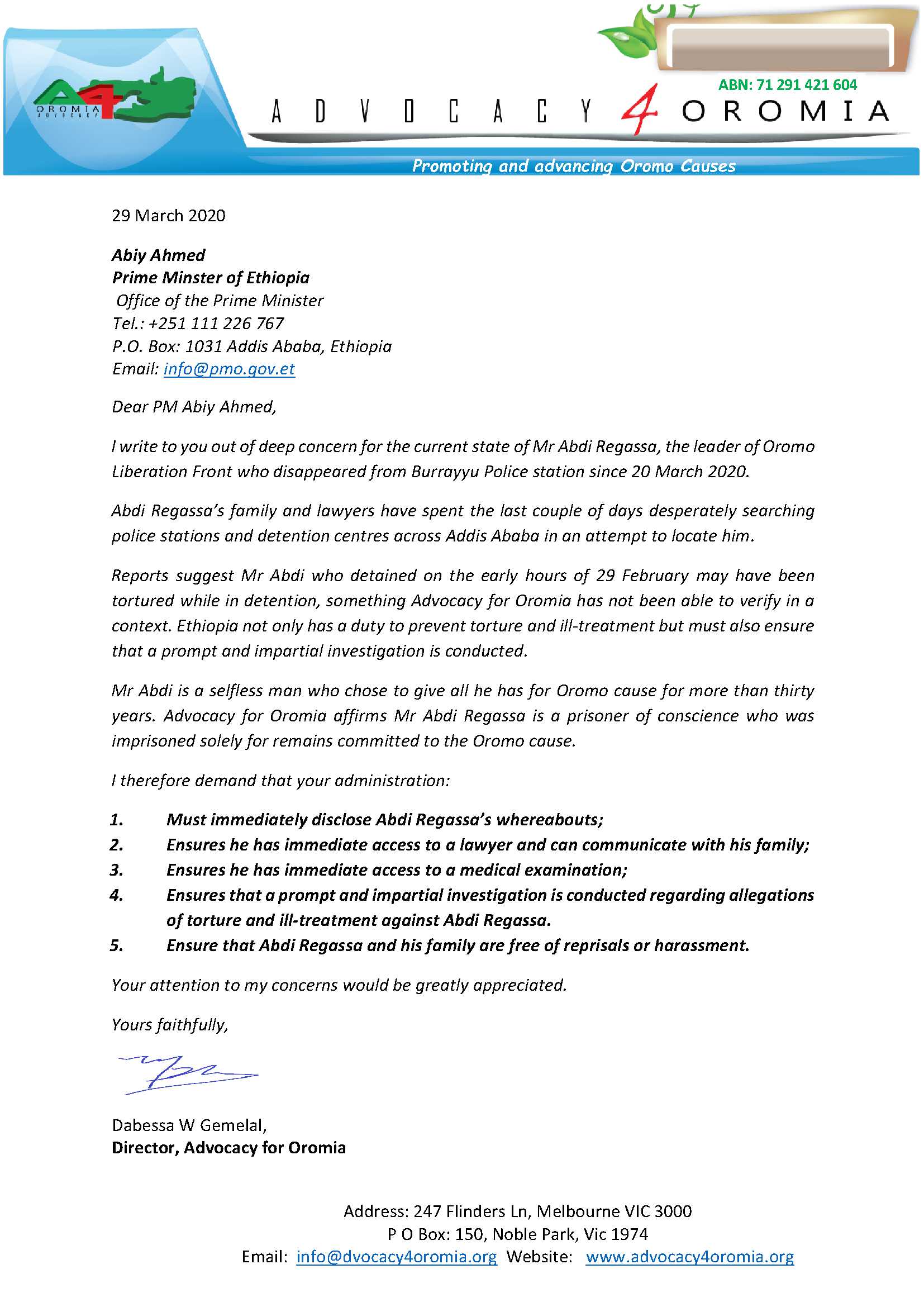
(A4O, Appeal Letter, 29 March 2020) Advocacy for Oromia is deeply concerned by reports of the diappreance of Mr. Abdi Regassa, the leader of Oromo Liberation Front who disappeared from Burrayyu Police station, Oromia, since 20 March 2020.
The letter sent to Ethiopian Prime Minster today by Advocacy for Oromia expresses its deep concern regarding Mr Abdi Regassa’s current state: detained without charges and with out access to the outside world, his colleagues and his family, since 29 February 2020.
The letter demands PM administration to ensures Mr Abdi Regassa has immediate access to a lawyer of his choosing and can communicate with his family.
For full appeal letter: Appeal Letter Abdi Regassa 29 March 2020





 Advocacy for Oromia