Author Archives: advocacy4oromia

THE EXPANSION OF THE AMORPHOUS ADDIS ABABA, THE ENDLESS PERSECUTION AND EVICTION OF TULAMA OROMOO

By Bulbulaa Tufaa | April 6, 2014

Around FinfinneeAmong the major Oromo descent groups, the Matcha-Tulama group has got one of the largest populations, stretching on vast area of land in central and western Oromia. As we are able to learn from our fathers, Matcha and Tulama are Borana brothers, being Tulama angafa (first born) and Matcha qixisuu (second born son). As common to all Oromo ethno-history, the tradition that governs the social role of “angafa and qixisuu”, which begins right from the immediate family unit, has a deep genealogical meaning and social role in re-invigorating the solidarity of the nation. From the earliest time of which we have a tradition hanging down to us,

Matcha-Tulama Oromo has had a supreme legislative organ known as Chaffe. The Chaffe legislates laws which will eventually be adopted as Seera Gadaa. They have a senatorial council known as “Yaa’ii Saglan Booranaa”, in which elected individuals from major clans are represented. The function of Yaa’ii Saglan Booranaa is to deliberate on issues pertaining to regional issues, resolve inter-clan disputes and oversees how interests of each clan in the confederacies are represented; how local resources are fairly shared and wisely utilised according to the law.

These two northern Boorana brothers are historically referred to as Boorana Booroo or Boorana Kaabaa
Among the known five Oromo Odaas, Odaa Nabee and Odaa Bisil are found in Boorana Booroo
However, beginning from the 13th century onward, the Match-Tulama country (Boorana Booroo), adjacent to Abyssinian border, has begun to be ravaged by a group of individuals whose legendary genealogy connects them to a certain King Solomon of non-African origin. They came and settled at a place they call “Manz”.They organised themselves at this place, and started to attack neighbouring villages of Cushitic Oromo family stock of Laaloo, Geeraa and Mammaa. The attacked villages were gradually incorporated into the expanding Manz, which eventually developed to a military outpost known as Showa in the late 18th century. Hereafter, they declared themselves “Ye Negasi Zer, the root of Showa Amhara Dynasty.

After vanquishing Agaw people’s identity and sovereignty on the northern frontier, the Solomonic Negasi Dynasties of Showa intensified their attacks against the Match-Tulama of Borana and the Karrayyu of Barantu Oromos. In such turbulent situation, the rule of yeNegasi Zer entered nineteenth century era, which ushered the era of the Scramble for Africa by European imperialist powers. From Africa, it was only King Minilik of Showa (1866-1889) who was recognised as a partner and invited to attend the Berlin Imperialist Conference of 1884. In this conference, Minilik was represented by his cousin, Ras Mekonnen Tenagneworq Sahile-Sellasie (1852-1906). After completing their mission, King Minilik and the European imperialist powers made concession on border demarcation. After the border demarcation had been completed, a systematic elimination of his prominent general, Ras Goobanaa Daacci (1819-1889), was meticulously carried out. Minilik was so confident to declare himself Emperor of Ethiopia (1889- 1913).This was the Ethiopia, the first time in the history of the region, that brutally annexed and included Oromo, Sidama, Walaita, Kaficho, Beneshangul, Gambella, and others to the expanding of Abyssinia.

The years 1887-89 were the boiling point for Minilik’s declaration of being “Emperor of Ethiopia, ye Itiyophiya Nuguse, nägest. Why?

Because, it was the time when he exterminated the Gullallee Oromo from the marshy-hot spring and pasture land of Finfinnee and collectivised the place under a new colonial name Addis Ababa.
Because, it was the time when he built full confidence in himself and built his permanent palace at Dhaqaa Araaraa, a sacred hill, where the evicted Oromos peacefully used to sit together and conduct peaceful deliberation for reconciliation.
It was the time when he annexed three-fourth of southern peoples’ territories, including the Oromo territory, to the expanding Showan Dynasty and put under the iron-fist of his inderases (viceroys).
It was the time when he assured un-shivering confidence of being continued to be assisted and advised by his European colonial partners: militarily, diplomatically and technically.
Here is the question: What happened to those Oromos who were living in Finfinnee for centuries? Particular mention has to be made about those Tulama Oromo groups of Gullallee, Eekkaa, Galaan, Aabbuu, Jillee. The answer is very simple: They were mercilessly decimated; their villages burnt down, their pasture and arable lands confiscated and shared among the invading Manzian Nagasii families of whom the Dejazmach Mangasha Seifu and the Ras Birru families were the most notorious ones. Thereafter, the Oromo territory occupied by Matcha-Tulama was officially changed to the expanding Kingdom of Showa, a detached enclave from Gonder, Abyssinia. Finfinnee was given a new colonial name “Addis Ababa”, just like Zimbabwe was changed to Rhodesia, Harare to Salisbury. Under this excruciating condition, the conquered Matcha-Tulama region had to lose its historic significance and had to be involuntarily submitted to the colonial name Showa.

In addition to the former derogatory term “Galla”, imposed on the conquered Oromos as a whole, the new regional name of Showa is prefixed to the derogatory term Galla. Hence, “ye Showa Galla” came into force as a collective insulting name in addressing the whole Oromo of Matcha-Tulama. This clearly justifies the vertical segregation policy of the conquerors for easy identification of who is who in the newly colonised territory.

Using various forms of oppressive models, Abyssinian colonial tactics and strategies have been going on violently and, now entered into the first half of the 21st century. Since the second half of the 19th century in particular, the oppressive models have been amassing massive firearms from European colonialist partners, enjoying diplomatic immunities and profitable political advises.

In the late 19th century, one European writer commented that, if the Abyssinians had not been armed and advised by global colonial powers of the day, notably France and Britain, late alone to defeat the ferocious Oromo forces, they could not have even dared to encroach upon the limits of Oromo borders. He wrote what he witnessed the real situation of the time as follows:

“Against the Galla [Oromo] Menelik has operated with French technicians, French map-makers, French advice on the management of standing army and more French advice as to building captured provinces with permanent garrison of conscripted colonial troops. The French also armed his troops with firearms, and did much else to organize his campaigns. Menelik was at a work on these adventures as King of Shewa during John’s lifetime; adding to his revenues and conscripting the Oromo were thus conquered by the Amhara for the first time in recorded history during the last thirteen years of the nineteenth Century. Without massive European help the Galla [Oromo] would not have been conquered at all.”

The writer further explained what he personally encountered during the campaign in the following unambiguous language:

“A large expedition was sent as far South in Arsi as frontier of Kambata to return with100, 000 head of Cattle. The king’s army fought against tribes who have no other weapons but a lance, a knife and shield, while the Amahras always have in their army several thousand rifles, pistols and often a couple cannon.—-Captive able-bodied males and the elderly were killed. The Severity of the Zamacha [campaign] was aimed at the eradication of all resistance. Whenever the army surged forward, there was the utmost devastation. Houses were burned, crops destroyed, and people executed:”

When we see the history of Abyssinian political philosophy, from which we have a written record, it is entirely based on the philosophy of depriving the Oromos from having any right to homeland. To convert Oromummaa to Amaarummaa and ultimately to Itiyophiyawwinnet has been the policy in action up to this very day. Even though the policy works on all Oromos indiscriminately, the one which has been exercising on the Oromos of Tulama in Finfinnee and surrounding areas has its own unique feature. Some of the unique features are embedded in the formation of “Addis Ababa” itself; as a seat of colonial headquarters with all its oppressive machineries. To have ample space for the settlers, to build army headquarters, to build churches in the name of numerous Saints of Greek and Hebrew origins, to build residences and offices for foreign embassies and missionaries, to build factories and storage houses the crucial demand is land. To fulfil these crucial demands of the customers, helpless Oromo peasants of the area have to be evicted. They have been under routine eviction and land deprivation since the seizure of Burqaa Finfinnee and the establishment of Ethiopian Imperial capital at this place.

It could be incorrect to think of the current TPLF-Arinnet Tigray regime as a detached entity from the whole system of Abyssinian colonial regimes, when we equate what they need against the survival needs of the peoples they generically conquered as “Galla and Shanqilla”. Though since 1991, the Ethiopian imperial system has been overtaken from the Showan Nagasi Dynasty by their junior Tigrean brethren, the life of the colonised Oromo people has been going down from worse to the worst.

What makes TPLF-Arinnet Tigray different from its predecessors is its total monopolisation of resources of the empire, right from the imperial palace to the bottom village levels, from the centre to the periphery. Arable and pasture lands, plain and forest lands, rivers and mining areas are totally under its predatory control. It is routinely evicting peasants from their plots, their only means of existence. They are selling to Chinese, Indians, European, Turkish, Pakistani, Arabians and other companies at the lowest price. In making this huge business, the most preferable area in the empire is Oromoland; of which the land around Finfinee holds rank first.

This politically architected scheme, in the name of investment and development, is daily evicting Oromo peasants around Finfinnee often with meagre or no compensation at all. As a consequence,

some of the evicted families are migrating to cities like Finfinnee and are becoming beggars
Some of them are leaving the country for unknown destination and found being refugees in neighbouring countries like Kenya and Yemen.
Since most of them who have no any alternative, they remain on the sold land and become daily labourers, earning less than half dollar a day.
Farm lands that had been producing sufficient grains of various types are now turned to produce non-edible flowers and toxic chemicals that contaminate rivers and lakes.
The incumbent Ethiopian regime of TPLF-Arinnet Tigray, more than any other imperial regimes of the past, is committed to make the Oromo people an “African Gypsy”. At one time the deceased prime minister of the Empire and EPDRF leader, Meles Zenawi, refers to the Oromos, who are numerically majority ethnic group in the Empire, said, “It is easy to make them a minority”. They are practically showing us the evil mission they vowed to accomplish. When they become rich of the richest in the Empire, the Oromo peasants they are daily uprooting are becoming poor of the poorest, being reduced to beggary and often deprived of burial sites after death. This evil work, as indicated above, has given priorities to sweep off “garbage” around Finfinnee and ultimately to encompass three-fourth of the region of “Showa” as a domain of “non-garbage” dwellers.

As vividly explained above, the Oromo of Tulama, since the onset of colonisation, have begun to be collectively addressed as “ye Showa Galla”. Those who resisted the derogatory name, the eviction, and the slavery system have been inhumanly executed or hanged. Their land and livestock have been confiscated and shared among the well-armed conquering power.

When Minilik invaded the Gullalle Oromo in Finfinnee, for instance, they remarkably resisted to the last minute but finally defeated. Those who remained behind the massacre had no other option except to leave for other regions against their choice. In their new homes, they have been even treated as collaborators of the invading “Showans” by their own kinsmen, calling them “Goobanaa”.Those able-bodied Gullallee, Eekkaa, Galaan, Abbichuu youths were involuntarily conscripted to the colonial army which is typical to all colonial policies. They were forced to go for further campaign to the south, east and west commanded by Showan fitawuraris and dejazmaches

From time to time, all Abyssinian forces, changing forms of their names, swearing in the name of Ethiopian unity and inviolable sovereignty, have never turned down the initial policy of evicting and persecuting the Oromo from their ancestral araddaa. Araddaa Oromoo is the embryonic stage where Oromummaa has begun to radiate from. Hence, by virtue of its original formation, now and then, it could not be integrated into the enforced Abyssinian policy of Itiyophiyawwinnet .

Since the enforced policy has shown no visible success for the past 130 years, this time, it has taken on to shoulder the last option of “sweeping them off” from around what they call “Addis Ababa” as a priority number one. As a consequence, came into being the destruction of Oromo survival relationship with their ancestors’ plot of land. The desecration of their shrines, sacred rivers, sacred mountains and sacred trees of which the case of Odaa and Burqaa Finfinnee, Dhakaa Araaraa and Caffee Tumaa in the vicinity of Finfinnee are quite enough to mention. TPLF’s long range missile policy of destroying Oromos’ relation to their historic araddaa is not the end. It is just the beginning extrapolated to destroy Biyyoo Oromoo.

At this critical time, any concerned Oromo should not be oblivious of the dreadful situation going on in Oromiyaa right now; in Finfinnee and surrounding areas in particular. The deliberate expansion of the amorphous city they call “Addis Ababa” is politically architected to divide Oromiyaa into east and west sector. It is not a master plan. It is an evil plan mastered to consummate an evil goal.

At this critical time, may we believe in the “No life after death”? Rather, may we are for the life right now? Those who are for the life right now are genuinely expected to show discernible power through tangible solidarity to our victimised families at home. Pursuant to our tradition, we have been nurtured learning the wisdom of “Dubbiin haa bultu”. Now, we should redirect this wisdom to “Dubbiin kun hin bultu”,that we ought to swear by great confidence to move in unison against the inhuman act, endless atrocities and perpetual eviction of our families from their ancestral araddaa. Thereof, could we recall the intrinsic wisdom of our fathers’ saying “Tokko dhuufuun namummaadha, lama dhuufuun harrummaadha?

Voices from the margins: Young Oromos Speak

This is the first in a series titled Voices from the margins: Young Oromos Speak dedicated to amplifying the experiences and perspectives of young Oromos in the diaspora in their own words.

My first experience of becoming interested in Oromo identity as a form of personal study began when I took a class in African popular culture. I decided to write a paper on Oromo identity in the diaspora and the responsibility of those living outside of Ethiopia to bring global consciousness to our heritage. A constant theme within this is the role of telecommunications development over the past few decades which have created a virtual village which connects Oromos in Ethiopia and abroad.

In terms of my experience as an Oromo person in the diaspora, I feel that outside of my family and friends, my interactions with Oromo identity has been established through social media networks which have allowed me to keep up to date with the latest Oromo news, connect with organizations and activist groups as well as share knowledge.  My use of the media has given me access to new understanding of my heritage and allowed me to distinguish myself from the overarching identity of being an ‘Ethiopian’ while living in Canada. Whether we like it or not, once we enter a host country we are viewed as an Ethiopian, not by choice, but by circumstance.

My parents did not land in Canada with an Oromo passport, but with an Ethiopian one. I have heard many Oromo before say that it is just easier to say they are Ethiopian when explaining their identity to an outsider – that saying they are Oromo isn’t met with legitimacy. But I think that just because Oromia is not yet a state does not mean that Oromo identity should be relegated secondary to Ethiopian identity.

My personal goal as an Oromo in the diaspora is to learn how to write in Afaan Oromo.  One of the key things that I have learned from Toltu Tufa’s recent language campaign is the importance of the ability to write in Afaan Oromo, something we sometimes forget is an issue especially for Oromo children born outside of Oromia.

Many of us who have grown up in the diaspora can speak in Oromo, but have not been formally taught how to write in it. Personally, both of my parents left Ethiopia well before the language reforms of the 1990s and neither are able to write in Oromo with great fluency.  I have come across many people that are ashamed to say that they do not know how to read or write in Oromo – but I do not think this is something to be ashamed of. The ability to access resources to develop Afaan Oromo as a written language is still a new phenomena, both in Ethiopia and abroad. Oromos in the diaspora of all ages should feel empowered to learn Oromo orally and through written word.

In the end, my personal embodiment and representation as a self identifying Oromo has its roots in my immediate family but has grown through my own search for other Oromos in the diaspora. I am proud to identify with my ethnic heritage and I feel that I have a responsibility to contribute to the growth of Oromo cultural expression and heritage. One of the great things about living in Canada is my undeniable right to freedom of cultural expression. This is a right that I am grateful for especially when I realize the ongoing struggle of Oromo identity within Ethiopia.

However, I also understand that my privilege has limitations. I myself have never lived in Ethiopia and I cannot speak of oppression from firsthand experience. I speak through the experiences of my parents and other elders around me who came to Canada from Ethiopia in later years. Yet this does not take away from the fact that I believe that Oromo in the diaspora carry a large responsibility in facilitating Oromo cultural renaissance.

Young Oromos in Diaspora

Young Oromos born and/or raised away from Oromia, Ethiopia, have a wide range of experiences and perspectives.
However, they share the same longing for belonging, identity and community. They have nagging questions about identity and belonging, about history, and the past as it makes ghostly returns. They seek for resources to make sense of their families’ violent relationship with Ethiopia and define their own relationship to histories that shape their worlds in ways they often do not understand. So they ask questions. Many of these questions remain unanswered.

Young Oromos in the diaspora long for frameworks and lenses through which they can understand and make sense of the past, and through which they can imagine a better future. In the absence of physical spaces and resources for making sense, many turn to social media, and other online spaces where they often find contradictory and colliding information/relationships/frameworks. They come face to face with Oromos who have different understanding of history and identity. They come face to face with Ethiopians who refuse to recognize Oromo identity. They come face to face with themselves. For many young Oromos, the search continues, for the search is about identity, belonging, security and empowerment. The search is about life. 

About Bissy Waariyo

Bissy Waariyo was born and raised in Toronto, Canada. She is currently completing an undergraduate degree at York University double majoring in Political Science & African Studies.

She is focused on studying how States incorporate or oppress ethnic identities within their political spheres and how peoples oppressed within their state are able to form cultural identity, belonging, and citizenship through digital avenues, i.e. the Internet, Facebook, blogs, Twitter, and other social networking mediums. Ultimately, Bissy’s goal is to become a professor of African Political Economy. 

Follow Bissy on twitter @BissyLansaa

{ Send an email to oromusings@gmail.com or on twitter @oromusings to add your experience and perspective to the series }

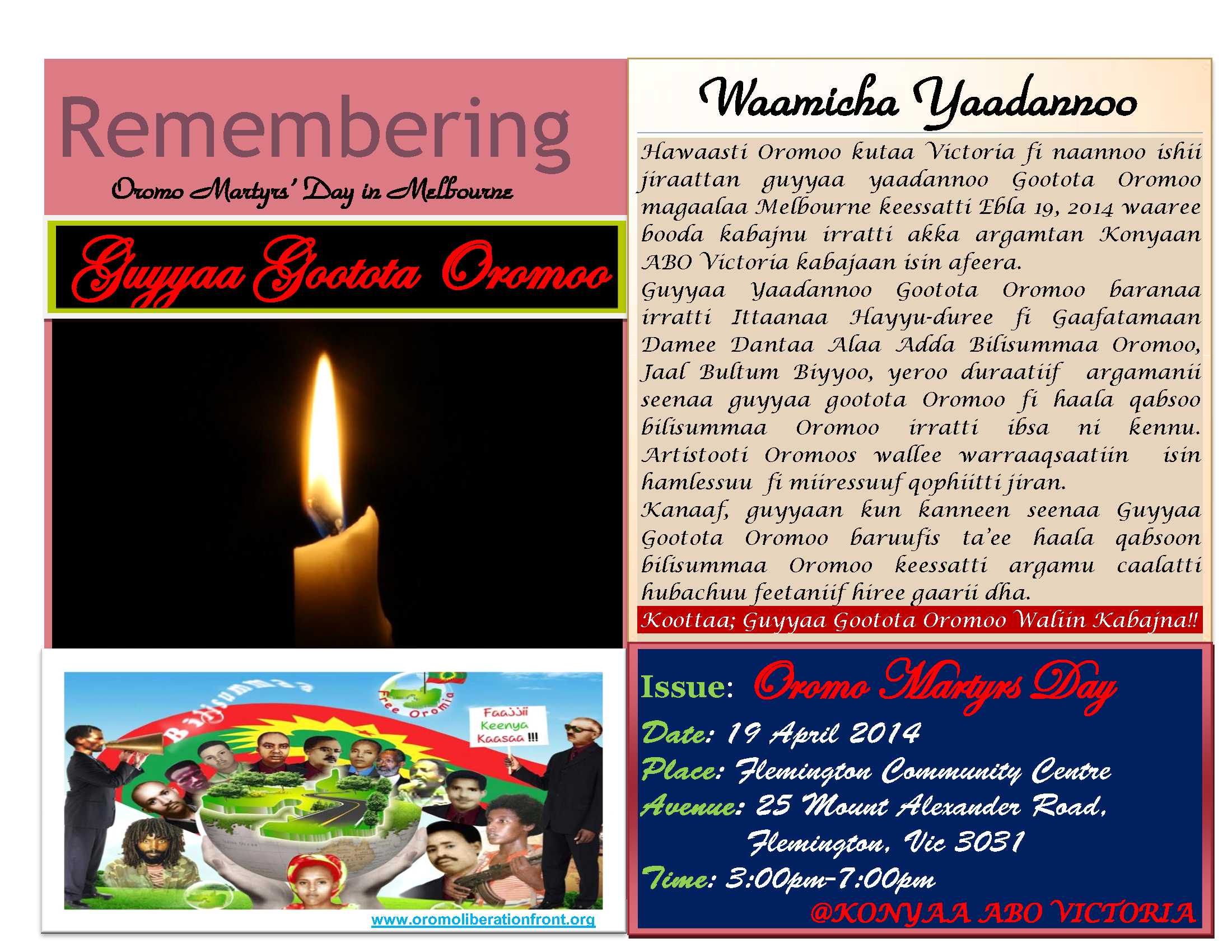
Remembering Oromo Martyrs Day in Melbourne

April 15  announcementWe warmly invite you to join us in celebrating this year’s Oromo Martyrs Day on April 19, 2014 at  Flemington Community Centre.  This commemorative day was first started by Oromo Liberation Front (OLF) following the execution of its prominent leader’s on diplomatic mission enrouted to Somalia on April 15, 1980. Since then this day was observed as Oromo Martyrs Day by Oromo nationals around the world to honour those who have sacrificed their lives to free Oromia and to renew a commitment to the cause for which they have died.

To welcome the Oromo Martyrs Day, Oromias will be hosting different memorial ceremony at their places. This is a perfect opportunity to network with friends and colleagues and support the work of the Oromo Liberation Front in promoting Oromo freedom struggle.

The event will commence with a special memorial service from 3.00pm, followed by the speech of the Vice Chairperson and Head of OLF Foreign Affairs, Mr Bultum Biyyo, with ample time being given for Q&A and discussion about the historic commencement of Oromo Martyrs Day and current Oromo freedom struggle.

Indeed, it is the right day to salute all martyrs of our people for national freedom struggle as well as our ongoing struggle for full liberation, equality and justice who fell while trying to fight a tyrant by his own weapons.

The Oromo Community in Victoria

April 15: Oromo National Memorial Day

April 15th is the Oromo Martyrs’ Day, also known as Guyyaa Gootota Oromoo. This commemorative day was first started by the Oromo Liberation Front (OLF) after the executions of its prominent leaders on a diplomatic mission en routed to Somalia on April 15, 1980. Since then, this day has been observed as the Oromo Martyrs’ Day by Oromo nationals around the world to honor those who have sacrificed their lives to free Oromia, and to renew a commitment to the cause for which they had died.
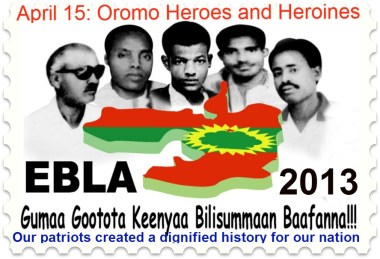
Why April 15th?

Mid 1978-1979 is remembered as the period when the survival of the Oromo national liberation struggle, led by the Oromo Liberation Army (OLA), was under a severe threat of extinction. It was feared that OLA units in Arsi, Bale and Hararghe would disintegrate, and their channel of connection and supplies would be cut off by the Dergue army that just recuperated from the Ethio-Somali war. Upon defeating the Siad Barre army, the Dergue turned its face on OLA. The OLA, in the fronts of Arsi, Bale and Hararghe, fought steadfastly and scored victory over the Dergue army and regrouped once again on January 1st 1980. In the wake of their military victory, OLF intensified its political struggle inside the country and abroad. The initial political victory included the persuasion of the Siad Barre government to allow the opening of OLF office in Mogadishu, Somalia, in 1980, to serve as a center of consultation and deliberation between OLF political and military leaders.

In the same year, a ten-member high-ranking military and political delegates (see list below) were on their way to Somalia to meet with political leaders there when they were captured by Somali bandits in Shinniga desert (in Ogaden). These bandits were members of a splinter group from the Siad Barre army that harbored bitter hatred towards Oromo and the OLF. These bandits abused and severely tortured their Oromo captives. The bandits finally ordered the Muslims and Christians to segregate before their executions. The Oromo comrades chose to stay together and face any eventualities than identifying themselves as nothing else, but Oromo. On the day of April 15, 1980, all the ten were executed and their bodies thrown into a single grave.

Reasons for Celebrating the Oromo Martyrs’ Day
There are four major reasons why we commemorate this day.

First, this day allows us to remember those Oromo heroines and heroes who sacrificed their lives to restore Oromo culture, identity, and human dignity that were wounded by Ethiopian colonialism. In other words, this commemoration assists us to recognize the dialectical connection between martyrdom, bravery, patriotism and Oromummaa.
Until Oromo heroes and heroines created the OLF and maintained its survival by paying ultimate sacrifices, Oromo peoplehood, culture, language, and history were dumped into the trashcan of Ethiopian history. These heroes and heroines had clearly understood the significance of Oromo culture, history, language, and identity in building Oromummaa, and victorious consciousness to consolidate the Oromo national struggle for achieving Oromian statehood, sovereignty, and democracy.

Second, this commemoration day reminds us that Oromo liberation requires heavy sacrifices, and those who have given their lives for our freedom, are our revolutionary models. Such patriots created dignified history for our nation.

Third, this day reminds us that we have historical obligations to continue the struggle that Oromo martyrs started until victory.

Fourth, this celebration helps us recognize that Oromo heroes and heroines are still fighting in Oromia today. Overall, those Oromo patriots, who by luck have survived and continued the difficult and complex struggle, deserve recognition and respect for what they have done for their people. We must protect them from lies and propaganda of the internal and external enemies. Without the persistent efforts of our patriots, the multiple enemies of the Oromo nation would have destroyed the OLF a long time ago. This does not mean that we do not criticize them when they make mistakes. It is the responsibility of Oromo nationalists to develop constructive criticisms to strengthen our national movement.

The Oromo leaders and members of the OLF, who ignited the fire of Oromummaa or Oromo nationalism, whether dead or alive, have been the foundation and pillar of the Oromo national movement. They left their families, wives, husbands, houses, professions, and children by choosing Oromo human dignity and freedom. By making these kinds of difficult choices, they confronted suffering and death. Consequently, they opened a new historical chapter in our history, and showed to us new possibilities by taking risky and courageous actions. Today, Oromo heroes and heroines are engaged in the Oromo struggle; members of the OLA, Oromo activist students and other activists are our contemporary heroes and heroines, who are intensifying the struggle. All Oromos all over the world who demonstrate their support and sympathy for the Oromo national struggle by contributing whatever they can for these brave men and women are also engaged in patriotic and brave activities.

We, Oromos in exile/Diaspora, should follow the footsteps of the fallen and surviving Oromo heroes and heroes by contributing anything we can to support the Oromo national struggle. If the fallen Oromos had paid with their lives to liberate us, how can we fail to contribute our time, money and expertise to liberate our beloved country, Oromia? How can we sleep when our mothers, daughters and sisters are raped in Oromia? How can we be at peace when genocide is committed on our people? Since our people live under Ethiopian political slavery, and since no country supports the Oromo struggle, we must fulfill our historical obligations by supporting the Oromo national struggle.

April 15th is then chosen to be a day of remembrance for these and all other martyrs, who died in any month and season of the past 120 years of the Oromo anti-colonial struggle.

The following Oromo leaders were martyred on April 15, 1980
1. Bariso Waabii (Magarsaa Barii)
2. Gadaa Gammadaa (Demise Tacaane)
3. Abbaa Xiq (Abboma Mitikku)
4. Doori Barii (Yiggazu Banti)
5. Falmataa (Umar, Caccabsaa)
6. Fafamaa Doyyoo
7. Irrinaa Qacale (Dhibaa)
8. Dhadhachaa Mul’ataa
9. Dhadhachaa Boruu
10. Marii Galaan

Conclusion
Our martyrs lost their lives while dreaming and fighting for freedom, justice, democracy, and development of their people and their country. They recognized that agitating, educating, organizing, and mobilizing a colonized and dehumanized nation for liberation requires courage, determination, bravery and self-sacrifice without fear of suffering and death in the hands of the enemy and their collaborators. We have moral and national responsibilities to achieve the objectives for which our heroines and heroes sacrificed their lives.

The Oromo national movement is a very dangerous project. Tens of thousands of our people have been imprisoned, tortured, raped, and received all forms of abuse from successive Ethiopian governments in general, and that of the Meles Zenawi in particular. The Tigrayan-led government has been systematically targeting and killing all Oromo leaders and those who have potentials of leadership while promoting the most despicable elements of Oromo society and the children of colonial settlers as leaders of the Oromo nation.

While commemorating our fallen heroes and heroines, we must also remember our current ones who are engaging in the bitter struggle and those who are suffering in Ethiopian prisons. We must double our support for the OLA that is engaging in implementing the missions of the fallen Oromo heroines and heroes in Oromian forests, valleys, mountains, and Ethiopian garrison cities. We should sustain the spirits of our fallen heroes and heroines by taking concrete actions every day. It is our national responsibility to educate, mobilize and recruit passive or unconscious Oromo individuals to join the Oromo national movement. Such actions must start in families by educating and training children; husbands and wives must teach one another and their children the essence of Oromoummaa. The spirits of our heroes and heroines require that all of us must be grass-root leaders who engage in a systematic struggle to fight those agents of the enemy or those misled individuals who undermine the Oromo national struggle intentionally or unintentionally.

All Oromo nationalists must be cadres, teachers, students, leaders, followers, fighters, financiers, ideologues, organizers, defenders and promoters of the Oromo cause. We should not keep quiet when certain individuals attack our organizations, leaders, communities and Oromo peoplehood to satisfy their troubled egos or their masters. If we do some of these activities in our daily lives, the spirits of our fallen heroes and heroines will survive through our actions.

Karrayyu preserves Oromo culture and identity

(A4O, 26 March 2014) The Karrayu Oromo who have lived for generations (for more than 6ooo years) in the north-east of Oromia, Metehara Plain and Mount Fantalle area keeps the wonderful Oromo culture and history.

MenduringGadaceremonyinKarrayyutribe-EthiopiaThey trace their descent from Oromo through Barentuma whom they regard as their genealogical father while they consider the Ittu as their genealogical brother.

According to a popular belief, Karrayu begot two sons known as Dullacha and Basso, names that represent the two major genealogical groups within the Karrayu. 

The Karrayu consider a location called Meda Wollabu, a natural lake located between the Borana and Bale areas, as their place of origin.

Oral tradition has it that the Karrayu settled around Fantalle mountain where they had been residing around lake Basaqa, in the Sabober plains and the Metehara area for the past 6000 years.

The present Karrayu land is located on the edge of the Upper Valley of the Awash River Basin.

It lies at an altitude of not more than 1000 meters above sea level falling to 955 meters at Metehara Plain and rising as high as 2007 meters at Mount Fantalle, which is the highest elevation in the area.

The neighbors of the Karrayu are the Afar Debine in the North, Arsi Oromo in the South, the Awash National Park in the East, and beyond the Park are the Ittu of West Harrerge, the Argoba in the West and the Amhara in the district of Berehet in the southwest.

However, the socio-cultural identity they have preserved for centuries as a predominantly pastoralist community is being put to test both spontaneously and systematically. 

The Oromo Studies Association is organizing its mid-year conference

Hello Everyone,

As you all may know, the Oromo Studies Association is organizing its mid-year conference here in Chicago. The local organizing committee and OSA’s leadership is working diligently to make this conference successful and a memorable one.

OSA2011logo

I am very excited by the fact that the honorable professor Beyene Petros will be attending OSA’s mid year conference. He is a long time opposition politician and an ex-parliamentarian, and one of leaders of the main opposition coalition in Ethiopia. He is here in Chicago on a sabbatical leave.

We are also working very hard to have among us some of the Chicago/IL public servants/representatives. We are hoping that Senator Heather Steans will attend our conference. Cook County Election Coordinator, Befekadu Retta, is interested to talk on election process. He observed elections in Ethiopia twice and once in south Sudan, and run for Aldermanic position of the 46th ward in Chicago. Mr. Harry Fouche, former Haiti Consul General in New York (2003/2004) will also be attending.

We also have a speaker on HIV from the Hennepin County Medical Center, Dr. Rachel Prosser, sponsored by Gilead Sciences. She will be giving us her own experience of treating HIV patients from the horn of Africa and the epidemiology of HIV, diagnosis and linkage to care.

I am expecting a wonderful keynote speech from our two young professionals and leaders, Aadde Obse Lubo and Obbo Nagessa Oddo. We have the honor and privilege of hearing the Oromo resistance history from those who lived it and took part in the making of history. the giants of the 60’s struggle against oppression, heroes of the Dhombir war and subsequent protracted rebellion of Bale and other southern Oromiya regions. I personally consider hearing their stories more inspiring than reading several books. It is the stories that they tell us that inspires some of our scholars and academicians to pursue further research and right the wrong in the Oromo history as told by others.

From Canada, we have Dr. Begna Dugasa, forfmer OSA president, Mr. Garoma Wakessa, founder and Director of Human Rights League of the Horn of Africa (HRLHA), and Tesfaye Kumsa, the editor of the banned Urjii newspaper. Obbo Kumsa will also share with us some of his poetic writings…”Walaloo”

We also have panelists in several other panels…Dr. Guluma from Michigan, former OSA president and ex-board chairman of OSA, Dr. Tekleab S. Gala (Tennessee State University), Dr. Ahmed Bedasso, Kadiro Elemo, Ibrahim German, Fenta, Said, Engineer Abdul Dirre from Minnesota, Liiban Waaqoo, Adam Wario, Jarso Jianmario, and myself making presentations on the conflicts in Borana/ southern Oromiya, environmental issues and the need to form an umbrella organization of the Oromo community organizations.

I am also excited by the fact that the newly established Oromia Media Network will be broadcasting our conference to our bigger audience, the Oromo people back home and around the globe.

The Oromo community of Chicago’s fundraising cultural night is being organized by the Oromo youth of Chicago under the leadership of the Board of Directors. This is another event that I believe will contribute to the success of our much anticipated conference.

Please, talk to your friends and colleagues ( Oromos and non-Oromos) and encourage them to attend our conferences and cultural night. We should work towards equal participation of both men and women.

Thanks,
Ibrahim Elemo,
President, Oromo Studies Association

Kemants Call on Nations and Nationalities for Support

(A4O, 22 March 2014) Kemant Recognition and Self-Governance Coordination Committee called on Ethiopian Nations and Nationalities for support on the 7th NNPD celebrated in Bahir Dar on the 8th of December.

The call was made on the Amharic pamphlet distributed and indicated below. Some of nations and nationalities representatives communicated back Kemants for further information.

There was also another pamphlet from the Addis Ababa communities, but that was not dispatched to public because it was strongly worded protest to celebration of NNPD at Bahir Dar what the document called the oppressive region for nationalities.

Get your issue heard in Geneva!!

Calling all individuals and refugee community groups!

As part of the annual UNHCR-NGO (United Nations High Commissioner for Refugees) consultations in June, Australian Refugee Rights Alliance (ARRA) are inviting Individuals and refugee community groups to lodge submissions on current issues of concern for people living in refugee situations overseas.

The Australian Refugee Rights Alliance (ARRA) are a coalition of Australian NGOs, refugee advocates and academics who engage in advocacy at an international level with and on behalf of refugees in Australia and the region. Submissions are due by Monday, 14 April, 2014.

Find out here: http://ow.ly/uLEus


PTW Baxter obituary

  By Hector Blackhurst
 
PTW Baxter studied and championed the culture of the Oromo, Borana and Kiga peoples of Ethiopia, Kenya and Uganda.

PTW Baxter, anthropologist, who has died aged 89My friend, the social anthropologist PTW (Paul) Baxter, who has died aged 89, made a significant contribution to western understanding of the Oromo peoples of northern Kenya and Ethiopia and championed their culture, which was frequently denigrated by colonial and local elites.

His work on the plight of the Ethiopian Oromo became a standard text in Oromo studies and a rallying point for the Oromo cause. Paul was not always comfortable with the praise he received as a result, and was often self-deprecating, describing himself as the world’s most unpublished anthropologist. That was a harsh judgment, since a complete list of his output is respectably long. He also made a wider contribution by editing the journal Africa and sitting on the Royal African Society board.

Born in Leamington Spa – his father was a primary school headteacher in the town – Paul attended Warwick school. Academic ambitions were put aside when he joined the commandos in 1943, serving in the Netherlands and occupied Germany. He married Pat, whom he had met at school, in 1944, and after the war went to Downing College, Cambridge, studying English under FR Leavis before switching to anthropology.

On graduation he moved to Oxford, where anthropology under EE Evans-Pritchard was flourishing. Field research on the pastoral Borana people in northern Kenya followed for two years, accompanied by Pat and their son, Timothy. He gained his DPhil in 1954 and more fieldwork followed among the Kiga of Uganda.

With UK jobs scarce, he took a position at the University College of Ghana. This was a happy time for the family, who found Ghana delightful. Returning to the UK in 1960, he was offered a one-year lectureship at the University of Manchester by the sociology and social anthropology head, Max Gluckman, after a recommendation by Evans-Pritchard. He then spent two years at the University College of Swansea (now Swansea University) before returning permanently to the University of Manchester. Over the next 26 years Paul contributed significantly to anthropological studies and to Oromo research, spending 12 months among the Arssi Oromo of Ethiopia before retiring in 1989.

Paul was never interested in winning academic prizes; instead his focus was on helping people. Generations of students, both at home and overseas, benefited from friendship and, often, a warm welcome in his home.

Paul’s life was touched by sadness, particularly Timothy’s death from multiple sclerosis in 2005, but he took great pleasure in his family. He is survived by Pat, their son Adam, four grandchildren and three great-grandchildren.

Source:http://www.theguardian.com/science/2014/mar/18/ptw-baxter-obituary

Help send the Oromo Support Group to the UN – Fundraiser

22 March, 2014

Date: 22, March, 2014
Time: 6:00 pm – 9:00 pm
Location: The Blue Room, Multicultural Hub. 506 Elizabeth st, Melbourne
Cost: $30
Contact: Phone: Marama 0411 672 163, or Email:  info@osgaustralia.com

Join the Oromo Community of Australia as they celebrate their culture.

Enjoy traditional Oromo cuisine, dancing and entertainment, and contribute to supporting their efforts toward protecting human rights for all Oromo and Ethiopian people.
