(A4O, March 10, 2020) Ethiopian Press Agency said that it has suspended journalists who were are linked to the PM’s and his wife’s photoshopped image in a bedroom
Ethiopian Press Agency suspended journalists linked to it, but their identities and the number of journalists involved in it are undisclosed.
Ethiopian Press Agency, state-owned media outlet, published doctored images of Ethiopian Prime Minister Abiy Ahmed and his wife Zenash Tayachew on Tuesday, and it said: “it was a mistake.”
In the image, Zenash Tayachew is seen lying on the side on the bed while Abiy Ahmed is on the floor.
The image was used for a story about Ethiopia’s Election Board map for the upcoming election in August of this year.
The Agency removed the image moments later and issued a brief statement on social media asking for an apology for what it called “mistake.”
The statement said, “The image that Ethiopian Press Agency used for the news ‘the board will announce polling station maps on Saturday’ is a wrong one, and we apologize for the ‘mistake.’”
It also announced that journalists linked to it are suspended from work and that it will make public the next step.
Doctored image of Abiy Ahmed and Zenash Tayachew ( his wife)
Based on screenshot of Ethiopian Press Agency Facebook Timeline, the image with Ethiopian Election Board story was on social media at least for five minutes.
Screenshot from social media
In December 2019, a false story about the death of Debretsion Gebremichael (President of Tigray regional state and chairman of Tigray People’s Liberation Front) was published on another state-owned media – Walta Information. The Agency terminated journalists linked to it. At the time, the Tigray regional state was very infuriated about it. To date, the public is not informed about the result of the investigation – especially what the motive was and what political entities were behind it.
Conspiratorial politics is, at times, noticeable on contents from state-owned media outlets. But it never was too graphic like the one published by Ethiopian Press Agency on Tuesday.
Today’s publication of Abiy Ahmed’s doctored image seems to have a sinister motive behind it.
Ethiopian political reform was the product of the youth movement that was able to shake the roots of the authoritarian regime. The Oromo youth movement or the Qeerroo movement championed this change with their blood, limbs and lives. The establishment who hijacked the fruit of this struggle will even go as far as discrediting and criminalizing the Oromo youth. This is not a new phenomenon, the successive Ethiopian regimes have perfected the art of denial of Oromo lived history, contribution and significance. The attempt to discredit and discredit Qeerroo movement validates our point of historical denials of past atrocities, injustices and our collective subjugation. They are trying to minimize, deny and put away the Qeerroo movement legacy while the world was witnessing it from the front seats. The revolution was televised, tweeted, shared and collectively documented by Oromos and Western world combined.
The question then becomes, if they can try to deny and discredit this movement that took the world by storm and shook one of the most notorious authoritarian regimes in Africa, how can we argue with them about what happened a hundred or more years ago? The answer is we do not. History is written with freedom; we must focus on liberation. Liberated people have the means and the power to write their own stories, create a to pass it down to future generations and so on. The Qeeroo movement was to bring lasting change for all justice loving people and the Oromo in particular. However, the desired change showed up as reform instead of dismantlement of the regime. This option was taken to avoid chaos and mayhem in Ethiopia but was it worth it to us? This is another example of how Ethiopia as a country was saved in the expense the Oromo question. We were all hopeful at the beginning of the reform, even though it was a system perpetuating harm trying to be the savior all at the same time. However, no one has anticipated the birth and the glorification of the philosopher king, Abiy Ahmed.
He shows up stroking the egos of the past regimes in a nostalgic sense and vowed to return us to those glorious days. That was the day most Oromos understood our aspiration and goals were under a threat non other than the philosopher king himself. What makes this complicated for our people was that he claims his identity as Oromo while every policy, ideology and practice run in the opposite direction. Today, Oromia is under a threat, violence the language of communication, prisons started to fill up with Oromo leaders again, harassment and war is ongoing. The philosophy of synergy (medemer) for Oromos is like trying to divide a number with 0, undefined.
The philosopher king is attempting to brainwash, indoctrinate and force this ideology on people. What he does not understand is that the philosophy of Oromo nationalism is written in blood and bones. Oromo nationalism will stay forever ingrained in our hearts, minds and every action we take. This thirst can only be quenched when our people have the right to choose their own leaders, make their own policies regarding identity, language, land and resources. The snake oil salesmen you have collected around you cannot and will not fool the Oromo people because they know what kind of life they are living. It is simple everyone on earth want the same thing, a good life. A good life is not possible if your safety, your identity, your resources and your livelihood is danger. That is what has guided us to continue the fight for equality and freedom, not a baseless and merit-less philosophy.
The continent of Africa and especially Ethiopia cannot move towards Democracy as long as the strong man syndrome is in effect. The philosopher king, Abiy Ahmed is aspiring to be the next strong man of Ethiopia, the system of one man. Democracy requires checks and balances. Democracy requires respecting the voice and the aspiration of the people. The power belongs to the people. The strong man syndrome is antithesis to Democracy, they want to fluff their feathers and seem mightier than they are, smarter than everyone else, experts in every field and the judge and the jury. If Ethiopia can have a chance, building an institution and systems that can withstand any regime change is the way to go.
What do we do now? We must fight with everything we have got. We must make sure the sovereignty of Oromia is intact, and we must get ready for all possible outcomes. The opposition parties need to stand on their own, create their own agenda and execute than reacting to the frivolous regime non-agenda thrown their way. It is the job of the opposition to inform our people, to keep our people’s unity and chart a clear pathway. I understand it is a very dark time and it seems hopeless at time; however, we have faced worse. This is just a set back and something we can learn from as people. We cannot be discouraged or falter we owe it to our brothers and sisters who gave their lives for what they thought was the change we needed. We need to put our heads together and resist.
(A4O, Appeal Letter, 3 March 2020) Advocacy for Oromia is deeply concerned by reports of the incommunicado detention of detention of Mr. Abdi Regassa, the leader of Oromo Liberation Front.
The letter sent to Ethiopian Prime Minster today, Advocacy for Oromia expresses its deep concern regarding Mr Abdi Regassa who detained without charges and with limited access to the outside world, his colleagues and his family, since 29 February 2020.
The letter demands PM administration to ensures Mr Abdi Regassa has immediate access to a lawyer of his choosing and can communicate with his family.
Advocacy for Oromia also asks all peace-loving people to take similar action to ensure that a prompt and impartial investigation is conducted regarding allegations of torture and ill-treatment against Abdi Regassa.
It added that this appeal letter is needed to ensure that the Ethiopian government presents charges against him or releases him, and refrains from potentially taking actions that may amount to ill-treatment against him.
(A4O,Press Release 2 March 2020) Ethiopian authorities detained the leader of the Oromo Liberation Front, Abdi Regassa, on 29 February 2020. He was held incommunicado for 72 hours and remains imprisoned without charges.
Advocacy for Oromia affirms Mr Abdi Regassa is a prisoner of conscience who was imprisoned solely for remains committed to the Oromo cause.
Mr Abdi Regassa has been held in detention for reasons that remain unknown. He has not been informed of the charges against him.
Advocacy for Oromia requests the government to unconditional release and access to legal counsel and family while in custody.
Call of Action: Show your SOLIDARITY AND SUPPORT for him in every way you can: going to the police station, changing your social media profile, campaigning for justice, and doing everything that is orderly and peaceful.
When:From today, 2 March 2020
Where: Detention without access to the outside world
(A4O,Press Release 29 February 2020) Advocacy for Oromia, a non-profit advocacy organisation working to ensure that the Oromo people’s rights and wishes are respected, requests SOLIDARITY AND SUPPORT for detained Oromo Liberation Front officials, members, advisers and supporters.
The organisation says in today’s press release, more than 10,000 Oromo individuals are imprisoned because of their bold stand against in justice in Oromia.
Issue: Five Oromo Liberation Front (OLF) officials including two EC members and two guards & two drivers have been arrested in Finfinne, Oromia.
Call of Action: Show your SOLIDARITY AND SUPPORT for them in every way you can: going to the police station, changing your social media profile, campaigning for justice, and doing everything that is orderly and peaceful.
When: From today, 29 February 2020
Where :‘sostegna’ police station, Finfinne, Oromia
(A4O, 29/02/2020) Five Oromo Liberation Front (OLF) executive committee leaders have been arrested in Addis Ababa.
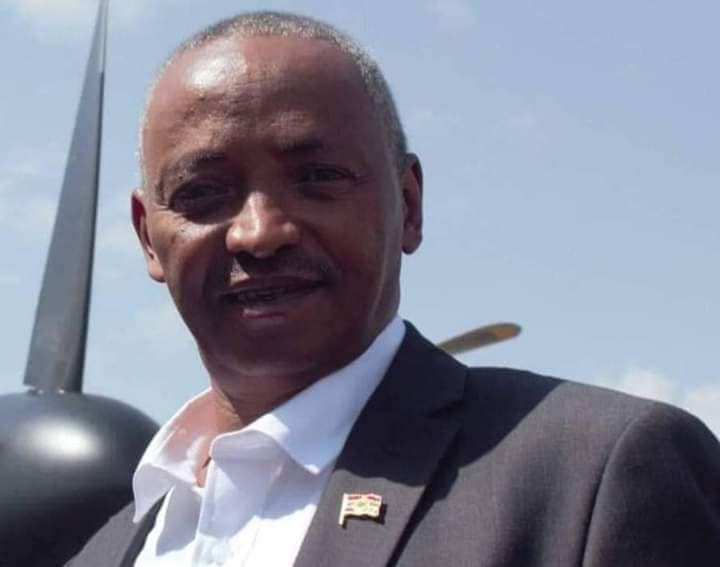
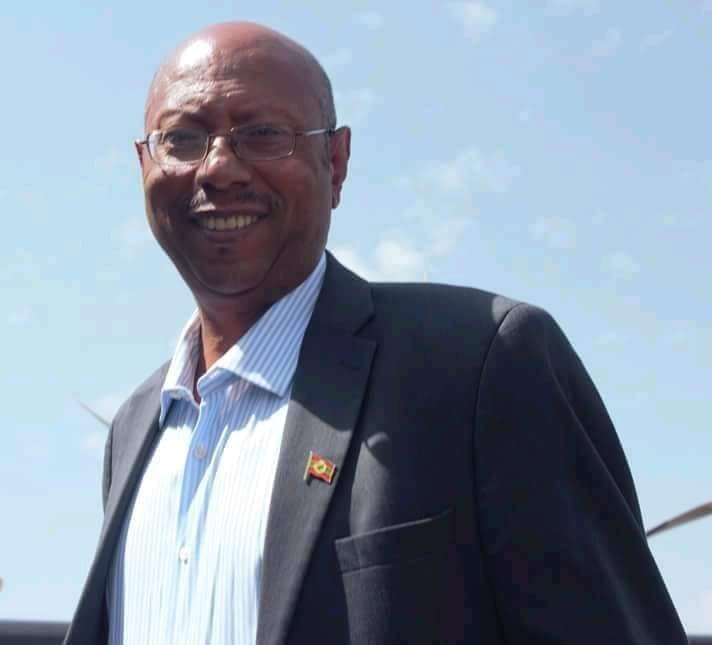
Gamtessa Boru, OLF economic advisor,
Dr Shigut Geleta, OLF Advisory Head,
Abdi Regassa, OLF Executive Committee member,
Kenessa Ayana, OLF CC member.
Michael Boran, OLF Executive Committee member,
Among those detained today are Gamtessa Boru, OLF economic advisor, Abdi Regassa, OLF Executive Committee member, Dr Shigut Geleta, OLF Advisory Head, Michael Boran, OLF Executive Committee member, and Kenessa Ayana, OLF CC member.
According to reliable sources, police broke into their home in Finfinnee, Oromia on Saturday 29/02/2020 and arrested them.
The house of five OLF leaders have been surrounded by security forces.
The OLF is a major political force in Oromia.
The return of mass arrests of opposition leaders and supporters is a worrying signal for opposition leaders in Ethiopia.
Just months ahead of the elections, the Abiy’s regime intensifies mass arrest and detention in Oromia.
Parts of Western Oromia have been shut off from the internet and phone services since late 2019. At a press conference in mid-January, EthioTelecom CEO Frehiwot Tamiru acknowledged the shutdowns and said they were “connected to peace and security” in the area, according to the Addis Standard.
Several Ethiopian media houses have reported that OLF-Shane, the military splinter wing of the OLF, has been waging war against the government in the Kelem Wollega region.
Amnesty International has documented for decades government control over the judiciary. Mass mobilization is needed to ensure that the Ethiopian authorities allow independent monitoring of his trial to ensure that it is fair.
The guerrilla group Oromofolk’s Liberation Front (OLF) was allowed to return to Ethiopia 2018 as part of the newly-appointed Prime Minister Abiy Ahmed’s reforms. Now its new chairman Dawud Ibsa Ayana believes in an upcoming election victory.
The receptionist at Scandic Hotell in Skärholmen looks stressed up from his paper. Around her, an entire wedding party dances past to beat-up claps and loud calls, while popping up for dinner and fixing up for tomorrow’s conference.
– A quiet place for an interview with one of our guests? It will probably be a little difficult, she replies.
After some deliberation, we are referred past the table tables into a room with a wallpaper with bookshelf motifs.
When Dawud Ibsa Ayana settles down, I apologize for the strut, but he is happy that we have room to sit. He has long wanted to tell.
For over 40 years, the Liberation Army’s liberation army was fought against the central government in Addis Ababa, and journalists then had to venture into the guerrilla-controlled areas to understand OLF’s positions on various issues, which meant that their struggle was either in practice misunderstood or remained completely unknown to outside world. Swedish journalist Martin Adler was one of the few who reported on the movement in the 2000s.
But in the wake of the political changes in the Horn of Africa, the Dawud Ibsa Ayana guerrilla group has for some time been a political party running for election.
– A few years ago I had not thought that we would prepare for such a situation. What a choice!
Blankspot’s Martin Schibbye interviews OLF’s chairman.
The Berlin Wall fell. The Soviet collapsed. But in the wooded parts of southern Ethiopia, Dawud and his comrades fought a war that, for many of the rebels, was older than themselves.
The Ethiopian emperor of the 20th century, who was from the Amhara people group, had colonized the Oromo people’s wealthy home territories, while the European great powers colonized the rest of Africa.
The other countries had finally gained their independence but not the Oromo people – one of the largest ethnic groups in Africa.
Continental Kurds.
The popular revolution that swept away the Mengistu dictatorship in 1991 also did not resolve the region’s fundamental conflict with the central power.
Dawud Ibsa Ayana’s own personal history is closely linked to the organization. He studied at Hailie Selassies University in the 1970s and then came into contact with the student movement for which he subsequently became leader. In the late 1970s he was elected to the OLF Central Committee and imprisoned shortly afterwards by the Ethiopian regime. After being released, he fled to Sudan and combined studies in statistics with participation in the rebel group’s military training.
Back in Ethiopia, he led the OLF platoon that started the armed struggle in Welega province. But after a while, he was arrested again, poisoned, tortured and imprisoned without a trial until 1986 when he rejoined the rebel army and resumed his work in the Central Committee.
In interviews with him from that time, he is always firmly convinced that the day free elections are allowed, OLF will win and form the backbone of the country’s next government.
But despite the fact that he is now preparing for just such a choice – it still did not turn out as he intended.
– The goal of our armed struggle was to dissolve the TPLF, I never thought they would survive. But now they are also running for election and since they now claim that they have opened up the political space and invited us to participate so, yes, then we have chosen to do so.
When Ethiopian Prime Minister Abiy Ahmed received the Nobel Peace Prize last fall, he was rewarded primarily for the peace with Eritrea. More forgotten, but all the more important for Ethiopia’s future was peace with the local rebel groups, including the OLF.
That the TPLF survived, Dawud Ibsa Ayanas believes, is because the regime understood that the protests that grew strong were directed at their own party and that they had to “reform” the country in order to continue to govern.
– I put “reforms” in quotes because they were forced to release prisoners. It was nothing they wanted to do. There was no amnesty. We are not completely happy about the situation, but we decided to “play the game”.
Was it a difficult decision?
– It was a tough decision absolutely, but we had no choice. The TPLF created confusion and the outside world thought this was a genuine change, so we were then forced to “play the game” because the government said they would invite exile organizations and remove the stamp of terror. If we had not taken the chance, we would have been branded as those who “destroyed the peace” or “nihilists”, says Dawud Ibsa Ayanas.
Dawud Ibsa was on a flash in Sweden before returning to Ethiopia. Blankspot received a unique interview with OLF’s chairman.
When the OLF and the Ethiopian government settled down after decades of armed conflict, one of the major stumbling blocks was the OLF members who disappeared over the years.
– We presented a list of 300-400 names and wanted answers: are these people living or are they dead?
They did not get a straight answer to that question, but they agreed that the criminals for human rights violations on both sides should be tried and OLF suggested that a commission be appointed. The idea was not rejected, but did not become a reality, but was postponed until after the election.
– If the choice goes well, this will be a priority for us. Whether we agree on a South African reconciliation model or a personal arrangement remains to be seen, says Dawud Ibsa Ayana.
The movement’s problematic relationship with the state powers also did not end because they laid down their weapons and withdrew from the armed struggle.
Even when they were to register their party, the process was delayed and delayed and it took over a year after the peace agreement to get the formal in place.
– Since we brought home our soldiers from Eritrea in September 2018, we have had a tough time. The government has obstructed and hampered our work, they have closed down our local offices which we have opened and over 20,000 of our members have been imprisoned for short or longer periods.
The areas where the movement has encountered most difficulties are in Ambo and the southwestern parts of the region.
– Here are the large garrisons of the Ethiopian army and in these, several members have been detained for months without a trial, often under torture-like conditions. Not only former soldiers, but also farmers, young people and teachers have been taken from the entire Oromo region to these places, says Dawud Ibsa Ayanas
He thinks the purpose is to weaken the party ahead of the August 2020 elections.
“Yes, our relationship with the government looks like,” he says, turning his arms out.
But despite the difficulties, he is as victorious today as before and OLF has formed electoral alliances with other organizations such as the Oromo Federalist Congress and the Oromo National Party prior to the election.
– We are confident that we will win a majority regionally and significantly with the seats in the national parliament, predicts Dawud Ibsa Ayanas.
But the party’s concern is now about the time leading up to the election in August, and it is now more than OLF itself that is concerned about the development in the region.
In mid-February, Amnesty issued a report showing that 75 members of OLF had been arrested at the beginning of the new year. The human rights organization said it was inadvertent that opposition politicians were so close to the impending election.
In addition, this was just how the previous regime operated and Amnesty warned that what was happening was a trend break that risked undermining both the newly won organizational and freedom of expression in the country.
Amnesty also noted that several local offices opened by OLF were stormed by police and in connection with this, several OLF members had been killed. Journalists who worked for the satellite TV channel Oromia News Network (OMN) had also broken their vehicles and equipment according to Amnesty.
The government itself believes that it is fighting the Oromo Liberation Army (OLA), an outbreak group from the Oromo Liberation Front (OLF) that did not accept the peace agreement but continued the armed struggle.
Dawud Ibsa Ayanas is worried about how local militias and “soldiers taking orders from political parties” will act during the upcoming election campaign.
– Will they continue to harass and arrest our members or will the government discipline them? he asks himself.
Another shock test is the upcoming staffing of the polling stations and the question of the voters’ sympathies. During the TPLF era, many organizations that called themselves “civil society” were in fact fronts for the ruling party.
– We will closely monitor the election authority’s staffing at village level so that they recruit independent administrators and volunteers?
If the situation continues to escalate, the question also arises as to whether it is possible to hold elections as the situation looks?
– No, today it is not possible to hold free elections in the areas that are under emergency conditions and are controlled by the military’s command post, says Dawud Ibsa Ayanas.
OLF’s concern is that the areas in the region where you are strongest, it is also in the areas where the military will create a situation that makes choices impossible to make.
– We await the election authority’s assessment of where elections can be held, we have a good dialogue with the authority and know that they also listen to us before they make a decision.
In his work on the formal elections, Dawud Ibsa Ayanas believes that countries such as Sweden have a big role to play.
Both with independent election observers and knowledge, he also points out that foreign states that have supported Abiy Ahmed’s reforms are responsible for the process and for pushing the government so that the military stays away during the electoral movement.
– We expect that Sweden does not accept that anyone abuses power, but ensures that it becomes a free, genuine choice in which the people can choose their representatives.
Dawud Ibsa Ayana’s continued reasoning is submerged in the sound of the wedding party, which is once again on its way through the lobby.
We go further into the room and find a new place where the base passage causes both tables and walls to vibrate.
I say that a few weeks ago I interviewed activist and journalist Eskinder Nega who said that there is an ethnic cleansing in the Oromo region with the aim of expelling non-Oromos.
At the bottom, Eskinder Nega argued that there was a vengeance for perceived historical injustices.
– It is not surprising that Eskinder exploits this and travels around the world, warning the UN that Oromo’s youth, querroos, are terrorists, but it must stand for him. But if you are going to talk about the matter: the situation of Amharas in the Oromo region he is wrong, that they would be forced to flee is nonsense, says Dawud Ibsa Ayana.
According to him, recent reports of attacks on civilian students are nothing for which his organization has no responsibility.
– OLF operated in the region for 40 years while tens of thousands of civilians from the Amharic region lived in the area, but they were not attacked by OLF. We fought against the Ethiopian army, never against the people of Amharas, their houses or homes.
He points out that in several of the region’s largest cities there have always been 100,000 Amharas and that there are also officers and generals from the Amharan region within OLF’s ranks.
– Why would any of us attack innocent young students? To say that is an attack on us.
So in a future Oromoregion, where you own a majority of the sites, will the rights of minorities be guaranteed?
– Undoubtedly! It has been black and white in our political program since 1976: OLF respects the rights of minorities. They have the right to choose and to candidate and run their own affairs in Parliament. Why would we have changed now after 27 years? We are crystal clear in this regard.
“Will the election be peaceful? Will the result be accepted? We don’t know that yet – but we want to show the outside world that we are for peace and for free elections, ”says the OLF chairman.
The indictment is also not new. Since the movement was formed, they have been fighting the term as a terrorist organization.
Prior to the 2005 elections, the country’s then prime minister Meles Zenawi called OLF the “country’s Interhamwe”, that is, he compared the movement with those responsible for the Rwanda genocide.
In interviews, OLF has always rejected the accusation, claiming that terrorism is a method of desperate groups and individuals, while they are an established mass organization that has the support of a majority of the population and that this type of method would only mean that they lost their popular support.
But what, according to OLF, can be done to stop the violence that is happening at the universities, both in the Oromo and the Amharic region?
– It is the government that has to take its responsibility. The government has a responsibility to protect the students and put an end to the abuse. The federal police must investigate whether local militia attacks students or whether it is the security service or other political organizations. The students who have been forced out must return and the families who have lost children must be compensated.
Although OLF now faces a roadmap, its struggle has always been about two things: firstly, to create a political consciousness of the population but also about independence.
After a long period of feudal oppression, according to OLF, a political culture had been created that led many to give up their belief in being able to influence their lives either financially or politically.
When the OLF was formed, the aim was therefore to fight against oppression in all its forms and to give the inhabitants of the region the political confidence to stand up for themselves.
But the main issues were also that the region and its inhabitants had the right to self-determination and to their own country.
So when the Ethiopian Constitution was written after Mengistu was overthrown in 1991, a section on the right to self-determination was enrolled. But the movement also chose, when the Constitution was drafted, to participate in the transitional government with the goal of creating a democratic Ethiopia and not pushing the issue of independence.
But shortly thereafter, the transitional government collapsed and OLF chose or forced, depending on how it looks, into the forest again.
So how does OLF today view the demand for an independent state?
– It was OLF’s position previously to work for it. But at present we understand that it is not something we can demand from the Ethiopian state because it is not capable of giving it to us, ”replies Dawud Ibsa Ayana.
Just as in the years 1991-1992, people have been chosen to participate in the democratization process with the goal that they want to see a democratic Ethiopia.
– We have chosen to play down our own historic demand for independence and prioritized the democratization of Ethiopia as a federation, a country with several states, several nations, living in peace. We wanted to and then we want to give this a chance again, says Dawud Ibsa Ayana.
According to him, it is a “pragmatic move” based on the analysis that today’s Ethiopian state formation would not respect a fully independent Oromo.
– What happens in the future, it lies in the future, there are of course several Eritrea-like opportunities to jump off, if they were so rigid that they do not accept self-determination, under this Ethiopian umbrella.
If everything goes the way of the election then a priority issue will be a land reform in the region.
– Land ownership is the central political issue for us. Land that was formerly owned by feudal lords in the region is now owned by the government and because the people do not own the land they use, they also have no control over their lives.
The goal is a land reform where users take over ownership. But Dawud Ibsa Ayana emphasizes that previous owners should be compensated.
– Such a process is complex and in order for no one to be deceived by banks or investors, we also want to set up a control authority to monitor how land is sold and bought in the region.
Areas that are now agricultural areas may also be considered for future industrial areas.
– Industrialization will be a “game changer” for the area and mean that we are moving from an agrarian economy to a more mixed one. In this upcoming development, we welcome private companies and investors, but we have a social democratic view of society and want central functions such as communications, education, infrastructure, healthcare to be taken care of by the general public.
He can’t say more before the wedding party pulls up the music again and we go back to reception.
Political self-confidence is great and despite harassment and imprisoned party members, Dawud Ibsa Ayana believes that they will soon be the victors of the election.
But the question he is pondering a lot is whether the ruling party will hand over power?
– Will the election be peaceful? Will the result be accepted? We don’t know that yet – but we want to show the outside world that we are for peace and for free elections. Then it becomes clear who is breaking this. We have our fears that the result will not be accepted, says Dawud Ibsa Ayana.
**
Blankspot has been closely following developments in Ethiopia for some time . Earlier reports in this series can be read here. If you want a daily update on the process, join our facebook group “Mission: Eritrea and Ethiopia” and contribute your knowledge.
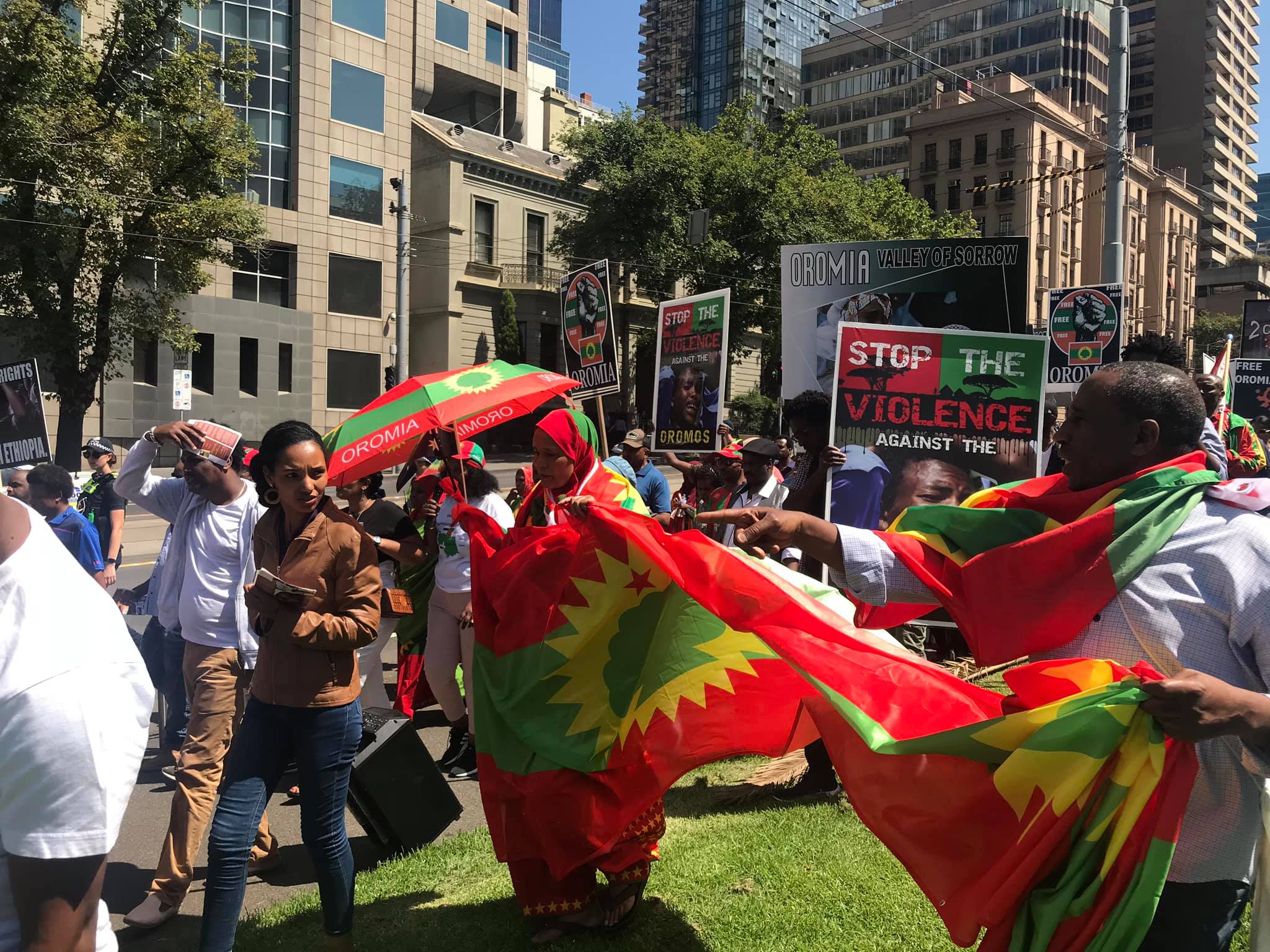
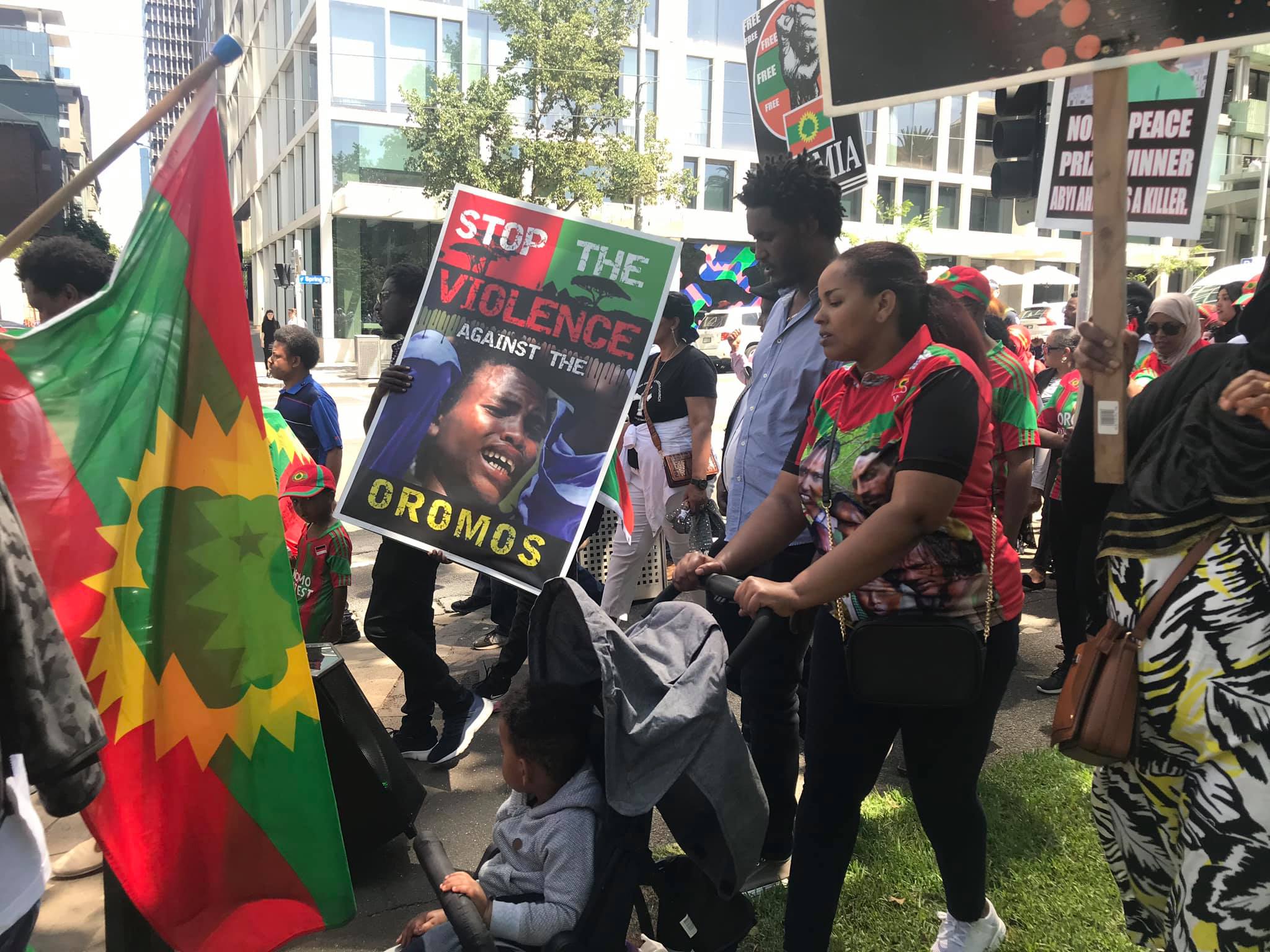
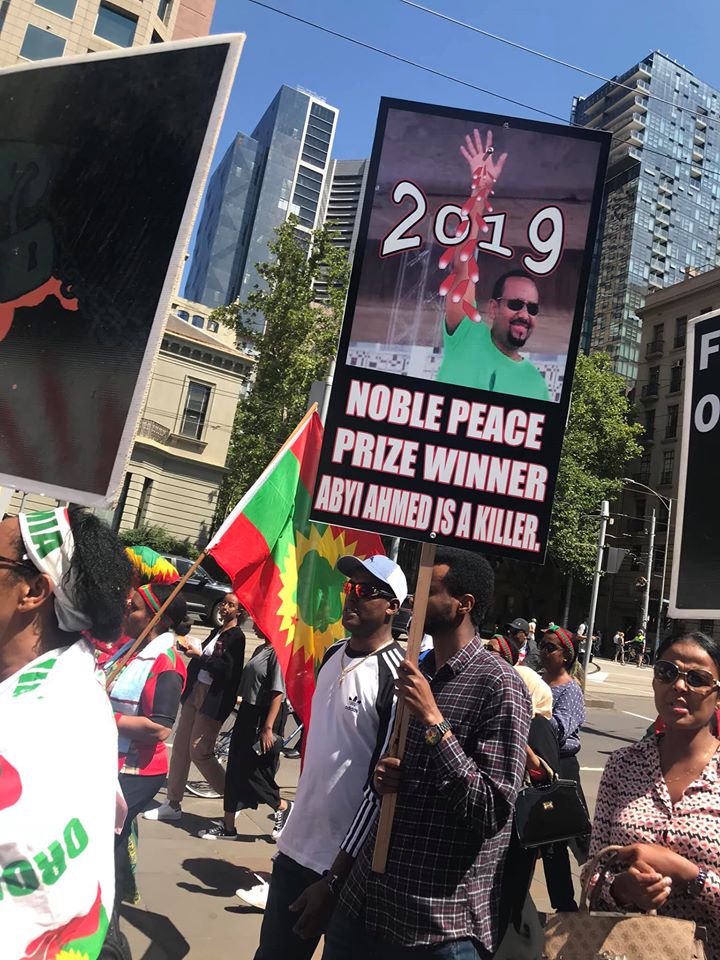
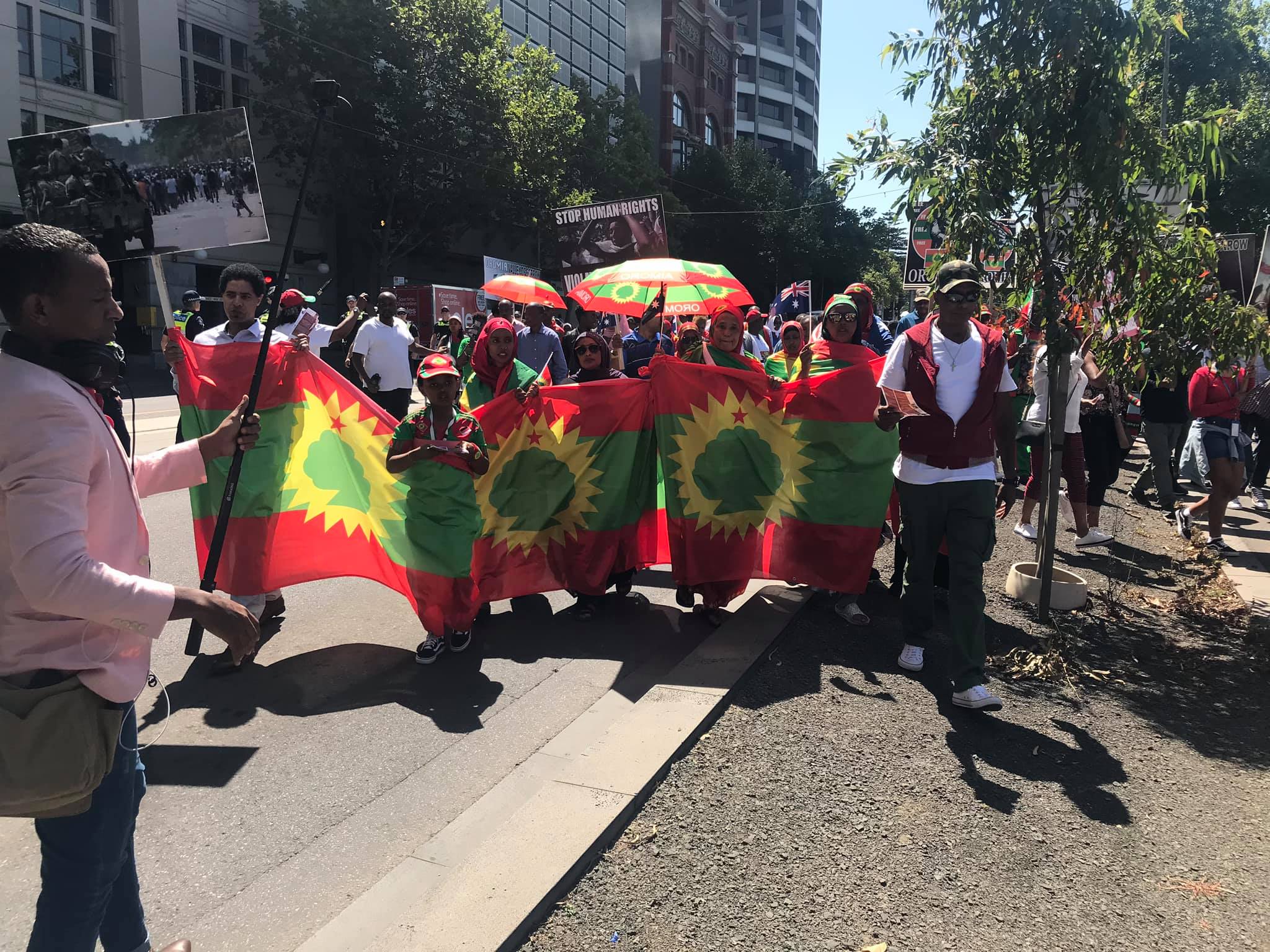
(Advocacy4Oromia, Melbourne, 17 February 2020) Melbourne’s Oromo community rallied on February 17 as part of a world-wide action in solidarity with the Oromo people.
Australian Oromo community stages solidarity Rally in Melbourne, 17 February 2020
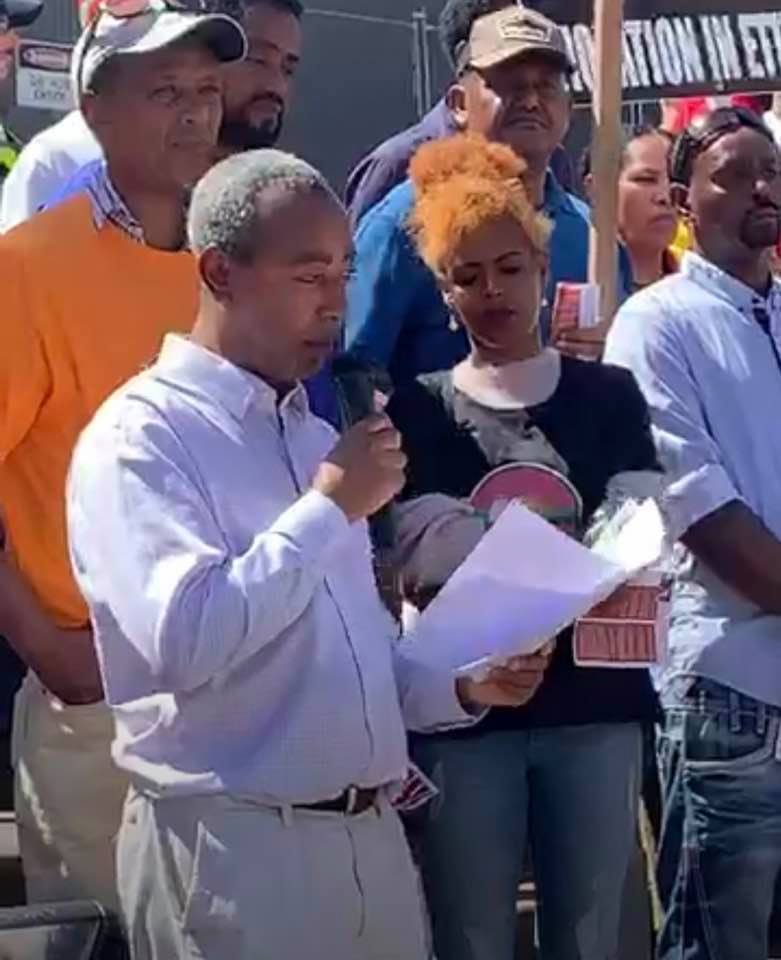
Demonstrators marched from Victorian Parliament to Federation Square, where community leaders spoke of unity in the face of oppression.
Speaking to the crowd on Monday, President of Australian Oromo Community, Dr Tarekegn Cimdi said that the community organised the rally to express their grave concerns and to demand the international community to pay attention to the development in Ethiopia.
Dr Tarekegn Cimdi
“Today here in Melbourne the Oromo community staging the rally to Stand in solidarity with the Oromo people and to be witness of the suffering people,” said Dr Tarekegn Cimdi.
Demonstrators denounced the killings and violent repressions being meted out by the regime.
Demonstrators also appealed to the Government of Australia and the wider international community to put diplomatic, political, economic pressure on the Ethiopian regime that’s waging an undeclared war on Oromo people in Oromia.
“While we’re here today in the spirit of solidarity and love, government must respect the Oromo dignity, Oromo peace and Oromo freedom,” said one of the demonstrators.
He added that the Oromo is “peace, equality and non-discrimination. We stand together promote peace, to stand against violence, and to raise the awareness of the Australian public about the atrocities, violent political repression, and massive violation of human rights in Oromia and the wider Ethiopia.”
Australian Oromo community stages solidarity Rally in Melbourne, 17 February 2020
A renowned Oromo activist Urgé Dinegde, also expressed strong message about the sliding backwards of Ethiopia under Abiy Ahmed on her Facebook.
” Under this government, protesters have been jailed, the internet has been blocked… I know this for a fact, university students have been killed and a new law has just been passed that could jail people whose online posts stir ‘so called’ unrest.”
“However, Mr Lencho Bati, a senior adviser to the office of the prime minister, says the government of Abiy has done nothing wrong. I could not disagree anymore. It is time to call out the fake and phony profiting from the continued instability,” she says.
Rights groups say the Oromo have been systematically marginalised and persecuted for the last 150 years. Some estimates put the number of Oromo political prisoners in Ethiopia as high as 10,000 as of February 2020.
Australian Oromo community stages solidarity Rally in Melbourne, 17 February 2020
According to Amnesty International at least 75 supporters of the Oromo Liberation Front (OLF) were arrested over the weekend from various places in different parts of Oromia Regional State, as Ethiopian authorities intensify the crackdown on dissenting political views ahead of the general elections.
“The return of mass arrests of opposition activists and supporters is a worrying signal in Ethiopia,” Deprose Muchena, Amnesty International’s Director for East and Southern Africa.
The message of Australian Oromo community is just calling for peace and freedom. “We’re not afraid to stand together, to be able to stand against violence and repression. We join the Oromo protests to help raise our voices against a shared experience of brutal repression by the State.”
Australian Oromo community stages solidarity Rally in Melbourne, 17 February 2020
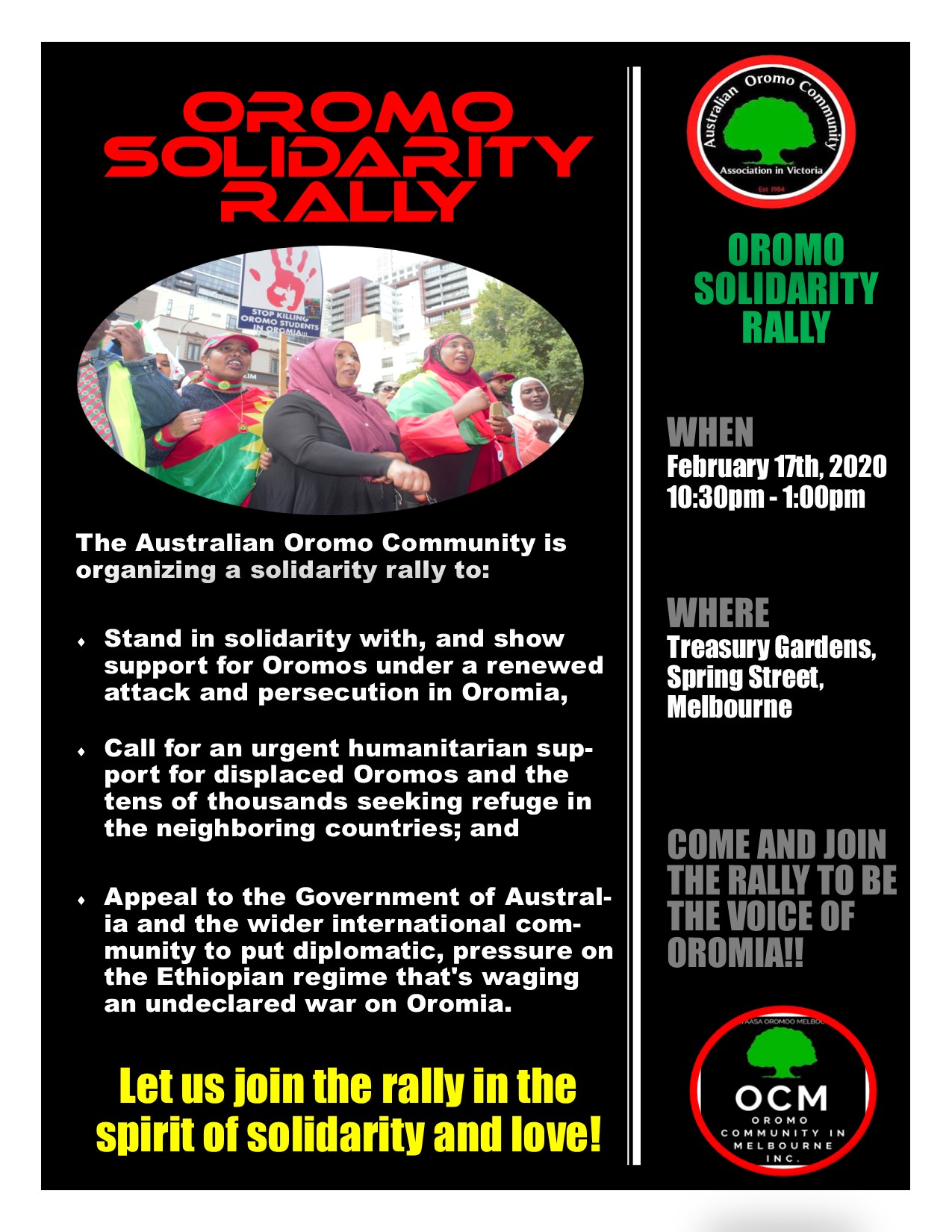
(A4O, 9 February 2020) The Australian Oromo Community is organizing a solidarity rally in Melbourne on Monday, 17th of February 2020.
According to the information received, the Oromo solidarity rally is organised to stand in solidarity with, and show support for, Oromos under a renewed attack and persecution in western and southern Oromia.
The organisers of the rally also aimed to appeal to the Government of Australia and the wider international community to put diplomatic, political, economic pressure on the Ethiopian regime that’s waging an undeclared war on Oromia.
“We’re not afraid to stand together, to be able to stand against violence and promote nonviolence,” said one of the members of Oromo community who planned to attend Monday’s rally.
The promotional flyer also indicate that the rally aimed to call for an urgent humanitarian support for the over five million displaced Oromos and the tens of thousands seeking refuge in the neighboring countries.
Similar solidarity rallies are underway in North America, and Europa to raise the awareness of the public about the atrocities, violent political repression, and massive violation of human rights in Oromia and the wider Ethiopia.
The Ethiopian regime are well known in massive violation of human rights in Oromia and the wider Ethiopia.
Oromo, also known as Afaan Oromoo, and Oromiffa, is a language from the Cushitic branch of the Afro-Asiatic language family, and the third most widely spoken language in Africa, after Arabic and Hausa. The Oromo people are the largest ethnic group in Ethiopia. They are an indigenous African people who have maintained their cultural identity and language despite the Oromo language being forbidden for much of the 20th century. Most Oromos live in the Horn of Africa (Ethiopia and Somalia), Kenia, Eritrea, and Djibouti, as well as in the Oromo Diaspora abroad.
The Oromo Written Language Is One Of The Youngest In The World
The Oromo language was banned in Ethiopia for many years, forbidden from being used in schools and in the public sphere. In 1991, the language was allowed again. In the early 1970s, the Oromo Liberation Front decided on the Latin alphabet as the official script for the Oromo language. It is also sometimes written with the Arabic script, as well as the Ge’ez script and the Shaykh Bakri Sapalo orthography. The Oromo writing system based on the Roman alphabet is called Qubee. Due to the political situation that affected the Oromo language for a long time, it is one of the youngest languages in the world to become a written language.
Speakers of all variations of Oromo can easily understand each other, although the relatively late development of the writing system means that there are some differences in written dialects as the writing system is not fully standardised across all of the Oromo language.
Oromian Literature Was Mostly Oral Until 1970s
The Oromos have a rich oral literary tradition which is expressed through various songs for all life eventualities, as well as poems, proverbs, and storytelling.
Since being allowed again, the language has experienced a literary revival, with popular plays, novels, and short stories published in the Oromo language. Dhaabaa Wayyessaa’s play Dukanaan Duuba (Beyond the Darkness), propelled the playwright and novelist to national fame in the early 1990’s. Another good example of Oromo’s development as a literary language is Gaaddisaa Birru’s novel Kuusaa Gaddoo.
The Oromo People Created One Of The Earliest Democracies
The traditional Oromo society is structured according to the Gadaa system, also spelled as Gada. The system is considered to be one of the earliest democratic societies in the world and is based on an 8-yearly election of all political, military, economic, religious, and social administration.
The society has five classes with one fulfilling the function of the ruling class; this changes every 8 years. Each class progresses through a number of grades before it can participate in authority.
A Gadaa election is preceded by a campaign. One of the basic rules of the Gadaa is that a father and his son are always exactly five grades apart, which is always forty years. This means that the Gadaa class incorporates people of various ages.
Most Oromos Live In Rural Areas
Around 90 percent of Oromia’s population are employed in agriculture, producing coffee, pulses, oil, and animal products such as hides and skins.
The Irreechaa Ceremony Is Oromo Thanksgiving
Each September, millions of the Oromo people gather on the shores of Hora Harsade (Lake Harsadi or Arsadi) for the Irreechea Ceremony. The meaning of the ceremony is to give thanks and to pray to Waaqa (God).
Many Oromo people practise monotheism, and the Irreechaa ritual ceremony is believed to be one of the oldest forms of monotheism in Africa.
There are two types of the Irreechaa ceremonies: Irreechaa Tulluu (Irreecha on a mountain) and Irreechaa Malkaa (Irreechaa on a river). Irreechaa Tulluu is practised on top of mountains and hills during dry season. It is usually performed in March. Irreechaa Malkaa is celebrated either near a local body of water or at Lake Arsadi in Bishoftu which is located about 45 km from the capital of Oromia, Finfinnee.
Advocacy for Oromia was established in 2010 with the purpose of enabling and empowering Oromo people by providing accurate and timely information that will help to make better choices to create the kind of future in which they wish to live.
It also provides information focus on the major issues facing us in the 21st century and it is going to try and bring a balanced approach with factual information that is positive and solution based.
The website has been in operation for the last nine years with the mission of promoting and advancing causes of Oromo people through advocacy, community education, information service, capacity building, awareness raising and promotion.
The website is also the official site of Advocacy for Oromia Association in Victoria Australia Inc., a non-profit organisation, registered under the Associations Incorporation Reform Act 2012 in Victoria as April 2014.
Our team already had considerable community development experience and expertise. Our various projects helped to develop our confidence and the capacity of our agency. Our team used every gained knowledge, skills and experiences as an opportunity to design and develop new approaches, to documenting progress, supporting positive employment outcomes, liaising with community stakeholders, and conduct evaluation.
Advocacy for Oromia is devoted to establishing Advocacy for Oromia organisation to close the gaps where we can stand for people who are disadvantaged and speaking out on their behalf in a way that represents the best interests of them. We are committed to supporting positive settlement and employment outcomes for Victoria’s Oromo community.
Advocacy for Oromia Office
Addresses:
39 Clow St,
Dandenong VIC 3175
=====================
247-251 Flinders Lane
Melbourne VIC 3000
Activities Address
Springvale Neighbourhood House Inc
Address: 46-50 Queens Ave, Springvale VIC 3171
Postal Address:
P. O. Box 150
Noble Park, Vic 3174
With your support, we can continue to help community build a better future.
Advocacy for Oromia Mental Health Program
The aim of the program is to improving the mental health and well-being of Oromo community in Victoria. It aims to assist those experiencing, mental ill-health, their families and carers of all ages within this community to address the social determinants of mental health for Oromo community. It helps:
Identify and build protective factors,
Reduce stigma and discrimination
Build capacity for self-determination
Better understand mental wellbeing, mental ill-health and the impacts of trauma
The goal of the project is to increase mental health literacy of Oromo community that aims:
To assist people with mental health issues
To increase the capacity of mental health worker
To better understand mental wellbeing
To provide mental health education and information
To address the social and cultural causes of mental health issues
Advocacy for Oromia will organise information session, women performance, radio programs, culturally adopted conversations on Oromo Coffee Drinking ceremony, providing training for mental health guides and forum and producing educational materials on the selected groups and geographical area.
Human Rights Education Program
The Human Rights Education Program is a community based human rights program designed to develop an understanding of everyone’s common responsibility to make human rights a reality in each community.
Human rights can only be achieved through an informed and continued demand by people for their protection. Human rights education promotes values, beliefs and attitudes that encourage all individuals to uphold their own rights and those of others.
The aim of the program is to build an understanding and appreciation for human rights through learning about rights and learning through rights. We aimed at building a universal culture of human rights. Thus, we aimed:
To build an understanding and appreciation for human rights through learning about rights and learning through rights.
To build capacities and sharing good practice in the area of human rights education and training
To develop human rights education and training materials and resources
The goal of the project is to increase human rights literacy of Oromo community that aims:
To better understand human rights
To increase the capacity of human rights worker
To analyse situations in human rights terms
To provide human rights education and information
To develop solidarity
To strategize and implement appropriate responses to injustice.
The ultimate goal of education for human rights is empowerment, giving people the knowledge and skills to take control of their own lives and the decisions that affect them.
Human rights education constitutes an essential contribution to the long-term prevention of human rights abuses and represents an important investment in the endeavour to achieve a just society in which all human rights of all persons are valued and respected.
Advocacy for Oromia will organise information session, performance, radio programs, culturally adopted conversations on Oromo Coffee Drinking ceremony, providing training for Human Rights guides and forum and producing educational materials on the selected groups and geographical area.
Community Safety Program
The program aims to strengthen existing collaborations and identify opportunities for the development of partnerships aimed at community safety and crime prevention activities. This approach seeks to improve the individual and collective quality of life by addressing concerns regarding the wider physical and social environment. Importantly, community safety means addressing fear of crime and perceptions of safety as without this any actions to address the occurrence of crime and anti-social behaviour are of less value.











 Advocacy for Oromia