Author Archives: advocacy4oromia
TPLF hardliners oppose return of former OLF members; ODF has submitted a letter at Ethiopian Embassy in DC.
(A4O, 11 February 2014) The recurrent attempts by the United States (ION 1211) and Norway for some former opponents to be allowed to return to the country have been torpedoed by the more conservative parts of the Tigray People’s Liberation Front (TPLF) and the Oromo People’s Democratic Organization (OPDO), two parties that are members of the ruling coalition Ethiopian People Revolutionary Democratic Front (EPRDF).
The idea was to persuade Addis Ababa to accept the return of a dissident group of the Oromo Liberation Front (OLF, armed opposition) headed by Lencho Letta and including Dima Negewo, ahead of the general election in 2015.
Despite these misgivings, Lencho Letta is still negotiating the terms of such a return, seeking to have some members of his group given positions in the administration.
But hardliners in the Ethiopian regime will have no truck with this, as they see him as “a traitor” and especially fear that his return could weaken the OPDO.
However, a wing of the TPLF, grouped aroundDebretsion Gebremichael, current Deputy Prime Minister, seems willing to play the game so as to give a better picture of the Ethiopian government vis-à-vis Western countries.
On the other hand, the moderate Oromo opponent Merera Gudina (read here) who will take up residence in the United States for a few months this year may be able to convince other Diaspora groups to negotiate their return, as OLF dissidents are now doing.
Meanwhile, Ethiopian Prime Minster Haile Mareyam Desalegn says ODF has submitted a letter for negotiation at press conference. According to PM Hailemariam, ODF [Lencho Lata]has submitted a letter at the Ethiopian embassy in Washington for negotiation to enter domestic politics and contest next election.
However, the negotiation is not started yet, according to the news source.
Addis Ababa’s master plan under revision, again
(A4O, 11 February 2014) The development of a new master plan for Addis Ababa which also integrates the Oromia special zone is in the final stages.
An international conference, which aims to add some inputs to the new international-level master plan, is scheduled to be held at the end of the current budget year.
The Addis Ababa and Surrounding Oromia Integrated Development Plan Project Office has drafted the new Addis Ababa master plan that will incorporate the outskirts of the Oromia Regional state with the development of the metropolis.
The new draft master plan aims to modernize the city in collaboration with the Oromia Special zone and has been presented to civic society on Tuesday, June 4, to obtain additional feedback from the public.
Officials of the project office told Capital that similar panel discussions will be held with different stakeholders to gather fresh ideas to include in the new master plan. “The final event will be the international conference that will take place in the town of Adama (Nazareth) for three days, from 26 to 28 June.
At the event, federal government officials, all regional administrations, officials from other African countries, African Union officials, prominent European master plan institutions and other relevant stakeholder will be able to comment, evaluate critique the draft plan,” Fetuma Lemessa, Deputy Manager of Addis Ababa and The Surrounding Oromia Integrated Development Plan Project Office, told Capital.
“The draft master plan will be finalised by the end of July 2013 after it includes the new inputs that shall be drawn from the international conference,” he added.
According to the plan, in the coming budget year the project office will undertake the accomplishment of the implementation strategy, the second phase of the project that will help realise the new master plan, which is expected to take the whole of the coming budget year.
Fetuma said that the actual implementation of the master plan will take place after one year.
Twelve studies involving different sectors were used to draft the master plan and took one year. According to the plan, towns on the outskirts of Addis Ababa, those under the Oromia Regional administration, will be included during the implementation of the master plan.
The development of highways and roads, parking lots for buildings, the establishment of several market areas throughout the metropolis, the various development of land, a detailed classification of mass and private transportation, the classification of metropolitan areas and the development of an international standard airport, are some of the studies included in the new plan.
The master plan for the city and the Oromia Special zone covers 1.1 million hectares of land and incorporates 5.7 million people currently, and is a plan for the coming 25 years.
For further information https://www.dropbox.com/sh/351vsabzpixbol1/5y6lqogioK
The Oromo year is twelve lunar synodic months of 354 days
(A4O, 10 February 2014) The original Oromo calendar is a lunar-stellar calendrical system, relying on astronomical observations of the moon in conjunction with seven particular stars (or star groups).
According to the researchers at no time (except indirectly by way of lunar phase) does it rely upon solar observations.
The Borana year is twelve lunar synodic months (each 29.5 days long), 354 days.
While it will not correspond to the seasons, this may not be of primary importance for people this close to the equator.
There are twenty-seven day names (no weeks), and since each month is either 29 or 30 days long, the first two (or three) day names are used twice in the same month starts on a new day name.
Many argue that it is not the pride of Oromo people, but the heritage of the whole humanity if properly recognized.
According to Nure Adem it is the symbol of Oromo civilization. “The great Oromo is pride of all Africans and one of the indicators of Oromo Wisdom in Black Civilization!”
The original Oromo months (Stars/Lunar Phases) are Bittottessa (iangulum), Camsa (Pleiades), Bufa (Aldebarran), Waxabajjii (Belletrix), Obora Gudda (Central Orion-Saiph), Obora Dikka (Sirius), Birra (full moon), Cikawa (gibbous moon), Sadasaa (quarter moon), Abrasa (large crescent), Ammaji (medium crescent), and Gurrandala (small crescent).
The concept of Oromo Calendar
Time is a very important concept in Gadaa and therefore in Oromo life.
Gadaa itself can be narrowly defined as a given set of time (period) which groups of individuals perform specific duties in a society.
Gadaa could also mean age.
The lives of individuals, rituals, ceremonies, political and economic activities are scheduled rather precisely. For this purpose, the Oromo have a calendar. The calendar is also used for weather forecasting and divination purposes.
The Oromo calendar is based on astronomical observations of the moon in conjunction with seven or eight particular stars or star groups (Legesse, 1973 and Bassi, 1988) called Urji Dhaha (guiding stars).
According to this calendar system, there are approximately 30 days in a month and 12 months in a year. The first day of a month is the day the new moon appears. A day (24 hours) starts and ends at sunrise.
In the Oromo calendar each day of the month and each month of the year has a name. Instead of the expected 29 or 30 names for days of a month, there are only 27 names. These 27 days of the month are permutated through the twelve months, in such a way that the beginning of each month moves forward by 2 or 3 days. The loss per month is then the difference between the 27-day month and the 30-day month, (Legesse, 1973).
One interesting observation is that, as illustrated in the computing of time like in the Oromo calendar, Oromos visualization of events is cyclical just as many events in nature are cyclical.
Since each day (called ayyaana) of a month has a name, the Oromo traditionally had no use for names of the days of a week.
Perhaps it is because of this that today in different parts of Oromia different names are in use for the days of a week. Each of the 27 days (ayyaana) of the month have special meaning and connotation to the Oromo time-keeping experts, called Ayyaantu.
Ayyaantu can tell the day, the month, the year and the Gadaa period by keeping track of time astronomically. They are experts, in astronomy and supplement their memory of things by examining the relative position of eight stars or star groups, (Bassi, 1988) and the moon to determine the day (ayyaana) and the month.
On the basis of astronomical observations, they make an adjustment in the day name every two or three months. The pillars found a few years ago in north-western Kenya by Lynch and Robbins (1978) has been suggested to represent a site used to develop the Oromo calendar system.
According to these researchers, it is the first archaeo-astronomical evidence in subSaharan Africa. Doyle (1986) has suggested 300 B.C. as the approximate date of its invention.
According to Asmarom Legesse (1973), “The Oromo calendar is a great and unique invention and has been recorded only in a very few cultures in history of mankind.” The only other known cultures with this type of time-keeping are the Chinese, Mayans and Hindus. Legesse states that the Oromo are unusual in that they seem to be the only people.
It is believed that the Oromo developed their own calendar around 300 BC.
https://advocacy4oromia.org/oromian-issues/current-anthropology/
http://web.archive.org/web/20081029073246/http://www.tusker.com/Archaeo/art.currentanthro.htm
More than 36 towns and 17 districts will be integrated to Addis Ababa administrative.
(Oromedia, 10 February 2014) The newly established office of “Addis Ababa and surrounding Oromia Integrated Development Plan” has drafted a new master plan in an international conference held in Adama on June 2013.
Sources from Finfnenne says about 36 towns and 17 districts which are currently in Oromia and administered by Oromia regional state will be merged with Finfinne, so that the land use and the administration issues will be determined by the central mayor of Finfinne.
According to the proposed plan, which you can see from the map, the new Master plan will incorporate all the Oromia towns and districts lying within the range of 100 km from Finfinnee.
Some of the towns are Adama,Sodere,Mojo,Wenji, Ejere, Alem Tena, Koka, Adulala, Bushoftu, Dukem, Gelen, Akaki Beseka, Godino,Chefe Donsa,Sebeta,Sendafa, Milkewa, Wendoda,Sirti, Duber, Gonfo,Chancho, Mulo, Debre Muger, Ulo, Adis Alem, Holota, Burayu, Debre Genet, Illu Teji, Tefki, Sebera Boneya, Melka Kunture and etc.
According to the sources, some of the districts areas are Adma Dodota,Bora, Lome, Liben chukala, Adea, Akaki,Gimbichu, Bereh, Aleltu, Jida, Sululta, Ejere, Welmera, Illu, Sebeta, Hawas and etc.
Leaving behind the unresolved constitutional right over Finfinne, the TPLF government is going to grab our fertile land and clear the indigenous dwellers.
When farmers of these areas are forced to leave their land, caused by road and industrial area construction, they usually don’t receive any equivalent compensation, and many find themselves migrating to find another daily labour occupation to survive their big family.
Analyst says the concept of integration and interconnection is not against the will of the Oromo people but the indigenous right must be respected.
“Oromos are not against interconnection and integration of cities and towns that enhance mutual development of other parties, but we are against the clearing of indigenous people, loosing right of land, the political administrative issue and not least the geographical and identity issue,” says.
There is a big discussion on this issues on different social media.
According to Hawi Chala, Oromo young Oromo activist and analyst the current trend has direct impact on the indigenous right . “Peripheral small towns are becoming overpopulated by new comers kicking out the indigenous farmers.
Gadissa H says, “this is clear and present danger for the Oromo people in all aspects; politically, economically and socio-culturally. The question now should be how can we prevent/mitigate?”
According to Habte Dafa the action is a “systematic eviction and the abuse of the God given rights of the Oromo people needs to be approached collectively, cohesively and purposefully.
He added that the action to evict the Oromo people from birth place is unacceptable. “Enough is enough for our people. …It is the high time when all the able citizens of Oromia must put the feasible legal actions into motion. This is an ethical and moral responsibility.”
Abdii Gemechu also criticized the Oromo ruling party strongly for unable to protect Oromo’s natural right over their homeland.
“That is why I vehemently oppose the coward OPDOs.”
Why Gadaa System Denied Recognition to Be a World Heritage?
BY SAMUEL TAYE
(A4O, 9 February 2014) The Oromo Gada system is a system of generational classes that succeed each other every eight years in assuming political, military, judicial, legislative and ritual responsibilities. Each one of the eight active generation classes–beyond the three grades–has its own internal leadership and its own assembly, but the leaders of the classes become the leaders of the nation as a whole when their class comes to power in the middle of the life course at a stage of life called “Gada” among the Borana.
The class in power is headed by an officer known as Abba Gada or Abba Bokku in different Oromo areas.
Gada is an existing system in Borana Oromo. It is still able to preserve its structural values though various external challenges tested it to abolish or decline it through time. Scholars and researchers argue that it is the best model for the modern democracy of the world. The existing Gada system in Borana today witnesses the reliability and creditability of the scholastic argument.
Teferi Nigusse is a PHD candidate at Addis Ababa University and is also a writer. According to him, the Gada system is a typical example of popular democracy that a world must learn from and gain invaluable substance from it mainly in today’s politics. “It is a complete system and fully characterized by democratic values that undergone centuries without any internally disruptive actions and managed to get here especially among Borana and Guji Oromos,” Teferi says.
“Basically the system is democratic and endowed with overall social, economical and political developments that pass through necessary and possible stages. Power transition is smooth and free from any conflict. It is also inexpensive; it does not need any high cost, but other political democracies do,” he added.
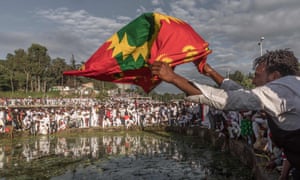
10-year-old Bonsen Wakjira raises two flags on Australia Day
Ten-year-old Bonsen D Wakjira, honoured Australia Day by raising two flags – the Australian flag and the flag of his nation Oromia, in Ethiopia.
The Oromo activist calls for the establishment of the Oromo Genocide Memorial Day
The marks of Aannolee, Azulee, and Chalanqoo Cannot be erased from the memory of successive Oromo generations and from the history of the Oromo people. These marks are incorporated into our collective memory. For this, centuries may pass, generations may come and go but the crimes of Abyssinia-the mutilation of breasts of women and girls and of the right hands of men and boys at Aannolee and the mass massacres at Azulee and Chalanqoo will not be erased, will never be diminished, and never be forgotten.
Abyssinians always avoid public discourse of the genocide at Aannolee, Azulee, and Chalanqoo believing that sooner or later in the course of time that generation would pass from the scene and their children would become acculturated and assimilated in the Abyssinian way of life and Abyssinian political thought and then the issue of genocide dies out and will be forgotten. However, what the Abyssinians forgot or failed to understand is that the genocide at Aannolee, Azulee, and Chalanqoo shapes not only the outlook of the immediate victims of the generation of the time but also of subsequent generations of the future. It is very important for the descendents of the perpetrators- the deniers of Oromo genocide to engage introspection to face and learn from their own history. It is time for the Nafxanyaas-the deniers of genocide to ask themselves question as to how that gross mass genocide could have occurred, instead of denying it and trying to maintain a false righteous self-image.
No one escapes from the history of one’s people. For this, we should and must not allow the past to rest and to be forgotten. Every generation must teach the succeeding generation about the past history, their heroes and heroines. The past, the present as well as the future belong to the succeeding generations. Each new generation hold the entitlement of the past and the present. For this, the establishment of the Oromo Genocide Memorial Day is the order of the day that the marks of Aannolee, Azulee, and Chalanqoo Cannot be erased from the memory of successive Oromo generations.Prospective Oromo Group Hopes To Spread Awareness
(A4O, 25 December 2013) A recent Southerner survey showed that a small, but significant, group of incoming freshmen speak Oromo, a language spoken mainly by an ethnic group in Ethiopia, Kenya, and Somalia. Junior Umar Hassan is working with others to start up a student group similar to Umoja or Unidos centered around Oromo culture. “[We want to] revive our culture,” said Hassan, emphasising the importance of “knowing your identity.”
One problem that he pointed out was that Oromo and Somali students are often grouped together by other members of the community. “I don’t want to be regarded as Somali when I’m not,” Hassan said. There seems to be a lack of awareness of Oromo culture in the school. He estimates that the number of Oromo students in the school has decreased, saying that there were about 200 Oromo students at South a few years ago, while only ten incoming freshmen this year say they speak Oromo.
Hassan outlined the path of Oromo people in the United States: they first came in the 1970’s, and the government began to send them to Minnesota in the 1990’s. More recently, many Oromo people have spread out into different neighborhoods of the Twin Cities and into the suburbs.
Along with South Students Hamdi Abdujalil, Abdi Wake, and Mubarak Hassan; Umar Hassan formed the activist group Oromo Young Generation. They have been involved in events at the University of Minnesota as part of the Books for Africa program, and an exhibit at the Traditions Institute.“[We’re] working on a citywide project now,” Hassan said. They are also working on organising a new exhibit for the Traditions Institute.
Overall, the group focuses on educational issues. Hassan says that they want to “help the community grow,” and have a particular focus on closing the achievement gap. “[Education] is the only way out,” he said. Oromo Young Generation wants to promote academic education for Oromo youth and also education about Oromo culture for others.
Hassan hopes to have a student group up and running soon, with the goal of being a resource and support system for Oromo students, while educating others about Oromo culture.
– See more at: http://www.shsoutherner.net/news/2013/11/22/6015/#sthash.MXvToo1s.dpuf
Telling New African Stories: Afaan Publications
A shared concern among many immigrant groups is how to preserve their culture across generations. For many parents, passing on language and customs to their children is a huge concern. Like many first generation children, I remember my parents setting aside time for me to learn their languages, and my personal favorite, to hear my father tell stories about his own childhood growing up in the Wellega province of the Oromia region in Ethiopia. In the 1990s, there were few materials to assist my weekly lessons, and at the time, few additional stories about Wellega besides my father’s.
Unfortunately, my name is one of the few words that I understand in my father’s first language of Afaan Oromo. I took to my mother’s language of Amharic more easily since her language was better represented in our local community. When working as an educator in the diverse neighborhoods of Northwest Washington, D.C., I gained an appreciation for the challenges that my parents, and other immigrant families face in preserving language while supporting their children’s social integration. Afaan Publications is a new initiative dedicated to creating high quality educational tools for children in the Oromo language, which will be an invaluable tool for the many families — like mine — who can benefit from additional language and cultural resources.
“Afaan Oromo” roughly translates to “Oromo language.” It is the fourth most widely-spoken language in Africa, with over 40 million native speakers. The Oromo people mostly live in Ethiopia — where they comprise the majority of the population. There are also communities in neighboring Kenya and Somalia. Outside of the Horn of Africa, the Oromo people are not a widely known group, even though they are the largest ethnic group in the region. There are historical reasons for this relative anonymity.
The modern country of Ethiopia was created in the latter half of the 18th century. By the end of the century, the kingdom of Abyssinia (another name for ancient Ethiopia) expanded its power and territory beyond the northern highlands through sometimes brutal wars of conquest to gain control over a multi-ethnic state, twice the size of Texas.
This new state of Ethiopia, like many countries, tied its national and political identity to the ethnic group in power. It has to be transparently acknowledged that the governments in Ethiopia for the majority of the 20th century were highly discriminatory towards ethnic groups outside of the ruling Amhara ethnicity, which became the de facto national culture and language. There are many complexities in this history, but regardless, the Oromo language was especially repressed throughout this time period. Through the reign of Haile Selassie and the Communist Derg dictatorship, it was illegal to teach Afaan Oromo in schools, and remained so until the end of the dictatorship in 1991.
Afaan Publications was created by Toltu Tufa, an Oromo educator living in Melbourne, Australia. She has over 10 years of experience teaching the language in her local community, and has organized a team of 12 to develop a curriculum. I was able to speak with Toltu recently about the history of and goals of the project:
How did the Afaan Publications project start?
(Toltu): I actually didn’t set out to create a curriculum. It was a natural process, because I thought: “So many Africans are multi-lingual,” and it is common for many to speak two or three languages, so we should work to be multilingual in the Diaspora also.
I’m also working towards a PhD in Psychology, and know that in social psychology, it is accepted that language informs identity. I was working on the weekend teaching Afaan Oromo, and I found that there was such little instructional material for the language. So I understood that we had a huge need in our community for high quality teaching materials.
What are your goals for Afaan Publications?
We want to increase access to the Oromo language, but we also wanted to create something beautiful. We paid attention to not only the language content, but also brought in staff that specialized in graphics and printing to develop stand-out materials. I think that every culture has stories to tell, and this was our way of helping to share our stories as Oromos, and using our language.
We focused the textbooks and materials primarily on the family unit as instructors, but the materials can also be used in other settings. The Oromo language is currently taught through rote memorization, and I wanted to incorporate more contemporary learning strategies and curriculum.
How has the feedback been so far?
Our team was able to visit nine different Oromo communities around the world, including both the Oromia region and in the Diaspora in Europe, Australia and the Middle East. A big concern was that the books would not be relevant to our diverse communities, but the feedback from the trips has been positive. We were also able to develop relationships with organizations and individuals in the different countries to ensure that Afaan products are available locally in each of these areas.
For some of the older generations, the response has been emotional at times. I think they see it as tool to continue to keep the language fresh and for young people outside of Oromia to connect with their culture, and to begin to share their own stories in Afaan Oromo.
We also wanted to get an idea of the right cost for the textbooks and materials to make sure that this is something that is accessible for families. We currently have a crowdfunding drive through Pozible to cover production and shipping costs to ensure that it is affordable for families.
***The Afaan Publications project, in my opinion, shows some of the best qualities of the African Diaspora and what we can achieve. Toltu and her team have been able to leverage their skills and resources to provide a meaningful product that is not only a relevant to the Oromo community, but also serves as a positive example to anyone with an interest in revitalizing language and culture across generations and spatial separation. Furthermore, their work is focused on the family, which is the ultimately the main institution that defines our community.
For more information on Afaan Publications, visit, http://afaan.com.au
Follow Kumera Genet on Twitter: www.twitter.com/KumeraZekarias
Being Recognised – Sinke’s journey
(A4O, 10 December 2013) Sinke Wesho is an Oromo refugee who migrated to Australia at the end of 2007. Her story shows what can happen when young people from migrant backgrounds are given the support to overcome the barriers thrown up in front of them as they attempt to settle in Australia.
“My people come from the horn of Africa and their reason of migrating has been due to a brutal government regime. We have been driven out of our country because we are what we are, Oromos. Although we are about 45 million in Oromia, we have been forced to be called Ethiopians and refused the opportunity to call ourselves Oromo; we had our lands grabbed off us and our families, students and elites have been imprisoned for decades. Mind you, this is still happening!”
For more reading: https://advocacy4oromia.org/oromian-issues/being-recognised-sinkes-journey/