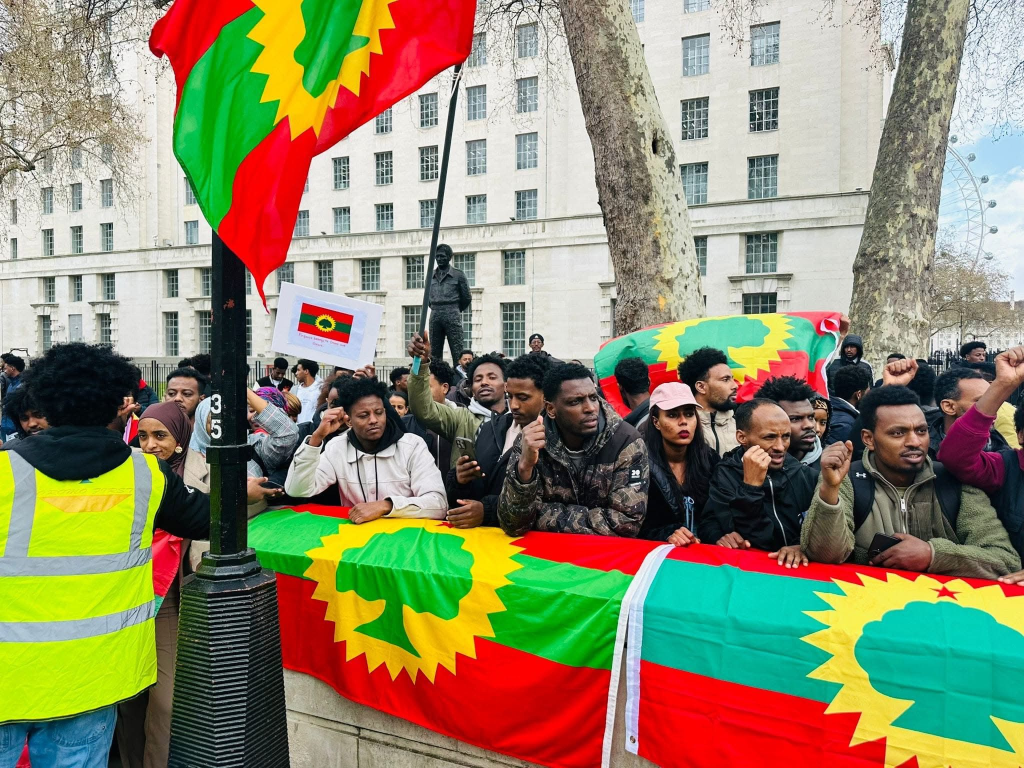
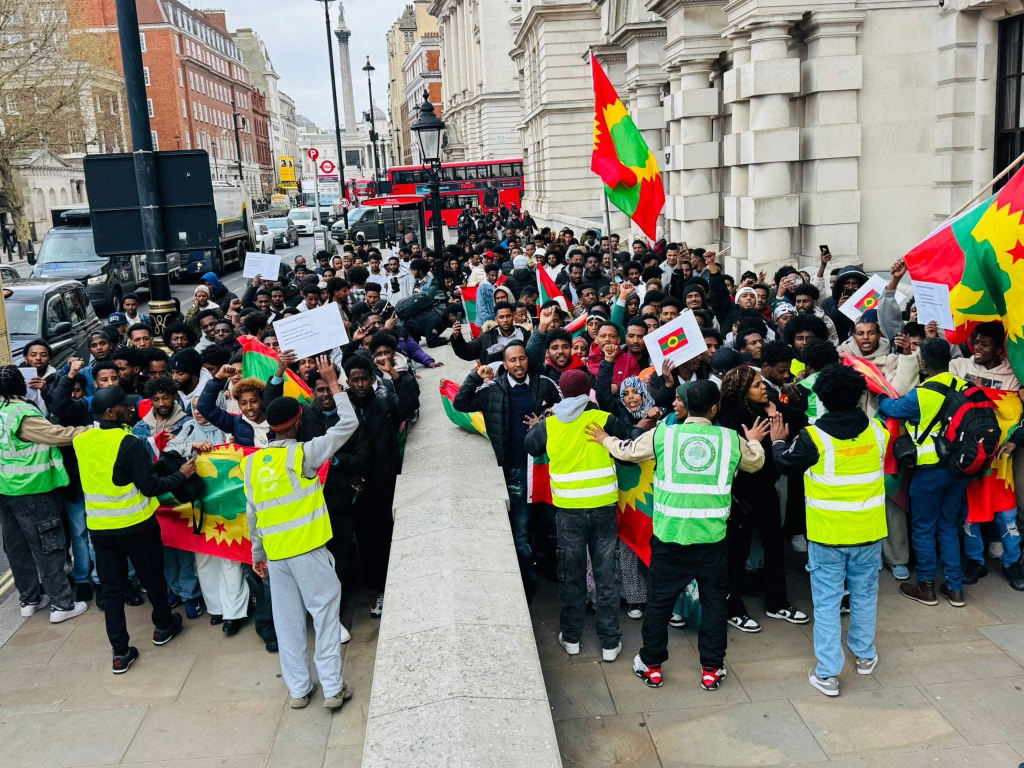
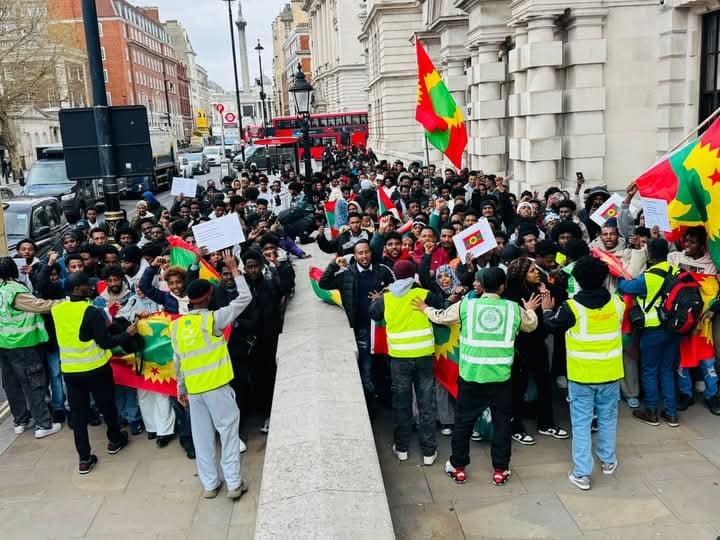
It was a cold, grey morning in central London when the first voices began to rise. By noon, the streets around the Ethiopian Embassy had become a river of red, green, and red – the colours of the Oromo flag – flowing with a quiet but unshakable resolve. Men, women, and children, many wrapped in traditional scarves against the March chill, stood shoulder to shoulder. Some carried photographs of faces they would never see again. Others held placards that declared, in bold letters, “Stop the Killings in Oromia” and “Justice for the Voiceless.”
The date was 30th March 2026. For the thousands who gathered, it was not just another protest. It was a hiriiraa– a gathering – that they called “Seena Qabeessa Sagalee Dhabeessa Taasifame”: a historic assembly that gives voice to those who have been silenced.
—
A Gathering Born of Grief
Every protest has a backstory, but the one that unfolded on the streets of London this past Monday was carved from grief too heavy for silence. The demonstrators, members of the Oromo diaspora from across the United Kingdom, had come to demand that the world finally pay attention to what they describe as a relentless wave of atrocities against the Oromo people in Ethiopia’s Oromia region.
“We are not here because we want to be,” said Firaol T., a 34-year-old software engineer who travelled from Manchester with his two young daughters. “We are here because our families back home are living in fear. My cousin was killed last month – shot at a checkpoint simply because he was Oromo. I cannot sit in comfort here while my people are being buried in mass graves.”
Firaol’s words were echoed by dozens of speakers who addressed the crowd through a portable sound system set up on the pavement. The speeches were delivered in Afaan Oromo, Amharic, and English – a multilingual testimony to a diaspora that spans generations and geographies but remains bound by a shared anguish.
—
‘They Want to Erase Us’
Protesters carried banners listing the names of towns and villages in Oromia that have become shorthand for suffering: Wollega, Guji, Shashamane, Walliso. Many held portraits of Hachalu Hundessa, the iconic Oromo singer and activist whose assassination in 2020 ignited the largest protests Ethiopia had seen in decades. Hachalu’s face was everywhere – on placards, on T‑shirts, even painted on a large cloth banner that hung from the embassy gates. For many in the crowd, his death was the beginning of a darker chapter that has yet to close.
“Hachalu sang for our freedom,” said Marta D., a university lecturer from London. “They killed him because they feared the power of our voice. But here we are, five years later, still speaking, still demanding justice. They cannot kill us all.”
The demonstrators accused the Ethiopian federal government, under Prime Minister Abiy Ahmed, of orchestrating a systematic campaign of extrajudicial killings, mass displacement, and ethnic cleansing against the Oromo. They pointed to reports from international human rights organisations documenting widespread violence in the Oromia region, including the use of drones and heavy artillery against civilian areas.
—
The Unseen Crisis
While the world’s attention has often been drawn to Ethiopia’s internal conflicts in Tigray and Amhara, the Oromo – the country’s largest ethnic group – say their suffering has been rendered invisible. “There is a media blackout on Oromia,” said Bontu B., one of the protest organisers. “When Oromos are killed, it does not make the headlines. That is why we are here – to force the world to see.”
The protesters carried a petition addressed to the UK Foreign Office, demanding an immediate halt to all British military and financial support to the Ethiopian government. They also called for the International Criminal Court to investigate what they term “crimes against humanity” perpetrated by Ethiopian security forces and allied militias.
“The UK government continues to fund a regime that is bombing our villages,” Bontu added. “Every pound that goes to Addis Ababa is a pound that buys bullets aimed at Oromo children. That must stop. Today.”
—
A Diaspora Unmuted
What made the 30th March gathering particularly striking was the range of participants. Young British-born Oromos, many of whom have never set foot in Ethiopia, stood alongside elders who fled political persecution in the 1980s and 1990s. There were mothers pushing prams, university students in graduation gowns as a symbol of the future they fear is being stolen, and even a small contingent of non-Oromo Ethiopians who had come in solidarity.
“I am Amhara, and I am here because the suffering in our country is not ethnic – it is political,” said Elias M., a London-based architect holding a sign that read “Ethiopia Needs Peace, Not War.” “The government has turned our nation into a graveyard. We must all say: enough.”
The atmosphere was sombre but disciplined. Police officers stood at a distance, observing the largely peaceful crowd. Only once did tensions rise, when a small group of counter-protesters tried to approach the embassy gates, but they were quickly separated by officers and absorbed back into the flow of London traffic.
—
‘A Day That Will Be Remembered’
As afternoon turned to early evening, the crowd began a slow, silent march towards Trafalgar Square. There was no music, no drumming – only the soft thud of footsteps and the occasional whispered prayer. At the square, they formed a circle, and for one full minute, they stood in complete silence. Then, as if on cue, a single voice rose: “Oromoo, dagaagaa!” – “Oromo, rise up!” The chant was taken up by hundreds, then thousands, until the square echoed with a roar that seemed to shake the stone lions at its base.
Organisers later described the gathering as the largest Oromo diaspora protest in London in recent years. “This is a turning point,” said Lammi G., a community elder who has lived in the UK since 1992. “For too long, our people have been told to be quiet, to wait, to hope that things will improve. But 30th March 2026 will be remembered as the day we said: we will wait no longer.”
—
The Weight of Absence
Amid the chants and the flags, there were also moments of intimate grief. Near the embassy gates, a small shrine had been set up: a row of framed photographs, each one showing a young Oromo man or woman. Beside each photo was a lit candle and a handwritten name. Gammachiis. Faayyisaa. Roobee. Caalaa. The names spanned the years 2020 to 2026 – a timeline of unending loss.
A young woman knelt in front of one photo, her forehead touching the pavement. When she stood up, her face was wet with tears. “My brother,” she said softly, gesturing to the picture. “He was a student. They killed him in 2023. I promised him I would never stop speaking his name.”
—
A Long Road Ahead
As dusk settled over London and the protesters began to disperse, there was a sense that this was not an ending but a beginning. Organisers announced plans for a follow-up rally outside the Houses of Parliament, and for a sustained campaign targeting Ethiopian diplomatic missions across Europe.
“We will not be satisfied with one day of speeches and signs,” said Bontu. “We are building a movement. The voices of the dead demand it.”
Before leaving Trafalgar Square, many of the protesters turned one last time to face the National Gallery – a monument to British history. They raised the Oromo flag high, and someone began to sing an old Oromo freedom song. The melody was haunting, carried on the cold London air, a reminder that even far from the hills of Oromia, the struggle for justice continues.
—
In the days that followed, the images from 30th March would circulate across social media, shared under the hashtag #OromiaRising. For the thousands who had gathered, however, the memory was already etched not in pixels, but in the cold ache of their hands from holding signs, the rasp of their throats from chanting, and the quiet, stubborn hope that somewhere, someone was finally listening.
Because on that day, in the heart of London, the voiceless were given a voice – and they made sure it was heard.
(London, UK, ONA) – In a stirring display of collective grief and political defiance, hundreds of members of the Oromo diaspora gathered in central London today to raise their voices against the government of Ethiopian Prime Minister Abiy Ahmed. The protesters, many draped in the traditional red, green, and red colors of the Oromo flag, marched to demand an immediate end to what they describe as systematic human rights violations, including extrajudicial killings and forced displacement in the Oromia region.
“We Are Here to Speak for the Voiceless”
The demonstration, which saw the closure of a major thoroughfare outside the Ethiopian Embassy, was marked by a palpable sense of urgency. Chanting slogans and holding placards reading “Stop the Genocide” and “Abiy Ahmed is a killer,” the protesters accused the Ethiopian National Defense Forces and allied regional militias of waging an offensive against Oromo civilians.
Recent reports from international observers have painted a grim picture of the security situation in Ethiopia. In its World Report 2026, Human Rights Watch (HRW) documented continued hostilities between federal forces and the Oromo Liberation Army (OLA) in parts of Oromia, resulting in significant civilian casualties and widespread displacement. Similarly, Genocide Watch’s 2025 country report highlights systematic patterns of violence against ethnic groups, noting that thousands of civilians have been killed in the Oromo and Amhara regions over the past year.
“We are here to speak for the voiceless in Oromia,” said one organizer, who identified himself as Bulti. “The international community cannot stay silent while our people are killed, our villages are burned, and our children are forced to flee their homes.”
Demands for Sanctions and ICC Prosecution
The London protest, which follows similar rallies in other major European capitals, carried a list of specific demands. Organizers submitted a formal petition to the UK Foreign Office, urging the British government to suspend financial and diplomatic support for the Ethiopian administration.
Among the key demands issued by the protest leaders were:
· Immediate Halt of Offensives: A call for the Ethiopian government to cease military operations in Oromia and withdraw security forces from civilian areas.
· Accountability: A demand for Ethiopian officials implicated in human rights abuses to be brought before international courts, including the International Criminal Court (ICC).
· Release of Political Prisoners: An urgent request for the unconditional release of opposition figures and activists held without trial.
· Justice for Slain Activists: The demonstrators specifically demanded justice for murdered artists and activists, including the iconic singer Hachalu Hundessa, whose death in 2020 sparked massive nationwide protests.
“We want the UK government to stop arming this regime,” protester Lemlem Tadese told reporters. “They have blood on their hands.”
A Deepening Crisis
The unrest in Ethiopia, Africa’s second-most populous nation, has been escalating for years. While the Tigray war officially ended in 2022 with the signing of the Cessation of Hostilities Agreement (CoHA), violence in the Amhara and Oromia regions has continued unabated.
Recent conflict dynamics have further complicated the situation. Reports from late March 2026 indicate that a rebel alliance, including Oromo forces, was closing in on the capital, Addis Ababa, leading to a state of emergency declaration. Concurrently, fierce fighting has been reported in western Oromia, where Oromo and Amhara militants have clashed, leaving civilians caught in the crossfire.
The humanitarian toll is staggering. According to the UN Office for the Coordination of Humanitarian Affairs (UNOCHA), over 288,000 people have been displaced since July 2025 following renewed inter-communal violence along the Oromia-Somali regional border, with many lacking access to clean water, shelter, or medical care.
A History of Marginalization
For many in the diaspora, the protests in London are not just a reaction to recent events but a culmination of decades of perceived marginalization. The Oromo, Ethiopia’s largest ethnic group, have long complained of political and economic disenfranchisement, including the historical banning of their language and the expropriation of their ancestral lands.
Protesters pointed to the government’s handling of the Addis Ababa Master Plan as a flashpoint, arguing that the expansion of the capital constitutes land grabs that displace Oromo farmers. “This is a struggle for survival,” said protester Desta Mulugeta. “We are fighting for our right to exist.”
A Divided Response
The Ethiopian government has consistently denied allegations of committing atrocities or targeting civilians along ethnic lines. Officials often characterize the OLA and other opposition groups as terrorist organizations bent on destabilizing the nation.
The London protest, however, highlighted the deep divide between the diaspora and the current administration. While the demonstration was largely peaceful, it reflects a growing frustration among the Oromo diaspora, who feel that diplomatic pressure alone is insufficient to halt the violence.
The Road Ahead
As the sun set over London, the protesters dispersed, but they vowed to return. Organizers announced plans for a nationwide awareness campaign and a potential mass rally in front of Parliament.
“We will not be silenced,” Bulti declared. “Until justice is served in Oromia, we will be here, every week, until the world listens.”
A Celebration of Heritage: Melbourne’s Oromo Community Marks Third Annual Oromtittii Day with Joy and Warmth
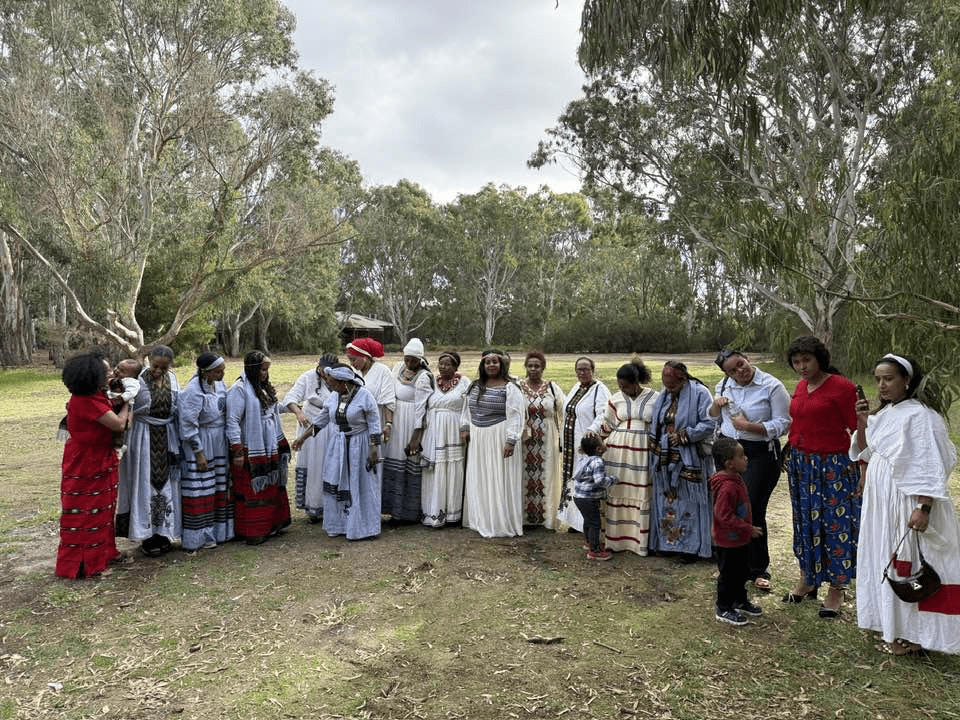
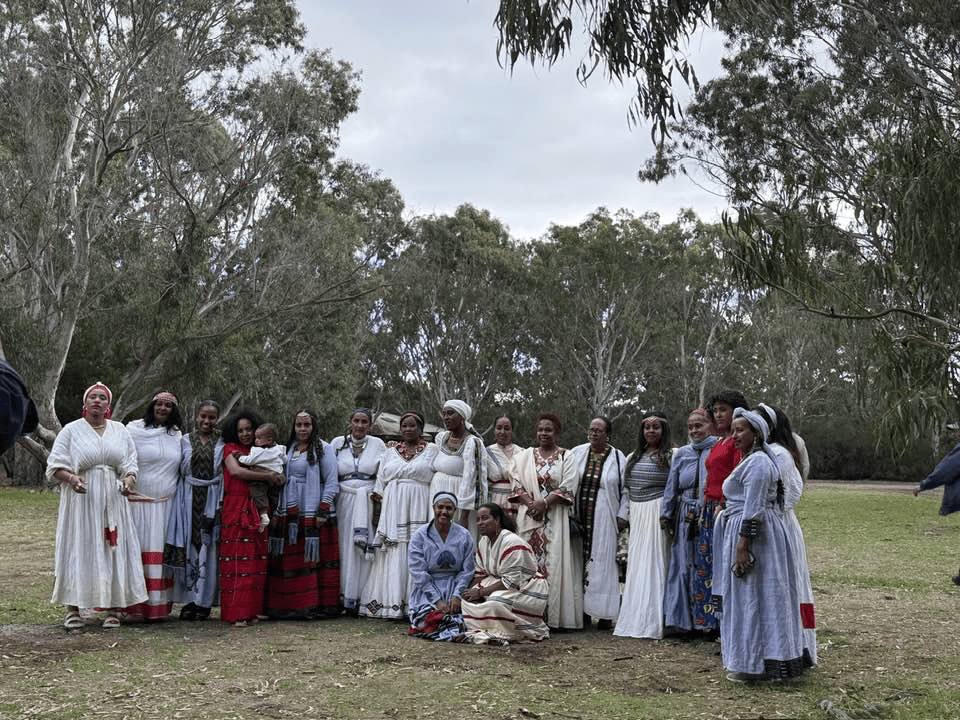
Melbourne, Australia – The Oromo community in Melbourne has once again demonstrated its rich cultural pride, celebrating Oromtittii Day (Oromo Mothers’ Day) for the third time in a vibrant ceremony held today. The event, which took place in a setting filled with warmth and beauty, was distinguished by a strong sense of family, with elders and children gathering together to honor the occasion.
This year’s celebration was dedicated to elevating the respect and recognition deserving of mothers. Attendees described the event as a heartwarming success, noting that the third annual commemoration brought immense joy to all who participated.
Organizers have already set their sights on the future, with plans to expand the event further. “We are already planning to make next year’s celebration even warmer and more inclusive than this one,” a member of the organizing committee shared.
“Our goal is to deepen community involvement and elevate this tradition.”
Community leaders extended their gratitude to all who participated, stating, “We thank our community members who came together to be part of this.”
The inaugural Oromtittii Day in Melbourne was first celebrated in 2024, and today’s event marks a continued commitment to honoring Oromo heritage and the pivotal role of mothers within the community.
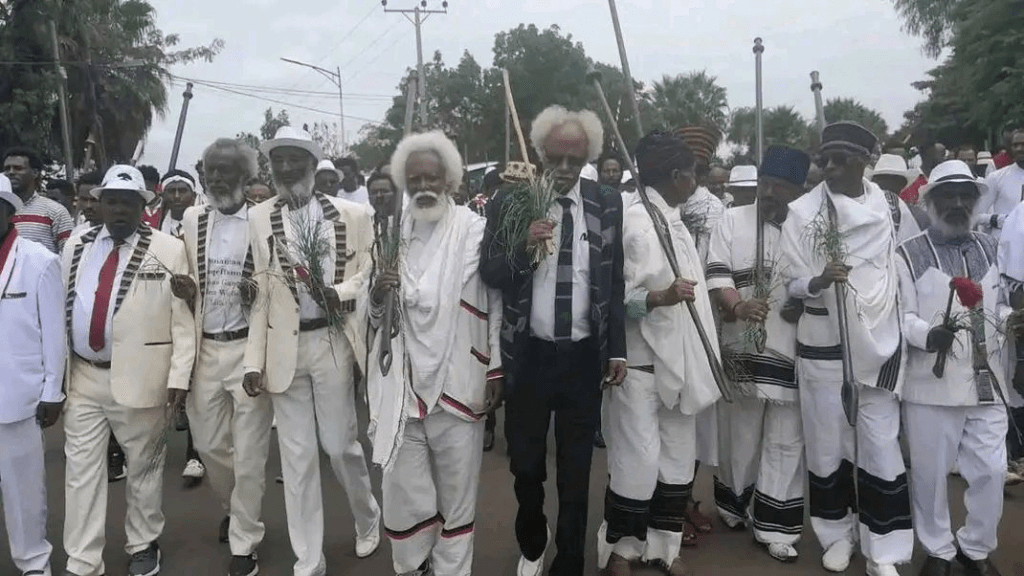
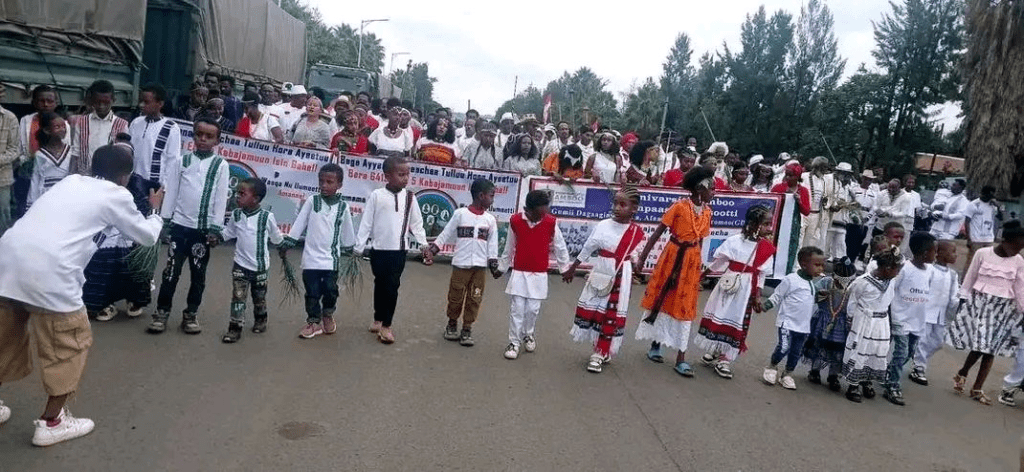
As the sacred season approaches, anticipation is building across Oromia and beyond. The annual Irreechaa Arfaasaa—the Thanksgiving festival of the Oromo people—is set to be celebrated with unparalleled splendor at the historic site of Tulluu Hora Ayeetuu.
According to an announcement from the Galmi Duudhaa Ganamaa Walisoo Liiban, preparations for the occasion have entered their final phase. The festival, which marks the transition from the rainy season to the bright days of peace and harvest, is scheduled to take place in a manner befitting its profound cultural and spiritual significance.
A Sacred Gathering
Irreechaa is more than a festival; it is the spiritual heartbeat of the Oromo nation. Celebrated twice a year, Irreechaa Arfaasaa (the spring thanksgiving) is a moment when millions gather at sacred lakes and hills to offer gratitude to Waaqaa (God) for life, health, and the blessings of renewal.
This year, all eyes are on Tulluu Hora Ayeetuu, a site revered for its deep historical and spiritual roots. The location holds special significance as a center of Oromo cultural identity, where generations have gathered to raise their hands in prayer and solidarity.
Final Preparations Underway
In a statement released to the public, organizers from Galmi Duudhaa Ganamaa Walisoo Liiban confirmed that all necessary arrangements are nearing completion. The celebration is being planned as a “warm and beautiful ceremony” —a phrase that reflects the commitment to ensuring both dignity and joy for the multitudes expected to attend.
Logistical preparations include:
Site organization and safety measures at Tulluu Hora Ayeetuu
Coordination of traditional protocols led by cultural elders
Arrangements for attendees traveling from across Oromia and the diaspora
A Call to the Oromo People
The message from the organizing body carries a tone of both invitation and affirmation. Speaking on behalf of the community, the leadership emphasized that the celebration is not merely an event but a reaffirmation of identity. As stated in their communication:
“Ayyaanni Abdii fi Hawwiin eegamu, kan Lafaa fi Nafa Oromoof gabbinaa.” (A festival where hope and aspiration are upheld—a thanksgiving for the land and soul of Oromoo.)
Significance of the Date
Irreechaa Arfaasaa will be observed according to the traditional Oromo calendar. While the exact date aligns with Bitootessa 27 / 7 / 2018 E.C. (which corresponds to approximately late March / early April in the Gregorian calendar), the spiritual resonance transcends the calendar itself. It is a time of unity, reflection, and collective renewal.
Looking Ahead
As the final preparations are completed, the message from Galmi Duudhaa Ganamaa Walisoo Liiban serves as both a confirmation of readiness and a call to the Oromo people worldwide to embrace the season with pride and reverence.
In a time when cultural preservation carries profound political and social weight, the gathering at Tulluu Hora Ayeetuu stands as a powerful testament to the resilience of Oromo traditions. The anticipation of warmth, beauty, and spiritual elevation suggests that this year’s Irreechaa will be remembered as a moment of unity and hope.
For further updates on logistics and participation, the public is advised to follow official communications from the organizing committee.
Through this Iyyaafannoo (Remembrance) page, Bariisaa Gazette presents to its readers the story of individuals who, in their time, performed great and unforgettable services for their country and people.
With this publication, we share a brief interview with a scholar who laid a solid foundation for the development of the Oromo language—particularly its standardization—founded the Oromo Language Standardization Committee, and served in leadership for many years, continuing his work even into retirement. This is his story as told in his own words.
Place of Birth
Abarraa Nafaa was born in 1938 in Qarree Ittisaa, Gindabarat district, West Shewa Zone, Oromia Region. His upbringing was typical of rural children of that era.
When he reached school age, he attended grades 1–6 at Kaachisi Elementary School, grades 7–8 at Ginciit, and grades 9–10 at Amboo. He began his education in 1954.
After completing his secondary education at Ma’araga Hiywot Secondary School, he enrolled at TTI (Technical Teacher Institute) in Harar, where he trained for two years and received his teaching certification in 1964.
He began his teaching career in Sidama region at Kaasaa Barii Elementary School. He was later transferred to Yirgaalam town, where he taught for three years at Adaraash Elementary School. In total, he served as a teacher for seven years.
In 1971, he pursued higher education at Finfinne University in the field of linguistics, graduating with a Bachelor of Arts (BA) in 1974.
Work in Oromo Language Research
In 1975, under the assignment of the time, he was posted to the Academy of Ethiopian Languages at the Ministry of Culture and Information, where he was directly assigned to Oromo language research.
In 1978, seeking to further his education, he received permission to study while working and completed his Master of Arts (MA) in linguistics in 1980.
After the Derg regime took power, scholars working within the Ministry of Culture and Sports were reassigned to various regions based on their language skills and work performance. Abarraa was similarly transferred to the Oromia Bureau of Culture and Sports, where he began conducting research on the Oromo language.
The language research work involved extensive collection of data from across Oromia. They organized the linguistic studies on a house-to-house basis, entered the data into computers, and began publishing. He served as a senior editor and organizer for the published books. Among the works to which he contributed his expertise are:
Proverbs (Mammaaksa) – Volumes 1–6, published by the Oromia Bureau of Culture and Tourism, for which he served as senior researcher and editor.
Traditional Songs (Walaloo Sirba Warroommii, Faaruu, Geerarsa Tuulamaa) – Volume 1, published by the Oromia Bureau of Culture and Tourism, for which he served as senior researcher and editor.
Dur durii – Volumes 1–5, and Hibboo – Volume 1, published by the Oromia Bureau of Culture and Tourism, for which he served as senior researcher and editor.
Yeroo (Oromo–Oromo Dictionary) – Initially prepared in manuscript form and published, for which he served as senior researcher and editor.
Amharic–Oromo–English Dictionary – Published by the Oromia Bureau of Culture and Tourism, for which he served as senior researcher and editor.
Hirkoo (English–Oromo–Amharic Dictionary) – Published by Asteer Naggaa, for which he served as editor.
Oromo Dictionary – Prepared and published by the Language Academy, for which he served as senior researcher and editor.
Oromo Grammar (Caasluga Afaan Oromoo) – Volumes 1 and 2, published by the Oromia Bureau of Culture and Tourism, for which he served as senior researcher and editor.
Wiirtuu – Volumes 1–7, published by the Oromia Bureau of Culture and Tourism, for which he served as senior researcher and editor.
Overall, he worked as a senior editor and organizer, ensuring that Oromo language research was carried out with great attention and dedication until his retirement. He retired from the Oromia Bureau of Culture and Tourism, where he had served in the Oromo language research department.
On the Standardization of Oromo
What does he say about the standardization of the Oromo language?
Abarraa explains:
“There was an institution called the Academy of Ethiopian Languages within the Ministry of Culture and Tourism. Many Oromo youth worked there. At that time, we were also conducting research, so we had knowledge about standardization.
In 1983, when we were told to go serve in our respective regions, I was transferred to Oromia. I was assigned to the language department. From there, believing that the language had now gained an opportunity and must be standardized, we began our work.
We decided that language research should start from the ground up, so I established the Oromo Language Standardization Committee. I was the one who founded that committee.
Members came from various bureaus. There was a representative from Bariisaa Gazette as well. There were also representatives from the Bureaus of Information, Education, and the Office of the Attorney General in Oromia.
Journalists like Huseen Badhaasoo and Bulloo Siibaa were among the committee members. At that time, there was great enthusiasm and dedication.
The Oromo Language Standardization Committee was established in 1983, and its work continued.
We traveled to bureaus and zones to collect data, prepared a project, and received a budget from the Oromia Regional Government to work with. I, in turn, organized the collected data. In this manner, we collected and published around 36,000 proverbs alone. The work was done well.”
On Standardization
Regarding standardization itself, he says:
“We recognized that there were challenges with standardization while I was working at the Ministry of Culture and Information, which motivated us to establish the standardization committee. Standardization means using common terms consistently.
For example, it means using the names of months and days in a uniform way. Even today, some people are careless and do not use them correctly. The names of the days from Wiixata to Jimaata were set by the standardization committee.
However, some people still refer to ‘great Sabbath’ and ‘small Sabbath.’ This is incorrect. The terms ‘great Sabbath’ and ‘small Sabbath’ come from religious influence. The standardization committee standardized them as Sanbata and Dilbata.
The Oromia Regional Council passed a decision on this matter. It changed the calendar to the Ethiopian numbering system. The names of the days and months standardized by the committee were officially ratified by the Oromia Regional Council through a directive.
At that time, there were people who said ‘let it be as it is,’ but we worked through consensus to achieve standardization.
Calling it ‘great Sabbath’ and ‘small Sabbath’ is religious, not originally Oromo. The Oromo tradition is Sanbata and Dilbata. The term Sanbata itself comes from Jewish tradition. Dilbata is Oromo.
We say Sanbata, Dilbata, Wiixata, Kibxata. Days have many names; for Kibxata, there were many options—we selected one and adopted it.
Political parties and the government have now agreed on using standardized terms.
I worked in the Standardization Committee for many years. I worked there from 1983 until I retired. The fact that the Wiirtuu series has been published up to 13 volumes is very encouraging. I have a great thirst for this language.
My work on the language and the results achieved feel to me like a person who was thirsty for water finally quenching their thirst.
What we worked on was standardizing pronunciation, writing, and vocabulary. Through this, we aimed for Oromo people everywhere to use a uniform standard.
For example, the word Wiixata should be recognized universally. Schools, courts, and offices should use it uniformly.
Those who seek to pull this language backward still exist today, so it is necessary to guard it carefully.
Authorities must use standardized terms. Writers and media must do the same.
If this is not done, those who write books must ensure that their works are not undermined. Their books must be written in full compliance with the rules of the Oromo language, verified by the relevant body.
For this reason, I have long called for the establishment of an Oromo Language Academy. Language develops culture, and culture develops language.
This can only be achieved by directly conducting research. Wiirtuu is a reference for Oromo language standardization. Other similar publications should also be printed.
Publications like the weekly Bariisaa Gazette and Kallachaa Oromiyaa should multiply. Without working in this way, the language will neither grow nor be standardized.
Children must learn it from the earliest levels. This effort, which had weakened, must regain its strength.
The language needs support and attention. Like a shepherd watches over livestock, the language must be tended. Now that it has gained momentum, scholars must work with focus.
Since there are those who, by writing the Oromo language incorrectly, seek to corrupt it, make it despised, and cause it to fail, strict control and vigilant care are essential.”
To enrich this article further and to provide this scholar’s story, we extend our deep gratitude to Aadde Dirribee Qana’aa (from the Oromo Research and Study Institute) for her assistance.
Yeroo sana namoonni kan koo haata’u jechaa turan jiraatanillee walamasiisuudhaan akka waalteffamu gochaa turre.
Sanbata guddaa Sanbata xiqqaa jechuun kan amantiiti malee kan Oromodurii miti. Kan Oromoo Sanbataafi Dilbata. Jechi Sanbata jedhamu uumamasaatiin kan Yuhudotaati. Dilbanni kan Oromooti.
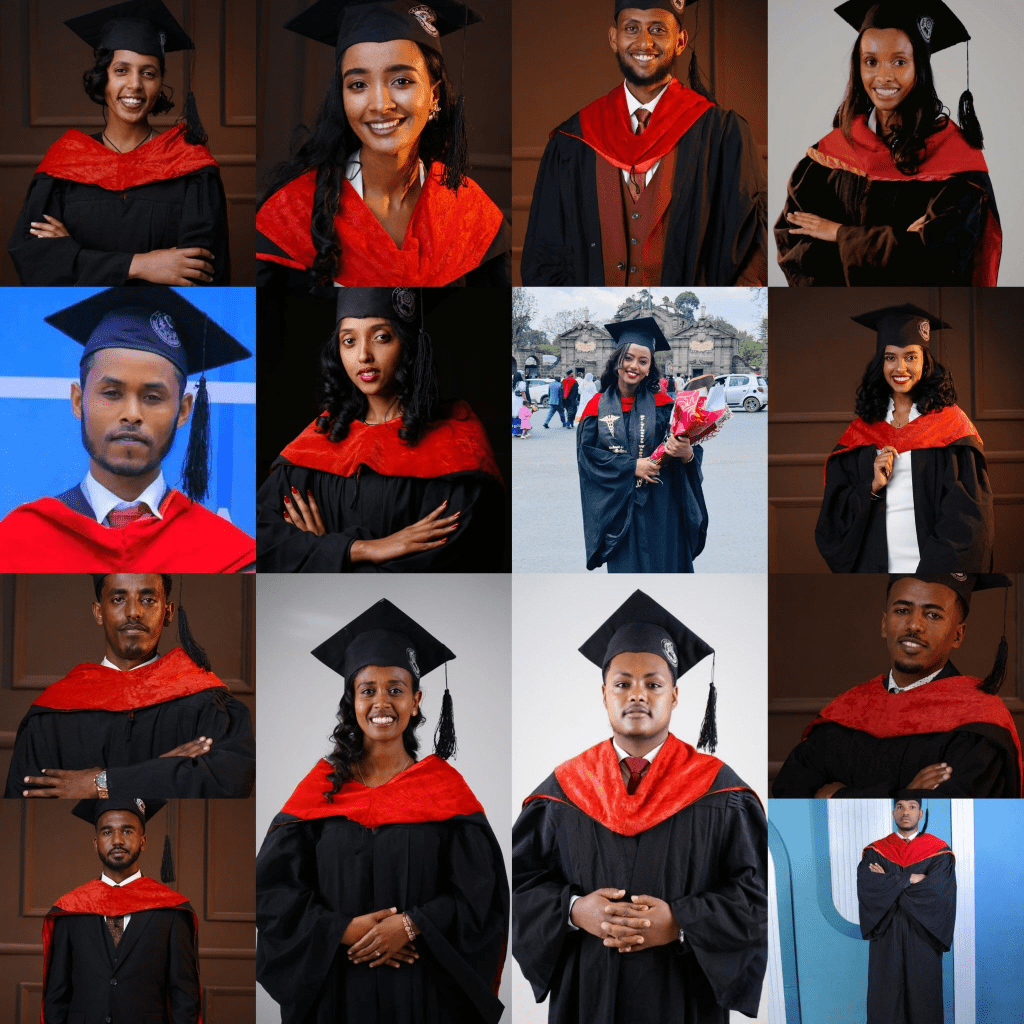
Finfinne, March 22, 2026 – The Oromia Development Association (ODA) Bultii Addaa Secondary School is celebrating a remarkable achievement as fifteen of its former students have successfully graduated with Medical Doctor (MD) degrees from Finfinne University.
The fifteen graduates—Dr. Araaree Irreessoo, Dr. Aliyyii Huseen, Dr. Beteliyeem Girmaa, Dr. Ermiyaas Tagan, Dr. Hiroowaaq Kabbadaa, Dr. Ibsaa Mohammed, Dr. Jibril Xaahir, Dr. Musee Birhaanuu, Dr. Obsinaan Tarreessaa, Dr. Phaawulos Gammadaa, Dr. Radi’eet Birhaanuu, Dr. Saaloomee Taammanaa, Dr. Tinsaayee Waggaarii, Dr. Yoonaas Hiikaa, and Dr. Zalaalam Simee—have all recorded outstanding scores in the national 2010 entrance examination, which paved the way for their medical studies.
These accomplished individuals have now completed their rigorous medical training with distinction, earning the right to be called medical doctors. Their journey from the classrooms of ODA Bultii Addaa to the halls of Finfinne University Medical School represents years of dedication, hard work, and perseverance.
The Oromia Development Association, in a statement celebrating the achievement, expressed immense pride in the graduates. The organization highlighted that the students’ success is a shining example of the fruits of commitment and integrity. The ODA emphasized that these new doctors carry with them the trust of the Oromo people and urged them to serve their nation and community with honor, faithfulness, and the expertise they have acquired.
“The success of our students is a testament to the fact that ODA nurtures a generation that upholds dignity and makes significant contributions to our country and people,” the statement read.
The ODA extended its heartfelt congratulations to all the graduates, acknowledging the collective effort behind their success. The organization also recognized the vital roles played by the ODA Board members, school leadership, teachers of Bultii Addaa Secondary School, families, and all stakeholders who supported the students along their academic journey.
“As you complete your education with excellent results, your victory is great,” the ODA stated, celebrating the milestone.
The achievement of these fifteen medical doctors marks a proud moment for the institution and serves as an inspiration for current and future students of ODA Bultii Addaa Secondary School. The organization reaffirmed its commitment to fostering excellence and contributing to the development of skilled professionals dedicated to serving the community.
“Congratulations once again. We are truly proud of you!” the ODA concluded, celebrating the success of its alumni and the bright future they represent for the Oromo people and beyond.
A Life of Struggle and Service: Yonathan Dhibisaa’s Journey Captured in New Book
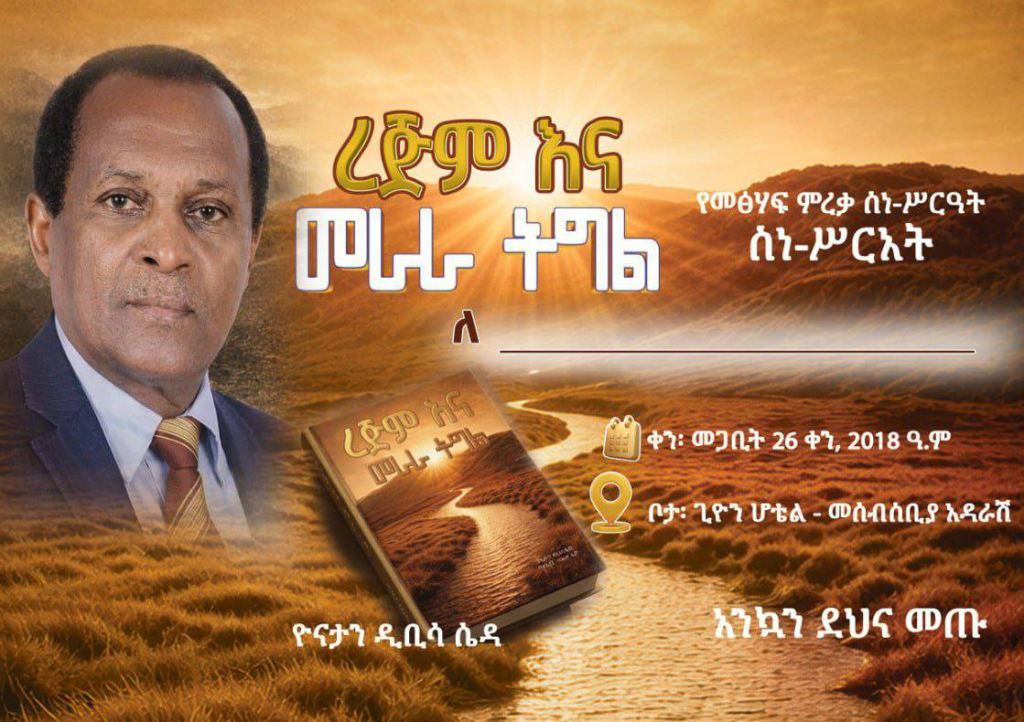
Addis Ababa – A new literary work is set to offer an unprecedented glimpse into the life of one of Oromia’s most prominent political figures. A book chronicling the life and legacy of Yonathan Dhibisaa Seedaa—a founding member and former central committee leader of the Oromo Peoples’ Democratic Organization (OPDO)—will be launched on April 4, 2026, at Ghion Hotel starting at 7:00 PM.
The event marks not just the release of a book, but a celebration of a life defined by decades of political activism, military leadership, and public service. Organizers have extended a warm invitation to the public, calling on all who revere history and political struggle to attend.
A Storied Career in Politics and Public Service
Yonathan Dhibisaa is no stranger to the corridors of power or the rigors of the battlefield. As a founding member of the OPDO, a party that later merged to form the Prosperity Party, he played a pivotal role in the region’s political evolution. His leadership extended beyond party politics into the highest echelons of regional government, where he served in key positions—from holding a high-level security post to eventually becoming the Minister of Justice for the Oromia regional state.
A Military Leader in the Struggle for Freedom
Before his political career, Dhibisaa’s life was forged in the crucible of armed struggle. His commitment to the cause of the Oromo people saw him traverse a vast arc of conflict, journeying from Eritrea to Egypt as a leader within the Oromo Liberation Army (Waraana Bilisummaa Oromoo—WBO). For over 17 years, he served on the front lines, dedicating his youth to the pursuit of self-determination.
Perhaps one of the most defining chapters of his legacy unfolded in the Metekel Zone of the Benishangul-Gumuz region, specifically in Gida and Kiramu districts of eastern Wollega. Historians and comrades recall his role in leading armed resistance to protect Oromo communities that were facing grave threats. His willingness to stand on the front lines during those dark days has cemented his reputation as a leader who did not simply command from a distance but faced danger alongside his people. That chapter of his life, marked by personal sacrifice and direct confrontation with violence, is one that organizers say “will never be forgotten.”
Returning to Civilian Life
After decades of service—first as a freedom fighter and later as a high-ranking government official—Dhibisaa ultimately stepped away from formal political power. Following his tenure in the cabinet, he chose to lay down the mantle of authority, returning to a quieter life focused on personal reflection and family. It is from this space of experience and retrospection that the new book emerges.
What the Book Offers
According to those close to the author, the book is more than a memoir. It is described as a deep reflection that shares insights into his political journey, personal experiences, and the vision he holds for the future. It promises to provide readers with an intimate look at the decisions, struggles, and moments of clarity that shaped his path.
Organizers believe the book holds immense value—not just for those who followed his career, but for a new generation of leaders interested in governance, resilience, and social transformation.
An Invitation to All
In a statement released ahead of the launch, the organizers emphasized the importance of remembering history.
“If people forget history, history will not forget the people,” they said, underscoring the significance of documenting and honoring the experiences of those who have shaped the nation’s political landscape.
The event is open to the public, and attendees are encouraged to share the invitation widely. The launch will take place at Ghion Hotel, a historic venue in the capital, on the evening of April 4, 2026.
For those who value stories of perseverance, leadership, and the long arc of the struggle for justice, this book promises to be an essential addition to their library.
Event Details:
Occasion: Book Launch – Celebrating the Life of Yonathan Dhibisaa Seedaa
How Victoria is leading the fight against racial discrimination in the workplace
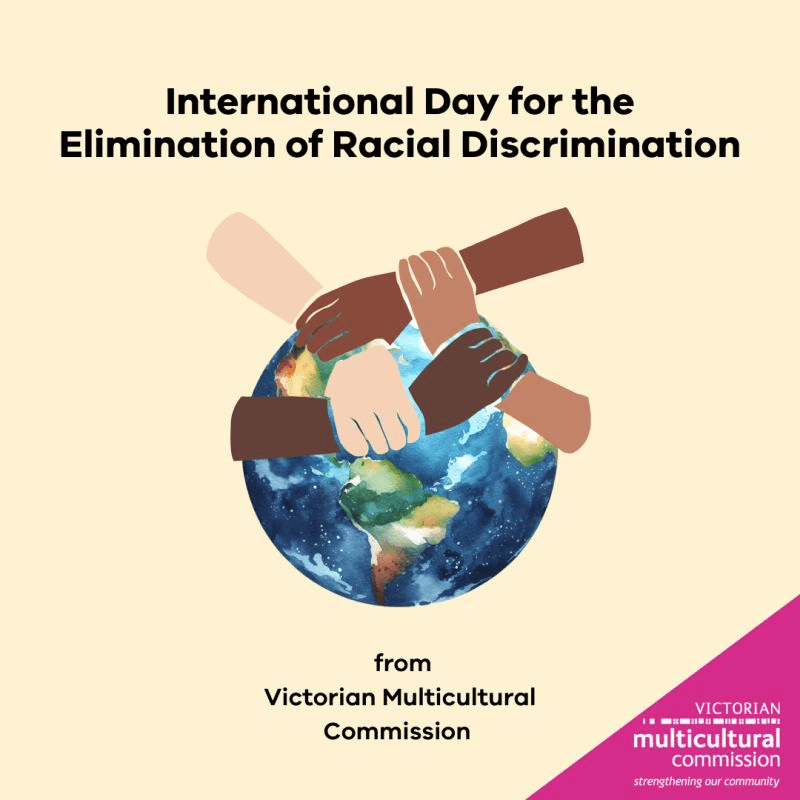
On March 21, the world observes the International Day for the Elimination of Racial Discrimination. It is a day of remembrance, a call to action, and a global reminder that the fight for equality is far from over. This date was chosen to honor the 1960 Sharpeville massacre in South Africa, a tragic event that underscored the deadly consequences of unchecked racism.
In Victoria, this day serves as a powerful catalyst to examine not only our society but the spaces where we spend most of our time: our workplaces. While the ideal of a fair go is central to the Australian ethos, the reality is that racial discrimination remains a persistent issue. However, in Victoria, the law is clear: every worker has the right to be treated fairly, regardless of their race, skin color, descent, or national or ethnic origin.
The Legal Framework: More Than Just Policy
Under the Equal Opportunity Act 2010 (Vic), it is against the law to discriminate against someone based on their race. This protection covers all aspects of employment, from recruitment and promotion to termination and the day-to-day conditions of the job.
But the law does more than just prohibit negative behavior. It places a positive duty on employers. This means that Victorian employers have a legal responsibility to be proactive. They cannot simply wait for a complaint to occur; they must take reasonable and proportionate steps to eliminate racial discrimination, sexual harassment, and victimization as far as possible. Creating a safe, inclusive environment isn’t just good ethics—it’s the law.
Identifying Racism in the Workplace
Racism isn’t always overt. While blatant acts like using racial slurs or denying a promotion based on ethnicity are clear-cut violations, racial discrimination often manifests in more subtle, systemic ways. Recognizing these is the first step toward action.
Racial Vilification: This involves public acts that incite hatred, serious contempt, or ridicule against a person or group of people because of their race. This can happen in meetings, via work emails, or on internal communication platforms.
Discriminatory Jokes or “Banter”: Often dismissed as harmless humor, persistent jokes about a person’s cultural background, accent, or appearance create a hostile and degrading work environment.
Indirect Discrimination: This occurs when a workplace policy or practice appears neutral but disproportionately disadvantages people of a particular race. For example, requiring all staff to work on a specific religious holiday without flexibility may indirectly discriminate against employees of certain faiths.
Exclusion: Being left out of important meetings, social gatherings, or informal networks where information and opportunities are shared.
Microaggressions: Subtle, often unintentional, slights or insults that communicate negative messages. Examples include consistently mispronouncing a colleague’s name despite correction, asking “where are you really from?”, or making assumptions about a person’s abilities based on their background.
Know Your Rights: The Power of Action
If you experience or witness racism at work, it is crucial to know that you are protected and there are clear pathways to act.
For individuals who experience discrimination:
Keep a Record: Document what happened, including dates, times, witnesses, and any evidence like emails or messages.
Seek Support: Check your workplace policy and speak with a trusted manager, a human resources representative, or a union.
Make a Complaint: You can make a formal complaint internally. You also have the right to make a complaint to the Victorian Equal Opportunity and Human Rights Commission (VEOHRC), which handles complaints about discrimination in Victoria. The process is designed to be fair and can lead to conciliation, where both parties work to find a resolution.
For bystanders—those who witness discrimination—the role is just as vital. Silence can be interpreted as acceptance. The Victorian Equal Opportunity and Human Rights Commission has developed “Workplace Bystander Guides” that empower colleagues to intervene safely and effectively. Being an active bystander can mean:
Interrupting: Politely but firmly challenging the behavior in the moment. (“That joke isn’t funny, please don’t say that.”)
Supporting: Checking in with the person who was targeted. (“Are you okay? I saw what happened.”)
Reporting: Documenting the incident and reporting it to a manager or HR, especially if the targeted individual is hesitant to do so themselves.
Accessing Resources in Your Language
Understanding your rights is the foundation of empowerment. To ensure that every Victorian worker can access this vital information, VEOHRC has made key resources available in multiple languages.
Employers, HR professionals, and individuals can download practical fact sheets and the comprehensive workplace bystander guides. These materials provide step-by-step advice on how to identify discrimination, understand legal protections, and take effective action.
The International Day for the Elimination of Racial Discrimination is a moment to reflect, but the work of building truly equitable workplaces is a daily endeavor. It requires more than just legal compliance; it demands a cultural shift.
When employers embrace their legal responsibility to eliminate discrimination, they don’t just avoid legal action—they foster environments where innovation thrives, where employees feel safe, and where everyone has the opportunity to succeed. When workers know their rights and have the tools to act as allies, they transform their workplaces from places of mere tolerance to places of genuine belonging.
This March 21, let Victoria’s commitment to equality be more than a statement. Let it be an action. Know your rights, support your colleagues, and help build a future where diversity is not just respected, but celebrated.
For more information, or to access fact sheets and guides in your language, visit the Victorian Equal Opportunity and Human Rights Commission’s resource page.
Understanding the Vision and Sacrifice Behind the Struggle
The Oromo Liberation Front (OLF) stands as a political organization that has long moved in accordance with the will and aspirations of the Oromo people. At its core, the OLF is presented as a peace-loving organization that consistently seeks the wellbeing of its people. Its primary objectives focus on ensuring the rights of the Oromo people, strengthening national unity, and establishing lasting peace.
The Centrality of Peace
Peace is the foundation of human existence. Without peace, no community can achieve meaningful development, education, or a complete life. Recognizing this fundamental truth, the OLF has repeatedly expressed its commitment to dialogue and peaceful agreements throughout various periods of its history. This demonstrates the organization’s belief that conflicts should be resolved not through force alone, but through discussion, agreement, and mutual understanding.
When we say “the OLF is a peace-loving organization,” this reflects its commitment to prioritizing peace in both its actions and objectives. The organization understands that sustainable solutions emerge not from the barrel of a gun, but from the negotiating table where differences can be addressed through constructive dialogue.
A Symbol of Hope
The OLF’s role as the hope of the Oromo people carries deep and broad meaning. For generations, the Oromo people have traversed through various challenges and difficulties. During such times, an organization that advocates for the people appears as a light of hope. Just as light guides one through darkness, the OLF is perceived within its community as hope and illumination.
The saying “The OLF is the light of the Oromo people” carries the promise that the organization guides its people from the darkness of hardship and oppression toward the light of freedom, rights, and peace. This metaphor resonates deeply with a people who have long struggled for recognition and self-determination.
Leadership Through Sacrifice
The leaders of the OLF play an enormous role in this ongoing journey. Among the well-known examples is Dawud Ibsa, who served the organization as a long-time leader and throughout his life paid repeated sacrifices for the cause of his people. His example, along with that of other leaders, serves as a profound lesson for both current leadership and future generations about the patience, perseverance, and faithfulness required to work for the people’s cause.
“Serving the people throughout one’s lifetime and paying the ultimate sacrifice” is no simple phrase. In its deepest meaning, it represents the act of offering one’s personal life, time, energy, and future opportunities for the sake of the nation. This level of dedication transforms political leadership into something approaching sacred duty.
The Legacy Continues
The examples set by leaders like Dawud Ibsa demonstrate that the path to freedom requires not just political vision, but personal sacrifice. Their lives teach that the struggle for rights and recognition is not a sprint but a marathon, requiring sustained commitment across generations.
As the Oromo people continue their journey toward full recognition of their rights and aspirations within Ethiopia, the sacrifices of those who have gone before serve as both foundation and inspiration. The struggle continues, carried forward by those who believe that peace with justice is possible and that the hopes of the Oromo people will one day be fully realized.
This feature examines the role and perception of the Oromo Liberation Front within the context of its stated commitments to peace and the sacrifices of its leadership.
Advocacy for Oromia was established in 2010 with the purpose of enabling and empowering Oromo people by providing accurate and timely information that will help to make better choices to create the kind of future in which they wish to live.
It also provides information focus on the major issues facing us in the 21st century and it is going to try and bring a balanced approach with factual information that is positive and solution based.
The website has been in operation for the last nine years with the mission of promoting and advancing causes of Oromo people through advocacy, community education, information service, capacity building, awareness raising and promotion.
The website is also the official site of Advocacy for Oromia Association in Victoria Australia Inc., a non-profit organisation, registered under the Associations Incorporation Reform Act 2012 in Victoria as April 2014.
Our team already had considerable community development experience and expertise. Our various projects helped to develop our confidence and the capacity of our agency. Our team used every gained knowledge, skills and experiences as an opportunity to design and develop new approaches, to documenting progress, supporting positive employment outcomes, liaising with community stakeholders, and conduct evaluation.
Advocacy for Oromia is devoted to establishing Advocacy for Oromia organisation to close the gaps where we can stand for people who are disadvantaged and speaking out on their behalf in a way that represents the best interests of them. We are committed to supporting positive settlement and employment outcomes for Victoria’s Oromo community.
Advocacy for Oromia Office
Addresses:
39 Clow St,
Dandenong VIC 3175
=====================
247-251 Flinders Lane
Melbourne VIC 3000
Activities Address
Springvale Neighbourhood House Inc
Address: 46-50 Queens Ave, Springvale VIC 3171
Postal Address:
P. O. Box 150
Noble Park, Vic 3174
With your support, we can continue to help community build a better future.
Advocacy for Oromia Mental Health Program
The aim of the program is to improving the mental health and well-being of Oromo community in Victoria. It aims to assist those experiencing, mental ill-health, their families and carers of all ages within this community to address the social determinants of mental health for Oromo community. It helps:
Identify and build protective factors,
Reduce stigma and discrimination
Build capacity for self-determination
Better understand mental wellbeing, mental ill-health and the impacts of trauma
The goal of the project is to increase mental health literacy of Oromo community that aims:
To assist people with mental health issues
To increase the capacity of mental health worker
To better understand mental wellbeing
To provide mental health education and information
To address the social and cultural causes of mental health issues
Advocacy for Oromia will organise information session, women performance, radio programs, culturally adopted conversations on Oromo Coffee Drinking ceremony, providing training for mental health guides and forum and producing educational materials on the selected groups and geographical area.
Human Rights Education Program
The Human Rights Education Program is a community based human rights program designed to develop an understanding of everyone’s common responsibility to make human rights a reality in each community.
Human rights can only be achieved through an informed and continued demand by people for their protection. Human rights education promotes values, beliefs and attitudes that encourage all individuals to uphold their own rights and those of others.
The aim of the program is to build an understanding and appreciation for human rights through learning about rights and learning through rights. We aimed at building a universal culture of human rights. Thus, we aimed:
To build an understanding and appreciation for human rights through learning about rights and learning through rights.
To build capacities and sharing good practice in the area of human rights education and training
To develop human rights education and training materials and resources
The goal of the project is to increase human rights literacy of Oromo community that aims:
To better understand human rights
To increase the capacity of human rights worker
To analyse situations in human rights terms
To provide human rights education and information
To develop solidarity
To strategize and implement appropriate responses to injustice.
The ultimate goal of education for human rights is empowerment, giving people the knowledge and skills to take control of their own lives and the decisions that affect them.
Human rights education constitutes an essential contribution to the long-term prevention of human rights abuses and represents an important investment in the endeavour to achieve a just society in which all human rights of all persons are valued and respected.
Advocacy for Oromia will organise information session, performance, radio programs, culturally adopted conversations on Oromo Coffee Drinking ceremony, providing training for Human Rights guides and forum and producing educational materials on the selected groups and geographical area.
Community Safety Program
The program aims to strengthen existing collaborations and identify opportunities for the development of partnerships aimed at community safety and crime prevention activities. This approach seeks to improve the individual and collective quality of life by addressing concerns regarding the wider physical and social environment. Importantly, community safety means addressing fear of crime and perceptions of safety as without this any actions to address the occurrence of crime and anti-social behaviour are of less value.















 Advocacy for Oromia