Category Archives: Information

The Asmara Enigma: What Does Eritrea’s Power Signify, and What Does It Seek?
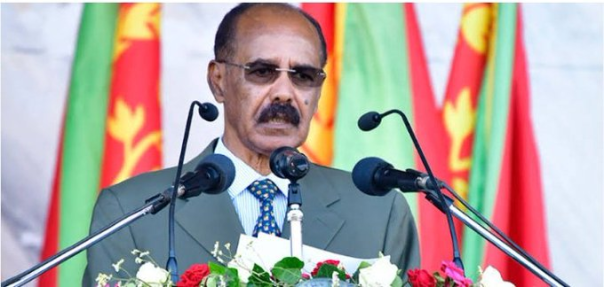
By Daandii Ragabaa
In the turbulent landscape of the Horn of Africa, few actors are as consistently consequential—and as persistently misunderstood—as Eritrea. A small nation of approximately 6.3 million people, with a modest economy and a military that punches significantly above its weight, Eritrea has nonetheless woven its influence through nearly every major geopolitical conflict in the region . From Ethiopia’s internal convulsions to Sudan’s protracted war and Somalia’s fragile transitions, Asmara’s role—direct or indirect—has repeatedly surfaced at moments of regional stress .
This presents a strategic puzzle. How does a state with limited economic weight and modest demographic size exercise such persistent regional impact? Why does Eritrea appear consistently aligned with fault lines rather than with stability and integration platforms? And most critically: What does Eritrea’s power signify, and what does it seek?
The answers are not found in simplistic narratives of irrationality or isolation. Instead, a sharper diagnosis is required—one that recognizes Eritrea’s external conduct as reflecting a deliberate survival doctrine in which regional fragmentation serves as strategic depth .
The Asmara Doctrine: Survival Through Fragmentation
To understand what Eritrea seeks, one must first understand how it perceives the world. For Asmara, the most significant threat is not territorial invasion. It is structural encirclement by consolidated neighboring states capable of projecting economic, political, or ideological influence inward .
A confident Ethiopia pursuing reformist leadership, a unified Sudan embedded in external alliances, or a stabilized Somalia anchored in international security frameworks—each of these presents distinct risks to Eritrea’s tightly controlled domestic order. The consolidation of strong, institutionally coherent neighboring states introduces long-term challenges to a regime whose survival depends on managed siege mentality .
In this calculus, fragmentation offers insulation. Divided or internally preoccupied neighbors lack the capacity to coordinate sustained pressure or export alternative governance models. Fluidity in the regional environment enhances the relative value of Eritrea’s centralized command structure and military discipline. This does not imply a desire for chaos. Rather, it reflects a preference for a strategic landscape in which no single neighboring state accumulates overwhelming coherence or leverage .
Regional integration—particularly when tied to institutional harmonization, economic transparency, or political conditionality—can expose internal vulnerabilities. Fragmentation, by contrast, preserves autonomy. This is the Asmara Doctrine: regime survival through managed regional fragmentation .
The Securitized State: From Liberation to Permanent Mobilization
Eritrea’s foreign policy cannot be separated from its internal formation. The state emerged from a decades-long liberation struggle defined by discipline, hierarchy, and strategic patience. The transition from insurgency to sovereignty did not dissolve these traits; it institutionalized them .
National service became more than a defense policy. It evolved into a mechanism of political consolidation and social control. Political pluralism was indefinitely deferred in favor of unity under threat. The experience of existential conflict—first during liberation, then in the 1998–2000 border war with Ethiopia—embedded siege mentality into statecraft .
The prolonged “no-war-no-peace” period that followed reinforced this orientation. Border militarization and diplomatic isolation hardened threat perceptions. Sanctions deepened the conviction that vulnerability invited coercion. Over time, securitization became permanent rather than exceptional. Under such conditions, foreign policy ceased to be an arena for economic growth or cooperative expansion. It became an extension of regime preservation .
Today, Eritrea maintains an estimated 350,000 active personnel and 680,000 reservists out of a population of just over 6 million—one of the highest military-to-population ratios in the world . This massive mobilization is not merely defensive. It is the structural backbone of a state that organizes society around permanent readiness.
What Eritrea Seeks: A Framework of Strategic Objectives
Based on its actions, alliances, and historical trajectory, Eritrea’s strategic objectives can be understood across several interconnected dimensions.
1. Sovereignty as Absolute Priority
Since achieving independence, Eritrea has adopted an uncompromising approach to national sovereignty. The state exhibits heightened sensitivity toward any regional or international frameworks that could be interpreted as encroachments upon its internal affairs . This perception is rooted in past experiences in which regional organizations supported international measures—including sanctions—targeting Eritrea .
Sovereignty, for Eritrea, is not negotiable. It constitutes the cornerstone of foreign policy. Any arrangement that appears to cede decision-making authority to external bodies is viewed with deep suspicion. This explains Eritrea’s strained relationship with IGAD and its eventual withdrawal from the organization in December 2025—only two years after rejoining .
2. Prevention of Regional Encirclement
Eritrea’s primary strategic anxiety is the emergence of a coherent bloc of neighboring states aligned with external powers that could coordinate pressure against Asmara. A re-centralized and economically dynamic Ethiopia with regional leadership ambitions introduces long-term strategic risk. A consolidated Sudan aligned firmly with external actors could recalibrate strategic balances .
Thus, Eritrea’s posture toward its neighbors oscillates between tactical alignment and guarded distance. It is neither unconditional partnership nor entrenched hostility. It is calibration. The objective is not domination but prevention of configurations that compress Eritrea’s maneuver space .
3. Red Sea Relevance and Strategic Leverage
Eritrea controls a long Red Sea coastline, sits opposite Saudi Arabia, and occupies a decisive position in the corridor linking the Horn, the Gulf, and the wider maritime-security ecosystem . Its geography gives Asmara leverage that few regional actors can ignore.
Recent developments underscore Eritrea’s strategic pivot toward Red Sea governance. In May 2026, Egypt and Eritrea signed a groundbreaking maritime transport cooperation agreement, reaffirming their shared stance that Red Sea security is the exclusive responsibility of its littoral states . The agreement, signed during a high-level Egyptian delegation visit to Asmara, includes establishing a shipping line connecting Egyptian and Eritrean ports .
Egyptian Foreign Minister Badr Abdelatty emphasized that “the governance and security of the Red Sea are the exclusive responsibility of its littoral states,” firmly rejecting any attempts by outside parties to impose security arrangements . This alignment with Egypt—a major regional power with its own tensions with Ethiopia over Nile waters—positions Eritrea as a key player in Red Sea geopolitics.
4. Preservation of Domestic Order Through External Fluidity
Eritrea’s operating model links domestic militarization with external maneuvering. Indefinite national service sustains a highly securitized state structure; political closure reduces internal accountability; and regional disruption then becomes a mechanism for projecting strength outward while insulating the regime at home .
In this sense, Eritrea’s foreign policy cannot be separated from its domestic architecture. The same state that organizes society around permanent mobilization also benefits from a neighborhood kept under strategic pressure. Fragmentation serves as strategic depth—preserving maneuver space and preventing the emergence of pressures that could challenge the internal order .
Strategic Partnerships: Egypt, the Gulf, and Beyond
Eritrea has cultivated strategic partnerships that enhance its regional leverage while avoiding deep institutional entanglement. The emerging alliance with Egypt is particularly significant.
The Egypt-Eritrea alignment is rooted in shared concerns about Red Sea governance, opposition to non-littoral state involvement in maritime security, and, implicitly, a shared strategic perspective on Ethiopia . Egypt has expressed full support for Eritrea’s “sovereignty, unity, and territorial integrity”—a position President Abdel-Fattah El-Sisi personally reaffirmed when President Isaias Afwerki visited Cairo in October 2025 .
President Afwerki, for his part, has praised Egypt’s active regional role and reaffirmed Eritrea’s commitment to strengthening coordination with Cairo across political, economic, and security domains . The relationship is described not as a new beginning but as the latest chapter in a long and substantive partnership.
This alignment gives Eritrea a powerful patron at a time when its relations with other neighbors remain fraught. It also positions Asmara as a gatekeeper in Red Sea geopolitics—a role that external powers, including the United States, appear increasingly willing to accommodate .
The “Licensed Spoiler” Debate
Eritrea’s strategic posture has attracted significant international attention, particularly regarding potential shifts in U.S. policy. According to a Reuters report published in May 2026, the United States is preparing to remove sanctions on Eritrea, with analysts linking the move to Asmara’s strategic location along Red Sea shipping routes and Washington’s interest in easing regional tensions .
This prospect has generated concern among regional observers. As the Institute of Foreign Affairs has argued, a policy designed to stabilize a volatile frontier may end up rewarding a state whose regional posture has repeatedly complicated the very stability Washington seeks to preserve . The concern is not whether Eritrea matters—it clearly does. The concern is whether Washington is converting Eritrea’s strategic geography into diplomatic impunity.
The term “licensed spoiler” has emerged to describe this dynamic: an actor with a record of disruption is not rehabilitated because its conduct has clearly changed, but because external powers decide that its geography has become too valuable to ignore. The spoiler is not transformed. It is repackaged as a necessary partner. Its leverage rises precisely because the surrounding security environment deteriorates .
What Eritrea Does Not Seek
To understand Eritrea, it is equally important to recognize what it does not seek. Eritrea is not pursuing economic integration in any meaningful sense. Its development model, anchored on self-reliance and national ownership, prioritizes domestic resilience over regional interdependence . The state has shown little interest in the kind of cross-border infrastructure, trade liberalization, or institutional harmonization that defines conventional regional integration.
Eritrea is not seeking democratic transformation—either for itself or for its neighbors. Political pluralism has been indefinitely deferred. The export of governance models is not on the agenda. What Eritrea seeks from its neighbors is not ideological conformity but strategic fragmentation that preserves Asmara’s relative insulation.
Eritrea is not seeking institutional engagement. Its withdrawal from IGAD, its marginal participation in African Union mechanisms, and its general skepticism toward multilateral frameworks all point to a preference for bilateral, ad hoc arrangements over binding institutional commitments .
Implications for the Horn of Africa
If regime survival through fragmentation remains Eritrea’s guiding principle, the implications for the Horn are profound.
First, security transitions will remain fragile. Efforts to consolidate post-conflict settlements in Ethiopia, Sudan, or Somalia may encounter recalibrations that preserve Eritrea’s maneuver space. A neighbor that benefits from fluidity is unlikely to be a reliable partner for stabilization .
Second, multilateral institutions face silent constraints. Organizations seeking consensus-driven integration depend on baseline convergence among member states. A key actor operating from insulation logic complicates harmonization. IGAD’s difficulties in mediating Ethiopia-Eritrea tensions reflect this structural challenge .
Third, infrastructure-led integration—corridors, ports, energy grids—requires political confidence. Fragmentation erodes the trust necessary for durable interdependence. Ethiopia’s pursuit of maritime access, for example, unfolds in a context where its most direct neighbor views Ethiopian economic dynamism as a strategic risk .
Fourth, external powers navigating Red Sea competition must account for Eritrea’s asymmetric influence. Engagement strategies that ignore Asmara risk misreading regional dynamics. However, engagement without conditionality risks rewarding disruptive behavior .
Conclusion: A System Under Negotiation
The Horn of Africa is undergoing contested reordering. Sovereignty, integration, and external competition intersect across shifting arenas. Within this landscape, Eritrea occupies a paradoxical role: materially limited yet strategically consequential.
What does Eritrea’s power signify? It signifies the enduring relevance of geography, the persistence of siege mentalities, and the uncomfortable truth that fragmentation can serve as strategic depth for states that equate openness with vulnerability.
What does Eritrea seek? At minimum, it seeks regime survival through managed regional fragmentation—a strategic landscape in which no neighboring state accumulates overwhelming coherence or leverage. At maximum, it seeks to convert its Red Sea coastline into permanent strategic relevance, securing external partnerships that enhance its leverage without binding it to institutional constraints .
Whether the Horn can move toward negotiated interdependence without triggering survival reflexes in one of its most militarized states remains uncertain. The Asmara Doctrine endures because it aligns internal regime logic with external maneuver. The region’s broader transition will depend on whether that alignment can be recalibrated—or whether fragmentation continues to serve as strategic depth in a system still struggling to consolidate coherence .
For Ethiopia, for the Horn, and for external powers navigating this complex arena, the challenge is not simply to condemn disruption but to redesign incentives. Stability must cease to appear threatening to those who equate openness with exposure. And engagement must be conditional, anchored in regional architecture, and designed to pull Eritrea into a rules-based framework rather than simply accepting its role as a hard-edged gatekeeper on the Red Sea .
The Asmara enigma endures. Its resolution will shape the Horn for decades to come.

The One Who Stayed: Jaal Dawud Ibsa and the Courage of Constancy
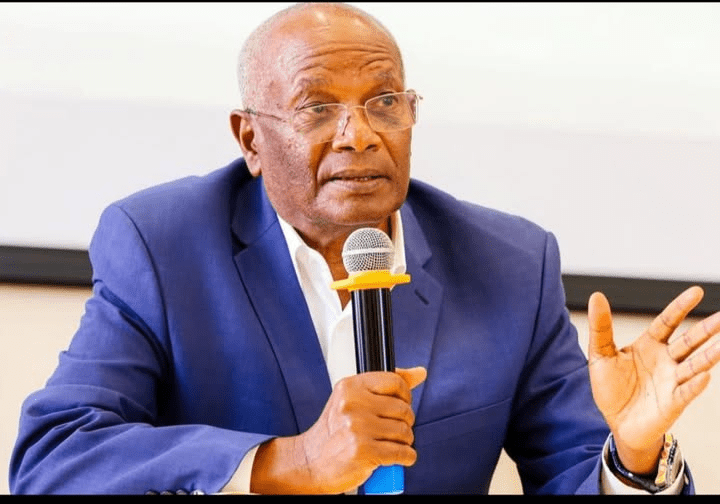
By Daandii Ragabaa
Author’s Note on Attribution: The following feature story is based on a reflection written by Giiftii Waaqoo. Daandii Ragabaa has engaged with that reflection as a commentator, and the present feature draws substantially from the themes, observations, and framing originally articulated by Giiftii Waaqoo. This story is offered as a synthesis and expansion of that shared conversation, with full acknowledgment of the original source.
In an age of fleeting loyalties and fair-weather friends, there is a quality so rare that when we encounter it, we almost do not recognize it. We have become accustomed to leaders who rise on waves of enthusiasm and vanish at the first sign of storm. We have learned to expect that today’s champion may be tomorrow’s deserter.
But then there are those who refuse to follow that script. They do not leave when the road gets rough. They do not silence themselves when the applause fades. They simply stay. They keep moving. They keep believing. And no matter what—no matter the betrayal, no matter the setback, no matter the exhaustion—they show up.
Giiftii Waaqoo, in a reflection that has moved many, names such a man. And Daandii Ragabaa, as commentator, amplifies that recognition. The subject of this reflection is Jaal Dawud Ibsa, chairman of the Oromo Liberation Front.
But this feature story is not merely about one leader. It is about the quality of leadership that his life exemplifies—a quality that the Oromo people, in their long struggle, have desperately needed and too rarely received.
The Simple Thing That Sets Him Apart
Giiftii Waaqoo begins with a striking claim: “What sets him apart is simple.”
Not complex. Not mysterious. Not hidden in secret strategies or charismatic performances. Simple.
He stayed the course. He kept moving. He kept believing. He always showed up—no matter what.
In a political culture where leaders often emerge from nowhere, burn brightly for a season, and then disappear into comfortable exile or cynical silence, Jaal Dawud Ibsa has done something almost unremarkable in its description yet extraordinary in its execution: he has remained.
He has seen it all. The victories that lifted spirits and the setbacks that crushed them. The betrayals—those wounds inflicted not by enemies but by those who once stood beside him. The storms that threatened to uproot everything. And the stillness—those long, quiet periods when the world seemed not to be listening, when the struggle seemed to have stalled, when every day required a fresh decision to continue.
Through every moment—the high and the low, the loud and the silent—he kept going.
Not because it was easy. Giiftii Waaqoo is careful to name this. The easy path would have been to stop, to retreat, to claim exhaustion and rest on past laurels. He kept going because he stayed true to his commitment. Not to popularity. Not to comfort. To commitment.
Beyond Applause
There is a particular temptation that haunts public figures: the hunger for applause. It is a seductive drug, the sound of crowds cheering your name, the sight of hands raised in your honor. Many leaders begin their journeys with genuine conviction, only to find themselves, years later, performing for approval rather than acting from principle.
Jaal Dawud Ibsa, Giiftii Waaqoo observes, never chased applause. He never sought attention for its own sake. Instead, he focused on something larger than himself—a belief that the Oromo nation deserves better.
That belief is not a slogan. It is a fire that has sustained him through decades of struggle. It is the answer he gives himself in the dark hours when no one is watching. It is the compass that has kept him oriented when every external marker of success—recognition, power, safety—pointed in the opposite direction.
The Stamina to Behold
Giiftii Waaqoo uses a striking phrase: “His stamina is something to behold.”
To behold means to see with wonder, to regard with awe. Stamina, in the context of political struggle, is not merely physical endurance. It is the capacity to absorb disappointment after disappointment and still rise the next morning with purpose. It is the ability to forgive betrayals without becoming cynical. It is the discipline of continuing to do what is possible under difficult circumstances, even when the ideal remains out of reach.
Jaal Dawud Ibsa has been fighting for the Oromo people for longer than many of his critics have been alive. He has outlasted regimes that imprisoned him. He has outlasted factions that splintered from him. He has outlasted the patience of those who expected quick victories.
And he is still standing. Still giving. Still mentoring. Still coaching. Still holding the fort.
The Wisdom Carried Through Years
There is a kind of wisdom that cannot be learned from books. It cannot be downloaded from the internet or acquired through workshops. It is earned slowly, painfully, through years of experience—through mistakes made and owned, through losses absorbed and transcended, through the slow accumulation of small, hard-won insights.
Giiftii Waaqoo notes that Jaal Dawud Ibsa carries such wisdom. And he does not hoard it. He gives it away—to the young, to the aspiring, to anyone who will listen. He mentors. He coaches. He shapes the next generation of Oromo leaders not through grand speeches but through patient investment in individual human beings.
This is perhaps the most underappreciated aspect of his leadership. While others seek the spotlight, he has quietly been building the bench—training those who will lead after him, ensuring that the struggle does not die with his generation.
The Gratitude of a People
Giiftii Waaqoo concludes with words that many Oromos, whether they agree with every political decision of Jaal Dawud Ibsa or not, would recognize as true:
“For that, we are grateful.”
Gratitude is a rare virtue in politics, where criticism is constant and appreciation is often withheld until after death. But Giiftii Waaqoo names what deserves to be named: a man has given his life to a cause. He has sacrificed comfort, safety, and the ordinary joys of family life. He has endured imprisonment, exile, and the particular pain of being attacked by those who once called him comrade.
He has not done it perfectly—no human being has. But he has done it persistently. Faithfully. Courageously.
And so the reflection ends with a blessing: “May God continue to bless you and protect you, Jaal Dawud Ibsa, chairman of the Oromo Liberation Front.”
What His Example Teaches Us
For those who read Giiftii Waaqoo’s reflection and Daandii Ragabaa’s commentary, the example of Jaal Dawud Ibsa offers several lessons.
First, that commitment is not a feeling. It is a decision made daily, renewed each morning, often in the absence of any emotional reward.
Second, that leadership is not about being the loudest or the most visible. It is about being the most reliable—the one who shows up, who does not flee when the situation turns difficult, who can be counted on when counting is all that remains.
Third, that the Oromo struggle, like all liberation movements, requires not only warriors but also elders—people who have accumulated wisdom through decades of experience and who are willing to transmit that wisdom to the young.
Fourth, that gratitude, properly expressed, is not weakness. It is recognition. It is the acknowledgment that no one achieves anything alone, and that those who have carried the heaviest burdens deserve to hear, while they can still hear, that their labor has been seen and valued.
The Unfinished Work
Jaal Dawud Ibsa, at this stage of his journey, is still working. He is still holding the fort. He is still doing what is possible under difficult circumstances.
The Oromo nation has not yet achieved its full liberation. The struggle continues. There will be more setbacks, more betrayals, more storms.
But there will also be more moments of victory, more acts of solidarity, more mornings when the sun rises on a people still determined to be free.
And through it all, if Giiftii Waaqoo’s reflection holds true, Jaal Dawud Ibsa will be there. Not because he needs applause. Not because the path is easy. But because he made a commitment—and he stayed the course.
Conclusion: The Courage to Stay
In a world that celebrates the new, the young, the freshly emerged, there is a special kind of courage in staying. Staying when the spotlight has moved elsewhere. Staying when younger, louder voices have captured the public imagination. Staying when your body is tired and your heart has known too many betrayals.
Jaal Dawud Ibsa has that courage. He has stayed. He has kept moving. He has kept believing. He has shown up, no matter what.
For that, the Oromo people owe him something that cannot be repaid in a single feature story or a single moment of recognition. They owe him the continuation of the work—the completion of the struggle to which he has given his life.
May God bless him. May God protect him. And may the Oromo nation, one day soon, arrive at the freedom for which he has so long and so faithfully labored.
“He never chased applause. He focused on something bigger than himself. A belief that the Oromo nation deserves better.”
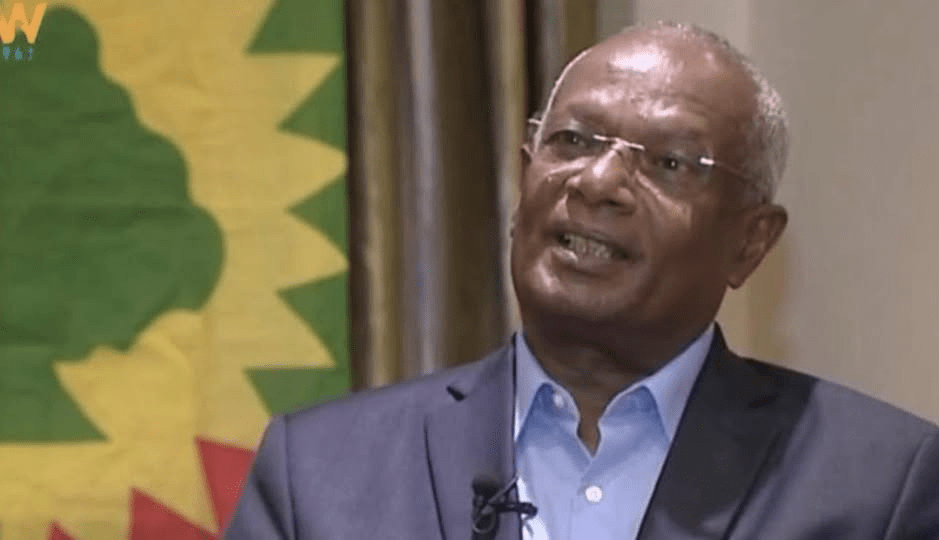

Surrounded by Empowerment: The Circle of Success
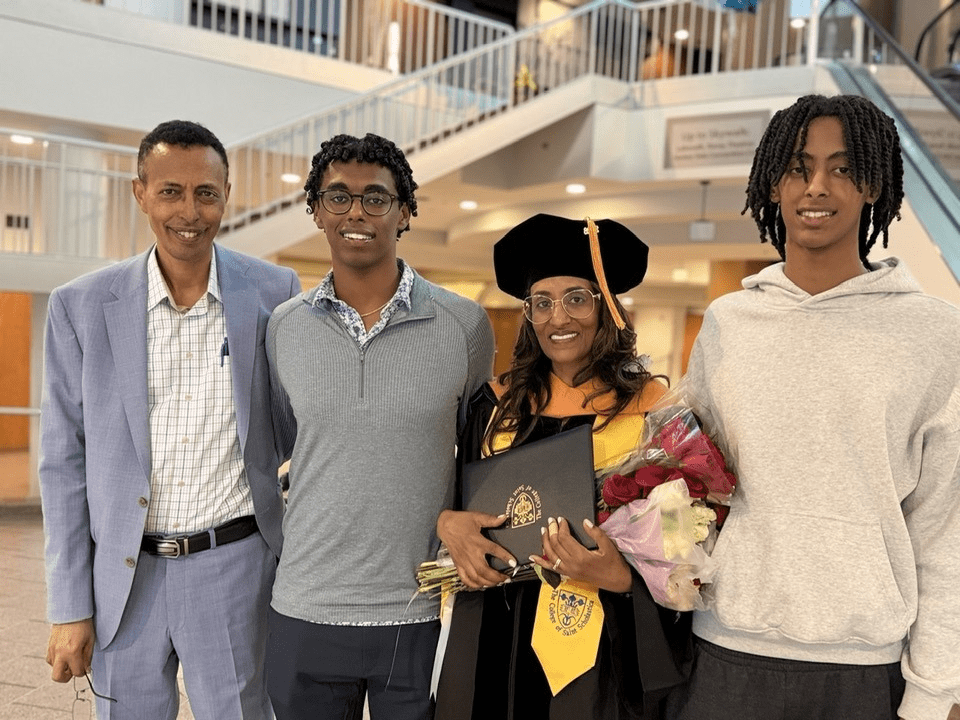
“Yeroo namoota si humneessan, jajjabeessanii fi deeggaraniin marfamtu, akka milkooftu shakkiin hin jiru.”
“When you are surrounded by people who empower you, encourage you, and support you, there is no doubt that you will succeed.”
—
By Dhabessa Wakjira*
The Circle of Success: Why No One Rises Alone
There is a quiet truth that survivors know, that athletes whisper before championships, that artists carry into their studios, and that revolutionaries feel in the dark hours before dawn: success is never a solitary act.
The Oromo people, with their deep wisdom of community, have long understood this. Their proverb rings like a bell across generations: “Yeroo namoota si humneessan, jajjabeessanii fi deeggaraniin marfamtu, akka milkooftu shakkiin hin jiru.”
When you are surrounded by people who empower you, encourage you, and support you, your success is not a matter of hope. It is a matter of certainty.
This feature story explores the anatomy of that circle—what it means to be empowered, what it looks like to be encouraged, and why support is not a luxury but a necessity for any human being daring to achieve something meaningful.
The Three Pillars of the Circle
The proverb names three distinct gifts that others bestow upon us. They are not the same. And each is indispensable.
Humneessan: Those Who Empower You
To empower is not merely to praise. It is to provide the tools, the resources, the access, and the authority that a person needs to act. Empowerment says, “I believe in you—and here is what you need to prove me right.”
Think of the mother who sells her last chicken to buy a notebook for her daughter. Think of the teacher who stays after school to explain a difficult lesson for the third time. Think of the community that pools its meager savings to send one promising student to university. These are acts of empowerment. They are not abstract. They are hands reaching down to lift another up.
Jajjabeessan: Those Who Encourage You
Encouragement is the oxygen of the human spirit. It costs nothing materially, yet it is often the rarest gift of all. The encourager says, “You are not alone. You are not wrong to try. You are not foolish to dream.”
In the long journey of any struggle—whether against political oppression, personal trauma, or professional failure—there are moments when the only thing keeping a person moving forward is a voice saying, “You can do this. I have seen you do hard things before. You will see the other side.”
The Oromo struggle, like all liberation movements, has been sustained not only by weapons and strategies but by songs, by poems, by whispered words of encouragement passed from cell to cell, from village to village, from mother to child.
Deeggaraniin: Those Who Support You
Support is the scaffolding. It is not flashy. It does not seek recognition. But without it, the entire structure collapses. Supporters show up. They cook meals when you are too exhausted to cook. They watch your children when you must attend a meeting. They contribute money when your resources run dry. They defend your name when you are not in the room to defend yourself.
Support is the quiet architecture of every successful life. And it is almost always invisible to the outside world.
The Myth of the Self-Made Person
Western culture, in particular, has elevated the myth of the “self-made” individual—the lone genius, the solitary warrior, the entrepreneur who pulled himself up by his own bootstraps. It is a seductive story. It is also a lie.
No one is self-made. Every successful person stands on a foundation laid by others. Every champion was once a beginner who was coached. Every leader was once a follower who was mentored. Every revolutionary was once a child who was fed, protected, and taught to dream.
The Oromo proverb cuts through this myth with the precision of a blade. It does not say “if you are strong, you will succeed.” It does not say “if you work hard enough, you will succeed.” It says: when you are *surrounded*—by empowerers, encouragers, and supporters—success is inevitable.
The focus is not on the individual. The focus is on the circle.
What Happens in the Absence of the Circle
To understand the power of the circle, one must also understand the devastation of its absence.
What happens to a child who is never empowered? They grow into an adult who does not believe they have the right to act, to speak, to claim space.
What happens to a person who is never encouraged? They become paralyzed by self-doubt, convinced that their efforts are worthless, that their dreams are ridiculous, that failure is the only possible outcome.
What happens to a community that receives no support? It fragments. It turns inward. It cannibalizes its own hope.
The absence of the circle is not merely disappointment. It is a form of slow death. It is the death of potential, the death of possibility, the death of the future.
This is why oppression is so effective. Oppressive systems do not merely take away resources. They isolate. They silence. They ensure that the empowered, the encouraged, and the supportive are removed from your side. They leave you alone—because a person alone is a person easily defeated.
The Circle in the Oromo Struggle
The history of the Oromo people is a history of circles. Under successive regimes that sought to divide, conquer, and erase, the Oromo have survived precisely because they have refused to let each other stand alone.
Think of the Gadaa system—an indigenous democracy built not on individual ambition but on collective responsibility. The Gadaa circle rotates power, shares knowledge, and ensures that no leader governs without the counsel of elders, the wisdom of the Qaalluu, and the consent of the assembly.
Think of the Siinqee institution—women gathering under the sacred staff to demand justice, to halt conflicts, to protect the vulnerable. That is a circle of empowerment, encouragement, and support.
Think of the afooshaa (burial societies) and buusaa gonofaa (savings rotations)—grassroots institutions where ordinary people pool their meager resources to ensure that no family faces death or poverty alone.
These are not charities. These are circles of survival. And they have kept the Oromo people alive through conquest, through famine, through imprisonment, and through exile.
The Modern Circle: Rebuilding What Was Broken
In the contemporary world, the forces that break circles have only grown stronger. Urbanization scatters families. Economic pressure forces migration. Social media creates the illusion of connection while eroding the substance of community.
Many Oromo today find themselves far from the villages of their ancestors, far from the elders who carry the oral histories, far from the physical presence of those who speak their language and share their struggles. The circle has been stretched thin.
But the proverb does not despair. It insists on a truth that cannot be broken: when the circle is present, success is certain. The task, then, is to rebuild the circle. To find new forms of empowerment, new voices of encouragement, new structures of support.
This is happening. In diaspora communities across the globe, Oromos are gathering in living rooms, in community centres, in virtual meeting spaces. They are teaching their children the language that was once forbidden. They are creating media, art, and scholarship that centre Oromo experience. They are sending money home, advocating for justice abroad, and refusing to let distance destroy the bonds of mutual care.
What the Circle Asks of You
If the proverb describes the conditions for success, it also implies a responsibility. To be surrounded by empowering, encouraging, supportive people, you must also be willing to be that person for others.
You cannot demand a circle that you are unwilling to join.
The circle asks: Whom have you empowered today? To whom have you spoken words of encouragement? Whose burdens have you lightened through your quiet, unglamorous support?
Success is not a trophy you receive. It is a current that flows through a network of relationships. You are either part of that current—receiving and giving—or you are standing outside, wondering why the water never reaches you.
Stories from the Circle
Consider the young Oromo woman who wanted to become a doctor. Her family had no money. Her village had no clinic. But her mother empowered her by selling the family’s only cow. Her teacher encouraged her by staying late to tutor her in science. Her community supported her by raising funds for her university application. Today, she is a physician. She did not succeed alone. She succeeded because a circle held her.
Consider the political prisoner who spent seven years in a dark cell. He was tortured. He was isolated. But he later said that the reason he survived was the letters—smuggled, infrequent, but relentless—from his wife. She empowered him by reminding him of his worth. She encouraged him by describing the future they would build together. She supported him by keeping the children alive on the outside. His survival was not his alone. It was hers, too.
Consider the artist whose work was ridiculed by critics. She nearly gave up. But a friend—just one friend—said, “This is important. Do not stop.” That friend spent months helping her find galleries, connecting her with other artists, sitting with her through rejection after rejection. Today, that artist’s work hangs in museums. The friend’s name appears nowhere. But the friend was the circle.
The Certainty of Success
The proverb ends with a bold claim: *shakkiin hin jiru* — there is no doubt.
This is not the language of wishful thinking. It is the language of empirical observation. The proverb is not saying “if you have a circle, you might succeed.” It is saying “if you have a circle, you will succeed.”
Why such certainty? Because human beings are not islands. We are not designed to achieve alone. When the conditions of empowerment, encouragement, and support are present, failure becomes nearly impossible. Not because the path is easy—it never is—but because the circle absorbs the blows that would otherwise destroy the individual.
When you stumble, the circle catches you. When you despair, the circle lifts you. When you are attacked, the circle defends you. With such a structure around you, how could you not eventually reach your goal?
Conclusion: Building the Circle, Securing the Future
The Oromo people are engaged in a long struggle for recognition, justice, and self-determination. There will be setbacks. There will be betrayals. There will be moments when the darkness seems absolute.
But the proverb offers a strategy and a promise.
The strategy: surround yourself—and surround each other—with empowerment, encouragement, and support. Build the institutions that sustain the circle. Be the person who empowers, encourages, and supports, even when you are tired, even when you have received nothing in return.
The promise: when that circle is in place, success is not a question of *if*. It is only a question of *when*.
*Yeroo namoota si humneessan, jajjabeessanii fi deeggaraniin marfamtu, akka milkooftu shakkiin hin jiru.*
When you are surrounded by people who empower you, encourage you, and support you, there is no doubt that you will succeed.
Let the circle hold. And let the success come.
—
No one rises alone. But when we rise together, no power on earth can keep us down.
*Dhabessa Wakjira is a journalist, social worker, community worker, and interpreter who writes commentary, features, analysis, and reflections on issues that build and empower the Oromo people and their affairs. Dhabessa Wakjira can be reached at dabessa@socialworker.net

Standing Alone, Standing Proud: The Quiet Defiance of Najat Sakaye Hamza
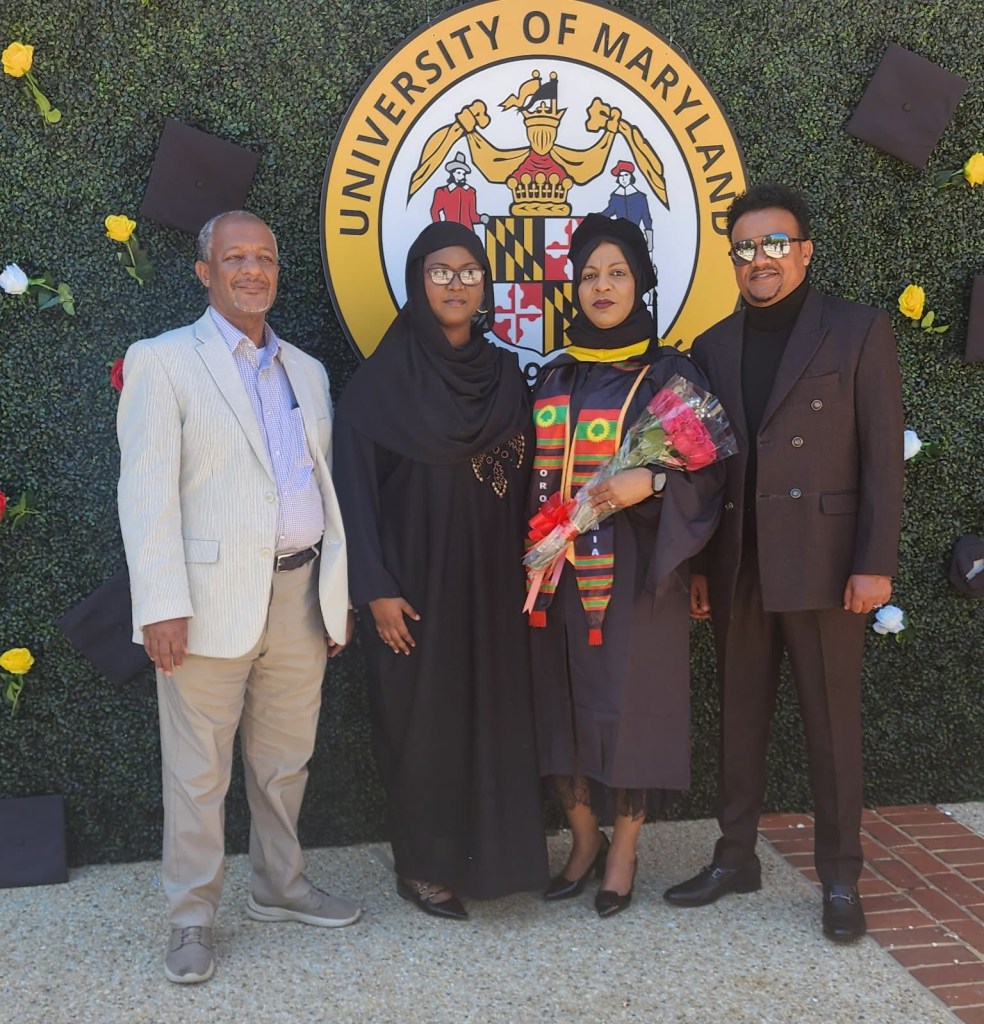
By Dhabessa Wakjira* (based on a reflection by Najat Sakaye Hamza)
“My life is about standing for my dreams even if it means standing alone sometimes.”
—
There is a photograph that Najat Sakaye Hamza keeps on her phone, not as a screensaver but as a secret talisman. In it, she is young—perhaps nineteen—sitting on a worn suitcase in a bus station somewhere between Oromia and the unknown. Her face is tired. Her eyes are not. She is leaving something behind, though she is not yet sure what she is walking toward.
Years later, she would find the words to describe that moment. “My life,” she would write, “is about standing for my dreams even if it means standing alone sometimes.”
Najat Sakaye Hamza is not a politician. She is not a general or a public intellectual in the traditional sense. She is, by her own definition, a woman who decided that the cost of kneeling was higher than the risk of standing. And in that decision, she has become something quietly revolutionary: an example.
This is her story—not of power, but of persistence. Not of armies, but of a single voice that refused to be absorbed into the noise.
—
The Education of a Dreamer
Born into an Oromo family that valued resilience over complaint, Najat learned early that dreams require rent. They do not live in the mind for free. They demand time, sacrifice, and the ability to endure the puzzled looks of those who cannot see what you see.
She was a curious child in a world that often punished curiosity in girls. She asked questions that made elders uncomfortable. She wanted to study when marriage was the expected path. She wanted to speak when silence was the safer option. And so, early on, she learned to stand alone.
“Representing who I am everywhere I am and in any situation,” she would later reflect, “is my quiet protest and my pride.”
That quiet protest took many forms. In classrooms where her language was dismissed, she learned two more. In workplaces where her identity was questioned, she performed her duties with an excellence that left no room for debate. In social settings where Oromo women were expected to be seen and not heard, she spoke—not loudly, but clearly.
The Loneliness of the Standing Woman
There were years when standing alone felt less like courage and more like punishment. Friends drifted away, unable to understand why she could not simply “fit in.” Relatives suggested she was too proud, too political, too difficult. There were nights, she has admitted privately, when she wondered if they were right.
But she kept standing. Not because it was easy, but because the alternative—sitting down, blending in, disappearing—was a kind of death she refused to accept.
She found sustenance in her faith. Alhamdullilah, she would whisper. Thank God for this moment, for this day. Gratitude became her anchor. Not gratitude for the struggle itself—that would be romantic nonsense—but gratitude for the fact that she was still upright, still breathing, still capable of taking the next step.
And then, the steps began to lead somewhere.
A Family That Stands Together
The photograph on her phone now is different. In the newer image, Najat is not alone. She is holding a baby—her daughter, Seran—and beside her stands her husband, Sabsib. There is a softness in this picture that the bus-station photo lacks. The tired eyes have been replaced by something warmer: not rest, but purpose.
“I get to share this moment with my baby, Seran, and my amazing husband Sabsib,” she wrote. The word amazing is not casual. It is the recognition that finding a partner who does not ask you to shrink is a miracle as profound as any in scripture.
Sabsib, by all accounts, is a man who never asked Najat to be smaller. He met her when she was already standing, and he chose to stand beside her rather than in front of her. Together, they have built a home where Seran is being raised to know that her mother’s quiet protests are not embarrassments but inheritances.
The Work Behind the Dream
Najat is careful to demystify her own journey. She has no patience for the myth of the self-made dreamer who simply wished upon a star.
“Dream realization belongs to those who work to achieve it,” she insists.
The work was unglamorous. Early mornings. Late nights. Jobs that had nothing to do with her passions but paid for the rent while she pursued her passions on the side. Rejection letters. Doors that closed. People who said “no” so many times that the word lost its sting.
But she kept working. And eventually, the work began to answer back.
She found platforms to speak about the Oromo experience, about the specific weight that Oromo women carry, about the need for community and also for the courage to stand outside the community when the community is wrong. She wrote. She organized. She showed up to meetings where she was the only Oromo face in the room—and spoke anyway.
Quiet Protest as a Way of Life
There is a phrase in the Oromo language: of-beekuu—to know oneself. Najat Sakaye Hamza has made of-beekuu her compass. To represent who she is, everywhere she is, regardless of the situation, requires a deep and unshakable self-knowledge. It requires knowing what you believe before the test arrives.
That is her quiet protest. Not shouting from a rooftop (though she has done that too, when necessary). But living, daily, as a visible, proud, unapologetic Oromo woman who happens to also be a mother, a wife, a professional, and a believer.
“Pride,” she says, “is not the opposite of humility. Pride is knowing that your existence has value, and refusing to act as if it doesn’t.”
The Moment She Is Living Now
On the day she shared her reflection, Najat was not marking a major public victory. There was no award ceremony, no signed legislation, no standing ovation. She was simply pausing—with her baby in her arms and her husband nearby—to say Alhamdullilah. Thank God for this moment. Thank God for this day.
It is a radical act, in a world that demands constant striving, to stop and give thanks. To acknowledge that the dream is not only in the future but also in the present—in the weight of a child, the steadiness of a partner, the simple fact of still being here, still standing.
The Legacy of the Standing Woman
Najat Sakaye Hamza is not famous. You will not find her name in the headlines of major newspapers, nor her face on the covers of magazines. She is, in the best sense, ordinary—an ordinary woman who decided that ordinary was not the same as invisible.
And that is precisely why her story matters. Because most of us will never be revolutionaries with monuments. Most of us will never speak before the United Nations. Most of us will struggle, in quiet and unglamorous ways, to hold onto our dreams in the face of pressure to let them go.
Najat’s life is a letter to those people. It says: Stand. Even if you stand alone. Even if no one applauds. Even if the only witness to your standing is God and the child sleeping in the next room.
And then, when the moment comes, stop standing long enough to say thank you.
Epilogue: The Unfinished Sentence
At the end of her reflection, Najat does not declare victory. She does not announce the completion of her dreams. She simply shares the moment—a moment that contains her daughter, her husband, her faith, and her own still-standing self.
The sentence is not finished, because her life is not finished. There will be more lonely days. More quiet protests. More mornings when the dream feels distant and the work feels endless.
But there will also be more Alhamdullilahs. More moments of sharing. More proof that standing for your dreams, even alone, eventually brings others to stand with you.
Najat Sakaye Hamza is still standing. Her daughter, Seran, is learning to stand. And somewhere, in a bus station or a boardroom or a quiet living room, someone who reads her words will decide to stand too.
That is not a small thing. That is everything.
—
Alhamdullilah for this moment. For this day. For the women who stand alone and discover they were never truly alone.
*Dhabessa Wakjira is a journalist, social worker, community worker, and interpreter who writes commentary, features, analysis, and reflections on issues that build and empower the Oromo people and their affairs. Dhabessa Wakjira can be reached at dabessa@socialworker.net

A Great Tree Has Fallen: Feature Condolence for Jaal Waldee Hurrisoo (1944-2026), Founding Father of the Oromo Liberation Front
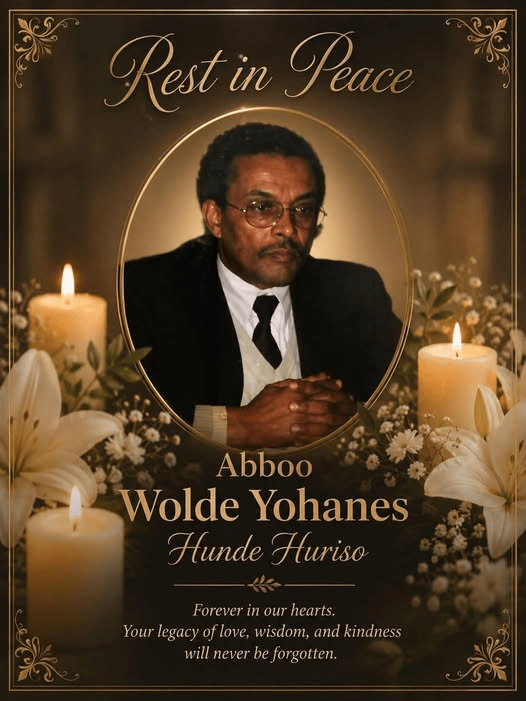
“Du’aan addunyaa irraa godaanuu Jaal Waldee… gadda guddaa itti dhagahame ibsata.” — Adda Bilisummaa Oromoo (ABO)
—
FINFINNEE– The Oromo Liberation Front has announced, with profound grief and a sense of irreplaceable loss, the passing of Jaal Waldee Hundee Hurrisoo (also known as Waldayuhaannis) – a founding pillar of the Oromo struggle, a prisoner of conscience, a teacher, a journalist, and a lifelong servant of his people. He was 82 years old.
The news, delivered on 16th Caamsaa, 2026 (May 16, 2026), has sent waves of sorrow across Oromia and the wider Oromo diaspora. For those who knew him – and for countless more who knew only his name and his sacrifice – the death of Jaal Waldee is not merely the loss of an elder. It is the falling of a great tree under whose shade generations of Oromo freedom fighters found rest and resolve.
From the Highlands of Arsii: A Humble Beginning
Jaal Waldee was born in 1944 (Ethiopian calendar 1937) in Ona Boqqojji, East Arsi, in the highlands of Oromiya. His father, Obbo Hundee Hurrisoo, and his mother, Aadde Ayeetuu Gammadaa, were simple farmers. Like any rural child of his time, young Waldee grew up herding cattle and working the land alongside his family. There was no prophecy of greatness, no early sign of the revolutionary he would become – only the quiet dignity of a people who knew their worth long before the world acknowledged it.
But even among those humble beginnings, something burned. A hunger not just for food, but for knowledge.
The Path of Education, The Call of Conscience
Jaal Waldee completed his primary education in Boqqojji and other local schools, then enrolled at the Teacher Training Institute (TTI) in Dabra Birihan, graduating in 1966. For five years, he served as a teacher in Bale Province – a region that would later become a crucible of the Oromo liberation struggle. He taught children to read and write, but the classroom could not contain him. The injustices he witnessed – land alienation, cultural suppression, the daily humiliations of the Oromo people – planted seeds that would soon sprout into activism.
In 1971, he entered Haile Selassie I University (now Finfinnee University). It was there that he found his political voice. Joining an underground student movement, he began organizing Oromo students, discussing not just grades but grievances, not just textbooks but tyranny. The university became his second battlefield – quieter than the forests, but no less dangerous.
The 1975 Campaign: Bullets and Bread
When the “Idigat Bahibrati” (Development through Cooperation) campaign was launched in 1975, Jaal Waldee volunteered to go to Wallo Province. The region was ravaged by famine, and the official response was a cruel mixture of neglect and propaganda. He did not go as a soldier. He went as a human being – distributing food, organizing relief, and bearing witness to the starvation that the state refused to see. He saw children die in his arms. He saw mothers sell their last possessions for a handful of grain. And he swore that such suffering would never be forgotten.
The Birth of the OLF: A Brotherhood of Struggle
Returning to university after the campaign, Jaal Waldee deepened his commitment to the Oromo cause. Alongside his comrade and closest friend, Magarsaa Bari, he became one of the founding members of the Oromo Liberation Front (OLF) – Adda Bilisummaa Oromoo. Together, they dreamed of an independent Oromia, a nation where Oromo children would never again be ashamed of their language, their name, or their land.
After graduation, Jaal Waldee worked as a journalist for the newspaper Bariisaa (The Dawn), eventually rising to the position of assistant editor. He understood that the pen could be as powerful as the gun. His articles gave voice to the voiceless, exposed abuses, and called Oromos to unity. But the Derg regime – the brutal military junta that had seized power – had no tolerance for Oromo journalism.
Twelve Years in Hell: The Prisoner of Conscience
In 1980 (Amajjii), Jaal Waldee was appointed to a position in the government as a continuing official. But two days later, without trial, without charge, without even the pretense of justice, he was arrested and thrown into prison.
For twelve years, he remained behind bars. Twelve years of torture. Twelve years of solitary confinement. Twelve years of watching comrades die from untreated wounds and deliberate neglect. The Derg’s interrogators wanted confessions, names, betrayals. They received only silence and the occasional smile from a man who had already decided that his body could be broken but his soul would not negotiate.
When he was finally released in May 1991 (Caamsaa), as the Derg collapsed, Jaal Waldee emerged a different man. The torture had left permanent physical damage. For the rest of his life, he would suffer from the consequences of those years – chronic pain, weakness, and the ghosts of a dozen deaths he had witnessed. But he never spoke of revenge. Only of justice.
A Brief Season in Parliament, A Lifetime of Service
After the fall of the Derg, the Transitional Government of Ethiopia was established. Jaal Waldee served as a member of parliament representing the OLF for one year. It was a frustrating time – he saw the compromises of power, the betrayals of principle, the slow strangulation of the very ideals for which he had been imprisoned. When the OLF withdrew from the transitional government, he withdrew with it.
But he never withdrew from his people. He traveled extensively through Bale and Arsi, educating communities about their rights, organizing political awareness, and reminding Oromos that liberation was not a gift to be received but a struggle to be waged. Later, he worked within the OLF’s external affairs department, helping to raise funds, build solidarity, and keep the flame alive during years of exile and repression.
The Juba Award: A People’s Gratitude
The Oromo community recognized his sacrifices. He was honored with the Juba Award, a tribute to those who have given everything to the Oromo struggle. For a man who had received nothing from the state but chains and suffering, this recognition from his own people meant more than any title.
He also left behind a written legacy – most notably a work titled “The Ten-Minute Mission,” along with many other unpublished manuscripts. He was a historian of his own times, determined that the truth of the Oromo struggle would survive even if its tellers did not.
The Final Goodbye
In recent months, Jaal Waldee’s health – already fragile from decades-old torture wounds – declined sharply. On the appointed day, 16th May 2026, he finally laid down the burden that he had carried since 1944. He left this world not as a defeated man, but as a soldier who had fought to his last breath and now, at 82, had earned his rest.
The OLF’s grief statement captures the sentiment of millions: “Addi Bilisummaa Oromoo du’aan addunyaa kanarraa godaanuu jaala keenya Jaal Waldee… dhagahutti gadda guddaa itti dhagahame ibsata.” (The Oromo Liberation Front expresses its profound sorrow upon hearing of the passing of our beloved Jaal Waldee…)
A Legacy That Will Not Fade
What do you say about a man who gave twelve years of his youth to a dungeon, who emerged with his principles intact, and who then spent the remaining decades of his life serving a people who could offer him nothing in return but love?
You say: Qabsaawaan ni kufa, qabsoon itti fufa. (A fighter may fall, but the struggle continues.)
Jaal Waldee is gone. His voice is silent. His hands, which once held chalk in a Bale classroom and a pen at Bariisaa and a smuggled manuscript in a prison cell, have finally stilled. But the Oromo nation he helped to awaken will not go back to sleep.
To his family, his friends, his comrade Magarsaa Bari (who now walks alone), and to the millions who never met him but knew that his survival was their survival – we offer the only comfort that truth allows: He lived for you. He suffered for you. And because of him, you stand taller than you would have.
Farewell, Jaal Waldee Hundee Hurrisoo. The dawn you wrote for has not yet fully broken. But your ink has made it certain.
Injifannoo ummata bal’aaf.
Victory to the broad masses.
— Adda Bilisummaa Oromoo, 16 May 2026
Rest in power, Jaal Waldee. The struggle continues.

The Unbowed: Seenaa G-D Jimjimo and the Art of Refusing to Break
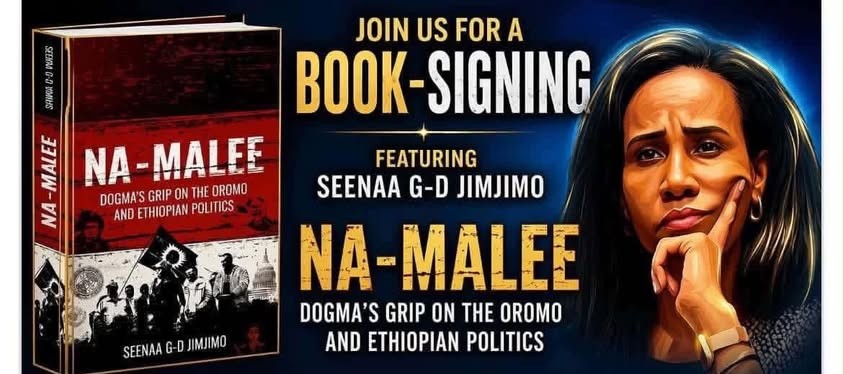
“Jabduu-dhiibbaan keessaa fi alaa kamiyyuu gadhinqabne.”
— “She did not bow to any pressure, from inside or outside.”
—
WASHINGTON, D.C. – In the polished corridors of the U.S. State Department, she speaks with the measured precision of a public health expert. In the dusty highlands of rural Oromia, she kneels beside girls who have never seen a classroom, handing them pencils and hope. And in the pages of her own writing, she dissects the lonely space between two worlds—the Oromo homeland she loves and the American life she built.
Her name is Seenaa G-D Jimjimo. For those who know only her acronym—OLLAA, the Oromo Legacy Leadership & Advocacy Association—she is the Executive Director who has briefed the White House, lobbied the U.K. Parliament, and helped steer House Resolution 128 into law. For those who know her heart, she is something rarer: a leader who has never forgotten that the loudest pressure comes not from external enemies, but from the whispers inside one’s own community to be silent, to be small, to bow.
And she has never bowed.
—
The Roots of Resistance
Born and raised in Oromia, Seenaa G-D Jimjimo grew up watching the slow, systematic strangulation of her people. The Oromo—the largest nation in the country—had been subjected to land confiscation, linguistic suppression, and political marginalization for generations. But it was the violence against Oromo women that carved the deepest wound into her young consciousness.
She saw neighbors dragged from their homes by Ethiopian security forces. She heard stories of girls, barely teenagers, who were arrested, abused, and never seen again. And she made a quiet promise to herself: I will learn. I will speak. And I will never look away.
That promise carried her across an ocean.
In the United States, she pursued higher education with a ferocity that astonished her professors. She earned an undergraduate degree in political science—the tool for understanding power. Then graduate degrees in public health and public administration—the tools for healing and organizing. At the University of Illinois, her peers elected her Senator at Large for the Graduate Student Association and treasurer for the African Student Organization. She was awarded the Dr. Martin Luther King Jr. Scholarship and the Whitney M. Young Fellowship—honors that recognized not just her intellect, but her commitment to justice.
But she was not content to remain in classrooms. The lessons she learned, she brought back to her people.
Forging a Leadership Legacy
Today, as Executive Director of the Oromo Legacy Leadership & Advocacy Association (OLLAA), Seenaa G-D Jimjimo oversees a global apparatus of advocacy. The organization does not simply issue press releases; it builds coalitions. It does not merely condemn human rights abuses; it documents them, presents them to international bodies, and demands accountability.
Under her leadership, OLLAA has engaged directly with the White House, the U.S. State Department, and the United Kingdom’s All-Party Parliamentary Group on Africa. She has sat across tables from diplomats who once could not locate Oromia on a map—and left those tables with commitments to investigate atrocities, support democratic reforms, and amplify Oromo voices.
One of her most significant achievements came through House Resolution 128. Introduced in 2017 and passed in 2018, the resolution urged respect for human rights and encouraged democratic changes in Ethiopia. It was not a sweeping victory—no single piece of legislation could undo a century of oppression—but it was a crack in the wall. And Seenaa G-D Jimjimo was among the key figures who pried that crack open, lobbying members of Congress, mobilizing the diaspora, and refusing to let the issue die.
“People think advocacy is glamorous,” she once told a young organizer. “It is not. Advocacy is showing up to the same office forty-seven times until someone finally agrees to listen. Advocacy is being told ‘no’ so often that the word loses its meaning. And then showing up again.”
The Danboobiduu Foundation: Building What Advocacy Cannot
But Seenaa G-D Jimjimo knows that laws and resolutions are not enough. They do not put food on a child’s table. They do not keep a rural girl in school when her family needs her labor.
That understanding gave birth to the Danboobiduu Foundation in 2014. Named after a cherished Oromo concept of nurturing and empowerment, the foundation focuses on one deceptively simple goal: keeping girls in school.
In rural parts of Oromia, young girls are often pulled from classrooms to work—in the fields, in domestic labor, sometimes in conditions that amount to exploitation. Early marriage remains a threat. Poverty makes education seem like a luxury. Danboobiduu intervenes with scholarships, mentorship, and community engagement, convincing families that a girl with a diploma is worth more than a girl with a dowry.
The foundation does not make headlines. It does not appear in congressional testimony. But for the hundreds of girls who have stayed in school because of its work, it is the difference between a future and a sentence.
The Writer as Truth-Teller
Beyond the boardrooms and the village paths, Seenaa G-D Jimjimo is also a writer. Her work is not the polished propaganda of a movement; it is the raw, searching reflection of a woman trying to diagnose her people’s wounds without romanticizing them.
Her book, The In-Between, addresses the cultural and social fractures that her community faces—the clash between tradition and modernity, the silence around internal problems, the difficulty of building a future when the past is still on fire. She writes about the Oromo Gadaa system, the ancient democratic governance model that predates many Western constitutions, and asks how its principles might be revived for a new generation.
She also writes about the pressures from inside—the fear of criticizing one’s own community, the reluctance to hold fellow Oromos accountable, the temptation to present a flawless front to the world. “We must tell the truth about our struggles,” she has written, “including the ones we inflict on ourselves. Only then can we be truly free.”
The Unfinished Work
Today, Seenaa G-D Jimjimo continues to balance multiple roles: Executive Director, public health specialist, keynote speaker, mentor, and commentator on African intellectual traditions. She is as comfortable discussing epidemiological trends as she is debating Oromo nationalism. She moves between Finfinnee and Washington, between the Gadaa council and the House Foreign Affairs Committee, with a fluency that seems almost effortless—until one remembers the weight she carries.
That weight is the memory of every Oromo woman who was silenced. Every political prisoner who did not emerge from the dungeon. Every child who never learned to read because her school was burned and her language banned.
And yet, she does not bow. Not to the pressure of despair. Not to the cynicism that says change is impossible. Not to the internal critics who accuse her of being too radical or not radical enough. Not to the external forces—states, lobbies, powerful men—who would prefer that she simply disappear.
“I did not bow to any pressure, from inside or outside.” Those words, carved into the identity of Seenaa G-D Jimjimo, are not a boast. They are a discipline. A daily decision to stand, even when standing requires more than one person should have to give.
The Legacy She Is Building
She will tell you, if you ask, that she is not a hero. She is a daughter of Oromia who happened to learn English, earn degrees, and find herself in rooms where decisions are made. She will tell you that the real heroes are the girls in the Danboobiduu program who walk two hours to school each morning, the mothers who hide Oromo books under their beds, the prisoners who refuse to name their comrades under torture.
But those girls and mothers and prisoners would say something different. They would say: She gave us a voice when we had none. She took our whispers and shouted them into the halls of power. She did not bow, and because she did not bow, we can stand.
Seenaa G-D Jimjimo’s story is not finished. The Oromo struggle is not finished. But every morning, in an office in the United States or a village in Oromia, she wakes up and chooses to continue. The pressure will come again—from inside, from outside, from the thousand small deaths of hope deferred. And she will refuse, again, to bow.
That is not a story of suffering. That is a story of unbending grace.
And to the woman who taught them to stand—honor upon honor.

A Historic First: The Walabu Oromo Law Dictionary Inaugurated in Finfinne
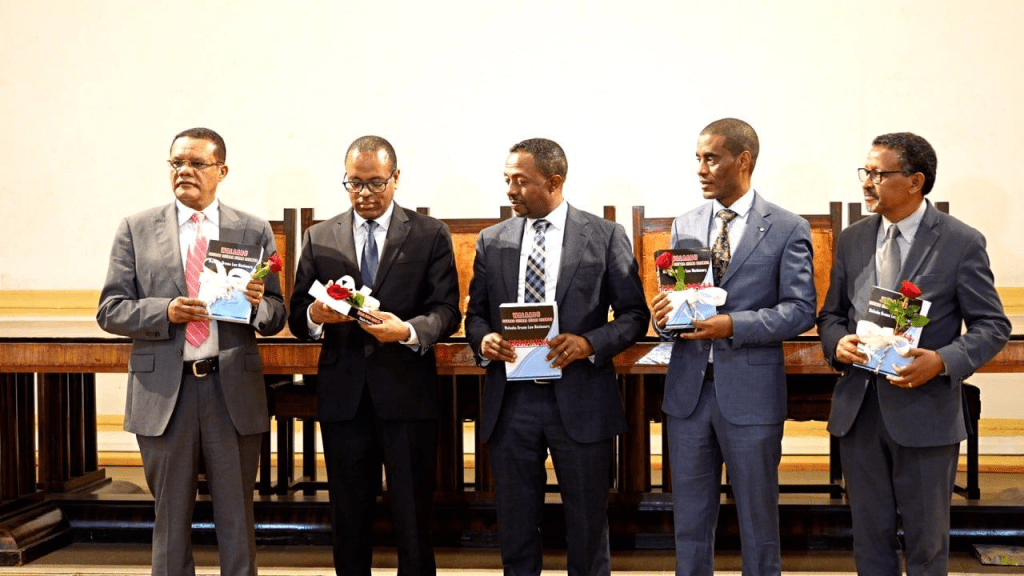
By Dhabessa Wakjira
(Finfinne, May 14, 2026) — In a landmark moment for Ethiopia’s legal history, the very first Oromo language law dictionary—titled the Walabu Oromo Law Dictionary (Walaabuu Guuboo Jechoota Seeraa Afaan Oromoo)—was officially inaugurated today in a vibrant ceremony at Ras Mekonnen Hall, Addis Ababa University.
This monumental legal reference work, which opens an entirely new chapter in Ethiopian jurisprudence, is the result of a collaborative effort between the Federal Law and Justice Institute (FLJI), the Ethiopian Studies Institute at Addis Ababa University, and Justice for All – PFE Ethiopia (JFA-PFE).
A Ceremony of Significance
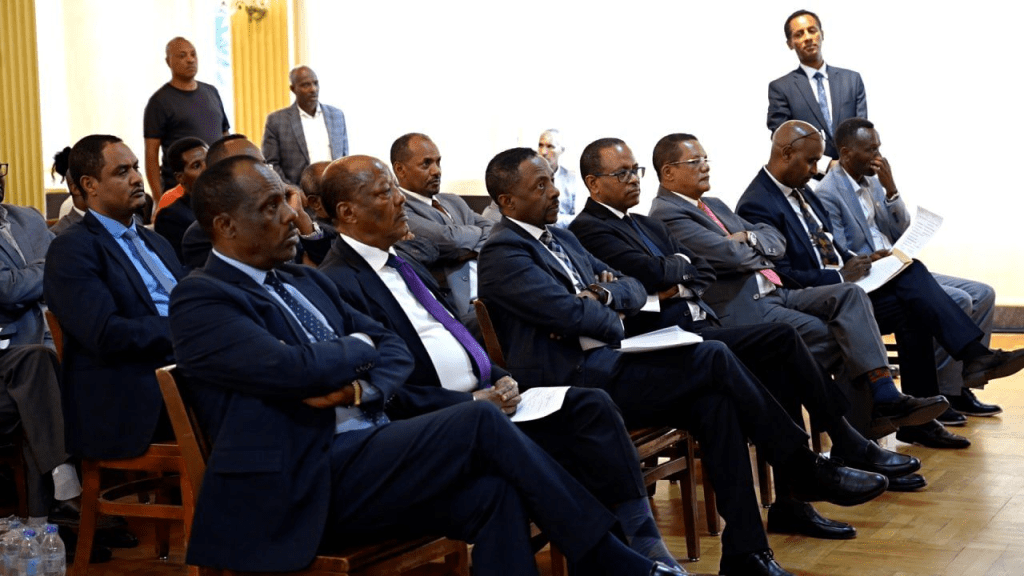
The inauguration ceremony was attended by high-ranking government officials, leaders of justice institutions, legal scholars, researchers, and distinguished invited guests. The atmosphere was one of collective pride and historical awareness—those present understood that they were witnessing not merely the launch of a book, but the solidification of a language’s place in the formal legal architecture of the nation.
The President of the Federal Supreme Court Speaks
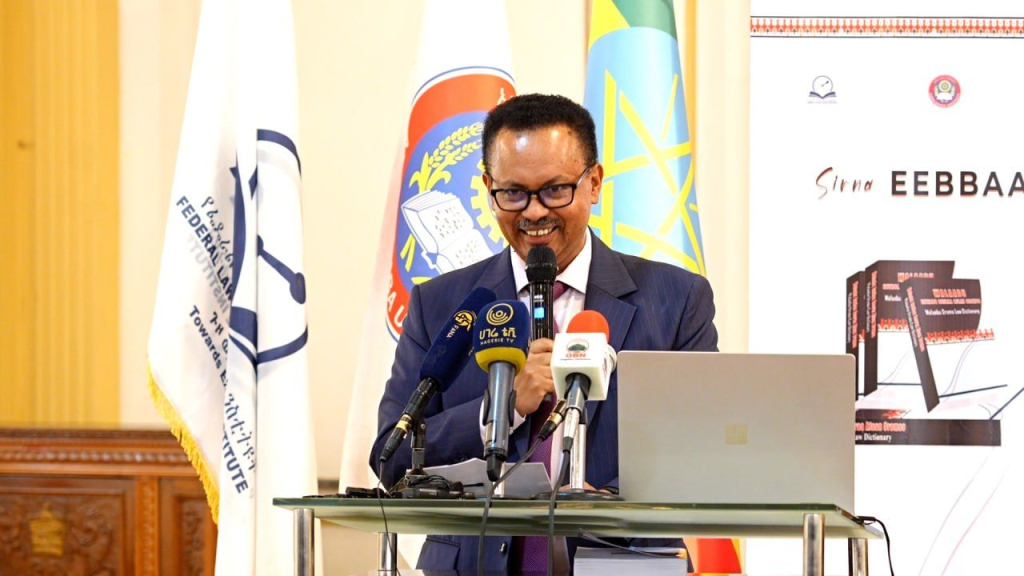
Honorable Mr. Tewodros Mihret, President of the Federal Supreme Court, addressed the gathering with particular gravity. He emphasized the profound utility of the dictionary in resolving one of the persistent challenges within the justice system: inconsistency.
President Tewodros explained that until today, legal professionals had been translating legal terminology into Afaan Oromo according to their individual understandings and preferences. This ad hoc approach, he noted, had a negative impact on the quality of justice delivery. Different judges, prosecutors, and lawyers might interpret the same legal concept differently, leading to confusion, contradiction, and ultimately, a erosion of public trust in the fairness of the legal system.
The Walabu Oromo Law Dictionary, the President declared, will serve as an authoritative reference work that eliminates fragmented translations and divergent interpretations. By establishing a unified legal vocabulary, the dictionary will enable consistent justice services and strengthen the rule of law. It is, he said, a major achievement.
Ambassador Degife Bula: A Testament to Dedication
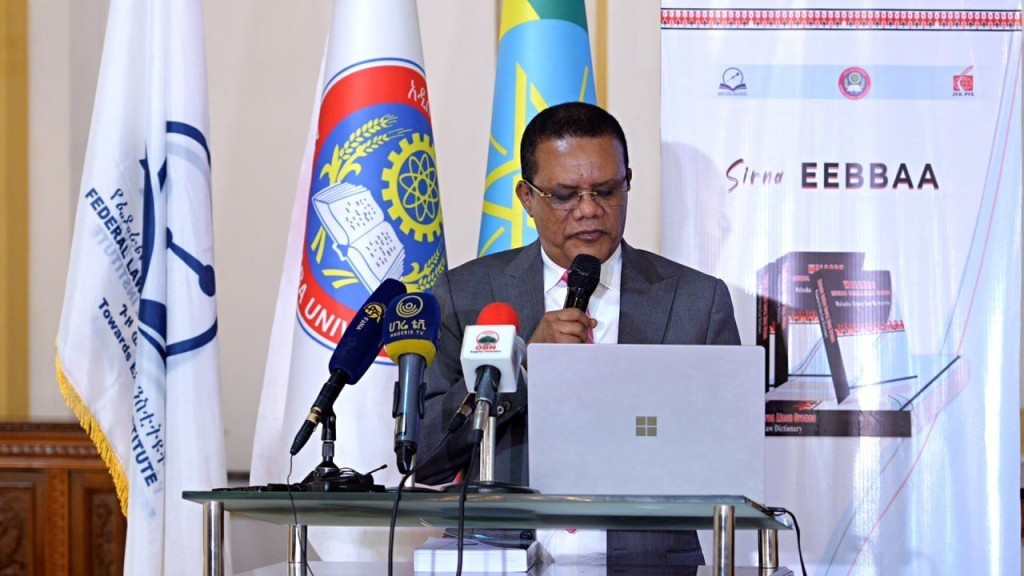
Following the President’s remarks, Ambassador Degife Bula, Director General of the Federal Law and Justice Institute, delivered a message that traced the dictionary’s journey from conception to completion.
Ambassador Degife emphasized that the dictionary will play an irreplaceable role in harmonizing the linguistic and conceptual differences that have long been observed within the legal and justice systems. He noted that the work is not only significant because it is the first of its kind in Oromo history. Its distinction is further elevated by the fact that it was prepared in collaboration with Addis Ababa University—Ethiopia’s most venerable institution of higher learning—and inaugurated within its very premises.
The Director General acknowledged that the project took considerable time. However, he stressed that its quality was assured by the dedication of Oromo legal scholars and professionals with exceptional linguistic expertise—individuals who committed themselves tirelessly to the task. He extended his profound gratitude to the media, religious institutions, and political organizations that played supportive roles in ensuring the work’s successful completion, whether directly or indirectly. Most of all, he thanked the scholars who labored day and night in their respective fields.
A Dictionary Rooted in Oromo Reality
A particularly noteworthy aspect of the Walabu Oromo Law Dictionary, as explained by Ambassador Degife, is its methodological grounding. The preparation process made significant efforts to harmonize the dialectal variations and terminological usage patterns from all regions of Oromia. Rather than privileging one dialect over others, the dictionary seeks to represent the richness of the Oromo language in its full diversity.
Furthermore, the dictionary’s foundation and explanatory framework are entirely in Afaan Oromo. This is not a translation of a foreign legal dictionary into Oromo; it is a legal dictionary born in Oromo, for Oromo, from Oromo conceptual frameworks. This approach, Ambassador Degife argued, greatly enhances understanding of legal terminology because users are not forced to think through a second language.
The Practical Impact on Justice
Given that Afaan Oromo is currently serving as the working language of education and administration across all three branches of government in the Oromia region, the Walabu Oromo Law Dictionary will provide an indispensable resource for the region’s judicial and justice institutions.
For the ordinary citizen—the farmer, the market woman, the teacher, the patient—access to justice has often been blocked by language barriers. Legal proceedings conducted in a language they do not fully understand leave them vulnerable, dependent on interpreters, and disconnected from the proceedings that determine their lives. With this dictionary, judges, lawyers, and legal aid providers can now communicate legal concepts to Afaan Oromo speakers with precision, consistency, and clarity.
The dictionary will also serve as a vital resource for legal professionals at the federal level who speak, write, and read Afaan Oromo. As Ethiopia continues to navigate the complexities of its federal system, the availability of authoritative legal references in multiple languages is not a luxury—it is a necessity for genuine equality before the law.
A Broader Meaning: Language as Justice
Beyond its immediate utility, the inauguration of the Walabu Oromo Law Dictionary carries a deeper symbolic weight. For centuries, Afaan Oromo was systematically excluded from formal legal, educational, and administrative domains. It was relegated to the private sphere—the home, the market, the oral tradition—while Amharic dominated the courts, the parliament, and the classroom.
The presence of a comprehensive law dictionary in Afaan Oromo, inaugurated at Addis Ababa University and supported by federal institutions, signals a shift. It is a tangible acknowledgment that justice cannot be truly blind if it is also monolingual. A citizen who cannot understand the language of their own trial is not receiving justice; they are receiving procedure.
This dictionary is a tool of decolonization. It is an act of epistemic justice. It says, in the most concrete terms possible: the Oromo language is not inferior. The Oromo language can carry the full weight of legal reasoning, of complex jurisprudence, of the rights and responsibilities of citizenship.
The Road Ahead
The launch of the Walabu Oromo Law Dictionary is not the end of the journey. It is a beginning. Legal terminology evolves as societies change, as new laws are written, and as new legal challenges emerge. The dictionary will require updates, expansions, and continuous refinement.
Moreover, the model established by this project—collaboration between federal institutions, universities, and civil society—can and should be replicated for other Ethiopian languages. A truly multilingual legal system, where every citizen can access the law in their mother tongue, remains an unfinished project. But the Walabu Oromo Law Dictionary has laid the first bricks.
Conclusion: A Day to Remember
May 14, 2026 (Ginbot 6, 2018 E.C.) will be remembered as the day when the Oromo language took another decisive step toward full institutional equality. It will be remembered as the day when legal professionals gained a tool that will enable them to serve their Oromo-speaking fellow citizens with greater precision, consistency, and dignity.
The scholars who labored day and night, the institutions that provided support, the leaders who championed the project—all of them have earned the gratitude of a people who have waited too long to see their language honored in the halls of justice.
The Walabu Oromo Law Dictionary is here. May it serve justice. May it serve truth. May it serve the Oromo people—and all Ethiopians—in the relentless pursuit of equality before the law.
“When a citizen understands the law in their own language, justice is no longer a distant promise. It becomes a daily reality.”

The Hands That Build: Women and the Unfinished Work of Nation Building
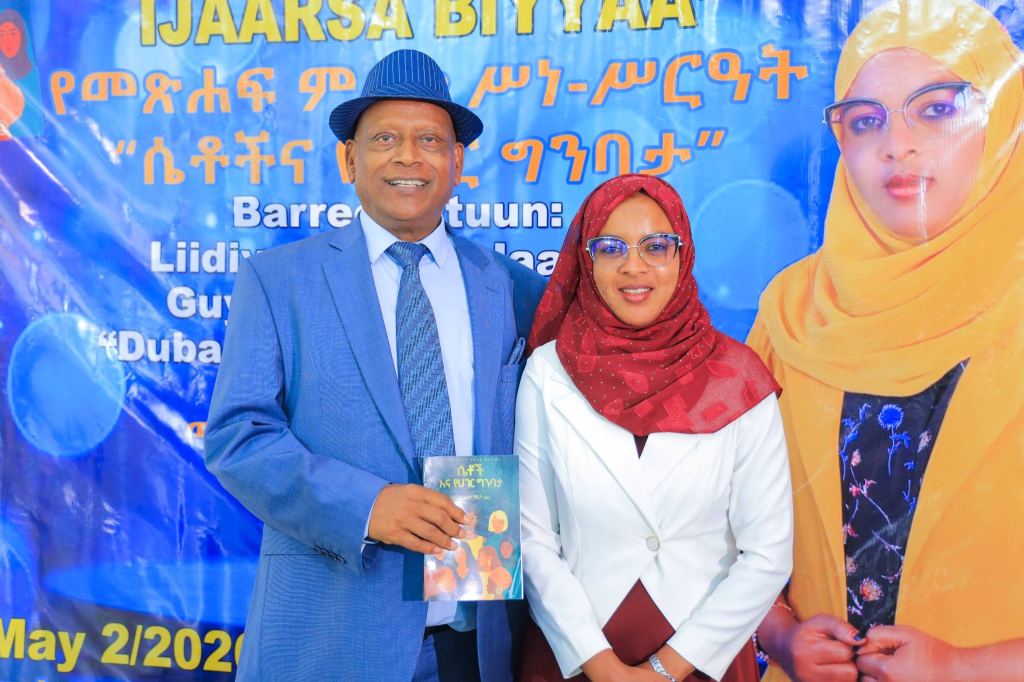
By Dhabessa Wakjira*
There is a proverb in many African cultures: “When a woman stumbles, the whole household trembles.” But the corollary is rarely spoken: when a woman rises, the entire nation ascends with her.
For generations, the story of nation building has been told as a masculine epic—a tale of warriors, kings, negotiators, and generals. Yet the quiet truth, known in every village and every home, is that nations are not built by speeches alone. They are built by hands that grind grain, by backs that bend over rivers, by voices that sing children into sleep and then rise at dawn to plant the seeds of tomorrow.
This feature story turns the lens on the women of Oromia and Ethiopia—not as victims, not as symbols, but as architects. It is a reflection on what it means to say dubartootaafi ijaarsa biyyaa: women and the construction of a country.
The Invisible Foundation
Walk into any rural household in Oromia before the sun has touched the horizon. Who is awake? The woman. She has already fetched water, kindled the fire, and begun preparing the marqaa that will fuel the day’s labor. By the time the first light breaks, she has completed a morning’s work that would exhaust a city dweller by noon.
This is not a scene from the past. This is the present. And it is the foundation upon which the national economy rests—unpaid, unacknowledged, and utterly indispensable.
Yet when we speak of “nation building,” we speak of parliaments, budgets, roads, and treaties. We speak of the visible architecture of power. The invisible architecture—the reproductive labor, the agricultural toil, the social cohesion woven through kinship networks—is left to women, and left out of the story.
Beyond the Domestic Sphere
To say “dubartootaafi ijaarsa biyyaa” is to make a claim that challenges this erasure. It is to insist that women are not merely beneficiaries of development or recipients of aid. They are active agents in the creation of the nation.
Consider the Gadaa system, the indigenous Oromo democracy. For centuries, it has been understood primarily as a male institution—five parties, eight years each, a cycle of power passed between generations of men. But what of the Siinqee? The institution of the Siinqee staff, carried by Oromo women, was not a decoration. It was a check on power. When a woman raised the Siinqee, disputes stopped. When women marched together, decisions were delayed until justice could be heard. The Siinqee was not outside the Gadaa; it was the conscience of the Gadaa.
This is the deeper meaning of women and nation building. It is not about “including women” in structures designed by men. It is about recognizing that women have always possessed their own structures, their own forms of authority, their own ways of holding the nation together when men—with their armies and their ambitions—pulled it apart.
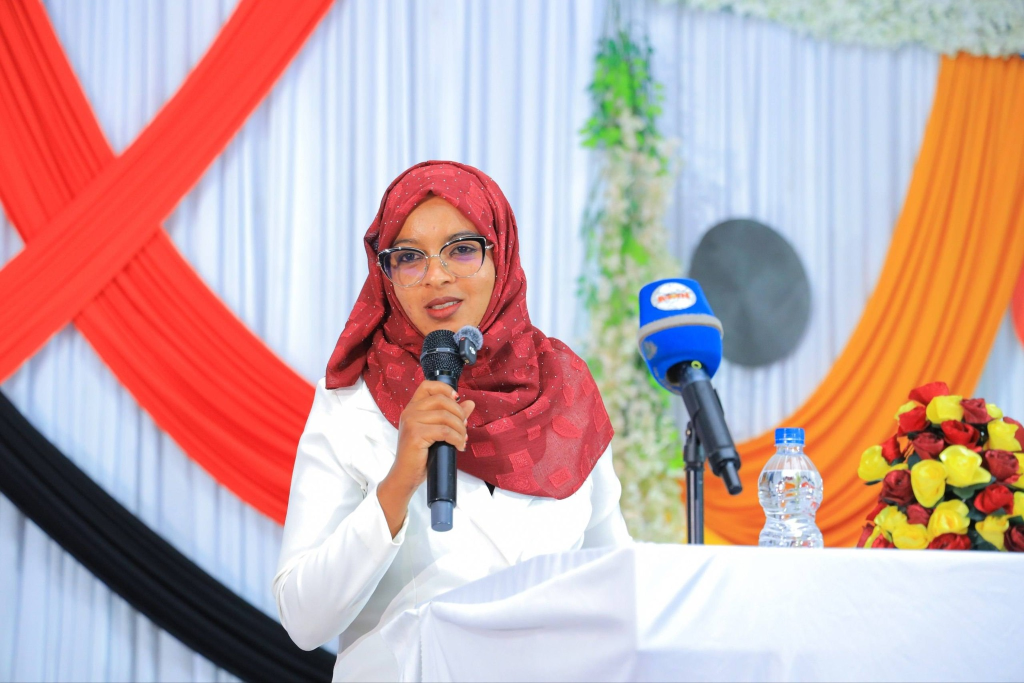
The War Women Fight
In times of conflict, women are called the “first victims.” They bear the weight of displacement, of sexual violence, of watching their children starve. But they are also the first responders, the first rebuilders, the first to gather the scattered pieces of a shattered community.
The women of Oromia know this intimately. They have buried sons who fell in the struggle. They have visited husbands in prisons built by regimes that feared their names. They have fled across borders with infants on their backs and nothing else in their hands. And then, when the shooting stopped—or even before it stopped—they began to rebuild.
They formed iddir (burial associations) to ensure that the dead were honored. They formed iqqub (rotating savings groups) to send children back to school. They turned refugee camps into marketplaces, turning nothing into something, turning survival into life.
This is nation building. This is ijaarsa biyyaa.
The Politics of Presence
In recent years, the political landscape of Oromia and Ethiopia has shifted. Women have taken seats in parliament, ministries, and regional councils. The language of gender equality has entered the constitution, the party platforms, and the international donor reports.
These are victories. They are not empty.
But presence is not power. A woman sitting in a chair designed by a patriarchal system, following rules written by that same system, speaking a language that was never her mother tongue—this is not liberation. It is a foot in the door. And a foot in the door, while necessary, is not the same as building a new house.
The true work of dubartootaafi ijaarsa biyyaa lies deeper. It lies in asking: What would a nation look like if it were built not on competition but on care? Not on extraction but on cultivation? Not on the logic of the battlefield but on the logic of the kitchen—where resources are shared, where no one eats until everyone is served, where waste is a sin and generosity is survival?
These are not soft questions. They are revolutionary ones. And they are questions that women, who have been excluded from the official story of nation building, are uniquely positioned to ask.
The Double Burden
No honest reflection on women and nation building can ignore the double burden. Women are expected to build the nation while also building the home. They are told to lead, but only after they have cooked, cleaned, raised the children, and cared for the elderly. They are praised for their strength while being denied the rest that strength requires.
This is not sustainable. A nation that demands everything from its women while giving them nothing—no shared domestic labor, no affordable childcare, no protection from violence, no recognition for unpaid work—is a nation that is eating its own seed corn.
Ijaarsa biyyaa requires the bricks of justice. And justice begins at home.
The Young Girl and the Future
Imagine a girl born today in a rural village of Oromia. If she is lucky, she will go to school. If she is very lucky, she will finish. If she is extraordinarily lucky, she will find work, marry by choice, and live without fear of violence.
But luck is not a policy. And nation building is not a lottery.
The question before the Oromo people—before all Ethiopians—is whether they will continue to build their nation on the backs of women, or whether they will finally build with them, for them, through them.
The girl in that village has her hand on the future. She does not yet know the word “feminism.” She may never read a book about “gender and development.” But she knows what her mother knows: that the country will be what women make it. Because women have always made it. They have just never been given the credit.
Conclusion: The Unfinished House
Dubartootaafi ijaarsa biyyaa is not a slogan. It is a description of reality. Women have been building this nation since the first seed was planted, since the first child was named, since the first council gathered under the sycamore tree.
The house is not yet finished. The roof leaks. The walls have cracks. Some rooms are still locked to those who built them.
But the builders are still here. They are waking before dawn. They are fetching water. They are raising the Siinqee. They are sitting in parliament and sleeping in refugee camps. They are doing two jobs, three jobs, the work of generations compressed into a single day.
The question is not whether women can build a nation. They already have.
The question is whether the nation will finally acknowledge their hands—and let them help design the blueprints.
When a woman rises, the entire nation ascends with her. Let her rise. Let the nation rise.
*Note on Attribution: The feature story is based on the author, Lediya K Jarso, the book reflection. Dhabessa Wakjira engaged with that reflection as a commentator, and the present reflection draws substantially from the ideas, themes, and framing originally articulated by the author. This feature story is offered as a synthesis and expansion of that shared conversation, with full acknowledgment of the original source.
The Unfinished Struggle: Leencoo Lataa and the Long Road to Oromo Freedom
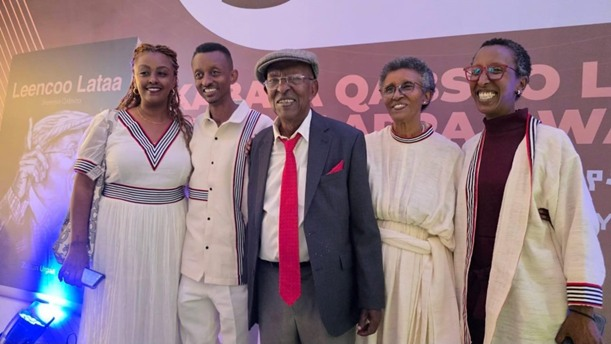
By Daandii Ragabaa*
“Akkuma mootummaa Hayilasillaasee, Dargiifi Wayyaanee lolaa turetti lolla taanaan gaarii hinta’u.”
Like the governments of Haile Selassie, the Derg, and the Woyane that were fought, it is not good for this one to become a battlefield.
These words belong to Obbo Leencoo Lataa. They were spoken not in the heat of revolution, nor in the shadows of exile, but at a book launch in Finfinnee—a ceremony celebrating the publication of his own memoir, “Leencoo Lataa: Jireenya Qabsoo” (Leencoo Lataa: A Life of Struggle). The book, written by Zufaan Urgaati and published in both Afaan Oromo and Amharic, was unveiled on a recent Saturday to an audience of federal and regional officials, members of parliament, scholars, ambassadors, artists, political leaders, Gadaa elders, Siinqee mothers, family members, and ordinary citizens.
It was a gathering of memory. And at its center sat a man who has spent more than fifty years in the trenches of the Oromo liberation struggle.
A Life Forged in Struggle
Obbo Leencoo Lataa is not a newcomer to the stage of Oromo politics. He is a well-known figure, a seasoned political intellectual, a man who has dedicated more than half a century to the cause of Oromia and the Oromo people. He was among the founders of the ABO (Afran Qallo Oromo) and one of the original architects of Gaazexaa Bariisaa—a publication that has served as a voice for the Oromo struggle across decades.
His memoir, spanning three volumes, eleven chapters, and 447 pages, is priced at 1,200 Ethiopian Birr. It is not a light read in any sense—neither in weight nor in content. It is the record of a life lived on the edge, a chronicle of sacrifice, imprisonment, exile, and unyielding commitment to a people who have known generations of subjugation.
The Family That Struggle Built
The book launch was not merely a political event. It was also a family reunion—of a family shaped in profound ways by the struggle.
Obbo Leencoo is married to Professor Kuwee (Maartaa) Kumsaa, herself a scholar and activist of considerable stature. Together, they have three children: two daughters, Huriyaa and Goolii, and one son, Roobaa. Their family story is not one of quiet domesticity. It is a story of separation, of longing, of children growing up without fully knowing their father, of a mother who endured her own imprisonment while her husband was in the forests.
Huriyaa Leencoo, the eldest daughter, spoke at the event. Her testimony cut through the political rhetoric and landed like a stone dropped into still water:
“In my childhood, I do not remember my father very much. But I remember the suffering my mother went through. My mother and father were married for only three years, and in that time they had three children.
My father—the husband, the lover of struggle, the father of her children—left home without proper farewell and went into the battlefield. When he left, my mother was heartbroken. I remember her lying on the sofa, tears flowing, repeating, ‘Beenu ka’ii, beenu ka’ii, allaattii koo joobiraa beenu sifaanan bu’aa’ — ‘Let’s go, get up, let’s go, my bird, my joobira, let’s go down from here.’
At that age, I did not understand why she was crying. I tried to ask her, but I was afraid.
Before my father left for the battlefield, he used to play with us as a father plays with his children. We experienced his love. Then he left. After he was gone, my brother and I would constantly trouble our mother, asking, ‘Where is our father?’
Finally, our mother printed a poster of his photograph and hung it on the wall. She told us, ‘From today onward, do not ask me about your father! This is your father!’ But whenever we had the chance, we still wanted to talk about him.
After our mother was imprisoned, we hardly spoke of him at all. When she was released and we fled the country, crossing into Kenya, we finally heard his voice on the phone. He was at a conference in London. I listened as he spoke. The voice on the other end said, ‘Who is this?’ I said, ‘A wild animal told me to call.’ I felt in my heart that it was my father’s voice. I handed the phone to my mother. It was him.
For three months after that, we talked about him constantly at home. Then, just days before we left for Canada, he came and saw us.
We knew our father as Yohaannis Lataa. We had to learn to call him Leencoo Lataa. That name—Leencoo—appeared in my mind as someone very tall, very great. When he stepped out of the car to speak to us, the first thing that came out of my mouth was, ‘Why are you so short?’
The audience laughed. But the laughter carried tears. This is what struggle does to families. It steals the ordinary moments—the graduations, the birthdays, the simple act of a father coming home for dinner. And it replaces them with phone calls from London, with posters on walls, with children who must learn their father’s revolutionary name as if meeting a stranger.
Roobaa Leencoo, the son, added his own testimony:
“I did not know my father in my early childhood. Our family came together in Canada. Because we had not grown up together, my father once gathered the family and said, ‘Let’s start as friends, beginning with me.’ Slowly, patiently, we built our relationship. He became a good father to us. He is a man of great patience and strong determination.”
And Goolii Leencoo, the youngest daughter, reflected on the uniqueness of their family:
“My family is different from others—I have known this my entire life. When we were children, our parents were not with us. Our father was in the forest. Our mother was in prison.
The three of us grew up among relatives. Only after we had grown and gained some independence did I understand why we were separated from our mother and father. Our mother would tell us, ‘I was not imprisoned because I hated anyone or killed anyone. I was imprisoned because of Oromummaa.’
After we came to know our father, he would tell us why he fought. We came together as a family after we had already grown. But the love between us, the way we came to know each other, the patience, the mutual respect, the way we corrected and advised one another—for me, that is what makes us unique.”
The Scholar’s Reflection: Professor Kuwee Kumsaa
Professor Kuwee Kumsaa, wife of Leencoo and a distinguished intellectual in her own right, addressed the gathering with characteristic gravity:
“I want to speak briefly about the history of Obbo Leencoo’s struggle. When we entered the struggle in the early years, we knew that the struggle would take a long time—that it would span generations. The oppression and enslavement of our people was not a matter of one hundred or two hundred years. It was the work of many generations.
When we entered that struggle, we did not think we would live to see this moment.
Leencoo committed himself to the fight for justice. He met me as a fighter and an activist. A true fighter lives for the truth of his cause and does not harm his own people. A true fighter puts himself aside in order to pass the cause on to his nation. Leencoo’s purpose in entering the struggle was not for himself—it was to pass something on to his people. His purpose was made visible through his actions and his work. The spirit within us that seeks freedom, justice, and equality—that spirit is what endures.”
The Warning from a Veteran
Then Obbo Leencoo himself spoke. His words were not triumphant. They were measured, reflective, and laced with warning.
“The gratitude truly belongs to those who were sacrificed on this struggle. For those of us still living, any recognition we receive is enough. In my life, there are certainly those I have angered. Much criticism has come my way.
When we entered Finfinnee during the transition period, the Oromo language had reached the point of near disappearance. And the disappearance of the language, I say, means the disappearance of the nation itself.
Today, however, the Oromo is insulted as ‘Baala Gizee’—a leaf of the season. That kind of insult is good. Previously, we were not even able to be insulted like that. The struggle has a record of where it started and what it has accomplished. There is still work remaining.
If we only analyze what is missing and do not move forward, that is not good.
Like the governments of Haile Selassie, the Derg, and the Woyane that were fought, it is not good for this one to become a battlefield. We must adapt our strategy to the times. We must ask ourselves: What has been accomplished by the struggle we have waged? What is missing? We must complete what is lacking—not start again from zero.”
The Heart of the Warning
This is the core of Leencoo’s message—and the core of Natsaannat Taadsasaa’s reporting, as reflected upon by Daandii Ragabaa.
The Oromo struggle has known three regimes: the Imperial monarchy of Haile Selassie, the Marxist Derg, and the Woyane (TPLF) regime. Each was met with resistance. Each was fought. And each, eventually, fell or transformed.
Now, a new political order exists. Leencoo’s warning is clear: it is not good for this new order to become yet another battlefield. The Oromo people have spilled enough blood. They have filled enough prisons. They have raised enough children on posters and phone calls.
But this is not a call for surrender. It is a call for strategic evolution. Adaptation, not abandonment. Completion, not restarting from zero. The struggle has a record. It has accomplishments. It has sacrifices that cannot be forgotten. But it also has gaps—and those gaps must be filled.
The Unfinished Work
Huriyaa asked her father, through her testimony, why he was so short when she had imagined him so tall. It is a metaphor for the gap between the legend and the man, between the hero of the struggle and the father who missed his children’s childhoods.
But perhaps there is another meaning. Perhaps the struggle itself has been imagined as something larger, taller, more imposing than it has turned out to be. Not because it has failed—but because the mountain is still being climbed. The summit is not yet visible. And the climbers are tired.
Leencoo’s message, as carried through Natsaannat Taadsasaa’s reporting, is that the path forward is not to throw away the map and start over. It is to study the map, see where the journey has gone wrong, and correct the course.
Akkuma Hayilasillaasee, Dargiifi Wayyaanee lolaa turetti lolla taanaan gaarii hinta’u.
Like the governments of Haile Selassie, the Derg, and the Woyane that were fought, it is not good for this one to become a battlefield.
Conclusion: The Legacy and the Road Ahead
The book launch was a celebration—of a life, of a struggle, of a memoir that will preserve Leencoo Lataa’s experiences for future generations. But it was also something rarer: a moment of honest reckoning.
Professor Kuwee spoke of the spirit that seeks freedom, justice, and equality. That spirit, she said, endures.
Huriyaa spoke of a mother crying on a sofa, of a poster on a wall, of a phone call from London, of meeting a father who was shorter than she had imagined.
Roobaa spoke of patience and determination.
Goolii spoke of love built slowly, carefully, through mutual correction and advice.
And Leencoo himself—the man who spent fifty years in the struggle—spoke not of victory but of adaptation. Not of the end but of the unfinished.
The Oromo people have not yet reached their destination. But they have traveled far. They have paid a price that cannot be calculated in Birr or in years. And they have, in Leencoo Lataa and his family, a living testament to what the struggle costs—and what it is worth.
Galanni kan maluuf namoota qabsoo kanarratti wareegaman qofaafi.
The gratitude truly belongs to those who were sacrificed on this struggle.
May their sacrifice not be in vain. May the unfinished work be completed. And may the children of the struggle—Huriyaa, Roobaa, Goolii, and all the others who grew up on posters and phone calls—inherit a world where no father has to choose between the battlefield and the dinner table.
The struggle continues. But it must not continue forever as it has been. Adaptation. Completion. Liberation. That is the message of Leencoo Lataa
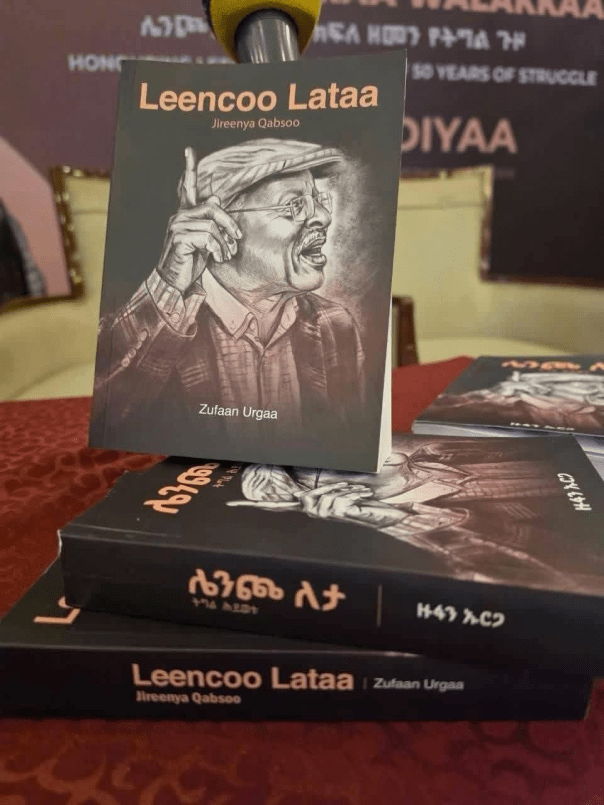
*Author’s Note on Attribution: The feature story is based on a post written by Natsaannat Taadsasaa and published in Gaazexaa Bariisaa on May 5, 2018 (according to the Ethiopian calendar). That post reported on the book launch event for Obbo Leencoo Lataa’s memoir, including remarks from Obbo Leencoo Lataa himself, Professor Kuwee Kumsaa, and his children Huriyaa, Roobaa, and Goolii Leencoo. Daandii Ragabaa has engaged with that reporting as a commentator, and the present reflection draws substantially from the ideas, testimonies, and framing originally presented by Natsaannat Taadsasaa. This feature story is offered as a synthesis and expansion of that shared conversation, with full acknowledgment of the original source.

The Unfinished Project: Language, Liberation, and the Oromo Struggle for Epistemic Freedom
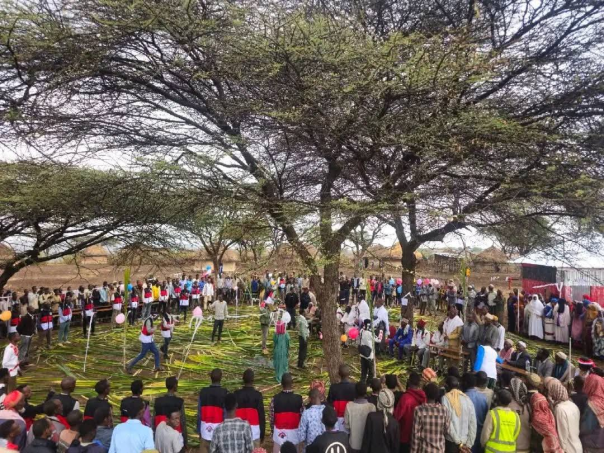
By Dhabessa Wakjira
Introduction: Language, Power, and the Unfinished Multilingual Project
Language is not merely a tool for communication. It is the backbone of identity, the engine of governance, and the very medium through which a citizen accesses justice, opportunity, and dignity. In multilingual nations, language policy determines not only how people speak to their government but also who receives power, who finds justice, and who is consigned to the margins.
Ethiopia, one of the world’s most linguistically diverse nations, enshrines equality for all languages in Article 5 of its constitution. On paper, it is a model of multicultural federalism. But between the constitutional promise and the lived reality lies a vast chasm—a gap where Amharic has continued to enjoy structural dominance at the expense of other languages, most notably Afaan Oromo, the most widely spoken language in the country.
This feature story explores how Amharic supremacy was forged during imperial expansion (which many scholars directly term colonization), how it has been perpetuated through institutional mechanisms, and the profound political, social, and economic consequences for the Oromo people. More critically, it examines this struggle through the lens of decoloniality—the understanding that true liberation requires not merely political independence but the dismantling of colonial power structures that persist in knowledge production, governance, and identity.
For the Oromo people, whose lands were incorporated into the Ethiopian Empire through military conquest in the late 19th century, the struggle against Amharic dominance is not a request for administrative convenience. It is an act of decolonial resistance.
The Historical Foundations of Amharic Supremacy: The Colonization of Oromia
The dominance of Amharic was forged in the crucible of empire. During the late 19th and early 20th centuries, the expanding Ethiopian Empire absorbed Oromia through military conquest. Amharic was imposed as the language of administration, military command, taxation, and the courts.
This was not a neutral or practical choice. It was a political weapon—a tool for centralizing power, assimilating cultures, and controlling subjugated populations. The policy was explicit. In 1933, Education Minister Sahle Tsedalu called for the suppression of so-called “pagan languages.” In 1968, the renowned British anthropologist Paul Baxter documented that in Arsi, the speaking of Afaan Oromo was actively suppressed. Publishing, preaching, teaching, or broadcasting in Afaan Oromo was forbidden.
While Amharic was institutionally elevated, Afaan Oromo was relegated to the informal sphere—the home, the oral tradition, the market. This historical process established a linguistic hierarchy that persisted through the Imperial era, the socialist Derg, and even into the current federal system. After Ethiopia adopted ethnic federalism in 1991, the structural advantages of Amharic remained largely untouched. The constitution embraced diversity, but the daily machinery of the state continued to reflect older, colonial norms.
For the Oromo people, this history is not abstract. The Gadaa system—an indigenous democratic governance structure and knowledge system—was suppressed. The language was erased from public life. Stripped of meaningful representation and denied the ability to govern their own social existence, the Oromo were subjected to what scholars Asafa Jalata and Mohammed Hassen have described as a condition of landlessness, rightlessness, and systematic exploitation on their own soil.
As decolonial theory teaches, colonialism does not end with a change in political structure. It continues in the organization of knowledge, in education, and in the daily interactions between state and citizen. The continued dominance of Amharic is a living scar—proof that the colonization of the Oromo has never been fully undone.
Institutional Mechanisms of Linguistic Hierarchy: Coloniality in Practice
Decolonial thinkers, including Anibal Quijano, argue that colonialism created a global system of power organized around three interconnected hierarchies: the coloniality of power (racial/ethnic ranking), the coloniality of knowledge (the suppression of indigenous ways of knowing), and the coloniality of being (the imposition of foreign values of humanity). In Ethiopia, these hierarchies are embodied in the dominance of Amharic over Afaan Oromo.
The Civil Service and Employment Structures
The most glaring evidence of linguistic inequality lies in federal employment. A study cited by Bulto shows that while Afaan Oromo speakers constitute approximately 34.5 percent of the population, they hold only 7.9 percent of federal civil service positions. In stark contrast, Amharic speakers, representing 29 percent of the population, occupy 68.5 percent of these jobs.
This is not an accident. Civil service examinations are administered in Amharic. Hiring processes require Amharic proficiency. Internal communications—including policy documents and performance evaluations—are conducted in Amharic. Career advancement is contingent upon navigating a bureaucratic environment that assumes Amharic fluency. The language requirement has become a systematic filter that disadvantages Afaan Oromo speakers and restricts their access to state power.
Access to Justice and Legal Communication
The right to justice is fundamental, yet language barriers have systematically excluded Afaan Oromo speakers from equitable participation in Ethiopia’s legal system. Laws, regulations, and the official legal gazette (Negarit Gazeta) are published primarily in Amharic alone. For citizens whose primary language is Afaan Oromo, understanding the law, participating in legal proceedings, and defending their rights presents an overwhelming obstacle.
The absence of a consistent multilingual legal framework undermines the principles of fairness and equal protection under the law. This is a manifestation of what decolonial theory terms epistemicide—the systematic destruction of other knowledge and communication systems by rendering them invisible before the law.
Symbolic and Ceremonial Dominance
Beyond formal institutions, language carries symbolic power. Amharic has long been associated with state authority, national identity, and political legitimacy. Major national ceremonies, government announcements, and presidential addresses are predominantly conducted in Amharic. This symbolic supremacy reinforces the perception that “serious” national affairs belong to Amharic speakers, while other languages—and their speakers—are secondary.
For the Oromo, these symbolic structures are daily reminders of their colonial subjugation. They are not abstract grievances; they are concrete triggers that reinforce feelings of exclusion and second-class citizenship.
Educational Structures and Language Hierarchy: The Coloniality of Knowledge
The education system plays a central role in reproducing linguistic inequality. While mother-tongue education expanded under the federal system, higher education and professional advancement remain tightly linked to Amharic and, to a lesser extent, English. Students who fail English proficiency exams cannot enter university regardless of their knowledge in other subjects.
Students educated primarily in Afaan Oromo face a sudden barrier when transitioning to Amharic-dominated systems, limiting their competitiveness and access to opportunity. The language hierarchy is thus reproduced in educational outcomes and professional trajectories.
This echoes the critique of Kenyan writer Ngũgĩ wa Thiong’o, who argued that the colonial education model ensures that a child sees himself not through his own culture but through the lens of London and New York. In the Oromo context, a child is taught to see the state through Amharic—to internalize the colonizer’s language as natural and their own as inferior.
Decolonial “epistemic liberation” requires rejecting these internalized narratives and reclaiming an identity shattered by colonial structures. A genuine educational policy would allow students first to study their own community’s culture and environment, then to relate it to others. In Ethiopia, however, Oromo students are rarely afforded that equal foundation.
The Wider Consequences of Linguistic Inequality
Barriers to a Shared Civic Identity
A shared civic identity depends on inclusive communication. When major national debates occur primarily in Amharic, large segments of the Oromo population are forced to participate indirectly—through translation or second-hand interpretation. This asymmetry diminishes democratic engagement and prevents the emergence of a truly inclusive national conversation.
Social Mobility and Economic Opportunity
Language competence profoundly affects individual life chances. Oromo citizens who do not speak Amharic face additional barriers when seeking federal employment or pursuing higher education. Professional networks among lawyers, doctors, engineers, and civil servants are constrained by language differences, limiting inter-regional mobility and integration.
Tensions Between Regional and Federal Authorities
Regional governments like Oromia have developed administrative systems based on Afaan Oromo, yet they must interact with federal institutions that operate primarily in Amharic. This creates an unequal burden: regional officials must be bilingual, while their federal counterparts operate monolingually. Such asymmetry contributes to tensions between regional self-governance and federal centralism—tensions that a properly functioning federal system should have resolved by requiring federal officials to speak at least two languages.
The Mind in the Structure
Even within Oromia’s cities and bureaucracy, Amharic retains its dominance. No language in the world can develop its full capacity if confined to rural areas alone. Worse, in Finfinnee (Addis Ababa)—a city Oromia claims as its “capital”—Afaan Oromo is not even the working language. Ethiopia remains the only country in the world where the most widely spoken language is neither the federal working language nor a recognized national language.
If there exists anywhere in the world a city where the language of the majority of its inhabitants is spoken only as a foreign tongue, an island of alien speech, that city is Finfinnee. This reality exposes the failure within Oromia itself: Afaan Oromo has not achieved the institutional status and development it requires, even within the region’s own boundaries.
This failure is partly due to a leadership shaped by colonial mentality—leadership that has continued to maintain Amharic dominance through both policy and inaction—and partly due to colonial structures that were never dismantled. As Ngũgĩ argued, “decolonizing the mind” is a personal and collective project of rejecting the colonizer’s language, values, and internalized narratives. For the Oromo, this begins with their own institutions and leadership.
Emancipation vs. Liberation: A Critical Distinction
To properly address the Oromo condition, one must understand the difference between emancipation and liberation.
Emancipation means achieving reforms within an existing oppressive system—securing a few more government jobs, amending a few laws, while the overall colonial structure remains intact. Liberation, by contrast, demands radical political and economic freedom, including epistemic freedom.
Post-1994 South Africa serves as a cautionary tale. The liberation movement transformed into an emancipation project, embracing liberal democracy rather than genuine decolonization. The Black majority remains mired in poverty, and the colonial economy continues unchanged. Similarly, Ethiopia’s post-1991 ethnic federalism was emancipation, not liberation. It granted limited cultural recognition but left intact the Amharic-based federal power structure.
Indigenous elites—the adbarayoch—regardless of their ethnic identity, remain captives of colonial modernity. They learned Amharic systematically, internalized colonial administrative logic, and seek not to transform the system but merely to replace the old elite. For the Oromo people, genuine liberation means breaking free from the coloniality of power entirely—rejecting the assumption that federal affairs must be conducted in Amharic, making Afaan Oromo a full language of education, research, law, and administration as a matter of right, not a favor.
Decolonial theory demands “peripheral thinking”—producing knowledge from the colonized context. Oromo scholars, teachers, and citizens must not translate their concepts into Amharic or Western frameworks. They must stand on their own validity.
Consider a simple metaphor: A bird in a cage is not free. Opening the cage and removing the bird is emancipation—a concrete act that ends captivity. But when the bird flies through the sky, going wherever it chooses, that is liberation—the result of that act. The Oromo people will be truly liberated only when they secure self-determination through free popular participation.
Toward a Decolonial Language Policy
Breaking free from Amharic dominance requires more than symbolic recognition. It demands structural transformation grounded in decolonial principles. Ethiopia—and particularly Oromia—needs a comprehensive language policy that includes the following elements:
First, institutionalizing multilingualism. Federal institutions must accommodate multiple working languages in daily operations, provide translation and interpretation services, and ensure that internal communications are accessible in Afaan Oromo and other major languages.
Second, civil service reform. Hiring and promotion processes should treat multilingual competence as a valuable asset, eliminate unnecessary language barriers, and ensure that the civil service reflects Ethiopia’s actual linguistic diversity.
Third, expanding multilingual public services. Health facilities, legal aid, administrative services, and commercial transactions must be accessible in Afaan Oromo and other major languages.
Fourth, legal and judicial reform. Laws must be published in Afaan Oromo. Court proceedings must guarantee interpretation services.
Fifth, educational transformation. Mother-tongue education must be strengthened at all levels—including higher education—ensuring that Afaan Oromo becomes a language of research and professional service.
Sixth, building multilingual public platforms. Media, civic education, and political debates must not only be conducted in multiple languages but must also ensure proportional representation based on population size and economic contribution. Given the number of Afaan Oromo speakers and the Oromo people’s critical role in the national economy, Afaan Oromo deserves proportional attention and space in media, education, and political discourse.
The Unfinished Multilingual Project
Ethiopia’s constitution dreams of a multilingual federal system built on language equality. But in practice, the state remains trapped within a historical colonial framework that privileges Amharic. This linguistic gap is not a mere operational issue. It reflects a deep tension between federal aspirations and the persistence of colonial inheritance.
Decolonial theory teaches that colonialism does not end—it updates itself, changing form but not substance. In the Oromo context, decolonization means questioning the very foundations of the Ethiopian state: its linguistic hierarchy, its health service accessibility, its commercial and religious languages, its education system, its access to justice, and the very meaning of citizenship.
It means actively building new structures—schools, courts, media, and bureaucracies—grounded in Oromo perspectives and practices. It is a project of “living again” for a people told they had no right to exist on their own terms.
A reimagined language policy—rooted in equity, inclusivity, and the practical realities of decolonial thought—can transform language from a source of division into a foundation for cooperation. For Oromia and for Ethiopia as a whole, the path forward lies not in replacing one dominance with another but in building a system where all languages and their speakers can participate equally in the nation’s comprehensive life.
This is the unfinished multilingual project. This is the call to liberation. And this struggle continues—in the schools, in the courts, in the civil service offices, and in the daily conversations of millions who dare to dream not merely of dreaming, but of changing the world.
Language is not only a cultural expression. It is economic power. It is diplomacy. It is technology. It is global influence. And for the Oromo people, it is the final frontier of freedom.
The unfinished project calls. The struggle continues. And liberation, once chosen, cannot be undone.
*Author’s Note on Attribution: The above feature story is based on a social media post written by Jaal Daawwiit Abdataa Hundeessaa. Dhabessa Wakjira engaged with that post as a commentator, and the present reflection draws substantially from the ideas, analysis, and historical framing originally articulated by Jaal Daawwiit Abdataa Hundeessaa. This feature story is offered as a synthesis and expansion of that shared conversation, with full acknowledgment of the original source.




 Advocacy for Oromia