Category Archives: Promotion

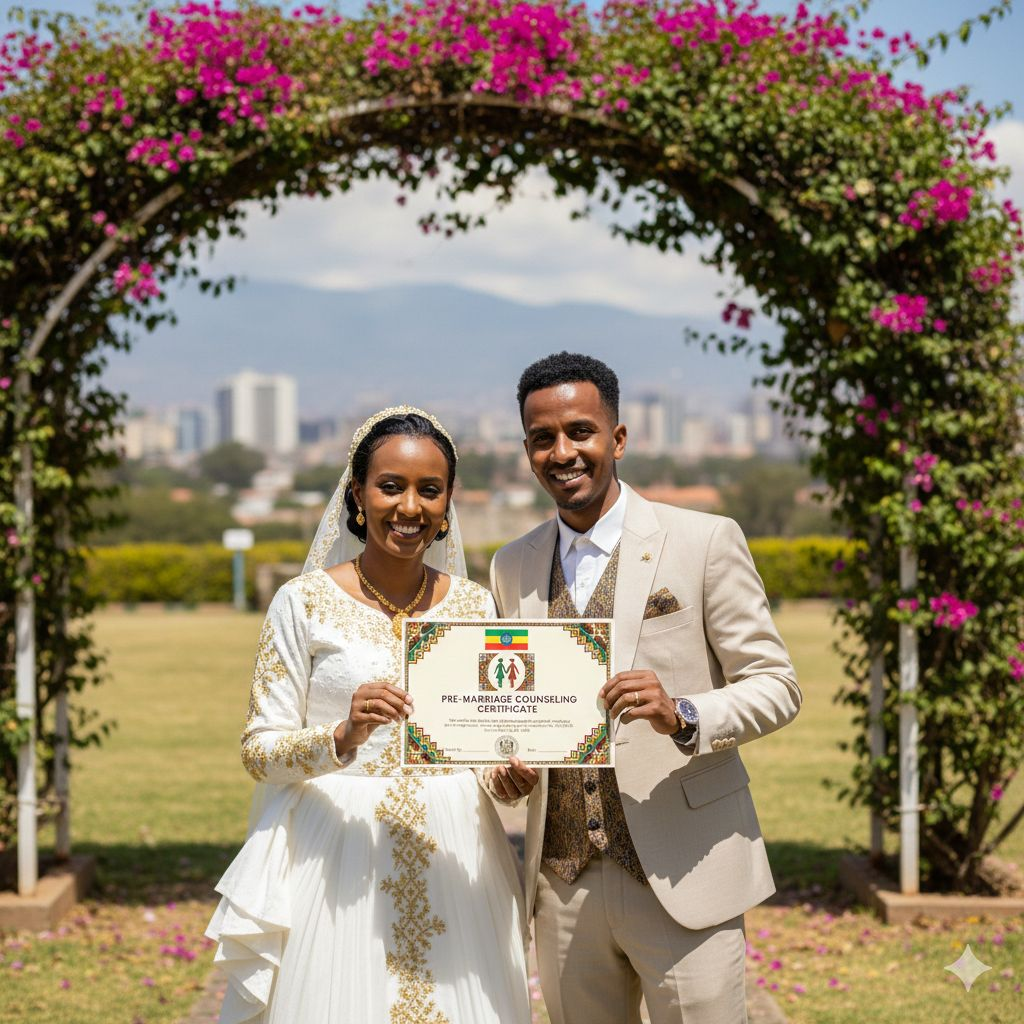
Ethiopia to Mandate Premarital Training Certificate for Couples Seeking Marriage

Ministry announces new regulation to combat skyrocketing divorce rates through mandatory education and certification

ADDIS ABABA — In a landmark initiative aimed at reversing Ethiopia’s rising divorce rates, the Ministry of Women and Social Affairs has announced plans to implement mandatory premarital training certification for all individuals seeking to enter into marriage. The new regulation would prohibit anyone without the required certificate from legally marrying .

The innovative approach, slated to take effect next year, represents a significant intervention in Ethiopia’s social policy landscape, targeting what officials identify as a primary cause of marital breakdown: lack of awareness and understanding about the realities of married life .

Alarming Statistics Drive Policy Response

The announcement follows concerning data released by the Addis Ababa City Civil Registration and Residence Service Agency, which revealed that divorce rates have increased by 54 percent compared to previous years. With over 20 million families currently in Ethiopia, the stability of the family unit has emerged as a pressing national concern demanding urgent attention .

Mr. Tesfaye Robele, Chief Executive for Elderly and Family Affairs at the Ministry of Women and Social Affairs, confirmed that preparations are underway to implement the system in the coming year. Speaking to Sheger Radio, officials outlined the ministry’s comprehensive approach to addressing what they describe as a crisis in Ethiopian family life .

“We have prepared training manuals to address this problem,” Mr. Tesfaye stated. “The primary cause for many marital breakdowns is the lack of awareness and understanding about what marriage truly entails” .

Collaborative Development with Religious and Community Leaders

Recognizing that marriage in Ethiopia is deeply intertwined with religious and cultural traditions, the ministry is pursuing a collaborative approach to implementation. Officials emphasize that the new system will be developed in consultation with religious institutions and community elders, ensuring respect for diverse cultural and faith-based marriage traditions .

“We are working in consultation with religious institutions and elders,” Mr. Tesfaye confirmed, highlighting the ministry’s commitment to creating a system that honors Ethiopia’s rich diversity of marriage practices while establishing consistent standards for preparation .

This collaborative framework acknowledges that marriage ceremonies in Ethiopia are performed through various institutions—religious bodies, civil authorities, and traditional community structures—all of which will need to participate in implementing the new requirements.

Comprehensive Strategy Beyond Certification

The premarital certification requirement represents just one component of a broader strategy to strengthen Ethiopian families. The ministry also announced the establishment of a joint forum bringing together various institutions working on family issues .

According to Mr. Tesfaye, this forum aims to identify and address gaps in family management practices while providing recommendations and guidance to the government on necessary actions to support family stability. The initiative reflects a holistic understanding that healthy marriages require ongoing support, not merely preparation before the wedding .

“We must begin the journey toward national change starting from the family,” the official emphasized, highlighting the fundamental role that stable households play in broader societal development . This perspective positions family stability as not merely a private concern but a public good essential to national progress.

Training Curriculum and Implementation

Ministry officials indicate that training manuals have already been prepared for the program. While specific curriculum details are still being finalized in consultation with religious and community leaders, the training is expected to cover fundamental aspects of marriage including communication skills, conflict resolution, financial management, and realistic expectations about married life .

The duration of required training and specific certification mechanisms remain under development, with implementation details to be announced following the consultation period. The goal of launching within the next year provides a clear timeline for completing these preparations .

Addressing a Growing Social Challenge

Ethiopia’s divorce rate increase of 54 percent reflects broader social transformations affecting families across the nation. Urbanization, changing gender roles, economic pressures, and evolving social expectations have all contributed to shifting dynamics in marital relationships .

The ministry’s initiative recognizes that many couples enter marriage with romanticized expectations rather than practical understanding of the commitment involved. By requiring structured preparation, officials hope to reduce the likelihood of marriage breakdown stemming from preventable misunderstandings or mismatched expectations.

Religious and Cultural Considerations

The collaborative approach with religious institutions acknowledges the complex landscape of marriage in Ethiopia, where religious ceremonies carry legal weight and traditional marriages performed by community elders remain common. Any successful intervention must work within these existing structures rather than attempting to supersede them.

Ethiopia’s religious diversity—encompassing Orthodox Christianity, Islam, Protestant Christianity, and traditional belief systems—means that marriage preparation will need to accommodate varied perspectives while maintaining consistent core content about marriage fundamentals.

Potential Impact and Challenges

If successfully implemented, the mandatory premarital training requirement would position Ethiopia among a growing number of countries recognizing the value of marriage preparation. Research in other contexts has suggested that well-designed premarital education can reduce divorce rates by helping couples develop realistic expectations and essential relationship skills.

However, implementation challenges remain significant. Ensuring accessibility of training across Ethiopia’s diverse regions, managing costs for prospective couples, and maintaining consistent quality while respecting local traditions will require careful planning and adequate resources.

The ministry’s emphasis on collaboration with existing institutions—religious bodies, community elders, and family service organizations—suggests an awareness that successful implementation depends on building upon established community structures rather than creating parallel systems.

Broader Social Implications

The initiative reflects growing recognition in Ethiopia that family stability has cascading effects on broader social outcomes. Children from stable households generally show better educational and health outcomes, while family breakdown can contribute to economic hardship and social challenges .

By intervening at the point of marriage, the ministry aims to prevent problems before they develop rather than responding after families have already fractured. This preventive approach aligns with public health models that emphasize early intervention and education as cost-effective strategies for addressing social challenges.

Looking Forward

As Ethiopia prepares to launch this innovative program, attention will focus on the consultation process with religious and community leaders, the development of culturally appropriate training materials, and the establishment of certification mechanisms that are accessible to all Ethiopians regardless of location or economic circumstance.

The coming year will see these elements take shape, with ministry officials working to transform policy announcement into operational reality. If successful, Ethiopia’s experiment in mandatory marriage preparation could offer lessons for other nations grappling with similar challenges of family stability in rapidly changing societies.

For Ethiopian couples planning to marry in the coming years, the new requirement will add an additional step to the marriage process—one that officials hope will prove invaluable in building the foundation for lasting, healthy unions. As Mr. Tesfaye emphasized, the ultimate goal extends beyond certification to the creation of stable families capable of contributing to national development and social wellbeing .

The TPLF: A Brutal Force That Should Never Have Been Given a Single Day’s Opportunity as an Organization

Oromo voices reflect on three decades of suffering under Tigrayan-led rule

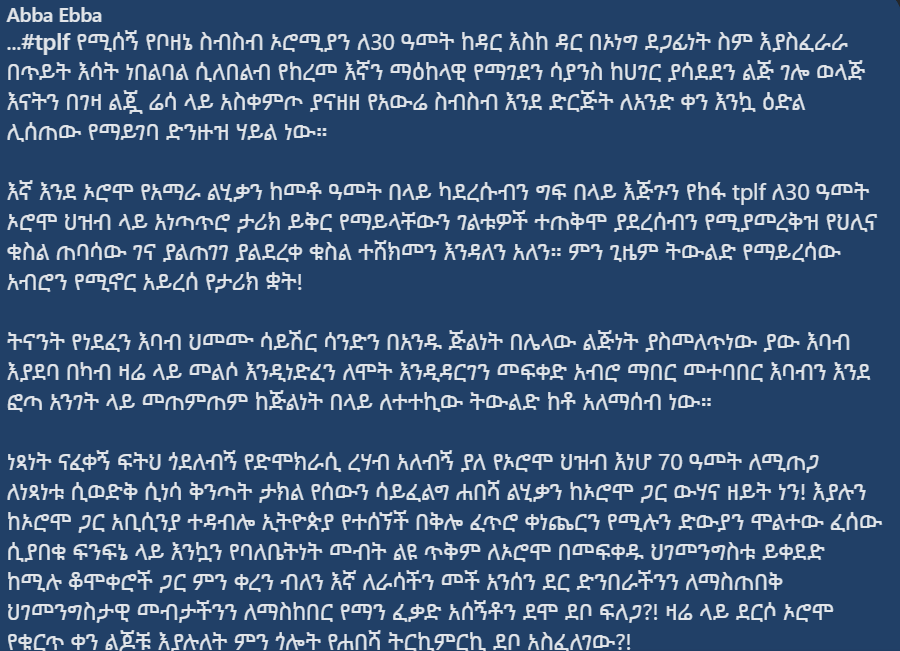
FINFINNE — In a powerful and searing social media commentary that has resonated across Oromo networks, a voice identified as Abba Ebba has articulated the deep historical wounds and enduring grievances of the Oromo people against the Tigray People’s Liberation Front (TPLF), describing the organization as a “brutal force” that should never have been legitimized .

The statement, shared under the hashtag #Abba_Ebba, offers a raw and unflinching examination of the TPLF’s three-decade rule over Ethiopia and its specific impact on the Oromo people—a period the author describes as inflicting wounds “far worse than a hundred years of Abyssinian elite oppression” .

Thirty Years of Suffering

According to the commentary, the TPLF, operating under the banner of the Ethiopian People’s Revolutionary Democratic Front (EPRDF), controlled Oromia for thirty years, threatening the region from end to end in the name of supporting the Oromo Liberation Front (OLF) while actually enveloping the land in flames of gunfire .

The author describes how the TPLF blocked Oromos from the center, drove them from their country, killed children, and placed mothers upon the corpses of their own offspring in acts of unspeakable cruelty . This “collection of beasts,” as the author characterizes the TPLF, is portrayed as having committed atrocities that have left permanent scars on the Oromo collective consciousness .

“More than a hundred years of oppression by Abyssinian elites, the TPLF targeted the Oromo people for thirty years with historically unforgivable atrocities, using every means available,” the statement reads. “The wound of conscience they inflicted upon us is still unhealed, a scar not yet dried—we carry this unhealed wound with us” .

A Legacy That Lives With Generations

The commentary emphasizes that these historical wounds are not merely past events but living realities carried by the Oromo people. “Generations will not forget—it lives with us, an unerasable historical scar” .

The author draws a powerful analogy: “Yesterday, a snake bit us. Before the pain subsided, because of the foolishness of one and the childishness of another, we let it escape. That same snake, growing fat and multiplying, has returned today to bite us again, to bring us to death” .

Allowing this to happen, the author argues, is worse than foolishness—it is a failure to think of the coming generation. Collaborating with such forces, treating the snake as if it were a towel to be wrapped around one’s neck, represents a profound betrayal of the future .

The Quest for Freedom and Justice

The commentary gives voice to the Oromo people’s longstanding aspirations: “The Oromo people who say ‘I long for freedom, justice has been denied me, I hunger for democracy’—here they are, for nearly 70 years falling and rising in their struggle for freedom” .

Unlike others, the author asserts, Oromos have never sought scraps from anyone’s table. Yet Abyssinian elites have consistently declared, “We are like water and oil with Oromos!” while simultaneously claiming to have created a hybrid “mule” called Ethiopia through fusion with Oromos .

The author questions how, when the constitution grants special rights to Oromos even in Finfinne, there are those who would tear up the document, asking what remains for Oromos. “When will we stand up for ourselves, to protect our borders, to secure our constitutional rights—whose permission do we need to seek?” .

Today, the author notes, people say of Oromos, “They are children of the moment.” But what need has the Oromo of Abyssinian political maneuvering and crumbs?

The Folly of Sacrificing Justice for Peace

The commentary critiques those who urged compromise: “Yesterday, for the sake of peace, we abandoned justice! We forgave what you did publicly! There is no peace without justice” .

Those who stole wealth, whether collectively or individually, who used power to destroy lives, burn forests, displace people, commit inhuman acts in any form—the author insists they must not escape accountability .

Questions are raised about political transitions: “What and who is bringing the transition? From where to where?” The author suggests that those who mocked others for not understanding politics are now seeing the consequences .

What once appeared to some as downhill before them now seems as distant as the sky, transformed into an uphill struggle. “Are you truly not angered as you watch?” the author asks, suggesting that deep regret, not indifference, is the appropriate response .

Historical Memory: The Western Oromo Confederation of 1936

The commentary invokes a crucial but often overlooked chapter of Oromo history: the Western Oromo Confederation of 1936. Before the TPLF was even created, Oromos sent a delegation to the United Nations seeking to govern themselves through confederation .

This historical episode, disrupted by Italy’s five-year colonization of Abyssinia, demonstrates the long-standing Oromo pursuit of self-determination, predating the TPLF’s emergence by decades .

The author cites scholarly work by Ezekiel Gebissa on “The Italian Invasion, the Ethiopian Empire, and Oromo Nationalism: The Significance of the Western Oromo Confederation of 1936,” pointing to a tradition of Oromo political organizing that Abyssinian and Tigrayan narratives have systematically obscured .

Cultural Appropriation: The Heritage of “Weyane”

The commentary also raises questions of cultural appropriation, asking whether the TPLF has forgotten that “Weyane”—the traditional struggle strategy from which the organization derives its name—is actually Oromo heritage from Raya and Rayuma .

This observation, the author explains, is offered to counter any suggestion that Tigrayan or Amhara elites taught Oromos about freedom struggle. The historical record, including scholarship on “Peasant Resistance in Ethiopia: the Case of Weyane” published in the Journal of African History, demonstrates that Oromo traditions of resistance long preceded TPLF organizing .

The Complexity of Recognition

The author acknowledges that the situation is complex—like makeup applied and removed, artificial people appearing before cameras, living under disguise. But the weight of the matter, they emphasize, concerns the supremacy of the people, the formation of the nation, the debt owed to fathers, mothers, and faith .

“Knowledge means grasping the trunk of the tree, not hanging on its branches—hold the branches and you will fall” .

A Warning Unheeded?

The commentary concludes with a stark image: “O TPLF! The one who never says ‘enough’ will spit and continue. ‘Emboor! Emboor!’ (Get away! Get away!) they say to those who hold back and separate—now the flood has reached the neck, asking ‘What has brought my situation?'”

This metaphorical warning suggests that those who ignored calls for restraint and justice now find themselves overwhelmed by consequences of their own making .

Historical Context

The TPLF led the armed struggle that overthrew the Derg regime in 1991 and subsequently dominated Ethiopian politics for nearly three decades until Prime Minister Abiy Ahmed came to power in 2018. During their rule, the TPLF was the dominant force within the EPRDF coalition, controlling the levers of state power and directing security forces that, according to numerous human rights reports, committed widespread abuses against civilians in Oromia and other regions .

The period from 1991 to 2018 saw repeated military campaigns in Oromia, mass arrests of Oromo activists and politicians, and systematic suppression of Oromo political expression. The International Criminal Court’s Office of the Prosecutor noted in 2019 that it had received information regarding alleged crimes against humanity in Ethiopia dating back to 2015, including in Oromia .

Contemporary Relevance

The commentary appears against the backdrop of ongoing tensions in Ethiopia’s post-2018 political transition. While the TPLF was removed from federal power, it retained control over Tigray regional state until the recent Tigray War (2020-2022) dramatically altered the political landscape .

For Oromos, the question of accountability for past abuses remains unresolved. Many Oromo activists and politicians have called for justice for victims of TPLF-era atrocities, even as they navigate complex relationships with other political forces in contemporary Ethiopia .

A Voice for the Unhealed Wound

Abba Ebba’s commentary gives voice to what it describes as an “unhealed wound” in Oromo collective memory—the accumulated trauma of three decades of TPLF rule that compounded more than a century of Abyssinian domination .

The response to the post, shared widely across Oromo social media networks, suggests that these sentiments resonate deeply within the Oromo community. The demand for justice, the insistence on historical memory, and the refusal to accept narratives that minimize Oromo suffering emerge as consistent themes .

As Ethiopia navigates an uncertain political future, with ongoing conflicts in multiple regions and unresolved questions about the country’s constitutional order, voices like Abba Ebba’s serve as reminders that for many Oromos, the past is not past—it is a living wound that demands acknowledgment and, ultimately, healing through justice .

Whether such justice will be achieved, and what form it might take, remains one of the most pressing and unresolved questions in Ethiopian politics. For the Oromo people, as the commentary makes clear, the struggle continues—not only for freedom and democracy in the future but for acknowledgment and accountability for the crimes of the past.

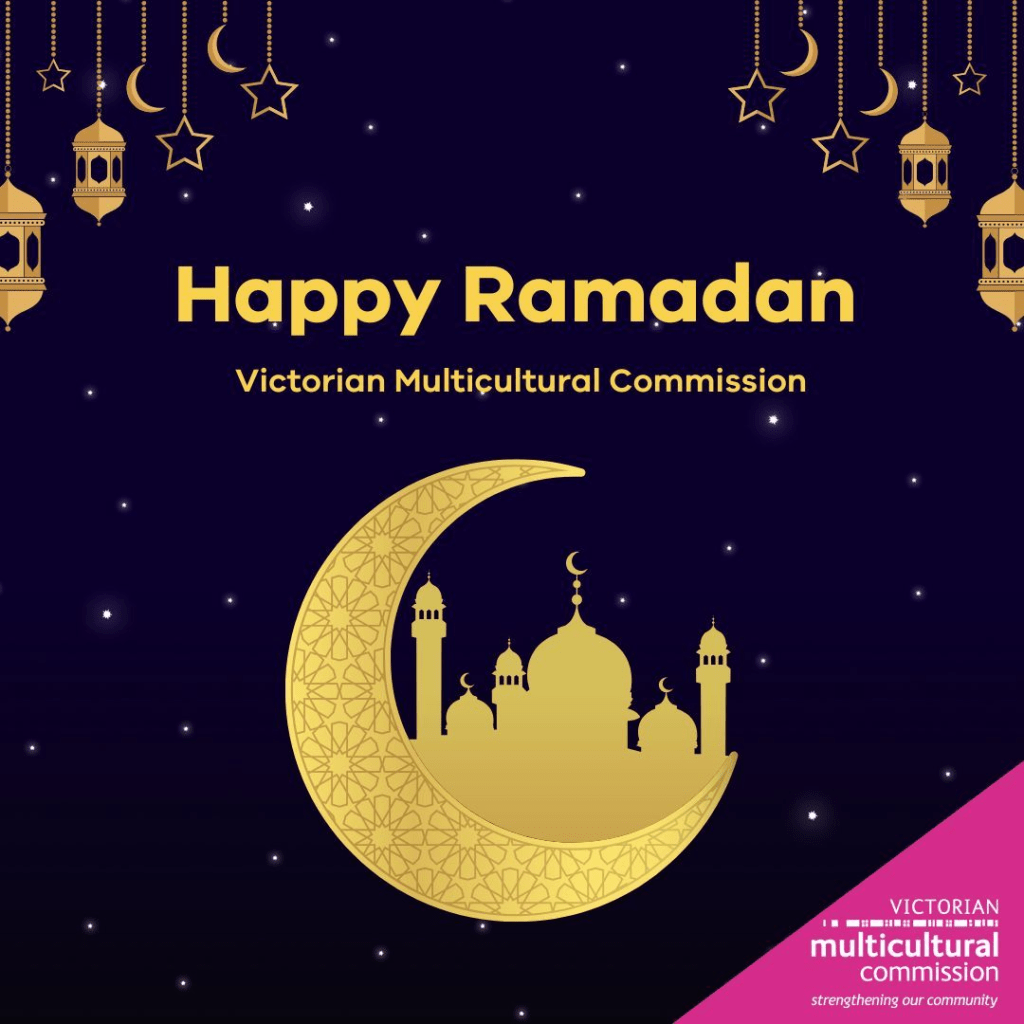
Ramadan 2026 Begins: A Month of Fasting, Reflection, and Community for Muslims Worldwide

Victorian Multicultural Commission extends warm wishes as holy month commences

MELBOURNE, Australia — This week marks the beginning of Ramadan, the holiest month in the Islamic calendar, observed by Muslims around the world as a sacred period of fasting, prayer, and spiritual reflection. The crescent moon sighting ushers in approximately 30 days of devotion during which the faithful will abstain from food, drink, and other physical needs from dawn until sunset .

Ramadan commemorates the month in which the Quran was first revealed to the Prophet Muhammad, making it a time of heightened religious significance for the global Muslim community. For the world’s approximately 1.8 billion Muslims, the month represents an opportunity for profound spiritual renewal and connection with the divine .

Spiritual Significance and Practice

From first light until sunset, fasting—known as sawm—is practiced to strengthen faith, cultivate self-discipline, and foster empathy, generosity, and care for others . The daily fast serves multiple purposes: it reminds believers of those less fortunate who experience hunger not by choice, teaches patience and humility, and creates space for increased devotion through prayer and Quranic recitation.

Each day’s fast begins with a pre-dawn meal called suhoor and ends with iftar, the evening meal with which Muslims break their fast. Iftar is often a communal affair, bringing families and communities together and extending to neighbors, friends, and those in need. The practice of sharing meals with the less fortunate exemplifies Ramadan’s emphasis on generosity and social responsibility .

Beyond abstaining from physical sustenance, Ramadan calls Muslims to refrain from negative behaviors such as gossip, arguing, and ill feelings, directing focus instead toward spiritual growth, charitable acts, and strengthening community bonds. The month is also a time for personal growth and spiritual renewal, as believers seek to draw closer to God through increased prayer and reflection .

Community and Connection

Ramadan is traditionally a time when community bonds deepen significantly. Mosques fill for nightly Taraweeh prayers, extended congregational prayers offered only during this month. Families and friends gather for iftar meals, and communities organize shared meals for those who may be alone or in need .

The emphasis on generosity finds expression in increased charitable giving, or zakat—one of the five pillars of Islam. Many Muslims choose to pay their annual charity during Ramadan, believing the rewards for good deeds are multiplied during the holy month. Food drives, community iftars, and fundraising for humanitarian causes all see significant increases during Ramadan .

Victorian Multicultural Commission Extends Wishes

In Victoria, Australia, the Victorian Multicultural Commission has recognized the significance of Ramadan and the values it represents, including compassion, devotion, and connection. In a statement marking the beginning of the month, the Commission extended warm wishes to all observing this sacred time .

“We extend our warm wishes to all who are observing this sacred month and hope it brings peace, wellbeing and a strong sense of belonging across Victoria,” the Commission stated .

Victoria is home to a diverse Muslim population representing numerous cultural backgrounds, including significant communities with Turkish, Lebanese, Pakistani, Afghan, Bangladeshi, Somali, and Indonesian heritage, among others. For these communities, Ramadan provides an opportunity to maintain cultural and religious traditions while contributing to Victoria’s multicultural fabric.

Observance Across Australia

Across Australia, approximately 800,000 Muslims will observe Ramadan this year, with significant communities in Melbourne, Sydney, Brisbane, and Perth. Islamic councils and local mosques have announced prayer schedules and iftar programs, many of which welcome non-Muslim neighbors and friends to share in the evening meal as an opportunity for interfaith understanding and community connection .

Major mosques, including Melbourne’s Islamic Council of Victoria and Sydney’s Lakemba Mosque precinct, anticipate thousands of worshippers for nightly prayers and community iftars. Local councils in areas with significant Muslim populations have adjusted services and schedules to accommodate observers.

The Rhythm of Ramadan Days

For those observing, Ramadan transforms daily rhythms. Mornings begin early with suhoor before dawn, followed by morning prayers. The workday continues with fasting, requiring focus and energy management. Afternoon hours can be particularly challenging as energy levels dip, but the approaching sunset brings anticipation of breaking the fast.

At sunset, the adhan—call to prayer—signals time for iftar. Traditionally, dates and water or juice are consumed first, following the example of the Prophet Muhammad, before the main meal. After evening prayers, many Muslims head to mosques for Taraweeh, which can include recitation of significant portions of the Quran.

The final ten days of Ramadan hold special significance, marking the period when the first revelations of the Quran were sent down. During these nights, Muslims increase their devotion, with some engaging in itikaf—spiritual retreat in the mosque—to focus entirely on worship. One of these nights is Laylat al-Qadr, or the Night of Power, described in the Quran as “better than a thousand months.”

Eid al-Fitr: The Celebration Ahead

The conclusion of Ramadan will be marked by Eid al-Fitr, the festival of breaking the fast, expected to fall in late March depending on the lunar sighting. The day begins with a special prayer service followed by celebrations that include feasting, gift-giving, and gatherings with family and friends. Eid is a time of joy and gratitude, marking the successful completion of the month’s spiritual journey .

For businesses, schools, and community organizations across Victoria, awareness of Ramadan and its practices supports inclusion and understanding. Many workplaces accommodate observing employees with flexible hours or designated prayer spaces, recognizing the significance of the month.

A Message of Shared Values

The Victorian Multicultural Commission’s message emphasizing compassion, devotion, and connection highlights how Ramadan’s core values resonate beyond the Muslim community. In an increasingly diverse society, recognition and respect for religious observances strengthen social cohesion and mutual understanding .

As Muslims across Victoria and around the world begin this month of fasting and prayer, the wishes for peace, wellbeing, and belonging extend across communities, reflecting the universal aspirations that Ramadan represents.

Ramadan Mubarak to all observing this holy month.

OROMIA: OSG Releases its 53 Reports on Human Rights Violations in Ethiopia

#MoveForMentalHealth!

Community mental wellbeing doesn’t just appear. We must CREATE IT by setting up safe spaces where people can connect with others, talk, be heard & find a sense of belonging. #MentalHealthForAll#TimeToInvest#WMHD2020

Ethiopia’s security forces accused of torture, evictions and killings – report

(A4O, 29 May 2020, Oromia) Prime minister Abiy Ahmed has been lauded for his democratic reforms. But Amnesty International are now urging him to investigate allegations of serious human rights abuses

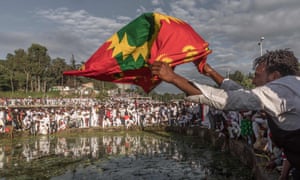
A man waves an Oromo flag
 A man waves an Oromo flag as people from the community gather in Addis Ababa in October 2019, on the eve of Irreecha, their thanksgiving festival. Photograph: Yonas Tadesse/AFP

Ethiopia’s Nobel peace prize-winning prime minister Abiy Ahmed has been urged to investigate allegations that state security forces have committed a raft of serious human rights abuses including torture and unlawful killings since he came to power in 2018.

According to a report by Amnesty International, published on Friday, Ethiopia’s military and police in its two most populous regions arbitrarily detained more than 10,000 people, summarily evicted whole families from their homes – some of which were burnt and destroyed – and in some cases were complicit in inter-communal violence targeting minorities.

Federal authorities have not responded to the report, which focuses on the period between January and December 2019 in the regions of Amhara and Oromia.

“Given the gravity and the duration [of the period in which abuses were reported] I cannot believe top officials are not aware of what was happening,” the report’s author, Fisseha Tekle, told the Guardian. “And if they are not then it is a dereliction of duty.”

In Oromia, security forces are waging a counter-insurgency campaign against rebels from the Oromo Liberation Army (OLA), an armed guerrilla movement demanding more autonomy for Oromos, which returned from exile in 2018 after Abiy removed it from Ethiopia’s list of terrorist organisations.

The move was part of a package of democratic reforms which won the prime minister widespread acclaim and, along with making peace with neighbouring Eritrea, secured him the Nobel peace prize last year. Shortly after becoming prime minister Abiy also confessed that security officials had in the past committed torture, and promised to ensure the sector was fully accountable in the future.

But the OLA has since returned to armed conflict, and accuses the government of failing to deliver its promises of more democracy and self-rule for Oromos.

Fighting in western and southern parts of Oromia has involved targeted killings of local officials and community leaders and what the UN has described as “serious human rights violations”. In Oromia’s Guji district the unrest had driven 80,000 people from their homes by the start of this year.

Amnesty said it had a list of 39 people suspected of supporting the OLA who had been unlawfully executed in two parts of Guji since January 2019. It also said that on a single day in December 2018, soldiers from the federal military killed 13 people in the town of Finchawa in West Guji. One of those killed was an old woman selling milk on the street, according to an eyewitness who spoke to Amnesty.

Security forces are estimated to have detained more than 10,000 men and women suspected of supporting or working for the OLA, among other abuses documented by the organisation.

Many were detained for several months without being charged, in violation of both national and international human rights laws, under conditions which at times amounted to torture, the report found. Detainees were made to undergo two months of “training” in subjects such as constitutionalism, the rule of law and the history of the Oromo people’s struggle.

In Amhara, according to the report, regional police, militia and local vigilante groups engaged in targeted attacks on ethnic Qemant, a minority group demanding more autonomy, in inter-communal violence which resulted in at least 130 deaths last year. In January 2019, at least 58 people were reportedly killed in less than 24 hours and buried in mass graves.

Nobody has yet been held accountable for the atrocity.

Amnesty said it had sought responses to its findings from nine government offices including the defence ministry and the attorney-general’s office but had only received a response from Amhara’s regional security bureau, which denied that state security forces had been involved in any atrocities.

The rights group called on the government to carry out full investigations into human rights violations and to order security forces to stop carrying out unlawful executions, arbitrary arrests and detention, as well as forced evictions and destruction of property belonging to people suspected of supporting opposition political parties or armed groups.

In February last year the former head of the Ethiopian army said it had embarked on “deep institutional reform” as part of the democratic changes sweeping the nation.

The head of the Ethiopian Human Rights Commission, Daniel Bekele, told the Guardian: “While the Amnesty findings and ongoing reports of killings and arrests in parts of Oromia region should be taken seriously and fully investigated, it is also important to understand the complex nature of the security operations where armed groups are seriously destabilising the affected areas.”

The prime minister’s office said it would put the Guardian’s request for official comment to the peace ministry, which did not respond in time for publication.

Source: The Guardian 
THIS IS JUST A LITTLE ADVICE

By  Teshale Aberra

I came across something in a book I grabbed this morning called “POLITICS BY OTHER MEANS: Law in the struggle against apartheid. 1980-1994.”

Somewhere in this book, it says the following about apartheid South Africa ‘s Courts:

“[They] occasionally invalidated racist actions by the executive or legislator, such as segregation of public accommodation or disenfranchisement of Cape Coloured voters.”

Apartheid South Africa courts were not the ideal types of courts. No sane person is meant to praise that era’s judicial system, as there is nothing praise worthy about them.

And yet, there were instances where they were used by the oppressed majority black people to defend some of their rights. They were used as a channel through which oppression was aired, dramatized, exposed and challenged.

In short, even apartheid South Africa Courts were used to challenge the force of apartheid.

My question is, can Ethiopia’s courts, both Federal or States level draw some lesson from apartheid South Africa’s Courts?

To be honest, I have always thought that way and puzzled by this comparison.

I say so, because, leave alone judges who are paid by the government and frequently removed from office, allegedly, for lack of loyalty to the ruling party, even private attorneys (lawyers) are not free to take up cases which they think could call the attention of the ruling party. Fear of reprisal is real.

We witnessed time and again while lawyers decline cases for fear of reprisal. I am sure the South African lawyers were not totally free to represent the victims of the system of apartheid.

But they tried their best and some judges did what they had to. They are, as judges and their decision as the work of courts is remembered for the good work done.

I think Ethiopia’s courts may try to follow their suit.

Just imagine what could happen if lawyers brought a legal case at Ethiopia’s courts to challenge ‘the recent government measure of deployment of the deffense force, which put a large part of the country under miltary administration, suspending civil and political rights of people in those areas and caused huge loss of life and property, all in clear violation of the constitution!

Perhaps the lawyers who contributed to this kind of effort and the judges who could have made a decision to stop this kind of madness would have been remembered for generations. Above all they could have contributed something towards the continuity of Ethiopia as a state/nation.

More importantly they could’ve contributed in efforts of or wishes to establish a somehow independent judiciary.

Rather than participating in the melodrama and orchestration of breaking the constitution, as we saw on TV yesterday, judges, legal scholars and lawyers better spend their time on devising strategies on how to pull the entire judiciary out of the deep crisis it puts itself in, or the crisis forced on it by the system.

THIS IS JUST A LITTLE ADVICE

FINNA KAN GAMA : The very small dot on Borana and Ethiopian Empire from Haile Sillase I to Abiy Ahmed

By: Jatani Bonaya.


July 29,2018 and April 10, 2020 @S.E

– Every men are fighting for their right! It is natural law, no doubt!
– The marginalized people my people fight for their right and defend their land of our ancestors for many centuries and also todays.
– Ethiopian government from the very beginning marginalized Borana people, bc the Ethiopian govt know that they are naturally brilliant and kind people. So bc of their malignant, purposely they wear the hot political blanket to this destitute people.
Phase-1
– During the King Hailey Sillassea I , they ask the children required to join modern school in the name of ” Ijoollee bulguu Kennan” ; which is the witness for what am talking means marginalization of Borana by Ethiopian Empire. But, by hearing this name who sent their children to school? No one! So at the first and second round no one of Borana sent their children to school.
– At the 3rd round they ask the children sending to modern school as the taxes; then those whom have a cattle, by giving 2-5 bulls to taxes collector’s and find loophole to stay their children @home. And then, unfortunately those whom have no such opportunity sent their children to school. …that’s how 1939 and 1944 the fifty four (54) of Borana Ethiopia (Liban and Dirre Province) children got the chance to join modern school. Even though they became the figa of Finna kan Gama later.
……phase-2
During the Durgue regime Borana was the top in the some high sectors of the regime as those members of 54 students play the great role in the position they got. Eg Shalaqaa Jatani Ali Tandhu, Godana Tune, Jarso Sora (the Abebe Biqila trainer), Sara Jarso, Leut.kol Salesaa Jalo,..and others .
Phase-3
– After the fall of Durge, later so called ” the day hyena by PP” Woyane come to the Empire. As they conquered the Ethiopian Empire, as soon as they defeated the Durgue regime, the grounded plan was to destruct and destroy this Nobel people “Borana/Oromo”. Bc they know that’s they never succeeded over the Oromia until they consume utterly the Borana people.
– After going far in the people, TPLF become lucky to cut the sociocultural unit net of Borana. Then they killed 1st&most patriotic Borana leader Major Jatani Ali Tandhu, they killed Aba Gadaa Boru Guyo @the first and asserted to use Aba Gada Boru Madha to conquer Borana , then they killed him too after they got unbelievable Gutu Aba Liban confidential way of life. (NB: they sent soundless bullet to Abbaa Gadaa Boru Madha, that’s no one never thought and no idea even today), purposely they are using that bullet still now, specially @the rural area. Totally, the assassination of Aba Gad Boru Guyo and Major Jatani Ali dumbed Borana.

Recently, in 2017 and around beginning of 2018 there was the atrocious massacre at Moyale, Sodda, Dira Dima, Mata Wayama, etc and everywhere at Dheda Liban of Guji Zone. Eg. March 10,2017 above ten innocents were killed and many injured in Moyale at the mid day by EAF ruled by TPLF.

In other way, as the TPLF rooted as the leader of Ethiopian Empire; the Somali start again to grab Borana/Oromo land as they believe in their Lord Woyane. Then, the mass land of Oromo/Borana occupied. But, the Borana people never rest to defend. Even up to the moment Borana defending the enemy to save Oromo and Oromia. Borana people are the castle to Oromia. But, Neither FDRE nor Oromia Regional State have no mind about the Borana whom bleeding for Oromia and Ethiopia. I ve no idea why ORS never feel about the Oromia boarder along Eastern and southern part.

For example, the No-1 pic below show numbers of the Borana students those come to their home from different colleges and Universities during vacations. As they return to the home @Summer for vacation or after graduation, they have the duty to shift their fathers and brothers those whom were @guardian for ten months/ over the year. Similarly pic-2 shows the Borana students peacelful demonstration against land grabbing and border attack by EAF and LP of SRS.
Be Noted that; after the graduation other students in d/t part of the country’s may stay @city in order to search for the job opportunity. But, Borana students are not lucky for such chance as they are on field or battle to safe life of our community. …..etc. Always my people hopefully wait for to FINNA KAN GAMA, but unluckily, every Finna seems similar.
Phase-4
When OPDO take power over TPLF by Qeerroo-Qarree and wide Oromo nation struggle , the Borana people Slaphappy as much as all Oromo nation and celebrated hotly as they were hopefully waiting for to the ” Finna kan Gama (the administration after this/means after TPLF during that’s time)”. But, the result real inverse and they continue to hoping again Finna kan Gama! …..is that Finna nearer?
The new established Ethiopian government ” the first transition one” led by Oromo son called Abiy Ahmed Ali (PhD) failed to understand that’s our people Borana/Oromo waiting and hoping for Finna kan Gama. Even the PM failed to lead them as equal as any nations of the country. I think so that, the ruling part recently named PP forget their role as government on how to curb with insecurity issues if any, in some part of the country. They start to take again the ff measurement instead of enjoying “Finna Kana” peacefully .
*******1. PP bans the motorcycles and block internet – they said it was a very simple punishment. As mostly used vehicle ( Motorbikes ) in southern Oromia (Borana and Guji), it results economic decline as these vehicles were the income sources of the mass youths and core transport of the rural areas, these was the least impact .
******2. PP/ODP renewed the genocide act as of EPRDF. Again the bloodbath by E/Empire continued and Borana bleeding again by EAF.
Horrific bloodshed history repeats itself in Western and southern Oromia, by usual mass murder film on civilians by EAF continue playing Carnage Theater. Many live lose!
Eg. – @Miyo District Bride and groom were killed with bridal suit and others.
– @Moyale they finalized the pre-plan of TPLF and killed Borana Key elders
– @Duda Dawa of West Guji zone they did the same
– @Many PA ward the burned house were unccouted
– @Dheeda Liban again the did the same and still doing. …etc. Let U continued the rest and I took u to the present situation of COVID-19 pandemic prevention and testing center establishment.

As Borana/southern Oromia bordered with neighboring country, Borana people asked the government to establish the COVID-19 TESTING CENTER at the twin city of Moyale , Borana , Ethiopia. But, the gov’t too late to give the attention and again still I ve no idea abt the the response. People are screaming, But no ears to listened. I’m not more surprised of the Ethiopian Empire ruling party Biltiginna silence, bc it is not new for us. We Borana/Oromo experienced a lot whether E/E ve idea about our people. Therefore, again am hopeful pray the Almighty to save life of our people from this pandemic virus so called COVID-19 and jumping as to an other Finna kan Gama!
I hope that “Finna kan Gama” will be the Finna of Hope, Libration, Love, Joy and Prosperity.


Resolution: Conference of Oromo Civic, Professional and Faith-Based Organizations

(A4O, 28 March 2020) Whereas, the Oromo nation, Oromummaa and Oromia are being subjected to unprecedented repression by the Government of Ethiopia (GoE);
Whereas, the GoE engages in a deliberate destruction of Oromo nationalism, dismantling Oromia and reversing the victories our people achieved by heroic sacrifices of our sons and daughters;
Whereas, the GoE works in concert with neo-nafxayas who aspire to re impose their former oppressive and exploitative system;
Whereas, the GoE promotes division and conflict among the Oromo people along regional and religious lines as a strategy for its success;
Whereas, the GoE, having imposed illegal Command Posts on parts of Oromia, is subjecting the Oromo people to untold misery through military rule;
Whereas, the GoE has widened and deepened the killings, arbitrary arrests and beatings of the Oromo people;
Whereas, the GoE burns houses with families inside and granaries full of grain; and sets fire to farmlands and forests without concern for crops or wildlife;
Whereas, the GoE has deployed armed forces to continue hunting down and murder Oromo youth on a daily basis;
Whereas, the GoE continues to refuse to bring to justice those who committed ethnically motivated murders of Oromo students on the campuses of universities in the Amhara regional state,
Whereas, the GoE is not willing to provide any protection to those spared from the killings, but finds the flimsiest of excuses to suspend or dismiss Oromo students from universities;
Whereas, contrary to its promises a few months ago to widen the political space in the country, that the GoE has actually narrowed the space significantly by illegally arresting and/or causing disappearances of leaders and members of the opposition parties and by obstructing and hindering the contacts of opposition parties with their constituents;
Whereas, the GoE intimidates independent Oromo media outlets and imprisons their management and reporters for reporting the truth;
Whereas, the GoE is engaged in hunting down and arresting politically conscious Oromos for not supporting the ruling Prosperity Party of Prime Minister Abiy Ahmed;
Whereas, the economic deprivation of Oromo people and robbery of the resources of Oromia by the GoE and its cronies have intensified;
Whereas, the GoE is leaving no stone unturned to demoralize and to force the Oromo nation to surrender and;

Deeply Concerned about the fate of the Oromo people and the survival of the Oromo as a nation and Oromia as land of the Oromo, if the current situation is allowed to persist;
Recognizing the need for the Oromo unity inside and outside the of country more than ever before in combating the ongoing difficult situation imposed upon our people;
We, Oromo Civic, Professional and Faith-Based Organizations, whose names are listed below and who share the aforementioned concerns about the situation of our people and our nation, having deliberated on wide-ranging issues pertaining to our people’s dire situation, and having successfully concluding our first conference from March 28-29, 2020;
We, hereby
1. Approve a Memorandum of Understanding (MOU), and pledge to work together to achieve our shared vision of advocating for the voiceless victims of injustices in Oromia and beyond;
2. Authorize and direct the coordinating committee, and the three others operational committees to lead our Advocacy, Information collection and dissemination, and Resource mobilization and organization efforts, to execute the MoU;
3. Strongly condemn and demand an immediate stop to the ongoing killings, arbitrary arrests, rapes and beating against the Oromo people by Ethiopia armed forces;
4. Demand the immediate lifting of the illegal and undeclared command posts and military rule imposed on Western and Southern parts of Oromia;
5. Call up on the Oromo diaspora to join us in condemning and actively opposing the ongoing repression against our people;
6. Call up on Oromo civic organizations whose names are not listed below to join us so that we can together defend our people’s rights;
7. Call up on all Oromo political organizations operating in Oromia to put their differences aside and unite in condemning the repressive policies of the GoE and, coordinate our people’s resistance to end the killings and arbitrary arrests being committed against our people;
8. Call up on all Zones of Oromia to come to the aid of their compatriots in other zones to once and for all uproot the GoE’s repressive policies which are the root causes of the poverty and misery of our people for there is strength in numbers;
9. Call up on all nations and nationalities in Ethiopia to condemn and actively oppose the killings and arbitrary arrests that the GoE is perpetrating against the Oromo and other peoples as all conflicts in one region can easily spread to their regions;
10. Call up on all organizations advocating for respect of human rights to inform the international community the untold human rights violations the Oromo people are subjected to by the GoE;
11. Remind the international community of its moral obligation and responsibility to speak up against, and to work to prevent the population exodus that is sure to ensue from the continued hunting down and killings of Oromo youth and the resulting forced migration and refugee problems;

12. Urge the international community to bring pressure to bear on the GoE to immediately stop the war it has declared on the Oromo people before the situation escalates into massive displacement, famine, civil war and genocide.

United we Stand!!

Oromo Civic, Professional and Faith-Based Organizations

1. Advocacy4Oromia
2. Bilal Oromo Dawa Center
3. Canaan Oromo Evangelical Church
4. Charismatic International Fellowship Church
5. Global Gumii Oromia
6. Global Oromo Advocacy Group
7. Global Waaqeffannaa Council
8. Horn of Africa Genocide Watch
9. Human Rights League of the Horn of Africa
10. International Oromo Women’s Organization
11. International Qeerroo Support Group
12. Mana Kiristaanaa Fayyisaa Addunyaa
13. Oromo Christ Evangelical Lutheran Church
14. Oromo Communities’ Association of North America
15. Oromo Evangelical Lutheran Church of Washington DC Metropolitan Area
16. Oromo Evangelical Lutheran Mission Society
17. Oromo Human Rights and Relief Organization
18. Oromo Legacy, Leadership and Advocacy Association
19. Oromo Lutheran Church of Baltimore
20. Oromo Parliamentarians Council
21. Oromo Studies Association
22. Oromia Support Group
23. Tawfiq Islamic Center
24. Union of Oromo Communities in Canada
25. United Oromo Evangelical Church
26. Washington DC Metropolitan Oromo SDA Church
March 28, 2020

Two journalists and a driver arrested, held without charge in Ethiopia

(Nairobi, March 18, 2020) Authorities in Ethiopia should immediately and unconditionally release journalists Dessu Dulla and Wako Nole and media worker Ismael Abdulrzaq, and let them work freely, the Committee to Protect Journalists said today.

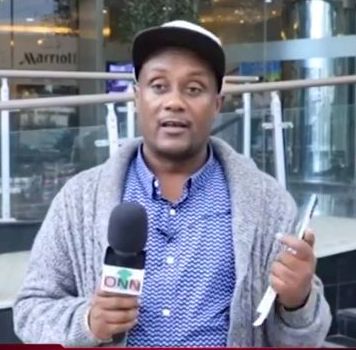
ONN Journalist Dessu Dulla

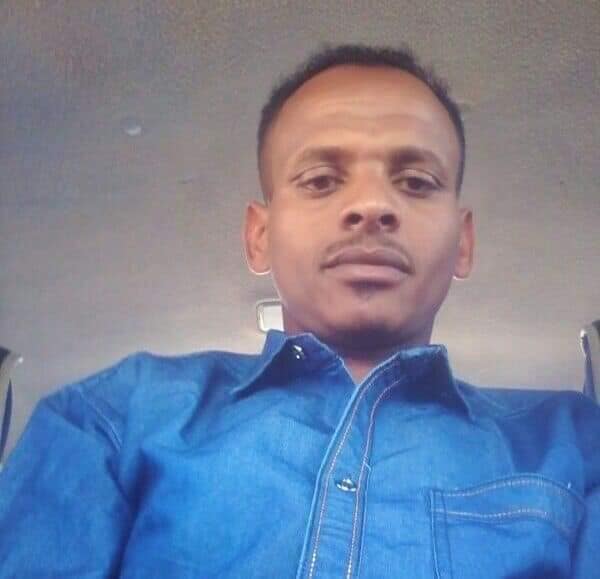
ONN Journalist Wako Nole

On March 7, police arrested Dessu, deputy director of the privately owned Oromia News Network broadcaster, Ismael, a driver for the station, and Wako, a reporter with the Sagalee Bilisummaa Oromoo radio broadcaster, in Burayu, a town in the Oromia region, according to Muhammed Regassa and Betie Urgessa, two Oromia News Network employees who spoke to CPJ via messaging app, and an eyewitness to the arrests who spoke to CPJ on the condition of anonymity, citing safety concerns.

Betie told CPJ that the three appeared in court on March 10, and that police were granted 14 days to hold them in custody, but said they were not charged with any crime.

“Holding journalists for weeks without charge is a violation of their basic rights and a clear effort to intimidate the press; Ethiopia must release Dessu Dulla, Wako Nole, and Ismael Abdulrzaq immediately,” said CPJ Sub-Saharan Africa representative Muthoki Mumo. “Journalists must be allowed to cover regional politics without official interference or fear that they will be arbitrarily arrested.”

Police arrested the journalists and driver shortly after they left the Burayu police station, where they had traveled to speak with Abdi Regassa, a senior member of the opposition Oromo Liberation Front political party, who was detained there, according to Muhammed, Betie, and the eyewitness. Two Oromo Liberation Front party members who were visiting Abdi were also arrested, those sources said.

The eyewitness told CPJ that he heard a police officer shouting that the journalists had taken pictures on their phones before they arrested them and added that officers were likely uncomfortable with the journalists visiting Abdi Regassa. Prior to 2018, Abdi was a commander in the liberation front’s armed wing while it operated from exile and was designated a terror organization; police initially denied having him in custody, according to a report by the privately owned news site Addis Standard.

The Oromia News Network vehicle was involved in a minor road accident at the scene, but those sources told CPJ that it was unrelated to the arrests. Police are still holding the vehicle, Betie told CPJ.

The Oromia News Network, which operated in exile until 2018, primarily covers politics and is targeted at an Afaan Oromo-speaking audience; Sagalee Bilisummaa Oromoo, which broadcasts some of its programming on the news network, hosts programming that is supportive of the Oromo Liberation Front and also covers regional news, according to Muhammed and Betie, as well as CPJ’s review of the broadcasters’ content.

In a phone interview on March 10, Oromia regional government spokesperson Getachew Balcha told CPJ that he did not know anything about the journalists’ arrests. Getachew later acknowledged their detention in an interview with the U.S. Congress-funded Voice of America broadcaster, but said that they were arrested due to prior offenses.

Getachew referred CPJ to the head of the Oromia Peace and Security Bureau, identified as “Mr. Jibril,” for comment. Jibril told CPJ in a phone interview yesterday that he did not know about the journalists’ cases.