Category Archives: Uncategorized
Irreecha Arfaasa to be held May 30
(Melbourne, Irreechaa, September 20, 2021)-The Oromia Irreechaa Organising Committee in Victoria is preparing to celebrate Irreecha Arfaasaa in Melbourne on 30th May.
Head of the Committee, Ob Abdeta Homa, said the celebration marks the end of the dry season (October to April) and the beginning of the rainy season for planting (May to September).
The organisers states that the celebration helps to strengthen and promote the Oromo tradition of respect for nature and gratefulness for life in Melbourne.
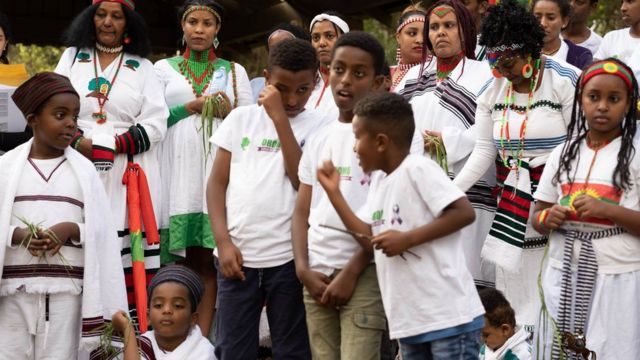
Australian Oromo celebrated this Irreecha on the Mount Dandenong which is found in the South Eastern region of Melbourne.
On this day, people come to gather on mountain tops to give thanks to the almighty Waaqaa(God) for all the blessings throughout the past dry season and ask for Araaraa (Reconciliation), Nagaa (Peace), Walooma (Harmony) and Finnaa (Holistic Development) for the present and the future.
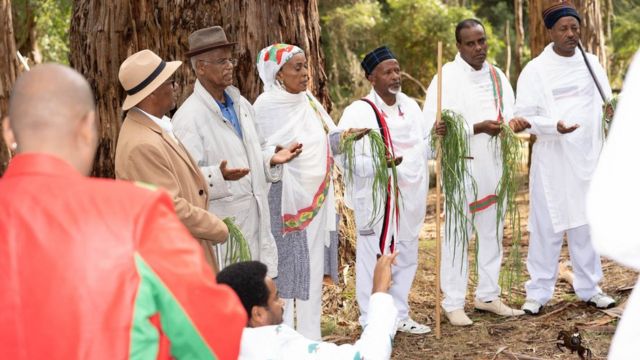
Irreecha Arfaasaa is another annual Oromo Thanksgiving Day that repeats once in a year to mark the end of the dry season and beginning of the rainy and planting season.
The ceremony honors elders’ blessings and wisdom, preserves the heritage and assesses the progress of humanity.
There is also a ceremony of thanking all forebears for their endurance and determination to survive their culture and history – paving the way for further social victory.
In the Oromo tradition the tops of mountains, the hills and other elevated grounds are respected landscapes because they believe that these landscapes represent the value of life and nature.
It is a unique Oromo cultural, historical and natural beautification (planting) in their full glory at the height of the season.
Irreecha Arfaasaa is one of the previous Cushitic religious traditions of praying to God (Waaqa). It has been observed by the Oromo people for more than 6400 years.
Advocacy for Oromia Press Release
(Advocacy for Oromia, 15 May 2021) Advocacy for Oromia condemns the illegal, brutal, barbaric killing of Amanuel Wandimu.
On its press release, Advocacy for Oromia calls all concerned bodies to exert the maximum possible pressure on the Ethiopian government
- to immediately give appropriate political space to the Ethiopian people,
- to address their long-term grievances and demands,
- to allow all-inclusive National Dialogues among political organizations, and
- to extend the election time to include all political parties in the upcoming national poll.


OMRHO e.V. Report for the year 2020
(A4O, 12/01/2021) OMRHO reports documents extrajudicial killings of civilians & other violence perpetrated by Ethiopian govt forces in the year 2020.
“Human Rights Abuses Committed by the Ethiopian Army and the so called ‘’Oromia Special
Forces’’ in Different Parts of Oromia and Ethiopia,” says OMRHO.
The atrocity encompasses extra-judicial killings, mass detentions, torture, arrest of members and supporters of Oromo political parties, without court warrants and etc.
OMRHO e.V. Presents the state of Human Rights violations in Ethiopia since the incumbent group
came to power.
This Report claims by no means a complete coverage of Human Rights abuses in the Empire as:
• people are detained in military camps and in hidden places as opposed to official prisons,
• arrests and detentions are arbitrary and without court warrants,
• the relatives of the imprisoned get no information where the victims are.
• Those who who ask whereabout of prisoner face dangers of arbitrary arrests, abuses etc.
• Lack of access and capacity to cover comprehensively.
Here below is the full report:

OSG Report 54: The Ethiopian government is using extreme violence to force a unitary state on an unwilling population.
Empire strikes back: catastrophic consequences
There seems to be a pattern to all this. It is very worrying.
Teshale Abera, former President of Oromia Region Supreme Court, November 2020.
Despite severe restrictions on the flow of information from Ethiopia OSG continues to record a relentless rise in the death toll as the government stifles all aspirations for selfdetermination for the peoples of Ethiopia.
Particularly large numbers have been killed in Western Oromia, especially in Wallega, where another 92 killings of Oromo have been added to the 350 recorded previously since October 2018. Of these 92, 54 died before mid-2019 and 38 in 2020. An additional 60 Amhara settlers died by government hands in Guliso on 1 November. Government forces have been responsible for at least 442 civilian deaths in Western Oromia, 340 in 2020 alone.
The names of another 42 killed within days of Hachalu Hundessa’s assassination on 29 June are recorded (all except 6 in Central Oromia) and added to the 42 already named as being killed in Report 53.
OSG has now documented 505 killings in 2019, including 100 Qimant in Amhara Region and 150 Sidama in SNNPR. Up to publication, OSG has recorded 777 killings in 2020, including 58 Walaita in SNNPR and 60 Amhara in Oromia Region. Those civilians killed in the war in Tigray have not been included in this total or in this report.
A most worrying development is the increase in reports of detainees being taken from police custody and summarily executed. At least ten of the killings by security forces recorded in this report occurred in custody or when detainees were removed from custody by soldiers.
Another significant development is the arrest of Oromo who are prominent in development, finance, the Oromo Relief Association and the Human Rights League for the Horn of Africa.
No longer are government forces restricting arrests to political activists and journalists. Just as in 1992/3, any prominent Oromo in any sphere is at risk of arrest or killing.
In this report, another 208 killings by government forces are recorded, making the total, despite poor access to information, of over 1,342 killings of civilians by Ethiopian government forces since October 2018.
“Independence is a natural way of being!”
“Independence is a natural way of being!”, says, the apologetic younger generation of Oromia.
The energetic, highly educated, self-respecting, self-confident, very assertive, young and smart Oromo generation is fully determined to be independent by destroying all shackles of colonialism, and the psychology of bondage to Abyssinian/Ethiopian Empire.
Their weekly program, a podcast aims to educate the inferior Oromos, who internalized colonial oppression, and enlighten the world public at large.
We are very much proud of the new generation, and thank the parents who brought them up, teaching them “Independence is a natural way of being” – the way we are created – free from any external subjugation.
Here, please, listen to the weekly podcasts, from ‘Free Oromia Team’: https://www.buzzsprout.com/1447450
Interview with Dr Trevor Trueman, OSG chairman, regarding OHRG Conference 2020
OHRG, a recently set Human Rights group, has organised a two-days public conference to be held on October 24 & 25, 2020.
The theme of the Forum will be “Human Right Crisis in Transition”.
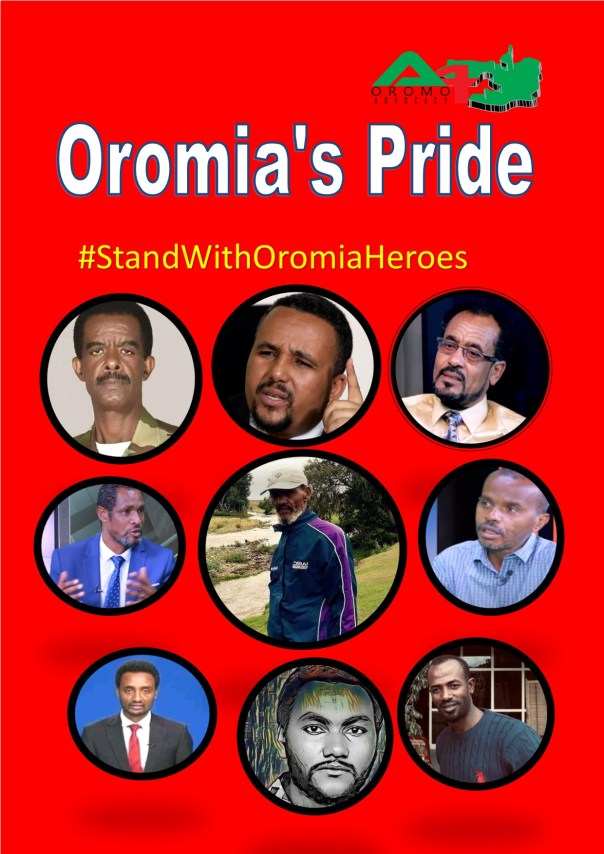
Oromia’s Pride
Abdi Raggasa, Jawar Mohammed, Bekele Gerba, Dejene Tafa, Dhaqqaba Wario, Gammachu Ayyana, Mallasa Dirribsaa, Lammii Beenyaa, Yaasoo Kabbabaa and many thousands of Oromo political leaders, human rights defenders and journalists behind bars: you are the Freedom’s Pride; you are the Oromia’s Pride.
Your bravery, strength and passion for peace, freedom, justice and democracy will prevail.
A4O sent a letter to CARE Ethiopia
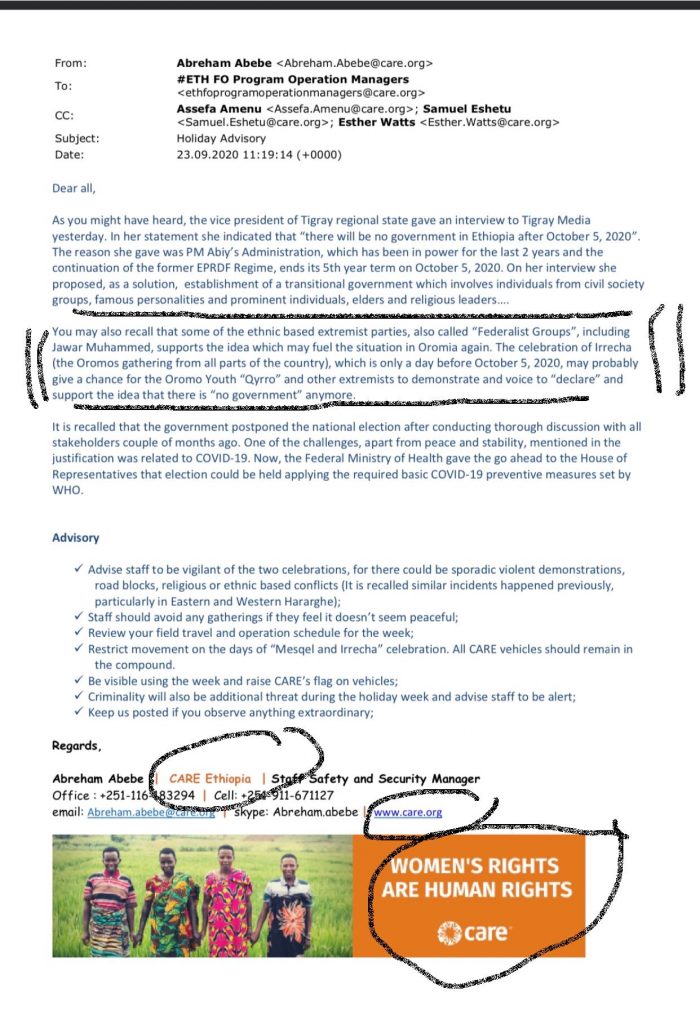
(A4O, 27 Sept 2020) Advocacy for Oromia expresses its great concern regarding recently leaked email sent out to CARE Ethiopia staff.
In the letter sent to CARE Ethiopia, Advocacy for Oromia indicated that the email sent out to give advice to the staff contained oppressive content.
“The email was unprofessional, based in propaganda, unethical, and violates the code of conduct of CARE International,” says the letter.
Advocacy for Oromia further indicates that the content of the internal email contained highly biased words, sensationalised warnings which were discriminatory and vilified Oromos.
The writer of the leaked email, Mr. Abreham Abebe made a bold and false allegation about Jawar Mohammed with no evidence, again inserting highly politicized propaganda into a professional email without context.
Advocacy for Oromia says such remarks are very harmful to the Oromo people (which CARE serves) who are currently facing a government that is accusing and detaining all prominent Oromo leaders to prevent them from participating in the election.
The leaked email is currently circulating on social media and raising concern about CARE Ethiopia’s political involvement in Ethiopia.
Though, Advocacy for Oromia appreciates the services that CARE Ethiopia provides for our community, we also expect respect and dignity to the people being served.
We kindly ask your office to carefully investigate this allegation and to make your stance clear regarding the content of this email sent by Mr. Abebe on 23 September 2020,” says A4O in its letter

Ethiopia detains – then releases – Norwegian academic after he observed Tigray election
The arrest and detention of Kjetil Tronvoll, a highly regarded and engaged scholar with a particular expertise on Ethiopia and the Horn of Africa, will have a chilling effect on freedom of expression and academic inquiry.
Kjetil has now been freed and is on his way home. He has attended two Eritrea conferences hosted by Eritrea Focus.
Source: Blankspot
Norwegian professor detained at Ethiopia airport
By Martin Schibbye | September 13, 2020
Norwegian professor Kjetil Tronvoll is said to have been abducted by police at Bole Airport in the capital Addis Ababa. He most recently came from Mekelle in the Tigray region, where he followed the “illegal election” criticized by the central government.
According to the Norwegian Ministry of Foreign Affairs, information was received during the evening that a Norwegian citizen had been detained at the airport.
– We have also been informed that he has now had the opportunity to travel further, says Ane Haavardsdatter Lunde at the press service at the Norwegian Ministry of Foreign Affairs to Blankspot.
Kjetil Tronvoll is head of the think tank Oslo Analytica as well as professor of peace and conflict knowledge at Bjorknes University. For the past thirty years, he has conducted field studies in Ethiopia, Eritrea and Zanzibar and also worked as an advisor and mediator in several peace processes.
One of his special areas is the development of democracy on the African continent.
But his presence during the election, which was won by the former ruling TPLF party, has been criticized by supporters of Prime Minister Abiy Ahmed for taking a stand for the opposition party.
Something he rejected on twitter this week.
“Just to clarify. I observe the election as part of my 30-year research on political developments in Tigray and Ethiopia. Studying a process does not mean supporting it, but the empirical reality is a key to later being able to analyze the situation. Some seem to confuse this, “wrote the Norwegian professor.
In another follow-up comment on twitter, Kjetil Tronvoll wrote that there was a smear campaign against his presence with allegations that he was there and working illegally on a tourist visa.
“It’s fake! I am here as part of my work as an adjunct professor at the University of Mekelle on an official visa issued by the Ethiopian government. ”
The whole of Ethiopia was supposed to go to the polls in August, but they were postponed to the future. However, politicians in the Tigray region have opposed the postponement of national elections indefinitely, criticizing the Prime Minister for remaining in power without winning any election.
That is why the region’s politicians have arranged their own.
In an interview that Kjetil Tronvoll did recently with Al-Jazeera, he highlighted that both the people in the region and the TPLF party have undergone radical changes in recent years.
According to the ruling party TPLF, what has now taken place is a historic election that has given citizens an opportunity to choose between different political alternatives. They have also warned the government against intervening or in any way trying to stop the election because, according to them, it would be “a declaration of war”.
Relations between Tigray and the central government in Addis Ababa are strained, and in the past the TPLF, the dominant party in Tigray, has dropped out of government cooperation.
When asked by state television (EBC) about the election, the prime minister replied that it was a “minor headache” and that “the election is illegal because only the country’s national election commission can organize elections in Ethiopia”.
When Professor Kjetil Tronvoll returned to Addis Ababa’s airport Bole, he was taken away and detained, according to other passengers.
On Twitter, The Economist correspondent Tom Gardner writes that he was taken to a hotel.
According to the Norwegian Ministry of Foreign Affairs , he now has the opportunity to continue his journey.




 Advocacy for Oromia