Canadian Oromos protest the Ethiopian dictator supports
(A4O, 22 July 2013) July 21, 2013, According to Edmonton, Canada based TV news (CTV) an estimated 100 people were believed to be involved in a heated protest at the Belmead Community League Hall Saturday afternoon.
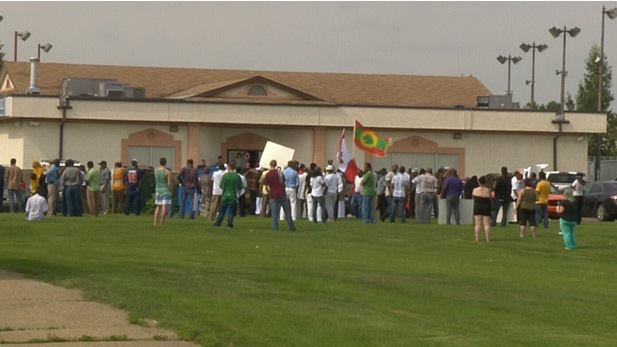 Authorities said about 20 police officers were called in after the situation escalated.
Media and the general public were removed to a safe distance.
Protesters called the gathering in the hall of Ethiopian government supports was illegal and they were standing up for those in their home country.
“They are speaking out you know for the right of their brothers and sisters in their home country and the illegal meeting the government agents are holding here and they are agents and messengers,” Derej Geleta explained to CTV News.
“It is a peaceful demonstration for the right of our peoples in our home country,” he added.
A confrontation was avoid as police lined up with riot gear at the back of the building, creating a safe space for those inside the building to exit into a bus.
Complicating the Notion of Home: Notes on Kuwee’s ‘Home and Exile’
by Tsegaye R. Ararssa
(A4O, 22 July 2013) – Professor Kuwee Kumsa’s 2007 article, ‘Home and Exile’, evoking (and perhaps inspired by) Chinua Achebe’s book with the same title (2000), is extraordinary. It is extraordinary both in its style and in its effect.
In style, it is atypical in that it is presented as a story although it appears in a professional academic journal devoted to social work. It tells a story and does so rather dramatically. In its effect, it enchants us first lamenting injustice (exile) and later expressing a longing for justice/freedom (home). To me, it is one of the most remarkable pieces she has written so far. The fact that it appeared in Qualitative Social Work aside, the piece echoes the style of ‘magical realists’. The story it tells is one that is written as such: a story written in prose but told poetically.
In less than five pages, ‘Home and Exile’ tells the story of suffering and loss, a story of how she lost her brother, but more importantly how she lost her freedom, how she ‘regained’ it, and how she lost it again to a life of exile. Her story can be read as one that does what good stories do: remembering. Re-membering (and bringing back) the deceased and mourning the loss. And unleashing a longing, thereby enchanting us to a different world, a better world, a fairer and a more just world. In her attempt to come to grips with her loss, she tells of the epiphanic moment of reconnecting with her deceased brother, that moment with the Ekerdubbiftuu. And the story— and the re-membering work of the ekerdubbiftuu—brings the brother back. And now, he lives on, with her and, by extension, with us.
1. Complicating the Notion of Home
In this piece, Kuwee successfully problematizes and complicates the notion of home as it should be. “What is home, baby Brother? And what is exile?” she asks. She then refers to enjoying “home in exile” and to the state of being “rendered homeless at home”. She complicates the notion by nudging us in the direction of collapsing boundaries we often take for granted. She does so, for example, by collapsing the boundary between home and exile as she does the ones between escape and entrapment, freedom and bondage, loss and victory, friend and foe, death and life, and dream and reality. “Home is freedom…Home is bilisumma. Home is dignity. Home is justice.”
And “exile is wherever home is not”, at once suggesting that wherever home is not is exile, and wherever oppression is not is home. Even the state of struggle and resistance, the itching and groping, is home—even if it is only a state of longing, of desire, of hope and anticipation. “In an unjust world,” she reminds us, again, through the words of her brother, “home can only be in the struggle to restore freedom and justice.” In a broken world, home is what you make of whatever you have: resistance, struggle, longing, be-longing. In an unjust world, home is made, not necessarily inherited—whether you live in it or you fly away from it, or you submit to its tyranny. Home is what you make. Even when betraying angst at being on exile (deploring the scorching sun and the greed), she seems to insist that, in the context of the Oromo struggle, home can be exile and exile can be home. Hence, the complication.
Reading Kuwee unleashes a host of thoughts in us about home/exile and its deeply problematic nature as a social construct. We are reminded, twice, that at least in the saga of the Oromo struggle for freedom, the friend is the foe, the loss is in triumph, and victory in the loss.
Kuwee seems to draw out this fact, the fact that home is complex as a concept, that it is multiple, layered, fluid, and shifting. As we read Kuwee, we note that the notion of home is at once inviting and elusive. We also note that it is intensely contested and contestable, not to mention the fact that it could be a site of contestations. We encounter its sheer malleability.
2. Malleability of Home
Home is malleable. As such, it can have contrasting meanings. Home can be romanticized as well as demonized. It can, for instance, be viewed as a place to be desired: the cozy space of rest, protection, grounding, and belonging. It can also be viewed as a place to be detested: the unsightly site of oppression, inequality, dispossession, displacement, and injustice. It can be a place of joy, celebration, and festivity. But it can also be a place of woe, lamentation, and suffering. Likewise, it can be a place of love. It can also be a site of violence. It can at once be a place of peace, and a site of war. As a place of peace, home can be viewed as the site of rest, relief, recovery, and of restoration. But it can also be a place of strife, of fear, terror, pain, and suffering. It can be conceived of as a place of care, nurture, and flourish. It can also be a site of domination, exclusion, and destruction. It can be a place of fertility and hope. It can also be a site of death and despair, a site of aborted dreams and deferred hope.
As a metaphor, ‘home’ has been used varyingly as one’s private house, one’s state, one’s country (homeland), or even as one’s body, etc. We shall take up these varied conceptions of home that these metaphors evoke in other subsequent discussions. For now, let us to focus on Kuwee’s ‘Home and Exile’ as we respond, albeit in gloss, to the questions we had raised a while back and share our take on her piece.
3. Five Ways of Viewing ‘Home’: Lessons?
From reading Kuwee, one can identify at least five major ways of conceiving the home, namely: a) home as agency; b) home as a moment; c) home as a process; d) home as a/in relationship; and e) home as a longing.
a. Home as Agency
Home can be conceived as an assertion of agency. In this sense, home is subjecthood, reclamation of the self. It is a re-appropriation of lost and recovered self-hood. It is a projection of a recovered self. It is a discovery of the self, the ‘I’, or the discovery of the collective self, the ‘We’. Home is belonging. For the Oromo person, home therefore is Oromumma, or those layers of identity we juggle through in the routine of everyday life. In a sense, home is me; Home is ‘I’. Home is us, home is ‘We’. Home is in the desire, the deep aspiration to name oneself, and to declare ‘I am me’, that I am the real and the imagined me, but perhaps the as-yet-not-named me. Indeed, home is a moment of self-determination in its primal form. The insistence on freedom and dignity is, in part, an insistence on the imperative of regaining agency.
b. Home as a Moment in time: Home in its Temporality
Home is a moment. It is temporal. It is in time, not just in place, not just in space. It is a moment of arrival, the moment of “slumber” (or death in bilisuma), the moment of rest and infinite bliss. In a sense, it is also that liminal moment, the twilight zone, the moment of reflective and reflexive critical self-awareness. It is a moment of reckoning with oneself. It is one’s moment of destiny. As such, it includes the moment of critical engagement with the self.
c. Home as a Process
But home is also a process, one of self-discovery, self-construction and reconstruction. As a friend once said to me, it is a process of self-recovery. As a process, it involves struggle. Yes, home is struggle. Home is resistance. Kuwee makes this very point in her piece rather emphatically. And, for us, resistance is in the geographic everywhere. And in the temporal now, always.
d. Home as a Relationship and as Relational
Although we don’t see this point made explicitly in Kuwee’s piece, one hardly fail to observe how ‘home’ is implicitly postulated as intensely relational. One notices it in the intense longing to see her brother, in her brother’s lamentation of the loss of several family members which he names one after the other, and in the familial metaphor he uses to refer to the struggle (“the struggle was my only friend, my only love, my only family, my only home”). Even in his insistence that the struggle is not monolithic (“there are struggles within a struggle”), thereby suggesting that the struggle (his home) is not monolithic–that the home has its discords, too–one is confronted with how the notion of home is relational, and intensely so.
Along that line, or away from it, I sometimes think that home is other people. (‘Hell is other people,’ Sartre said. Is he right, I sometimes wonder. But I guess he is, at least in part.) In ideal situations, in the best of times, home is people in whose presence we are free to let be. Home thus is presence. Home is togetherness. It is companionship. Home is friendship. When it works well, it is ‘mutual recognition’ of each other informed by ‘other-regarding’ set of ethical imperatives. Home, conceived in this sense, is harmony. Peace. But home is also strife, friction, quarrel, and misunderstanding. Home could be a site of heartbreak, even of murder.
e. Home as a Longing
For me, home has increasingly come to strike me as that sense of infinite longing to belong. Home is a moment of hope. It is a moment of anticipation. Kuwee’s reconceptualization of home as a longing is thus apt. Thus, home is/in the longing. The longing for freedom, dignity, and justice. The longing that prompts one to struggle. Home is in the wanting to go away, in the wanting to come back. Home is in the desire to go away from injustice—even on to exile—but also the desire to come back, to… the place of wholeness, dignity, and peace.
As a longing, home can be conceived of as a movement, a flight away from an impossible self to a preferred possibility. (Some of us find our homes in our imaginations. Some of us in our readings, in the metaphors, in words that transport us from ‘here’ to ‘there’.) Home is a flight away from injustice, abuse, and all forms of oppression. As Kuwee reminds us in relation to her brother’s escape, prison was a ‘home’ to run away from, and such running away marked the realm of possibilities, of new openings (and of closure, too).
For the Oromo person, home-as-movement is a flight away from colonialism, from that monstrous enemy of selfhood. Home is thus in decolonization (of the mind, the body, and the land.) It is in the re-appropriation of one’s legitimate place of abode, one’s place of seeing, being, and living. In a sense, home is self-estrangement. It is a flight away from the self, in the constant search for a better self, in becoming “what we were not at the beginning” (a la Foucault). As a longing, home is in the transience, too. It is the quest for the permanent in the transient, the abiding in the passing.
But most importantly, home is the quest for that eschatological moment, the moment of experiencing the sublime, the moment of bliss. It is the longing for bilisumaa, for the “ultimate home”, for our “only permanent exile”, and our “only permanent home.” (Here we witness complication par excellence’.)
Conclusion
In conclusion, one can also say that home is in us (echoing the social constructionist thesis which Kuwee seems to embrace). Home is what we make, both literally and figuratively. As we read Kuwee’s extraordinary piece and the remarkable story she tells, we find ourselves thinking that, in a sense, home is our story. It is in what we tell the world. Even when it is the place we tell a story about, home is, in a sense, in what we say. It is in our words. With words, we create our homes. We claim our homes. We claim our place in the world. With them, we make, or find, our way of being in the world. We find our bearings, collective as well as individual. In our stories, we find our voices.
Our voices, our words, our home.
May we continue to tell our stories, stories of resistance, struggle, and longing. May we all find, and found, our homes in our words, in our voices, in our stories. May our words take us from ‘here’ (the site of exile, the site of oppression, violation, and injustice) to ‘there’ (the home site, the site of freedom, emancipation, dignity, and justice). May we, like Kuwee, find the words—and the concepts–with which we can imagine our freedom. May we find metaphors with which to inscribe the tunes of our hearts, even the songs of freedom. May we discover words with which to write songs of (re-)enchantment, songs that excite us towards the pillars of our freedom: liberty and equality, justice and dignity–our values in the presence of which we find our home, in the absence of which we will always be on exile.
__
*Tsegaye R. Ararssa is a Melbourne-based legal scholar.
Abbyssinia accused of `cultural genocide’
(A4O, 22 July 2013) Dr. Gemechu Megerssa who was in the U.S. to be a part of the 50th Golden Jubilee of artist Ali Muhammed Birra strongly accused the Abyssinian cultural, economic and political volition.
“We lost our rights and our land, as well as our identity by weapon,” said Dr. Gemechu Megerssa. “Cultural genocide is the systematic destruction of Oromo traditions, values, language, heritage, legacy and other elements which make an Oromo people distinct from other groups.”
Dr Gemechu added that the the governments of the west have a moral responsibility for the genocide of Oromo people from past to present. “We are saying you can’t just continue killing us, this has to stop somewhere, and we are telling to all governments who are supporting wrong regimes in Ethiopia. They should instead make positive intervention so that we who live in the horn all come together and peacefully settle our differences and start a new chapter.”
In this second part, Dr. Gemechu discusses effects of State sponsored violence on indigenous Oromo cultural heritage, legacy of systematized Abyssinian supremacy, and the historical portrayal of the Oromo in the Ethiopian State.
Oromos are masters of coexistence with their neighbors
(A4O, 21 July 2013) Jawar Mohammed speaks, finally: “For those who are still attempting to recycle the old divide and destroy tactic, be sure that Oromos have a time tested culture and system that cherishes its diversity and promotes pluralism.”
In recent weeks, several video clips from my speeches at various events have been systematically edited to present a narrative that portrays me in the worst moral and political light. The latest of these doctored videos are pieced together to create the impression that I was advocating violence against Christians in Ethiopia. Needless to say, this is a calculated and horrendous political strategy so commonplace in the Ethiopian political landscape. Let me say as clearly as I can: I find such views so revolting and so repugnant that it has no place in any civil political discourse. Whatever motivated those who engaged in EPRDF style character assassination, this past week has given us an impeccable evidence about the state of our media and the place of truth, and journalistic ethics in their operations. It is also ironic that many of the individuals and groups engaged in this propaganda are the same people who went a long way to disparage me as ’naïve’, ‘spineless’, and ‘passivist’ for writing and speaking about nonviolence. Given the sensitivity of the issue and the malicious manner in which these videos were edited and presented, I want to take this opportunity to explain the context in which that particular speech was delivered.
On May 25, 2013, I was invited to speak at a town hall gathering organized by Risala International, a consortium of three Minnesota-based mosques. There were several prominent spiritual and secular leaders from various communities in North America. Present were also representatives from the Minnesota delegation to the U.S. congress. Based on my own observation and the organizers account, the audience consisted of Muslim Oromos, non-Muslim Oromos, non-Oromo Muslims, and Ethiopians of other faiths.
As I do with every invitation, I asked the organizers to give me a specific topic to address, a language of their preference, and format of the presentation. In this case, the organizers asked me to analyze whether the Oromo struggle and ongoing Muslim protests for religious freedom are complementary or contradictory. I prepared my presentation in Afan Oromo, however, after learning there were attendees who do not understand the Oromo language, I ended my comments with a rather condensed summary in Amharic. Given the moderator was flying the ‘times up’ sign on my face, I did not have the privilege of explaining my point in details
It was at the end of that comment that I made a statement which led to a controversy and used by interested group to advance their own political agenda. I said where I grew up, where Muslims make up majority, there is a broad consensus that people would stand up and fight; and the saying goes, they would fight with what is traditionally known as Menca in Afaan Oromo. Here I was trying to underscore the point that even if politically powerless, being numerical majority brings about a sense of collective security which leads people to confront the abusive state head on forcefully. Hence, this serves as a restraining factor against those who seek to undermine their dignity. In contrast, where the politically oppressed is also numerically outnumbered, the sense of vulnerability might lead to submission to injustice; consequently enabling the oppressive system to violate their rights with no fear of repercussion.
Every normative community has its own unique way of assigning and discerning meaning in a text or utterance. The expression I used is a sarcastic expression used for a humorous effect. Although it did not occur to me at the time, sarcasm, like satire and irony, works precisely on the slippage between what is said and what is meant. It is often joked among Oromos that Manca is a weapon of pride in Hararghe, as Shimala (a stick) is in Shawa, Eboo (a spear) is among the Arsi, Togorri for Karrayyuu and so on. These cultural expressions make meaning only within the cultural geography in which they are uttered. I suspect that the majority of the participants attending the consortium understood that the expression is intended not as a statement of fact but as sarcastic expression that signifies almost the opposite of what it seems to say. However, when several versions of the video—some of it doctored to generate the political effects needed by my detractors—several friends, colleagues, and other individuals who did not understand this cultural context expressed their disappointment, hurt, and even a rage. I fully regret these unintended consequences and the lack of foresight on my part.
I understand that a lot of Ethiopians disagree with my views and I welcome all constructive debates and criticisms. However, taking my statements out of context and juxtaposing unrelated events for mere character assassination is not only malicious but also an outdated political tactic. In this era of heightened instant communication lies have a shelf life of minutes before being countered by facts. But during that short lifespan, they could cause serious harm, not so much to their targeted subject, but more so to the unsuspecting general public.
If it is of any help, those who want to mislead the public should know that I am a product of an interfaith marriage. My father was a Muslim and my mother was from an Orthodox Christian background. Moreover, my wife is a Lutheran. I do not advocate religious freedom and interfaith understanding and tolerance because it is fad of the time. I was raised with and live by those values.
Now let me return to the real issue at stake. I would like to remind all that the defamation campaigns, including the distortion of this video followed the Al Jazeera program that focused on the plight of the Oromo people, in which I was a panelist. The frenzy has now gone beyond defamation and verbal threat. Abdi Fite, a young Oromo journalist was recently ambushed in Washington DC, physically attacked and threatened with knife to his throat. This attack happened following a video Abdi released sharing his perspective on being an Oromo. Those who are trying to silence the Oromo voice through physical and symbolic violence should reflect on history and revise their strategy. My reading of history is that targeting Oromo individuals have not yielded the intended result of destroying the struggle of Oromo People.
The Oromo people have a just cause that no amount of violence nor distortion can delegitimize. The Oromo nation has produced and continue to produce sons and daughters that pick up and carry the flag when one comrade falls. For those who are still attempting to recycle the old divide and destroy tactic, be sure that Oromos have a time tested culture and system that cherishes its diversity and promotes pluralism. Oromos are masters of coexistence with their neighbors. They are also fierce warriors in defense of their sovereignty. The just Oromo struggle is about restoring dignity to a people who have been ruthlessly denigrated, and violently subjugated. It is a struggle that gives back to the people their right to self determination in its fullest sense. This sacred goal must be achieved no matter the cost.
Source: http://www.gulelepost.com/2013/07/20/jawar-mophammeds-clarification-on-minnesota-specch/
The Oromo and the War on Terror in the Horn of Africa
(A4O, 18 July 2013) In August 2011, Bekele Gerba, an English teacher at Addis Ababa University and prominent politician, met with a delegation from Amnesty International to discuss the human rights situation in Ethiopia.
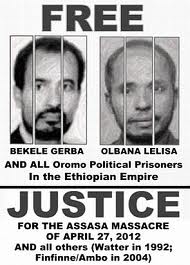 Gerba, a vocal activist on behalf of his largely Muslim Oromo people, was deputy chairman of the opposition party Oromo Federalist Democratic Movement (OFDM) and a member of the executive committee of Medrek, the country’s main opposition coalition.
To the Ethiopian government, however, Gerba was a terrorist. Four days after the meeting, he was arrested. In November 2012 Gerba was convicted and imprisoned under Ethiopia’s 2009 Anti-Terrorism Proclamation for association with the banned Oromo Liberation Front (OLF), which the government has asserted is linked with al-Qaeda affiliated entities.
According to organisations like Amnesty International and Human Rights Watch, however, Gerba was guilty of being Oromo and talking of the plight of his people. Shortly before his arrest, Gerba had described the challenges facing his community, telling Voice of America “Anyone who speaks the [Oromo] language and does not belong to the ruling party is a suspect and can be taken to prison any time.” Gerba and other incarcerated Oromo (Oromo rights groups estimate there are around 20,000 Oromo political prisoners in Ethiopia) continue to spark protests in Ethiopia and across the global Oromo diaspora.
Who are the Oromo?
For Further Reading: https://advocacy4oromia.org/oromia-issues/the-oromo-and-the-war-on-terror-in-the-horn-of-africa/
Dr Gemechu Megerssa shares his in-depth knowledge and understanding of Oromummaa
(A4O, Jul 18, 2013) On July 4th, Oromos gathered in Minnesota to celebrate the 50th Golden Jubilee of artist Ali Muhammed Birra. As a lifelong friend and compatriot, Dr. Gemechu Megerssa talks about Dr. Ali Birraa, Afran Qallo, the concept of Oromo, Oromummaa, the Oromo notion of race, “we” & “them” dichotomy & much more.
Dr. Gemechu also shares his work, life, knowledge of Anthropology of over the last 40 years experiences.
In this first part, Dr. Gemechu discusses his life and work, the legacy of the Afran Qallo cultural movement, Ali Birra’s work, and his understanding of Oromumma.
The following individuals contributed to the rich discussion with Dr. Gemechu: Dr. Ezekiel Gebissa, Ayantu Tibeso, Jawar Mohammed, Hashim Adam, Girma Taddese, Birhanemeskel Segni.
Exploring Oromia
(A4O, 9 June 2013) Exploring Oromia is a unique exploration program that provides an opportunity to learn about a wide variety of Oromia.
The exploration program presented by Daandii Ragabaa Production shows a wonderful school project produced by Jitu Dhabessa.
The project was presented @ Noble Park secondary college, Melbourne, Australia for exploring the world project. The purpose of the project was to widen the students’ geological and cultural knowledge but also for the benifits of the students’ public speaking skills.
Jitu said “I wanted to present Oromia because it deserves more recognition.”
Oromos seek justice in Ethiopia
(A4O, June 25, 2013) The Oromo people make up about 40 per cent of Ethiopia’s population, yet face widespread discrimination and have long been targeted by the government.
Over many years, millions of Oromos have fled their homeland to become refugees in other nations. The Oromo people are found largely in Ethiopia, northern Kenya and parts of Somalia.
So what should be done to stop the marginalisation of the Oromos and end Ethiopia’s internal ethnic divide?
Ogaden Refugees Fleeing Government Persecution
By Graham Peebles
Voices from Dadaab
The Ethiopian military and paramilitary forces, operating in the Ogaden region of Ethiopia, are, it is alleged, carrying out extra judicial killings and gang rapes; falsely arresting and torturing innocent civilians; looting and destroying villages and crops in a systematic attempt to terrify the people. This is the consistent message coming out of the region and from those who have fled persecution and are now in the world’s largest refugee camp, in Dadaab, Kenya. It is a message of government brutality and collective suffering taking place not only the Ogaden but in a number of areas of Ethiopia, including the Amhara region, Gambella, Oromia and the Omo valley. Regime brutality thatGenocide Watch (GW) consider “to have already reached Stage 7 (of 8), genocide massacres, against many of its peoples, including the Anuak, Ogadeni, Oromo, and Omo tribes”. They call on the EPRDF regime to “adhere to it’s own constitution and allow its provinces the legal autonomy they are guaranteed.”
Around five million people live in the Ogaden (or Somali) region of Ethiopia. Predominantly ethnic Somali’s, mostly pastoralists, they live in what is one of the least developed corners of the world. Ravaged by drought and famine, the region has been the battleground for violent disputes between Ethiopia and Somalia for generations. The Ogaden National Liberation Front (ONLF), claim the people of the region want self-determination from Ethiopia, a right they have ben fighting for since their formation in 1984. A right enshrined in the 19th Century agreement (enacted in 1948) with Britain, when sovereignty and control of the region was passed to Ethiopia. A crucial proviso, successive Ethiopian governments have conveniently ignored.
With the international media banned by the Ethiopian government since 2007 and with an economic and aid embargo being enforced the region is totally isolated, making gathering information about the situation within the five affected districts difficult. I recently spent a week in Dadaab where I met dozens of refugees from the Ogaden; men, women and children who repeatedly relayed accounts of murder, rape, torture and intimidation at the hands of government forces. Accounts that if true, – and we have no reason to doubt them, confirm reports from among others, Human Rights Watch, Amnesty International and Genocide Watch – who make clear their view, that the Ethiopian government has “initiated a genocidal campaign against the Ogaden Somali population”, constituting “war crimes and crimes against humanity”.
State terrorism
The people, victims of terrible abuse, carry with them the scars, often physical, always psychological, of their horrific ordeal. Listening to their stories and the testimonies of former Liyuu personnel, a clear picture of the systematic approach being employed by the Ethiopian military and Liyuu Police operating within the Ogaden emerges.
Arbitrary killings, rape, torture and destruction of property are the unimaginative preferred tools of terror, ‘use the penis as a weapon against the women’ the men are told, burn villagers homes and steal their cattle, confiscate humanitarian aid-including food and create an intolerable fear ridden environment in which to live. Men joining the Ethiopian military and Liyuu Police, like 25 year old Abdi who arrived in Dadaab in January 2013 and like many was forcibly recruited, are told, “there is no court that can control you, that we were free from the law, enjoy your freedom, they told us.” The methodology of occupation, including extra judicial killing, is made clear, “we were told to rape the young women… When we went into the rural areas, we were 300 men. When we saw a young mother with children aged from one years old to five years old, we would rape her.”
Soldiers that commit many rapes, murders and robberies, Abdi tells us, are “rewarded and praised. They were given bonuses of around 5000 ETB ($250) as a present, in addition to the salary that was 2000 ($100) ETB a month.”
Women, like 27-year-old Rohar, tell of arbitrary arrests and torture. Imprisoned with her husband when she was “in the ninth month of pregnancy. We were made to walk for three days and three nights before a bus collected us and drove us for one more day/night to Jijiga.” Detained for two years without charge in Jail Ogaden in Jijiga, Rohar, as most detainees are, was accused of supporting the ONLF and “repeatedly tortured from the very beginning even though I was pregnant. They would tie a rope around the branch of a tree and a noose around my neck, then they would pull on the rope to strangle me. The evidence is still on my body – (she shows me a terribly burn scar on her neck).” Throughout this time she reports being “raped by groups of soldiers. It used to happen around midnight. I can only remember the first three men who raped me. They would take me out and leave the child/baby in the room with the other women, and bring me back in the early morning.” Rohar was released when she was no more use to the soldiers after becaming unwell with abdominal pains, caused, she believes, by the repeated rapes. This account, from beginning to end is typical of many women’s experiences.
A divisional commander, now in Dadaab, related how during their three-month training in the Liyuu they were shown demonstrations in “how to rape a woman, and how to break a virgin”. They are carrying out these atrocities in order “to make the people afraid and to place them under the control of the Ethiopian military, and fundamentally “because there is oil in the region and the government wants the oil for themselves. The military is there to make the people fearful so they won’t support the ONLF.”
Back in the late 19th century, when the region was under British control, oil was suspected to be present in the region, in 1936 under the Italian occupation geological mapping of the Ogaden Basin began by the Italian oil company AGIP. Their records were later used by other companies in early studies of the region and in the early 1940’s oil exploration in the Ogaden basin began.
In 1972 the American company Tenneco drilled a series of wells and found oil and gas. These discoveries mean the region now desperately poor, is potentially the richest area of the country. In 1975 in the wake of the Ethiopian revolution, the company stopped operations and the military junta expelled all foreign companies. In the past fifty years or so it is estimated that 46 wells have been drilled searching for the black gold.
It would appear the Ethiopian government sees the natural resources of the Ogaden as another party asset to add to its burgeoning portfolio. People living within 100 km of oil exploration sites have been displaced, some GW tell us are herded into internally displaced camps, whilst others are simply made homeless. Sharing the view of the Liyuu recruit, the ONLF believes the Ethiopian military intends to secure the resources for the government and exclude local people. The Africa Faith and Justice Network confirms this view, saying: “With the discovery of petroleum leading to exploration missions by foreign companies, the government’s motives [in the region] are questionable.”
Donor neglect and self-interest
Why, In the face of such blatant state criminality, do donor countries – America, Britain and the European Union, who provide between a third and a half of Ethiopia’s federal budget, remain silent. Ethiopia is of course a key strategic ally of America and the west in their fight against extreme Islamic groups, conveniently situated for the Gulf States the US has military bases in Ethiopia from where it launches its unmanned drones into Somalia and Yemen. Add to this the potential oil bonanza in the Ogaden and indeed elsewhere in the country and a toxic cocktail of mixed motives and self-interest starts to ferment.
The EPRDF government, under the premiership of Mr. Hailemariam Desalegn, when confronted with accounts of military criminality issues blanket denials and accuses groups such as HRW of political bias and misinformation. Duplicitous and disingenuous, the regime, which own most of the media in Ethiopia, seeks to control the flow of information within and without the country, and hide the atrocities being committed by the military and Liyuu to innocent civilians in the Ogaden and indeed elsewhere. If the government has nothing to hide Mr. Desalegn then open up the region to humanitarian aid groups and international media and allow journalists unrestricted access.
Peace is the number one priority in the Ogaden and for humanity more broadly, and all measures to remove the obstacles to its realization should be made by those working for the people of the region. Discussions held in Nairobi in September 2012 (and I understand set to resume), broke down when the ONLF refused to accept the condition of constitutional recognition asked of them by the government team. This was unfortunate and to my mind ill-judged; better to enter into discussions with an open mind and, once trust is established, begin to make requests and agree compromise than deny the possibility of progress. What should be insisted upon however, is that both the military/Liyuu and the ONLF lay down their arms and agree an unconditional ceasefire, it is hard to see how one can negotiate a long term solution whilst innocent men are being tortured, women raped, children terrified and homes destroyed.
Source: http://www.nationofchange.org/ogaden-refugees-fleeing-government-persecution-1371218628
Persecuted ethnic Oromo demand UN protection
(A4O, 20 June, 2013 Cairo, Egypt )- For months, Gutama Gallatobati, a proud farmer and mechanic of Oromo descent languished in an Ethiopian prison over accusations he burned an Ethiopian flag. While inside, guards physically abused him.
Sada Ahmed, a mother of five children and wife of a wealthy husband lived a good life in Ethiopia until she was accused of financially supporting the rebel group Oromo Liberation Front (OLF). Her husband disappeared in Sudan and she was forced to flee to Egypt.
The Oromo make up 40 percent of the Ethiopian population. However, the minority Tigray government has persecuted the Oromo people, jailing more than 20,000 suspected OLF members. As a result, many have been forced to flee, leaving behind family, friends and jobs.
Ahead of World Refugee Day on Thursday, the Oromo who have fled to Egypt are again endangered.
| “Our case cannot be resolved with lawyers and judges and courts … We don’t want legal protection, we want physical protection.“– Mohamed Zein, Ethiopian journalist |
Over the last few weeks, there has been an emergence of xenophobic attacks against Ethiopians on the streets of Cairo, motivated by Ethiopia’s goal to build the “Grand Renaissance Dam“.
The Ethiopian government is planning to dam the Blue Nile for hydroelectric power, a move Egypt worries will affect its water supply.
In response to the project, Egypt’s government has reached a new level of bellicose rhetoric. In a televised meeting of key government officials recently, former presidential candidate Ayman Nour suggested Egypt launch air strikes to stop construction of the dam. Others proposed destabilising the Ethiopian government by funding rebel groups.
The Oromo in Egypt are now caught in the middle here and say they’re facing increased hostility from Egyptians.
In response, hundreds of Oromo refugees have staged a sit-in outside the Cairo office of the United Nations High Commissioner for Refugees (UNHCR) demanding safety. They’ve refused to leave, sleeping on the grass outside the building, near leaking sewage from a surrounding apartment complex.
Jeylan Kassim, head of the Oromo Sons/ Daughters Refugee Association, has played a leading role in organising the protests. “We will not leave until the UNHCR will protect us,” he told Al Jazeera.
A heavy silence blankets the Oromo as they sit on scraps of cardboard listening to members of the community discuss in frustration fruitless meetings with UNHCR representatives.
The UN says it cannot provide temporary shelter or food outside the UNHCR building because they do not have authority over the land, nor the resources to supply those camping out for the nearly two weeks.
The UN has offered a phone hotline for refugees to call with their problems, as well as legal assistance.
But the Oromo say this is not enough. “Our case cannot be resolved with lawyers and judges and courts … We don’t want legal protection, we want physical protection,” says Mohamed Zein, a journalist from Ethiopia.
He fled to Egypt after he was falsely accused of providing secret government information to NGO Human Rights Watch and the Eritrean government.
 |
| Follow spotlight coverage of the struggling young democracy |
The UNHCR acknowledges the situation is a difficult one but says its options are limited. “The outcome is not in your hands. As the United Nations, you don’t get involved in [internal] politics,” says UN press officer Ahmed Aboughazala.
The Oromo in Egypt are united not only by their heritage, but also by a collective sense of uncertainty.
When 33-year-old Gutama Gallatobati arrived in Cairo a month ago, he thought his biggest troubles had been left behind. A week ago, however, his landlord evicted him from his apartment and his belongings were taken. When asked what reason he’d been given, he sighed: “The Nile.”
“They said if you take our water, we will take your blood,” recounted Abdi Harboury, a lanky youth shy to make eye contact.
According to the Oromo community, Abdi was the first person to have been attacked over the dam issue. He was beaten by three Egyptian youth, they say.
Hussein Ahmed, an asylum seeker who has been in Cairo almost two years, admitted he lies when asked about his origins. “I was at the barber and he asked me, ‘Where are you from?’ I said Nigeria. I am scared to say I am from Ethiopia.”
Even outside the UNHCR office, the refugees say it is not safe. Ahmed said he was beaten recently, and a woman was groped on her way to find a toilet. They claim the police did nothing to stop the attacks.
Some police officers have told locals passing by that the refugees are not suffering, and are being paid by the American government to protest, the Oromo say. “They protest in the day and then at night they’re paid and many of them leave,” said a young officer, who declined to give his name because he was not authorised to talk to the press.
Egyptian Foreign Minister Mohamed Kamel Amr, meanwhile, arrived last Sunday in Addis Ababa to meet with his Ethiopian counterpart in an attempt to find a political and economic solution over the dam issue.
Ethiopia and Egypt agreed to hold further talks on the impact of a huge Ethiopian dam project to quell tensions between the two countries over water-sharing.
Until it gets resolved, however, the Oromo who fled persecution in Ethiopia say they will continue to face threats to their safety in Egypt.
Source: http://www.aljazeera.com/indepth/inpictures/2013/06/201361711365644208.html




 Advocacy for Oromia