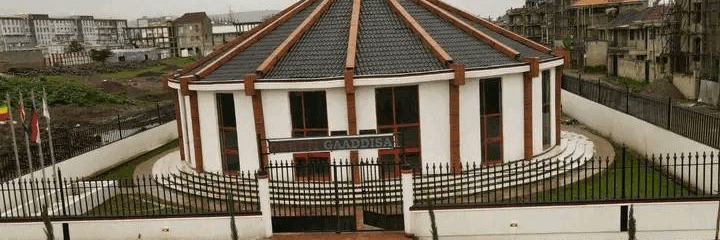
Special Report: ABO Women’s and Children’s Affairs Wing (DDD) Celebrates International Women’s Day in Gullallee
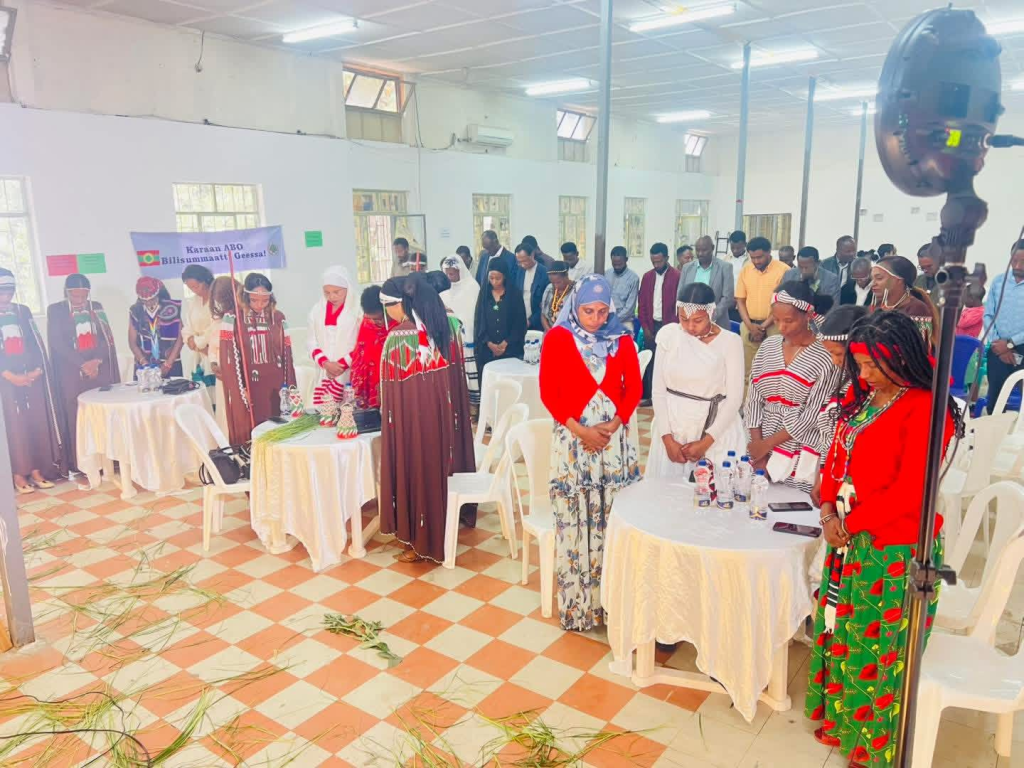
Under the powerful theme “Women’s Participation in Politics is Fundamental to Peace, Justice, Unity, and Nation-Building,” the Women’s Wing honors the indispensable role of women in the Oromo struggle.
GULLALLEE, March 7, 2026 — The Women’s and Children’s Affairs Wing (DDD) of the Oromo Liberation Front (ABO) celebrated International Women’s Day today at the ABO Main Office in Gullallee, gathering under a theme that left no doubt about the centrality of women to the liberation movement.
The event, held on March 7—one day ahead of the global observance—carried the resonant theme: “Women’s Participation in Politics is Fundamental to Peace, Justice, Unity, and Nation-Building.”
A Celebration of Recognition
The gathering in Gullallee brought together women fighters, community members, and leaders to honor not only International Women’s Day but specifically to recognize the contributions of Oromo women to the ongoing struggle for liberation.
The Women’s Wing organized the celebration with deliberate timing—ensuring that the message of women’s indispensable role would echo through the community before the world turned its attention to International Women’s Day on March 8.
The Theme: Participation as Foundation
The chosen theme reflects a profound understanding within the ABO: women are not merely participants in the struggle—they are its foundation. Without their full political participation, peace cannot be lasting, justice cannot be complete, unity cannot be achieved, and the nation cannot be properly built.
This recognition moves beyond rhetoric. It acknowledges that the liberation of Oromia cannot be separated from the liberation of Oromo women, and that any future Oromo state must be built with women’s full and equal participation from the ground up.
Women at the Heart of the Struggle
The celebration in Gullallee comes at a moment when the role of women in the Oromo liberation movement is receiving increasing attention. From the ancient Siinqee institution—a traditional women’s system of mutual protection and conflict resolution—to the Qarree movement of young women activists today, Oromo women have always been at the forefront of resistance.
Yet their contributions have too often been overlooked in historical accounts. Events like this International Women’s Day celebration serve as corrective acts—public acknowledgments that the struggle could not continue without the women who fight, organize, endure, and sacrifice alongside their male counterparts.
A Message to the World
By celebrating International Women’s Day with this particular theme, the Women’s and Children’s Affairs Wing sends a clear message to the international community: any engagement with the Oromo question must take seriously the role and rights of Oromo women. Peace processes that exclude women will fail. Political settlements that ignore gender equality are illegitimate. Nation-building that sidelines half the population builds on sand.
Looking Forward
As the world marks International Women’s Day on March 8, the women of the ABO and the broader Oromo community stand as living proof that the struggle for national liberation and the struggle for women’s liberation are one and the same. Their participation in politics is not a concession to be granted—it is a right to be recognized and a necessity to be embraced.
The celebration in Gullallee on March 7, 2026, will be remembered as a moment when the ABO affirmed, clearly and publicly, that the future Oromia they are fighting to build will be one where women’s voices are heard, their contributions honored, and their leadership embraced.
The Women’s and Children’s Affairs Wing (DDD) of the ABO extends warm International Women’s Day greetings to all Oromo women and to women around the world fighting for justice, equality, and liberation.

Honoring Oromo Women: A Celebration of Strength and Sacrifice
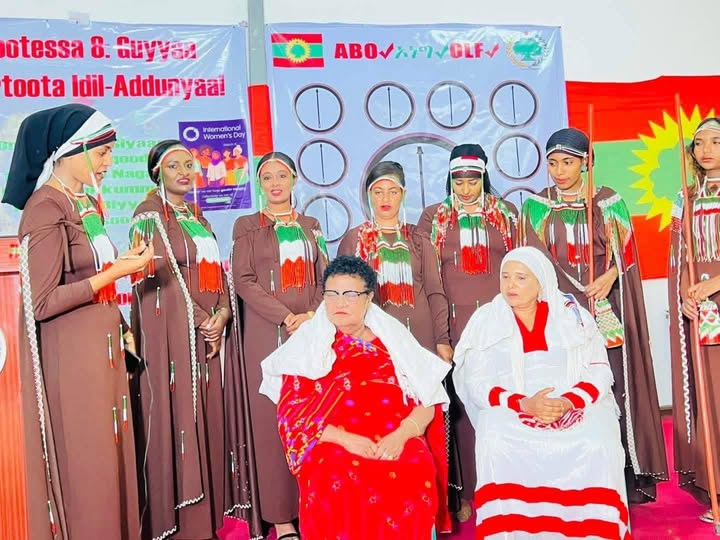
In a ceremony marked by deep respect and gratitude, the Women’s and Children’s Affairs Wing of the Oromo Liberation Army (ABB) in Gullallee honored two remarkable women for their enduring contributions to the Oromo struggle.
GULLALLEE, OROMIA — As the world celebrated International Women’s Day, the Women’s and Children’s Affairs Wing of ABO in Gullallee turned the occasion into a powerful moment of recognition for two women whose artistic and personal sacrifices have left an indelible mark on the Oromo liberation movement.
In a formal ceremony, the Women’s Wing presented a ceremonial shawl (Gaabii) to Artist Ilfineesh Qannoo and Aadde Olaantuu Gammachuu, wife of the late artist Zarihuun Wadaajoo. The gesture was more than symbolic—it was a public acknowledgment of women whose contributions to the struggle have often been carried out away from the spotlight, yet whose impact resonates through generations.
Ilfineesh Qannoo: The Mother of Love and Resistance
Artist Ilfineesh Qannoo, widely known as “Haadha Jaalalaa” (Mother of Love), represents a unique convergence of art and activism in the Oromo experience . Her life and voice have become intertwined with the identity and aspirations of her people, making her far more than an entertainer—she is a symbol of resilience, a living archive of Oromo cultural expression, and a quiet warrior whose medium has always been melody and meaning.
Throughout her decades-long career, Ilfineesh’s songs have carried the deep cultural motifs and subtle yearnings of the Oromo people, serving as a soundtrack to both everyday life and collective struggle . She did not simply perform; she gave voice to history, to joys, to sorrows, and to an enduring hope that has never dimmed despite the challenges faced by her people.
In the words of those who have documented her legacy, Ilfineesh became a “mallattoo cichoominaati”—a symbol of identity and steadfastness . Her music has been a vessel carrying the language, the pain, and the beauty of her community, affirming its existence and its right to be heard. The title “Haadha Jaalalaa” speaks to the nurturing quality of her presence, both personal and public. For her biological family, she has been the center of love and care. For her wider community, she has offered a maternal embrace through her art, providing comfort, strength, and a profound sense of belonging.
One tribute to Ilfineesh captured her essence powerfully: “Her life is a triptych of resistance—the body as battleground and banner, the art as weapon and compass, the bridge between fronts” . She has stood with the Oromo Liberation Army in spirit and solidarity, strengthening their resolve, while also being the soulful voice reaching diaspora halls, university students, and international audiences. She has connected the armed vanguard to the cultural heartland, proving that the struggle is fought with both conviction and culture, in both the forest and the concert hall.
Aadde Olaantuu Gammachuu: Strength Through Sacrifice
The ceremony also honored Aadde Olaantuu Gammachuu, widow of the esteemed artist Zarihuun Wadaajoo. Her recognition speaks to a different but equally vital dimension of the struggle: the quiet, often invisible sacrifice of women who support, sustain, and survive alongside those who take up the public mantle of resistance.
As the wife of Zarihuun Wadaajoo—an artist whose own contributions to Oromo culture and consciousness remain cherished—Aadde Olaantuu has carried the weight of personal loss while continuing to embody the resilience that defines Oromo womanhood. Her presence at the ceremony, honored alongside Ilfineesh Qannoo, served as a reminder that the struggle is not fought by individuals alone, but by families, by partners, by those who endure separation, worry, and grief while their loved ones answer the call of their people.
The Women’s Wing’s decision to honor both women together reflects a profound understanding: the artist who gives voice and the woman who gives strength through her quiet endurance are two sides of the same coin. Both are essential. Both deserve recognition.
The Significance of the Gaabii
The presentation of the Gaabii—a traditional ceremonial shawl—carries deep cultural meaning. In Oromo tradition, draping a respected figure with a shawl is an act of profound honor, a public acknowledgment of dignity, worth, and gratitude. It says: “We see you. We value you. We thank you.”
For the Women’s and Children’s Affairs Wing of ABO in Gullallee to bestow this honor on International Women’s Day amplifies its significance. It declares that the struggle for Oromo liberation cannot be separated from the struggle for women’s recognition, and that the women who have carried the movement—as artists, as mothers, as widows, as quiet pillars of strength—must be honored not in abstract but in tangible, public ways.
Women in the Oromo Struggle
The ceremony in Gullallee reflects a broader recognition of women’s indispensable role in the Oromo liberation movement. From the ancient Siinqee institution—a traditional women’s system of mutual protection and conflict resolution—to the Qarree movement of young women activists today, Oromo women have always been at the forefront of resistance .
Yet their contributions have too often been overlooked, their sacrifices minimized, their names omitted from the roll of honor. Events like this International Women’s Day ceremony serve as corrective acts—small but significant gestures toward setting the historical record straight.
A Call for Continued Recognition
As the Gaabii was draped around Ilfineesh Qannoo and Aadde Olaantuu Gammachuu, the message was clear: this honor is not merely for them, but for all the women whose names may never be recorded but without whom the struggle could not continue.
The Women’s and Children’s Affairs Wing of ABO in Gullallee has set an example that deserves emulation across Oromia and the diaspora. By taking the time to identify, honor, and thank the women who have given so much, they remind us all that gratitude is not merely a feeling but an action—and that honoring those who came before is essential work for those who carry the struggle forward.
Ilfineesh Qannoo and Aadde Olaantuu Gammachuu join a growing list of Oromo women being formally recognized for their contributions to the liberation movement. May their examples inspire gratitude and recognition for women everywhere who give, sacrifice, and endure for the sake of their people.

Honoring the Heroes of Oromia: A March Tribute to Those Who Sacrificed for Liberation
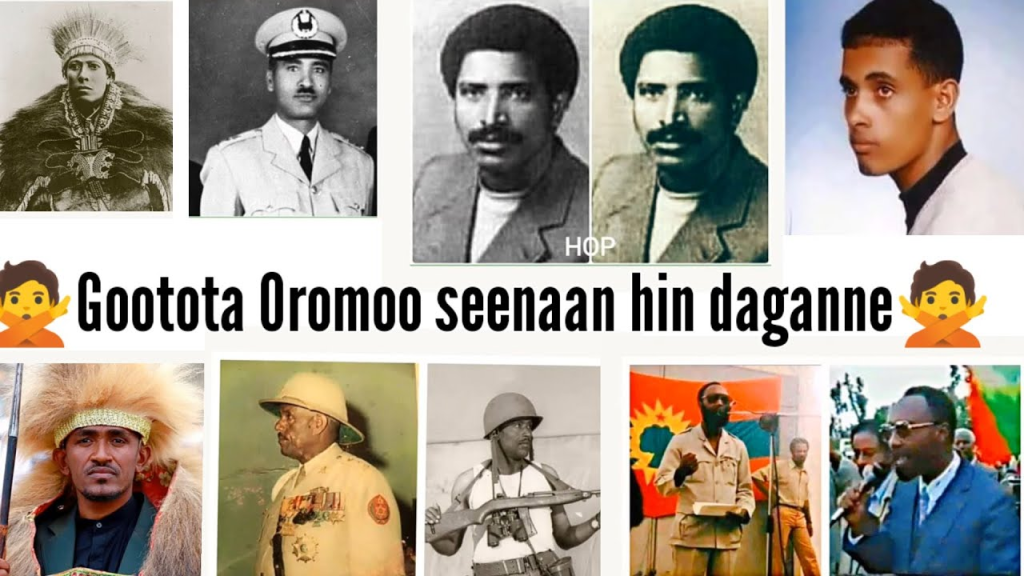
As the month of March unfolds, it carries with it the weight of memory—a time to reflect on the extraordinary sacrifices of Oromo heroes who gave everything for the freedom and dignity of their people.
March holds particular significance in the Oromo liberation struggle. It was in this month, on March 19, 1975, that General Tadesse Birru—the father of modern Oromo nationalism—was executed by the Derg regime alongside fellow commanders Hailu Regassa and other Oromo leaders. Their blood soaked the soil of Addis Ababa, but their legacy seeded the consciousness of generations to come.
General Tadesse Birru: The Father of Oromo Nationalism
Colonel General Tadesse Birru (circa 1920 – March 19, 1975) stands as a colossus in Oromo history—a man whose journey from loyal imperial soldier to revolutionary nationalist embodies the Oromo people’s awakening to self-determination .
Born in Salele, Shewa province, Tadesse’s early life was marked by tragedy. His father, Birru, was killed by poison gas during the Second Italo-Ethiopian War, and his mother died of grief just three months later. Orphaned, young Tadesse joined his uncle as a member of the Arbegnoch—patriots fighting Italian occupation. Captured and sentenced to life in prison with hard labor in Mogadishu, he was freed when the British captured the city in 1940, received military training in Kenya, and returned to Ethiopia in 1941 .
His military career was distinguished. By 1954, he was a lieutenant colonel, later commanding the “Fetno-Derash” (Rapid Force)—Ethiopia’s special forces. In a remarkable historical footnote, it was Tadesse Birru who trained Nelson Mandela in guerrilla warfare and gave the South African anti-apartheid leader his famous lost Liliesleaf pistol .
The turning point came during a meeting with Prime Minister Aklilu Habtewold. Unaware of Tadesse’s Oromo heritage, the prime minister suggested it was unwise to educate or recruit Oromos into the military. This revelation of deep-seated prejudice transformed the general. He joined the Mecha and Tulama Self-Help Association in 1963, a Oromo social movement that his public stature elevated into a pan-Oromo organization advocating for Oromo empowerment through education and self-reliance .
The government responded with brutal repression. The organization was banned, its members arrested, killed, or exiled. Tadesse was placed under house arrest, escaped after three years, and attempted an unsuccessful coup in 1966. Captured and tortured, his death sentence was commuted to life imprisonment. Released but kept under house arrest in Gelemso, he was visited by legendary Oromo leaders including Baro Tumsa, Elemo Qiltu, and Shaykh Bakhri Saphalo .
As the imperial regime weakened in 1974, Tadesse escaped and returned to Addis Ababa. The Derg offered him the Ministry of Interior—he refused twice. When police came to detain him, he fled again and began organizing an armed Oromo rebellion in Shewa, joined by fellow officers including Colonel Haile Regassa. In respect to the defunct Oromo army of Elemo Qiltu, his forces operated under the name of the Oromo Liberation Army (Waraanna Bilisummaa Oromoo) .
Captured along with Hailu Regassa, they were tried, sentenced to life imprisonment, then executed by the Derg on March 19, 1975. The OLA continued to operate and became part of the Oromo Liberation Front in 1976 .
Tadesse’s legacy is immeasurable. His lectures on Oromo identity and nationhood inspired an entire generation, leading to the reaffirmation of Oromo culture, language, and identity. He is rightly considered the father of modern Oromo nationalism .
Jaarraa Abbaa-Gadaa: The Uncompromising Combatant
March 2013 brought another grievous loss. Jaarraa Abbaa-Gadaa, the great national hero of Oromia, passed away in exile on March 3 of that year, still actively engaged in the liberation struggle until his final days .
Known in his youth as Abdulkarim, Jaarraa began his activism organizing secondary school students in Harar, speaking with “touching eloquence” about the trials of the Oromo people under imperial rule and the responsibility of the new generation to organize for national resistance .
He joined the heroic Bale resistance led by Waaqo Guutoo and others, then continued organizing in neighboring Somalia, where he resisted efforts to subordinate Oromo national aspirations to the Greater Somalia project. Finding sanctuary in South Yemen, he played a decisive role in planning a pan-Oromia liberation struggle. His daring 1969 return to Oromia ended in over five years of Somali imprisonment—a setback that only hardened his resolve .
Released in 1975 as Siad Barre prepared for war with Ethiopia, Jaarraa courageously reminded the Somali president that Oromos wished to continue their sacred mission to liberate Oromia. When this proved unacceptable, he secretly slipped back into Oromia, consulted with underground leaders including Baro Tumsa, and successfully reignited the fire of pan-Oromo national liberation .
General Ismail Ahmed of the Somali regime later recalled Jaarraa’s courage in speaking truth to power: “Abdulkarim was courageous, and he loved and respected his people very much” .
The Bale Resistance: Waqo Gutu and Elemo Qiltu
The Bale Revolt of the 1960s produced two other towering figures whose sacrifices in March and beyond shaped Oromo resistance.
Waqo Gutu Usu (1924 – February 3, 2006) was a revolutionary leader of the Bale Revolt, which fought against the feudal system of the Ethiopian Empire. Born to an Oromo father and Somali mother, his rebellion began almost accidentally when a grazing rights conflict was ignored by the central government. After waiting in vain for three months, Waqo “went to Somalia and brought back 42 rifles and two Thompson submachine guns” .
By 1966, about three-fifths of Bale Province was in turmoil. The revolt, running from 1964 to 1970, addressed issues of land, taxation, class, and religion. Waqo surrendered in 1970, but the struggle he ignited continued .
After the Ethiopian revolution, Waqo established the United Oromo People Liberation Front in 1989 and later formed the ULFO in 2000 to unite armed and political groups fighting for Oromo self-determination. He died in a Nairobi hospital on February 3, 2006, survived by 20 sons and 17 daughters. Following the fall of the EPRDF regime in 2018, a statue of Waqo Gutu was erected in Bale .
Elemo Qiltu (Hassen Ibrahim) was another legendary figure who gave his life in the struggle. Visited by General Tadesse Birru during his house arrest, Elemo commanded Oromo forces in the Bale resistance. The Oromo Liberation Army later named its Shewa unit in honor of his defunct army, ensuring his name lived on .
Hachalu Hundessa: The Voice of a Generation
Though June 29, 2020, not March, claims the date of his assassination, no tribute to Oromo heroes would be complete without Hachalu Hundessa—the 34-year-old singer whose murder by gunmen in Addis Ababa sent shockwaves through Oromia and the diaspora .
Hachalu was more than a musician. He was “a voice for the deliberately silenced,” in the words of Amina Dedefo, a young Oromo activist. “A majority of Oromo people don’t have education or access to education. They’re not able to articulate their struggles, but he did it for them through his music” .
His songs like Maalan Jira directly addressed the preservation of Oromo land and culture. His lyrics served as the soundtrack to the Oromo-led social movement that defined Ethiopian politics from 2014 to 2018. Ayantu Ayana, an Oromo historian, likened Hachalu to “a living, breathing historical archive for a group of people whose cultural ways have been continually endangered” .
Hachalu spent five years in prison for his activism as a young man, writing many of his early songs behind bars. His music resonated in “the soul of every Oromo person,” bridging generations in the diaspora and at home. “Hachalu made it cool to be Oromo and to be proud of it,” said Girma Hassen of the Oromo Cultural Institute of Minnesota .
His assassination sparked massive protests and a brutal government crackdown, with Amnesty International reporting at least 5,000 arrests. But his legacy endures. As Abdulrahman Wako, a young Oromo organizer in Minnesota, reflected: “Being Oromo is something I used to run away from. But when I saw Oromo youth peacefully protesting against the Goliath that is the Ethiopian government, I felt closer to what my dad and grandfather had to go through” .
Ancient Heroes: Oromo Commanders at the Battle of Adwa
The tradition of Oromo heroism extends back centuries. At the Battle of Adwa on March 1, 1896—another March date of profound significance—Oromo commanders played decisive roles in securing Ethiopia’s victory over Italian invasion .
Fitawrari Gebeyehu (Abba Gammada) was a top-ranking Oromo commander and hero, known for his bravery and leadership. He led the advance guard and is celebrated for his sacrifice, dying in the heat of battle while charging Italian positions .
Dejazmach Balcha Safo (Abba Nefso) was an influential Oromo general who later became Governor of Sidamo. He led Oromo soldiers and distinguished himself through valiant resistance .
Ras Makonnen Wolde Mikael, though of mixed Oromo and Amhara ancestry, commanded a large contingent of troops and was one of Emperor Menelik II’s most trusted generals .
Fitawrari Tekle and Birru Wolde Gabriel also commanded Oromo troops, contributing to the victory that ensured Ethiopia remained independent .
The Living Legacy
As March 2026 unfolds, the Oromo people carry forward the legacy of these heroes. The struggle they began continues. The torch they lit still burns.
General Tadesse Birru, executed March 19, 1975, taught that Oromo identity was not a source of shame but a wellspring of dignity. Jaarraa Abbaa-Gadaa, who passed March 3, 2013, demonstrated that courage never compromises. Waqo Gutu, who died February 3, 2006, showed that resistance can take many forms. Elemo Qiltu gave his life in the field. Hachalu Hundessa gave his voice, then his blood.
The young Oromo generation, in Minnesota and across the diaspora, has taken up their mantle. As Amina Dedefo said, borrowing Hachalu’s own words: “Waa’ee keenya yoo Otto dhissan silaa nama hin dhiisu”—”Even if we left our struggle, our struggle won’t leave us” .
In this month of memory, we honor:
- General Tadesse Birru – Father of modern Oromo nationalism, executed March 19, 1975
- Jaarraa Abbaa-Gadaa – Uncompromising liberation fighter, died March 3, 2013
- Waqo Gutu – Bale Revolt leader, died February 3, 2006
- Elemo Qiltu – Legendary commander of early Oromo forces
- Hachalu Hundessa – Voice of the Oromo people, assassinated June 29, 2020
- Fitawrari Gebeyehu and the Adwa commanders – Oromo heroes of March 1, 1896
Their sacrifices were not in vain. The Oromo people endure. The struggle continues. And one day, when Oromia is free, their names will be carved not only in memory but in the foundations of a nation they gave everything to build.
Gootota Oromoo, ulfina fi kabajaan isinif haa tahu!
(Heroes of Oromia, honor and respect be upon you!)

Amnesty Report Under Fire: OLA Rejects Sexual Violence Allegations as “Investigative Failure” and “Portrait of Bias”
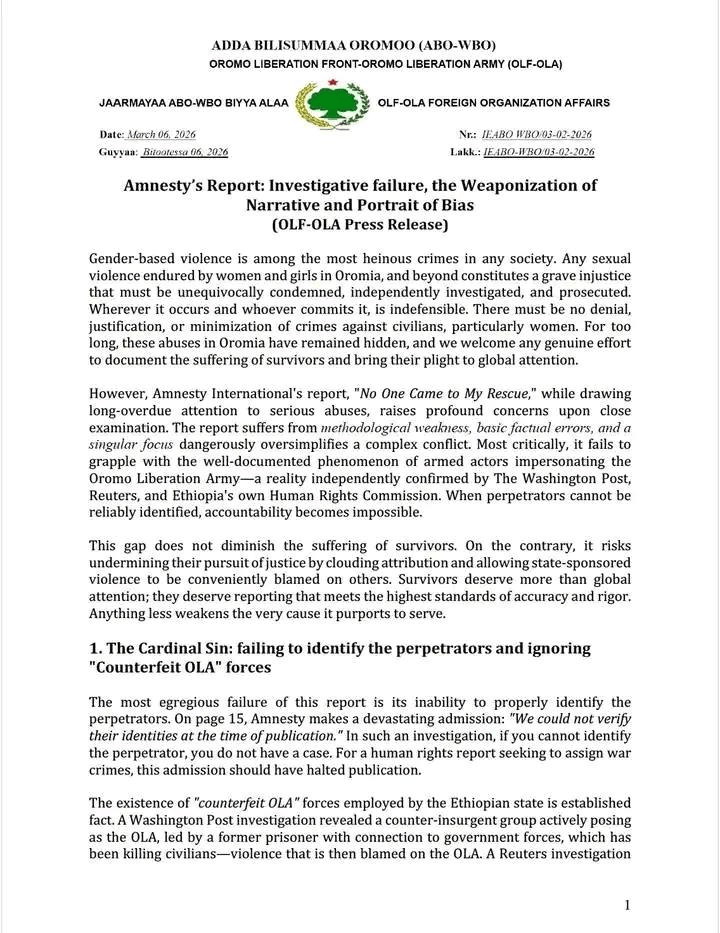
In a blistering 11-page response, the Oromo Liberation Army accuses Amnesty International of ignoring documented evidence of state-sponsored “counterfeit OLA” forces, factual errors about command structures, and selective focus that lets the Ethiopian government “off the hook.”
MARCH 6, 2026 — A day after Amnesty International released its devastating report documenting gang rape, sexual slavery, and mass displacement in western Oromia, the Oromo Liberation Army (OLA) has fired back with a detailed, point-by-point rebuttal accusing the world’s largest grassroots human rights organization of “investigative failure,” “weaponization of narrative,” and “portrait of bias.”
The OLA’s response, issued by its High Command, does not deny that women have suffered sexual violence. “Gender-based violence is among the most heinous crimes in any society,” the statement begins. “Any sexual violence endured by women and girls in Oromia, and beyond constitutes a grave injustice that must be unequivocally condemned, independently investigated, and prosecuted.”
However, the organization argues that Amnesty’s report, titled “No One Came to My Rescue,” is so fundamentally flawed in its methodology, factual accuracy, and attribution that it risks undermining the very justice it purports to serve.
The “Cardinal Sin”: Failure to Identify Perpetrators
The OLA’s most damning critique centers on what it calls the report’s “cardinal sin”: its inability to properly identify the perpetrators of the documented violence.
On page 15 of the Amnesty report, researchers make a striking admission: “We could not verify their identities at the time of publication.”
For the OLA, this admission alone should have halted publication. “In such an investigation, if you cannot identify the perpetrator, you do not have a case,” the response states. “For a human rights report seeking to assign war crimes, this admission should have halted publication.”
The OLA argues that this failure is particularly egregious given the well-documented existence of what it calls “counterfeit OLA” forces—armed actors employed by the Ethiopian state who actively pose as OLA fighters while committing atrocities, which are then blamed on the liberation movement.
The “Counterfeit OLA” Phenomenon: Documented Reality
The OLA’s response cites multiple independent investigations establishing the existence of state-sponsored forces masquerading as OLA fighters.
A Washington Post investigation revealed a counter-insurgent group actively posing as the OLA, led by a former prisoner with connections to government forces. This group has been killing civilians—violence that is then attributed to the OLA in official narratives.
A Reuters investigation uncovered the operations of the Koree Nageenyaa (Security Committee), a clandestine body of senior Oromia officials that has ordered extra-judicial killings and illegal detentions. Crucially, Reuters found that the massacre of the Karrayyuu Abba Gada leaders was orchestrated by these officials, who then instructed the Oromia Communication Bureau to attribute the killings to the OLA.
The OLA points to a telling detail in the Amnesty report itself: survivors say the perpetrators “wanted to be identified and explicitly told victims they were OLA” (p. 15). For the OLA, this is a classic hallmark of a false flag operation.
“Why would actual OLA fighters, operating in their own strongholds, need to announce their identity as they commit crimes, and to villagers who would already know them?” the response asks. “The behaviour described fits the precise profile of agents provocateurs sent by the state to commit atrocities and blame on the OLA.”
The OLA’s accusation is stark: “By utterly ignoring this well-documented reality, Amnesty International is not just making a mistake; they are actively laundering the reputation of a state-sponsored death squad. They are taking the government’s propaganda at face value and presenting it as human rights research.”
The “Draining the Sea” Doctrine: A State Confession Ignored
The OLA response highlights what it considers a staggering omission: the failure to connect documented displacement and home-burning to the explicit, publicized policy of the Ethiopian regime.
Fekadu Tessema, the Oromia Prosperity Party chief until recently, publicly stated: “We have to drain the sea to catch the fishes.”
This is a publicly stated counter-insurgency doctrine that views the civilian population (the sea) as the support base for the OLA (the fish). The mass displacement, the burning of homes, and the terrorization of communities described in the Amnesty report are, the OLA argues, a textbook implementation of this state policy.
“Amnesty’s report, by blaming the OLA for this displacement, has effectively taken the confession of a senior government official and turned it into an indictment of his victims,” the response states.
The report’s legal analysis, which claims “it is reasonable to believe that the armed group’s fighters are using sexual violence to expel a section of the civilian population” (p. 23), is, in the OLA’s view, “rendered absurd by the existence of a documented state policy with the exact same goal.”
Factual Errors: “Shoddy Research” Undermines Credibility
The OLA response catalogs what it describes as basic factual errors that undermine the report’s credibility. These include:
- “The OLA has five main commands” (p. 11) — The OLA states this is FALSE; it has eight commands across Oromia.
- “The Western command is led by Jal Gemechu Aboye” (p. 11) — The OLA states this is FALSE; Gemechu Aboye has never been the Western Commander.
- “The Central Regional Command… is reported to be led by Jal Jiregna” (p. 11) — The OLA states this is FALSE; the central command has never been led by anyone called Jaal Jiregna.
“If Amnesty International cannot accurately report the number of commands or the names of commanders, why should any reader trust their conclusions about specific acts of violence?” the response asks. “This is not a minor oversight; it demonstrates a fundamental lack of understanding of the subject they are investigating and casts yet another doubt on every single ‘finding’ in the report.”
The Selective Lens: Ignoring State Culpability
Perhaps the most substantive critique concerns what the OLA calls the report’s “selective lens”—its focus solely on the OLA while ignoring overwhelming evidence of state-perpetrated violence.
The OLA response cites United Nations data showing that state forces (ENDF, police, and affiliated militias) were responsible for 70% of all human rights violations in Ethiopia in 2023, affecting 7,103 victims. All non-state armed groups accounted for only 22.3%.
The UN also documented that between August and December 2023 alone, 18 drone strikes by the ENDF resulted in 248 civilian deaths and 55 injuries, destroying schools and hospitals.
Other investigations by the UN International Commission of Human Rights Experts on Ethiopia (ICHREE) have consistently indicated the disproportionate role of regime forces in abuses.
“Amnesty International is aware of these figures. They are public,” the OLA response states. “Yet they chose to produce a report that effectively ignores the primary perpetrator of violence in the region. This effectively makes the report a political hit job, not a human rights report. By singling out the OLA, Amnesty, wittingly or otherwise, seem to be providing cover for a state that has raped, killed and displaced far more civilians.”
Methodological Concerns: Remote Research and Unverified Claims
The OLA raises serious concerns about Amnesty’s research methodology. The report acknowledges it was conducted during a government-imposed communications blackout with restricted access (p. 11). Interviews were conducted via “encrypted communication apps” (p. 8).
“In an environment of intense state surveillance and propaganda, where ‘counterfeit OLA’ forces are actively trying to frame the OLA, relying on remote testimony without the ability to forensically verify the scene, the perpetrators, or the chain of command is a recipe for disaster,” the response argues.
“The victims’ trauma is real, but the attribution of that trauma is based on the word of individuals in a war zone who are being terrorized by multiple regime forces, including those pretending to be the OLA. A responsible human rights organization would have paused, acknowledged the ‘unverified’ status of the perpetrators, and investigated the role of state-sponsored imposters. Amnesty did the opposite: they rushed to print a headline that condemns the OLA and exonerates the regime.”
Call for Report Withdrawal and Independent Audit
The OLA’s conclusion is uncompromising:
“Amnesty International’s ‘No One Came to My Rescue’ is a reckless and biased document that fails the standards of investigative rigor. By ignoring the well-documented existence of ‘counterfeit OLA’ forces and the state’s own policy of ‘draining the sea,’ by getting basic facts about the OLA’s command structure wrong, and by ignoring UN data showing that the state is responsible for 70% of all abuses, Amnesty has produced a report that is as flawed as it is dangerous.”
The OLA alleges that the report, “wittingly or unwittingly, provides diplomatic cover for a regime that tortures its citizens, runs secret death squads (Koree Nageenyaa), and kills civilians with drones on daily basis. It denies the OLA, a legitimate armed actor in a non-international armed conflict, as the report itself concludes, the presumption of a fair investigation. And worst of all, it weaponizes the trauma of ten women to serve a political narrative that lets the primary perpetrators of violence in Oromia—the Ethiopian regime and its proxies—off the hook.”
The OLA formally requests that the report be withdrawn and its methodology subjected to an independent audit.
Call for Independent Investigations
The response concludes by reiterating the OLA’s long-standing call for independent investigations into serious crimes previously attributed to it—calls that have largely been dismissed or ignored by the Ethiopian regime and its backers.
The OLA notes that the regime has mounted a sustained diplomatic campaign to terminate the mandate of the International Commission of Human Rights Experts on Ethiopia at the United Nations Human Rights Council, effectively shutting down the body in the midst of its investigative work.
“Against this backdrop, the OLA reiterates its call for comprehensive and genuinely independent investigations, not only into the latest allegations documented in western Oromia, but across all parts of the Oromia region where there is evidence of grave abuses committed,” the statement concludes. “Ensuring justice for survivors requires a process that is independent, transparent, and capable of examining the actions of all actors involved in the conflict. Only through such an approach can accountability be established, disinformation avoided, and the dignity and rights of victims upheld.”
The OLA’s full statement was issued on March 6, 2026. Amnesty International has not yet responded to the OLA’s specific allegations regarding the report’s methodology and factual accuracy.

Navigating Media in Restricted Spaces: The Art of Careful Communication
In an era of information saturation, those living under media restrictions face a unique challenge: how to express truth without inviting persecution.
In countries where media freedom does not exist, the act of communication itself becomes a calculated risk. Every word published, every opinion shared, every piece of information disseminated carries potential consequences—not just for the individual, but for their family, their community, and their cause.
The principle is simple but its application requires constant vigilance: in places without free media, nothing is simply as one wishes it to be.
The Landscape of Control
When media is not free, it is not merely absent—it is actively controlled. Information is filtered, shaped, and often fabricated to serve the interests of those in power. Independent journalism is suppressed. Social media is monitored. Private communications are intercepted.
In such environments, citizens learn quickly that open expression carries risks. A post critical of the government can lead to arrest. Sharing a news article from an independent source can invite interrogation. Even private conversations, if overheard by the wrong ears, can have life-altering consequences.
This is not paranoia. It is the lived reality for millions of people across the globe—including, many would argue, in parts of Ethiopia where media freedoms have been severely constrained in recent years.
The Power of Brevity and Clarity
For those who must communicate under such conditions, the counsel is wise: present information briefly and clearly.
Long, elaborate arguments provide more material for those who would twist words. Complex analyses offer more footholds for misinterpretation. The clearer and more concise the message, the harder it is to distort.
This does not mean abandoning truth or avoiding difficult subjects. It means recognizing that in restricted spaces, communication is a strategic act. Every word must earn its place. Every statement must be crafted with awareness of how it might be read—not only by intended audiences but by those who would use it as a weapon.
The Necessity of Self-Censorship
The advice continues: understand that what is not explicitly stated may be subject to distortion.
In free societies, context and implication can be taken for granted. Readers understand nuance. They fill in gaps with shared understanding. But when communication crosses boundaries—whether geographic, political, or ideological—what is left unsaid becomes vulnerable.
Those who monitor communications for signs of dissent are trained to find meaning in omission, to read between lines, to construct narratives from silence. The careful communicator must anticipate this, must consider not only what they say but what others might claim they meant.
Strategic Self-Presentation
The final counsel is perhaps the most important: exercise care in presenting one’s own thoughts and opinions.
This is not about abandoning principles or hiding one’s true beliefs. It is about recognizing that in hostile environments, the manner of expression can be as important as the content. Timing matters. Audience matters. The choice of words—and the choice of which words to leave unspoken—can determine whether a message reaches its intended recipients or lands its sender in prison.
Lessons for Diaspora Communities
For those who have escaped such environments and now live in countries with greater media freedom, the habits of careful communication do not always fade. Many in the diaspora continue to practice the same caution they learned at home—guarding their words, measuring their statements, calculating risks even when risks may no longer exist.
This is both a survival instinct and a connection to those still living under restriction. When diaspora communities communicate with people inside restricted countries, they must remember that their words may be read by more than their intended audience. A supportive message from abroad can become evidence against someone at home.
The Ethical Responsibility
For journalists, human rights advocates, and all who communicate across these boundaries, the lesson is clear: we must exercise care not only in what we say but in how we say it.
We must be brief where brevity protects. We must be clear where clarity defends. We must anticipate distortion and guard against it. And we must never forget that for many of our sources, our readers, our colleagues, the stakes of communication are not abstract—they are matters of life and liberty.
Conclusion
In a world where media freedom remains the exception rather than the rule, the art of careful communication is essential. It is not cowardice to measure one’s words. It is not compromise to consider consequences. It is wisdom—the hard-won wisdom of those who have learned that in places without free media, nothing is simply as one wishes it to be.
The goal remains truth. The commitment remains justice. But the path must be walked with eyes open, with steps measured, and with constant awareness of those who would use our words against us and against those we seek to serve.
This commentary is offered in solidarity with journalists, activists, and ordinary citizens around the world who continue to speak truth under conditions of media restriction. Their courage inspires us; their safety concerns us; their voices must be amplified—carefully, clearly, and with constant attention to the consequences.

Amnesty Report Documents Sexual Violence in Oromia, But Critics Question Omissions
A new investigation from Amnesty International accuses OLA fighters of gang rape and sexual slavery, yet some argue the report fails to adequately address abuses committed by government forces.
NAIROBI/ADDIS ABABA — A highly anticipated report released yesterday by Amnesty International has documented horrific accounts of sexual violence, summary killings, and displacement in Ethiopia’s Oromia region—abuses the organization says may amount to war crimes. However, the findings have already drawn sharp criticism from some quarters, with detractors alleging the report is “filled with lies” and fails to properly investigate atrocities committed by government forces.
What the Amnesty Report Found
Titled “No One Came to My Rescue: Gang Rape, Sexual Slavery, and Mass Displacement of Women in Oromia, Ethiopia,” the briefing documents 10 cases of sexual violence in the Sayo and Anfillo districts of Kellem Wallaga zone—areas described as strongholds of the Oromo Liberation Army (OLA).
According to the report, nine of the survivors said they were raped or otherwise abused by OLA fighters, while one survivor reported sexual violence by both OLA fighters and a soldier from the Ethiopian National Defense Force (ENDF). Amnesty said five of the cases involved survivors who endured both gang rape and sexual slavery, sometimes over periods lasting days or weeks.
Seven of the survivors were under the age of 18 at the time of the assaults, Amnesty said, adding that three of them were 17 at the time they were interviewed by researchers. Two survivors became pregnant as a result of the assaults, one of whom was still pregnant during the interview.
The organization documented harrowing testimony from survivors. One mother told Amnesty: “For three weeks, 15 men raped my child and me. They took turns.” The mother and daughter were held for three weeks, “their hands tied to a tree where they were raped by multiple men from the OLA,” the report said .
“These May Amount to War Crimes”
Amnesty concluded that the conflict between the OLA and Ethiopian government forces—including the ENDF, Oromia Special Police, Oromia regional police, and local militias—meets the threshold of a non-international armed conflict under international law, governed by the rules of international humanitarian law including the Geneva Conventions.
“These repeated abuses are not only horrific but may amount to war crimes,” said Tigere Chagutah, Amnesty’s regional director for east and southern Africa.
The organization said several survivors reported being targeted because their male relatives were members of local government militias. Amnesty also documented cases in which survivors were forced to flee their homes after the attacks, fearing further violence from OLA fighters.
“Nine of the survivors are displaced from their homes after they were subjected to sexual violence,” the report said, noting that many feared fighters would return to rape them again or kill them. Amnesty added that fighters also burned homes in some cases, which it said contributed to the forced displacement of civilians.
Communication Blackout Enabled Abuses
The report raised concerns about limited documentation of abuses in Oromia, citing a year-long communications blackout in 2019 and subsequent restrictions on communications and access to conflict-affected areas by international and regional rights monitors. It also referenced what it described as increasing pressure on journalists and human rights defenders.
“These cowardly acts were partly enabled by a communication blackout that shut out the rest of world to the sustained atrocities against civilians,” Chagutah said.
Criticism: A One-Sided Narrative?
Despite the gravity of the findings, the report has already faced significant criticism from those who argue it presents an incomplete picture of the conflict. Detractors contend that the report is “filled with lies” and fails to properly investigate and expose abuses currently being committed by government forces.
The criticism centers on the disproportionate focus on OLA-perpetrated violence. Of the 10 documented cases, only one mentions abuses by government forces—and that single case involved violence by both an ENDF soldier and OLA fighters . Critics argue that government forces, including the ENDF, Oromia Special Police, and regional police, have been implicated in widespread abuses that deserve equal scrutiny.
This critique aligns with findings from other human rights organizations. The Oromia Support Group (OSG), in a comprehensive report submitted to the 61st session of the UN Human Rights Council just days before Amnesty’s release, documented a starkly different picture of the conflict. According to OSG, the organization has now recorded 7,511 Oromo civilian deaths under Prime Minister Abiy Ahmed’s rule, with most victims being young people from the Qeerroo generation.
OSG’s Report 72 documents horrific accounts of sexual violence perpetrated by government soldiers, stating that “children, prepubescent girls and young boys, and mothers of families have been cruelly raped. The rape and killing of teenage girls and girls aged as young as ten years are documented”.
The OSG report also details deliberate shooting of infants and children under ten years old by national defense forces, “for frivolous reasons”.
Broader Pattern of Violence
The Ethiopian Human Rights Commission (EHRC) has independently confirmed ongoing violence in Oromia. In a statement released just days before the Amnesty report, EHRC documented that since October 2025, renewed attacks by armed groups in multiple districts of Arsi Zone—including Shirka, Guna, Merti, Aseko, and Onkolo Wabe—have resulted in loss of lives, bodily injuries, and destruction of property, as well as the displacement of residents due to security concerns.
EHRC further confirmed that attacks perpetrated on February 26, 2026 in Jawi Kebele of Shirka District and Geba Kebele of Robe District resulted in killings, bodily injuries, abduction, and displacement of an as-yet-undetermined number of individuals.
EHRC Chief Commissioner Berhanu Adello stated that these attacks are making it “difficult for residents to exercise their right to life and carry out their daily activities in peace and security”.
OLA Responds to Allegations
In response to the Amnesty report, OLA leader Kumsa Diriba (also known as Jaal Marroo) rejected accusations that his fighters target civilians. “Our war is not against the people,” he told The Associated Press. “It is against the brutal regime that has occupied and oppressed the nation for generations”.
He added: “We are fighting to correct a system that treats the Oromo as subjects, rather than citizens. Our goal is to establish a democratic, inclusive political order based on the will of the people”.
International Response
Amnesty called on the OLA to immediately end attacks on civilians, publicly acknowledge abuses committed by its fighters, and cooperate with independent investigations. It also urged the Ethiopian government to conduct credible investigations into conflict-related sexual violence by all parties and to allow greater access to the region for human rights monitors, including UN investigators.
The organization further called on international mediators—including the Intergovernmental Authority on Development (IGAD) and the governments of Kenya, Norway, and the United States—to ensure that accountability for human rights violations is addressed in any peace negotiations between the parties to the conflict.
The Challenge of Documentation
All parties acknowledge the immense difficulty of documenting abuses in Oromia. The region has faced severe restrictions on communications and access, hampering the work of human rights organizations. Amnesty itself noted these challenges in its report.
The Oromia Support Group similarly highlighted that “poor access and communication continue to hinder data collection, especially from Guji and Borana zones”.
These access restrictions mean that any single report—whether focused on OLA abuses or government abuses—inevitably presents an incomplete picture of the conflict’s full human toll.
Conclusion: A Conflict in Need of Comprehensive Truth
The Amnesty International report represents a significant contribution to documenting the suffering of civilians caught in the Oromia conflict. The testimonies of survivors—particularly the seven minors who endured gang rape and sexual slavery—demand accountability and justice.
However, the criticism that the report fails to adequately address government-perpetrated abuses raises legitimate questions about the comprehensiveness of the investigation. The documentation by OSG and others of widespread abuses by government forces, including sexual violence, extrajudicial killings, and forced displacement, suggests that any complete accounting of the conflict must examine all parties equally.
As Ethiopia’s multifaceted conflicts continue to claim civilian lives, the challenge for the international community remains: how to piece together a complete picture of atrocities from fragments of testimony, restricted access, and competing narratives. The truth, as always, is likely more complex than any single report can capture.
Amnesty International’s full report, “No One Came to My Rescue: Gang Rape, Sexual Slavery, and Mass Displacement of Women in Oromia, Ethiopia,” is available on their official website. The Oromia Support Group’s Report 72 has been submitted to the 61st session of the UN Human Rights Council.

Oromo Women: Fighting for Equality and Justice on International Women’s Day
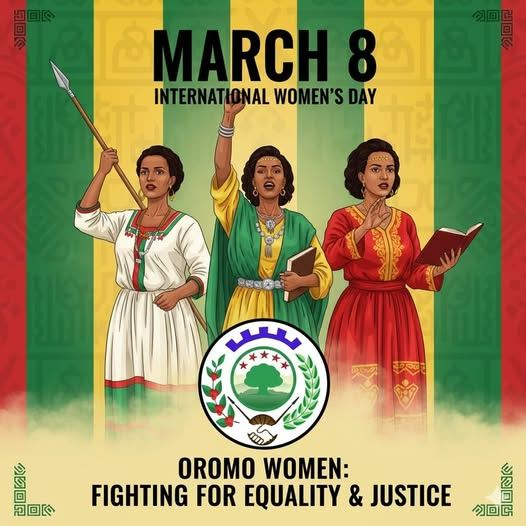
As the world marks International Women’s Day on March 8, the spotlight turns to the remarkable women of Oromia—custodians of culture, leaders of resistance, and unwavering advocates for justice who have fought for generations against the double oppression of gender discrimination and systemic marginalization.
For Oromo women, the struggle for equality and justice is not a recent phenomenon. It is woven into the fabric of their history, expressed through ancient traditions like the Siinqee institution, carried forward through decades of political imprisonment and torture, and articulated today by activists who refuse to be silenced.
The Siinqee Tradition: Ancient Feminism
At the heart of Oromo women’s empowerment lies the Siinqee—a traditional women’s institution that has functioned for centuries as both a symbol of unity and a practical tool for conflict resolution and rights protection .
The Siinqee is a ritual stick given to Oromo women by their mothers on their wedding day. Its meaning is profound: once a woman holds this stick, she commands respect from everyone in the community. If she places herself between two people fighting, all parties must fall silent and cease their conflict .
Dagnu Rabo, a 52-year-old tailor from Etaya in the Arsi region and a Haadha Siinqee (traditional women’s leader), describes her role: “I make it clear to them that everyone has the right to express their opinion, but no one may physically harm anyone else.” Her daily work involves mediating between couples, protecting women from violent husbands, and resolving community disputes .
When a woman is attacked or abused, other women rush to her aid. Wearing distinctive brown cloaks and colorful beaded necklaces, holding their Siinqee sticks aloft, they surround the victim, singing and chanting to draw attention to the perpetrator’s crime until the village elders intervene .
This institution was recognized by UNESCO in 2016 as part of the Gadaa system’s inscription on the Representative List of the Intangible Cultural Heritage of Humanity. Yet for Oromo women, it has never been merely a cultural artifact—it remains a living, breathing mechanism of justice .
Voices of Resistance: Martha Kuwee Kumsa
Perhaps no figure better embodies the courage of Oromo women than Professor Martha Kuwee Kumsa, a siinqee feminist and scholar who survived nearly a decade of imprisonment and torture for her journalistic activities promoting Oromo women’s rights .
Born in Dembidolo in Oromia around 1955, Kumsa’s middle name is that of an Oromo heroine—a name she would prove worthy of. After the 1974 Ethiopian Revolution closed universities, she trained as a journalist and began writing columns calling for Oromo women to defy existing power structures and reclaim their culture .
In 1980, plainclothes security officers detained her. She described arriving at the prison to find people on the floor, “bleeding from their mouths, [with] disfigured [faces] and pus ooz[ing] from wounds,” and an “overpowering stench.” She was tortured by foot whipping nine times during her first year of detention, then moved to another prison where she would remain for nine years—never charged, never tried .
Organizations including PEN America campaigned for her release. She received the 1989 PEN/Barbara Goldsmith Freedom to Write Award while still imprisoned. On September 10, 1989, she was released without warning in a mass amnesty .
Seven months later, fearing recapture, Kumsa escaped to Kenya with her children, walking two weeks through the forest. She eventually made her way to Canada, where she earned bachelor’s, master’s, and doctoral degrees and became a full professor at Wilfrid Laurier University, all while continuing her human rights advocacy .
In 2020, Kumsa co-authored a Washington Post piece criticizing media misrepresentation of Oromo protests following the killing of singer Hachalu Hundessa. She documented 9,000 arrests of Oromos and described a “wave of repression” targeting Oromo journalists and activists .
Dinknesh Deressa Kitila: Organizing for Change
Another towering figure is Dinknesh Deressa Kitila, founder of the International Oromo Women’s Organization. Her activism was born from childhood experience: during elementary school student council elections, a boy was preferred over her despite her having the highest grades. That moment of discrimination lit a fire that has never extinguished .
Deressa’s analysis of Oromo women’s situation is stark: “The state of oppression is very deep in general but Oromo women face even greater difficulty. Abyssinians treat Oromo women poorly. If a woman proposes a constructive idea, it doesn’t get proper attention as women are discriminated against up to a level where they are not considered as human beings” .
For Deressa, self-determination is not abstract but deeply personal: “a process by which one can take control of her/his whole life, decide freely what is good for her/him or not, what is important to her/him.” She emphasizes that organization is vital—that being organized is essential for anyone seeking to stand for peace and especially for women’s rights .
She has consistently called upon the international community to act: “The international community and humanitarian organisations have to take appropriate action to stop the Ethiopian government’s brutality against the Oromos” .
The Qarree Movement: Young Women Rising
In recent years, Oromo women have played a central role in the Qarree movement—the women’s counterpart to the better-known Qeerroo youth movement. These young Oromo women have been at the forefront of protests, organizing demonstrations, mobilizing communities through social media, and demanding both national liberation and gender equality .
Martha Kuwee Kumsa has defended these young activists against what she sees as media misrepresentation. She criticizes those who “categorically associate” the Qeerroo and Qarree with violence, arguing instead that they represent peaceful protest movements that helped overthrow the authoritarian EPRDF regime .
Multidimensional Contributions
The role of Oromo women in their society extends far beyond political activism. They are:
- Custodians of culture: Passing down traditions, songs, and stories to future generations; preserving the Afaan Oromo language; maintaining cultural practices like Irreechaa
- Economic backbones: Actively involved in farming, cultivating essential crops, and demonstrating entrepreneurial spirit that contributes significantly to local economies
- Peace brokers: Frequently involved in conflict resolution, using wisdom and insight to promote peace and harmony within communities
- Political participants: Increasingly taking on roles in organizations like the Oromo Federalist Congress (OFC) and advocating for women’s representation in decision-making processes
The Ateetee Tradition: Sung Justice
Among the Arsi Oromo, women have developed a unique form of dispute resolution called ateetee—a sung ritual process through which women protect, promote, and claim their rights. When an offense occurs, women travel to the offender’s house singing insults, then continue singing outside until a reconciliation ceremony is held. At the ceremony, they receive a cow as compensation and conclude by blessing the offender .
This tradition, documented in depth by ethnomusicologist Leila Qashu, demonstrates how music enables women to exercise power in a male-dominated society. It represents what scholars call “vernacular feminism”—a form of women’s empowerment rooted in indigenous culture rather than imported from external sources .
Ongoing Challenges
Despite their immense contributions, Oromo women face significant challenges:
- Gender-based violence: Both from state security forces and within their own communities
- Cultural barriers: Traditional gender roles can limit participation in leadership and decision-making
- Lack of recognition: Contributions are often overlooked or undervalued in both national and international narratives
- Double oppression: As Oromos facing systemic marginalization and as women facing gender discrimination
Conclusion: The Path Forward
As International Women’s Day 2026 is observed under the global theme “Rights. Justice. Action. For ALL Women and Girls,” Oromo women stand as living proof that empowerment is not a gift to be granted but a right to be claimed—and reclaimed, generation after generation, through courage, organization, and unwavering commitment to justice.
From the ancient Siinqee tradition to modern advocacy at the United Nations, Oromo women have fought for equality and justice on every front. They have endured imprisonment, torture, and exile. They have preserved culture while demanding change. They have led protests and raised children, documented atrocities and built organizations, spoken truth to power and sung justice into being.
Their struggle is not separate from the broader Oromo quest for self-determination—it is integral to it. As Dinknesh Deressa reminds us, true liberation requires women’s full participation and recognition. And as Martha Kuwee Kumsa’s life demonstrates, Oromo women will continue to fight until that liberation is achieved, no matter the cost.
On this International Women’s Day, the world would do well to listen to their voices, honor their sacrifices, and support their ongoing struggle for equality and justice. For in the words of the Oromo women themselves: when women participate fully, peace becomes lasting, justice becomes real, and the homeland becomes whole.
The International Oromo Women’s Association continues to advocate for Oromo women’s rights globally. For more information or to support their work, visit their official channels.

The Revolutionary Seed: Remembering Ethiopia’s “Children of the Mountain” and Their Lost Legacy
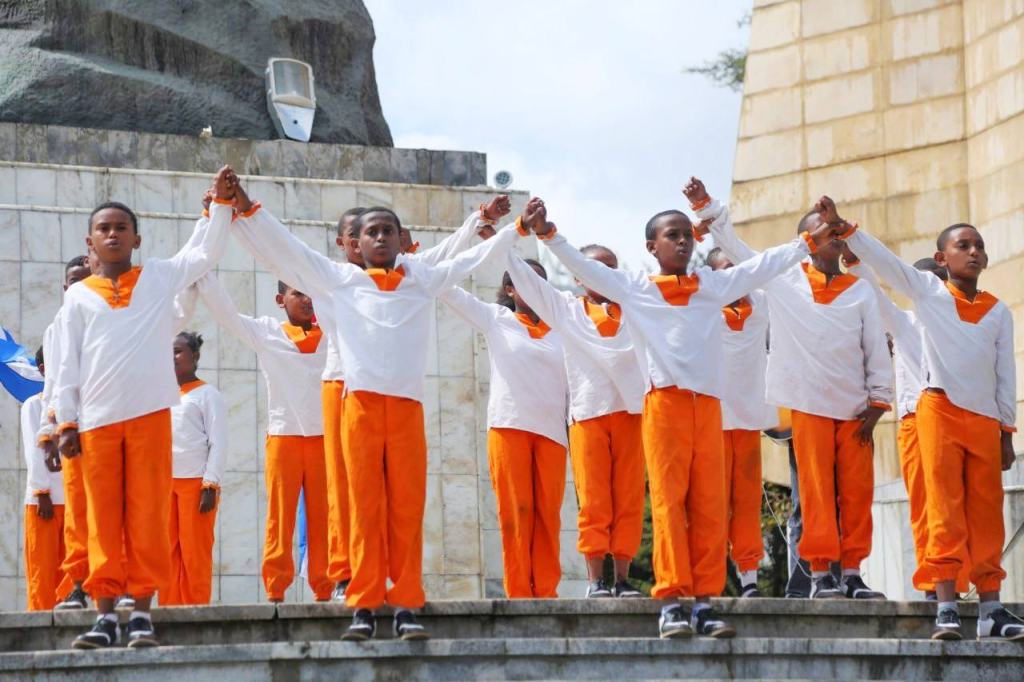
In the 1970s, a unique orphanage called “The Mountain of Revolutionary Ethiopia’s Children” was established to raise the sons and daughters of fallen soldiers. Its choir became legendary—then history forgot them.
The year was 1973 (Ethiopian Calendar), or 1980/81 in the Gregorian calendar. The country was engulfed in war on multiple fronts—fighting internal and external forces that claimed the lives of countless Ethiopian soldiers. Men fell on battlefields across the nation, leaving behind children with no guardians, no caregivers, no one to raise them.
The streets began to fill with orphans.
The Derg government, concerned by the growing number of abandoned children, took action. By special order of the country’s then-president, Mengistu Haile Mariam, an institution was established to shelter, educate, and raise these children. It was called “The Mountain of Revolutionary Ethiopia’s Children”—YeAbyotawi Ethiopia Children’s Amba.
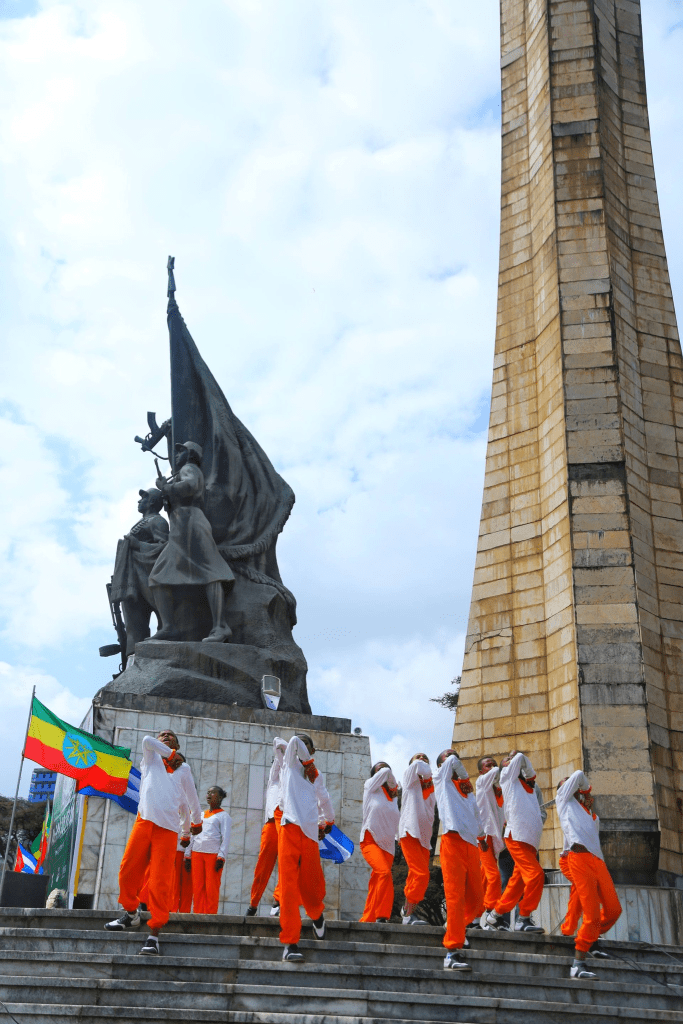
A City on a Hill
Located in what was then called Shoa Province, in the region of Lakes and Butajira, within the Alaba Kulito woreda, the Amba sat in an area known as Alage. It was here that children who had lost their parents to war, natural disasters, and other calamities found a new home.
The institution was divided into five “villages” or compounds: Seble Abiyot, Meskerem Two Ogaden, Zeray Deres, and Mengistu Haile Mariam—five communities that together formed a small city of children.
The Amba took in children of all ages, from newborns to adolescents. They were housed, fed, clothed, and educated within the institution’s walls. The mission was clear: raise these children with dignity, provide them education and moral guidance, and prepare them to re-enter society as whole human beings.
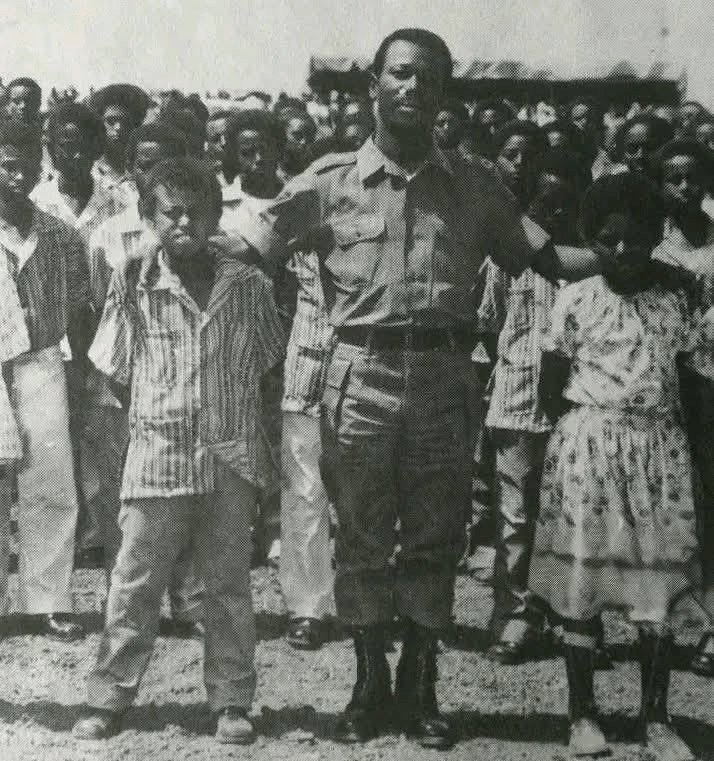
Growing Up on the Mountain
Former children of the Amba remember that when a child turned 18—or completed 12th grade—they would bid farewell to the institution that had raised them. But before departure, they received special counseling designed to ensure they left with strong moral character and, crucially, without the stigma of having grown up in an orphanage. The goal was integration, not isolation.
Those who excelled academically had paths forward. Some entered Ethiopia’s institutions of higher learning. Others were sent abroad—most often to Cuba or Russia—to continue their education. For children who had lost everything, the Amba offered not just survival but opportunity.
“Father” Departs, Shadows Fall
In 1983 (Ethiopian Calendar), disaster struck—not of the natural variety. President Mengistu Haile Mariam, whom all the children called “Our Father,” fled the country. For the children and staff of the Amba, his departure cast a long shadow. The man who had ordered their rescue, who had been the patron of their mountain, was gone.
What followed was a period of uncertainty. The institution continued, but the symbolic and practical support it had enjoyed evaporated with the regime that created it.
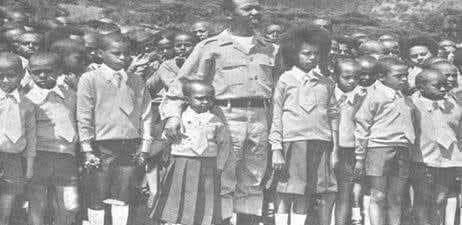
The Choir That Captured a Nation
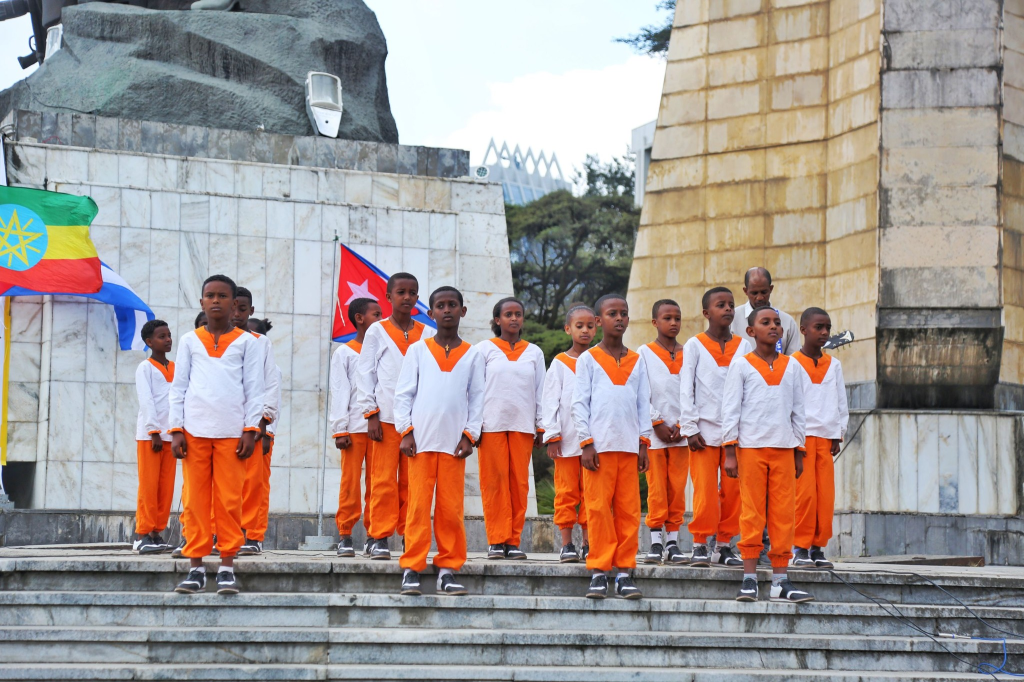
But the Children of the Amba were known for something beyond their orphanage: their music. Under the tutelage of the renowned poet and artist Alemtsahay Wedajo, the children received artistic training that would make them famous across Ethiopia.
Gathered into a performance group called YeJegna Fire—”The Seed of Heroes”—the children regularly presented musical and artistic programs for audiences. Their choir performances were deeply moving, laden with messages about sacrifice, heroism, and national pride.
Among their most beloved works were songs that became anthems for a generation: “Tsehayé” (My Sun), “Yejegna Lij Jegna” (A Hero’s Child is a Hero), and “Ergibitu Hijji” (The Dove Hijji). These songs were not mere entertainment; they were the voice of children who had lost everything yet found purpose in serving their nation through art.
The Soundtrack of an Era
In the late 1970s and early 1980s (Ethiopian Calendar), these songs were everywhere. Young people across Ethiopia knew them by heart, singing them as if they were folk songs passed down through generations. Ethiopia Radio and Television broadcast them repeatedly. To hear a YeJegna Fire performance on the airwaves was not a novelty—it was a regular part of the cultural landscape.
The children’s choir had achieved something remarkable: they had transcended their origins to become a beloved national institution.
Erased by History
Then came 1991. The Derg fell. The transitional government that followed had no interest in preserving the cultural legacy of the fallen regime. The songs of YeJegna Fire were silenced. The children of the Amba scattered. Their music became, as one observer put it, “history, then forgotten.”
For decades, these recordings sat in archives, unheard by new generations. The voices of those orphaned children, raised up by a revolutionary government and trained by one of Ethiopia’s great artists, faded into silence.
A Flicker of Return
Recently, however, word has spread that a CD has been published containing some of these long-lost recordings. For those who grew up with these songs, it is a chance to hear their childhood again. For younger Ethiopians, it is an opportunity to discover a piece of their national heritage that was deliberately buried.
The songs of YeJegna Fire are more than propaganda artifacts. They are the voices of real children—orphans of war who found shelter, education, and purpose in a state-run institution. Their music carries the hopes, dreams, and resilience of a generation that history tried to forget.
The Mountain’s Legacy
Today, the Alage area where the Amba once stood continues its educational legacy in different form. The Alage Agricultural College, established in its own time, sits in the same region. But the children’s mountain—the YeAbyotawi Ethiopia Children’s Amba—exists now only in memory and in the fading recordings of a choir that once captivated a nation.
For the children who grew up there, now in their 50s and 60s, the Amba remains an indelible part of their identity. They were the seeds of heroes, planted on a mountain, scattered by history’s winds, but never entirely lost.
As Ethiopia continues to grapple with its complex political inheritance, stories like that of the Children of the Amba remind us that behind every regime, every ideology, every political transition, there are human beings—children who grew up, loved, lost, and longed for the homes they once knew.
The songs are returning. The children are now elders. And the mountain, though silent now, still echoes with the voices of those who once called it home.
This feature is part of the #Karamara48 and #Karamara_EthiopianVictoryDay series, commemorating Ethiopia’s complex and layered history.

“Women Build Both Home and Homeland”: The Indispensable Role of Oromo Women in Nation-Building
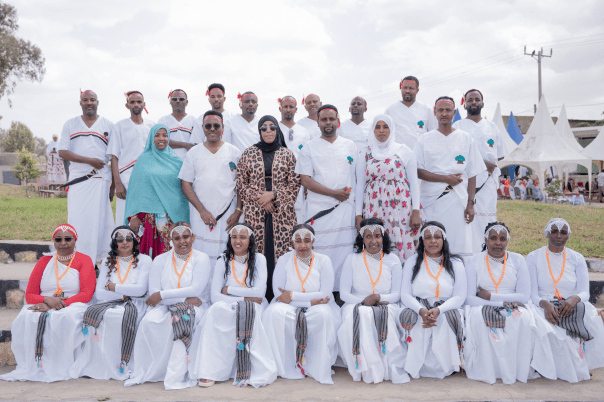
As International Women’s Day 2026 is celebrated globally, the women of Oromia stand as pillars of family, community, and liberation—their contributions finally receiving the recognition they deserve.
FINFINNEE, March 7, 2026 — As the world prepares to mark International Women’s Day on March 8, 2026, the spotlight turns to the indispensable role women play in every facet of society—from the daily rhythms of family life to the grand architecture of nation-building.
This year’s global theme, “Rights. Justice. Action. For ALL Women and Girls,” calls for translating commitments into concrete change: eliminating harmful practices, dismantling barriers to equality, and amplifying women’s voices on the world stage. Complementing this is the global campaign “Give to Gain,” which emphasizes that supporting and empowering women—individually, collectively, and nationally—is not charity but strategy. When women are empowered to contribute their full strength, participation, and potential, they become transformative forces in social and political change.
For Oromo women, this message resonates with particular urgency and pride.
From Home-Building to Homeland-Building
In Oromo society, the proverb holds true: a home without a woman is a deserted place. Women are mothers, sisters, wives, and daughters—each role carrying profound dignity and responsibility. But their contribution extends far beyond the domestic sphere.
The Women’s and Children’s Affairs Wing of the Oromo Liberation Army (DDD-ABO) has issued a powerful statement on the eve of International Women’s Day, affirming that Oromo women play a visible and undeniable role in both building families and building the nation.
“Women in Oromo society occupy a position of great honor and respect,” the statement reads. “From constructing homes to constructing the homeland, their contribution is clear and unmistakable. A home without a woman is an abandoned place.”
Women in the Liberation Struggle
The history of the Oromo liberation struggle is written in the blood and sacrifice of women. Despite facing double oppression—both as Oromos under a repressive system and as women in a patriarchal world—they have never been subjugated or silenced.
Throughout decades of struggle, Oromo women have shouldered immense burdens. They have been fighters on the front lines, organizers in the shadows, and the backbone of communities under siege. Foreign oppression and gender-based violence have sought to break them, but have only forged them stronger.
Their participation in the broader national movement has been unwavering, their commitment absolute. They have proven that the liberation of Oromia cannot be achieved without the liberation of Oromo women.
Political Participation: The Key to Lasting Peace
This year’s theme from the DDD-ABO carries a powerful message: “Women’s participation in politics is fundamental to peace, justice, unity, and nation-building.”
The statement emphasizes that when women are involved in governance and political decision-making, the outcomes are transformative. Their participation ensures lasting peace, upholds justice, strengthens national unity, and builds a proper foundation for the state.
“Women’s involvement in government and political decision-making demonstrates that they play a crucial role in achieving sustainable peace, ensuring justice is upheld, strengthening national unity, and building the nation properly,” the statement declares.
This vision aligns with the ABO’s commitment to establishing a peaceful and lawful government. The organization has put forward its symbol, Horooroo, as the choice before the people in the upcoming electoral contest.
Horooroo: A Symbol of Peace and Identity
The ABO’s electoral symbol, Horooroo, represents peace, reconciliation, justice, and the broad identity of the Oromo people. It embodies the right to self-determination and stands for democracy, justice, equality, and lasting peace.
As Oromia approaches its 7th round of elections in 2026, the ABO is contesting under this symbol, offering a vision of a lawful, people-centered government—government by the people, for the people. The DDD-ABO statement makes clear that this vision cannot be realized without the full participation and empowerment of women.
“To achieve this goal,” the statement affirms, “we must work together in unity. We must choose the ABO’s ‘Horooroo’ symbol in this 7th round of elections to build a lawful and just government that includes and empowers women to bring about real change.”
A Call to Action
As International Women’s Day 2026 is celebrated, the message from Oromo women is clear: their role in building both home and homeland is indispensable. Understanding this, ensuring their participation across all sectors—political, economic, and social—is not optional but essential for achieving lasting peace, restoring justice, reclaiming national truth, mending national unity, and building a democratic state.
The DDD-ABO concludes its statement with a rallying cry that echoes across Oromia:
“Victory to the Broad Public!
Women’s and Children’s Affairs Wing (DDD) ABO
March 7, 2026
Finfinnee”
The Road Ahead
This International Women’s Day, as the world reflects on the progress made and the journey still ahead, Oromo women stand as living proof that empowerment is not a gift to be granted but a right to be recognized. They have always built—homes, communities, movements, and a nation. The task now is to ensure they have their rightful place at every table where decisions about their future are made.
For in the words of the DDD-ABO, when women participate fully, peace becomes lasting, justice becomes real, and the homeland becomes whole.
International Women’s Day 2026 is being observed globally on March 8 under the theme “Rights. Justice. Action. For ALL Women and Girls.”

Oromia Support Group Submits Damning Report to UN Human Rights Council, Documents Over 7,500 Civilian Deaths
The 61st session of the UN Human Rights Council receives evidence of widespread abuses, forced conscription, and the catastrophic entanglement of Ethiopia in Sudan’s civil war.
GENEVA — The Oromia Support Group (OSG) has submitted a comprehensive report to the current 61st session of the United Nations Human Rights Council, documenting a grim catalogue of human rights abuses against Oromo civilians under the rule of Prime Minister Abiy Ahmed.
Report 72, now being distributed as widely as possible by the UK-based human rights organization, includes not only the organization’s formal submission to the UNHRC but also reveals Ethiopia’s deepening involvement in Sudan’s civil war—supporting the genocidal Rapid Support Forces (RSF) from a new base inside Ethiopia, funded and equipped by the United Arab Emirates.
“Please find attached Report 72 from the Oromia Support Group and please distribute it as far and wide as possible,” the organization urged in its statement accompanying the release.
A Bloody Toll: 7,511 Civilians Killed
According to OSG, the organization has now documented 7,511 Oromo civilian deaths under Abiy Ahmed’s rule—a staggering figure that represents only a fraction of the true toll. Most of the victims are young people, the Qeerroo generation, whose peaceful pro-democracy demonstrations in 2018 opened the political space that allowed Abiy Ahmed to seize power.
“Prime Minister Abiy Ahmed stated in government meetings in early 2019 that his top priority was the extermination of Qeerroo members because they were the greatest obstacle to his power,” the report reveals.
Since the beginning of 2025 alone, OSG has recorded 1,244 civilian killings—a dramatic escalation in violence that spans all zones of Oromia Region and the Oromia Special Zone in Amhara Region. Killings and destruction of property have been particularly egregious in Wallega zones, with increasing frequency in the latter half of 2025 in Arsi and West Arsi zones. Poor access and communication continue to hinder data collection, especially from Guji and Borana zones.
“Bullet Food”: Oromo Youth Forced into Sudan Conflict
One of the most alarming revelations in Report 72 concerns Ethiopia’s involvement in Sudan’s civil war. According to OSG, the Ethiopian government has established a base near Asosa to support the genocidal Rapid Support Forces, funded and equipped by the United Arab Emirates.
“Forcibly conscripted destitute Oromo youth are already ‘bullet food’ in this war and scores of thousands will follow,” the report warns.
The organization describes this development as a “catastrophic decision” that invites proxy wars to be fought by regional powers on Ethiopian territory, with Oromo youth paying the ultimate price.
A Government That Does Not Represent Its People
OSG’s submission challenges the characterization of Ethiopia’s government as an “Oromo government,” noting that although many individuals in government are Oromo, “the abuses against Oromo are as severe and widespread as those against any of the country’s other peoples.”
The Prosperity Party government, the report argues, “does not represent the interests of any of the peoples of Ethiopia.”
Economic Mismanagement and Militia Terror
Behind the facade of modernization and development projects lies a different reality, according to OSG. The report describes how poorly paid and poorly trained local militias engage in looting and extortion of spurious and arbitrary taxes from rural and urban populations already unable to sustain themselves economically or access adequate health care or education.
A “dog-eat-dog situation has developed whereby militia members depend for their and their families’ survival on looting and extortion from people with nothing left to give,” the report states.
Reasons given for extortion include financing local administrative buildings, “health insurance,” arming and feeding federal and local security forces, bribes for the release of prisoners and victims of forced conscription, and licenses for businesses and vehicles.
Military Tactics: Drones, Artillery, and Burning Villages
National defense forces continue to use drones and heavy artillery in attacks on defenceless villagers, killing people and livestock. In areas where the Oromo Liberation Army (OLA) is active, villages are burnt “to drain the ocean to kill the fish”—a military tactic that punishes entire communities for the actions of a few.
Villagers are threatened at gunpoint to indicate the homes of parents or other relatives of OLA members, which are then systematically destroyed.
Young men and respected community members without any connection to OLA have been killed in their homes, on the streets, in churches, and on their way to and from markets. Many have been taken from police custody or from detention in military camps and summarily executed, sometimes in public in order to terrorize the population.
Sexual Violence and Crimes Against Children
The report documents horrific accounts of sexual violence perpetrated by government soldiers. Children, prepubescent girls and young boys, and mothers of families have been cruelly raped. The rape and killing of teenage girls and girls aged as young as ten years are documented.
Deliberate shooting of infants and children under ten years old by national defense forces, for frivolous reasons, has also been recorded.
Forced Displacement: Modernization as a Weapon
Hundreds of thousands of villagers have been displaced due to the destruction of their homes and farms. Added to these are those displaced by “modernization projects,” where even moderately sized conurbations such as Dembi Dollo in Qellem Wallega have been subjected to “corridor projects”—private houses and business properties bulldozed without consultation or compensation.
Large-scale developments including the Gadaa Special Economic Zone project and the $12.5 billion Bishoftu “Mega” Airport in Aabbuu Seeraa, Bishoftu, are displacing tens of thousands with no consultation and hardly any compensation. The report warns that these projects appear designed to completely divide Oromia Region into two, destined to bring millions of people from other regions into a narrow strip of land in southern East Showa.
The Destruction of the Karrayyu and Gadaa Heritage
The Karrayyu pastoralists in East Showa—one of the major remaining centers practicing the Gadaa system of social, spiritual and democratic governance, acknowledged as UNESCO World Heritage—have been “almost completely destroyed” since fourteen of their leaders were killed on the orders of Oromia Region authorities in December 2021.
“The long-term livelihood of Oromo and the traditional heritage, deeply attached to their land, is being destroyed,” OSG states.
Inter-Ethnic Conflict: Deliberately Fomented
The report alleges that division and hatred between Oromo and Amhara peoples has been deliberately fomented by the government. Clandestine federal forces, masquerading as Fano Amhara fighters and as OLA fighters, have been established in at least Showa and Wallega zones, where they have been responsible for massacres and numerous smaller scale killings with the sole purpose of spreading discord and hostility.
In one chilling example, federal forces wearing wigs of braided hair and loudly calling to each other “Jaal” (comrade in Afaan Oromoo) terrorized villagers in Dandi district, West Showa in September 2025, going from house to house at night, raping and looting.
Innocent teenagers have been beaten and imprisoned, dressed in military uniforms and paraded on media as if they were OLA fighters.
Religious Persecution
The report documents persecution on religious grounds. Oromo priests within the Ethiopian Orthodox Tewahedo Church have been detained and killed. Followers of the traditional Oromo religion, Waaqeffannaa, have been killed and driven out of areas, and their worship halls (galma) burned down.
Regional Attacks Unopposed
National and regional governments have not opposed the killings of civilians and destruction of their property by Somali Region forces (Liyyu) in West Bale, East and West Hararge and South Borana zones of Oromia Region.
Desperate Refugees Face Hostility at Every Turn
Refugees fleeing to Djibouti and Somaliland in desperate attempts to seek illegal work in Saudi Arabia face abuse and extortion on their journeys and at their destinations. The report describes refugees being treated with hostility and disdain in Egypt, Libya, Tunisia, Djibouti, Somaliland, Somalia and Yemen.
Thousands are detained in life-threatening conditions or subject to slavery in Libya. Unknown numbers die in deserts between Ethiopia and the Red Sea or Mediterranean Sea and by drowning in those seas. Those who survive dangerous journeys to Europe are met with hostility, disbelief and discrimination.
Individuals Who Speak Truth Hounded Out
The report notes that individuals who have risked their lives to investigate and publish human rights abuses and the dire economic and health crises in rural areas have been hounded out of Ethiopia, and family members have been detained.
OSG’s Call: Distribute Widely
The Oromia Support Group concludes its report with a call for the widest possible distribution of its findings, urging recipients to share Report 72 “as far and wide as possible.”
The submission to the 61st session of the UN Human Rights Council represents a continued effort to bring international attention to the ongoing crisis in Oromia and to hold the Ethiopian government accountable for what OSG describes as systematic human rights abuses against the Oromo people.
For further information:
Dr. Trevor Trueman
+44 (0)7852 448337
osg@talktalk.net
This report includes information contained in Reports 69-72 from the Oromia Support Group (OSG).




 Advocacy for Oromia