Blog Archives

The Music Albums released by Elemoo Ali (1982-1998)
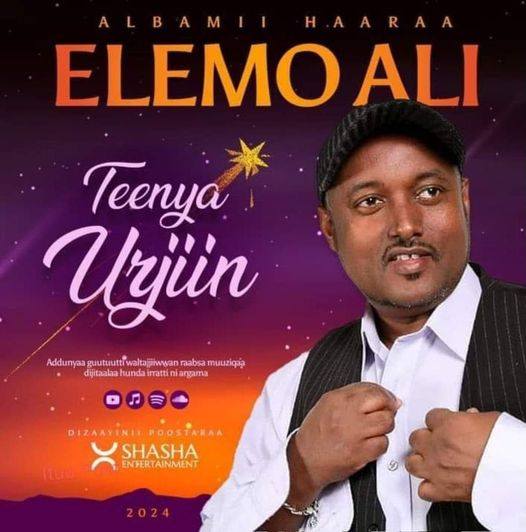
As a long time listener of Elemo Ali’s songs and an ethnographic writer who explores the music of different cultures, I list down the albums released by the artist so far and present my reflections in some of them.
1. His first album was released in Djibouti (circa 1982)-
It was an audio cassette. Elemo used his acoustic guitar ( a.k.a. “box guitar”) for that album.
2. His second album released in Saudi Arabia- 1986.
It was an audio cassette and a female singer called “Shamsi” featured Elemo Ali (she had two solo songs; the rest of the songs were by Elemo) . In the cassette Elemo sung in Harari language too. But what many people remember from that cassette was Elemo’s singing Mahmoud Ahmed’s famous Amharic song called “እንቺ ልቤ እኮ ነው” in Oromo language. The lyrics used by Elemo was very similar to the Amharic one.
3. The album he has done with Nuho Gobana in Saudi Arabia (1987)-
This was also an audio cassette. From that album a single that goes like “Biiftuu tiyya, urjii tiyya, suma bira jira yaadni kiyya” became popular in the media (I repeatedly heard it while Harar Radio Stations Oromo Language Service broadcasted it).
However, people usually confuse this album with the one he released with “Shamsii”. This happened because the music arrangements of the two albums were the very similar.
4. The album he released in Italy in 1988:
Truly speaking, I have no detail information about this album. I heard recently from the words of Elemo when we communicate through telephone that he released an album in Italy while he was living in that country for a short period of time. I will seek additional information on the album and bring to the public.
Elemo Ali produced most of his albums in Canada and a gained popularity there. Here are the list of those albums and my reflection on them.
5. “Jabeessa Aadaa Teenya”-1989:.
According to my evaluation this was Elemo Ali’s finest album of all time and one of the best albums in the history of Oromo Music and art. The rich linguistic treasure seen in the lyrics of the songs, the artist’s ability to sing in different musical scales in addition to the standard pentatonic scale derived from Oromo cultural beats, and Elemo Ali’s emblematic ability to display the vocals in a clear way were the main features that gave the album special color and quality. The most surprising thing was that almost all of the lyrics an the melodies of that album were created by Elemo Ali himself. Of course songs like ” Xiyyaan Nadirtee”, “Yaa jiruu biyya Ormaa”, “Jabeessaa Aadaa Teenyaa”, ” Koottu yaa Boontuu”, “Yaa Urjii Samiidhaa” are unforgettable.
6. “Oromiya”- 1990:
Another critically acclaimed and artistically emboldened album of Elemo Ali. It was a historical album in which Elemo addressed the Oromo people’s quest for freedom and justice in a highly organized and rhythmically synthesized Oromo poetry. This was also one of the best albums seen in the history of Oromo music. From the album ” Yaa Biyya too Gaarii”, “Oromiyaa” and “Carcar Xirroo” were the top ones.
7. ” Guyyaanis Keenya”- 1993:
This was the first album of Elemo Ali produced by a local music shop in our country. In that album Elemo brought many new songs together with certain songs from his earlier cassets (example: “Baadiyyaadha jirtii tanin ani jaallee from his album with Nuho Gobana, and Kottu yaa Boontuu Yaa shaggee tiyya from his album of 1989)
The album was released by Biftu Music Shop of Dire Dawa and became one of the best selling Oromo music albums of 1993 together with Shamsadin Yusuf’s “illii Jannataa” album.
7. “Leelloo Tiyya”: 1998:
Another critically aclaimed album of Elemo Ali which contains songs in multiple beats , the Oromo traditional “ragada” and “Shaggoyee”, the Caribbean “reggae”, the Central African “rumba” and “Afrobeats”, the Sudanese “hageeba” and the Western “pop”, “jazz” and “blues”. The band accompanied him for that album as well had members from many countries, Africans and North Americans.(Continued from above)
From the album the single titled ” Himi naaf Himi” became the most popular.
It was clear that Elemo brought a tradition of using multiple beats from different traditions for his songs in order to introduce the Oromo, Ethiopian and East African music and culture to the global audience.
The album was very fruitful in attaining its goals and introducing Elemo Ali to music fans of different countries. Elemo Ali won Canada’s annual music award for that album.
OROMO STUDENT PROTESTORS RELEASED FROM JAIL
(Advocacy4oromia, 9 July 2015) At least six Oromo university students were also among three journalists and two bloggers released from Ethiopian prison yesterday, according to various reports.
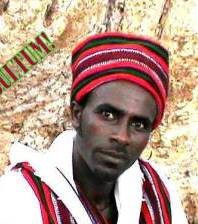
Adugna Kesso
The freed Oromo university students include Adugna Kesso, Bilisumma Dammana, Lenjisa Alemayo, Abdi Kamal, Magarsa Warqu, and Tofik. All were students who were arrested by security agents from various universities located in the Oromiya regional states. No charges were brought against many of them in the last year and three months.
The arrest of unknown numbers of Oromo University students followed a May 2014 brutal crackdown by the police against university students who protested when a master plan for the expansion of Addis Abeba, the city originally home to the Oromo, was introduced by the federal government.
The 10th Addis Abeba and Oromia Special Zone Integrated Development Master plan, which was in the making for two years before its introduction to the public, finally came off as ‘Addis Abeba and the Surrounding Oromia Special Zone Integrated Development Plan.’
The government claims the master plan, which will annex localities surrounding Addis Abeba but are under the Oromiya regional state, was aimed at “developing an internationally competitive urban region through an efficient and sustainable spatial organization that enhances and takes advantage of complementarities is the major theme for the preparation of the new plan.”
The students protested against the plan and the federal government’s meddling in the affairs of the Oromiya regional state, which many legal experts also say was against Article 49(5) of the Ethiopian Constitution that clearly states “the special interest of the State of Oromia in Addis Abeba.”
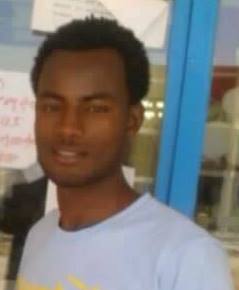
Aslan Hassen
Two months ago, student Nimona Chali, one of the detained students, was released from jail without charges. Abebe Urgessa of Haromaya University is still in Qaallitti prison.
Student Aslan Hassen died in prison in what the government claimed was a suicide.
However, many believe he was tortured to death. No independent enquiry was launched to investigate his death.
By the government’s own account, eleven people were killed during university student demonstrations in many parts of the Oromia regional state. However, several other accounts put the number as high as above 50.
Source: http://addisstandard.com/oromo-student-protestors-released-from-jail/
About Abebe Urgessa
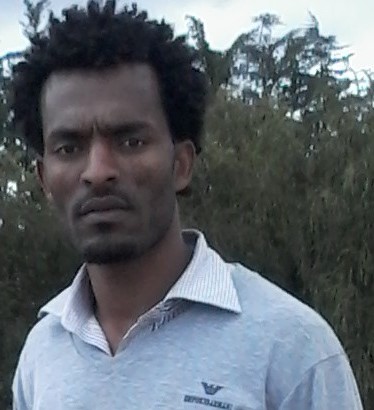
Abebe Urgessa
Abebe Urgessa was a second year student, Water Engineering Major, at Haramaya University. After classes were interrupted following the #OromoProtests movement that swept the whole nation in April 2014, Abebe like many other students went to visit his family till the classes resume.
He was arrested upon arrival at a small town called Teji, in South west Shawa, where his families are living. After detention incommunicado for three weeks, he was falsely accused of standing in a market place telling people not to pay taxes to the government. Though the court released him on bail on the 21st of May, 2014, student Abebe was abducted again just a week later on the 29th of May.
While his where about still remains a mystery to this very date, it’s known that the government accused him, on its media outlets, of detonating hand grenade at the Haramaya University facility.
Abebe’s story designates with many other innocent Oromo students unlawfully abducted and falsely accused with bogus charges while being taken to or kept at undisclosed detention centers under severe tortures, more often than not. His story is just one among the many.
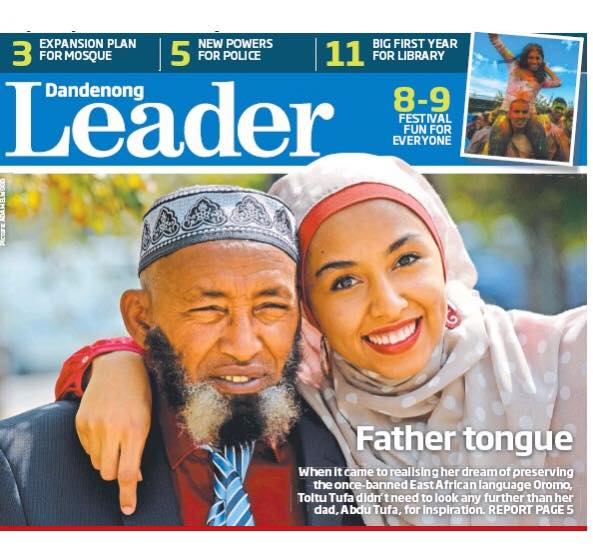
Father tongue
When it came to realising her dream of preserving the once-banned East African language Oromo, Toltu Tufa didn’t need to look any further than her dad, Abdu Tufa, for inspiration.
NOBLE Park’s Toltu Tufa had a dream to write a children’s book in her father’s native African language of Oromo, which was banned in parts of East Africa until 1991.
 Her initial goal was to raise $ 50,000 through a crowd- funding campaign, but thanks to overwhelming support to save the African language, she ended up raising $124,000.
Now her dream has come to fruition and she has launched a range of educational tools in Oromo, including four textbooks, picture storybooks for preschool children, stickers and flashcards.
Earlier this month she returned to Australia after a book tour of seven cities in seven weeks, visiting communities around the globe who donated largely to her campaign.
Her books have sold out in each of those seven cities and yesterday, at the Melbourne launch of her Oromo range at Springvale Town Hall, Ms Tufa presented awards to those who helped to make her dream a reality.
“There’s so many local people in the city of Greater Dandenong who’ve actually experienced what it feels like to not have their language being spoken,” she said.
“There’s a lot of people who have suffered during the regime who want to pass ( Oromo) on to their children.
“Then there’s a lot of children who are just excited about having something that’s high-quality, colourful and available.”
Ms Tufa said she planned to make cartoons and videogaming in Oromo.
“The whole theory of my work is culturally empowered storytelling,” Ms Tufa said.
“I wanted children to be able to learn about their language in a context they understand, so they have cartoons that look like them and sound like them.”
Aussie educator’s quest to document an African Language
A native African language has been brought to the pages of children’s textbooks for the first time by a Melbourne educator. More than 40 million people speak the Oromo tongue but, until now, it’s been largely passed down by word-of-mouth.
Source: http://www.sbs.com.au/news/video/399415363938/Aussie-educators-quest-to-document-an-African-Lang
Oromo language gets an advocate
(A4O, 20 October 2013) A Melbourne Oromo activist, Toltu Tufa, is driving an ambitious push to revitalise learning in her native African language. Social media is buzzing with positive responses to her efforts in reviving education in the once-doomed Oromo tongue.
According to SBS Tv reporter, Luke Waters, Toltu Tufa is a young lady with abundant energy and a clear objective. “My aim is to create Oromo educational resources for every child in every family in every home,” she says.
Frustrated at a lack of resources for Oromo language and culture classes, she created her own.
Not one to do things by halve, Toltu first visited and consulted nine Oromo communities around the world before devising the package comprising flash cards, posters and books.
She says community input ensured images and information are culturally appropriate, relevant and effective
An internet presence is critical in reaching more of the estimated 40-million Oromo people globally, but Toltu says there are practicalities to consider.
“I think with on-line technology there is a real potential for this to catapult into something viral… something massive,” Toltu says.
“I also think there’s still room for the hard copy books because there are so many countries where people don’t have access to technology and don’t have access to internet and wi-fi.
A website spruiking the program was launched last week and the hits are already in the thousands.
But for Toltu it’s all about the classroom.
“More than the verbal response…it’s the physical response that I see in children when they see the products,” she says.
“Their eyes light up and they say, ‘wow this is something I’ve never seen before’.
“And looking at the parents, some of the parents have been quite emotional saying I’ve never seen anything like this in my life.”
But one response means more than most.
“I think one person that who reacted like that who touched me most deeply was my dad.”
And she says he’s played a key role.
“When it came to the Oromo language, the only person I had was my Dad,” Toltu says.
“The way he taught me was literally verbally.
“This is how we do things, this is how we speak, this is what the Oromo language is about.
“He taught me with pen and paper and growing up that’s what everybody else seemed to be doing.”
In broken English, Abdul-Wahab Tufa describes his pride for his daughter’s work, and memories of a time when the Oromo language was banned in Ethiopia.
“Yes, punishment…put in the jail make some problem some people death,” he says, describing the punishments that speaking the banned language could exact.
Toltu Tufa says it’s a privilege to have ensured the survival of a language for her father and community.
“I feel really lucky that I’ve got a tool that I can use to help grow what my Dad actually planted a very long time ago.
“I feel really, really privileged to be able to do that and to be able to do that with my community. (It’s) not just me saying, ‘Hey this is what I’ve got, how we going to make this work?’
“But everybody is giving me feedback and suggestions and (we’re) creating something together. That’s been the most special part for me.”
Now, Toltu’s seeking funding to roll the program out globally – but there are no flash cards or posters involved in this appeal.
She has taken to YouTube to send her message.
“Regardless of where you are in the world, let me know if you have what it takes and together lets pledge to preserve a language whose story needs to be told.”
Source: http://www.sbs.com.au/news/article/2013/10/19/dying-ethiopian-language-revived




 Advocacy for Oromia