Blog Archives

The Music Albums released by Elemoo Ali (1982-1998)
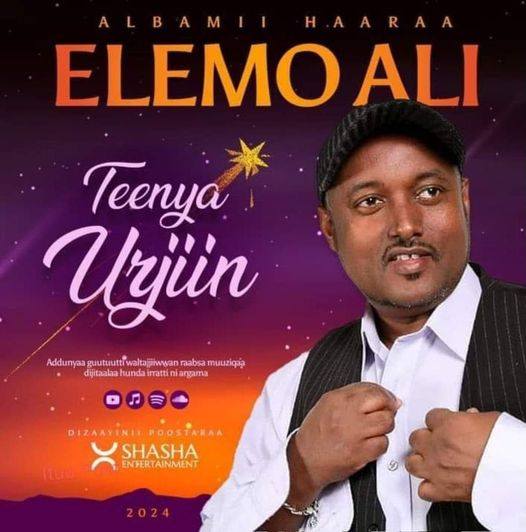
As a long time listener of Elemo Ali’s songs and an ethnographic writer who explores the music of different cultures, I list down the albums released by the artist so far and present my reflections in some of them.
1. His first album was released in Djibouti (circa 1982)-
It was an audio cassette. Elemo used his acoustic guitar ( a.k.a. “box guitar”) for that album.
2. His second album released in Saudi Arabia- 1986.
It was an audio cassette and a female singer called “Shamsi” featured Elemo Ali (she had two solo songs; the rest of the songs were by Elemo) . In the cassette Elemo sung in Harari language too. But what many people remember from that cassette was Elemo’s singing Mahmoud Ahmed’s famous Amharic song called “እንቺ ልቤ እኮ ነው” in Oromo language. The lyrics used by Elemo was very similar to the Amharic one.
3. The album he has done with Nuho Gobana in Saudi Arabia (1987)-
This was also an audio cassette. From that album a single that goes like “Biiftuu tiyya, urjii tiyya, suma bira jira yaadni kiyya” became popular in the media (I repeatedly heard it while Harar Radio Stations Oromo Language Service broadcasted it).
However, people usually confuse this album with the one he released with “Shamsii”. This happened because the music arrangements of the two albums were the very similar.
4. The album he released in Italy in 1988:
Truly speaking, I have no detail information about this album. I heard recently from the words of Elemo when we communicate through telephone that he released an album in Italy while he was living in that country for a short period of time. I will seek additional information on the album and bring to the public.
Elemo Ali produced most of his albums in Canada and a gained popularity there. Here are the list of those albums and my reflection on them.
5. “Jabeessa Aadaa Teenya”-1989:.
According to my evaluation this was Elemo Ali’s finest album of all time and one of the best albums in the history of Oromo Music and art. The rich linguistic treasure seen in the lyrics of the songs, the artist’s ability to sing in different musical scales in addition to the standard pentatonic scale derived from Oromo cultural beats, and Elemo Ali’s emblematic ability to display the vocals in a clear way were the main features that gave the album special color and quality. The most surprising thing was that almost all of the lyrics an the melodies of that album were created by Elemo Ali himself. Of course songs like ” Xiyyaan Nadirtee”, “Yaa jiruu biyya Ormaa”, “Jabeessaa Aadaa Teenyaa”, ” Koottu yaa Boontuu”, “Yaa Urjii Samiidhaa” are unforgettable.
6. “Oromiya”- 1990:
Another critically acclaimed and artistically emboldened album of Elemo Ali. It was a historical album in which Elemo addressed the Oromo people’s quest for freedom and justice in a highly organized and rhythmically synthesized Oromo poetry. This was also one of the best albums seen in the history of Oromo music. From the album ” Yaa Biyya too Gaarii”, “Oromiyaa” and “Carcar Xirroo” were the top ones.
7. ” Guyyaanis Keenya”- 1993:
This was the first album of Elemo Ali produced by a local music shop in our country. In that album Elemo brought many new songs together with certain songs from his earlier cassets (example: “Baadiyyaadha jirtii tanin ani jaallee from his album with Nuho Gobana, and Kottu yaa Boontuu Yaa shaggee tiyya from his album of 1989)
The album was released by Biftu Music Shop of Dire Dawa and became one of the best selling Oromo music albums of 1993 together with Shamsadin Yusuf’s “illii Jannataa” album.
7. “Leelloo Tiyya”: 1998:
Another critically aclaimed album of Elemo Ali which contains songs in multiple beats , the Oromo traditional “ragada” and “Shaggoyee”, the Caribbean “reggae”, the Central African “rumba” and “Afrobeats”, the Sudanese “hageeba” and the Western “pop”, “jazz” and “blues”. The band accompanied him for that album as well had members from many countries, Africans and North Americans.(Continued from above)
From the album the single titled ” Himi naaf Himi” became the most popular.
It was clear that Elemo brought a tradition of using multiple beats from different traditions for his songs in order to introduce the Oromo, Ethiopian and East African music and culture to the global audience.
The album was very fruitful in attaining its goals and introducing Elemo Ali to music fans of different countries. Elemo Ali won Canada’s annual music award for that album.
Obama’s Planned Visit to Ethiopia is Incompatible with Claims of Democratic Principles of the US Government
(Statement from Oromo Liberation Front (OLF) , July 4, 2015) The Oromo Liberation Front (OLF) strongly opposes the planned visit to Ethiopia of the US President Barack Obama on the end of July 2015.
As Ethiopia is one of the most brutal regimes of the world, OLF believes that such a visit will result in strengthening the dictatorial minority regime, will boost the regime’s confidence to strengthen its ruthless human rights violations, will give a green light to the regime to continue its repression, economic exploitation, and marginalization of various nations and nationalities of the country under its usual pretense of democracy.
OLF also believes that a lasting national and security interest of the US is better protected not by blessing and supporting such a well-known ruthless regime, but by being on the side of the people, supporting the struggle of the peoples of the country for freedom, democracy, and justice by using its leverage through exerting the necessary pressure on the regime on power.
For full Statment: OLF_Statement_on_Obma_visit
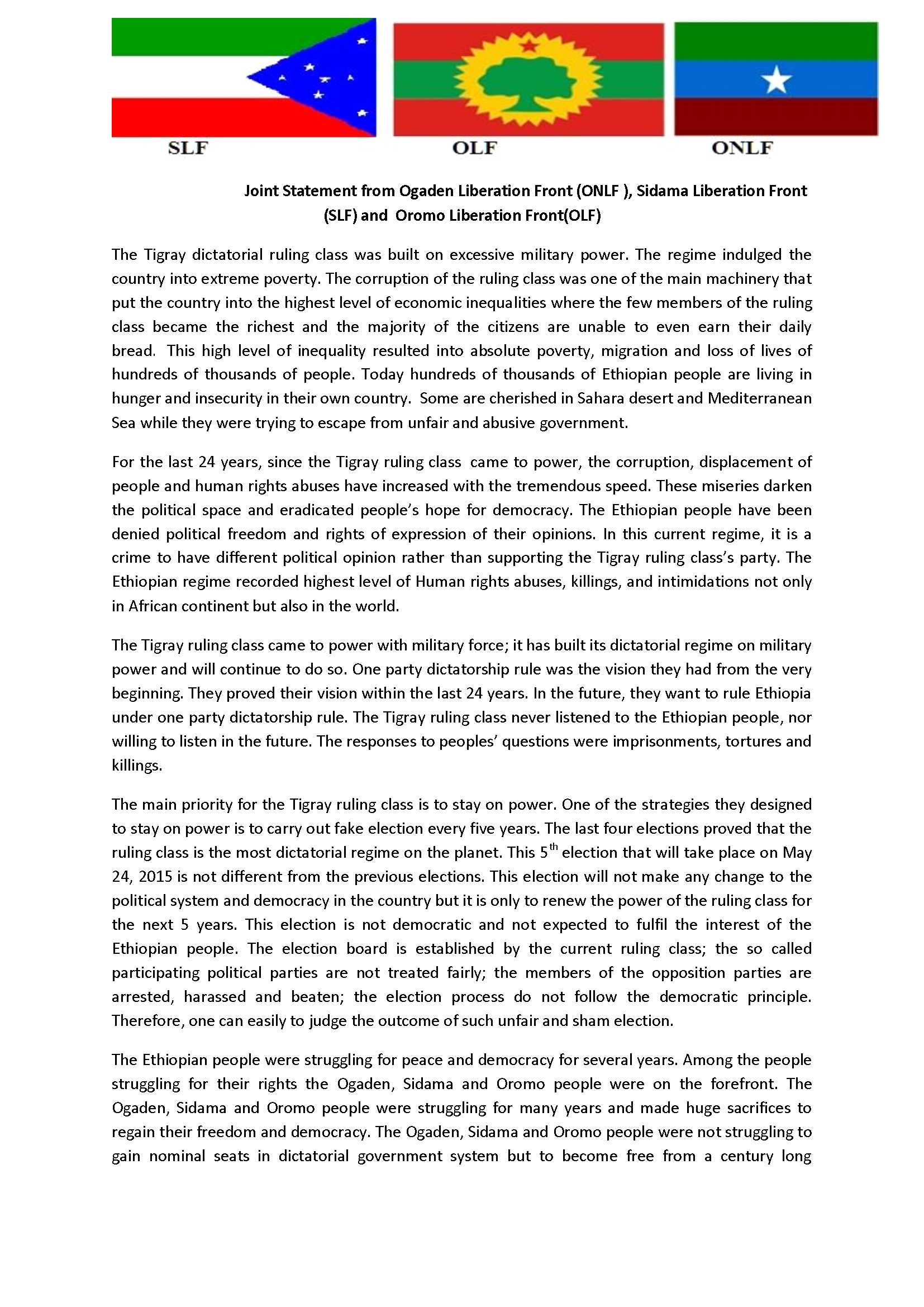
Joint Statement
By Ogaden Liberation Front (ONLF ), Sidama Liberation Front (SLF) and Oromo Liberation Front(OLF)
 The Tigray dictatorial ruling class was built on excessive military power. The regime indulged the country into extreme poverty. The corruption of the ruling class was one of the main machinery that put the country into the highest level of economic inequalities where the few members of the ruling class became the richest and the majority of the citizens are unable to even earn their daily bread. This high level of inequality resulted into absolute poverty, migration and loss of lives of hundreds of thousands of people. Today hundreds of thousands of Ethiopian people are living in hunger and insecurity in their own country. Some are cherished in Sahara desert and Mediterranean Sea while they were trying to escape from unfair and abusive government.
For the last 24 years, since the Tigray ruling class came to power, the corruption, displacement of people and human rights abuses have increased with the tremendous speed. These miseries darken the political space and eradicated people’s hope for democracy. The Ethiopian people have been denied political freedom and rights of expression of their opinions. In this current regime, it is a crime to have different political opinion rather than supporting the Tigray ruling class’s party. The Ethiopian regime recorded highest level of Human rights abuses, killings, and intimidations not only in African continent but also in the world.
The Tigray ruling class came to power with military force; it has built its dictatorial regime on military power and will continue to do so. One party dictatorship rule was the vision they had from the very beginning. They proved their vision within the last 24 years. In the future, they want to rule Ethiopia under one party dictatorship rule. The Tigray ruling class never listened to the Ethiopian people, nor willing to listen in the future. The responses to peoples’ questions were imprisonments, tortures and killings.
The main priority for the Tigray ruling class is to stay on power. One of the strategies they designed to stay on power is to carry out fake election every five years. The last four elections proved that the ruling class is the most dictatorial regime on the planet. This 5th election that will take place on May 24, 2015 is not different from the previous elections. This election will not make any change to the political system and democracy in the country but it is only to renew the power of the ruling class for the next 5 years. This election is not democratic and not expected to fulfil the interest of the Ethiopian people. The election board is established by the current ruling class; the so called participating political parties are not treated fairly; the members of the opposition parties are arrested, harassed and beaten; the election process do not follow the democratic principle. Therefore, one can easily to judge the outcome of such unfair and sham election.
The Ethiopian people were struggling for peace and democracy for several years. Among the people struggling for their rights the Ogaden, Sidama and Oromo people were on the forefront. The Ogaden, Sidama and Oromo people were struggling for many years and made huge sacrifices to regain their freedom and democracy. The Ogaden, Sidama and Oromo people were not struggling to gain nominal seats in dictatorial government system but to become free from a century long political, economic and social domination. This objective cannot be achieved through participating in the election organised by the dictatorial ruling class.
Particularly to the Ogaden, Sidama and Oromo youngsters and students, you have made significant sacrifices to move our freedom and democracy struggle forward. In order to make your sacrifices yield a fruit, you must continue your struggle for freedom and democracy. Participating in this fake election means that you forget the sacrifices your brothers and sisters made. Participating in this election means that you’re building the power of your perpetrators. From many years’ experience, the ONLF, SLF and OLF know the plan and behaviour the Tigray ruling class. The ONLF, SLF and OLF know that this regime is not prepared to leave its position even if they lose the election, which is unlikely within the current election process.
Therefore, we want to inform the Ethiopian people in general and the Ogaden, Sidama and Oromo people in particular, that this election stands only to serve the Tigray ruling class and to keep them in power for the next five years. This election does not fulfils the interest of the Ethiopian people and do not lead to peace, stability and economic development of the country. The Ogaden Liberation Front (ONLF ), Sidama Liberation Front (SLF)& Oromo Liberation Front(OLF) once again want to remind that our people should not mispleaded by this fake election. Particularly to the Ogaden, Sidama and Oromo people, you are the first target of the Tigray ruling class; the power and strength of this regime works against you. Hence, the ONLF, SLF and OLF remind you to stay away from any activity, including the current election that build the Tigray regime and keep them in power.
Victory to the people!
May 23, 2015
For PDF format Joint Statement from Ogaden Liberation Front
Amnesty Says Ethiopia Detains 5,000 Oromos Illegally Since 2011
October 27, 2014
Victims include politicians, students, singers and civil servants, sometimes only for wearing Oromo traditional dress, or for holding influential positions within the community, the London-based advocacy group said in a report today. Most people were detained without charge, some for years, with many tortured and dozens killed, it said.
“The Ethiopian government’s relentless crackdown on real or imagined dissent among the Oromo is sweeping in its scale and often shocking in its brutality,” Claire Beston, the group’s Ethiopia researcher, said in a statement. “This is apparently intended to warn, control or silence all signs of ‘political disobedience’ in the region.”
The Oromo make up 34 percent of Ethiopia’s 96.6 million population, according to the CIA World Factbook. Most of the ethnic group lives in the central Oromia Regional State, which surrounds Addis Ababa, the capital. Thousands of Oromo have been arrested at protests, including demonstrations this year against what was seen as a plan to annex Oromo land by expanding Addis Ababa’s city limits.
Muslims demonstrating about alleged government interference in religious affairs were also detained in 2012 and 2013, Amnesty said in the report, titled: ‘Because I am Oromo’ – Sweeping Repression in the Oromia Region of Ethiopia.
Government Denial
The state-run Oromia Justice Bureau said the findings were “far from the truth” in a reply to Amnesty included in the report. “No single individual has been and would not be subjected to any form of harassment, arrest or detention, torture for exercising the freedom of expression or opinion.”
The majority of detainees are accused of supporting the Oromo Liberation Front, which was formed in 1973 to fight for self-determination, according to Amnesty.
Senior Oromo politicians Bekele Gerba and Olbana Lelisa were jailed in 2012 for working with the group, which was classified as a terrorist organization by lawmakers in 2011.
“The accusation of OLF support has often been used as a pretext to silence individuals openly exercising dissenting behavior,” Amnesty said.
The bulk of Amnesty’s information came from interviews with 176 refugees in Kenya, Somalia and Uganda in July this year and July 2013. More than 40 telephone and e-mail conversations were also conducted with people in Ethiopia, it said.
Some interviewees said they fled the country because of conditions placed on them when released, such as being told to avoid activism, meeting in small groups, or associating with relatives who were political dissenters, the report said.
Amnesty has been banned from Ethiopia since 2011 when its staff was deported.
To contact the reporter on this story: William Davison in Addis Ababa at wdavison3@bloomberg.net
To contact the editors responsible for this story: Antony Sguazzin at asguazzin@bloomberg.net Paul Richardson, Karl Maier
(A4O, 1 November 2014) A new report released on Tuesday by an international human rights group said Ethiopia has “ruthlessly targeted” the Oromo people, the country’s its largest ethnic group.
Amnesty International said thousands of Oromo people had been systematically subjected to unlawful killings, torture and enforced disappearance.
“Because I am Oromo” – Sweeping repression in the Oromia region of Ethiopia exposes how Oromos have been regularly subjected to arbitrary arrest, prolonged detention without charge, enforced disappearance, repeated torture and unlawful state killings as part of the government’s incessant attempts to crush dissent.
The report said at least 5,000 Oromos had been arrested between 2011 and 2014 for their “actual or suspected peaceful opposition to the government”.
“The Ethiopian government’s relentless crackdown on real or imagined dissent among the Oromo is sweeping in its scale and often shocking in its brutality,” said Amnesty International researcher Claire Beston.
Amnesty said that the majority of the Oromo people were targeted over their alleged support to the Oromo Liberation Front (OLF), a group that is fighting for the self-determination of the Oromo people.
The report was compiled based on testimonies from 200 exiled Oromo people, including former detainees.
Torture
Amnesty International’s report documents regular use of torture against actual or suspected Oromo dissenters in police stations, prisons, military camps and in their own homes.
A teacher told how he had been stabbed in the eye with a bayonet during torture in detention because he refused to teach propaganda about the ruling party to his students.
A young girl said she had hot coals poured on her stomach while she was detained in a military camp because her father was suspected of supporting the OLF.
A student was tied in contorted positions and suspended from the wall by one wrist because a business plan he prepared for a university competition was deemed to be underpinned by political motivations.
Former detainees repeatedly told of methods of torture including beatings, electric shocks, mock execution, burning with heated metal or molten plastic and rape, including gang rape.
Although the majority of former detainees interviewed said they never went to court, many alleged they were tortured to extract a confession.
“We interviewed former detainees with missing fingers, ears and teeth, damaged eyes and scars on every part of their body due to beating, burning and stabbing – all of which they said were the result of torture,” said Claire Beston.
Detainees are subject to miserable conditions, including severe overcrowding, underground cells, being made to sleep on the ground and minimal food. Many are never permitted to leave their cells, except for interrogation and, in some cases, aside from once or twice a day to use the toilet. Some said their hands or legs were bound in chains for months at a time.
As Ethiopia heads towards general elections in 2015, it is likely that the government’s efforts to suppress dissent, including through the use of arbitrary arrest and detention and other violations, will continue unabated and may even increase.
“The Ethiopian government must end the shameful targeting of thousands of Oromos based only on their actual or suspected political opinion. It must cease its use of detention without charge, torture and ill-treatment, incommunicado detention, enforced disappearance and unlawful killings to muzzle actual or suspected dissent,” said Claire Beston.
Interviewees repeatedly told Amnesty International that there was no point trying to complain or seek justice in cases of enforced disappearance, torture, possible killings or other violations. Some were arrested when they did ask about a relative’s fate or whereabouts.
Amnesty International believes there is an urgent need for intervention by regional and international human rights bodies to conduct independent investigations into these allegations of human rights violations in Oromia.
Former detainees told Amnesty that methods of torture included “beatings, electric shocks, mock execution, burning with heated metal or molten plastic and rape, including gang rape”.
BBC interviewing torture survivor and Dr Awol K on Amnesty report.
The Oromo account for nearly 45% of the country’s 94 million population.
Irrecha: From Thanksgiving Ritual to Strong Symbol of Oromo Identity
By Asebe Regassa, PhD Candidate, Bayreuth University | August 24, 2013
 It has become evident since recently that the Oromo across religious, political and geographical boundaries have converged together in celebrating an annual ritual/festival called irrecha. Historically, irrecha has been understood and practiced within the context Oromo religion, Waaqeffannaa – a belief in one supernatural power called Waaqa (God). However, as I will discuss shortly in this piece, irrecha has undergone some transformations in accommodating non-religious aspects of Oromo culture and thus has played significant role in building Oromo identity and sense of unity. In the contemporary context where the ritual brings Oromo across different walks of life, irrecha should be understood more as an arena where Oromo identity is articulated, reconstructed, built and practiced, rather than as a religious-oriented or a mere thanksgiving celebration. Before delving into some historical trajectories that shaped irrecha to be the way it is practiced today, I will briefly clarify on some conceptual understandings of the ritual itself.
Traditionally, the Oromo practiced irrecha ritual as a thanksgiving celebration twice a year (in autumn and spring) to praise Waaqa (God) for peace, health, fertility and abundance they were given with regards to the people, livestock, harvest and the entire Oromo land. Irrecha is celebrated as a sign of reciprocating Waaqa in the form of providing praise for what they got in the past, and is also a forum of prayer for the future. In such rituals, the Oromo gather in places with symbolic meanings such as hilltops, river side and shades of big sacred trees. Here, I would like to make clear that Oromo people never worship any of these physical landscapes though some outsiders and detractors of Oromo culture and religion represent it as such. Rather, these physical landscapes are chosen for their representations in Oromo worldviews, for example, green is symbolized with fertility, peace, abundance and rain.
In Oromia, the core center of irrecha celebration has been around Hora Arsadi in Bishoftu town, some 25kms to the south of Finfinne, the capital city. Annually, particularly during the Irrecha birraa (the Autumn Irrecha) in September or October, the Oromo from different parts of the country come together and celebrate the ritual. In the past few decades, irrecha celebrations have been expanded both in content as well as geographical and demographic representations. This short commentary deals with such historical trajectories by contextualizing the changes within political discourses in Ethiopia vis-à-vis Oromo nationalism.
Irrecha in Pre-1991 PeriodsAny analysis of the rights of Oromo people to exercise its culture, religion, economy, governance, language and identity within the Ethiopian state should be positioned within the historical trajectories that brought the birth of the modern Ethiopian state and the subsequent political, economic and cultural dominations unfolded upon the subjugated peoples of the South in which the Oromo people was a part. Following the military conquest of the different hitherto autonomous states of the South by the army of Menelik II in the late 19th century, the Amhara ruling group imposed its culture, language, religion and political dominance over the subjugated nations and nationalities. Menelik’s soldiers dispossessed the land of the conquered people and reduced them to the status of tenancy. In areas of religion, Orthodox Christianity was installed as the only legitimate religion while other religious practices were denigrated, discouraged and at times banned. For instance, Orthodox priests took the place of Oromo Abba Qaalluu and other religious leaders. Oromo religious and cultural practices became targets of state repression during those times. Irrecha rituals were very restricted and were portrayed by state backed Orthodox Christian church as a practice of devilish worship.
The military regime that overthrew the imperial regime in 1974 initially seemed to have tolerated traditional cultural practices, language diversity and religion but its communist orientation and ‘modernist’ discourse had placed the regime at odds with these fundamental rights of the peoples of the country – the right to cultural and religious practices. While it outlawed ‘religion’ – though Orthodox Christianity did not face state persecution as other religious sects – it labeled traditional cultural practices such as irrecha as ‘backward’ and obstacles to development and revolutionary ethos of the regime. As a result, irrecha and other Oromo religious and cultural practices were banned by the government.
It is imperative to mention two fundamental motives behind state suppression of irrecha (as common to other Oromo cultural practices) during those eras. First, successive Ethiopian regimes had subtle and overt policies of establishing culturally, linguistically and religiously ‘homogenized’ Ethiopia in their quest to build Ethiopian nationalism as a replica of Amhara and to some extent Tigrayan identities. Secondly, the Ethiopian state was built on a cultural and political identity that depicted Amhara/Tigrayan cultural/political superiorities. The myth of ‘great tradition’ that portrays the North as cradle of ‘civilization’ and conversely demotes the South to the opposite was in the center of Ethiopian state identity. This myth has been used to legitimize exclusionary policies of the state against the people in the conquered region in the process of political, economic and cultural representations. In the process, denigrating the culture or religion of the ‘Others’ as ‘backward’ was used as strong instrument to place one’s own on the privileged position.
The Revitalization of Irrecha in post-1991 PeriodIn 1991, Ethiopia underwent remarkable political reconfiguration following the overthrow of the military regime. The analysis of the political ideologies of the new regime is not the objective and scope of this piece. Rather, it suffices to mention that the new political arrangement along ethnic federalism fundamentally deconstructed the old illusion of nation building along one dominant cultural path. Ethnic groups (nations and nationalities) were for the first time given a constitutional right to exercise, preserve and promote their religion, culture, language and history. Although the translation of these constitutional rights into practice has faced inconsistencies and flaws all through the last twenty years, it was a breakthrough in providing a political space for cultural revitalization.
Under the initiative and organizational leadership of Macha-Tulama Association, irrecha celebrations were started in Hora Arsadi in mid 1990s. As the period was the heyday of Oromo nationalism and self-conscious, irrecha became not only a religious practice as in the past; rather it served as an arena where Oromo people across religious boundaries could meet and share their common identity. However, it maintained its fundamental element of Oromo’s connection to Waaqa (God). The thanksgiving ceremonies, prayers and blessings by elders have put Waaqa in the center of the ritual while songs and material culture the youth decorated themselves with brought into the scene political and emerging Oromo national identity. In both cases however, two fundamental principles of the ritual were consistent across different time spans. Firstly, irrecha served and still serves as a medium or symbol of connection between Oromo and Waaqa through thanksgivings, prayers and blessings. Secondly, irrecha rituals reflect how emotional, cultural, psychological, spiritual and identity issues are embedded and embodied within the Oromo and thus one cannot dissociate one of these elements from another.
Another major feature of the post-1991 irrecha celebration was that it attracted more of the youth and the educated class than before. This should be contextualized within the broader Oromo consciousness and the rise in Oromo nationalism. University students, government civil servants, businessmen/women and people in different professions were highly involved in the celebrations. It became at times an arena where people could meet, discuss and demonstrate their common issues – political and cultural to a larger extent.
However, it soon became a contested space between different actors, mainly between political parties (the ruling party and opposition political parties and movements). The ruling party was confronted by two ambivalent developments on its side with regard to irrecha and other Oromo cultural revitalization movements. Firstly, the constitutional provisions its enacted grants, in theory, the right of nations and nationalities to exercise their culture, religion, language and history. On the other hand, people’s exercise of such rights – like the case of irrecha, music, language, etc. – would inevitably raise the level of self-consciousness of the people that would in the long run challenge the status qou. For example, using the constitutional right as a legal protection, many participants on irrecha used to ecorate themselves with material culture and costumes that reflect the flags of the Oromo Liberation Front (OLF) rather than that of Oromo People’s Democratic Organization (OPDO). Around the year 2003/04, the government of Ethiopia heavily scrutinized irrecha festival and tried to manipulate it for its own advantage. Since then, irrecha in Oromia fell under full control of the government. While such intervention gave irrecha more publicity on the one hand, as the celebration was at times given huge coverage on state media, it has added a political dimension on the other hand. It should be noted, however, that the contestability of this cultural field still persists despite strong state intervention.
Irrecha in ExileIrrecha is not only practiced among the Oromo in Oromia. As hundreds of the Oromo are in exile for different reasons, their culture, religion, language and identity also exiled with them. Because irrecha has a cultural ambiance in connecting the people to Oromo land and the creator, Waaqa, it still remained as strong element of connection between the Oromo in diaspora and home – Oromia. In the past ten years or so, the Oromo across different parts of the world (from Toronto to Melborne and Bergen to Johannesburg) have come together and celebrated irrecha as a common icon of their identity. If anything could be mentioned in bridging the differences (political and religious) within Oromo in the diaspora, irrecha has become the major binding force not as a mere cultural or religious practice but for its conjoint constitution of culture and identity. Currently, irrecha has got publicity among the non-Oromos (Ethiopians and non-Ethiopians alike) to the extent that city administrations in different countries recognized the celebration and granted the Oromo with the spaces for the ritual.
To sum up, irrecha as one of the Oromo cultural practices has responded to different forms of internal and external influences but persisted across history in binding the Oromo across religious, political and geographical boundaries together. Today, it is considered as the major unifying emblem of Oromo identity. Despite relentless attempts by different actors (interest groups) to appropriate irrecha for their interests or to demote it altogether, it continued to be a marker of Oromo’s embedded cultural identity. Among the diaspora in particular, where political rift is more apparent, irrecha is believed to converge differences and in the future investing on how Oromo common markers of identity would contribute to common visions of the people should be the core agenda of all the Oromo.
Ethiopia: At Least 11 Students Killed in Violence
By ELIAS MESERET Associated Press

At least 11 students have been killed in violent clashes with Ethiopian police in a region that has long been the scene of a secessionist movement, according to the government.
Violence has erupted in a number of university campuses across Oromia state as ethnic Oromo students protest a plan by the central government to expand the capital, Addis Ababa, into parts of Oromia, the government said in a statement late Thursday.
Student protests, which started on April 28, are happening in at least four university campuses in Oromia. The violence appears to be spreading from the campuses into nearby towns, causing serious damage to property. Protesters set fire to a bank, a gas station and some government buildings, according to police.
Oromo, the largest state in Ethiopia, has long had a difficult relationship with the central government in Addis Ababa. A movement has been growing there for independence from Ethiopia and a secessionist group, the Oromo Liberation Front, has been outlawed by the government.
Regional police said in a statement that the students’ protest may have been hijacked by anti-government activists in the region. At least one of the 11 dead students was killed in a bomb blast that also wounded several others, police said in a statement.
“We have established that the violence was not (on) the students’ agenda. As usual, there were some anti-democratic forces behind,” the statement said.
It warned the students about becoming a tool for “outside forces,” but did not name those forces.
http://abcnews.go.com/International/wireStory/ethiopia-11-students-killed-violence-23558140
Memorial Day of the Oromo Martyrs
By Leenjiso Horo | April 13, 2014
The legacy of heroes is the memory of a great name and the inheritance of a great example
–Benjamin Disraeli
The 15th day of April/Ebla is the Memorial Day of the Oromo Martyrs. For this, on this day of April, we come together to commemorate the fallen Oromo heroes and heroines. This day has been designated as the Memorial Day of Oromo Martyrs at the meeting of the National Council (Gumii Sabaa) of Oromo Liberation Front held in 1984. Since then, the Oromo have been observing this Memorial Day and it has gained widespread acceptance and popular support among the Oromo people and the Oromo nationals in the Diaspora. This day is popularly known as Guyyaa Yaadannoo Gootoota Oromoo.
Every nation has a day set aside for the remembrance of those who gave their lives for the defense of their country; for freedom, liberty and dignity of their people. This is also true for the Oromo nation. For the Oromo, Guyyaa Gootoota Oromoo is especially important and significant for two reasons. One is for no other people have given so many martyrs in the defense of their country and nation for over a century consistently without giving up the struggle and without failing to sacrifice their precious lives. The struggle and sacrifice are still continuing. The second significance of this day, as noted above, is this: on this day of 15th of April 1980, the whole leadership of the OLF was murdered by a splinter group of Somalia Army while this leadership was on a diplomatic mission to Somalia. Such a massacre of a whole leadership of an organization is the first in history.
Throughout our long history of occupation, each time an Oromo man, woman, or child stood up against the colonialist, he or she is brutally murdered. Every Oromo man, woman, or child who refused to give up his/her name, religion, language, national identity has been ridiculed, humiliated, despised, castigated, and denied opportunities. So, it is these nationals as a whole that through their resistance to colonial occupation and through their fighting against it that pulled the Oromo nation one step back from the abyss of extinction. These nationals chose death over betrayal of the struggle for independence of Oromiyaa. Hence, these martyrs form the core of Oromo history. They are the ones who bravely and selflessly with determination defended and still defending our existence as a nation and as a people. It is these nationals who fought and still fighting for the independence of Oromiyaa even to the point of giving up their own lives so that we could continuously have before us example of self-sacrifice which would serve to encourage us to preserve ourselves today and our country for future generation.
The legacy of our martyrs is a sacred obligation for each and every one of us to fight for our country to liberate, defend and protect it. But the question to be raised is this: have we Oromo nationals at the present time lived up to this obligation? It is clear that some nationals do indeed lived up to this obligation, while others not. It is also true some Oromo have fulfilled or fulfilling this obligation more thoroughly than others. Today, as it always has been, is the call of the time that all Oromo nationals fulfill their obligation so as to expel the enemy from their country-Oromiyaa.
This Martyrs Day is meant to commemorate the Oromo heroes and heroines who had fallen in the defense of and in liberation struggle of Oromiyaa beginning with its colonization to the present and to commemorate those who had been massacred by the successive Abyssinian colonial regimes. Throughout the history of colonization of Oromiyaa, massacres and persecutions have been with the Oromo people. Today, under the Tigrayan occupation army the massacres and persecutions of the Oromo have surpassed that of its predecessors combined. The Oromo people have been targeted for a total annihilation. Along with this, the plunder, the stealing and the looting of Oromo resources and the environmental degradation in Oromiyaa and mutilation of Oromiyaa itself have been undertaken. These are unparalleled in the history of colonial occupation of Oromiyaa.
Here are the names of heroic leadership who were murdered on the 15th of April 1980:
1. Magarsaa Barii (nom de guerre Barisoo Waabi)-Secretary-General of the OLF;
2. Demise Tacaane (nom de guerre Gadaa Gammadaa);
3. Abboma Mitikku (non de guerre Abbaa Xiqii);
4. Yiggazu Banti(nom de guerre Doori Barii);
5. Falmataa Gadaa (aka. Umar, Caccabsaa);
6. Fafamaa Doyyoo;
7. Irrinaa Qacale(non de guerre Dhiba);
8. Dhaddachaa Mul’ataa;
9. Dhaddachaa Boruu and
10. Marii Galan.
One really needs to understand that 15th day of April is the commemoration of these martyrs as well as the past, the present, and the future martyrs. On this day, we think of martyrs; retell their stories and their heroic did and remember their names. It is also a day for the inheritance of their great examples. In the light of their sacrifices, we must make a firm commitment for which these patriotic nationalists gave their lives. This is the only fitting way to commemorate our martyrs. For this, we must be determined to preserve the very things for which they gave up their lives- the independence of Oromiyaa, the liberty, dignity and honour of their people.
In this struggle of ours, we must understand that in the condition we are in now, the international community will not note us. It no longer remembers what we say at forums, and meetings. Our letters to Presidents, Prime Ministers, the Secretary-General of UN, Senators, Congressmen and women, Governors, Mayors, and to the Editors of Newspapers and the Media outlets do not mean anything to them. We must learn lessons from Cambodia, Rwanda, Darfur, Bosnia and etcetera. Genocides were committed in these countries while the international community was watching on. Despite these, some Oromo nationals are still foolishly penning their hopes on the international community particularly on western countries. These Oromo nationals miserably failed to understand that the Tigrayan regime is client of the western governments. For this, they do not pay attention to us, but international community can never avoid our direct action if we fight; if we build uncontested liberation military might and make the empire ungovernable, then and only then, everybody will pay attention to us. We are in a protracted national liberation struggle. We have to earn the name liberation by our action. We have to make sure that the Oromiyaa’s soil burn the enemy feet and the Oromiyaa’s air burn the enemy faces. The Oromo roads have to be hostile to the enemy. We must make Oromiyaa a graveyard of the enemy-the TPLF. For these, we must fight on the ground-in the valleys, plains and villages everywhere across Oromiyaa. No Oromiyaa land be left for the enemy to walk on. “Once we have a war,” remarked Ernest Hemingway, “there is only one thing to do. It must be won. For the defeat brings worse things than any that can ever happen in war.” We are the living example of the conquest. The success of Amhara at the Berlin Conference of 1884/85 was followed with Tigrayan success at the London Conference of 1991. Both Conferences facilitated the conditions for the Abyssinians for the conquest of Oromiyaa. With the Berlin Conference, over five million Oromo were exterminated; many sold into slavery; the land was taken away and the remaining Oromo population became landless-tenants and their institutions were destroyed.
A century later, in a political maneuver at the London Conference of 1991, the TPLF grabbed opportunity to occupy Oromiyaa and has become master over it. With this, the use of violence, disrespect for the Oromo nation, illegal method of acquiring Oromo properties, and killings of Oromo become the Tigrayan methods of rule. This is what the Tigrayan regime of TPLF is and has been. Long before arriving in Oromiyaa, the Tigrayan elites saw the control of Oromiyaa and the annihilation of Oromo as its only option to rule the Ethiopian empire. For this, as soon as it entered Oromiyaa, it disrespected our people, threatened and endangered their wellbeing and then it resorted to widespread wave of annihilation throughout Oromiyaa. Then, by the law of conquest, it began grabbing Oromo land, creating and securing settlement sights for Tigrayans and other non-Oromo from across the empire in Oromiyaa, while evicting the Oromo population from their lands to make way for the newly arriving settlers. This has been organized by the Tigrayan elites who stand to gain from the crimes against the Oromo people. These heinous crimes committed in Oromiyaa against the Oromo people are all perpetrated with planning, organization and access to the empire resources including weapons, budgetary, distention facilities and mass media.
In London Conference, the “Oromo delegates” lost in the battlefield of the game of politics, whereby rivals maneuver for control of the issues and outcomes, practicing a brutal form of politics in which loss often equals death. The Oromo loss is attributed to those who went to the London Conference on their own without securing authorization from the collective leadership of the Oromo Liberation Front, its members, supporters, and the Oromo people. Because of this failure, the Tigrayans grabbed the opportunity to win and enter Oromiyaa. This led to a renewed wave of Oromo genocide and mutilation of Oromiyaa by the Tigrayan regime of Meles Zenawi. This must be reversed sooner than later. The TPLF must be expelled from Oromiyaa and its leaders must be brought to justice for the genocide they committed on the Oromo people.
For over a century, the Oromo patriotic nationalists had been sacrificed their lives for independence fighting against Abyssinian colonial occupation of Oromiyaa and many are still sacrificing in the struggle. Therefore, it is for us the living, rather, to dedicate ourselves here and now to the unfinished cause for which our heroes and heroines those who had fought and fallen and those who are still fighting have thus far so nobly advanced. It is rather for us the living to dedicate ourselves to the great task standing before us-that from those honored martyred we take increased devotion to the cause for which they gave the last full measure of devotion-that we here and now decisively resolve that those who martyred shall not have martyred in vain-that this great nation of ours shall have a birth of new Oromiyaa-an independent Democratic Republic of Oromiyaa-and that independent Oromiyaa shall establish an independent government of the people, by the people, for the people of Oromiyaa.
The lesson of Oromo martyrs is the love of Oromiyaa, identification with it; loyalty to the Oromo nation and determination to fight for independence if necessary unto death. This is what the brave sons and daughters of Oromiyaa had done in their fight against the occupier of their country. These patriotic nationalists brought Oromiyaa to light and put it on the map through their sacrifice and action. They embody great virtues; they stand for great principles; they illustrate noble qualities. It is for these, the colonialist guns and swords, its prisons, tortures, and the killings could not kill their spirit of fighting and their love for their people and country. Kidnappings, arrests, persecutions, concentration camps, secret cells, and the death squads did not deter them from their struggle for independence. All these, strengthened their attachment to the love of their country and people and so strengthened their resolve to fight for the independence of their country and for freedom, liberty, justice, and dignity of their people. History teaches us that no amount of arrests, persecutions, killings, rapes, tortures and plundering can stop a nation that is determined to struggles for their liberation and human dignity. And so nothing can stop the Oromo nation and their nationalists from the struggle for the independence of their country-Oromiyaa. These are the lessons to be learned from the Oromo martyrs and should indelibly be written upon minds of present generation and the new generations to come.
There is only one thing which can be dangerous to the liberation of Oromiyaa and to the Oromo national existence as a nation. That is the indifference of our own nationals to the cause of their people. Other than this, nothing an outsider can do will ever permanently harm us, but the collaboration with the colonialist against independence of Oromiyaa and the attitude of indifference and neglect on the part of some of our own fellow nationals to the Oromo national liberation struggle will surely be the dangerous ones. Such individuals are those whose spirits are broken, determination effaced and their courage fled. Such are individuals that lick the enemy hand that smite them. These individuals are the profiteers in the blood of their people. And they are dangerous to the national liberation struggle.
For a national liberation struggle to be successful first it needs strong organization; it needs nationalists with high spirit, determination, and courage to fight. Second, it needs unity of members and leaders on common objective; along with these there must be internal peace, political stability and a unified central leadership and command with common vision. To win a war without these is impossible.
“Culullee dhibbaa mannaa Risaa tokko wayya,” says the Oromo proverb. Metaphorically speaking it means, strong organization is better than hundred weak ones. Looking back at the Oromo history, we see this to be true. During the war of Oromiyaa conquest in the late nineteenth-century, there were many Oromo kingdoms and many regional Abbaa Duulaas/Defense Ministers. Each of them was not strong enough by themselves. On the other hand, they did not unite to stand against the enemy. Consequently, they were defeated one by one by the Army of king Menelik. Again, in 1991 there were five Oromo political organizations against one Tigrayan organization-the TPLF. All of them were unable to stop the TPLF from entering Oromiyaa. Again, after it entered Oromiyaa, they were unable to expel it from their country. The reason was simply there was no unity among Oromo political organizations.
The saddest of all is, most of the leadership of the Oromo political organizations are living in exile. Leadership in exile is a wrong model of leadership. Even during the dark days of Dergue regime, no Oromo political leadership ever left the country to live in exile. This is first time in the history of the Oromo national liberation struggle for the leadership to be in exile. History teaches us that no a Liberation Movement has ever liberated its country from colonial occupation without its leadership embedded within it. Moreover, never in history a leadership has ever liberated its country from foreign occupation from exile. Hence, it is vitally important for the Oromo political organizations to re-visit and re-examine the mistakes they made in the past so as to rectify them and unite the organizations into one-single whole with unified Central leadership and command. And the Politico-Military leadership should be in the country. Let this Memorial Day of the Oromo Martyrs guide us in this direction.
On this Memorial Day of Oromo Martyrs, let us dedicate ourselves to the struggle for independence of Oromiyaa in unity and harmony. Let us be worthy of the example of our martyrs. Let us honour their memory in this most suitable way by preserving the very ideas, values, principles and goal for which these Oromo nationalists martyred for-the independence of Oromiyaa.
Finally, I would like to say this, that it is also important to set the Oromo Genocide Memorial Day or Guyyaa Yaadannoo Sannyii Duguuggaa Oromoo aside for the remembrance of those millions of Oromos exterminated by the colonialist regime of King Menelik II during his war of colonial conquest of Oromiyaa. To establish such a Memorial Day for the victims of genocide is important. We do not have to wait until independence to set a day for observation. Such a Memorial Day will lead to greater unity among the nations and nationalities who were the victims of genocide of King Menelik II of Abyssinia. Let us do our part first.
Oromiyaa Shall Be Free!
April 15: Oromo National Memorial Day
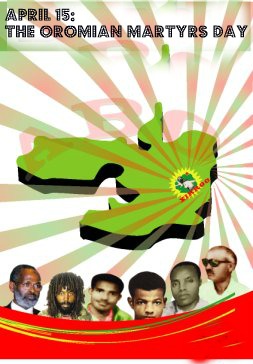 April 15th is the Oromo Martyrs’ Day, also known as Guyyaa Gootota Oromoo. This commemorative day was first started by the Oromo Liberation Front (OLF) after the executions of its prominent leaders on a diplomatic mission en routed to Somalia on April 15, 1980. Since then, this day has been observed as the Oromo Martyrs’ Day by Oromo nationals around the world to honor those who have sacrificed their lives to free Oromia, and to renew a commitment to the cause for which they had died.
Why April 15th?
Mid 1978-1979 is remembered as the period when the survival of the Oromo national liberation struggle, led by the Oromo Liberation Army (OLA), was under a severe threat of extinction. It was feared that OLA units in Arsi, Bale and Hararghe would disintegrate, and their channel of connection and supplies would be cut off by the Dergue army that just recuperated from the Ethio-Somali war. Upon defeating the Siad Barre army, the Dergue turned its face on OLA. The OLA, in the fronts of Arsi, Bale and Hararghe, fought steadfastly and scored victory over the Dergue army and regrouped once again on January 1st 1980. In the wake of their military victory, OLF intensified its political struggle inside the country and abroad. The initial political victory included the persuasion of the Siad Barre government to allow the opening of OLF office in Mogadishu, Somalia, in 1980, to serve as a center of consultation and deliberation between OLF political and military leaders.
In the same year, a ten-member high-ranking military and political delegates (see list below) were on their way to Somalia to meet with political leaders there when they were captured by Somali bandits in Shinniga desert (in Ogaden). These bandits were members of a splinter group from the Siad Barre army that harbored bitter hatred towards Oromo and the OLF. These bandits abused and severely tortured their Oromo captives. The bandits finally ordered the Muslims and Christians to segregate before their executions. The Oromo comrades chose to stay together and face any eventualities than identifying themselves as nothing else, but Oromo. On the day of April 15, 1980, all the ten were executed and their bodies thrown into a single grave.
Reasons for Celebrating the Oromo Martyrs’ Day
There are four major reasons why we commemorate this day.
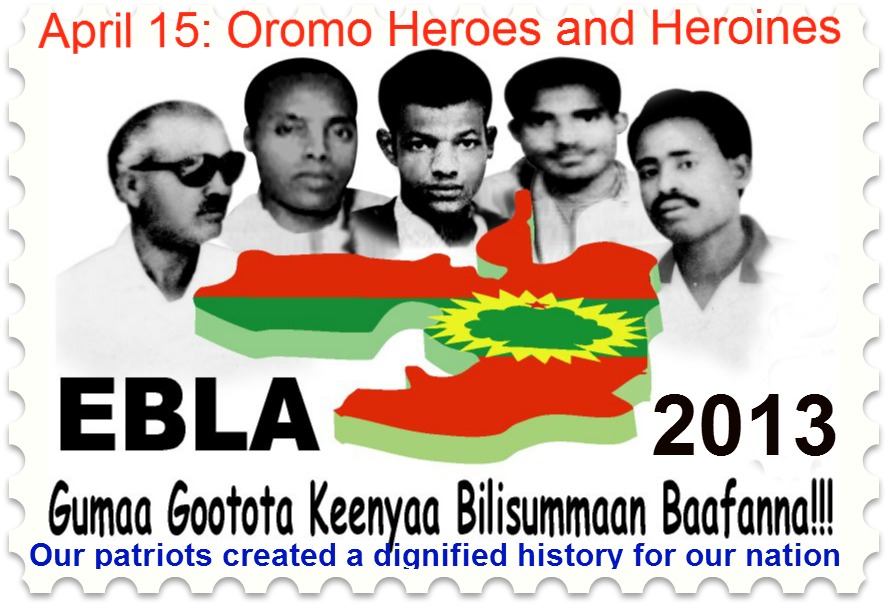 First, this day allows us to remember those Oromo heroines and heroes who sacrificed their lives to restore Oromo culture, identity, and human dignity that were wounded by Ethiopian colonialism. In other words, this commemoration assists us to recognize the dialectical connection between martyrdom, bravery, patriotism and Oromummaa.
Until Oromo heroes and heroines created the OLF and maintained its survival by paying ultimate sacrifices, Oromo peoplehood, culture, language, and history were dumped into the trashcan of Ethiopian history. These heroes and heroines had clearly understood the significance of Oromo culture, history, language, and identity in building Oromummaa, and victorious consciousness to consolidate the Oromo national struggle for achieving Oromian statehood, sovereignty, and democracy.
Second, this commemoration day reminds us that Oromo liberation requires heavy sacrifices, and those who have given their lives for our freedom, are our revolutionary models. Such patriots created dignified history for our nation.
Third, this day reminds us that we have historical obligations to continue the struggle that Oromo martyrs started until victory.
Fourth, this celebration helps us recognize that Oromo heroes and heroines are still fighting in Oromia today. Overall, those Oromo patriots, who by luck have survived and continued the difficult and complex struggle, deserve recognition and respect for what they have done for their people. We must protect them from lies and propaganda of the internal and external enemies. Without the persistent efforts of our patriots, the multiple enemies of the Oromo nation would have destroyed the OLF a long time ago. This does not mean that we do not criticize them when they make mistakes. It is the responsibility of Oromo nationalists to develop constructive criticisms to strengthen our national movement.
The Oromo leaders and members of the OLF, who ignited the fire of Oromummaa or Oromo nationalism, whether dead or alive, have been the foundation and pillar of the Oromo national movement. They left their families, wives, husbands, houses, professions, and children by choosing Oromo human dignity and freedom. By making these kinds of difficult choices, they confronted suffering and death. Consequently, they opened a new historical chapter in our history, and showed to us new possibilities by taking risky and courageous actions. Today, Oromo heroes and heroines are engaged in the Oromo struggle; members of the OLA, Oromo activist students and other activists are our contemporary heroes and heroines, who are intensifying the struggle. All Oromos all over the world who demonstrate their support and sympathy for the Oromo national struggle by contributing whatever they can for these brave men and women are also engaged in patriotic and brave activities.
We, Oromos in exile/Diaspora, should follow the footsteps of the fallen and surviving Oromo heroes and heroes by contributing anything we can to support the Oromo national struggle. If the fallen Oromos had paid with their lives to liberate us, how can we fail to contribute our time, money and expertise to liberate our beloved country, Oromia? How can we sleep when our mothers, daughters and sisters are raped in Oromia? How can we be at peace when genocide is committed on our people? Since our people live under Ethiopian political slavery, and since no country supports the Oromo struggle, we must fulfill our historical obligations by supporting the Oromo national struggle.
April 15th is then chosen to be a day of remembrance for these and all other martyrs, who died in any month and season of the past 120 years of the Oromo anti-colonial struggle.
The following Oromo leaders were martyred on April 15, 1980
1. Bariso Waabii (Magarsaa Barii)
2. Gadaa Gammadaa (Demise Tacaane)
3. Abbaa Xiq (Abboma Mitikku)
4. Doori Barii (Yiggazu Banti)
5. Falmataa (Umar, Caccabsaa)
6. Fafamaa Doyyoo
7. Irrinaa Qacale (Dhibaa)
8. Dhadhachaa Mul’ataa
9. Dhadhachaa Boruu
10. Marii Galaan
Conclusion
 Our martyrs lost their lives while dreaming and fighting for freedom, justice, democracy, and development of their people and their country. They recognized that agitating, educating, organizing, and mobilizing a colonized and dehumanized nation for liberation requires courage, determination, bravery and self-sacrifice without fear of suffering and death in the hands of the enemy and their collaborators. We have moral and national responsibilities to achieve the objectives for which our heroines and heroes sacrificed their lives.
The Oromo national movement is a very dangerous project. Tens of thousands of our people have been imprisoned, tortured, raped, and received all forms of abuse from successive Ethiopian governments in general, and that of the Meles Zenawi in particular. The Tigrayan-led government has been systematically targeting and killing all Oromo leaders and those who have potentials of leadership while promoting the most despicable elements of Oromo society and the children of colonial settlers as leaders of the Oromo nation.
While commemorating our fallen heroes and heroines, we must also remember our current ones who are engaging in the bitter struggle and those who are suffering in Ethiopian prisons. We must double our support for the OLA that is engaging in implementing the missions of the fallen Oromo heroines and heroes in Oromian forests, valleys, mountains, and Ethiopian garrison cities. We should sustain the spirits of our fallen heroes and heroines by taking concrete actions every day. It is our national responsibility to educate, mobilize and recruit passive or unconscious Oromo individuals to join the Oromo national movement. Such actions must start in families by educating and training children; husbands and wives must teach one another and their children the essence of Oromoummaa. The spirits of our heroes and heroines require that all of us must be grass-root leaders who engage in a systematic struggle to fight those agents of the enemy or those misled individuals who undermine the Oromo national struggle intentionally or unintentionally.
All Oromo nationalists must be cadres, teachers, students, leaders, followers, fighters, financiers, ideologues, organizers, defenders and promoters of the Oromo cause. We should not keep quiet when certain individuals attack our organizations, leaders, communities and Oromo peoplehood to satisfy their troubled egos or their masters. If we do some of these activities in our daily lives, the spirits of our fallen heroes and heroines will survive through our actions.
Tesfaye Gebreab: The man who created the first Oromo main character in the history of the vast Amharic literature.
By Hunde Dhugassa*

Pr Asmerom Legesse
Asmarom Legesse is an anthropologist, Ph.D. Harvard, Emeritus Professor, formerly of Boston and North-western Universities and Swarthmore College. He has conducted many years of field research among the Oromo of Ethiopia and Kenya. He is the author of several books including, Oromo Democracy: An Indigenous African Political System. He also wrote Gadaa: Three Approaches to the Study of African Society (1973). He is one of the few non-Oromo Hero to the Oromo people. We have dozens of articles, high level speeches and even Songs to honour his outstanding contribution.

Tesfahe Gebreab
After three decades, a young enthusiastic writer Tesfaye Gebreab emerged with “Yeburqa Zimita” a semi-historical novel surrounding the reflection and reaction of the Oromo people on the century old marginalization, discrimination and suppression which dates back to the annexation of the Oromo land by King Minilik II in the late 1890’s with the advice and logistical support of the then European leaders.
The book in general has resulted in at least three opinion groups as far as Ethiopian audiences are concerned. The majority who think he did what he have to do as a responsible author. The second group who think the book is correct in all aspect but fear the detailed revelation of the facts might hinder future and continued coexistence. There is also a minority third group who think he is a destabilizing agent commissioned by these who don’t like the Ethiopian unity.




 Advocacy for Oromia