Daily Archives: December 5, 2015
Widow of the late prime minister warns Oromo protesters on social media
(A4O, 06 December 2015) Widow of the late prime minister, Azeb Mesfin, warns Oromo protesters on December 3, 2015 on social media.
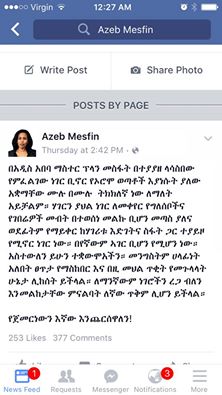 Azeb Mesfin, wife of Meles Zenawi tells the Oromo protesters to back off from questioning the implementation of the debatable Finfinnee (Addis Ababa) integrated master plan.
On Thursday, she appeared on her face book page that she left since the death of her husband and said the government has the responsibility to take every action to stop the Oromo protesters.
She also explains Oromo farmers could be affected when the master plan is implemented and that is the nature of such project.
“This plan may help you too and should not be against it”, she wrote.
Azeb Mesfin, a silent but a powerful hand in the current government circle is criticized in her reputation because of different business ventures she is involved.
Currently, Oromo students from different universities of the country are opposing the implementation of the master plan and the government still continued taking forceful action.
Miftah Juneydi Bushra
(A4O, 05 December 2015) Miftah Juneydi Bushra, the student who was shot during today’s protest at Furda town, Badanno district ( E Hararge) has passed away. As reported earlier, he was initially taken to Girawa Hospital.
Doctors who realized the severity of injury referred him to Harar.
He passed away on the way to Harar.
May he join our martyrs in heaven. Condolences to his family, friends and his beloved nation whom he gave his life defending.
Former Oromo political prisoner Dabala Tafa Robi has been killed.
(A4O, 05 December 2015) Former Oromo political prisoner Dabala Tafa Robi, who was recently released after 6 years of incarceration in Maekelawi and Kality, has been killed.
According to his relatives Dabala was kidnapped by security from Fiche town on December 2, 2015.
His body was found a day later in a ditch 1 KM away from Chancho town.
His funeral is taking place today in Fiche. May he joins our martyrs in heaven. Our condolences to his family, friends and our nation.
Dispatches: Yet Again, a Bloody Crackdown on Protesters in Ethiopia
Felix Horne
Researcher, Horn of Africa | Human Rights Watch
Student protests are spreading throughout Ethiopia’s Oromia region, as people demonstrate against the possibility that Oromo farmers and residents living near the capital, Addis Ababa, could be evicted from their lands without appropriate – or possibly any – compensation. Social media is filled with images of bloodied protesters; there are credible reports of injuries and arrests in a number of towns; and local police have publicly acknowledged that three students have died so far.

The current protests echo the bloody events of April and May 2014, when federal forces fired into groups of largely peaceful Oromo protesters, killing dozens. At least hundreds more students were arrested, and many remain behind bars. Both then and today, the demonstrators are ostensibly protesting the expansion of Addis Ababa’s municipal boundary into the surrounding Oromia region, which protesters fear will displace Oromo farmers from their land. But these protests are about much more: Many Oromos have felt marginalized and discriminated against by successive Ethiopian governments and have often felt unable to voice their concerns over government policies.
Of the student protesters detained in 2014, some have been released. Those I spoke with told me about the torture they endured as part of interrogations. But countless others remain in detention. Some have been charged under Ethiopia’s draconian counterterrorism law for their role in the protests; others languish without charge in unknown detention centers and military camps throughout Oromia. This week, five students were convicted of terrorism-related offenses for their role in the protests.
There has been no government investigation into the use of live ammunition and excessive force by security personnel last year.
Ethiopia’s tight restrictions on civil society and media make it difficult to corroborate the current, mounting allegations and the exact details of the ongoing protests emerging from towns like Haramaya, Jarso, Walliso, and Robe. The government may think this strategy of silencing bad news is succeeding. But while the fear of threats and harassment means it is often months before victims and witnesses come forward to reveal what happened in their communities, they eventually do, and the truth will emerge.
The government should ensure that the use of excessive force by its security personnel stops immediately. It should then support an independent and impartial inquiry into the conduct of security forces in the current protests – and last year’s as well. Those responsible for serious abuses should be fairly prosecuted. This would be the best way for the Ethiopian government to show its concern about the deaths and injuries inflicted on the students, that it does not condone the use of live ammunition against peaceful protesters, and that those who break the law are appropriately punished.
https://www.hrw.org/news/2015/12/05/dispatches-yet-again-bloody-crackdown-protesters-ethiopia
Finfinnee and Oromo over the last 15 years
By Birhanu M Lenjiso
1) 1991 – The capital city, Addis Ababa “Finfinne”, is separated from the Shewa province of Oromia and transitioned to a “special administration zone” of the federal Ethiopian government.
2) 1995 – The Federal government of Ethiopian adapts the constitution to re-create Addis Ababa as a “self governing region” without Oromo administration. Senior officials argued to include a clause (article 49) which still recognizes Addis Ababa belonging to Oromo and receiving ‘special interest’ over joint administration, resource sharing and service delivery and the constitution states the coming of subsequent law detailing the interest of the region.
3) 2004 – Federal government amended the constitution to relocate the Oromia regional government capital city away from Addis Ababa to another in city of Adaama. Heavy protests took place. 300 students were demised only from Addis Ababa University and jailed, some were died and some are still in jail.
4) In the same year, thousands of Oromo businessmen and women were imprisoned and their business were expropriated, confiscated and embezzled by the government cadres.
5) 2004 – In Relation this Oromo social organizations like Macha and Tullama association were dismantled
6) 2005 Oromia Regional Parliament (Caffee) restored Addis Ababa as capital of Oromia only because the opposition political party won the entire parliamentary seat in the city
7) 2007/8 – More towns (19) separated from the Shewa province of Oromia are transitioned as “special administration” zones around Addis Ababa/Finfinnee and massive land sales began.
8) 2009 – An “Addis Ababa Area Expansion Master Plan” was developed by Lyon Town Planning Agency for expansion of Addis Ababa (55,000 hectares) and consultation begins, with strong government support from France and China.
9) 2010/11 – The Massive volume of land sales raises concern among Oromo urban planning engineers who protested, resulting in dismissal and imprisonment of several of them.
10) 2014 – The Master Plan was official unveiled to ‘integrate’ the ‘Special Oromia Zone’ to Addis Ababa. The plan revealed some 1.1 million hectares of land would transfer from Oromia region to Addis Ababa with at least expected displacement of 2 million farmers around Addis Ababa.
11) March 2014 – senior officials of Oromia were called in Adama to approve the new plans, without success. 3 day meeting concluded in 1 day due to fierce protest by the Oromia regional government officials. The officials raised violation of constitutional and jurisdictional violation.
12) April 2014 Federal government bypasses formal approval procedure and moved straight to implementation, without Oromo consultation. Mid-level Oromia regional government officials were called for training on how to implements the project. These officials heavily criticize and demand the plan to be tabled for further discussion.
13) April 2014 – Oromo protests spread across universities. Police clash with non-violent protestors, over 50 students were killed, thousands were/are jailed and disappeared.
14) May 2014 – 30 international cities hold rallies to protest killing of students and the incorporation of the “Master Plan”
15) September 2015 – Oromia regional government passed a vague proclamation on urban development in the region
16) November 2015 – top official in the regional government gave a press conference and raised the controversial master plan again.
17) December 2015 – Oromo student protest out break again, beating, killings and imprisonment of students are undergoing right now.
#OromoProtests, #OromoStudents #Oromia, #Ethiopia, #BBC, #VOA, #aljeereza Melody Sundberg #Untoldstories




 Advocacy for Oromia