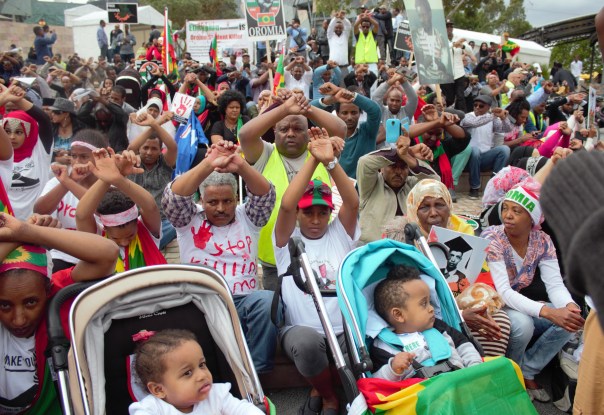
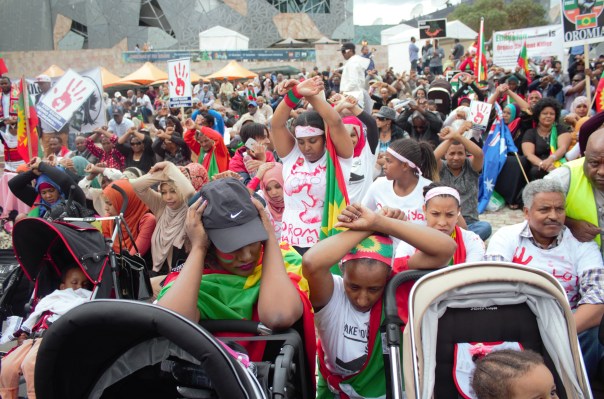
At least 10 students are said to have been killed and hundreds injured during protests against the Ethiopian government’s plans to expand the capital city into surrounding farmland.
According to Human Rights Watch, the students were killed this week when security forces used excessive force and live ammunition to disperse the crowds.
The students were protesting against a controversial proposal, known as “the master plan”, to expand Addis Ababa into surrounding Oromia state, which they say will threaten local farmers with mass evictions.
According to the Ethiopian constitution, Oromia is one of the nine politically autonomous regional states in the country, and the region’s Oromo people make up the largest ethnic group in Ethiopia.
However, rights groups say the Oromo have been systematically marginalised and persecuted for the last 24 years. By some estimates, there were as many as 20,000 Oromo political prisoners in Ethiopia as of March 2014.
It’s not the first time the security forces have reacted violently to protests in support of the group. At least nine students were killed in May 2014 while defending the rights of famers in the region when the “master plan” was first announced.
In response to the violence, Amnesty International issued a report on government repression last year, noting that “between 2011 and 2014, at least 5,000 Oromos [were] arrested based on their actual or suspected peaceful opposition to the government.”
The human rights organisation found that in numerous cases “actual or suspected [Oromo] dissenters were detained without charge or trial, killed by security services during protests, arrests and in detention.”
The ruling elite and members of government are mostly from the Tigray region, which is located in the northern part of the country.
Social media
The Ethiopian media has paid little attention to the protests. Demonstrators have been taking to Facebook and Twitter to report the clashes, with additional coverage coming from diaspora media.
— Soli ( ሶሊ) (@Soli_GM)December 7, 2015
The sad state of press in #Ethiopia , no media can give us information about#OromoProtests, social media is the only existing source.
“The Oromo youth are a powerful political entity capable of shaking mountains,” one Facebook user, Aga Teshome, wrote in support of the protesters. “This powerful political entity is hell bent on exposing the [ruling party] EPRDF government’s atrocious human rights record and all round discriminatory practices.”
Another user said more should be done to shine light on the movement: “The silence has truly been deafening. We need to see and hear the inspiring actions undertaken by huge numbers of #Oromo in #Ethiopia.”
— Oromo Press (@oromopress)December 10, 2015
Justice for massacred #Oromo students. #OromoProtests @WhiteHouse@StateDept #Ethiopia pic.twitter.com/WfnWgPao6h
Desu Tefera echoed the calls for better media coverage: “We call upon the media to investigate the conditions that these students died trying to expose and resist,” he wrote.
“Oromia needs a new kind of reporting by the international media, which gives voice to the voiceless Oromo people, who for a very long time have been killed, mistreated, abused, neglected and repressed in Ethiopia.”
Dubious development
For many Ethiopians, this week’s clashes show that the issue of Oromo rights refuses to go away.
Protests against the master plan for expansion first began in April last year, when students from outside the capital argued that if the proposal was implemented, it would result in Addis further encroaching into the surrounding territory, allowing the capital to subsume surrounding towns and leaving informal settlements vulnerable to government redevelopment.
The government rejected the accusation, claiming that the plan was intended only to facilitate the development of infrastructure such as transportation, utilities and recreation centres.
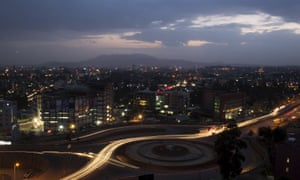
The unrest halted the development until now, but in November resentment boiled over again when it became clear the government had resumed its plan.
Since the highly contested 2005 national election forceful evictions and urban land grabbing have become frequent in Addis and its environs, opposition groups say. The city’s rapid growth has resulted in increasing pressure to convert rural land for industrial, housing or other urban use.
The population of the capital is estimated to have grown at a rate of 3.8% per year since 2007, but the repurposing of land in order to accommodate the expansion has been a particularly contentious issue.
Ermias Legesse, a high profile government defector, has argued that since 2000 the Addis Ababa city municipality, with the support of the federal government, has enacted five different pieces of legislation to “legalise” informal settlements, allowing them to be sold on to private property developers.
“Sometimes the informal settlers are given only a few days’ notices before bulldozers arrive on the scene to tear down their shabby houses and lay foundations for new investors,” Legesse said in an interview last week.
A version of this article first appeared on Global Voices
Source: http://www.theguardian.com/world/2015/dec/11/ethiopia-protests-master-plan-addis-ababa-students




 Advocacy for Oromia