Daily Archives: December 22, 2015
Blood and terror in Ethiopia as protests sweep the streets
Wolenkomi, (Oromia) (AFP) – Two lifeless bodies lay on the ground as the terrified crowd, armed only with sticks against gun-toting Ethiopian security forces, fled the fierce crackdown on protesters.
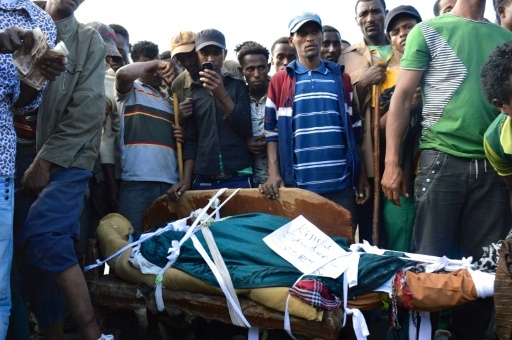
Blood and terror on the streets as protests grip Ethiopia
Blood seeped through a sheet covering one of the bodies on the road outside Wolenkomi, a town just 60 kilometres (37 miles) from the capital Addis Ababa.
“That was my only son,” a woman sobbed. “They have killed me.”
Back at the family home of 20-year-old Kumsa Tafa, his younger sister Ababetch shook as she spoke. “He was a student. No one was violent. I do not understand why he is dead,” she said.
Human Rights Watch says at least 75 people have been killed in a bloody crackdown on protests by the Oromo people, Ethiopia’s largest ethnic group.
Bekele Gerba, deputy president of the Oromo Federal Congress, puts the toll at more than 80 while the government says only five have been killed.
The demonstrations have spread to several towns since November, when students spoke out against plans to expand the capital into Oromia territory — a move the Oromo consider a land grab.
The sight of the protesters on the streets of towns like Wolenkomi — shouting “Stop the killings! This isn’t democracy!” — is rare in a country with little tolerance for expressions of discontent with the government.
Tree trunks and stones are strewn on the asphalt on the road west from Addis to Shewa zone, in Oromia territory, barricading the route for several kilometres.
Chaos broke out on a bus on the road when it emerged that the police were again clashing with demonstrators in Wolenkomi.
“My husband just called me,” said a woman clutching her phone, as others screamed and children burst into tears.
“He’s taking refuge in a church. Police shot at the protesters,” she said.
The man next to her cried in despair: “They’re taking our land, killing our children. Why don’t they just kill everyone now?”
The army raided Wolenkomi again the next day, the rattle of gunfire lasting for more than an hour.
“They grabbed me by the face and they told me, ‘Go home! If you come back here, we’ll kill you’,” said Kafani, a shopkeeper.
Rights groups have repeatedly criticised Ethiopia’s use of anti-terrorism legislation to stifle peaceful dissent, with the US expressing concern over the recent crackdown and urging the government to employ restraint.
But Prime Minister Hailemariam Desalegn declared on television that the government would act “without mercy in the fight against forces which are trying to destabilise the region.”
– ‘Land is everything’ –
Oromo leaders have vowed to keep up their resistance against proposals to extend Addis, and Human Rights Watch has warned of “a rapidly rising risk of greater bloodshed”.
“The government can continue to send security forces and act with violence — we will never give up,” said Gerba.
Land is at the heart of the problem. Under Ethiopia’s constitution, all land belongs to the state, with owners legally considered tenants — raising fears amongst the Oromo that a wave of dispossession is on its way.
“For farmers in Oromia and elsewhere in the country, their land is everything,” said Felix Horne, a researcher at Human Rights Watch.
“It’s critical for their food supply, for their identity, for their culture,” he said.
“You cannot displace someone from their land with no consultation and then inadequately compensate them and not expect there to be any response,” Horne warned.
Some Oromo have already seen their lands confiscated.
Further west, in the town of Ambo, a woman named Turu was expropriated of her two hectares, receiving only 40,000 birr ($1,900, 1,700 euros) in compensation.
“We had a good life before,” she said.
Today she struggles to support her four children and her disabled husband with the 30 birr a day ($1.40, 1.30 euros) she earns working in a factory.
With their own language distinct from Ethiopia’s official Amharic tongue, the 27 million Oromo make up nearly 30 percent of the country’s population.
“The Oromos are seen as more of a threat by the government in part because they are by far the largest ethnic group,” said Horne.
The proposed expansion of Addis is part of a 25-year development plan to boost the city’s infrastructure and attract new investors.
It sparked demonstrations last year, but on a smaller scale.
I Stand With #OromoProtests
A few days ago Melbournians Oromo Youth put a call out to Oromo youth in Melbourne to gather in light of the recent protests in Ethiopia.
This is their message.
Oromo youth across the world are responding to the call for solidarity in multiple ways, follow the #OromoProtests hashtag on twitter, facebook and instagram for regular updates and news.
The #OromoProtests movement is a truly remarkable act of resistance against the Ethiopian government and its plans to further erase and evict the Oromo people from their land, livelihood and future. It is a movement rejecting imperialist ideals of development and oppressive forms of government. The civilians and students protesting; those reporting and co-ordinating on the ground; those in the diaspora working around the clock to give this movement the attention it 100% deserves are all a testament to how completely done the Oromo people are with Ethiopia’s supremacist governance. The crimes against humanity being committed by the Ethiopian government against these protests is a testament to the long standing truth that those in power are incapable of leading the people of Ethiopia justly. We are bearing witness to a true revolution.
Melbourne, we are planning to hold a solidarity rally on the 3rd of January. Save the date. Event page to be shared soon, more cities to add the list of rallies.
U.S. Calls for Dialogue to Address Legitimate Oromo Grievances Following Violent Protests
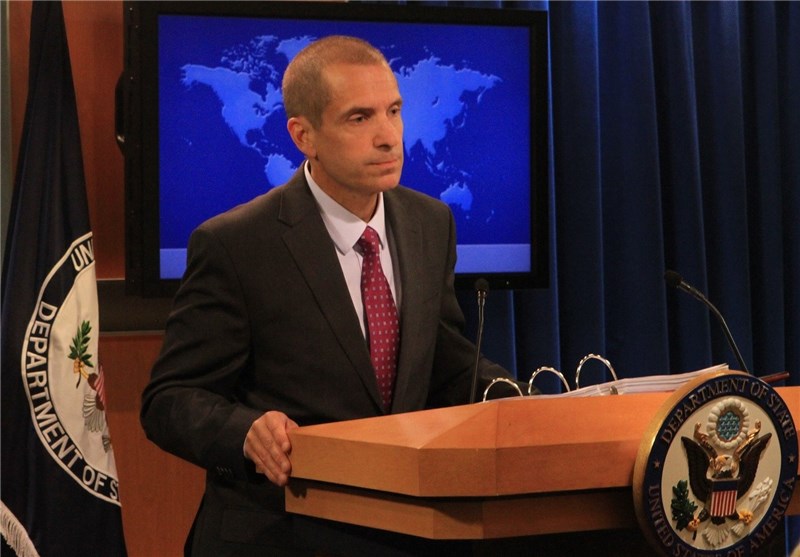 The United States has called for dialogue in Ethiopia’s Oromia region after student protests against a government expansion plan turned fatal.
According to Human Rights Watch (HRW), at least 75 protesters have been killed in clashes with Ethiopian security forces.
The new wave of protests against a plan to extend the capital city Addis Ababa into Oromia began in November.
Hundreds, including university, high school and even primary students, were reportedly involved in the violent protests.
The U.S. State Department has expressed concern about the violence and urged the Ethiopian government to permit peaceful protests.
In a statement published on Saturday, U.S officials admonished protesters from using violence while calling for dialogue to address their legitimate demands.
“We urge the government of Ethiopia to permit peaceful protest and commit to a constructive dialogue to address legitimate grievances,” deputy State Department spokesperson Mark Toner said. “We also urge those protesting to refrain from violence and to be open to dialogue.”
“The government of Ethiopia has stated publicly that the disputed development plans will not be implemented without further public consultation. We support the government of Ethiopia’s stated commitment to those consultations and urge it to convene stakeholders to engage in dialogue as soon as possible,” he added.
The protests originally began in 2014 when the Master Plan or the Addis Ababa and the Surrounding Oromia Special Zone Integrated Development Plan was first proposed. The students, who are predominately from Oromia, say the plan equates to land grab, which they claim would have devastating effects on the inhabitants of the region and their culture.
However, the government has said the plan, which will see the rapidly developing capital Addis Ababa expanded into Oromia state, will benefit the inhabitants.
Ethiopia’s Communication Minster Getachew Reda has said the ‘Master Plan’ will not intrude on the administrative boundaries of the Oromia region.
Officials say the demonstrations, which began peacefully, have since been high-jacked by people who want to destabilize Ethiopia.
“We know destructive forces are masterminding the violence from the forefront and from behind and they have burnt down a number of government and people’s property,” Ethiopia’s Prime Minster Hailemariam Desalegn said. “We have also seen that armed forces have killed and injured security forces and members of the public. This thing cannot continue like this. I would like to pass a message that we, in conjunction with the public, will take merciless legitimate action against any force bent on destabilizing the area.”
What Is Behind the Oromo Rebellion in Ethiopia?
The Ethiopian government is now faced with unprecedented rebellion from the Oromo ethnic group, consisting 35% of the Ethiopia’s population, which it disingenuously claims is inspired by terrorism. The immediate pretext is the Addis Ababa Master Plan encroaching and displacing Oromo farmers, but this masks a deeper grievance which has been brewing for at least two decades under this regime, and for over a century under successive highland Ethiopian rulers. In the following, I will try to provide some context and offer some analysis of the danger Ethiopia and the region are facing.
Background
The late Ethiopian Prime Minster, Meles Zenawi, achieved power in 1991 as “the first among equals” in a ruling coalition. After the 1998-2000 “border war” with Eritrea, he moved to consolidate his power by rewarding loyalists and weakening or imprisoning his rivals. Meles institutionalized one-party rule of the Tigray People’s Liberation Front (TPLF) and his Tigrayan inner circle, with the participation of other co-opted ethnic elites who were brought into the ruling alliance under the Ethiopian People’s Revolutionary Democratic Front (EPRDF).
The EPRDF consists of four groups: the Oromo Peoples’ Democratic Organization (OPDO), the Amhara National Democratic Movement (ANDM), the South Ethiopian Peoples’ Democratic Front (SEPDF) and the Tigrayan Peoples’ Liberation Front (TPLF). The Oromo Liberation Front (OLF) decided to withdraw from the EPRDF coalition in 1992 and was pushed out after unsuccessfully trying to assert its independence from the TPLF within the coalition. The role of OPDO, ANDM and SEPDF is simply to rubber stamp TPLF’s agenda. In North American parlance, one can describe the members of OPDO, ANDM and SEPDF as the uncle Toms of Ethiopian society.
Zenawi’s violent crackdown on the 2005 demonstrations protesting the widely believed rigged election was a clear indication of his determination to hang on to power. In the 2010 elections, the EPRDF won 499 out of 547 parliamentary seats — with all but two others going to EPRDF-allied parties — and all but one of 1,904 council seats in regional elections. Despite the semblance of parliamentary rule, those elected were irrelevant to the governance of the country, since the TPLF and PM Zenawi maintained near absolute control over the country’s politics.
If there was any doubt in 2005, in the 2010 and 2015 elections, it became clear that this was a one-party rule with a vengeance, ensuring the triumph of repression, the squashing of dissenting voices and the shutting down of independent media. Elections in Ethiopia are shenanigans to show complete EPRDF control rather than engagement in democracy. There is a clampdown on internet access, and the arrest and sentencing of political opponents and journalists. Even two Swedish journalistsreporting in the Ogaden were imprisoned on terrorism charges.
Succession Not Transition
There was a speculation that Meles’s passing in august 2012
could touch off an internal power struggle expected to take place within the ranks of his loyalists. But the succession of a new prime minister turned out to be an uneventful affair and at least outwardly peaceful. The number of Tigrayans in the cabinet decreased, but key posts remain in the hands of aging Tigrayan loyalists. The talk of “generational change” over the past few years was simply a charade.
Among the exceptions is the current PM Hailemariam Desalegn, the relatively unknown ex-Deputy Prime Minister. Desalegn’s ethnicity gives a superficial semblance of balance and cover for the Tigrayan oligarchy. Desalegn is a Wolayta, a somewhat marginalized ethnicity in the periphery of Ethiopian society, and a born-again Christian in a country where the dominant church is Ethiopian Orthodox. He never participated in the armed struggle that brought the various factions of the EPRDF to power. His status as an outsider was perceived by many to be an asset that gave him broader legitimacy, insulated him from criticism, and allowed him to present himself as an underdog protected from the historical baggage of the Amhara and Tigrayans.
Yet, in his three years in power, Desalegn has announced few new policies. Some suggest that he is a mere figurehead and that real power is still within a core TPLF group shadowing him. In any case, party leaders seem lost without Zenawi. They govern on autopilot, following the vision and templates he left behind. In effect, Zenawi is ruling from the grave. Yet developments like the Oromo uprising expose the limits of ruling from the grave. Regime officials seem confused. Different officials say different things and contradict each other. They look like deer caught in the headlights. As is often the case, oppressors are blind to what they perpetrate on their victims and surprised when the oppressed rise up defiantly.
Resistance to EPRDF Rule
While opposition and discontent have been growing in Ethiopia, the security apparatus is ever vigilant against them . Rioting Muslims were effectively contained. The TPLF marginalized both the legal and the extra-legal opposition, leaving little option but to protest as in the current Oromo uprising. The few co-opted Oromo elites within the EPRDF have little credibility, and protesters scoff at statements coming from Oromo leaders serving the regime.
Other ethnic groups deeply dissatisfied are the Ogadenis, Gambella and Benishangul-Gumuz. The Ogaden national liberation Front (ONLF) in Ogaden is waging an insurgency exacerbated by forcible relocations to allow oil and gas exploration. Similar insurgency rages in Oromia led by the Oromo Liberation Front (OLF). Oromia was incorporated into the Ethiopian empire in the 1880s by emperor Menelik IIduring the time the European scramble for Africa was underway.
Resentment to TPLF rule extends even among parts of Tigray, where a part of the population feel left out by the TPLF elites interested only in making money and investing it in the capital or abroad. The EPRDF has unsuccessfully lobbied the U.S. government to label the ONLF and the OLF as terrorist organizations. Nevertheless, the controversial use and abuse of the Anti-Terrorism Law is applied with impunity. The government attributes the ongoing Muslim and Oromo protest to infiltration from Saudi Arabia, Eritrea and the opposition Ginbot 7 movement.
Despite a dishonest attempt to externalize the issue, Ethiopian Muslims, who number anywhere from 40% to 50% of the population, and the Oromo have historically been marginalized, and the protest is very much homegrown and rooted in a long list of grievances.
Ethiopia, the U.S. and its Western Allies
Ethiopia is a key strategic ally for the War on Terror, which insulates it from any UScondemnation. Ethiopia receives the largest aid in Africa — an average $3.3 billionper year. The government abuses aid money to the extent that even government-provided seeds and fertilizer is denied to farmers who are not party members. Regarding the current uprising, the United States has issued a statement of concern. However, the regime itself is noticably unconcerned because it knows these statements by the U.S. are accompanied by little or no action. Even the African Union, with its headquarter in Addis Ababa, while rightly concerned about a potential genocide inBurundi, is conspicuously silent on the massacre taking place against the Oromo right on its doorstep.
The late Zenawi had the wit to position himself as an indispensable ally of the West in the fight against “terrorism.” Ethiopia is seen as a bulwark against extremism and the chaos of Somalia. From the U.S. point of view, Ethiopia is a military bridgehead to contain Al Qaida infiltration in Somalia and even across the Red Sea in Yemen.
International aid subsidizes about 50 % of Ethiopia’s national budget. United Kingdom funding of $4.9billion for a brutal resettlement scheme was only withdrawn this year. Germany continues to aid Ethiopia for “strategic” reasons despite voicing concern about human rights violations. The regime has deepened its economic relationship with China (which is tight-lipped on human rights issues) by utilizing its comparative advantage: capitalizing on the availability of plentiful cheap labor and Chinese subsidies for projects encroaching in Oromia.
The Economy
Zenawi engineered Ethiopia’s success in securing aid from the European Union and the U.S.; he was adept at maneuvering and securing money from Western financial institutions that even his detractors acknowledge. He counted among his admirers big names such as Professor Jeffrey Sachs of Harvard as well as Professor Joseph Stiglitz of Columbia University and a recipient of the Nobel Prize in Economics. The country’s rulers have perfected the culture of begging and dependency and are now appealing for a $1.4 billion to feed the 10.2 million drought victims even though they engage in the business of leasing fertile land to foreign investors who export everything they grow. Drought does not have to lead to hunger and famine, if a government plans for it. Poor governments can store grain when there is good harvest in preparation for such emergencies.
Consistent with the notion of state-directed developmentalism espoused by the EPRDF, it aspired to oversee the development of roads, rail, electricity and telecommunications, boasting double-digit growth although the IMF disputes those figures and puts the growth rate at 7.5 per cent . It did succeed in Addis Ababa getting sub-Saharan Africa’s first light-rail network. However, the government’s claim that its socio-economic policies have helped the poor is disputed by critics, who point out that the primary beneficiaries are the political elite and that the gap between the elites and the poor is ever wider. The Oromo uprising is partially resentment over displacement and over environmental damage in the name of development.Corruption is rampant in the country. Theft from state enterprises and participation in the black market, including widespread graft is all too common.
Federalism
Ethiopia under the EPRDF was officially declared a federal state. In states with true federalism, regions enjoy political primacy, as it is they who consciously decide to form the state, unlike centralized states where the constituting units come into being in line with EPRDF administrative requirements from the center. The strong center in Ethiopia never allowed for the true spirit of federalism to emerge. The country could never rid itself of the lingering grievance of the regions, of not getting their share, commensurate with their resources. There is a whole list of such claims, such as, misuse of river waters and cheaply leasing of indigenous land to foreign capitalists, urbanization (as in Addis Ababa’s Master Plan), and increasing Deforestation.
The TPLF military and the future
The Ethiopian military as an institution has acquired unprecedented power. Under any conceivable scenario, the military will continue to be a key and decisive player. Yet, it is not a truly national army; at the officer corps level, it is heavily dominated by Tigreans. Historically, the rank and file soldiers come mostly from the Oromo nation and have been the cannon fodder in the country’s numerous wars under Haile Sellassie, Mengistu Hailemariam, and now under the TPLF dictatorship. There is deep grievance within the army resulting in high profile desertions from the Air Force and other branches.
Control of key economic sectors by the military under the EPRDF have made it difficult to limit its role to a strictly military one. The military’s role has other consequences of spiraling ethnic conflicts which have reached a boiling point in the current uprising. EPRDF rule has engendered profound hatred and resentments among different groups with Ethiopian society and among the former ruling classes of the Amhara ethnic group.
The Ogadenis have a longstanding group grievance that is part and parcel of their indomitable desire for self-determination, which has never been addressed. The current uprising is a culmination of systematic injustice perpetrated against the Oromo. Resistance in Ethiopia in the absence of political space for cross-ethnic alliances is being channeled along ethnic and religious lines, potentially setting the stage for the balkanization of the country. In the 20th century, highland monarchist absolutism, Stalinist dictatorships and today’s make-believe “democratic federalism” may contribute more to fragmentation and dismemberment than nation-building. The legacy of dictatorship, from Menelik II, Haile Selassie, Mengistu Hailemariam to Meles Zenawi has endangered the country.
Ethiopia’s future is, therefore, clouded with uncertainties.




 Advocacy for Oromia