Daily Archives: December 24, 2015

Ethiopia security forces kill up to 50 people in crackdown on peaceful protests

Attempted land grab by Ethiopian government has led to violence against ethnic group.

The violence-torn Horn of Africa is seeing a fresh wave of repression as Ethiopian authorities crack down on protests by the country’s largest ethnic minority.

Human rights groups say an attempted land grab by the federal government has seen violence flare in the Oromia region, with up to 50 protesters killed by security forces so far this month.

Campaigners from the Oromo ethnic group say they have been labelled “terrorists” by Ethiopian authorities as they fight the government’s plan to integrate parts of Oromia into the capital Addis Ababa.

Some Oromo protesters fear that they will be forcibly evicted from their land as part of the rapid expansion of the capital, which they call a federal “master plan”.

The government has claimed that the protesters are planning to “destabilise the country” and that some of them have a “direct link with a group that has been collaborating with other proven terrorist parties”.

International observer groups have condemned the violent crackdown on protest movements, however.

“Instead of condemning the unlawful killings by the security forces, which have seen the deaths of more than 40 people in the last three weeks, this statement in effect authorises excessive use of force against peaceful protesters,” said Muthoni Wanyeki, Amnesty International’s regional director for East Africa, the Horn and the Great Lakes.

“The suggestion that these Oromo – protesting against a real threat to their livelihoods – are aligned to terrorists will have a chilling effect on freedom of expression for rights activists,” he said.

The latest round of protests, now in their third week, has seen the federal government mobilise its Special Paramilitary Police units from other states, as well as army units, against the ethnic Oromo people, Ethiopia’s biggest ethnic group of about 25 million people out of a population of approximately 74 million.

The protests began last month in Ginci, a small town about 50 miles west of Addis Ababa. Initially, campaigners’ demands were limited and concerned the fate of a local stadium and the clearing of nearby forest for development by foreign investors.

The uprising spread quickly, however, to more than 130 towns across Oromia. And gruesome images of protesters wounded, or killed by security forces appeared on social media sites despite deliberate power blackouts and disruption of internet services.

The Prime Minister, Hailemariam Desalegn, said on state television on Wednesday evening that the government knew that “destructive forces are masterminding the violence from the front and from behind”. He said he would take “merciless legitimate action against any force bent on destabilising the area”. The government said that the outlawed Oromo Liberation Front (OLF) was involved.

Ethiopia’s anti-terrorism legislation permits the government to use unrestrained force against suspected terrorists, including pre-trial detention of up to four months.

People that have been subject to pre-trial detention under the anti-terrorism law have reported widespread use of torture and ill-treatment. All claims of torture and ill-treatment should be promptly and independently investigated by the authorities.

“The government should desist from using draconian anti-terrorism measures to quell protests and instead protect its citizen’s right to freedom of expression and peaceful assembly,” said Ms Wanyeki.

Since moving into Ethiopia’s highlands in the 1600s, the Oromos have been discriminated against by the ruling Tigray and Amhara classes, who often saw them as “uncivilised”, according to the historian John Markakis.

Source:http://www.independent.co.uk/news/world/africa/ethiopia-security-forces-kill-up-to-50-people-in-crackdown-on-peaceful-protests-a6777631.html

Protesters rally to end ‘genocide’ in Oromia

A crowd of supporters of the Oromo people in Ethiopia staged a loud protest in front of the Gene Snyder U.S. Courthouse at Sixth and Broadway near noon Wednesday, saying the government is killing farmers and displacing them from their land to expand the capital city of Addis Ababa.
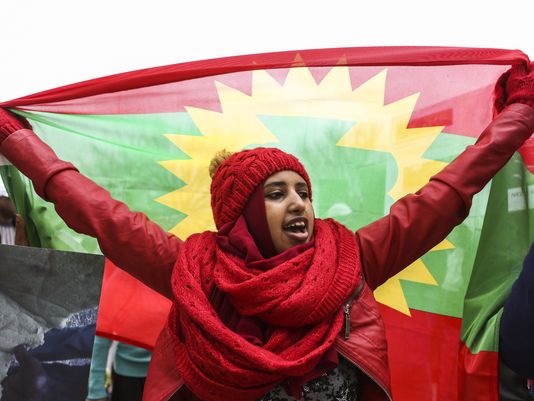
635864729466420366-ethiopia-protest23

Caption: Sima Ahamed holds the Oromian flag as she chants along with fellow protesters outside the Federal Building on West Broadway Wednesday afternoon as they denounce US support of the Ethiopian government. Dec. 23, 2015

They also said students and others who are peacefully demonstrating against government policies are being imprisoned, tortured and killed.

Oromia is a regional state in the vicinity of the capital, and protesters said most of the people at the rally were either refugees from the killings, immigrants from Oromia or in the U.S. as students, with many living in the vicinity of the former Americana Apartments in south Louisville.

Men, women and children shouted for “justice” and held banners and signs calling for “Justice and Freedom for the Oromo People” and “Justice for Massacred Oromo Students” and condemning “state terrorism.”

“We’re here to demand that the American government stop supporting the Ethiopian government,” Fanta Ketu, an organizer from Columbus, Ohio, said. When farmers’ land is seized, “they don’t give them anything,” Ketu said.

Amnesty International reported in October 2014 that “Thousands of members of Ethiopia’s largest ethnic group, the Oromo, are being ruthlessly targeted by the state based solely on their perceived opposition to the government.

The report “exposes how Oromos have been regularly subjected to arbitrary arrest, prolonged detention without charge, enforced disappearance, repeated torture and unlawful state killings as part of the government’s incessant attempts to crush dissent,” according to Amnesty International.

At the Louisville rally, Waago Chaama wore a red T-shirt reading: “In Holy Memory of My Fallen Oromo Heroes.”  He said he “stands in solidarity” with those in his native country.

The Oromo people makeup about a third of the population but protester Abdala Ali said they don’t have any representation in the government. Protesters have talked to representatives of U. S. Sen. Mitch McConnell’s office in the federal building, he said.

Andrew Condia of McConnell’s office said he and others were aware of Wednesday’s protest and that he would supply a comment to The Courier-Journal, after checking with Washington staff members.

“We need the U.S.A. to help us,” Ali said. “We need the world to hear.”

Reporter Martha Elson can be reached at (502) 582-7061 and melson@courier-journal.com.  Follow her on Twitter at @MarthaElson_cj.

Source: http://www.courier-journal.com/story/news/local/2015/12/23/protesters-rally-end-genocide-ethiopia/77828220/

Famous Oromo female singer Hawi Tezera feared to be under another torture

HawiTezera2015_20156

Report shows Hawi Tezera's bruised and swollen body from last week's torture

Report shows Hawi Tezera’s bruised and swollen body from last week’s torture; activists fear she could be tortured again

Report shows Hawi Tezera's bruised and swollen body from last week's torture

Report shows Hawi Tezera’s bruised and swollen body from last week’s torture; activists fear she could be tortured again

The famous Oromo female singer Hawi Tezera was detained and tortured last week by the Ethiopian Federal police after releasing an Afan Oromo single music that’s critical of the Ethiopian government’s affairs, i.e. the Master Plan and the killings following the protests against the Master Plan, in the Federal State of Oromia.

The single, which was released on December 15, 2015, was produced using the traditional Oromo protest genre called Geerarsa. Photos of the singer’s tortured body, showing the bruised and swollen areas, are shown here.

Upon the intervention of the Oromian State police, the report adds, Hawi was released from her ordeal only to be imprisoned again over the last few days. Activists fear that she could be tortured again; the Ethiopian government has a record of detaining and torturing dissidents (prisoners of conscience) who oppose its policies using peaceful and Constitutional means.

In addition to Hawi, thousands of Oromos, including a journalist, have been imprisoned across Oromia and Ethiopia over the last week – accused of expressing protests against the Addis Ababa Master Plan.

According to the protesters, who are using peaceful (nonviolent) means to demonstrate their opposition, millions of Oromo farmers will be evicted from their homesteads, and thousands have already been evicted and have become homeless, through the government’s large-scale land-grab project called the Addis Ababa Master Plan.

During the recent wave of arrests, the government has especially targeted Oromo singers and their families/relatives for imprisonment and harassment.

It is to be remembered that Oromo male singers Jireenyaa Shifarraa and Bilisummaa Dinquu were reportedly abducted last week by the government forces – after being accused of releasing music that’s critical of the government’s policy in Oromia; photos of Jireenyaa Shifarraa in handcuffs were circulating on social media last week (attached below).

Oromo artist Jireenyaa Shifarraa detained by the Ethiopian government

Oromo artist Jireenyaa Shifarraa detained by the Ethiopian government

Revolt in an African Stasi State

Revolt in an African Stasi State

Ethiopia is hailed as one of the fastest-growing economies in the world. For the last decade, the East African nation has averaged around 10 percent annual GDP growth, far outpacing most of its neighbors on the continent. It recently launched a new light-rail system in the capital of Addis Ababa, the first of its kind in Africa, and the government is aggressively pushing several Chinese-funded hydroelectric and infrastructure projects to reduce agricultural dependence and accelerate manufacturing growth. Many experts — including those at the African Development Bank — expect the country’s upward trajectory to continue in 2016.

But despite the outward veneer of progress, all is not well in Africa’s second-most populous nation. Weeks of student protests have roiled the Oromia region, which is home to the Oromo, the country’s largest ethnic group and among its most marginalized. More than 80 people have been killed in a violent crackdown by security forces, according to opposition parties. Coupled with a devastating drought that will leave an estimated 20.3 million people in need of urgent assistance by January of next year, the mounting public discontent in Oromia offers the latest warning signal that the same top-down social and economic model that has powered Ethiopia’s rise could ultimately bring it crashing down.

Unlike most of its economic peers on the continent, Ethiopia follows a stringent growth model known as the “developmental state.” This model borrows heavily from the so-called Asian Tigers, whose state intervention in macroeconomic planning led to impressive economic growth in East Asia in the 1970s. Ethiopia’s late Prime Minister Meles Zenawi, the chief architect of the “developmental state” and the driving force behind its initial implementation, defended the decision to ditch the neoliberal paradigm in 2007: “[D]eveloping countries face formidable market failures and institutional inadequacies which create vicious circles and poverty traps, which can adequately be addressed only by an activist state,” he wrote.

But under Meles, the “activist state” became a euphemism for state repression — albeit under the guise of development

But under Meles, the “activist state” became a euphemism for state repression — albeit under the guise of development. The ongoing protests in Oromia reflect growing public dissatisfaction with this experiment, as well as outrage over the routine and callous brutality demonstrated by the country’s security forces.Until recently, many international observers — no doubt influenced by effective Ethiopian propaganda — assumed that the country’s development strategy was working just fine. As a result, donor countries eager for an aid success story — most notably, the United States — have largely ignored mounting concerns about the narrowing of democratic space and the unequal distribution of growth benefits. But such illusions have been shattered over the past month as the public protests in Oromia have burgeoned, creating the most significant challenge to the ruling Ethiopian People’s Revolutionary Democratic Front (EPRDF) since it came to power in 1991.

Oromia is the largest of Ethiopia’s nine ethnolinguistic-based states, and it is no stranger to state-driven violence. The Oromo, who represent around 40 percent of the country’s 100 million people, have long suffered the brunt of the central government’s repression. The Tigrayan People’s Liberation Front (TPLF), the kingmaker in the loose EPRDF coalition, dominates the central government. TPLF leaders and their coterie control key government institutions, the military, and much of the economy, a fact deeply resented by the Oromo and other oppressed groups throughout the country.

In theory, Ethiopia is a federation based on decentralized ethno-national representation. But the EPRDF’s top-down approach to development — and its refusal to fully implement the ethno-federalist system laid out in its constitution — has contributed to the growing estrangement of a number of minority groups from the capital. The Oromo experience is a case in point: Time and again, Addis Ababa has responded to the group’s calls for greater autonomy with disinterest and, at times, brute force.

Oromo protests have become something of a ritual over the past decade, as have the government’s heavy-handed responses to them. In April and May of last year, for instance, security forces fired live ammunition at protesters in order to suppress a popular uprising against government encroachment on Oromo lands. Activists estimate that there are at least 20,000 Oromo political prisoners in Ethiopia today, meaning that roughly one out of every 1,400 Oromo nationals is currently in jail. According to Amnesty International, at least 5,000 Oromos were arrested solely based on their actual or suspected opposition to the government between 2011 and 2014.

Unsurprisingly, EPRDF leaders in Addis Ababa have blamed the latest unrest in Oromia on what they deem anti-development forces. (Communications Minister Getachew Reda went as far as to refer to protesters as “demonic” and “terrorists.”) This refrain has been employed often to violate constitutionally protected civil liberties and justify the use of disproportionate force against perceived domestic opponents. On Dec. 17, Prime Minister Hailemariam Desalegn signaled his intention to continue the crackdown on demonstrators, threatening to use “merciless action” to disperse future crowds.

The current round of Oromo protests began on Nov. 12, when local students in Ginchi, a rural area 50 miles west of the capital, took to the streets to oppose a draft “master plan,” introduced by the central government, which aims to expand its administrative control over Oromia. Since then, the demands of the protesters have expanded to include calls for self-rule, more equitable development, and respect for the country’s ethnic-based federalist system, which in theory preserves the autonomy of regions like Oromia.

In essence, the protests have evolved into a full-scale revolt against Ethiopia’s highly centralized one-party state, which has closed off political space to the opposition, to religious groups, and to civil society. Not even individual households can escape the prying eyes of state authorities. In Oromia and a number of other regions, the government enforces a special hierarchical system of party informants, known as gott and garee, to monitor the everyday activities of Ethiopian citizens. This deeply ingrained spy network consists of one government informant for every five citizens.

Draconian national security laws have also become a cornerstone of the EPRDF’s efforts to keep citizens in check. For example, the 2009 Anti-Terrorism Proclamation includes overly vague language on the government’s powers of arrest, search, and seizure; allows courts to consider evidence obtained under torture; and enables authorities to detain citizens without charge for up to four months. Another key feature of this law defines terrorism as simply intending to “influence the government.”

Despite this track record of oppression, Ethiopia remains a veritable darling of the West. Nowhere is this more evident than in Washington, D.C., where Ethiopian autocrats have long been lauded, praised, eulogized, and rewarded with billions of dollars in foreign and development aid — of which less than 1 percent is currently allocated for human rights and democracy-related programming.

The capstone to Washington’s love fest with the EPRDF regime came in July, when President Barack Obama became the first sitting U.S. president to visit Ethiopia. While there, Obama twice referred to the one-party government as “democratically elected,” a darkly comedic remark that came barely two months after the EPRDF claimed all 547 parliamentary seats in a national election.

The United States does occasionally raise human rights concerns and acknowledge the shrinking democratic space in Ethiopia. In a Dec. 18 statement responding to the latest crackdown in Oromia, for instance, the State Department called for “dialogue” while expressing “condolences to the families of those who have lost their lives.” But given Washington’s preoccupation with Islamic terrorism in the Horn of Africa, and its view that Ethiopia is a stable bulwark against extremism, it has routinely stopped short of condemnation. Leaders in Washington have also declined to apply any meaningful pressure on the regime to reform, conveniently forgetting that it has half a billion dollars in annual aid to use as potential leverage.

It is clear that the majority of Oromo people, like most other oppressedgroups in Ethiopia, are fed up with the EPRDF’s growing repression and its highly intrusive model of governance. Young people, especially, lack avenues to air their grievances, not to mention the basic democratic rights with which to demand a genuine platform to be heard. Instead of addressing their valid interests and concerns, Ethiopian authorities continue to respond with violence after their attempts to indoctrinate the youth fall short.

This cycle of violence will continue to tear at the fabric of Ethiopian society until the EPRDF regime allows genuine federalism to take root, thereby opening up the political environment and involving all of the country’s shareholders in the development process. The ongoing heavy-handed response to widespread discontent has already engendered a heightened ethnic self-awareness among Ethiopians and has contributed to a resurgent Oromo nationalism that is just now beginning to flex its collective muscle. Addressing the widening democratic deficit, as well as the country’s long-simmering ethnic grievances, remains the only sure way to safeguard Ethiopia’s stability and to sustain its recent economic trajectory.

Source: http://foreignpolicy.com/2015/12/23/revolt-in-an-african-stasi-state/

Oromo protests set to continue in Oromia

In an interview with DW, a spokesman of the Ethiopian Federal Democratic Unity Forum accused the government of abusing the country’s constitution with its plans to expand the capital Addis Ababa.

A crowd of Oromo protesters

Violence and chaos gripped Ethiopia this week as thousands of demonstrators took to the streets in protest against government plans to expand the capital Addis Ababa. Human Rights Watch said at least 75 people were killed in a bloody crackdown by heavily armed security forces. The demonstrations have spread to several towns since November, when students spoke out against plans to expand the capital into Oromia territory, a move the Oromo people consider a land grab. DW spoke to Merara Gundina, chairman of the opposition Oromo Federal Congress, in Addis Ababa.

DW: What exactly are you demonstrating against?

Merara Gundina: The Addis Ababa Master Plan is part of a larger land grab by the Ethiopian government around Addis Ababa, which has displaced not less than 200,000 people. Secondly, under federalism all the boundaries are being eroded by the ruling party which is bent on taking the land. People are very angry with the government and people who wanted to see change are frustrated.

Under the Ethiopian constitution all land belongs to the state, with people living there legally considered tenants. Doesn’t this allow the government to carry out any developments that may serve the interests of all Ethiopians?

No, no, the government is misusing it. The constitution says the land belongs to the public so it doesn’t allow the government simply to tell the people “go away” and it takes the land. No, it says there are bonds of state in the name of the people and there are individuals owning the land. It is the ruling party that is misusing the constitution. In fact, the state itself is privatising the country.

We understand you have vowed to continue the demonstrations despite the killings and Prime Minister Hailemariam Desalegn declared on television that the government would act without mercy. Is it not better to solve these issues through talks?

We continue to support the cause of our people. We continue our peaceful struggle. We cannot be intimidated as the government has done. We have popular support, we have millions of people behind us. The government cannot silence us easily. We are following the constitution but we are against the arbitrary misuse of the constitution by the ruling party. Our people will continue.

Is it true that your organization is getting support from outsiders?

The diaspora is far away. It’s school kids, high schools and universities and the government is simply accusing the left and the right. Probably the diaspora is very active in the media because the local media are totally controlled by the government. We have no access to the media and the diaspora have some media outlets and they report what is happening in the country. But a diaspora of a few thousand cannot move millions of people.

Source:http://www.dw.com/en/oromo-protests-set-to-continue-in-ethiopia/a-18937401

