Daily Archives: May 29, 2016
On Using Ethiopia’s other ‘others’ to Silence the Oromo and to Degrade their Quest for Justice
Tsegaye Ararssa, (27 May at 17:10 )
For some people, the urge to trivialize the Oromo demand for justice makes them “liberation fighters” for the other “others” of Ethiopia. They recklessly mention names of people whose existence they never knew, at the sounds whose names they have endless laughter.
They mention people whose names are otherwise the stuff out of which Amharic comedies are made. They mention these names just so they can talk about them as victims of various Oromo groups.
They talk about the rights of the people they don’t even know in order to disavow responsibility for the injustice they perpetrate on the Oromo they know.
Source: On Using Ethiopia’s other ‘others’ to Silence the Oromo and to Degrade their Quest for Justice
‘Did Menelik II really say he is Caucasian?’: Fragments for the Little chaps, Lest you celebrate Prematurely
There is a renewed frenzy among social media activists in the Ethiopian right, who vow that Emperor Menelik II of Ethiopia never claimed to be a Caucasian. They dispute the accuracy of his statement in which he said “I am not a Negro at all; I am a Caucasian.” In their most recent iteration, they claim that, among other things, the invocation of this statement is an attempt by “Some Oromo intellectuals” to trivialize the image of Menelik II and the famous battle of Adwa that supposedly he fought and won for the entire black race.[1] They also claim, wrongly, that these ‘Oromo nationalists’ are doing so motivated by an ideological commitment to vindicate the Oromo right to secession and destroy the Ethiopian state. They insist that there is a sinister motive behind this calculated move to trivialize Adwa because Adwa is not only the symbol of black independence but also the foundational moment of the unity of the Ethiopian people (people in the singular). By undermining the significance of Adwa, their rant goes, ‘some Oromo intellectuals’ in general, and especially I, in particular, seek to undermine the basis of Ethiopian unity. Nothing can be further from the truth.
Menelik II is the Least of my Worries: A Note to the Apologists of Empire
Tsegaye R Ararssa 26/05/16 ==================================
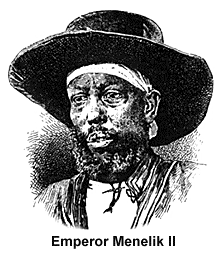 This is a short memo to the Ethiopian extreme right activists who charge us that we trivialize Menelik II’s persona and his deeds. While we note trivializing of such figures as a mode of critical engagement is legitimate and so doing is long overdue, I like to say that Oromos are not interested in doing so. I like to say that Menelik II is the least and the last of our Oromo worries. Here is why:
Menelik II is the last and least of my worries now.
If you worry about his image, that is fine. Do worry about it.
If you think he put you to shame because he said he is not black, that is your problem.
If he falsified your chants about TIKUR SEW, or if he destabilized the false narrative regarding him as the messiah of the black race, that too is your headache, not mine.
Source: Menelik II is the Least of my Worries: A Note to the Apologists of Empire
THE PEOPLES’ ADWA: The Imperative of Embracing Plural Interpretation
Tsegaye R. Ararssa (1 March 2016)
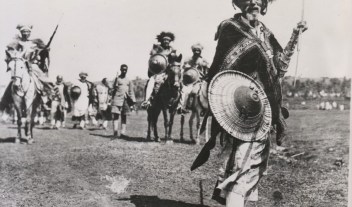 Every year, when March is around the corner, Ethiopian social media activists start to be noisy. The defenders of Adwa as a phenomenal black history moment and the revisionists battle it out, often in a vulgar mode of exchange. Over the last two years, I have been observing this discussion between those who seek to promote the old narrative of state orthodoxy as the only and the universal meaning of Adwa and those who take a more sceptical stance seeking to show the darker sides that the Adwa moment signifies. The following paragraphs were written in response to those who seek to impose on the Oromo this exhausted old narrative of the ideologically motivated imperial State Orthodoxy.
1. There are right reasons to celebrate the battle of Adwa. But to say Adwa is a black man’s war fought for securing the freedom of the people of the black race is celebrating the event for the wrong reason.
- Truth be told, it was a colonial war fought among colonial empires, framed by rules of colonial international law, with a colonizing consequence for Africa.
- It was a war fought between two maiden empires competing over the fate of black peoples in Ethiopia and beyond. This was clearly stated by the emperor himself several times, the emperor who also clearly denied that he is black, the emperor who rather mysteriously claimed to be Caucasian, the emperor who refused to identify with Afro-Americans and Haitians who saw him as one of their own and sought to salute him for his achievements at Adwa, the emperor who brutally murdered millions of black people, the emperor who personally owned over 70, 000 black slaves, the emperor who negotiated with white colonial powers on the fate of other black peoples (Eritreans, Djiboutians, Somalis, and the Sudanese) under white colonial rule.
- To say Adwa is a pride of black people, therefore, is a distortion of historical truth and a gross misrepresentation of the man and the event.
- To say that our people sacrificed, especially those of them who were in chains, to preserve a semblance of an African sovereignty; to commemorate the lives lost in that war and to honor the sacrifices thereof is the right reason to celebrate it. As someone whose forefathers have paid dearly for this and for the subsequent fascist war, I feel the pain, I share the loss, and I honor their sacrifice.
- As I honor their sacrifice and commemorate and celebrate the lives of the many black bodies lost there, I speak the truth, the whole truth, and stick only to the truth.
- To my compatriots who insist that we should celebrate it for the wrong reason, I insist in telling you the truth, the raw truth, especially on the issues we disagree strongly. Doing this is paying a proper tribute to the agony and anguish of those who lived and died in chains to defend a state that left them outside of the polity. To do this is a sacred duty, a civic duty, an act of loyalty–even to the state that is formed on my forefathers’ graves.
Source: THE PEOPLES’ ADWA: The Imperative of Embracing Plural Interpretation




 Advocacy for Oromia