Daily Archives: April 14, 2026

The Living Clock of the Oromo: How the Gadaa System Keeps Time, Justice, and Identity
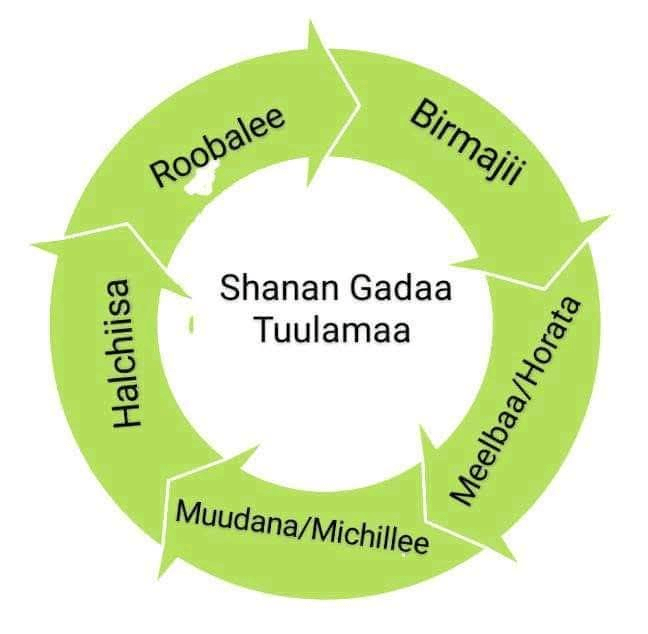
In the highlands of Tuulama, where the horizon rolls like an endless green drum, there is no king on a throne. There is only a cycle—a sacred, unforgetting wheel of five names.
In an era when most nations measure leadership by coups, elections, or hereditary bloodlines, the Oromo people have for centuries followed a stranger, wiser rhythm: the Gadaa system.
Among the Tuulama Oromo, this ancient democracy is not a relic in a museum. It is a living, breathing constitution written not on parchment, but on memory, ritual, and the rotating faces of fathers who pass power like a baton in a relay that has never stopped.
The system has five drums. Each beats for eight years. And together, they have kept time for over five centuries.
The Five Gates of Power
The Tuulama Gadaa cycle is built around five maddaa (parties or classes), each taking its turn to rule. They are:
- Roobalee – the rainmakers, the openers of the cycle.
- Birmajii – the sharpeners, who hone the laws of the previous generation.
- Meelbaa (Horata) – the gatherers, who are in power today.
- Muudana (Michillee) – the annointers, who will inherit the sceptre next.
- Halchiisa – the closers, who seal the cycle before handing it back to Roobalee.
👉 Right now, at this moment in history: the Gadaa Meelbaa holds the staff of authority.
👉 Next in line: Gadaa Muudana (Michillee) will take the baallii (ceremonial flag) when the birin (transition) comes.
The Fathers Who Did Not Die
The Gadaa system is not anonymous. It remembers names. Over the last 32 years—four full cycles of eight years each—four Abbaa Gadaa (fathers of the law) have stood at the center of the Oromo universe:
- Halchiisa – Abbaa Gadaa Lammaa Baarudaa
- Roobalee – Abbaa Gadaa Naggasaa Nagawoo
- Birmajii – Abbaa Gadaa Bayyanaa Sanbatoo
- Meelbaa – Abbaa Gadaa Goobana Hoolaati
Each man was not a dictator. In the Gadaa way, an Abbaa Gadaa is a custodian, not a commander. He sits under the odaa tree, listens to the assembly (chaffee), and speaks only after the women, the elders, and the youth have had their say.
Democracy, Oromo style, was never borrowed from Athens. It grew from these highlands.
When the Cycle Was Wounded
The Gadaa system has not had an easy path. Colonial conquest, imperial absorption, and modern state centralization—first under the Abyssinian emperors, then under Marxist Dergue, and later under ethnic federalism—all tried to break the clock.
For decades, the formal installation of an Abbaa Gadaa was driven underground. Rituals became whispers. The odaa tree became a dangerous meeting place.
But the Oromo people, stubborn as the volcanic rock of their homeland, found ways to keep the cycle turning.
They invented adaptive traditions:
- Foollee – a system of camouflage, where Gadaa rituals were hidden inside coffee ceremonies and weddings.
- Goodannaa – a form of itinerant counsel, where elders traveled secretly between villages to align the lunar and solar calendars of the cycle.
- Haarrii Buqqifannaa – a practice of renewal through symbolic “plowing,” where old wounds were ritually buried to make way for a new Gadaa generation.
These were not defeats. They were proof that a living tradition cannot be outlawed—only forced to sing in a quieter voice.
The Clock Is Still Ticking
Today, as Oromia navigates the pressures of modernity—urbanization, social media, formal state law—the Gadaa system faces new questions. Can a rotational indigenous democracy coexist with a national parliament? Should the Abbaa Gadaa be recognized by the modern constitution?
In Tuulama, the elders do not rush to answer. They sit. They listen to the wind in the sycamore. And they repeat the old law:
“Gadaan hin citu. Gadaan hin badu. Gadaan waan bineensi nyaate hin ta’u.”
(The Gadaa does not break. The Gadaa does not perish. The Gadaa is not food for wild animals.)
Epilogue: The Fifth Drum
There is a reason the Tuulama cycle has five gadaa—not four, not six. Five is the number of fingers on a hand. Five is the number of directions: east, west, north, south, and the center—where the odaa tree stands.
The Halchiisa closes the circle. The Roobalee opens it again. And between them, the Oromo people have learned that power is not a prize to hoard but a season to steward.
Today, as Gadaa Meelbaa holds the staff, the drum of Muudana is already being tuned. Somewhere in the countryside of Tuulama, a boy born into the next class is being taught the names of his ancestors—not as history, but as a promise.
He will rule in thirty years. And when he does, the clock will still be ticking.
The Gadaa system is not a memory. It is a meeting that never adjourned.
“Sirni Gadaa yeroo adda addaatti rakkoo seenaa keessa darbeera. Haata’u malee, uummanni Oromoo duudhaa isaa tikfachuuf jira.”
(The Gadaa system has passed through many historical trials. Nevertheless, the Oromo people live to preserve their custom.)

The Pharmacist Who Prescribed Freedom: Baro Tumsa and the Birth of the Oromo Dream
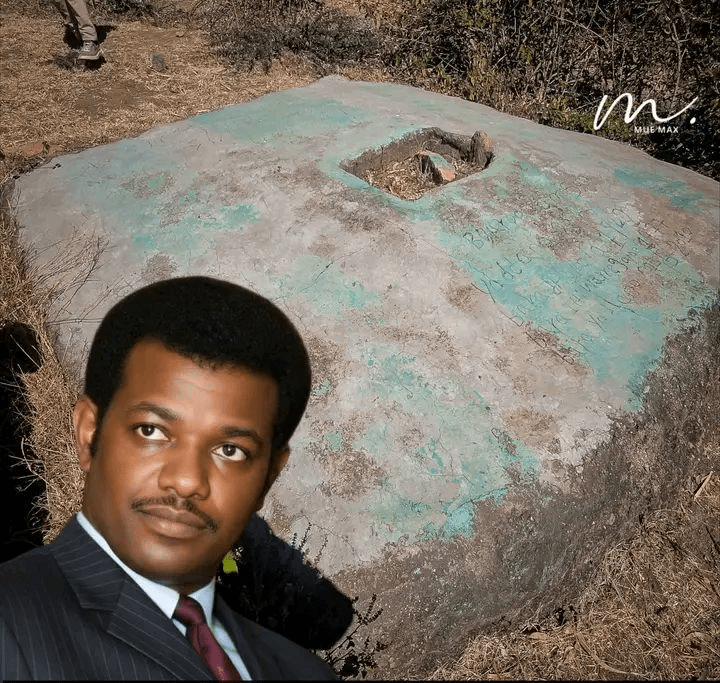
He carried two degrees—one in pharmacy, another in law. But his greatest prescription was not a pill or a legal brief. It was the idea that the Oromo people deserved a name, a flag, and a future.
In the cold, damp cells of an Ethiopian prison in 1978, a man in his forties scratched a final message into a piece of torn cardboard. He was not a soldier by training. He had never fired a weapon in anger. But he was about to become one of the most dangerous men the Dergue regime had ever captured.
His name was Jaal Baaroo Tumsaa. To his people, he was simply Baro Tumsa—the quiet revolutionary who built an army not with bullets first, but with books, chemistry, and a radical belief in Oromo unity.
The Making of a Nationalist
Born in 1938 in western Oromia, Baro Tumsa grew up in a world where speaking Afaan Oromo in a classroom could earn you a slap. Where Oromo history was written by the conquerors. Where the word Oromo itself was sometimes used as an insult.
But young Baro had a different chemistry in his blood.
He excelled in school—brilliant with numbers, sharper with words. He became a pharmacist, learning the precise science of healing bodies. But he soon realized that a deeper sickness afflicted his people: the sickness of silence, of land alienation, of a culture forced underground.
So he went back to school. This time, he studied law.
Now he had two weapons: the knowledge of how to heal, and the knowledge of how to fight injustice within a system that had been designed to ignore the Oromo.
The Quiet Architect of the OLF
By the early 1970s, Baro Tumsa had become a restless soul. He watched as successive Ethiopian regimes—imperial, then Marxist—treated Oromia as a colony within a colony. Land was taken. Languages were suppressed. Young Oromo men were conscripted into wars that were not theirs.
Baro Tumsa began to meet with other Oromo intellectuals, students, and farmers in secret. In living rooms, under odaa trees, in the back rooms of pharmacies in Addis Ababa, they asked a forbidden question: What if the Oromo organized for themselves?
That question became the seed.
In 1973, Baro Tumsa became one of the principal founders of the Oromo Liberation Front (OLF). Unlike the armed struggle that would follow, his early role was ideological and structural. He helped draft the movement’s early political programs. He connected rural grievances with urban intellect. He argued, passionately, that Oromo liberation was not a tribal ambition—it was a democratic necessity for all of Ethiopia.
He was, in every sense, the goota jiraachuu—the living hero who gave his life so that Oromiyaa could be built from the bones of the fallen.
The Arrest and the Silence
The Dergue, the brutal military junta that seized power in 1974, had long ears. By 1978, Baro Tumsa was on their most-wanted list. They did not want him for a crime. They wanted him because he had given the Oromo people something harder to kill than any guerrilla: a political consciousness.
He was arrested. Not in a dramatic firefight, but in the quiet way revolutions are often crushed—a knock at dawn, a hood over the head, a car disappearing into the gray morning.
For weeks, he was interrogated. The regime wanted names. They wanted confessions. They wanted him to renounce the OLF on the radio.
According to surviving accounts from fellow prisoners, Baro Tumsa refused every time. He did not shout. He did not weep. He simply repeated, in his calm pharmacist’s voice: “You can kill a man. You cannot kill a people’s right to exist.”
Freedom Fighter in the Mountains of Gara Mulata
Tumsa left behind the comfort of his privileged life in Finfinne to join the nascent guerrilla force of the OLF in the eastern command in 1978 and sacrificed his life for the freedom of the Oromo nation.
By then he was married and a father of three children. He comes from an unprivileged background and established himself as a member of the urban elite educated and well connected middle class.
However, he swapped these luxuries for the hardships in the mountains of Oromia for the sake of the freedom of his people whom he loved with all his heart and mind. The circumstances of his death remains unclear to this day.
He was 40 years old.
His body was never returned. No grave bears his name. The regime buried him in anonymity, hoping that without a tomb, the man would also be forgotten.
Why Ebla 15 Still Burns
Every year on Ebla 15, Oromos across the globe—from Finfinne (Addis Ababa) to Minneapolis, from Nairobi to Melbourne—pause. They do not hold parades with permission. They do not wait for government recognition. They light candles. They recite poetry. They name their children Baro and Tumsa.
They remember not just a man, but a generation: the gootota tokkummaa Oromoo—the heroes of Oromo unity who were executed together in 1980 so that a movement could live.
And they say a simple prayer, whispered in Afaan Oromo:
“Bakka jirru maratti maqaa isaa ol kaafnee faarsina.”
(Wherever we are, we raise his name and praise him.)
The Unfinished Pharmacy
Baro Tumsa left behind no mansion, no autobiography, no statue in a capital city. What he left behind was something more fragile and more powerful: an example.
He showed that an intellectual can be a revolutionary. That a pharmacist can heal a nation’s spirit before its body. That law, when it fails the people, must be resisted by a higher law—the law of dignity.
Today, the OLF has gone through splits, peace talks, and transformations. Ethiopian politics has shifted in a thousand ways. But the question Baro Tumsa asked in 1973 has never gone away: Who speaks for the Oromo?
And every Ebla 15, the answer echoes back: We do. Because he did.
Epilogue: The Cardboard Testament
They say that in his final days, Baro Tumsa wrote a message on a scrap of cardboard—a last prescription. It was smuggled out of prison by a guard whose heart had turned.
It read, in part:
“Do not cry for me. Cry for the land that makes its children prisoners. Then dry your tears. And finish what we started.”
The cardboard was lost. The guard disappeared. But the words have been memorized by thousands of Oromo youth who never met Baro Tumsa, but who carry him in their names, their songs, and their unbroken walk toward Bilisummaa—freedom.
He was not just a hero of the past. He is a verb in the present tense.
“Goota ofii wareegamee dhiiga lafee isaan Oromiyaa ijaare darbe.”
(A hero who sacrificed himself, whose blood and bones built the foundation of Oromia, has passed.)
Ebla 15. Remember. Raise his name. Continue the walk.

The Day Oromia’s Ten Sons Chose Unity Over Surrender
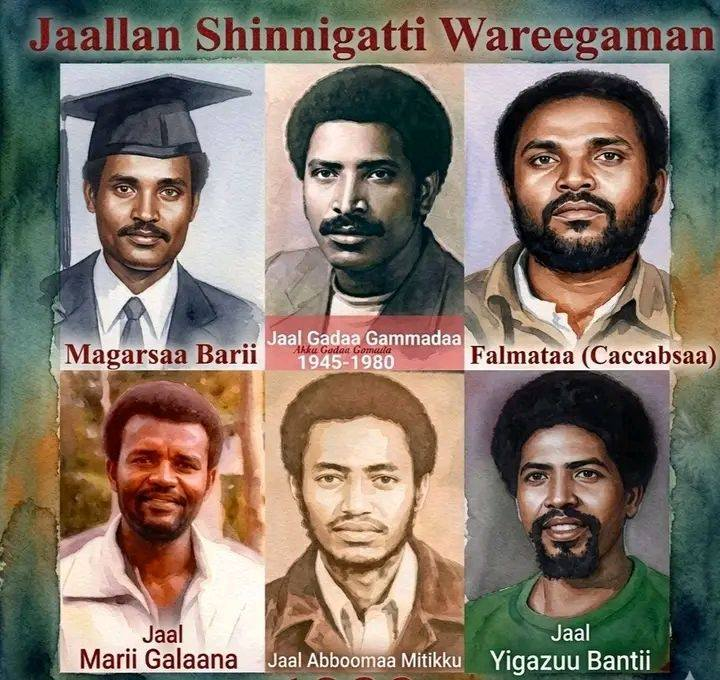
Remembering the Ebli 15 Martyrs of the Shinnigga Pit
(SHINNIGGA, Ethiopia) – In the chronicles of a people’s struggle for freedom, certain dates become etched not in ink, but in bone. For the Oromo people, one such date is **Ebli 15, 1980** (roughly late April in the Gregorian calendar). On that single, terrible day, the soil of Shinnigga drank a blood cocktail of revolutionary courage, religious tolerance, and unbreakable unity.
This is not merely a story of death. It is a story of how ten men—commanders and fighters of the Oromo liberation struggle—faced a common grave and refused to let their faith divide them.
They were the sons of *Oromiyaa hadhaa dhiigaa fi lafee isaaniin ijaaran*—Oromia built by their blood and bones. They were warriors of the *Adda Bilisummaa Oromoo* (Oromo Liberation Front), leaders who had carried the weight of the struggle during its darkest hours. Among them were legendary figures like Hayyuu-Duree Jaal Magarsaa Barii (Barisoo Waabee) and his deputy, Itti Aanaa Jaal Gadaa Gammadaa (Damisee Tacaanee).
But when the end came, they were not just commanders. They were brothers.
The Trap at Shinnigga
By 1980, the Oromo liberation army had become a thorn in the side of the Derg regime. The fighters, seasoned by the harsh terrains of Waabe and the strategic depth of the *Dirree Qabsoo Hidhannoo*, were pushing toward a new phase of the armed struggle. But war is also a game of betrayal.
While on a critical mission, a group of ten key figures—including the intellectual giants and tactical minds of the movement—were ambushed. Somali *Shifta* militia, operating as proxies for the regime, surrounded them near the rugged lowlands of Shinnigga. Outnumbered and cut off from reinforcements, the Oromo fighters fought to their last bullet.
They were not killed in the heat of battle.
They were captured alive.
The Pit
The militia dug a single, wide pit. It was not a grave for an individual. It was a mass tomb designed to swallow an ideology. The ten prisoners were forced to kneel at its edge. Their hands were bound. Their clothes were torn and stained with the dust of a long march.
According to survivors’ accounts passed down through the Oromo oral tradition, the *Shifta* executioners tried one final trick. They separated the prisoners by their names—some Muslim, some Christian, some following the *Waaqeffannaa* tradition of their ancestors.
“You see,” a commander allegedly said to the prisoners in a low, mocking voice. “You fought together. But you will die apart. Let each man pray to his own god before we throw him in.”
The executioners expected fear. They expected a scramble for last rites—a final, petty division to prove that the Oromo cause was a fragile lie.
They were wrong.
‘We Are One Name’
Jaal Magarsaa Barii, the senior commander, looked at his men. There was Jaal Abbaa Xiiqii (Abboomaa Mitikku), the strategist. Jaal Doorii Barii (Yiggazuu Bantii), the fearless cavalry leader. Jaal Faafam Dooyyoo, whose voice had rallied thousands. Falmataa (Umar/Caccabsaa), whose faith was as steadfast as his rifle. Jaal Irra’anaa Qacalee (Dhinsaa), Jaal Dhaddachoo Boruu, Jaal Dhaddachoo Mul’ataa, and the youngest, Jaal Marii Galaan.
Ten men. Ten names. One nation.
Without a word, they stood up. Jaal Magarsaa did not ask for a Christian priest. Jaal Gadaa did not ask for a *sheikh*. Falmataa did not turn his back on the others. Instead, they linked their arms—bound as they were—and stepped forward together.
“*Maqaa amantaan gargar hin baanu*,” Jaal Magarsaa declared. “We do not divide names by religion. Dig the pit wider or throw us in together. We are Oromo first.”
According to legend, Jaal Gadaa Gammadaa, the deputy, turned to the executioner and smiled. “You want to see us pray? Watch this.”
And together, the ten men—Muslim, Christian, and Waaqeffataa—intoned a single prayer. Not to Mecca. Not to the Cross. But to *Waaqa Oromoo*, the God of their land, who had seen their mothers’ tears and their fathers’ bones scattered across the highlands.
The executioners, unnerved, shoved them into the pit.
They fell as one. They died as one.
The Legacy of Ebli 15
Forty-six years have passed. The Shinnigga pit has long since been covered, but no grass grows there without a story attached. In Oromia today, the names of those ten men are whispered in schools, sung in protest songs, and invoked in political meetings.
They are called the *Ebli 15 Wareegamtoota*—the martyrs of Ebli 15.
They did not die for a flag or a single faith. They died for an idea: that an Oromo is an Oromo, whether they pray in a church, a mosque, under a tree, or in silence.
Jaal Marii Galaan, the youngest of the ten, was just 19 years old. Before he was pushed into the pit, he reportedly looked at the sky—the wide, unforgiving sky of Shinnigga—and shouted:
“*Oromiyaan hin duutu!* Oromia will not die!”
It hasn’t. And every Ebli 15, when the Oromo people gather to remember, they do not mourn ten separate men. They mourn one collective heart that beat for freedom until the dirt filled their mouths.
And in that final, defiant act of unity, they won a victory the pit could never bury.




 Advocacy for Oromia