The Living Clock of the Oromo: How the Gadaa System Keeps Time, Justice, and Identity
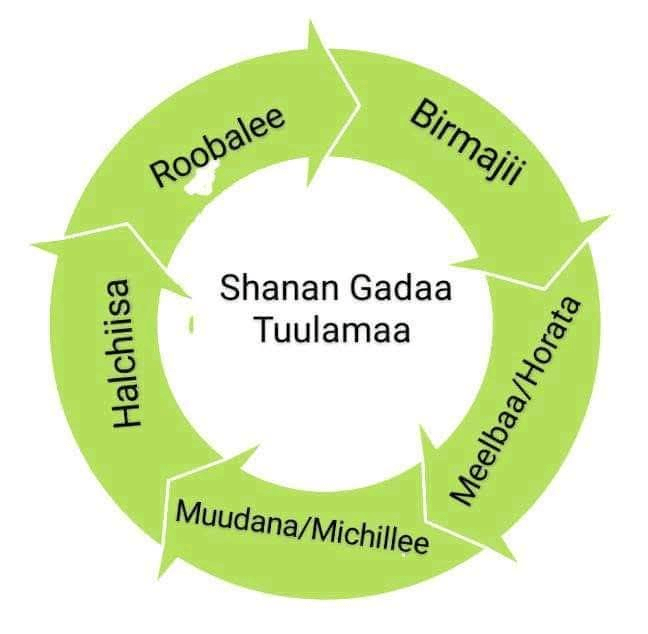
In the highlands of Tuulama, where the horizon rolls like an endless green drum, there is no king on a throne. There is only a cycle—a sacred, unforgetting wheel of five names.
In an era when most nations measure leadership by coups, elections, or hereditary bloodlines, the Oromo people have for centuries followed a stranger, wiser rhythm: the Gadaa system.
Among the Tuulama Oromo, this ancient democracy is not a relic in a museum. It is a living, breathing constitution written not on parchment, but on memory, ritual, and the rotating faces of fathers who pass power like a baton in a relay that has never stopped.
The system has five drums. Each beats for eight years. And together, they have kept time for over five centuries.
The Five Gates of Power
The Tuulama Gadaa cycle is built around five maddaa (parties or classes), each taking its turn to rule. They are:
- Roobalee – the rainmakers, the openers of the cycle.
- Birmajii – the sharpeners, who hone the laws of the previous generation.
- Meelbaa (Horata) – the gatherers, who are in power today.
- Muudana (Michillee) – the annointers, who will inherit the sceptre next.
- Halchiisa – the closers, who seal the cycle before handing it back to Roobalee.
👉 Right now, at this moment in history: the Gadaa Meelbaa holds the staff of authority.
👉 Next in line: Gadaa Muudana (Michillee) will take the baallii (ceremonial flag) when the birin (transition) comes.
The Fathers Who Did Not Die
The Gadaa system is not anonymous. It remembers names. Over the last 32 years—four full cycles of eight years each—four Abbaa Gadaa (fathers of the law) have stood at the center of the Oromo universe:
- Halchiisa – Abbaa Gadaa Lammaa Baarudaa
- Roobalee – Abbaa Gadaa Naggasaa Nagawoo
- Birmajii – Abbaa Gadaa Bayyanaa Sanbatoo
- Meelbaa – Abbaa Gadaa Goobana Hoolaati
Each man was not a dictator. In the Gadaa way, an Abbaa Gadaa is a custodian, not a commander. He sits under the odaa tree, listens to the assembly (chaffee), and speaks only after the women, the elders, and the youth have had their say.
Democracy, Oromo style, was never borrowed from Athens. It grew from these highlands.
When the Cycle Was Wounded
The Gadaa system has not had an easy path. Colonial conquest, imperial absorption, and modern state centralization—first under the Abyssinian emperors, then under Marxist Dergue, and later under ethnic federalism—all tried to break the clock.
For decades, the formal installation of an Abbaa Gadaa was driven underground. Rituals became whispers. The odaa tree became a dangerous meeting place.
But the Oromo people, stubborn as the volcanic rock of their homeland, found ways to keep the cycle turning.
They invented adaptive traditions:
- Foollee – a system of camouflage, where Gadaa rituals were hidden inside coffee ceremonies and weddings.
- Goodannaa – a form of itinerant counsel, where elders traveled secretly between villages to align the lunar and solar calendars of the cycle.
- Haarrii Buqqifannaa – a practice of renewal through symbolic “plowing,” where old wounds were ritually buried to make way for a new Gadaa generation.
These were not defeats. They were proof that a living tradition cannot be outlawed—only forced to sing in a quieter voice.
The Clock Is Still Ticking
Today, as Oromia navigates the pressures of modernity—urbanization, social media, formal state law—the Gadaa system faces new questions. Can a rotational indigenous democracy coexist with a national parliament? Should the Abbaa Gadaa be recognized by the modern constitution?
In Tuulama, the elders do not rush to answer. They sit. They listen to the wind in the sycamore. And they repeat the old law:
“Gadaan hin citu. Gadaan hin badu. Gadaan waan bineensi nyaate hin ta’u.”
(The Gadaa does not break. The Gadaa does not perish. The Gadaa is not food for wild animals.)
Epilogue: The Fifth Drum
There is a reason the Tuulama cycle has five gadaa—not four, not six. Five is the number of fingers on a hand. Five is the number of directions: east, west, north, south, and the center—where the odaa tree stands.
The Halchiisa closes the circle. The Roobalee opens it again. And between them, the Oromo people have learned that power is not a prize to hoard but a season to steward.
Today, as Gadaa Meelbaa holds the staff, the drum of Muudana is already being tuned. Somewhere in the countryside of Tuulama, a boy born into the next class is being taught the names of his ancestors—not as history, but as a promise.
He will rule in thirty years. And when he does, the clock will still be ticking.
The Gadaa system is not a memory. It is a meeting that never adjourned.
“Sirni Gadaa yeroo adda addaatti rakkoo seenaa keessa darbeera. Haata’u malee, uummanni Oromoo duudhaa isaa tikfachuuf jira.”
(The Gadaa system has passed through many historical trials. Nevertheless, the Oromo people live to preserve their custom.)

Posted on April 14, 2026, in Aadaa, Events, Finfinne, Information, News, Oromia, Press Release, Promotion. Bookmark the permalink. Leave a comment.




 Advocacy for Oromia
Leave a comment
Comments 0