The Unbroken Walk of Jaal Lagaasaa Wagii: From the Hills of Shinoo to the Frontlines of Oromo Freedom
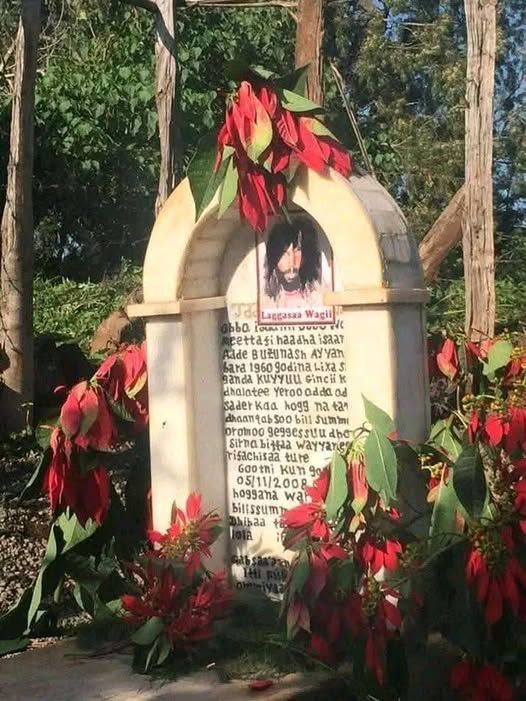
He left behind a wife, three daughters, and a thriving business. He walked into the wilderness not because he hated comfort, but because he loved his people more than his own breath.
In the quiet dawn of 1960, in a small village called Kuyyuu Giccii, nestled in the Meettaa Robii district of Aanaa Shinoo, West Shawaa, a child was born. The land was green. The air smelled of fresh buna (coffee) blossoms. No one knew then that this child—named Lagaasaa, son of Wagii—would one day become a name that governments would hunt and that a nation would memorize.
His father was Obbo Wagii Meettaa. His mother was Adde Buzunash Ayyaanaa. They were farmers, like most of their neighbors. But they gave their son something more precious than land: the gift of education.
The Schoolboy Who Dreamed Beyond the Fields
Young Lagaasaa Wagii walked barefoot to primary school in Bakkamee, where he sat on a wooden bench and learned to read and write—grades 1 through 4. For grades 5 through 8, he walked farther, to Hincinnii. Then, like many ambitious Oromo youth of his generation, he made the long journey to Finfinne (Addis Ababa) for grades 10 and 11.
But the classroom was not enough. The world was changing. In 1975, with the Dergue regime tightening its grip, Lagaasaa decided to learn a trade. He studied mechanics and driving—skills that would later prove as useful in the underground struggle as any weapon.
He worked. He saved. He traded. For seven years, he lived in the town of Dirree Dhawaa, moving goods, carrying merchandise on long journeys to western Oromiyaa. He was, by all accounts, a successful businessman. He had a future.
He also had a conscience.
The Call That Could Not Be Ignored
By 1990, Lagaasaa Wagii was a married man. On Waxabajjii 27, 1987 (Ethiopian calendar), he had wed Adde Waynisheet Geetaahu. Together, they had three beautiful daughters: Bilisummaa Lagaasaa, Fireehiwat Lagaasaa, and Natsaannat Lagaasaa. Their names meant Freedom, Joy, and Salvation—as if the father was already dreaming of a different Ethiopia.
But the suffering of the Oromo people—the land grabs, the cultural suppression, the daily humiliations—gave him no rest. He watched his people be treated as strangers in their own homeland. And something inside him broke open.
In 1990, he made a decision that would cost him everything. He left his beloved family, his business, his security. He walked west.
He joined the Oromo Liberation Front (ABO).
The Making of a Commander
Lagaasaa Wagii was not a natural soldier. He was a mechanic, a trader, a father. But he was also a fast learner. In 1991, he completed the 18th round of political and military training. He was assigned to the western front. He rose quickly—not because he sought power, but because he had something rarer: judgment.
He was sent for advanced training in Beelmuuguu in 1991. Then to Qaaqee as an administrator. Then, when the Dergue fell and the TPLF-led government (Woyyaanee) took over, the struggle did not end. It only changed shape.
Between 1993 and 1998, Lagaasaa Wagii moved from ordinary membership to senior military command. He fought in the western lowlands. He crossed into Sudan and back. He was part of the 1994 return to western Oromiyaa with newly organized forces. When the Woyyaanee regime crushed Sudanese bases in Kurmuk and Giizan in 1997, Lagaasaa was among those who held the line, ensuring the resistance did not collapse.
The Organizer of Exiles
Between 1998 and 2000, Lagaasaa was sent for special training abroad. When he returned, he was given a new mission: not to fight, but to build. In the diaspora, among Oromo communities living outside Ethiopia, he worked tirelessly to organize the scattered sons and daughters of Oromia.
In the year 2000, he achieved something remarkable. He helped establish the Oromo Community Association of Eritrea (Waldaa Hawaasa Oromoo Eritrea). He ensured that Oromos living in exile could contribute to the struggle—not just with money, but with unity.
The Lion of the Western Zone
By 2002, Lagaasaa Wagii had become a legendary figure on the western front. Under the overall command of Jaal Irreessaa Caalaa, he served as a commander of the Western Zone of the Oromo Liberation Front (WBO). He led operations in Qeebbee, Dambi Dolloo, Gidaamii, Begii, and Mandii—areas where the Woyyaanee military was heavily entrenched.
After Jaal Irreessaa Caalaa was executed, Lagaasaa Wagii took over as the commander of the Western Zone. From that moment until his own martyrdom on November 5, 2008 (05/11/2008), he led with a combination of tactical brilliance, personal courage, and deep love for his fighters.
The regime feared him. They called him “Abbaa tooftaa fi malaa”—the father of strategy and cunning. But his own people called him something else: Jaallataa (the beloved one).
The Meaning of Martyrdom
The Oromo have a proverb: “Namni gaafuma dhalate du’e” — Everyone born will die. But there is death, and there is sacrifice. Lagaasaa Wagii did not die because he was unlucky. He died because he chose to give his life for the rights of his people.
On that day in November 2008, after years of fighting—hungry, thirsty, exhausted, climbing mountains, crossing forests, enduring rain and sun—Lagaasaa Wagii fell.
But those who knew him say he did not fall defeated. He fell standing. He fell with his face toward the enemy. He fell as a goota—a hero whose blood does not disappear into the soil but waters the tree of freedom.
The Legacy That Refuses to Die
Lagaasaa Wagii left behind three daughters. He left behind a wife who never stopped waiting. He left behind comrades who still whisper his name before battle.
He was never wealthy. He never held a ministerial post. He never signed a peace treaty from a position of power. But he did something harder: he remained faithful to the end.
His name is not taught in Ethiopian government schools. No statue stands in Finfinne. But in the villages of West Shawaa, in the refugee camps of Sudan, in the living rooms of Oromo families in Minneapolis and Rome, his story is told.
They say: “Jaal Lagaasaa Wagii beela’e, dheebodhe, dadhabe, garuu hin jenne. Baddaa fi gammoojjii keessatti rooba, qorraa fi aduu danda’e.”
(He knew hunger, thirst, and exhaustion—but he never gave up. He endured the rain, the cold, and the sun in the highlands and lowlands.)
Epilogue: The Unfinished Sentence
There is a famous Oromo saying, repeated by the poet Mammo Mazamir:
“Qabsaawaan Kufus Qabsoon Itti Fufa!!!”
(Even when the fighter falls, the struggle continues!)
Jaal Lagaasaa Wagii is gone. But the walk he began—from a small village in Kuyyuu Giccii to the battlefields of western Oromiyaa—has not stopped. Thousands of young Oromos now carry his spirit. They do not carry his bones. They carry his example.
And one day, when the Oromo flag flies not in secret but in the open sky, over a land where justice is not a dream but a law, someone will point to that flag and say:
“This cloth was sewn with many threads. But one of the strongest threads was a man from Shinoo—a mechanic, a trader, a father, a freedom fighter. His name was Lagaasaa Wagii.”
Until that day, the struggle continues.
“Mirgi saba ofii akka kabajamuu fi abbaan biyyummaa ummata Oromoo akka mirkanaahu taasisuuf waan hunda caalaa gootummaan murteessa dha.”
(To ensure the rights of one’s people are respected and the nationhood of the Oromo is affirmed, nothing is more essential than heroism.)
— In everlasting memory of Jaal Lagaasaa Wagii (1960 – November 5, 2008)

Posted on April 14, 2026, in Aadaa, Events, Finfinne, Information, News, Oromia, Press Release, Promotion. Bookmark the permalink. Leave a comment.




 Advocacy for Oromia
Leave a comment
Comments 0