ABO Joins the 7th National Election as a Revolutionary Strategy – Jaal Alamaayyoo Diroo
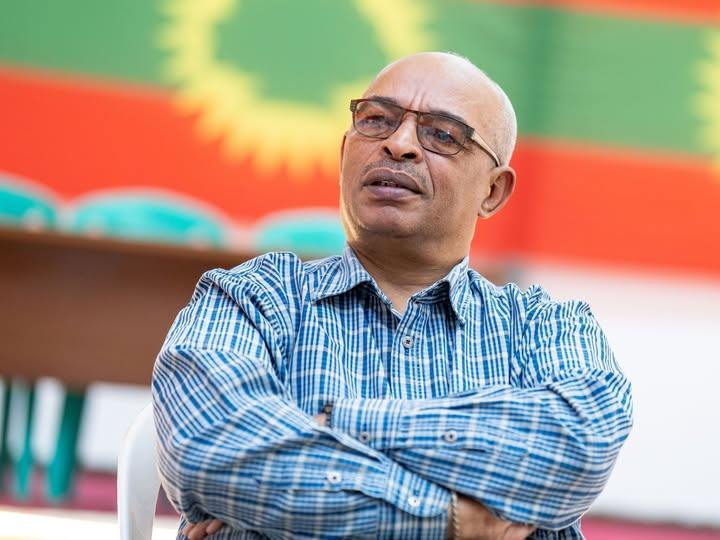
An exclusive interview with the ABO’s Head of Leadership, Ethics, and Control Committee on preparation, manifesto, and the path to Oromo self-determination.
By Natsaannat Taaddasaa | Bariisaa Newspaper | April 16, 2018 E.C. (April 24, 2026)
PROLOGUE: A Movement at a Crossroads
The Oromo Liberation Front (OLF or ABO) – one of the political parties contesting the upcoming 7th National Election – has made a strategic decision to participate in the electoral process. But not as an end in itself. Rather, as a tactical step within the broader Oromo liberation struggle.
In an exclusive interview, the Bariisaa Newspaper sat down with Jaal Alamaayyoo Diroo, Head of the ABO’s Leadership, Ethics, and Control Committee, to discuss preparations, the party’s manifesto, and the challenges ahead.
This is what he told us.
PART ONE: Why Participate in the Election?
Q: The ABO has decided to participate in the 7th National Election. Why now?
Jaal Alamaayyoo Diroo: Before proceeding with the 7th National Election, the ABO believes it would be better if the country’s internal problems were discussed first, and a conducive environment for the election was created.
However, we have serious concerns.
The ongoing security crises in Oromia, Amhara, and Tigray regions make it difficult to hold a free and fair election. The people living in these three regions constitute 70% of the electorate who should participate in the election. Under the current circumstances, we do not believe a lawful and orderly election can be conducted.
Nevertheless, the government has decided that the election must proceed. Therefore, the ABO has resolved to participate.
PART TWO: The Preparation – Limited but Determined
Q: How would you describe the ABO’s readiness for the election?
Jaal Alamaayyoo Diroo: The preparations the OLF is making for the 7th National Election are inadequate – if compared to the time spent in struggle and the breadth of the Oromo people.
Why? Because more than 230 branch offices – including the head office – have been closed for the past four years.
Currently, only the head office is open. Many members and leaders of the party are still in prison. Some have been killed. Others have fled the country.
Despite this situation, the OLF is preparing to compete in six regions:
- Two cities: Finfinne (Addis Ababa) and Dirre Dhawaa
- Four regions: Oromia, Harari, Amhara (Oromo Special Zone), and Benishangul-Gumuz
We have submitted 163 candidates to the National Election Board of Ethiopia. Half are running for federal seats; the remaining are contesting in the four regions.
PART THREE: The Conditions Are Not Favorable
Q: Do you believe the current environment is conducive for a fair election?
Jaal Alamaayyoo Diroo: Many of the conditions for a fair election are not in place.
Elections are meant to create conditions for building a people’s government. But before an election can be held – before a government can be formed – there must be:
- Peace
- An end to hostilities
- A stable and calm population
Political parties with grievances must come together, negotiate, bring about peace, and seek political solutions.
You cannot build a lawful and orderly people’s government by holding an election in the absence of peace.
The ABO cannot operate openly where its members and supporters are located, given the current security situation. Operating outside Finfinne and Adama – beyond media channels – is extremely difficult for a political campaign.
PART FOUR: The Manifesto – Core Demands and Vision
Q: What is the ABO’s manifesto for this election?
Jaal Alamaayyoo Diroo: The ABO has prepared a manifesto and is moving forward with participation in the 7th National Election.
Our goal is to secure the right to self-determination for the Oromo people.
The OLF (Oromo Liberation Front) transformed its 1991 program into a charter, and in 1995, it became the constitution. The party’s program is now enshrined in Articles 39 and 40 of the constitution. Land issues are also addressed in the constitution.
The party’s current struggle is to ensure that the rights granted by the constitution are implemented for the people.
To date, the Oromo people have never had the opportunity to decide what kind of country and government they want. Our struggle from now on is to ensure that the people get that opportunity.
Oromia is a member of the Ethiopian federal government. As a member of the federation, it is necessary that Oromia fulfills its conditions and succeeds in securing its right to self-determination.
Our manifesto states that the ABO will struggle until Oromia emerges as a center of democracy, development, prosperity, and peace.
PART FIVE: Economic Agenda – Agriculture, Industry, and Jobs
Q: What are the ABO’s economic priorities?
Jaal Alamaayyoo Diroo: Our priority is to address the economic crisis facing the Oromo people.
Agriculture is the backbone of the country’s economy. It contributes 40% of GDP and over 70% of foreign export earnings. Agriculture also creates 70-80% of employment opportunities and plays a major role in reducing unemployment.
The agricultural sector needs serious attention – but currently, it is not getting the attention it deserves. Since the current government came to power, we believe attention has shifted away from agriculture.
The ABO’s goal is to modernize agriculture, enable smallholder farmers to access technology, and ensure food self-sufficiency – at the very least, to lift people out of begging.
On industry, we focus on creating enterprises – government-owned, private, and revitalizing those that have fallen behind. We aim to strengthen industries such as textiles, leather, and ceramics.
Youth unemployment is at 70%. We must create widespread job opportunities for young people, expand infrastructure, and expand agro-processing.
PART SIX: Social Justice – Women, Rights, and Rule of Law
Q: What about social issues?
Jaal Alamaayyoo Diroo: The ABO’s manifesto addresses:
- Protecting the rights of women and nationalities
- Strengthening women’s organizations (Siiqqee)
- Ensuring the rule of law
- An independent judiciary – free from executive control
- A national bank run by professionals
- Freeing the economy from the influence of the IMF and World Bank
- Stabilizing the cost of living
PART SEVEN: The Cost of Living Crisis
Q: The cost of living is skyrocketing. What is the ABO’s solution?
Jaal Alamaayyoo Diroo: The cost of living crisis is caused by a mismatch between demand and supply, combined with currency devaluation.
This inflation cannot continue. The country’s strength cannot withstand inflation driven by rising fuel prices.
A country like Ethiopia needs a strong economy to withstand fuel-related inflation. But Ethiopia’s economy does not appear to be at a level that can withstand the current fuel-driven inflation.
The ABO’s solution includes:
- Modernizing agriculture
- Expanding agro-processing and enterprises
- Creating widespread employment for youth
- Fulfilling the basic infrastructure investments needed
PART EIGHT: Education – Language Policy and Digital Learning
Q: What is the ABO’s education policy?
Jaal Alamaayyoo Diroo: The ABO has a broad education policy.
We focus on making Afaan Oromo a language of science and education. In addition to Afaan Oromo, we want students to learn international languages such as Arabic, Swahili, Chinese, English, French, and others.
Knowing other Ethiopian languages is also important. We focus on expanding languages in our education policy and ensuring students learn multiple languages.
We also need to reform the education system. What is important is not just memorizing and repeating what is read. The current education system must focus on creativity.
Education should be delivered in a way that enables people to do and make things – not just through memorization as in the past.
Therefore, the education system must be reformed and balanced. Since education is a right, I believe citizens should receive education free of charge.
PART NINE: The WBO – A Brother Organization
Q: What is the relationship between the ABO and the WBO?
Jaal Alamaayyoo Diroo: The WBO was previously part of the ABO.
The ABO is currently pursuing a peaceful struggle. Since the government – and government bodies at various levels – see the WBO and ABO as interconnected, it is difficult for us to inform the people about our program and manifesto without causing concern.
Therefore, we are waiting for a favorable situation through the National Election Board of Ethiopia.
We have decided to participate in the upcoming national election because this election will serve as a tactical strategy to communicate our goals and agenda to the people.
We will use every opportunity to exert pressure and achieve our objectives.
PART TEN: The Right to Self-Determination – Non-Negotiable
Q: What is the bottom line?
Jaal Alamaayyoo Diroo: The ABO will struggle to ensure that the rights of the Oromo people – as well as other nations and nationalities – are respected.
The foundation of the party’s struggle is built on equality among people and nations. Our goal is to ensure that the Oromo people fully exercise their right to self-determination.
The ABO has good experience in both politics and struggle. The question of rights will never be abandoned. We have come this far paying a heavy price in sacrifices.
Therefore, the people must understand our program, vote for us, exercise their right to self-determination, and bring to completion the struggle for which many of our heroes and ancestors sacrificed.
PART ELEVEN: The Symbol – Horooroo
Q: What does the ABO’s symbol represent?
Jaal Alamaayyoo Diroo: Our symbol is Horooroo (a traditional Oromo headrest/stool).
Horooroo is sacred. Horooroo is a symbol of law, peace, equality, development, and prosperity.
We ask the Oromo people to choose the party.
PART TWELVE: A Legacy of Victory
Q: How has the ABO survived for over 50 years of struggle?
Jaal Alamaayyoo Diroo: The struggle has continued for over 50 years because what the party fights for is true – and because the struggle has achieved victories.
We believe this party is not just a national party but the greatest in Africa. It has registered strong victories:
- In 1991, the administrative border of Oromia was recognized
- The Oromo people were established as one nation
This is a great victory.
Through the party’s struggle:
- Land that was once in the hands of landlords became, by the constitution, the property of the government and the people
- Afaan Oromo became the working and educational language of the Oromia regional government, and a media language
- Oromo culture and traditions – such as Irreecha at Hora Harsade – were allowed to be celebrated in 1991
- Today, Irreecha is celebrated in Finfinne and wherever Oromos live around the world
- The Gadaa system – which had been forgotten – was revived and has now gained recognition at the UNESCO level
We believe these are great victories registered by the ABO’s struggle.
PART THIRTEEN: The Final Phase
Q: Where is the struggle now?
Jaal Alamaayyoo Diroo: The party is now in the final phase of the struggle.
The remaining struggle is to ensure that the rights enshrined in the constitution are exercised by the people, and that the people give their final decision.
The decision the party makes as a political organization is not necessarily final. The people themselves must be given responsibility.
The people must decide.
CONCLUSION: A Tactical Step in a Longer Struggle
The ABO’s participation in the 7th National Election is not an abandonment of the liberation struggle. It is a strategic tactic – a way to bring the party’s message to the people, to exert pressure, and to advance the cause of Oromo self-determination.
The conditions are far from ideal. The party has been weakened by prison, exile, and death. The security situation in Oromia, Amhara, and Tigray remains volatile.
Yet, the ABO moves forward.
As Jaal Alamaayyoo Diroo said: “The question of rights will never be abandoned. We have come this far paying a heavy price in sacrifices.”
Now, the people must decide.
© 2026 – Bariisaa Newspaper | Interview by Natsaannat Taaddasaa
“Horooroo is sacred. Horooroo is a symbol of law, peace, equality, development, and prosperity. We ask the Oromo people to choose the party.”
— Jaal Alamaayyoo Diroo, Head of ABO Leadership, Ethics, and Control Committee

Posted on April 22, 2026, in Aadaa, Events, Finfinne, Information, News, Oromia, Press Release, Promotion. Bookmark the permalink. Leave a comment.




 Advocacy for Oromia
Leave a comment
Comments 0